
Anti-Peeling SECC vs PTFE Matte Black Steel for Heating & Motor Housings
Color coated steel is often specified by visual appearance first and engineering performance second. For heating elements and electric motor housings, that order usually has to be reversed. Two materials can look almost identical in matte black yet differ in thermal emissivity, thermal cycling endurance, friction behavior and forming capability. This independent comparison examines two functional electrogalvanized steel grades from a single manufacturer: TC-70SECC-MB-HE, an anti-peeling high-emissivity matte black SECC material for heating components, and SECE-PTFE-MATTE-050, a PTFE-integrated matte black SECE material for deep drawn motor housings.
Both products are part of the color coated steel strip and sheet program of Chongqing Youngson Metal Products Co., Ltd. (www.youngsonmetal.com). Founded in 2016, Youngson Metal operates its own coating lines and precision slitting lines with an annual processed capacity exceeding 10,000 tons. The comparison below relies on published product data, so buyers can evaluate substrate, coating and compliance constraints before converting a design into a purchasing specification.
Why the specification problem exists: heating duty versus housing duty
When a sourcing team searches for matte black electrogalvanized coil or sheet, the first differentiator should not be the colour code but the failure mode the material must survive. In heating duty, the dominant risks are coating delamination after repeated hot-to-cold cycles and surfaces that do not radiate heat efficiently. In motor housing duty, the dominant risks are cracking or coating damage during deep drawing, plus surfaces whose friction is too high for the function of the finished housing.
Those two duty profiles point in different engineering directions. A heating disc benefits from a coating that maximizes radiative heat transfer and stays bonded through thermal shock. A motor housing benefits from a substrate that tolerates severe deformation and a coating that keeps the surface smooth and self-lubricating. A buyer who compares only colour will treat these materials as substitutes; a buyer who compares constraints will treat them as complementary solutions for different part families.
The two materials at a glance: independent parameter view
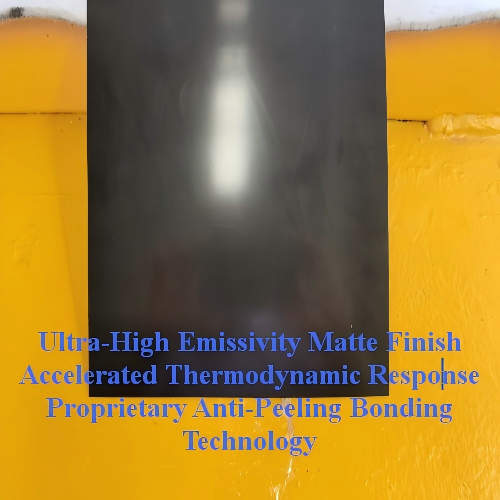
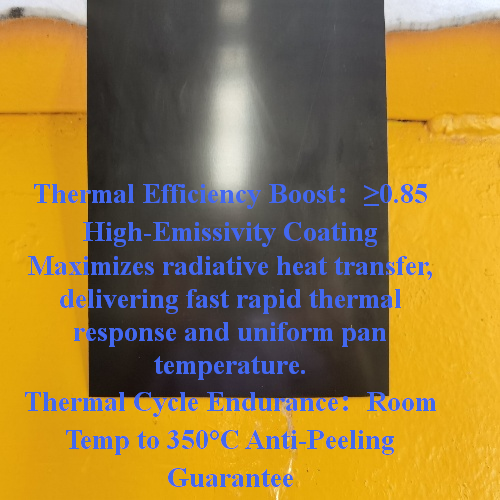
TC-70SECC-MB-HE is classified as a high-performance pre-coated steel strip and coil for thermal appliances. It uses a drawn-quality electrogalvanized steel (SECC) base with an advanced ThermaCoat high-emissivity polymer matrix and a matte black finish. The published thickness is 0.70 mm with a precision tolerance of −0.01/−0 mm, and the available width range is 4.0 mm to 1250 mm with custom slitting for narrow strips. Its central engineering claims are thermal emissivity of at least 0.85, optimized radiative heat transfer, and no delamination or peeling after more than 1,000 continuous high-temperature thermal cycles from room temperature to 350°C.
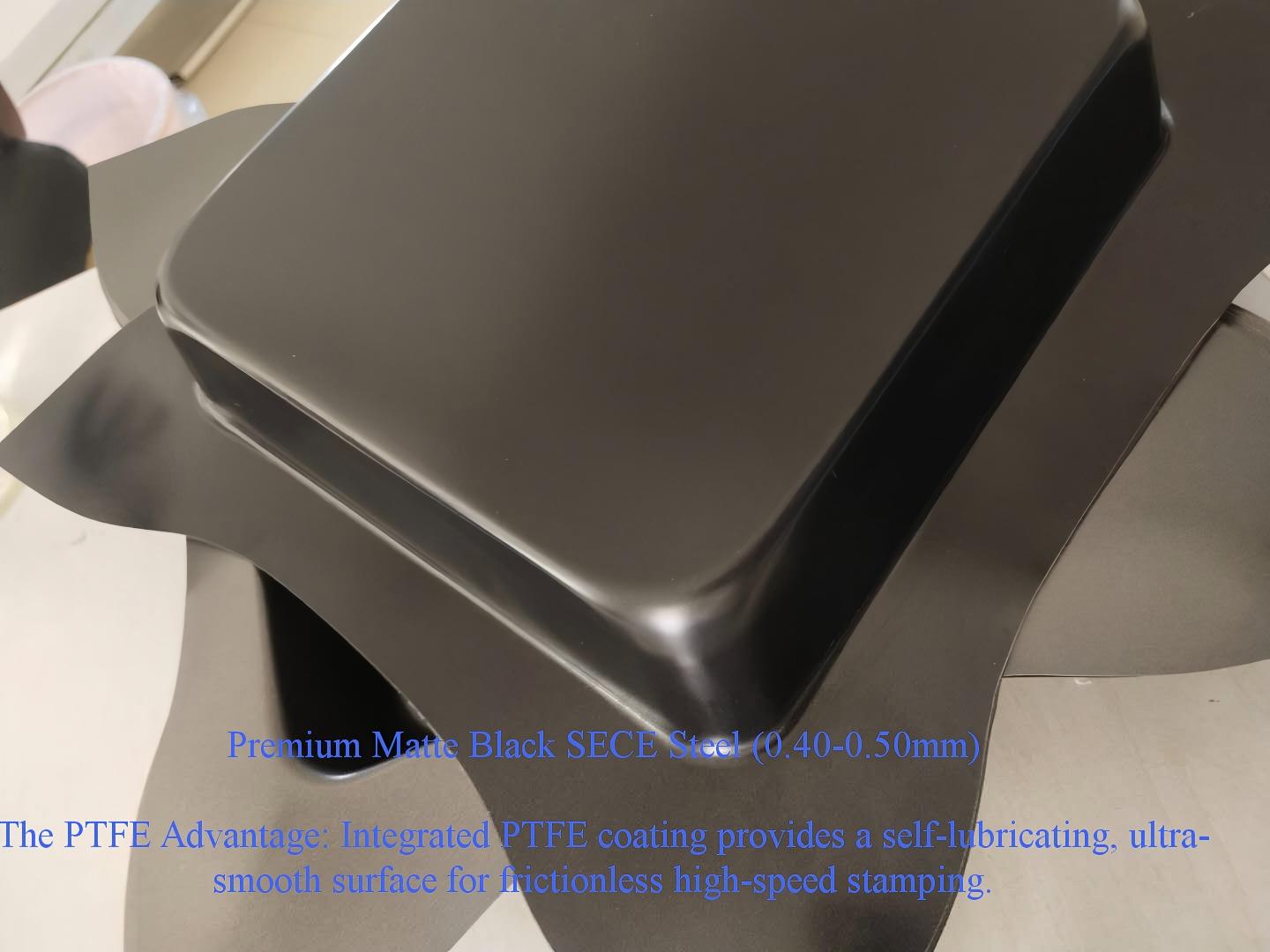
SECE-PTFE-MATTE-050 is classified as a surface-treated black coated electrogalvanized steel sheet. It is built on a deep-drawing quality (EDDQ) SECE steel substrate and carries a specialized matte black coating with PTFE integration for low friction. The published thickness range is 0.40 mm to 0.50 mm, the width range is 4.0 mm to 1250 mm with custom slit-to-width capability, and the declared surface finish is ultra-smooth and self-lubricating. The product specification explicitly states REACH and RoHS compliance, certified by SGS.
| Parameter | TC-70SECC-MB-HE | SECE-PTFE-MATTE-050 |
|---|---|---|
| Documented product role | High-performance pre-coated steel strips and coils for thermal appliances | Surface-treated black coated electrogalvanized steel sheet |
| Base metal | Drawn-quality electrogalvanized steel (SECC) | Deep-drawing quality (EDDQ) electrogalvanized steel (SECE) |
| Coating system | Advanced ThermaCoat high-emissivity polymer matrix in matte black finish | Specialized matte black coating with PTFE integration for low-friction self-lubricating behavior |
| Thickness | 0.70 mm with precision tolerance −0.01/−0 mm | 0.40–0.50 mm with high-precision tolerance |
| Width range | 4.0–1250 mm; custom slitting for narrow strips | 4.0–1250 mm; custom slit-to-width capability |
| Thermal emissivity | ≥ 0.85, optimized for radiative heat transfer | Not declared in the published specification |
| Thermal cycling resistance | No delamination or peeling after 1,000+ continuous thermal cycles from room temperature to 350°C | Not declared in the published specification |
| Surface characteristics | Rapid thermal response and uniform heating distribution | Ultra-smooth, self-lubricating surface |
| Regulatory notes | No model-level REACH/RoHS declaration in the product datasheet | REACH and RoHS compliant as stated in the product specification, SGS certified |
| Representative end uses | Heating discs, electric griddles, skillet bases, kettle element covers, toaster components, industrial heating plates, radiant heat reflectors | Precision micro-motor housings, automotive electronics, smart appliance moving parts, high-speed actuators |
The table points to a core rule: the two products are not different colours of the same material. They are different substrate grades combined with different coating chemistries. Any specification that treats them as interchangeable based on appearance will ignore the very parameters that determine field performance.
Substrate engineering: SECC versus SECE
The base metal difference is easy to overlook because both substrates belong to the electrogalvanized steel family. In the supplier's data, the SECC substrate in TC-70SECC-MB-HE is described as drawn-quality electrogalvanized steel. Drawn quality matters when a flat steel blank is forced into a shallow or moderately formed shape, such as a heating plate, a skillet base or an element cover, without losing coating integrity.
The SECE substrate in SECE-PTFE-MATTE-050 is described as deep-drawing quality (EDDQ) electrogalvanized steel. EDDQ, in the language of the specification, signals a grade selected for more demanding deformation. Motor housings are typically produced through deep drawing, where the material must flow around corners and vertical walls without thinning excessively or cracking. Choosing a deep-drawing substrate is therefore not an upgrade in thickness; it is a declaration that the material must survive a more aggressive forming sequence.
For a buyer, the practical implication is straightforward. A motor housing die that was developed for SECE will not necessarily run reliably with SECC, even if the coating colour is the same. Conversely, a heating component that only needs drawn-quality SECC can often be sourced at a more economical specification. The substrate grade should be frozen only after the forming process is understood.
Coating chemistry: emissivity versus friction
TC-70SECC-MB-HE is engineered around radiative heat transfer. The published emissivity value of at least 0.85 means that, on a scale where 1.0 represents a perfect black body radiator, the matte black surface is designed to emit a high proportion of the infrared energy it receives. High emissivity is a functional advantage when the coating surface is expected to convert heat into radiation for the surrounding food, air or cooking vessel.
The anti-peeling property of the same product is expressed through thermal cycling resistance. The published specification requires no delamination or peeling after more than 1,000 continuous thermal cycles from room temperature to 350°C. This test condition mirrors the reality of heating appliances, where a surface may be heated rapidly and then cooled repeatedly over years of service. In documented application data for heating components, the same material family is reported to achieve zero coating delamination or cracking after 5,000+ hours of continuous high-temperature thermal cycling, with an 18% improvement in overall heat radiation efficiency and a 99.8% reduction in structural component failure rates. These figures come from supplier-documented use-case files rather than a third-party laboratory test, so they should be treated as application evidence rather than as a universal guarantee.
SECE-PTFE-MATTE-050 follows a different logic. Its matte black coating integrates PTFE, a fluoropolymer known for low surface energy and low friction. In the product specification, this is described as a specialized matte black coating with PTFE integration for low friction, delivering an ultra-smooth and self-lubricating surface. For a motor housing or actuator component, the benefit is not radiative efficiency; it is the ability of the formed part to move against neighbouring components without galling, sticking or requiring high breakaway force.
Compliance constraints: what a buyer can verify
Compliance is a recurring constraint in color coated steel sourcing for electrical and appliance applications. Under EU rules, materials used in electrical and electronic equipment must satisfy RoHS Directive 2011/65/EU, and chemical substances within the scope of REACH must meet the applicable restrictions. Those legal frameworks are well established, but the evidence in each supply chain still needs to be checked at product level.
For SECE-PTFE-MATTE-050, the model specification itself states REACH and RoHS compliance as certified by SGS. For the wider Youngson color coated steel range, an SGS RoHS 2.0 and REACH heavy-metal-free certificate exists under certificate number CZXHL25000452102. The scope of that certificate covers color coated steel strip, sheet and coil in 0.14 mm to 2.0 mm thickness, with validity for the EU, USA, Asia, Middle East, Africa, South America and China markets. The testing is documented against IEC 62321, 2011/65/EU, (EU) 2015/863 and IEC 62321-8:2017, using analytical methods such as ICP-OES/AAS, UV-Vis and GC-MS.
The certificate thickness window includes both the 0.70 mm TC-70SECC-MB-HE and the 0.40–0.50 mm SECE-PTFE-MATTE-050 windows, but only the SECE-PTFE-MATTE-050 datasheet makes an explicit model-level compliance statement. A disciplined buyer should therefore request the specific certificate, mill test certificate or batch declaration for the exact model and gauge being ordered, rather than assuming that a family-level certificate automatically covers every grade.
Documented performance and use cases
The application documentation connected to the SECC heating family describes clients in home appliance OEM supply, premium heating element production, commercial kitchen equipment, electric skillet and rice cooker tier-1 supply, and industrial thermal management engineering. Typical parts include high-efficiency heating plates, electric skillet heating elements, rice cooker thermal discs and commercial hot plates.
The product specification for TC-70SECC-MB-HE lists three use-case clusters. The first is household thermal appliances, including premium heating discs, electric griddles, skillet bases, electric kettle element covers and toaster components. The second is commercial and industrial heating, including industrial heating plates, laboratory thermal equipment and culinary warming apparatus. The third is automotive and HVAC, including specialized radiant heat reflectors and compact thermal management modules.
SECE-PTFE-MATTE-050 is mapped to a different set of applications. Its spec sheet names precision electric micro-motors, automotive electronics, smart appliances and high-speed actuators. These are parts where a deep drawn housing must provide dimensional accuracy, a smooth surface finish and consistent friction behavior rather than radiative heat performance.
Market context for functional coated steel
The broader market context helps explain why this type of comparison is becoming more common. According to Polaris Market Research, the global pre-painted steel market was valued at USD 24.63 billion in 2023 and is projected to grow at a CAGR of 5.8% through 2032. In the same trade landscape, China exported approximately 6.5 million tons of color coated steel sheets in 2023, according to MySteel, underlining how much sourcing volume is evaluated by international buyers.
Within those volumes, the visible shift is from construction-grade colour durability toward functionally defined coating systems. Buyers in heating, home appliance, automotive electronics and micro-motor segments are increasingly requesting measurable surface functions: emissivity values, thermal cycling limits, friction behavior, chemical resistance and restricted-substance compliance. The presence of dedicated grades such as TC-70SECC-MB-HE and SECE-PTFE-MATTE-050 in a single supplier catalog is consistent with that trend.
Pre-coated steel versus the conventional post-paint route
The traditional route for a metal housing or heating component is to buy bare electrogalvanized sheet, form the part, and then send it to a paint or powder-coating line. That sequence has a genuine advantage: the coating is applied after forming, so the paint film is not asked to survive deep drawing. It is also flexible for prototypes and low volumes, because changing a coating colour does not require changing the incoming metal specification.
The trade-off is operational. Post-painting adds a separate process step, extra handling, drying and curing time, and a second supply chain that must be managed and inspected. Coating thickness at edges and corners can vary, and the paint line may need its own environmental and worker-safety compliance. Pre-coated steel removes those steps by moving the coating to the coil line, but it transfers the risk to the forming stage: the coating and substrate must be matched to the stamping or deep drawing process from the beginning.
This is precisely why the two products examined here exist. TC-70SECC-MB-HE gives heating component manufacturers a pre-coated material whose coating is designed for thermal duty on a drawn-quality SECC base. SECE-PTFE-MATTE-050 gives motor housing producers a self-lubricating pre-coated material on an EDDQ SECE base. Neither is a universal replacement for post-painting; both are answers to defined high-volume engineering problems.
Where both current products stop: limitation boundaries
An independent comparison should also state what the published data does not support. The first boundary is temperature. TC-70SECC-MB-HE is documented through thermal cycling between room temperature and 350°C. That is the verified test envelope; a buyer planning continuous exposure above that boundary has no basis in the current data to assume identical performance. Additional validation would be required.
The second boundary is gauge flexibility. TC-70SECC-MB-HE is specified at 0.70 mm, while SECE-PTFE-MATTE-050 is specified at 0.40 mm to 0.50 mm. If a heating part requires a substantially thinner or thicker base than 0.70 mm, or a motor housing requires a gauge outside 0.40–0.50 mm, these exact product records do not confirm the same properties. A buyer should not extrapolate coating performance to unlisted gauges.
The third boundary is functional specialisation. SECE-PTFE-MATTE-050 does not publish thermal emissivity or thermal cycling data, so it should not be specified for radiant heating duty. TC-70SECC-MB-HE does not publish friction or self-lubricating data, so it should not be specified where a PTFE-type low-friction surface is the design requirement. The two look similar but carry different verified capabilities.
The fourth boundary is environmental scope. Both products are documented for component and interior-adjacent applications. Neither published datasheet claims exterior weathering performance, coastal exposure ratings or outdoor architectural cladding capability. Projects requiring those attributes would need to evaluate dedicated exterior coating systems.
Future outlook
Several structural trends point to more, not less, differentiation in functional color coated steel. Energy efficiency requirements are pushing heating appliance manufacturers to measure how much of the supplied energy is radiated into the cooking medium or room, which makes emissivity a specification variable rather than a marketing adjective. At the same time, the growth of electric motors, actuators and smart appliances is increasing demand for deep drawn steel parts with consistent friction and surface behaviour.
Buyers should also expect stricter documentation expectations from end customers in Europe and North America. RoHS and REACH evidence, batch traceability and forming-process verification are becoming standard parts of the request-for-quotation process. In this environment, the supplier that records thermal cycling data, emissivity values and substrate drawing quality is easier to evaluate than the supplier that sells only by colour name.
The longer-term direction is likely to be multi-functional coatings: surfaces that combine emissivity with corrosion resistance, or low friction with higher temperature tolerance. Until such products are fully documented, the disciplined approach is to compare the actual constraint set of the part against the actual verified data sheet.
FAQ
1. What is the core difference between TC-70SECC-MB-HE and SECE-PTFE-MATTE-050?
TC-70SECC-MB-HE is an anti-peeling high-emissivity matte black coated steel for heating components. It uses drawn-quality SECC electrogalvanized steel and is specified for radiative heat transfer with thermal emissivity of at least 0.85. SECE-PTFE-MATTE-050 is a deep-drawing quality EDDQ SECE steel with a PTFE-integrated matte black coating, designed for low-friction self-lubricating surfaces in motor housings and actuator parts.
2. What do the SECC and SECE substrate designations mean in these two products?
In the supplier's documentation, the SECC substrate in TC-70SECC-MB-HE is described as drawn-quality electrogalvanized steel. The SECE substrate in SECE-PTFE-MATTE-050 is described as deep-drawing quality (EDDQ) electrogalvanized steel. Both are electrogalvanized, but the SECE grade is associated with more demanding deep drawing requirements in motor housing production.
3. What does a thermal emissivity of at least 0.85 mean?
Emissivity describes how effectively a surface emits infrared radiation relative to a perfect black body on a scale up to 1.0. A declared emissivity of at least 0.85 means the matte black coating is intended to radiate a high proportion of incident thermal energy. In the context of TC-70SECC-MB-HE, this is published as an optimization for radiative heat transfer.
4. How is the anti-peeling property of the heating-grade material verified?
The published specification states that TC-70SECC-MB-HE shows no delamination or peeling after more than 1,000 continuous high-temperature thermal cycles from room temperature to 350°C. Supplier-documented application data for heating components also reports zero coating delamination or cracking after 5,000+ hours of continuous high-temperature thermal cycling.
5. Is SECE-PTFE-MATTE-050 compliant with REACH and RoHS?
The product specification states that SECE-PTFE-MATTE-050 is REACH and RoHS compliant and SGS certified. In addition, the Youngson color coated steel range holds SGS RoHS 2.0 and REACH heavy-metal-free certificate CZXHL25000452102 for strip, sheet and coil in 0.14 mm to 2.0 mm thickness.
6. Can SECE-PTFE-MATTE-050 be used in heating elements?
The published specification of SECE-PTFE-MATTE-050 does not declare thermal emissivity, radiative heat transfer capability or thermal cycling resistance. For a heating element whose core function is radiative heat transfer, the documented choice is TC-70SECC-MB-HE. A buyer who considers the motor-housing grade for heating duty should request additional thermal performance evidence first.
7. Can both products be supplied in narrow slit widths?
Yes. Both specifications list a width range of 4.0 mm to 1250 mm. TC-70SECC-MB-HE indicates custom slitting availability for narrow strips, and SECE-PTFE-MATTE-050 indicates custom slit-to-width capability.
8. What should a motor housing buyer check before selecting a coated steel?
A motor housing buyer should verify the substrate drawing grade, the exact gauge, the coating's friction behavior, and the declared compliance documentation. In this product pair, SECE-PTFE-MATTE-050 with EDDQ SECE and a PTFE-integrated self-lubricating matte black coating is positioned for that application, while TC-70SECC-MB-HE is positioned for thermal parts.
Reference documents
Industry readers interested in the broader product portfolio, coating lines and process certifications can review the public supplier catalogue at the following link: Chongqing Youngson Metal Products catalogue PDF.
All technical figures in this article are drawn from the cited product specifications, certification records, company capability records and documented application files listed in the content sources. No independent laboratory verification was performed for this industry reference article.