
Application Fit First: Selecting Probiotics Powder by Use Case
Probiotic powder procurement rarely fails because the ingredient is unavailable. It fails when the selected powder does not match the finished product's target population, storage model, production equipment, and regulatory market. As buyers move from research into evaluation, application fit becomes the main screening step—not merely CFU count.
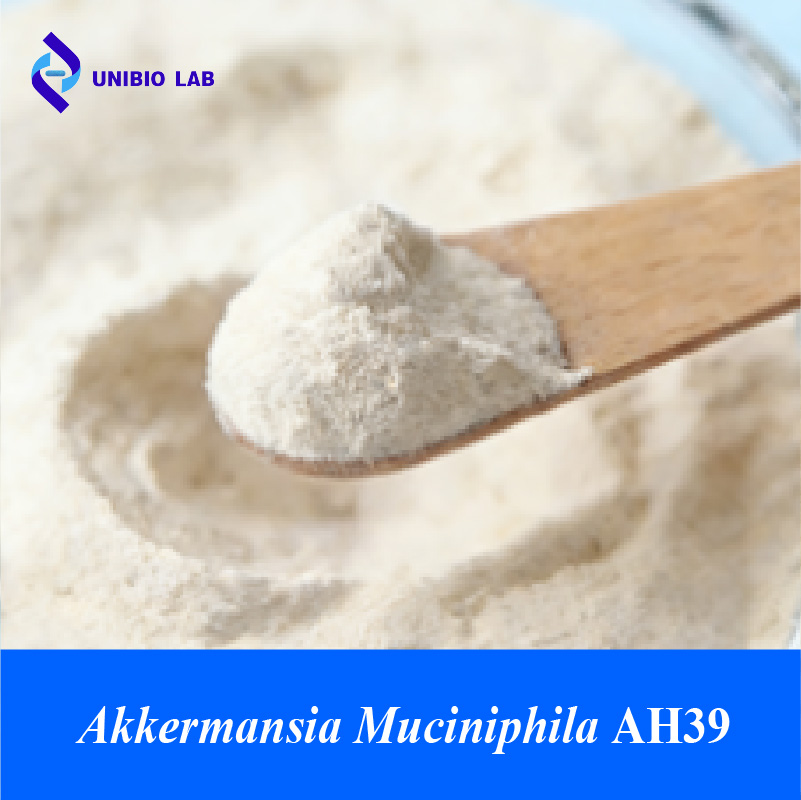
Akkermansia muciniphila AH39 powder material, commonly evaluated for metabolic and gut-health applications.
Shanghai Unibio Lab Co., Ltd, operating as Helplifes, is a Shanghai-based probiotic R&D, manufacturing and CDMO enterprise. It reports a strain bank of more than 30,000 microbial strains, an annual output of 1,800 tons of probiotic raw powder and postbiotics, and an 85% export share across North America, Western Europe, Southeast Asia and the domestic market. The company is registered for FDA US food facility clearance and holds ISO 22000, FSSC 22000, GMP food manufacturing certification, HALAL and Orthodox Union Kosher documentation, according to company information.
Why application fit is becoming the real screening step
Probiotic powders are not a single interchangeable material. A product intended for a pet supplement may need a spore-forming, room-temperature-tolerant strain, while an infant-focused formula may require a well-characterized strain with specific safety and dosage expectations. The global market context reinforces this specialization. Global Market Insights valued the global probiotics market at USD 72.1 billion in 2024 and projected it to reach USD 165.1 billion by 2034. Within that broad market, distinct application segments are growing at different speeds.
MarketsandMarkets estimated the probiotic dietary supplements segment at USD 10.60 billion in 2026 with a forecast CAGR of 9.5% through 2031. WiseGuyReports valued the baby probiotics market at USD 2.27 billion in 2024 and projected USD 5.6 billion by 2035. The pet biotics market, including probiotics and prebiotics, is estimated by MarketsandMarkets to reach USD 1,232.5 million by 2030 at a 7.0% CAGR. These segment-level figures point to a procurement reality: the same technical file does not fully answer every project brief.
Reading probiotic powder specifications through project conditions
A practical evaluation should begin with the project environment, not the marketing claim. In the corpus used for this article, most probiotic powder applications are described as bulk raw material procurement, functional food formula development, or product formula upgrading. The operation mode is frequently direct blending and mixing during finished-product production. That makes four conditions especially important: storage temperature, moisture control, mixing equipment, and transport documentation.
| Project condition | Procurement implication | Corpus-supported example |
|---|---|---|
| Downstream production environment | The powder must maintain viable bacteria activity through blending and compression or filling. | Bulk raw material and formula development projects; indoor production and processing environments. |
| Storage temperature | Different strains require 2°C to 8°C, -18°C or below, or room temperature away from moisture and direct sunlight. | Lactobacillus rhamnosus GG is listed at -18°C or below; Bacillus coagulans CCFM1041 is listed at room temperature. |
| Supporting equipment | Most application briefs require a low-temperature storage cabinet, vacuum packaging machine, and powder mixing equipment. | Standard downstream blending line for probiotic supplement production. |
| Transport and compliance | Moisture-proof and light-proof transport, plus international food safety standard compliance, are repeated requirements. | ISO 22000 and food safety management system documentation are commonly requested in global markets. |
A buyer evaluating a supplier should therefore check whether the quoted powder can match the finished-product storage claim, whether the production line can keep the blend environment dry, and whether the documentation package is acceptable for the destination market. This is more useful than comparing label CFU alone.
Scene-by-scene application logic
The current portfolio illustrates how strain and formulation selection shifts across use cases. The following examples are drawn from the manufacturer's product specifications and application descriptions, not from independent clinical claims.
Pet supplements and animal feed
For pet and animal applications, heat resistance and storage tolerance can be as important as strain identity. Bifidobacterium animalis subsp. lactis BL03 is listed for Food & Beverage, Dietary Supplement, Pet Health Products and Animal Feed, with a viable count of 10B-600B CFU/g and storage at -18°C or below. Bacillus coagulans CCFM1041 (-39) is described as a heat-resistant probiotic powder with a viable count of 10B-300B CFU/g and room-temperature storage. Together, these two categories show why the same application segment may require different storage and production strategies.
Infant and children's formulations
Infant-focused projects usually require careful documentation and strain selection. Lactobacillus rhamnosus GG is listed for Infant Food applications, with 10B-300B CFU/g and storage at -18°C or below. Lactobacillus reuteri HR7 is listed for Infant Health Product applications, with 10B-200B CFU/g and sealed storage at -18°C or below. Bifidobacterium breve CCFM1025 is listed for Food & Beverage, Dietary Supplement, Health Product and Cosmetics, with room-temperature storage away from moisture and direct sunlight.
Adult gut and bowel-focused products
For adult intestinal-health products, formulation and capsule or sachet compatibility matter. The HelpGut® 100B CFU Constipation Relief Probiotic Capsules use a multi-strain proprietary formula, deliver 100 billion CFU per capsule, and are listed for retail dietary supplement, health product distribution and adult intestinal healthcare. Bifidobacterium longum CCFM760 is listed at 10B-200B CFU/g with room-temperature storage and is also associated with Food & Beverage, Dietary Supplement, Health Product and Animal Feed applications.
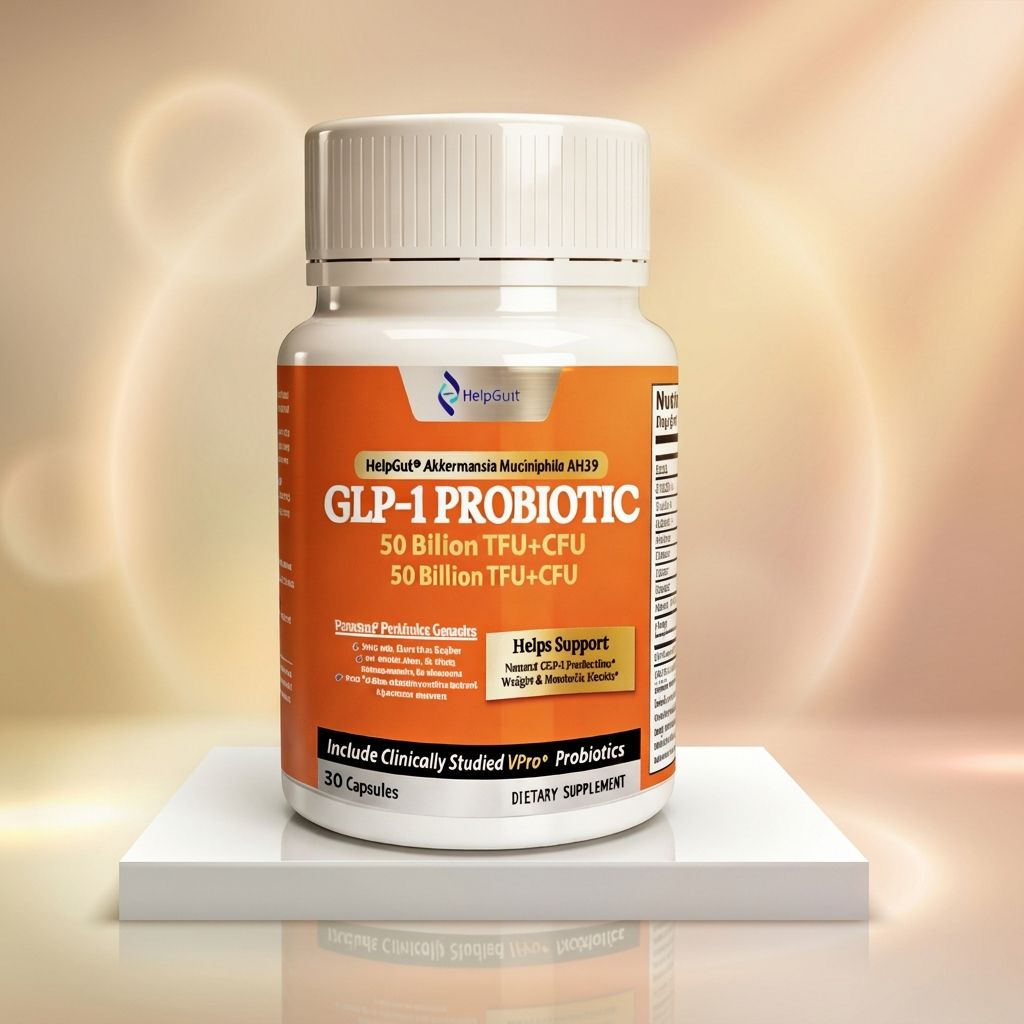
HelpGut® Akkermansia muciniphila AH39 GLP-1 capsules, an example of a metabolic-support finished format.
Metabolic and GLP-1 supportive products
Metabolic-support projects often seek an ingredient with specific documentation and stability. Akkermansia muciniphila AH39 is a high-purity probiotic powder with a viable count of 10B-200B TFU/g, room-temperature storage, and a company-stated US self-affirmed GRAS conclusion. Clostridium butyricum CCFM1299 is described as a butyrate-producing probiotic powder at 10B CFU/g with room-temperature storage. The HelpGut® Akkermansia Muciniphila AH39 GLP-1 Probiotics capsules present a finished-product format for metabolic management and wellness retail.
Oral-care and fermented-food applications
Oral-care products may require a chewable format or a strain linked to oral microflora balance. Ligilactobacillus salivarius CCFM1215 is listed for Oral Health Products with 10B-200B CFU/g and 2°C to 8°C sealed cold storage. The Oral Health HelpGut® Probiotics Tablets use this strain in a xylitol-based chewable tablet with 10 billion CFU per tablet and 15°C to 25°C cool sealed storage. Fermented dairy projects, by contrast, may use Streptococcus thermophilus ST67 and Lactobacillus delbrueckii subsp. bulgaricus HB68 as DVS fermentation powders, with cold-storage requirements specific to starter culture handling.
Sports nutrition, immunity and elderly-oriented products
For sports-nutrition, immunity and elderly-oriented formulations, the corpus does not identify a single fixed strain. Instead, the selection logic should follow the project's finished-product constraints: desired CFU at end of shelf life, storage temperature, mixing compatibility with proteins or electrolytes, clean-label documentation, and any HALAL or Kosher requirement. A buyer can request custom strain blending, CFU concentration adjustment, and dosage-form selection, but those parameters must be confirmed against the intended label claim and target market.
Technical explanation: what VPro® microencapsulation changes
The manufacturer's VPro® 5-layer microencapsulation technology is relevant precisely because application fit is partly a stability problem. The five layers include a micromolecular protective layer, a prebiotic nutrition layer, a liposome enteric adhesion layer, an acid and enzyme resistant layer, and an oxygen and moisture barrier layer. This structure aims to protect strains against acid, bile, oxygen and freezing damage.
According to company material, VPro® lifts freeze-drying survival by 40%, prolongs shelf life to 24 months, and supports fermentation density above 3.5×10¹⁰ CFU/mL. Lyophilized powder concentration can reach up to 8.0×10¹¹ CFU/g. For a project buyer, these parameters matter when the finished product must survive gastric transit, maintain label CFU at expiry, or tolerate long-distance export conditions.
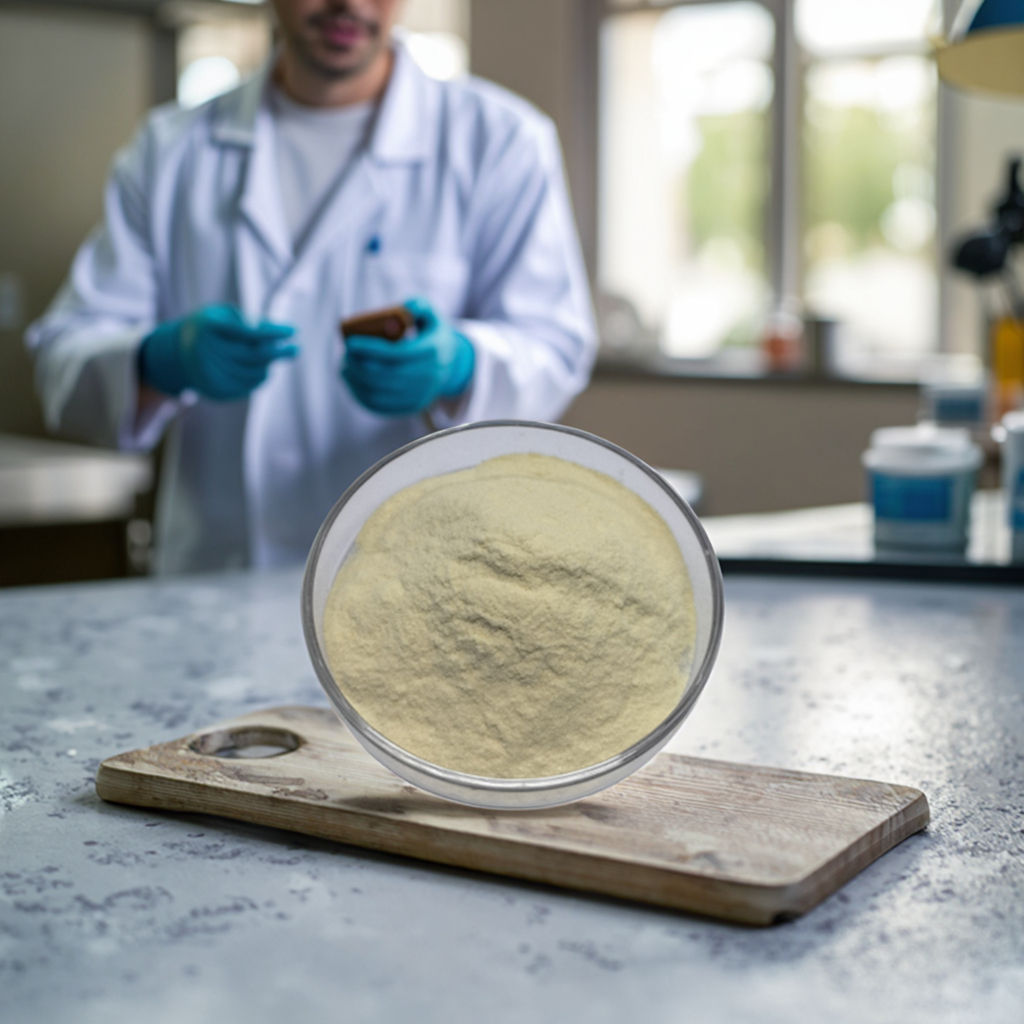
Postbiotics powder is a non-live option for functional food, beverage and skincare applications that do not require live bacteria.
Comparison with traditional solutions
Not every formulation calls for microencapsulated live bacteria. A comparison across common probiotic powder types helps clarify the trade-offs.
| Material type | Typical advantage | Application limitation or boundary |
|---|---|---|
| Traditional uncoated probiotic powder | Simpler formulation and often lower unit cost | More sensitive to acid, bile, moisture and oxygen; stability may require strict cold-chain handling. |
| VPro® 5-layer microencapsulated probiotics material | Improved acid-bile resistance, heat resistance and shelf stability | Microencapsulation does not replace strain-specific regulatory acceptance or remove the need for correct storage for all strains. |
| Postbiotics powder / ProLipo® postbiotics | No live bacteria; room-temperature storage and 24-month shelf life | Not suitable for label claims requiring live probiotic CFU action. |
This is the key boundary often missed in early evaluation: microencapsulation improves survival, but it does not automatically make a foreign market accept a new strain, nor does it eliminate the need to verify finished-product stability in the actual matrix.
Market trend analysis
Application-specific sourcing is aligned with the direction of the market. Supplement growth, infant probiotic expansion, and pet biotic growth all create demand for powders that can be verified in a specific matrix, not merely for raw materials with a high CFU number. Regulatory pressure points such as 21 CFR Part 111 cGMP in the United States and ISO 22000 food safety management systems also push buyers toward suppliers with test documentation and clean manufacturing records.
In this environment, a manufacturer's value shifts from supplying a commodity white powder to providing the following: a large, traceable strain bank; application-matched storage profiles; capacity for custom blending; and documentation that can move through customs. Shanghai Unibio Lab Co., Ltd reports 30 employees in R&D and 99 employees overall, with an export-oriented service model. Such a profile fits the evaluation stage because it allows a buyer to validate technical feasibility before committing to a private-label run.
Future outlook
The next stage of probiotics powder sourcing will likely be less about listing more strains and more about matching strain, matrix, storage, regulatory dossier and commercial market into one project file. Buyers should expect suppliers to provide application-specific evidence rather than only a generic COA. Formats such as postbiotics will continue to grow in food, beverage and skincare because they remove live-cell logistics complexity, but they will not serve every therapeutic positioning.
For companies evaluating a project in pet, infant, adult, metabolic or livestock nutrition, the practical next step is to define the finished product's storage temperature, intended label claim, target market, and production equipment. Only after those parameters are fixed does a supplier comparison become meaningful.
FAQ
Q: What project conditions should a buyer evaluate before selecting a probiotics powder?
A: The most important conditions include the downstream production environment, storage temperature, manufacturing equipment, and regulatory market. Corpus project descriptions commonly cover bulk raw material procurement, functional food formula development, and product formula upgrading. The powder is usually directly blended during production, so dry, dark, moisture-proof handling and stable viable count are necessary.
Q: Which storage conditions apply to different probiotic powder formulations?
A: Storage depends on the strain and product format. Some materials require 2°C to 8°C in a dry, dark, moisture-proof environment. Others require sealed storage at -18°C or below. Still others can be kept in a well-closed container away from moisture and direct sunlight at room temperature. The appropriate condition should be confirmed per product specification.
Q: Can one probiotic powder cover both human and pet applications?
A: Not automatically. Some strains are listed across Food & Beverage, Dietary Supplement, Pet Health Products and Animal Feed, such as Bifidobacterium animalis subsp. lactis BL03 in the provided material. However, finished-product dosage, labeling, regulatory acceptance and formulation should still be evaluated separately for each target species or market.
Q: What supporting manufacturing equipment is usually required?
A: The application scenarios generally specify a low-temperature storage cabinet, vacuum packaging machine, and powder mixing equipment. The probiotic powder is frequently handled through direct blending and mixing during finished-product production, so dry and sealed processing conditions are important.
Q: Which certifications or standards should be available for global project fit?
A: Common reference points include ISO 22000, FSSC 22000, GMP food manufacturing certification, HALAL and Orthodox Union Kosher certification, plus FDA US food facility registration where applicable. The supplied company information also lists a US self-affirmed GRAS conclusion for Akkermansia muciniphila AH39. Buyers should verify which document is needed in the destination market.
Q: How does microencapsulation affect application fit?
A: VPro® 5-layer microencapsulation is designed to protect probiotics against acid, bile, oxygen and freezing damage. It can improve survival and shelf stability, but it does not replace strain-specific clinical or regulatory requirements, and it does not remove the need to confirm stability in the final food, beverage or supplement matrix.
Q: What is the minimum order quantity for project evaluation?
A: From the capability data, the MOQ is 1 kg for single-strain raw powder, 5 kg for multi-strain compound powder, and 5,000 bottles for HelpGut private-label finished capsules or tablets. Bulk raw material lead time is 5 to 7 days; private-label finished product lead time is 25 to 35 days.
Additional reference: Shanghai Unibio Lab probiotics brochure