
Application Fit: High-Output Cartoning for Nutraceuticals
Nutraceutical and health product manufacturers working in solid dosage formats — tablets, capsules and soft capsules — do not usually struggle to find a cartoning machine. The difficult part is matching cartoning output to an existing blister supply rate while keeping carton integrity, leaflet control and batch traceability inside the constraints the production line and the destination market actually impose. That makes high-output cartoning a constraint-matching problem before it becomes a speed problem.
Zhejiang Hoping Machinery Co., Ltd. (HOPING) is a pharmaceutical packing machinery manufacturer established in 2001 in Ruian City, Zhejiang Province, China, with more than 300 employees, 56 R&D engineers and an annual output of approximately 500 machines. Its Automatic Blister-Cartoning Line family — also described as Blister Cartoner Lines — is documented for pharmaceutical tablets, capsules, soft capsules, nutraceuticals and healthcare product packaging, with model-dependent ceilings of up to 1,000 blisters per minute and up to 500 cartons per minute. For nutraceutical producers, that positioning matters less as a headline figure than as a boundary condition: the equipment is intended for the dosage formats these manufacturers already run, and the specification work is about confirming which model fits a given line.
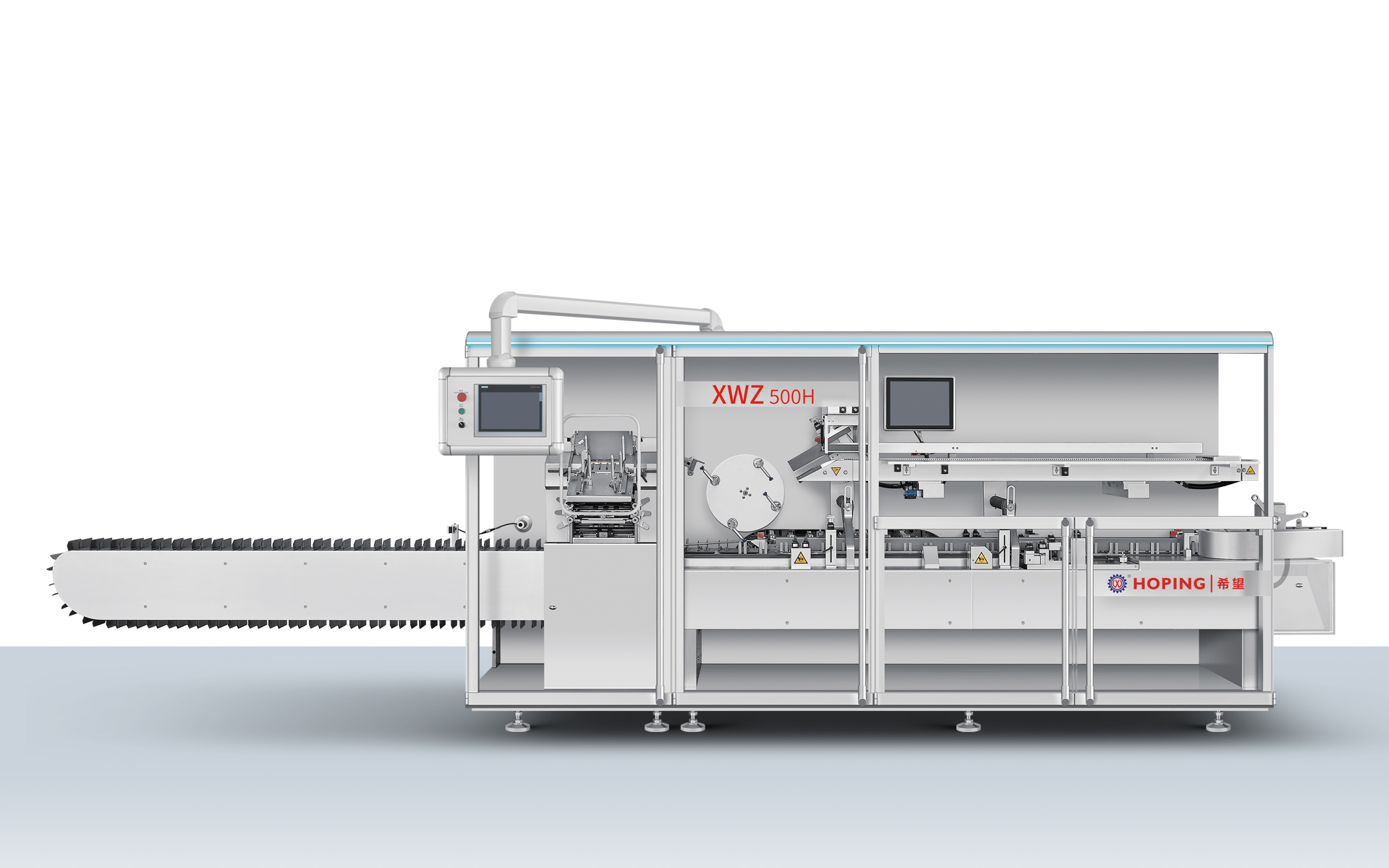
Why Nutraceutical Cartoning Is a Constraint Problem
Nutraceutical and health product lines share several operating realities with pharmaceutical solid dosage production, but not all of them. From a packaging-engineering viewpoint, the differences concentrate in four areas.
- Carton format variety. A nutraceutical portfolio often spans multiple carton sizes, counts per carton and leaflet formats. Every variation is a format change on the cartoner, and changeover time is a real output loss at high speed.
- Carton integrity at speed. A carton that is square, closed and legible at 60 cartons per minute can show crushed corners, weak glue flaps or skewed closures at several hundred per minute. Carton board grade, carton magazine feeding stability and the closing section interact.
- Leaflet and coding discipline. Missing leaflets, incorrect inserts and unreadable batch or date coding create the most downstream disruption, because these defects are typically detected late.
- Room and utility constraints. A packaging room is defined by compressed-air quality, electrical supply, cleaning access and guarding. Equipment that does not fit the room does not fit the project, regardless of rated output.
The opportunity is equally clear. An integrated blister-cartoning line removes the manual transfer step between blister output and carton input, and documented project objectives for this type of line include reducing manual transfer, improving blister-to-carton connection efficiency and reducing wrong insertion or missing leaflet risks. The constraint is that integration has to be confirmed during specification rather than assumed from a capacity sheet.
The HOPING Configuration for Solid Dosage Health Products
HOPING's declared product scope covers blister packaging machines, cartoning machines, case packing machines and end-of-line packaging machines. The company operates on an ODM/OEM and customizable production model, states a monthly capacity of 30–40 units, and quotes a typical lead time of 60–120 days after technical confirmation, subject to model, configuration, project complexity and contract terms. Documented export markets include Southeast Asia, the Middle East, Eastern Europe, South America and Africa, with exports representing about 25% of output.
For nutraceutical and health product lines in solid dosage formats, the directly relevant hardware is the Blister Cartoner Line family. Documented model ceilings are shown below; all figures are model-dependent and require confirmation against a specific blister format, carton format and leaflet specification.
| Model | Documented type | Blister ceiling | Carton ceiling | Control and transfer notes |
|---|---|---|---|---|
| DHL7005H | Fully servo high-speed blister-cartoner integral machine | Up to 700 blisters/min | Up to 500 cartons/min | Self-developed IRB24 intelligent transfer robot; Siemens motion controller and TP900 HMI; independent replenishment |
| DHL8005H | Intelligent fully servo high-speed blister-cartoner integral machine | Up to 800 blisters/min | Up to 500 cartons/min | D3 intelligent top-loading parallel tracking transfer system; Beckhoff motion controller and CP9315 industrial PC; three-channel servo-driven independent replenishment |
| DHL1000/5H | Intelligent fully servo high-speed blister-cartoner integrated machine | Up to 1,000 blisters/min | Up to 500 cartons/min | D3 intelligent top-loading parallel tracking transfer system; four-channel servo-driven independent replenishment; mold-change and recipe memory |
| DHL7004 | Fully servo high-speed blister-cartoner integral machine | Up to 700 blisters/min | Up to 400 cartons/min | IRB24 intelligent transfer robot; Siemens motion controller and TP900 HMI |
| DHL6004 | Intelligent fully servo high-speed blister-cartoner integral machine | Up to 600 blisters/min | Up to 400 cartons/min | Beckhoff motion controller and CP9315 industrial PC; servo-driven independent replenishment |
Where blister supply comes from a separate machine or an existing line, cartoning can be specified independently. HOPING's standalone cartoner range includes the XWZ500H full servo high-speed cartoner at about 100–500 cartons per minute, the XWZ300II intelligent high-speed cartoner at about 60–220 cartons per minute, the XWZ400 and XWZ300 models at about 100–400 and 100–300 cartons per minute respectively, and the XWZ120 horizontal cartoner at about 30–120 cartons per minute for lower-to-medium speed secondary packaging.
Technical Fit: Matching Blister Output to Cartoner Speed
A line rated at 1,000 blisters per minute upstream does not automatically deliver 500 cartons per minute downstream. The transferable figure depends on blisters per board, boards per carton, leaflet handling and the rejection logic configured for the project. This is why integrated lines are specified as linkable systems rather than as two independent capacity numbers.
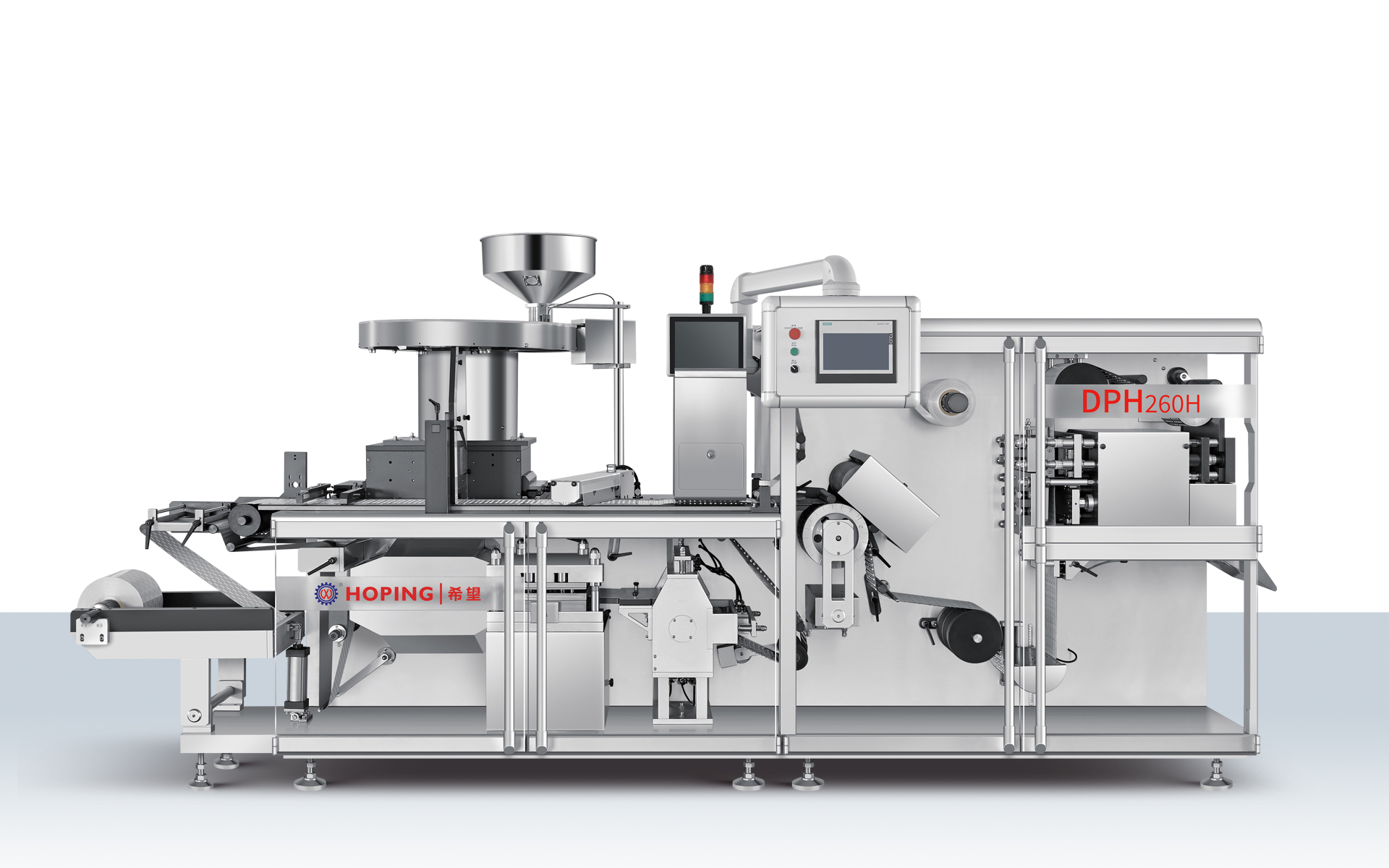
On the blister side, the documented DPH320HII rotary blister packing machine reaches a maximum capacity of 1,000 blisters per minute and a maximum punch frequency of 250 punches per minute, with a format area of 320 × 280 mm and a feed stroke of 100–280 mm. Its product-contact parts are made of AISI 316L stainless steel, non-product-contact parts from AISI 304 stainless steel and anodized aluminium alloy, and the machine is designed and manufactured in accordance with GMP requirements with corrosion-resistant, easy-to-clean surfaces. The DPH320H full servo roller blister packing machine is documented at a forming area of 320 × 280 mm, a forming depth of 12 mm, a stroke range of 100–280 mm and 29.5 kW power supply at 380V 50Hz.
On the cartoning side, three mechanisms matter for carton integrity at output. First, the transfer method: the D3 intelligent top-loading parallel tracking transfer system and the IRB24 transfer robot are documented transfer architectures on the DHL family, and their function is to move blister boards into the carton without crushing or misalignment. Second, replenishment architecture: three-channel and four-channel servo-driven independent replenishment systems are documented on the DHL8005H and DHL1000/5H respectively, which supports keeping the blister magazine fed during continuous running. Third, format memory: mold-change support with preset memory or recipe memory is documented on several models, which shortens the changeover window between nutraceutical SKUs.
Downstream, the same line logic extends to bundling and case level. The XWK4060 intelligent fully servo stretch bander is documented at about 30–60 bundles per minute, the XWK series case packing integral machine at about 5 cases per minute, and the ICP12 case packing and palletizing integral machine at about 12 cases per minute, with compatibility to carton or carton-bundle input depending on project configuration.
Constraint Checklist Before Specifying a High-Output Cartoner
A specification discussion for nutraceutical cartoning is more productive when it is structured around explicit constraints rather than around a target output figure alone. The following items are the ones that change the equipment or the project plan.
- Format constraints: blister size and material, quantity per carton, carton specification, leaflet format and coding or inspection method.
- Capacity constraints: the actual sustained blister feed rate, the cartons-per-minute target at that feed rate, and the acceptance rate after rejection logic.
- Utility constraints: documented clean compressed air pressure of 0.5–0.7 MPa and air consumption per module, plus 380V 50Hz supply for the larger servo-driven units and 220V 50Hz for feeder-type auxiliary equipment.
- Changeover constraints: number of SKUs per week, format parts inventory, and whether preset or recipe memory is required.
- Integration constraints: feeding method, downstream bundling, case-packing and palletizing connection, interface language, electrical component brand and data interface.
- Commercial constraints: lead time, MOQ and acceptance route.
On the commercial side, HOPING documents a minimum order of one set or one complete line, a monthly capacity of 30–40 units, and a lead time of typically 60–120 days after technical confirmation. The documented quality route covers incoming material inspection, key component inspection, assembly inspection, electrical safety check, no-load trial run, material trial, factory acceptance test, customer witness acceptance and pre-shipment inspection.
Compliance and Certification Boundaries
Certification is a constraint that removes options rather than adds them: a line that cannot demonstrate the right certificate scope for a destination market is not a candidate, whatever its output. HOPING's documented certification evidence includes the following entries.
| Certificate | Scope | Certificate number | Issuing body and standard |
|---|---|---|---|
| CE — Carton Packing Machine Series | Carton packing machine series, EU market | UCN 900339024607 | Certify International Ltd; EN 415-3:2000; 98/37/EC; 98/79/EC |
| CE — Cartoning Machine Series | Cartoning machine series, EU market | HTT190102307L | Shenzhen HTT Technology Co., Ltd.; EN 60204-1:2006+A1:2009+AC:2010; 2006/42/EC |
| CE — Blister Packing Machine Series | Blister packing machine series, EU market | HTT190102306L | Shenzhen HTT Technology Co., Ltd.; Machinery Directive 2006/42/EC; EN 60204-1:2006+A1:2009+AC:2010 |
| CE — Automatic Blister Packing Machine | Sample automatic blister packing machine, EU market | UCN 900175009261 | CELAB; EN 60204-1:1997; EN 415-3:1999 |
| ISO 14001:2015 | Design, production and after-sales service of packing machines and packing production lines | CN00123E33896R1M/3300 | China Quality Certification Centre (CQC); issued 2023-10-12, valid to 2026-10-11 |
| ISO 45001:2018 | Design, production and after-sales service of packing machines and packing production lines | CN00123S33121R1M/3300 | China Quality Certification Centre (CQC); issued 2023-10-10, valid to 2026-10-09 |
Two boundaries should be stated plainly. First, certificate scope is written against a series or a specific machine, so the certificate relevant to a project must be checked against the exact model and configuration being quoted. Second, the wider regulatory frame sits outside the machine builder: ISO 15378 integrates GMP requirements for primary packaging materials, and EU pharmaceutical equipment safety is governed by Machinery Directive 2006/42/EC together with the EN 415 series for packaging machines. Machine-side compliance evidence supports a buyer's qualification work; it does not replace site acceptance, installation qualification or operational qualification at the buyer's facility.
Application Fit: Which Nutraceutical Lines Suit an Integrated Blister-Cartoner
The documented working conditions for this equipment describe GMP-oriented cleanroom or pharmaceutical packaging workshops, continuous high-speed operation, multi-batch and multi-format production, and requirements for stability, easy cleaning, safety protection and traceability-oriented operation. Documented project types include a new solid dosage blister packaging line, an upgrade of an existing packaging line, a high-capacity expansion, an intelligent packaging workshop retrofit, and blister-cartoning-bundling or case-packing downstream integration.
That mapping suggests three typical nutraceutical fits. The first is a manufacturer running a small number of high-volume solid dosage SKUs who needs cartoning continuity without manual transfer. The second is a health product producer with many carton and count variations, where the value of preset or recipe memory and rapid format change is measured in changeover hours rather than in peak speed. The third is a site connecting cartoning to downstream bundling, case packing or palletizing, where the documented matched-equipment set includes the cartoner, leaflet folder, coding machine, vision inspection, checkweigher, bundler, case packer, palletizer and, depending on configuration, an ERP or MES data interface.
Documented representative applications cover blister packaging and automatic cartoning for tablets, capsules and other solid dosage forms, in configurations spanning new line construction, capacity expansion and upgrades of existing packaging lines, with typical project scale in the range of 5–10 lines for large solid dosage producers and engineering contractors. Customer names are disclosed only with authorization, and no fixed operating period should be assumed for a reference case unless it is confirmed against an authorized project record.
Market Trend: Integrated Secondary Packaging Keeps Expanding
Third-party market data supports the direction of travel, although the estimates should be treated as directional rather than precise. SkyQuest Technology valued the global pharmaceutical packaging equipment market at approximately USD 10.71 billion in 2024. Grand View Research reported that Asia Pacific held the largest regional revenue share, at 40.7%, in 2025. Within the primary packaging segment, Custom Market Insights projected the pharmaceutical blister packaging machine market to reach USD 2.57 billion by 2025, at a CAGR of 2.8%. On the cartoning side, Fortune Business Insights valued the global pharmaceutical cartoning machinery market at USD 1.46 billion in 2024.
Market concentration is also relevant to procurement planning. A market intelligence report estimates that the top three blister packaging machine players — Uhlmann, IMA and Marchesini — collectively hold approximately 29% of the blister packaging machine market. That leaves a large share of the market served by regional and specialist manufacturers, which is one reason lead-time flexibility and configuration depth matter as much as brand recognition in nutraceutical projects. Published estimates of total market size vary between research houses depending on whether primary or secondary equipment is included, so a single figure should not be used as a planning basis without checking the underlying definition.
Comparison with Traditional Solutions — and the Limits of Integration
Nutraceutical producers comparing options generally evaluate three configurations: manual or semi-automatic transfer between a blister machine and a cartoner, a standalone cartoner fed manually or by conveyor, and an integrated blister-cartoner line. The trade-offs are structural rather than promotional.
| Comparison dimension | Manual / semi-automatic transfer | Standalone cartoner, separate feeding | Integrated blister-cartoner line |
|---|---|---|---|
| Manual transfer labour | Highest; operators move blister boards between machines | Moderate; feeding and inspection remain people-dependent | Lowest; transfer is handled by robot or top-loading transfer system |
| Wrong insertion / missing leaflet exposure | Higher, because handling steps multiply | Depends on feeder and inspection configuration | Reduced where coding, inspection and rejection are configured in-line |
| Upstream – downstream coupling | Low; steps can be decoupled and buffered | Low; cartoner can run on independent feed | High; an upstream stop propagates unless buffering is designed in |
| Format changeover | Manual adjustments, no tooling coordination | Tooling limited to the cartoner | Tooling required on both blister and carton sides |
| Footprint and capital | Lowest equipment cost, highest space per unit output | Moderate | Highest capital and integration engineering effort |
| Traceability and data | Largely paper-based | Machine-level data only | Line-level data and ERP/MES interface can be configured |
Integration also has limits that should be acknowledged before a project is approved. Rated ceilings are model-specific and format-specific: the up-to-1,000 blisters per minute and up-to-500 cartons per minute figures apply to defined models such as the DHL1000/5H, while the DHL6004 is documented at up to 600 blisters and 400 cartons per minute. A single maximum number should therefore never be used as a general capability statement for the whole family.
Three further boundaries apply. Because blister and cartoning are linked, availability is shared; an upstream stoppage affects carton output unless the project design includes buffering. Format changes still require tooling and format parts, so a high-SKU nutraceutical portfolio needs a changeover plan rather than just a changeover-capable machine. And GMP-oriented design describes design intent, material choices and cleanability characteristics; it is not in itself a certificate, and installation and operational qualification remain the buyer's responsibility.
Future Outlook
Three developments look most relevant for nutraceutical cartoning over the next planning cycle. Servo-driven architecture continues to move from the high end of the range downward, which shortens changeover and improves repeatability across carton sizes. Recipe and preset memory is becoming a specification item rather than a premium option, which directly addresses multi-SKU nutraceutical portfolios. And line-level data interfaces to ERP or MES systems are increasingly part of project scope, moving traceability from carton coding alone to line-level records.
None of these changes the underlying constraint logic. Output, carton integrity, compliance scope and utility fit still have to be confirmed against a specific product format before a line is ordered, and the capacity ceilings documented per model remain the realistic planning basis.
FAQ
What is an automatic blister-cartoning line, and which products is it intended for?
An automatic blister-cartoning line is an integrated machine that links blister forming and sealing with blister transfer, leaflet folding, carton opening, insertion, carton closing, and inspection or rejection in one continuous flow. HOPING documents its Automatic Blister-Cartoning Line family for pharmaceutical tablets, capsules, soft capsules, nutraceuticals and healthcare product packaging, with optional downstream connection to bundling, case packing and palletizing equipment.
What capacity and utility parameters should be confirmed before specifying a high-output cartoner for nutraceutical production?
Confirm the sustained blister feed rate, the target cartons per minute at that feed rate, blisters per board and boards per carton, carton and leaflet formats, and the rejection criteria. On utilities, the documented compressed-air requirement is a clean pressure of 0.5–0.7 MPa with air consumption per module, and the electrical supply is 380V 50Hz for the larger servo-driven units. Rated ceilings vary by model: 600 blisters per minute and 400 cartons per minute on the DHL6004, up to 800 blisters per minute on the DHL8005H, and up to 1,000 blisters per minute on the DHL1000/5H, each at up to 400 or 500 cartons per minute depending on model.
Which certifications apply to these packaging machines, and what do they cover?
Documented certification evidence includes CE certification for the carton packing machine series under certificate number UCN 900339024607 issued by Certify International Ltd against EN 415-3:2000, 98/37/EC and 98/79/EC; CE certification for the cartoning machine series under HTT190102307L issued by Shenzhen HTT Technology Co., Ltd.; CE certification for the blister packing machine series under HTT190102306L; and CE certification for a sample automatic blister packing machine under UCN 900175009261 issued by CELAB. Management-system certificates include ISO 14001:2015 under CN00123E33896R1M/3300 and ISO 45001:2018 under CN00123S33121R1M/3300, both issued by the China Quality Certification Centre. Certificate scope is written against specific series or machines, so the applicable certificate must be verified for the exact model and destination market.
How is carton integrity maintained at several hundred cartons per minute?
Three documented mechanisms support this. Transfer architecture matters first: the D3 intelligent top-loading parallel tracking transfer system is used on the DHL8005H and DHL1000/5H, and the self-developed IRB24 intelligent transfer robot is used on the DHL7005H and DHL7004, both intended to place blister boards into cartons without misalignment. Second, servo-driven independent replenishment with three or four channels keeps feeding stable during continuous running. Third, in-line coding, inspection and rejection integration allows non-conforming cartons to be removed rather than shipped, which protects downstream carton quality.
What are the practical procurement constraints for this type of line?
Documented constraints include a minimum order of one set or one complete line, a manufacturing capacity of 30–40 units per month, and a lead time of typically 60–120 days after technical confirmation, subject to model, configuration, project complexity and contract terms. The documented acceptance route covers incoming material inspection, key component inspection, assembly inspection, electrical safety check, no-load trial run, material trial, factory acceptance test, customer witness acceptance and pre-shipment inspection. After-sales scope includes on-site installation and commissioning, operator and maintenance training, remote support, spare parts supply and process-parameter guidance, subject to contract and project configuration.
How does an integrated blister-cartoning line compare with a standalone cartoner for nutraceutical production?
An integrated line reduces manual transfer labour and reduces the handling steps that create wrong insertion and missing leaflet exposure, and it can be configured with line-level coding, inspection, rejection and ERP or MES data interfaces. A standalone cartoner fed separately offers more decoupling between upstream and downstream, lower capital and simpler format tooling, at the cost of more people-dependent feeding. The main trade-off with integration is that availability is shared: an upstream stoppage affects carton output unless buffering is designed into the project, and format changes require tooling on both the blister and carton sides.
Additional specification detail for HOPING blister packing machines, cartoning machines and end-of-line equipment is available in the company product catalogue: Hoping Machinery Catalog (PDF). Company information is published at www.hopingcn.com.