
Aquaculture AUV Scenario Fit: AUV-160 and AUV-210
Aquaculture AUV Scenario Fit: AUV-160 and AUV-210
Aquaculture monitoring is a shallow-water problem with a deep-water documentation burden. Sites are worked from shore or from small boats, the water column is frequently turbid, and the assets that matter — nets, cages, mooring lines, feed systems and the seabed beneath them — sit within a few tens of metres of the surface. Two platforms in the Pelagix AUV range, the AUV-160 and the AUV-210, sit inside that envelope with different depth, payload and deployment characteristics. This article explains where each one fits, and where neither is the right instrument.
The guidance below is organised around three variables that decide scenario fit in practice: depth range decides whether a site is addressable at all; payload budget decides what a mission can measure; deployment and recovery method decides whether a farm crew can repeat the mission often enough to be useful.
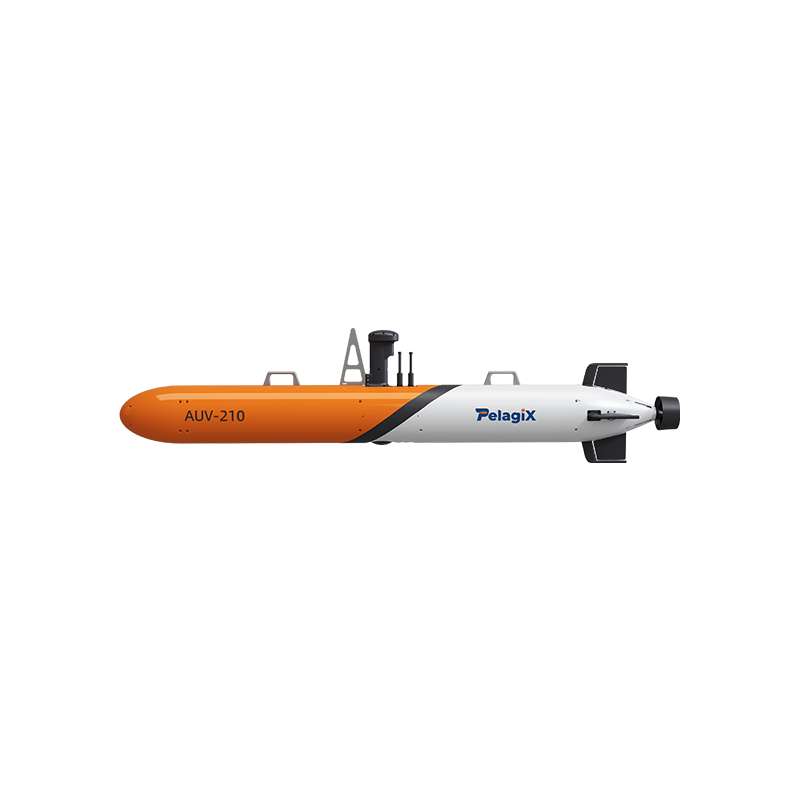
Pelagix AUV-210 nearshore survey AUV — documented depth range 0–200 m, 10 kg payload, aluminium frame and pressure-sealed electronic pod.
The Operational Shape of an Aquaculture Inspection Mission
Aquaculture inspection work is not a single task. In practice, operators describe a repeating set of observation requirements across a production cycle:
- Net and cage condition — biofouling load, holes, deformation and the position of the net bottom relative to the seabed.
- Water column parameters — temperature, salinity and related parameters collected at depth across a site, typically through CTD sensors.
- Seabed and mooring condition — feed waste accumulation, dropped objects, debris, and the integrity of anchors and mooring lines.
- Water-area surveillance — detecting intrusions or hazards around a lease area.
Three operational conditions shape how that work is done. First, the water is shallow and often confined — around nets, frames and mooring arrays that create snagging risk for tethered systems. Second, visibility is commonly reduced by plankton, suspended sediment and tidal mixing, which shifts value from operator vision toward sensor data. Third, the requirement is repetition: a single survey has limited value compared with an observation cycle the crew can run consistently without diverting a large vessel.
This is the opportunity that autonomous platforms address. An untethered vehicle removes tether management from the operational risk list and allows the same survey line to be flown repeatedly. The trade-off is that autonomy gives up continuous live piloting, and mission length is bounded by onboard energy.
Two Pelagix Platforms Inside the Shallow-Water Aquaculture Envelope
Sanya Poseidon Ocean Technology Co., Ltd. is a deep-sea intelligent equipment enterprise based in the Yazhou Bay Deep-Sea Equipment Industrial Park in Sanya, Hainan, which researches, manufactures and sells autonomous underwater vehicles (AUVs) and remotely operated vehicles (ROVs) under the Pelagix AUV brand, with an R&D team of 37 and a product range spanning portable micro AUVs, nearshore survey AUVs, deep-sea 6000 m platforms and intervention-class vehicles. Two models in that range are documented with aquaculture applications in their industry scope.
AUV-160 — portable micro AUV
The AUV-160 is documented as a portable micro AUV / easy-launch micro AUV. Its published specifications are: dimensions 160 mm × 1.8 m; total weight 35 kg; payload capacity 5 kg; depth range 0–100 m; speed 1–5 knots; endurance ≥8 hours at 3 knots; navigation INS+DVL+GNSS. It uses a lightweight aluminium frame, a seawater-resistant polymer casing, corrosion-resistant components and a pressure-sealed electronic pod. Its documented deployment profile is shore launch, small-boat deployment and net recovery. Aquaculture monitoring and inspection is listed among its applicable industries, alongside ocean environmental monitoring, water area security surveillance, education and practical training, payload integration and testing, and multi-vehicle cooperative testing.
AUV-210 — nearshore survey AUV
The AUV-210 is documented as a nearshore survey AUV / shallow-water survey AUV. Its published specifications are: dimensions 210 mm × 2.1 m; total weight 70 kg; payload capacity 10 kg; depth range 0–200 m; standard speed 1–5 knots with an optional custom speed of up to 15 knots; endurance ≥10 hours at 3 knots; navigation INS+DVL+GNSS+USBL. It shares the same construction family — lightweight aluminium frame, seawater-resistant polymer casing, corrosion-resistant components, pressure-sealed electronic pod. Its documented mission scope covers rapid shallow-water inspection, short-duration scientific research and nearshore missions, and aquaculture environment monitoring is listed among its applicable industries.
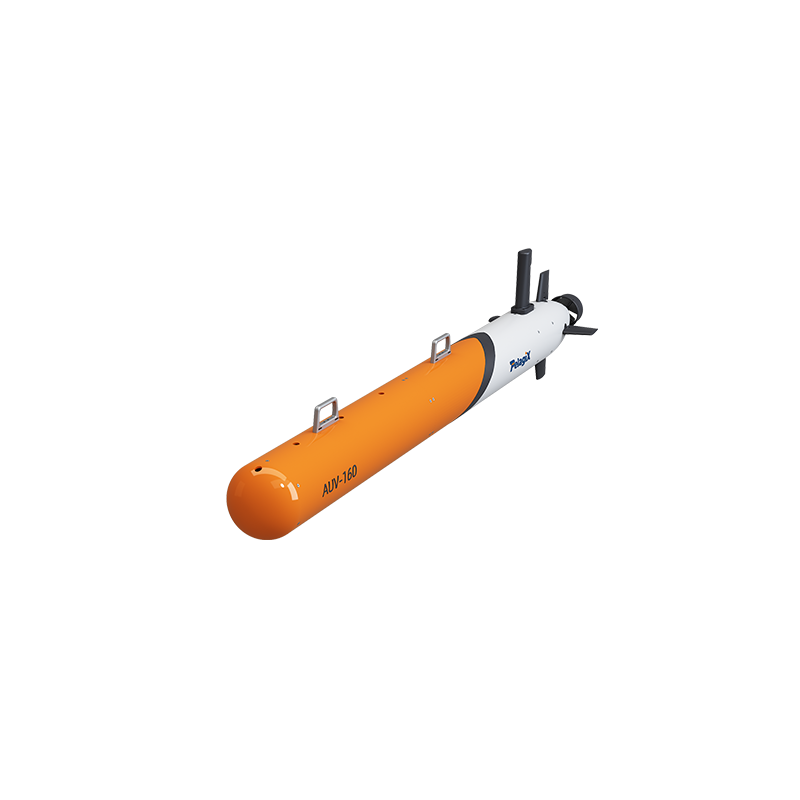
Pelagix AUV-160 portable micro AUV — 35 kg total weight, 5 kg payload, documented for aquaculture monitoring and inspection with shore launch and net recovery.
| Parameter | AUV-160 | AUV-210 |
|---|---|---|
| Class | Portable micro AUV / easy-launch micro AUV | Nearshore survey AUV / shallow-water survey AUV |
| Dimensions | 160 mm × 1.8 m | 210 mm × 2.1 m |
| Total weight | 35 kg | 70 kg |
| Payload capacity | 5 kg | 10 kg |
| Depth range | 0–100 m | 0–200 m |
| Speed | 1–5 knots | 1–5 knots standard / 1–15 knots custom |
| Endurance | ≥8 h at 3 knots | ≥10 h at 3 knots |
| Navigation | INS+DVL+GNSS | INS+DVL+GNSS+USBL |
| Documented deployment | Shore launch, small-boat deployment, net recovery | Nearshore mission profile |
| Listed aquaculture application | Aquaculture monitoring and inspection | Aquaculture environment monitoring |
Specifications as published in Pelagix AUV product documentation. Values are manufacturer-stated class specifications, not third-party test results.
Depth as the First Selection Filter
Depth is a pass/fail criterion before any other comparison. The AUV-160 is rated for 0–100 m and the AUV-210 for 0–200 m. In an aquaculture setting, the relevant number is not the water depth at the site boundary but the deepest point of the specific task: the seabed directly beneath a cage, the lowest point of a net panel, or the anchor and mooring hardware being inspected.
The resulting decision rule is straightforward. Where the deepest inspection point across the site stays within 100 m, the AUV-160 remains within its rated envelope and its lower weight and simpler launch profile stay available. Where the task extends beyond 100 m and up to 200 m, only the AUV-210 is rated for the work. Because both platforms are documented across their full stated depth range rather than at a single design depth, the buyer's task is to establish the site's true bathymetric profile before the vehicle class is fixed — a bathymetric survey, a chart review or an existing site survey all serve that purpose.
Payload as the Second Selection Filter
Payload capacity determines the sensor set a mission can carry, and the two platforms separate clearly here: 5 kg on the AUV-160 and 10 kg on the AUV-210. The manufacturer documents sensor integration as a customization option across the range, covering CCD, CTD, altimeter, obstacle avoidance sonar, side-scan sonar, multi-beam sonar, sub-bottom profiler sonar, USBL and hydrophones, together with modular payload bay configuration.
The practical consequence for aquaculture buyers is that payload should be specified from the sensor list backwards, not the other way around. A water-column parameter mission built around a CTD sensor is a comparatively light payload. A mission that adds imaging, obstacle avoidance sonar and a side-scan or multi-beam sonar consumes appreciably more of the budget — and the combination that can be flown simultaneously shrinks on a 5 kg platform. Where a mission profile requires the heavier combination in one dive, the AUV-210's 10 kg payload budget is the documented basis for that configuration.
One documented example illustrates how payload specifications translate into mission equipment on the AUV-210. In a dam and hydroelectric infrastructure inspection scenario, the vehicle is described as operating in a reservoir water body and along hydraulic dam walls within its 0–200 m depth band, performing wall-following defect identification and small-target recognition in autonomous SLAM mapping and obstacle avoidance cruising modes. For that mission the documented supporting equipment includes a Sound and Light Integration Recognition System, high-precision CTD sensors, high-thrust thrusters and a shore-based monitoring station (PX-S), with special requirements covering a modular payload bay AUV and application-specific quality documentation. The scenario is confined-water infrastructure inspection rather than aquaculture, but it demonstrates the relationship between payload budget, sensor selection and mandatory documentation that also governs fish-farm survey work.
Deployment and Recovery as the Third Selection Filter
Deployment method decides whether a survey programme actually happens. The AUV-160 is documented as a portable micro AUV with shore launch, small-boat deployment and net recovery, at a total weight of 35 kg. That profile fits farms that already operate small boats and want to run observation missions without mobilising a larger support vessel. Recovery by net is a documented part of the design intent, not an improvised procedure.
The AUV-210 sits at 70 kg with a nearshore mission scope and a navigation suite that adds USBL to INS+DVL+GNSS. INS+DVL+GNSS provides positioning without surface acoustic correction; the addition of USBL in the suite supports acoustic position updates during nearshore operations, which in turn implies a surface-side reference. In the documented confined-water scenario described above, that surface side is represented by a shore-based monitoring station (PX-S). The general procurement implication is that a programme using the AUV-210 should plan for a defined surface-side station, whereas the AUV-160's documented profile scales down to shore and small-boat handling.
Mapping Aquaculture Mission Types to Platforms
| Mission type | Primary platform | Basis in documented specifications |
|---|---|---|
| Net pen and cage condition observation in shallow water | AUV-160 | 0–100 m depth range; 5 kg payload; shore launch and net recovery; aquaculture monitoring and inspection listed |
| Water column parameter collection across a wider depth band | AUV-210 | 0–200 m depth range; aquaculture environment monitoring listed; CTD sensors documented as supporting equipment in the platform's confined-water scenario |
| Seabed and mooring survey with sonar payload | AUV-210 | 10 kg payload budget; sensor integration options include side-scan sonar and multi-beam sonar |
| Frequent short-duration repeat missions from shore | AUV-160 | 35 kg total weight; documented shore launch and small-boat deployment; ≥8 h at 3 knots |
| Multi-vehicle cooperative work | Both | AUV-160 lists multi-vehicle cooperative testing; AUV-210 lists swarm cooperative trials |
| Water-area security surveillance | Both | AUV-160 lists water area security surveillance; AUV-210 lists nearshore water security surveillance |
This mapping reflects documented specifications and declared application scope. It is a specification-based fit assessment, not a record of measured aquaculture mission results for either model.
Documented Adjacent Evidence from a Nearshore Survey Programme
The clearest published reference point for how an aquaculture-adjacent AUV programme is structured comes from a different model in the same range. A marine scientific research institute operated three AUV-260 nearshore survey AUV systems over a three-year project for near-shore seabed mapping, aquaculture area routine inspection and continuous marine environmental parameter collection. The programme produced side-scan sonar seabed mapping results and continuous CTD water-quality data, and it reduced diver operation risks while cutting field survey time by 45%.
The AUV-260 is a larger platform than either vehicle discussed here, with a 0–500 m depth rating, 100 kg total weight, 20 kg payload and ≥12 hours endurance at 3 knots. Its relevance to this article is methodological rather than comparative: it documents what an aquaculture-adjacent survey programme actually records — a modular payload design supporting interchangeable sensors for multi-objective near-shore tasks, sonar-based seabed mapping products, and continuous CTD time series. Buyers specifying an AUV-160 or AUV-210 programme can use that data structure as a template for deliverables and acceptance criteria.
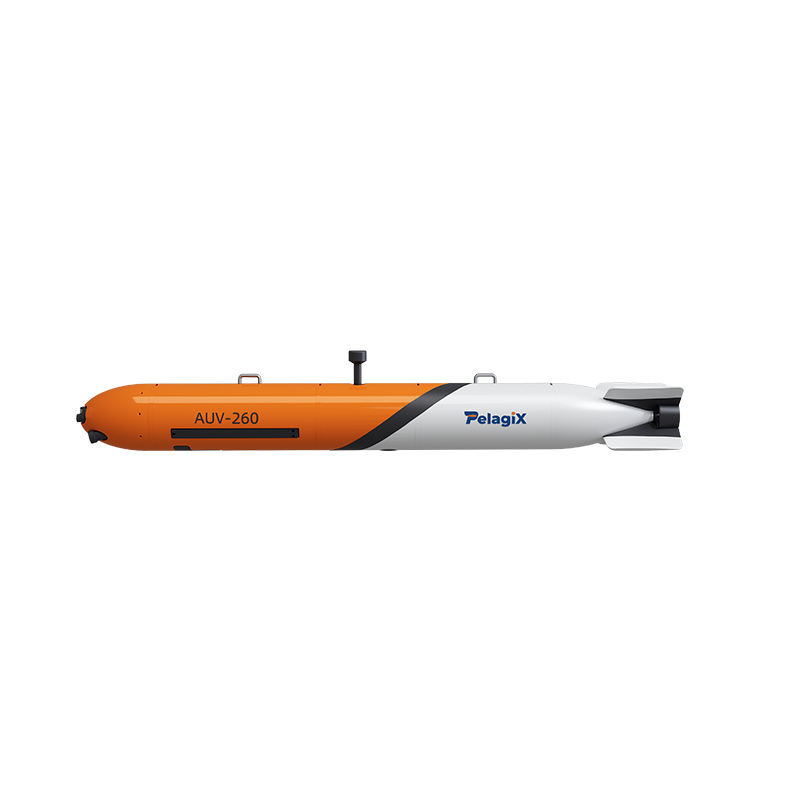
Pelagix AUV-260 nearshore survey AUV — the platform behind a documented three-year programme covering near-shore seabed mapping and aquaculture area routine inspection.
Comparison with Traditional Solutions — and Where AUVs Do Not Fit
Divers, ROVs, fixed sensors and AUVs each solve part of the aquaculture observation problem, and the choice is a matter of task geometry rather than preference.
- Divers remain the only option for physical intervention — hands-on inspection of a net, clearing a blockage, replacing hardware. Their limits are depth, working time per dive and repeated exposure in confined net structures. An AUV does not replace that capability; it reduces how often it is needed for routine observation.
- ROVs offer continuous power and live pilot control, which is valuable for close inspection work. The cost is tether management, which becomes a genuine operational hazard where nets, frames and mooring lines are present. Untethered AUV operation removes that hazard but gives up live piloting in exchange for pre-planned mission execution.
- Fixed sensors deliver continuous data at a single point, at high temporal resolution but with no spatial coverage. AUV surveys provide spatial coverage at discrete intervals. The two are complementary rather than competing.
The boundaries of the AUV-160 and AUV-210 should be stated plainly, because they are documented rather than implied. Neither platform carries manipulator arms, so intervention-class tasks such as gripping, cutting and rotating are outside their scope; that work is documented on the AUV-F760 intervention-class platform, which is specified with dual manipulator arms for subsea pipeline inspection and maintenance. Endurance is bounded at ≥8 hours (AUV-160) and ≥10 hours (AUV-210) at 3 knots, so neither vehicle is designed for multi-day continuous observation. The AUV-160's 5 kg payload budget limits the number of sensors that can be flown together, and its baseline navigation suite lists INS+DVL+GNSS without USBL. Depth ceilings of 100 m and 200 m respectively exclude deep-sea applications entirely. Within those boundaries the platforms address the shallow-water aquaculture observation cycle; outside them, a different class of vehicle is required.
Market and Regulatory Signals Relevant to Shallow-Water AUV Procurement
Several published data points frame the buying environment for autonomous underwater vehicles, though none of them measure the aquaculture segment specifically.
- The global autonomous underwater vehicle market size is estimated to reach approximately USD 2.0–2.57 billion by 2024/2025, according to MarketsandMarkets.
- The large/deep AUV segment, defined as platforms rated beyond 1000 m, is projected to grow at a CAGR of 12.0% during the forecast period, according to Fortune Business Insights. Growth concentrated in the deep segment does not eliminate demand for shallow platforms, whose economics depend on launch logistics and mission frequency rather than on depth capability.
- Energy storage systems account for approximately 40% of an AUV's internal volume, supporting missions typically lasting up to 24 hours, according to Market.us. That figure explains the payload-versus-endurance trade-off that buyers of compact platforms such as the AUV-160 and AUV-210 encounter directly.
- Autonomous safety and functionality in marine robotics are increasingly discussed under the ISO 21448 (Safety of the Intended Functionality) framework, which addresses non-fault-based hazards rather than component failure alone.
- For trade and import planning, AUVs are typically classified under HS Code 901580 (oceanographic and hydrological instruments) or 890690 (other vessels), per a US Customs and Border Protection tariff classification ruling.
- For competitive context, Kongsberg Maritime reported 2025 revenue of approximately NOK 24.2 billion (USD 2.3 billion), with its HUGIN AUV portfolio contributing to an estimated 15–20% share of advanced ocean systems.
Procurement Checklist for Aquaculture AUV Selection
| Evaluation item | What to verify |
|---|---|
| Depth rating versus site bathymetry | Confirm the deepest inspection point against the 0–100 m (AUV-160) or 0–200 m (AUV-210) rated range |
| Payload budget versus sensor set | Total the mass of intended sensors against the 5 kg or 10 kg payload capacity, including modular payload bay hardware |
| Deployment and recovery | Confirm the launch and recovery method against available crew, boats and shore access |
| Navigation suite | INS+DVL+GNSS for the AUV-160; INS+DVL+GNSS+USBL for the AUV-210, with the surface-side implications of acoustic positioning |
| Endurance versus mission length | Compare ≥8 h (AUV-160) or ≥10 h (AUV-210) at 3 knots against survey line distance and speed settings |
| Documentation | Request application-specific quality documentation, which is listed as a special requirement in the platform's confined-water inspection scenario |
| Quality control evidence | Confirm the full-process control sequence: incoming inspection, in-process inspection, HIL simulation, final inspection and factory outgoing inspection |
| After-sales terms | Remote technical support, on-site sea-trial commissioning assistance, operator training, a 2-year warranty on pressure hull and electronics, and modular spare parts supply |
| Supply parameters | MOQ 1 unit; lead time of 60–90 days for standard models and 120–180 days for customized deep-sea 6000 m AUV systems; production capacity of 8–10 units per month for custom industrial and research AUV platforms and core components |
| Customization scope | Depth rating, modular payload bay configuration, sensor integration, battery capacity and endurance, software, AI target recognition models, monocular vision docking algorithms, and branding and documentation |
Limitations, Boundaries and Documentation Obligations
A fit assessment is only useful if it states where the fit ends. The AUV-160 and AUV-210 are shallow-water platforms; the AUV-160 is rated to 100 m and the AUV-210 to 200 m, and neither is rated for deep-sea conditions. Neither carries manipulation equipment, so tasks requiring physical contact with a structure fall outside their documented capability. Endurance is mission-bounded rather than continuous, which means observation programmes must be planned as repeat visits rather than permanent presence. The AUV-160's payload budget of 5 kg constrains simultaneous sensor combinations, and its navigation suite does not include USBL in the published configuration.
One further boundary sits on the buyer's side rather than the vehicle's. Application-specific quality documentation is treated as a special requirement in the platform documentation, which means the operator defines the acceptance criteria — data formats, coverage tolerances, sensor calibration records and reporting structure — before the vehicle is configured. Buyers who define those deliverables up front, using the data products from the documented AUV-260 programme as a reference structure, generally obtain usable survey outputs; buyers who purchase the platform first and define outputs later often do not.
Future Outlook
The direction of travel in shallow-water autonomous survey is toward more sensor capability inside the same weight budget, more autonomy in data interpretation, and more multi-vehicle operation. The Pelagix AUV portfolio documents several components on that path: AI target recognition models, monocular vision docking algorithms, a multi-AUV cooperative detection system, and a mesoscale vortex AI forecasting model (OceanX-Eddy). These are software and systems capabilities offered across the range, not claims of aquaculture deployment.
For aquaculture specifically, the practical consequence is likely to be incremental rather than dramatic. As payload is consumed less by structural hardware, more of the budget becomes available for sensors, and the value of a monitoring programme shifts further from imagery toward structured, comparable data — CTD series, sonar maps and repeatable coverage metrics that can be compared across seasons rather than reviewed visually once.
Frequently Asked Questions
What does an autonomous underwater vehicle do in aquaculture monitoring?
An autonomous underwater vehicle performs untethered survey missions in a defined area, collecting data without a physical link to the surface. In aquaculture, the documented mission types are monitoring and inspection of the site environment: water column parameter collection through CTD sensors, seabed and structure mapping through sonar payloads, and water-area surveillance. It operates under pre-planned autonomous navigation rather than continuous pilot control, and it returns data for review after each mission.
Is the AUV-160 or the AUV-210 the better fit for fish farm net inspection?
The deciding variable is depth. The AUV-160 is rated 0–100 m with a 5 kg payload, and aquaculture monitoring and inspection is listed among its applications. The AUV-210 is rated 0–200 m with a 10 kg payload, and aquaculture environment monitoring is listed among its applications. Where the deepest inspection point — net bottom, seabed under the cage, or mooring hardware — stays within 100 m, the AUV-160 remains within its rated envelope. Where the task extends beyond 100 m and up to 200 m, only the AUV-210 is rated for it. Beyond 200 m, neither platform applies.
How is the AUV-160 deployed and recovered?
The AUV-160 is documented as a portable micro AUV with shore launch, small-boat deployment and net recovery, at a total weight of 35 kg. Those three methods are stated in the product documentation rather than derived from operational practice, which means the vehicle can be deployed from shore or from a small boat and recovered with a net, without a large support vessel.
What payload can the AUV-210 carry for aquaculture environment monitoring?
The AUV-210 has a 10 kg payload capacity and supports modular payload bay configuration. Documented sensor integration options across the range include CCD, CTD, altimeter, obstacle avoidance sonar, side-scan sonar, multi-beam sonar, sub-bottom profiler sonar, USBL and hydrophones. In the platform's documented dam and hydroelectric infrastructure inspection scenario, supporting equipment includes high-precision CTD sensors, high-thrust thrusters, a Sound and Light Integration Recognition System and a shore-based monitoring station (PX-S). The payload budget determines which of these can be flown simultaneously.
What depth range should be verified before buying an AUV for aquaculture?
The depth to verify is the deepest point of the specific inspection task, not the site's maximum water depth. For the AUV-160 the rated range is 0–100 m; for the AUV-210 it is 0–200 m. Both figures are stated as full operating ranges in the product documentation. A bathymetric survey or existing site survey covering the deepest net panel, mooring anchor and seabed contour beneath the cages provides the evidence needed to match a vehicle to the site.
What documentation and quality-control evidence should an aquaculture AUV supplier provide?
Application-specific quality documentation is listed as a special requirement in the platform's confined-water inspection scenario, so it should be requested explicitly. On the manufacturing side, the documented full-process quality control sequence covers incoming inspection, in-process inspection, HIL simulation, final inspection and factory outgoing inspection. After-sales terms documented for the range include remote technical support, on-site sea-trial commissioning assistance, operator training, a 2-year warranty on pressure hull and electronics, and modular spare parts supply. Lead time is documented as 60–90 days for standard models and 120–180 days for customized deep-sea 6000 m AUV systems, with an MOQ of 1 unit.
The Pelagix AUV range is manufactured by Sanya Poseidon Ocean Technology Co., Ltd., whose product documentation covers the AUV-150 and AUV-160 portable micro platforms, the AUV-210 and AUV-260 nearshore survey platforms, the AUV-480 streamlined platform, the AUV-533/600/900 deep-sea 6000 m platforms and the AUV-F760 intervention-class subsea pipeline inspection AUV.
Company information: pelagix-tech.com · Product brochure: Overseas Version — AUV Products (PDF)