
Aquaculture AUV Scenario Fit: AUV-160 and AUV-210
Aquaculture operators do not need a general answer about autonomous underwater vehicles. They need a specific one: can a given vehicle be launched from the site they actually work from, reach the depth of the structures they inspect, and carry the sensors their monitoring programme uses? Depth rating, payload allowance, and launch-and-recovery method settle that question, and the three interact. Two models in the Pelagix AUV range sit closest to typical farm and nearshore inspection conditions. The AUV-160 is a portable micro AUV rated to 0–100 m, with a total weight of 35 kg and a 5 kg payload. The AUV-210 is a nearshore survey AUV rated to 0–200 m, with a total weight of 70 kg and a 10 kg payload. Pelagix lists Aquaculture Monitoring & Inspection among the applicable industries of the AUV-160, and Aquaculture Environment Monitoring among those of the AUV-210.
Pelagix AUV is the autonomous underwater vehicle product line of Sanya Poseidon Ocean Technology Co., Ltd., a deep-sea intelligent equipment enterprise located in the Yazhou Bay Deep-Sea Equipment Industrial Park in Sanya, Hainan, China. The company integrates research and development, manufacturing, sales and technical services across AUV and ROV systems, and its portfolio also covers core underwater components and marine software systems.
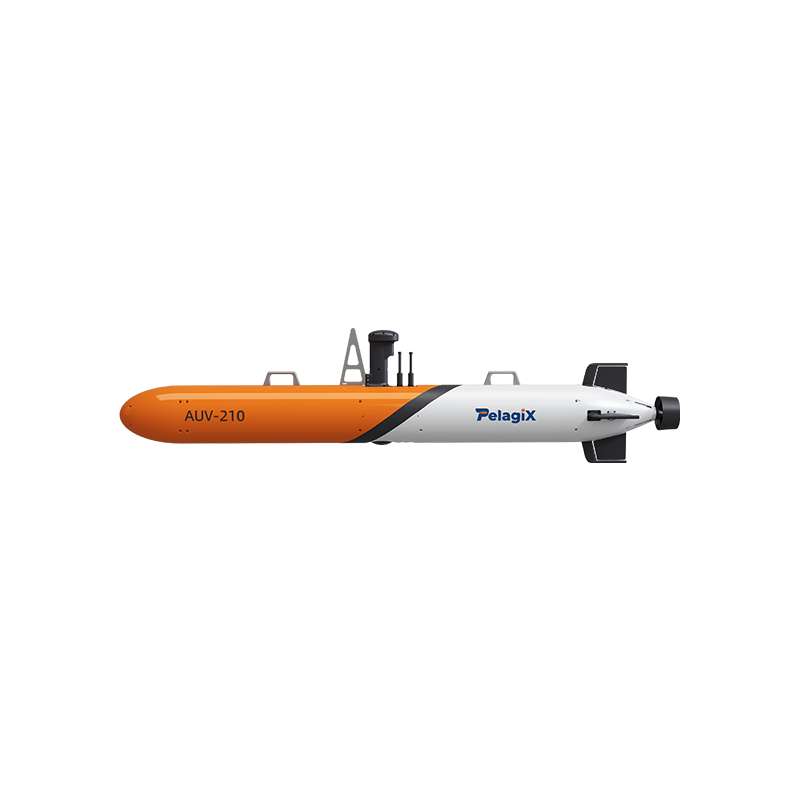
AUV-210 — nearshore survey AUV, 0–200 m depth range, 70 kg total weight, 10 kg payload, designed for rapid shallow-water inspection and nearshore missions.
Why Aquaculture Monitoring Has Become a Platform Decision
Aquaculture monitoring and inspection is not one task. A farm site may need routine water-column parameter collection, seabed mapping across the lease area, inspection of submerged structures, and surveillance of the surrounding water. Each of these carries a different tolerance for water clarity, depth and submerged time, and each has historically been handled by a different method: divers, a tethered ROV flown from a workboat, or fixed sensors left in place.
Those methods remain valid, but they carry recognised constraints. Diving requires trained personnel, is limited by depth and working time, and places people in water around nets, moorings and vessel traffic. A tethered ROV removes the diver from the water but keeps the tether, which restricts range in structured environments and requires a surface control unit and an operator. Fixed sensors deliver continuity at a single point but say little about conditions a few hundred metres away. Autonomous operation removes the tether and the pilot, which is why the selection question shifts from what a pilot can fly to what a site can support.
That shift is where depth, payload and deployment method become the deciding criteria rather than secondary specifications.
The Three Variables That Decide Scenario Fit
Depth rating sets a hard boundary
The AUV-160 operates from 0 to 100 m. The AUV-210 operates from 0 to 200 m. Shallow coastal farm infrastructure typically falls inside the first envelope, while deeper lease areas, deeper mooring and anchor assemblies, and sites with a steeply shelving seabed push the requirement into the second. A platform chosen beyond its rated depth is not a candidate at any price, regardless of how well its payload or endurance fits the mission.
Payload allowance decides how much sensing travels on one mission
Payload determines the sensor load a vehicle can carry in a single deployment. The AUV-160 carries 5 kg and the AUV-210 carries 10 kg. Both are total allowances, so a mission combining a CTD sensor with an acoustic or imaging payload has to be planned inside that budget. Documented sensor integration options offered across the Pelagix range include CCD, CTD, altimeter, obstacle-avoidance sonar, side-scan sonar, multi-beam sonar, sub-bottom profiler sonar, USBL and hydrophones, configured against the depth rating and payload capacity of the specific model.
Launch and recovery decides whether the site can operate the vehicle at all
Aquaculture sites rarely keep a survey vessel on standby. The AUV-160 is specified for shore launch, small-boat deployment and net recovery, at a total weight of 35 kg. The AUV-210 is specified for nearshore missions and rapid shallow-water inspection, at 70 kg. Those figures determine how many people a launch needs, whether a jetty or slipway is sufficient, and how quickly a survey can be organised when conditions allow.
AUV-160: Portable Micro AUV for Shallow-Water Farm Monitoring
The AUV-160 is the smaller of the two platforms. It measures 160 mm × 1.8 m and weighs 35 kg, which places launch and recovery within the capability of a small team working from shore or from a small boat. Its depth rating is 0–100 m, its speed range is 1–5 knots, and its endurance is at least 8 hours at 3 knots. Navigation uses an integrated INS+DVL+GNSS suite, which maintains positioning once the vehicle is below the surface and satellite reception is lost.
The vehicle is built around a lightweight aluminium frame with a seawater-resistant polymer casing, corrosion-resistant components and a pressure-sealed electronic pod. Its documented applicable industries are Education & Practical Training, Payload Integration & Testing, Multi-Vehicle Cooperative Testing, Ocean Environmental Monitoring, Aquaculture Monitoring & Inspection, and Water Area Security Surveillance.
For an aquaculture buyer, the practical reading is straightforward. A 5 kg payload supports a focused sensor fit for a defined task — water-column profiling on one mission, a compact acoustic or imaging payload on another — rather than a full simultaneous suite. An endurance of at least 8 hours at 3 knots covers repeated survey lines within a single working day at a shallow site, and the 35 kg all-up weight means recovery does not require lifting equipment.
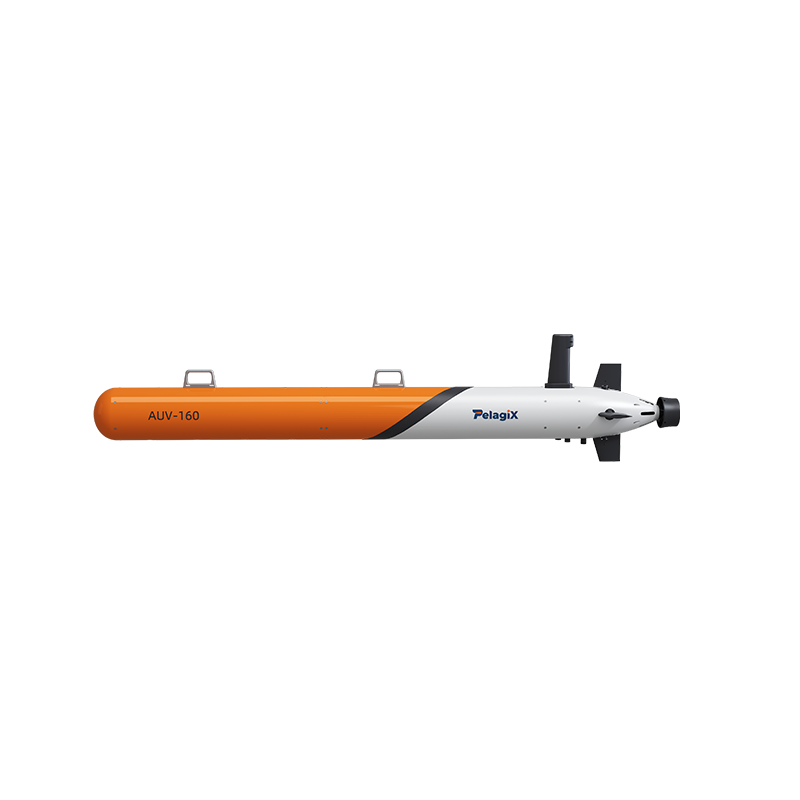
AUV-160 — portable micro AUV, 0–100 m depth rating, 35 kg total weight, 5 kg payload, shore launch, small-boat deployment and net recovery.
AUV-210: Nearshore Survey AUV for Deeper Farm Footprints
The AUV-210 extends the same design philosophy to deeper and slightly more demanding work. It measures 210 mm × 2.1 m and weighs 70 kg, with a 10 kg payload and a depth rating of 0–200 m. Standard speed is 1–5 knots, with a custom option up to 15 knots, and endurance is at least 10 hours at 3 knots. Navigation integrates INS+DVL+GNSS+USBL; the USBL element adds an acoustic positioning link to a surface reference during the mission, which is useful when survey lines need to be referenced against fixed surface coordinates rather than free water.
Construction follows the same pattern as the AUV-160: a lightweight aluminium frame, seawater-resistant polymer casing, corrosion-resistant components and a pressure-sealed electronic pod. Documented applicable industries include Equipment Integration Testing, Marine Scientific Research, Swarm Cooperative Trials, Offshore Wind Farm O&M, Nearshore Water Security Surveillance and Aquaculture Environment Monitoring.
Where the AUV-210 becomes relevant to inspection rather than monitoring is in confined, low-visibility structural work. A documented scenario for this model covers reservoir and dam-wall conditions within a 0–200 m depth range under zero-visibility turbulent water flow, using autonomous SLAM mapping and obstacle-avoidance cruising modes to perform wall-following defect identification and small-target recognition. That scenario is not an aquaculture application, but it demonstrates the inspection behaviours — following a surface, holding a standoff distance, and registering small targets where a camera alone is unreliable — that inspection work on submerged structures requires. The same model is also used with supporting equipment including a Sound and Light Integration Recognition System, high-precision CTD sensors, high-thrust thrusters and a shore-based monitoring station (PX-S).
Side-by-Side Specification View
| Parameter | AUV-160 | AUV-210 |
|---|---|---|
| Class | Portable micro AUV / easy-launch micro AUV | Nearshore survey AUV / shallow-water survey AUV |
| Dimensions | 160 mm × 1.8 m | 210 mm × 2.1 m |
| Total weight | 35 kg | 70 kg |
| Payload | 5 kg | 10 kg |
| Depth rating | 0–100 m | 0–200 m |
| Speed | 1–5 knots | 1–5 knots standard; up to 15 knots custom |
| Endurance | ≥8 h at 3 knots | ≥10 h at 3 knots |
| Navigation | INS+DVL+GNSS | INS+DVL+GNSS+USBL |
| Deployment / recovery | Shore launch, small-boat deployment, net recovery | Nearshore missions, rapid shallow-water inspection |
| Aquaculture-related applicable industry | Aquaculture Monitoring & Inspection | Aquaculture Environment Monitoring |
| Construction | Lightweight aluminium frame, seawater-resistant polymer casing, corrosion-resistant components, pressure-sealed electronic pod | Lightweight aluminium frame, seawater-resistant polymer casing, corrosion-resistant components, pressure-sealed electronic pod |
What the Hardware Design Means for Data Quality
The pressure-sealed electronic pod is the element that most directly affects data consistency. By isolating the electronics from hydrostatic pressure and saltwater, it allows the same vehicle to behave predictably from the surface down to its rated depth, rather than degrading as depth increases. The aluminium frame keeps mass low enough for manual handling, while the seawater-resistant polymer casing and corrosion-resistant components address the repeated immersion and cleaning cycles that define working life on a coastal site.
Navigation architecture matters equally in an aquaculture context, because GNSS is unavailable below the surface. The AUV-160 combines an inertial navigation system, a Doppler velocity log and GNSS — the DVL measures velocity over the seabed, the inertial system dead-reckons between updates, and GNSS re-fixes position at the surface. The AUV-210 adds USBL acoustic positioning to that stack, which gives a surface-referenced position update during the dive. For survey work where results must be tied to a specific pen, mooring line or seabed feature, that additional reference is the difference between a mapped area and a set of tracks of uncertain placement.
Deployment and Recovery: The Constraint That Decides Most Site Decisions
The AUV-160's documented deployment profile is shore launch, small-boat deployment and net recovery. In practice this means a farm crew can launch from a jetty, run a mission from a small workboat, and recover the vehicle without a crane or a dedicated support vessel. At 35 kg the vehicle can be handled by two people, and the vehicle's documented applicable industries include Payload Integration & Testing and Multi-Vehicle Cooperative Testing, which indicates the platform is also intended for integration work before full operational deployment.
The AUV-210 is heavier at 70 kg, and its documented scope is nearshore missions and rapid shallow-water inspection. It occupies the middle ground: enough payload and endurance for a structured survey, still operable from a nearshore platform rather than a large vessel. For both models, the operational question to settle during evaluation is not whether recovery is possible, but how many personnel and how much time each launch-and-recovery cycle consumes, because that figure determines how many survey lines a working day actually contains.
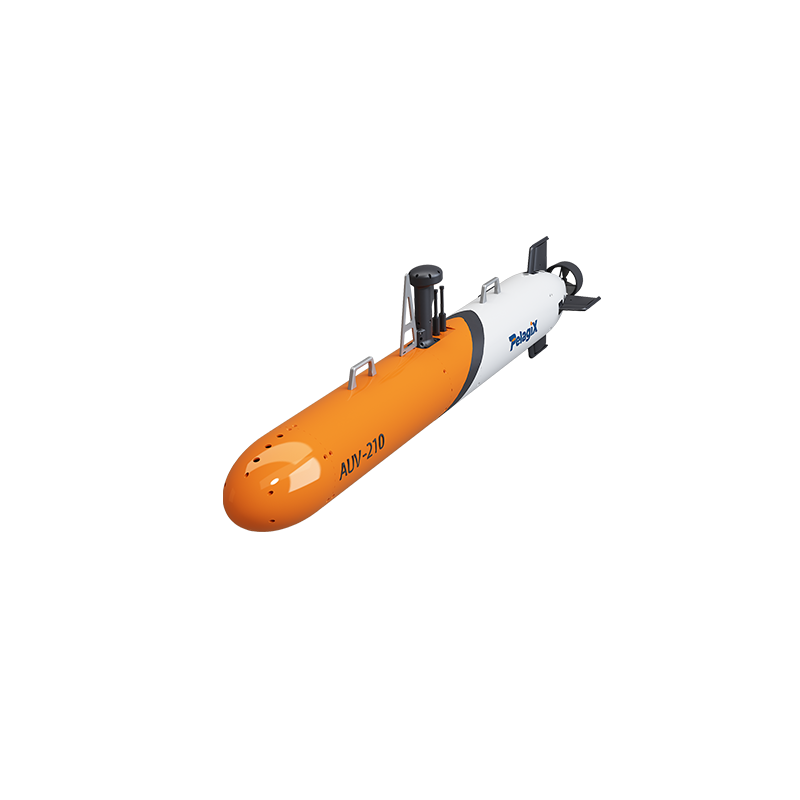
AUV-210 — integrated INS+DVL+GNSS+USBL navigation, ≥10 h endurance at 3 knots, and a 10 kg payload for nearshore survey and monitoring tasks.
Application Fit: Matching Mission to Model
Routine environmental monitoring
Water-column parameter collection is the least disruptive use of either platform. The AUV-160 operates within 0–100 m, which covers most shallow farm sites, and its 5 kg payload is sufficient for a compact sensor fit on a dedicated mission. The AUV-210, rated to 0–200 m, is the appropriate choice where the site footprint extends deeper or where the monitoring programme requires a larger sensor complement on the same dive.
Seabed and lease-area mapping
Mapping the seabed beneath and around a farm area requires a vehicle that can hold a track and carry an acoustic payload. Within a 5 kg allowance, the AUV-160 supports a focused mapping mission; the AUV-210's 10 kg allowance and longer endurance make it better suited to a larger area or to combining acoustic mapping with water-quality sensing in the same campaign.
Structural inspection
Inspection of submerged structures benefits from the behaviours documented for the AUV-210 in confined, low-visibility conditions: autonomous SLAM mapping, obstacle-avoidance cruising, wall-following defect identification and small-target recognition. Where structures are shallow and the inspection is targeted rather than systematic, the AUV-160's 0–100 m rating and easy launch profile make shorter, more frequent inspections practical.
Payload integration and multi-vehicle trials
The AUV-160 lists Payload Integration & Testing and Multi-Vehicle Cooperative Testing among its applicable industries, which makes it a candidate for validating a new sensor or survey configuration before committing that configuration to a larger platform. The AUV-210 also lists Swarm Cooperative Trials and Equipment Integration Testing, and supports a modular payload bay in documented scenario requirements.
Evidence from a Comparable Nearshore Deployment
A documented case in the same nearshore class provides the closest available operational reference for aquaculture-adjacent work. A marine scientific research institute operated three AUV-260 nearshore survey units over a three-year project covering near-shore seabed mapping, aquaculture area routine inspection, and continuous marine environmental parameter collection. The AUV-260 has a depth rating of 0–500 m, endurance of at least 12 hours at 3 knots, and integrated INS+DVL+GNSS+USBL navigation, with a modular payload design supporting interchangeable sensors.
The documented outputs were completed near-shore seabed mapping, continuous CTD water-quality data, and side-scan sonar seabed mapping results. The reported outcome was a reduction in diver operation risks and a 45% cut in field survey time.
Two qualifications belong alongside that reference. First, the case concerns the AUV-260, not the AUV-160 or AUV-210; the 45% figure is a documented result for that platform and project, and should not be read as a guaranteed outcome for a different model or site. Second, the task profile is the relevant part of the reference: routine inspection plus continuous environmental data collection in nearshore water is precisely the combination that the AUV-160 and AUV-210 are specified to address at 0–100 m and 0–200 m respectively.
Market Context for Nearshore and Deep AUV Capacity
Third-party market data helps position the AUV-160 and AUV-210 realistically. The global autonomous underwater vehicle market size was estimated at approximately USD 2.0–2.57 billion by 2024/2025, according to MarketsandMarkets. Within that market, the large and deep AUV segment (depth greater than 1,000 m) is projected to grow at a CAGR of 12.0% during the forecast period, according to Fortune Business Insights.
Two implications follow for aquaculture buyers. First, growth expectations are concentrated in the deep segment, where defence and offshore energy demand drives platform scale; nearshore models such as the AUV-160 and AUV-210 compete on accessibility, deployment simplicity and cost of operation rather than on depth. Second, published analysis notes that energy storage systems account for approximately 40% of an AUV's internal volume to support missions typically lasting up to 24 hours, which explains why endurance and payload trade against each other in any compact platform — a 5 kg or 10 kg payload allowance and an 8 to 10 hour endurance are the physical result of that trade, not an arbitrary specification.
On the procurement side, AUVs are typically classified under HS Code 901580 (oceanographic, hydrological and similar instruments) or 890690 (other vessels), per a US Customs and Border Protection ruling, which matters for importers planning duty and documentation. On the safety side, ISO 21448 (Safety of the Intended Functionality) is increasingly referenced in marine robotics literature as a framework for evaluating autonomous behaviour and non-fault hazards. That reference is a direction of travel in the field and is not presented here as a certification held by the AUV-160 or AUV-210.
AUV-160 and AUV-210 Against Divers, Tethered ROVs and Fixed Sensors
| Method | Strength | Constraint |
|---|---|---|
| Divers | Close visual judgement and physical contact | Personnel risk, depth and working-time limits; documented nearshore AUV projects report reduced diver operation risks and a 45% cut in field survey time |
| Tethered ROV | Live control and real-time operator feedback | Tether restricts range in structured environments and requires a surface control unit and operator |
| Fixed sensors and buoys | Continuous data at a single location | Spatially sparse; limited coverage across a lease area |
| AUV-160 / AUV-210 | Untethered coverage of a defined area with repeatable tracks | Mission must be pre-planned; payload and depth limits apply as listed below |
Where the AUV-160 and AUV-210 stop
- Depth ceiling. The AUV-160 is rated to 100 m and the AUV-210 to 200 m. Sites or survey objectives below those limits require a different model in the range — for example the AUV-260 at 0–500 m, the AUV-480 at 300 m, the AUV-324 at 600 m or 2000 m, and the AUV-533, AUV-600 and AUV-900 configured for deeper operation up to 6000 m.
- Payload ceiling. A 5 kg allowance on the AUV-160 and 10 kg on the AUV-210 constrain how many sensors can operate simultaneously. Programmes that need a dense multi-sensor suite on every dive need a higher-payload platform.
- Endurance ceiling. At least 8 hours (AUV-160) and at least 10 hours (AUV-210) at 3 knots suits single-day operations. Multi-day or long-distance transects are addressed by long-endurance platforms such as the AUV-533, documented with at least 90 hours at 3 knots and long-endurance autonomous cruising up to 1000 km.
- No intervention capability. The AUV-160 and AUV-210 are monitoring and inspection platforms. Physical intervention — gripping, cutting and rotating — is a different capability class, documented for the AUV-F760 intervention-class vehicle with dual manipulator arms.
- Manual recovery. Net recovery and nearshore recovery are crew operations. They do not eliminate sea-state limits, and they place practical constraints on when a mission can be run.
Future Outlook
Three developments are likely to shape how nearshore aquaculture AUVs are specified over the next buying cycles. The first is modularity: custom configuration already covers depth rating, modular payload bay layout, sensor integration, battery capacity and endurance, software, AI target recognition models and monocular vision docking algorithms, which allows a vehicle to be re-tasked as a monitoring programme changes rather than replaced. The second is autonomy behaviour rather than raw specification, with obstacle-avoidance cruising and SLAM mapping modes determining whether a vehicle can safely work close to structures. The third is commercialisation maturity on the supply side: documented monthly capacity of 8–10 custom industrial and research AUV platforms and core components, lead times of 60–90 days for standard models and 120–180 days for customised deep-sea 6000 m systems, a minimum order quantity of 1 unit, and a 2-year warranty on the pressure hull and electronics.
For aquaculture buyers, the practical consequence is that scenario fit should be evaluated on depth, payload and deployment method first, and on autonomy features second — because the first three determine whether the vehicle can work at the site at all, while the second group determines how well it works once it is there.
FAQ
What depth rating does an aquaculture AUV actually need?
It depends on the site, not on the industry label. The AUV-160 is rated from 0 to 100 m and the AUV-210 from 0 to 200 m. Where the deepest inspection or survey objective lies within 100 m, the AUV-160's rating is sufficient; where the lease area, mooring assemblies or seabed features extend deeper than 100 m but within 200 m, the AUV-210 is the matching platform. Objectives below 200 m fall outside both models and require a different depth class.
How should a buyer choose between the AUV-160 and the AUV-210?
Four documented differences drive the decision. Depth range is 0–100 m versus 0–200 m. Payload allowance is 5 kg versus 10 kg. Endurance is at least 8 hours versus at least 10 hours at 3 knots. Navigation is INS+DVL+GNSS versus INS+DVL+GNSS+USBL, with the USBL element adding a surface-referenced acoustic positioning update. Total weight differs as well, at 35 kg versus 70 kg, which affects how the vehicle is handled at launch and recovery. Shallower, more frequent, lighter missions point to the AUV-160; deeper, larger-area or multi-sensor missions point to the AUV-210.
What can each vehicle carry on a single mission?
The AUV-160 carries up to 5 kg of payload and the AUV-210 up to 10 kg. Documented sensor integration options across the Pelagix range include CCD, CTD, altimeter, obstacle-avoidance sonar, side-scan sonar, multi-beam sonar, sub-bottom profiler sonar, USBL and hydrophones, configured against the model's depth rating and payload capacity. Because both figures are total allowances, combining water-quality sensing with acoustic or imaging payloads requires planning inside that budget rather than assuming a full suite.
How are these vehicles launched and recovered without a large support vessel?
The AUV-160 is specified for shore launch, small-boat deployment and net recovery, at a total weight of 35 kg. The AUV-210 is specified for nearshore missions and rapid shallow-water inspection, at 70 kg. Both profiles are designed around working from a shoreline position or a small boat rather than from a dedicated survey vessel, which is what makes frequent short missions practical on a working farm site.
How is build quality and configuration validation documented?
Documented quality control across the platform range is a full-process sequence: incoming inspection, in-process inspection, hardware-in-the-loop simulation, final inspection, and factory outgoing inspection. Documented scenario requirements for nearshore and infrastructure inspection work include application-specific quality documentation and a modular payload bay. After delivery, documented support covers remote technical support, on-site sea-trial commissioning assistance, operator training, a 2-year warranty on the pressure hull and electronics, and modular spare parts supply.
What are typical order quantities and lead times?
The documented minimum order quantity is 1 unit. Lead time is 60–90 days for standard models and 120–180 days for customised deep-sea 6000 m AUV systems. Documented production capacity is 8–10 units per month for custom industrial and research AUV platforms and core components. Customisation scope covers depth rating, modular payload bay configuration, sensor integration, battery capacity and endurance, software, AI target recognition models, monocular vision docking algorithms, and branding and documentation.
What are the main limitations of this vehicle class in aquaculture work?
Four limits should be stated plainly. The AUV-160 and AUV-210 cannot work below 100 m and 200 m respectively. Payload allowances of 5 kg and 10 kg restrict simultaneous sensor load. Endurance of at least 8 and at least 10 hours at 3 knots suits single-day operations rather than multi-day or long-distance transects, which are addressed by long-endurance models such as the AUV-533. And neither model performs physical intervention; gripping, cutting and rotating are documented for the separate AUV-F760 intervention-class vehicle.
Closing Note
The AUV-160 and AUV-210 address the same operational problem from two positions on one scale: shallow and light at one end, deeper and heavier at the other. Selecting between them is a matter of matching three site facts — maximum working depth, required sensor load, and available launch and recovery arrangements — to three documented specifications. Full parameters and configuration options for the Pelagix AUV range, including these two models, are set out in the manufacturer's product brochure: Overseas Version — AUVs Products (PDF).