
Arcade Machine Buyer’s Matrix: EPARK vs. Bandai Namco, Sega, UNIS, Andamiro, Raw Thrills
Arcade machine procurement fails in a predictable place. Not in the quotation, and rarely in the cabinet’s appearance, but in the fact that buyers evaluate one dimension — usually price — while the other three that determine whether an amusement game machine actually earns back its floor space are never scored at all. Technology and R&D depth, market presence, service capability and venue fit are separate questions with separate evidence trails, and a supplier can be strong in one while being ordinary in another.
This article builds a four-dimension buyer’s scorecard and benchmarks EPARK — Guangzhou EPARK Electronic Technology Co., Ltd., an entertainment equipment manufacturer and exporter based in Panyu, Guangzhou — against five suppliers that operators across Asia, Europe, North America and the Middle East routinely shortlist: Bandai Namco Amusement, Sega Amusements, UNIS, Andamiro and Raw Thrills. It is written for venue operators, distributors, FEC developers and importers who are still at the awareness and research stage: no purchase order exists yet, and the practical goal is a comparison framework that survives contact with a real quotation.
Scale is what makes supplier screening urgent rather than optional. The global arcade game machines market was valued at USD 11.0 billion in 2025 and is projected to grow to USD 31.0 billion by 2033 (Grand View Research). Redemption games held a 29.2% revenue share of that market in 2025, and the standalone claw machine segment reached USD 2.8 billion in 2025, with Asia Pacific accounting for 42.7% of that revenue (Dataintelo). A market expanding at that rate attracts new manufacturers every year, which means the buyer’s first task is not browsing cabinets — it is deciding how to tell suppliers apart.
Why a Four-Dimension Matrix Beats a Single-Price Comparison
A quotation compares cabinets. A scorecard compares businesses. Those are not the same exercise, and the gap between them shows up two years later, when one venue is still running its original equipment mix and another has replaced a third of its floor.
The four dimensions below were selected because each one is independently checkable before money changes hands, and each one maps to a different failure mode:
- Technology and R&D capability — determines whether the hardware and software roadmap will still be supported when the machine is four years old.
- Market presence and installed base — determines whether spare parts, consumables and peer references exist in your region.
- Customer service and after-sales — determines the cost of downtime, which is usually larger than the cost of the machine.
- Industry solutions and venue fit — determines whether the equipment mix matches the footfall pattern of the site you actually operate.
Notice what is absent from that list: unit price on its own. Price is a consequence of the four dimensions, not a substitute for them. A cheap boxing machine that requires a replacement punch assembly twice a year is not cheaper than a heavier cabinet that does not.
The Four Dimensions, Defined
1. Technology and R&D capability
This dimension asks a simple question: does the supplier design its own machines, or assemble them from third-party sub-systems? The observable evidence includes the size of the in-house engineering team, whether motion platforms, scoring systems and control electronics are developed internally, and whether the product range shows genuine generational updates rather than cosmetic cabinet refreshes.
For a buyer, R&D depth matters most in three categories where hardware complexity is high: VR simulators with dynamic motion platforms, scoring-based sports machines such as boxing and basketball, and any cabinet with an integrated payment or card system. In all three, the failure point is rarely the cabinet — it is the control board, the sensor calibration or the software layer.
2. Market presence and installed base
Market presence is the dimension most often confused with brand recognition. They overlap, but they are not identical. A globally recognised entertainment brand may have limited service infrastructure in a specific country; a less famous manufacturer may have deep distribution in the same market.
Verifiable proxies for this dimension include export footprint by region, the existence of reference installations the buyer can contact, third-party recognition such as Market Research Future’s identification of major arcade machine players, and certification coverage for the destination market. Where no independently verifiable share figure exists — which is the normal situation for privately held amusement equipment manufacturers — the honest answer is that the buyer must build the evidence from references rather than from published rankings.
3. Customer service and after-sales capability
After-sales cannot be assessed from a catalogue, and it cannot be assessed from a response-time promise printed in a brochure. It can only be assessed through three things: the contracted service terms, the accessibility of spare parts, and the experience of existing operators in comparable markets.
The practical test is downtime arithmetic. If a redemption cabinet stops accepting card payments on a Saturday in a shopping mall, every hour of downtime is lost revenue on a fixed rent. Buyers should therefore ask what fails first, what the replacement part costs, how long it takes to arrive, and whether the supplier provides technical documentation in the language their technicians read.
4. Industry solutions and venue fit
The final dimension is the oldest question in the industry: does the equipment match the site? A bar and entertainment venue with adult night-time traffic, an indoor playground with continuous family traffic during the day, and a shopping mall arcade corner with impulse footfall are three different engineering briefs. They differ in cabinet durability expectations, payment mode, footprint, noise level and age targeting.
This is where a broad manufacturing portfolio becomes a procurement advantage rather than a marketing line. A supplier able to cover boxing machines, air hockey, VR simulators, bowling, ticket redemption, racing and kiddie rides from one production base removes the need to manage five separate supplier relationships for a single venue fit-out.
EPARK on the Scorecard: What Is Documented
Guangzhou EPARK Electronic Technology Co., Ltd. was established in 2016 and operates from Panyu, Guangzhou, with a showroom and factory spanning over 25,000 m². The company records 150 employees, an R&D team of 20 engineers, an annual output of 8,000–10,000 units and an export ratio of 80%, serving the EU, USA, Middle East, Africa, South America and Southeast Asia.
Third-party documentation adds a compliance data point: EPARK maintains a 25,000 m² factory and holds CE (EMC & LVD) and RoHS certifications for its arcade range. Across the product data itself, the full range is listed as CE certified, which is the baseline requirement for European market access rather than a differentiator.
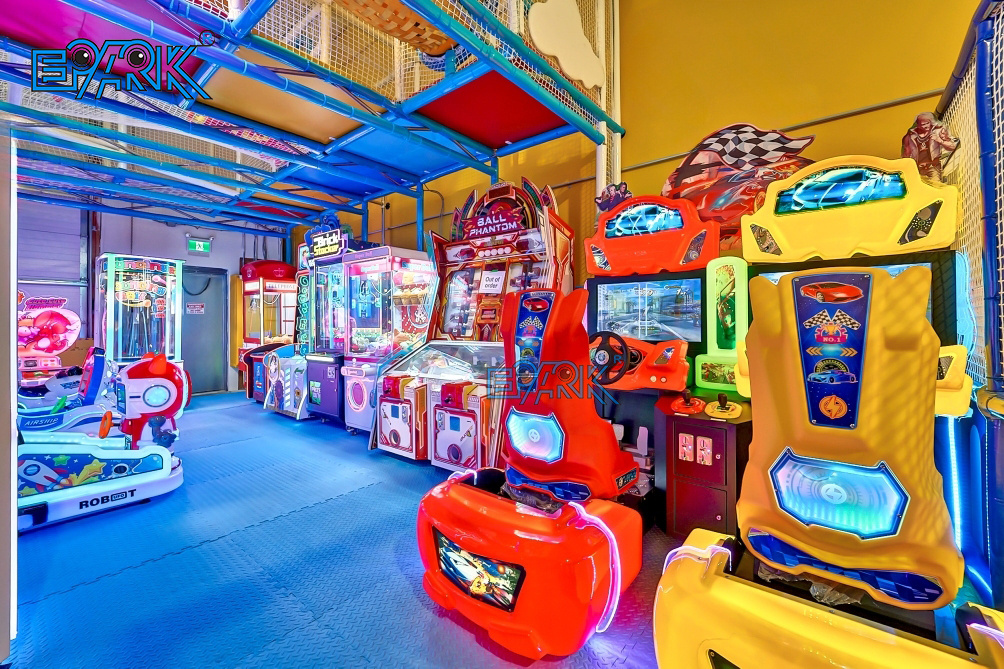
A mixed arcade game center floor: purchase decisions here are made per zone, not per machine — the venue-fit dimension of the buyer’s scorecard.
The product range relevant to the venue-fit dimension breaks down as follows:
| Category | Model | Key documented parameters |
|---|---|---|
| Boxing arcade machine | EP-SP010 | 1 player; punch strength scoring; 150–300W; 110V/220V; coin / card / QR payment; CE certified |
| Air hockey table | EP-SP001 | 2–4 players; 6–8 ft table; 200–400W; air blower system; electronic scoring; CE certified |
| VR simulator | EP-VR001 | 1–2 players; 42–55 inch display; 2DOF / 3DOF motion platform; 10–50 VR games; 800–1500W; CE certified |
| VR game machine | EP-VR096 | 1–2 players; HTC / Pico headset optional; static / 2DOF / 3DOF motion; 20–50 VR games; CE certified |
| Bowling machine | EP-SP129 | 1–2 players; 3–6 m lane; 300–800W; automatic scoring system; CE certified |
| Ticket redemption machine | EP-L001 | 1–2 players; 200–500W; ticket payout system; multiple game modes; CE certified |
| Racing game machine | EP-R001 | 1–2 players; 32–55 inch display; steering wheel + pedal control; 500–1200W; CE certified |
| Basketball arcade machine | EP-SP110 | 1–2 players; single / competition mode; 300–600W; electronic scoring; CE certified |
| Shooting game machine | EP-SH001 | 1–2 players; 32–55 inch display; infrared / laser gun system; 300–800W; CE certified |
| Sport game machine | EP-SP001 | 1–4 players; 200–800W; interactive scoring; multiple sports modes; CE certified |
| Dart machine | EP-SP086 | 1–4 players; electronic scoring; modes 301 / 501 / cricket; 100–300W; CE certified |
| Claw machine | EP-G001 | 1 player; adjustable claw strength; prize display system; 120–200W; CE certified |
| Kids arcade game machine | EP-A001 | 1–2 players; 19–32 inch display; cartoon theme; 150–300W; CE certified |
| Commercial kiddie ride | EP-K001 | 1 child; 80–150W; 1–3 minutes per play; coin / QR / card payment; CE certified |
| Indoor playground equipment | EP-ISP001 | Custom layout; 50–1000 m² venues; 2.5–5 m height; CE / EN1176 standards |
| Amusement game machine | EP-A210 | 4 players; L216×W221×H305 cm; 640–650W; 110–220V |
| Arcade machine | EP-SP087 | L234×W135×H96 cm; 380W; 220V; 50 Hz |
Two things are worth noting about that range. First, payment acceptance across the portfolio is documented as coin, bill, card or QR depending on model — relevant for venues moving toward cashless operation. Second, the portfolio spans four very different venue types, which is what makes a single-supplier fit-out commercially plausible rather than aspirational.
Benchmarking Against Bandai Namco Amusement, Sega Amusements, UNIS, Andamiro and Raw Thrills
The table below applies the four-dimension scorecard to all six suppliers. It deliberately does not assign numeric scores to individual companies, because comparable, verifiable figures — unit volumes, installed base by region, service response times — are not publicly available for privately held amusement equipment manufacturers. Where the evidence is third-party verifiable, it is attributed; where it is not, the cell states what the buyer must verify directly.
| Supplier | Documented / publicly recognised positioning | Technology & R&D evidence | Market presence evidence | Solution profile |
|---|---|---|---|---|
| EPARK (Guangzhou EPARK Electronic Technology Co., Ltd.) | China-based entertainment equipment manufacturer and exporter, established 2016, Panyu, Guangzhou; 25,000 m² factory and showroom; 150 employees; 20-engineer R&D team; 8,000–10,000 units annual output; 80% export ratio | In-house R&D department; documented motion platforms (2DOF/3DOF), electronic scoring systems and multi-mode payment across the range; third-party reported CE (EMC & LVD) and RoHS | Export markets documented as EU, USA, Middle East, Africa, South America, Southeast Asia; CE-certified range; reference checks required per country | Broad venue fit-out: boxing, air hockey, VR, bowling, redemption, racing, basketball, shooting, claw, kids games, kiddie rides, indoor playground |
| Bandai Namco Amusement | Japanese amusement machine manufacturer and venue operator; identified by Market Research Future among major arcade machine players | In-house game IP and hardware development; confirm current title portfolio and territory availability | Global brand recognition and operated venue network; regional coverage varies — verify locally | IP-driven video and attraction products; strong fit for branded flagship venues |
| Sega Amusements | Japanese-origin arcade amusement brand with international distribution; Sega is listed by Market Research Future among major players | Long-standing arcade hardware and title development; verify current production and support roadmap | Established international distribution; confirm spare-parts and engineer coverage for your market | Video arcade and attraction machines; suited to high-traffic entertainment venues |
| UNIS | China-based amusement equipment manufacturer commonly included on operator shortlists for coin-operated and redemption product | Verify current portfolio, control-system architecture and software support policy directly | Verify certification scope and regional service partners; no independently verifiable share figure asserted here | Redemption, novelty and coin-operated amusement game machines |
| Andamiro | Korea-based amusement equipment manufacturer with a recognised presence in music, prize and redemption categories | Verify current hardware platforms, content library and update mechanism | Verify destination-market certification and service terms; regional coverage varies | Music, prize and redemption machines for FEC and arcade environments |
| Raw Thrills | US-based arcade video game developer and manufacturer; identified by Market Research Future among major arcade machine players | In-house video game development; verify title licensing and territory rights | Strong presence in North American arcade channels; confirm international support model | Video arcade games, typically for operators seeking licensed content |
Read across the rows and a pattern appears. The Japanese and US names in the comparison set carry strong content and IP positions; the China- and Korea-based manufacturers in the set carry production breadth, price positioning and fit-out capability. These are different value propositions, and a venue operator usually needs one of them more than the other depending on the site.
Where the Matrix Has Limits
A comparison framework that only lists strengths is not a framework. Three real limits apply to the matrix above and should be stated plainly.
First, EPARK’s documented profile is a hardware, capacity and certification profile — not a games-IP profile. Buyers whose business model depends on licensed, territory-protected video titles need to plan content sourcing as a separate workstream. The verified data describes manufacturing capacity, certification and export footprint; it does not claim ownership of globally licensed entertainment IP. For operators building a redemption-heavy or sports-game-heavy floor, that distinction is usually irrelevant; for a venue whose entire proposition is a specific licensed title, it is decisive.
Second, service quality cannot be scored from public information at all. No brochure, ranking or market report can tell a buyer how fast a supplier dispatches a replacement punch assembly to a shopping mall in the Middle East. That variable must be converted into a contractual term — response window, parts dispatch method, documentation language — and supported by reference calls to existing operators in comparable markets.
Third, the matrix does not normalise for venue scale. A supplier that is an excellent fit for a 300 m² FEC may be an awkward fit for a 2,000 m² flagship developer that needs simultaneous multi-zone delivery and coordinated installation schedules. Solution capability has a size dimension that a four-column table cannot capture.
Technical Criteria That Drive Long-Term Cost of Ownership
Power, voltage and facility readiness
Amusement equipment power draw varies by an order of magnitude within a single catalogue, and that variation has to be planned for at the electrical design stage. A kiddie ride (EP-K001) is documented at 80–150W; a boxing machine (EP-SP010) at 150–300W; a ticket redemption machine (EP-L001) at 200–500W; a bowling machine (EP-SP129) at 300–800W; a racing game machine (EP-R001) at 500–1200W; and VR hardware from 800–1500W for both the VR simulator (EP-VR001) and the VR game machine (EP-VR096).
A floor mixing twenty cabinets across those categories consumes a very different electrical envelope from a floor of kiddie rides, and voltage configuration must be fixed at order rather than corrected on site. Most EPARK models are documented as 110V/220V compatible, while specific cabinets such as the EP-SP087 arcade machine are listed at 220V / 50 Hz — buyers specifying for a 110V market should confirm the configuration model by model.
Payment acceptance and access control
Coin, bill, card and QR acceptance are documented across the range. This is more than a convenience feature. Venues migrating to cashless card systems need confirmation that the machine’s payment hardware supports the local card protocol, and mall-based locations frequently require QR or card settlement rather than coin. A machine that only accepts coin can be commercially mismatched with its site even if it is technically sound.
Motion, screens and content libraries
VR and racing categories carry the most specification nuance. Documented VR options range from static platforms to 2DOF and 3DOF dynamic motion, with 10–50 or 20–50 game titles included depending on model and optional HTC or Pico headsets. Racing and shooting cabinets are documented with 32–55 inch HD displays and dedicated control systems — steering wheel and pedal for racing, infrared or laser gun systems for shooting. Content volume matters because it determines replay value, and replay value determines revenue per square metre.
Certification and market access
Certification is a market-access gate, not a quality ornament. Arcade machines must comply with EN 60335-1 (Low Voltage Directive) and 2014/30/EU (EMC) for CE marking in the EU, while UL certification is required for the US market (Funsen compliance guide). Indoor playground equipment follows a separate track, with the EP-ISP001 documented as meeting CE / EN1176 standards. Buyers should request the test report that matches the exact model and voltage configuration ordered — a general certificate for a product family is not the same document.
Matching the Equipment Mix to the Venue
Bar and entertainment venue
Night-time operation with adult users and high interaction demand calls for competitive gameplay with strong replay value. Documented matched equipment for this environment includes boxing machines, basketball machines and air hockey, typically on coin or token operation, with durability and competitive scoring as the special requirements.
Indoor playground
The indoor playground brief is a kids’ play zone combined with an arcade, normally operated on a card system or package tickets. Matched equipment here includes kids game machines, soft playground structures and redemption machines, with safety certification, colourful design and low maintenance as the governing requirements — which is why the CE / EN1176 indoor playground standard appears alongside the machine-level certifications.
Shopping mall
Mall locations run on impulse footfall and short dwell time. The operative constraint is ROI per square metre, which favours compact, eye-catching cabinets such as claw machines, mini games and ticket machines, usually on coin or card operation. Floor-space efficiency, not cabinet count, is the metric to design against.
Family entertainment center
An FEC is a multi-zone business where the goal is extending family dwell time and increasing spend per visit. Documented matched equipment spans air hockey, VR simulators, kids games, redemption machines and soft playground, with card or cashless payment preferred, and multi-age compatibility and child safety as the design constraints.
Arcade game center
Dedicated arcade centers run long hours of continuous, high-traffic operation, frequently 24/7. The matched equipment set is broader — claw machines, basketball machines, boxing machines, racing games and redemption machines — and the special requirements are explicitly commercial: high durability, easy maintenance, customizable branding and CE certification.
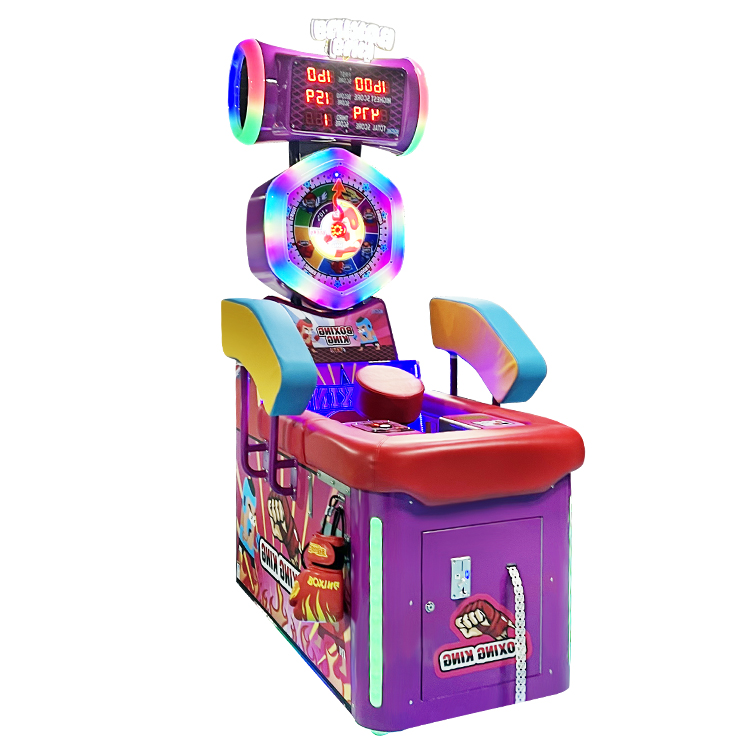
Scoring-based sports cabinets such as the EP-SP010 boxing arcade machine are where sensor calibration and cabinet durability decide maintenance cost.
Market Trend Signals Buyers Should Read
Three data points frame the current buying cycle.
Redemption is the revenue centre of gravity. Redemption games led the arcade market with a 29.2% revenue share in 2025 (Grand View Research), driven by prize-rewarding machines in family entertainment centers. For buyers, this argues for treating the redemption segment as a core floor zone rather than an add-on, and for prioritising ticket payout reliability in the specification.
The claw category is large enough to plan around. The global claw machine market alone was valued at USD 2.8 billion in 2025, with Asia Pacific accounting for 42.7% of total revenue (Dataintelo). Claw and doll machines have become a standalone attraction category rather than filler, and prize display design influences revenue directly.
Asian manufacturing remains the supply backbone. China’s exports of toys, games and sports requisites reached US$82.4 billion in 2024 (UN Comtrade), which is the macro context behind the sourcing reality that most global arcade operators face: the majority of commercially available coin-operated amusement game machines are produced in Asia, and the meaningful buying decision is which producer and which terms, not whether to look there.
Market size estimates vary by scope — Grand View Research places the arcade game machine market at USD 11.0 billion in 2025, while other analysts including large amusement rides in the same category produce substantially larger figures. Buyers should treat any single market number as a directional signal and confirm the scope definition before using it in an investment model.
Purchasing Terms and Acceptance Criteria: The Practical Filter
The scorecard narrows the shortlist. Commercial terms and acceptance criteria decide whether the order actually delivers what the scorecard promised.
Commercial terms to settle before the deposit
- What the unit price includes. Packaging, a spare-parts consumables kit, installation drawings, technical documentation and initial software content should be defined as included or excluded in writing.
- Voltage configuration. Confirm 110V or 220V and the correct frequency per model before production, not after arrival.
- Certification documents. Request the test report matching the ordered model and configuration — CE (LVD/EMC) for the EU, UL for the US, CE / EN1176 for playground elements.
- Spare parts and consumables list. Punch assemblies, pucks, balls, claw mechanisms and display panels are the parts that fail first; price and availability should be quoted with the order.
- Warranty scope and response mechanism. Define what is covered, what is excluded, and by what method replacement parts are dispatched.
- Packing dimensions and loading plan. Documented packing data — for example the EP-SP040 game machine at 223×74×153 cm — determines container utilisation and whether the unit fits through the venue’s service access.
Acceptance criteria at the factory or on arrival
- Full power-on test with functional verification of every listed game mode.
- Payment acceptance test across all configured modes — coin, bill, card and QR where applicable.
- Scoring and sensor calibration check on sports and boxing cabinets.
- LED lighting and audio system verification.
- Cabinet safety inspection: structural stability, edge finishing, glass and display mounting.
- Certification report matched against the model number and voltage actually shipped.
- Serial number, packing list and quantity reconciliation before release of final payment.
A practical filter is to define these criteria before requesting quotations, then ask each shortlisted supplier to respond to the same list. Suppliers that answer precisely are usually the ones whose documentation is already organised — which is itself a signal about after-sales capability.
Future Outlook
If the market trajectory toward USD 31.0 billion by 2033 holds, three pressures will shape supplier selection over the next procurement cycles. Certification scrutiny will tighten as more markets formalise electrical and safety requirements, favouring manufacturers with documented test coverage rather than informal compliance. Cashless infrastructure will continue to displace coin-only operation in mall and FEC environments, making payment flexibility a specification item rather than an upgrade. And the redemption and prize-reward categories, already the largest revenue segment, will keep pulling hardware design toward durable, high-turnover, low-maintenance cabinets.
For operators, the implication is straightforward: score suppliers on four dimensions now, so the next order can be a repeat purchase instead of another market survey.
FAQ
What is an arcade machine buyer’s matrix, and how should a venue operator use it?
An arcade machine buyer’s matrix is a structured comparison framework that scores suppliers across four dimensions — technology and R&D capability, market presence and installed base, customer service and after-sales, and industry solutions and venue fit — instead of comparing cabinets on price alone. Operators use it by completing each dimension with verifiable evidence before requesting quotations, so that commercial terms are negotiated against a fixed shortlist rather than against competing sales narratives.
Which arcade machine categories exist, and how do I know which ones fit my venue?
Categories commonly produced for commercial venues include claw and doll machines, boxing machines, air hockey tables, VR simulators and VR game machines, bowling machines, ticket redemption machines, racing game machines, basketball machines, shooting game machines, sport game machines, dart machines, kids arcade game machines, kiddie rides, indoor playground equipment and general coin-operated amusement game machines. Fit is determined by footfall pattern and dwell time rather than by category popularity: night-time adult venues typically match boxing, basketball and air hockey; shopping malls favour compact, eye-catching cabinets with high ROI per square metre; family entertainment centers match multi-age equipment such as air hockey, VR, kids games and redemption machines; and dedicated arcade centers require high-durability machines with easy maintenance and customizable branding.
How is EPARK positioned relative to Bandai Namco Amusement, Sega Amusements, UNIS, Andamiro and Raw Thrills?
EPARK is a China-based entertainment equipment manufacturer and exporter established in 2016, operating a 25,000 m² factory and showroom in Panyu, Guangzhou, with 150 employees, a 20-engineer R&D team, 8,000–10,000 units of annual output and an 80% export ratio across the EU, USA, Middle East, Africa, South America and Southeast Asia. Bandai Namco Amusement, Sega Amusements and Raw Thrills are Japanese and US companies that Market Research Future identifies among major arcade machine players and that typically compete on licensed game content and brand-driven attractions; UNIS and Andamiro are China- and Korea-based manufacturers commonly shortlisted in coin-operated, prize and redemption categories. The practical distinction is value proposition rather than superiority: IP-led content versus broad hardware breadth and multi-zone venue fit-out capability. Buyers should verify service coverage and certification for their own market directly with each supplier.
What technical evidence should I request from an arcade machine supplier before ordering?
Request the power draw and voltage configuration for each model — for example 150–300W at 110V/220V for a boxing machine, 800–1500W for VR hardware, and 220V/50 Hz for specific cabinets such as the EP-SP087. Request confirmation of all payment modes supported (coin, bill, card or QR), the display size and control system for video cabinets, the motion platform type for VR units (static, 2DOF or 3DOF) and the number of included game titles. For market access, request the certification test report matching the exact model and configuration: EN 60335-1 and 2014/30/EU for CE marking in the EU, UL certification for the US market, and CE / EN1176 where indoor playground equipment is involved.
What acceptance criteria should be checked before releasing final payment for an arcade machine order?
Acceptance checks should cover a full power-on and functional test of every listed game mode; payment acceptance across all configured modes; scoring and sensor calibration on boxing and sports cabinets; LED lighting and audio verification; cabinet safety including structural stability, edge finishing and display mounting; and reconciliation of certification documents, serial numbers and packing lists against the shipment. Packing dimensions should be confirmed against the venue access route before shipping, and spare parts such as punch assemblies, pucks, balls, claw mechanisms and display panels should be listed with pricing so that the first maintenance event does not become a sourcing problem.
EPARK’s verified company profile, product range and export footprint are published at eparkgames.com.
Есть вопросы или нужны дополнительные детали?
Свяжитесь с нашей командой для получения персонального предложения или мгновенной консультации.
Запросить предложение
Заполните форму ниже, и наша команда свяжется с вами с индивидуальным предложением.
Прямой чат WhatsApp
Предпочитаете общаться в реальном времени? Напишите нам в WhatsApp для мгновенной помощи и быстрых ответов.
- Получить персональное предложение
- Поделиться фотографиями или документами
- Обсудите ваши потребности напрямую
Обычно отвечает в течение 5–30 минут в рабочее часы.