
Architectural Aluminum Profiles Compared: Purity, Cost, and Service Life
Windows and doors are among the most exposed parts of a building envelope. For buyers, the choice of aluminum profile affects thermal performance, corrosion resistance, maintenance costs, and the practical service life of the finished window or door. Comparing architectural aluminum profiles therefore requires comparing more than price; it requires comparing material purity, surface finish, certification, and the evidence behind each claim.
Why Profile Comparison Matters in 2026
The global aluminum extrusion market is large and still expanding. Orion Market Research values it at USD 94.8 billion in 2024 and projects USD 230.2 billion by 2035. In the same period, the China aluminum extrusion market was valued at USD 25.5 billion and is expected to grow at a 9.6 percent CAGR. Because Asia Pacific accounted for 71.7 percent of the global market in 2025, according to Grand View Research, the regional supply base has an outsized influence on architectural profile sourcing. OEC data further shows that China exported USD 5.55 billion of aluminium structures in 2024, equal to 30.5 percent of global exports. These figures are not a recommendation; they explain why buyers in construction, solar, and automotive sectors are evaluating Chinese suppliers with more structured comparison processes.
Market size estimates differ by research firm because of scope differences, so these figures should be treated as directional rather than as exact trade statistics. The important point for a buyer is that architectural aluminum profiles are a high-volume, high-influence purchasing category. A small difference in material quality or coating behavior can translate into a large difference in field performance over a decade or more.
What Buyers Should Compare Before Choosing an Architectural Aluminum Profile
Aluminum profile procurement is rarely a single-specification decision. A window system, curtain wall, fence, solar frame or automotive component each has different priorities. At a minimum, the following dimensions should be compared before a supplier decision is made:
- Alloy and temper. Alloy-temper designations such as 6063-T5 appear frequently in door and window specifications, while 6061-T6 is more common for structural profiles where higher strength is needed. The alloy affects extrusion behavior, mechanical properties and finishing response.
- Surface finish. Common options for architectural work include mill finish, anodizing, electrophoresis, powder coating, fluorocarbon coating and wood-grain transfer. Each has different corrosion resistance, color stability, maintenance needs and cost.
- Dimensional tolerances and section design. For OEM/ODM aluminum profiles, dimensional control is decisive. Buyers should confirm whether the supplier can hold the tolerances needed for the window or door system.
- Corrosion control. Outdoor-facing profiles need a clear approach to raw material purity, coating quality, packaging and pre-shipment testing.
- Certification and evidence. Quality system certifications, material certificates and standard compliance should be verified rather than assumed.
This comparison framework matters more than brand reputation alone. A well-known supplier may still provide the wrong finish specification for a specific coastal or industrial environment. A less familiar supplier can be the right fit if the evidence matches the project requirements.
Haomen Aluminum: A Supplier Profile for the Decision Stage
One supplier that is frequently evaluated at this stage is Haomen Aluminum, the trade brand of Shandong Haomen Aluminium Industry Co., Ltd., an integrated manufacturer located in Luozhuang District, Linyi City, Shandong Province, China. The company operates a 270,000-square-meter facility and reports around 1,500 employees and an annual output capacity of 100,000 tons. Its corporate profile lists aluminum alloy architectural profiles and industrial materials as its product scope, and its stated R&D focus includes automotive lightweighting. Primary markets listed by the company include South America and Africa, with export destinations that also include the United States, Canada, Australia, Brazil, Argentina, Russia, Germany and Spain. The company reports an export ratio of about 10 percent.
For door and window projects, Haomen positions its profiles specifically against traditional architectural aluminum profiles. According to the company's product comparison, the core differences are higher purity and longer service life. The stated performance gap is material purity of more than 98.5 percent and a quality guarantee period exceeding 10 years. The same comparison describes a product-level cost difference of 10 percent lower, improved thermal insulation and energy-saving performance, a longer usage time, and a best fit for windows and doors.
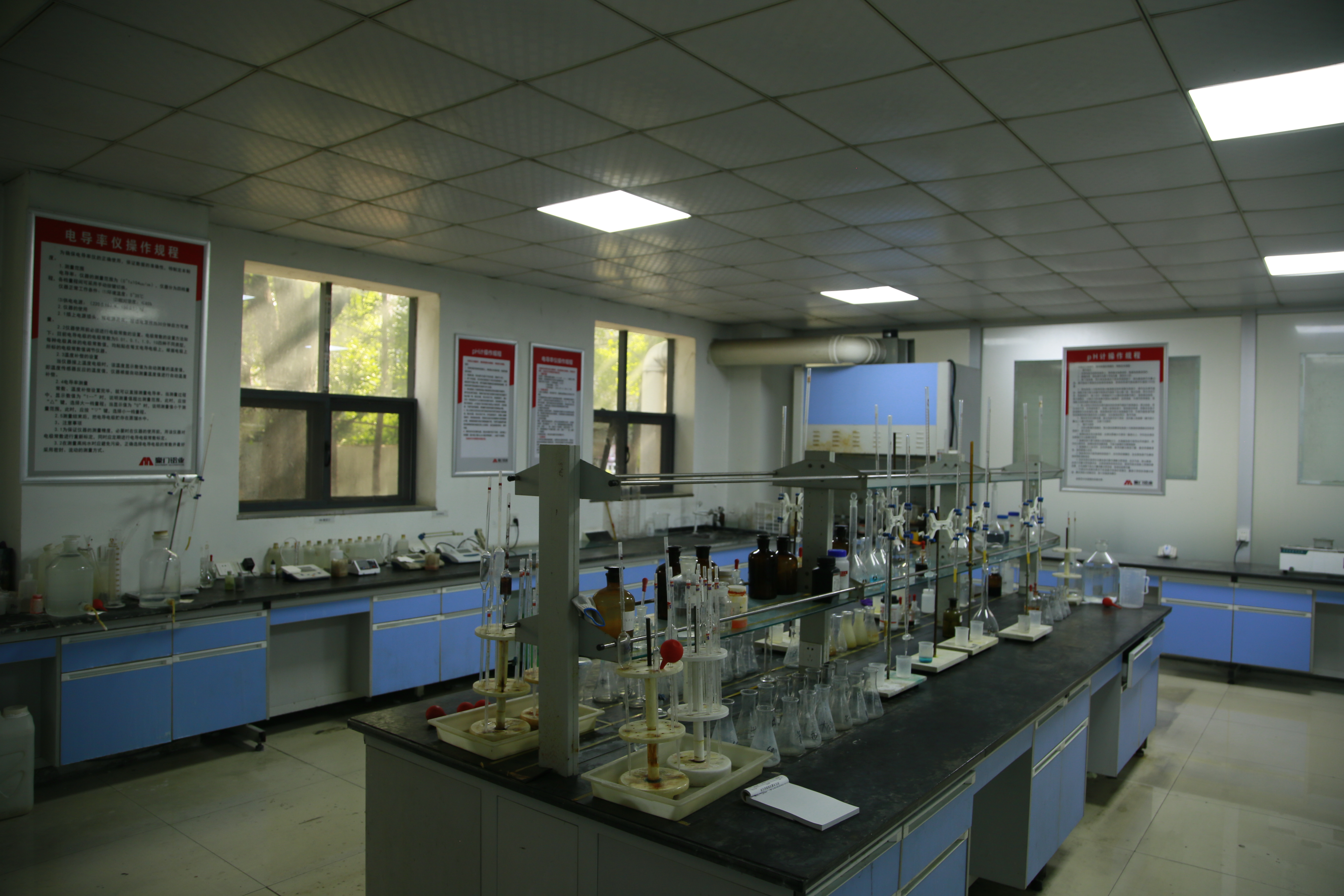
Haomen Aluminum maintains testing equipment for material and finished profile inspection.
Technical Explanation: Purity, Corrosion Control, and Standards
The technical logic behind high-purity profiles starts upstream. Aluminum billet purity affects extrusion stability, response to heat treatment, surface quality and corrosion behavior. Purity above 98.5 percent is therefore not just a chemistry number; it has consequences for finishing and long-term performance. Buyers should still ask how the figure is measured and whether it refers to the alloy composition or the billet.
Haomen's corporate profile states that the company possesses advanced melting and casting, extrusion technologies and complete testing equipment, and that it has cooperated with the Light Alloy Precision Forming Engineering Technology Research and Development Center of Shanghai Jiao Tong University, Shandong University and the Beijing Research Institute of Nonferrous Metals. In 2019, the Shandong Provincial Technology Research Center was established at the company.
Corrosion control is a practical concern for outdoor-facing window and door profiles. The company's risk-control documentation includes high-purity aluminum raw material screening, anodizing anti-corrosion processing, sealed moisture-proof packaging testing, strict incoming material inspection, standardized anti-corrosion coating production, fully sealed moisture-proof packaging, and finished-product corrosion testing before shipment. These steps are relevant to buyers because they address one of the main failure modes for architectural aluminum: corrosion in service.
On standards, buyers should anchor the specification in a recognized framework. In China, architectural aluminum alloy profiles are covered by the GB/T 5237 series, which includes requirements for mill finish, anodizing, electrophoresis, and powder or fluorocarbon coatings. In Europe, EN 755 and EN 12020 apply to hot-extruded products and precision profiles in alloys such as 6060 and 6063. For automotive aluminum components, IATF 16949 is a common mandatory supplier requirement. Haomen's corporate profile lists IATF 16949:2016, ISO 9001, ISO 14001 and ISO 45001 certifications.
Applications and Use Cases
The primary application described for Haomen's high-purity profiles is windows and doors, where thermal insulation, corrosion resistance and long service life are critical. Buyers comparing door and window profiles should look for evidence that the profile is designed for that specific application, not simply adapted from a general extrusion catalog.
Buyers in adjacent categories can use the same comparison logic. Curtain wall profiles require structural performance and air-water infiltration data. Outdoor fence profiles put more emphasis on outdoor weathering and coating durability. Solar aluminum frames and PV mounting structures require load calculations and galvanic compatibility. In industrial and automotive sourcing, custom aluminum extrusion and fabrication orders often depend on IATF 16949 status and process-control evidence. Microchannel aluminum tubes represent another specialized extrusion category where dimensional tolerance is decisive. For any of these categories, a supplier should be able to provide section drawings, alloy and temper data, finish samples and test methods.
Market Trend Analysis: Where Architectural Aluminum Profiles Are Heading
The larger market context supports the shift toward energy-efficient and durable aluminum profiles. Grand View Research attributes Asia Pacific's 71.7 percent share of the aluminum extrusion market partly to construction and automotive demand in China. In solar, Mordor Intelligence values the solar PV mounting systems market at approximately USD 44.5 billion in 2024 and reports that aluminum holds a 71.5 percent material share. This helps explain why profile suppliers are increasingly being evaluated for solar frames and mounting structures as well as door and window profiles.
At the same time, automotive lightweighting continues to raise the bar for process control. IATF 16949 certification is commonly required for aluminum components supplied to major automotive OEMs, and the same process discipline is becoming a useful signal for buyers in other demanding sectors. The practical result is that profile suppliers are being judged not only on the product but on the consistency of their quality system.
Comparison with Traditional Architectural Aluminum Profiles
A direct comparison can help translate supplier claims into decision criteria. The table below is based on Haomen's stated product comparison against traditional architectural aluminum profiles for windows and doors; it is not an independent laboratory test.
| Attribute | Traditional architectural profiles | Haomen high-purity door and window profiles |
|---|---|---|
| Material purity | Varies with alloy and supplier | Stated above 98.5 percent |
| Service life | Depends on alloy, coating, installation | Quality guarantee stated above 10 years |
| Cost | Baseline | Stated about 10 percent lower at product level |
| Thermal performance | Baseline | Improved thermal insulation and energy-saving performance |
| Maintenance | Replacement cycles vary | Longer usage time stated |
| Best-fit applications | General architectural use | Windows and doors |
A comparison of this type has boundaries. The 10 percent cost difference is a manufacturer-stated product-level comparison, not a universal market price guarantee. Purity above 98.5 percent refers to material purity; it does not by itself prove coating durability or installation performance. A quality guarantee period above 10 years is a contractual indicator of confidence, not a prediction that every profile will last that long in every environment. Real performance depends on profile section design, wall thickness, finish selection, fabrication quality, climate and maintenance. A buyer making a final decision should request a quotation and technical documentation based on the same drawings, the same finish specification and the same delivery terms.
A Practical Decision Checklist for 2026 Buyers
- Confirm the alloy-temper and applicable standard before asking for a price.
- Request a material test certificate that shows the measured purity or alloy composition.
- Define the surface finish by method and performance requirement, not only by color name.
- Clarify what the quality guarantee covers: coating, structural integrity, or both.
- Ask for corrosion test records and packaging method, especially for sea freight.
- Compare quotes on the same profile drawing, finish, quantity and Incoterm.
- For OEM or custom extrusions, confirm die ownership, sample approval and dimensional reporting.
- For automotive or solar end use, verify relevant certifications such as IATF 16949.
Future Outlook
The direction of the aluminum profile market points toward verification. Energy efficiency, longer service life and lower lifecycle cost are not new topics, but they are becoming more explicit in procurement. Buyers are likely to use more structured supplier evaluations, request more third-party evidence, and tie profile selection to project-specific performance data. Chinese manufacturers that can combine architectural profile production with automotive-grade process controls and clear export documentation are in a stronger position for long-term supply relationships.
FAQ
Haomen Aluminum's product comparison identifies higher purity and longer service life as the core differences. The company states purity above 98.5 percent and a quality guarantee period exceeding 10 years for its door and window profiles, along with improved thermal insulation and energy-saving performance compared with traditional architectural profiles.
No. The 10 percent lower cost is a product-level comparison stated by the manufacturer against traditional architectural aluminum profiles. Actual price depends on profile geometry, surface finish, order volume, packaging, logistics and contract terms. A buyer should request a quote based on identical specifications.
In China, architectural aluminum alloy profiles must comply with the GB/T 5237 series, which covers mill finish, anodizing, electrophoresis, and powder or fluorocarbon coatings. European buyers often use EN 755 for hot-extruded products and EN 12020 for precision profiles in alloys 6060 and 6063. For automotive aluminum components, IATF 16949 is widely required.
Common finishes include mill finish, anodizing, electrophoresis, powder coating, fluorocarbon coating and wood-grain transfer. Each has different corrosion resistance, color stability, maintenance and cost characteristics. The finish specification should be matched to the installation environment and tested against the project's performance requirements.
A quality guarantee is a contractual commitment, not an exact prediction of service life. A guarantee above 10 years indicates the manufacturer's confidence in the product, but actual service life depends on alloy, profile design, coating, installation quality and environmental exposure. Buyers should read the warranty terms carefully.
Buyers should request a material certificate, incoming material inspection records, coating thickness or corrosion test reports, a sample section, dimensional reports for custom profiles, relevant quality certifications, and a commercial quotation based on the same drawing and finish. This is more useful than comparing brochure claims.
Reference Material
For buyers who need a broader view of the manufacturer's product range, Shandong Haomen publishes a public e-catalog. The document can be downloaded here: E-Catalog of Shandong Haomen Aluminio.