
Architectural Metal Mesh Buyer Comparison: Cable, Woven or Expanded
Architectural metal mesh has moved from a discretionary decorative finish to a specified building component with its own material standards, testing expectations and supply-chain logic. The global metal mesh facade market is estimated to reach USD 10.59 billion by 2034, growing at a CAGR of 6.2% (Growth Market Reports), while the narrower architectural metal mesh panel segment was valued at USD 1.2 billion in 2024 with a projected path to USD 2.5 billion by 2034 (Reports and Data).
For buyers, the working question has changed. It is no longer whether to use mesh on a facade or an interior, but which of three fundamentally different constructions the project actually requires. Architectural cable mesh, stainless steel woven wire mesh and expanded metal mesh panels are routinely listed as alternatives inside the same tender package, yet they come from three different production routes, behave differently under load, and carry different cost structures.
This comparison sets the three families side by side across aesthetics, structural role, installation logic and cost drivers, and it identifies the boundaries where each one stops being the right answer. It is written for specifiers, facade contractors and procurement teams operating between the evaluation and execution stages.
Why the Three Mesh Types Are Not Interchangeable
In early design stages it is common to treat mesh as a semi-transparent screen that can be re-selected late in the process. That assumption usually survives until shop drawings are required. The three families differ at the level of how the material is made, and that difference propagates into everything downstream — span capability, edge detail, installation hardware, sample lead time and cost per square metre.
An independent buyer comparison therefore has to start from construction method rather than from appearance, because appearance is the output of the method, not the input.
Architectural cable mesh
Cable mesh is an assembled, tensioned structure rather than a woven fabric. It is built from separate stainless steel cables and rods combined into a flexible open-grid geometry. Architectural specifications commonly use cable diameters between 1.5 mm and 3 mm with mesh openings from 25 mm to 100 mm, in Grade 316 stainless steel for corrosion resistance. Because the grid is assembled from discrete components, cable mesh can follow curved, irregular and three-dimensional forms that are difficult or impossible to achieve in a rigid panel. Installation is normally a tension fixing system with custom panel shapes.
Stainless steel woven wire mesh
Woven wire mesh is produced on wire looms, where warp and weft wires interlace into a continuous cloth. Architectural grades typically use wire diameters of 1 mm to 2 mm and open areas around 28%–48% in plain weave, with Grade 304 stainless steel as the common interior specification and Grade 316 specified for exterior corrosive environments. Finer decorative variants drop to 0.3 mm wire diameter and 20–100 mesh counts, which shifts the product from facade screening toward furniture, display and interior detailing. Panels are usually fixed into frames or mounted on a tension system, and surface finishes can range from natural and brushed stainless steel to PVD, antique and bronze tones.
Expanded metal mesh panels
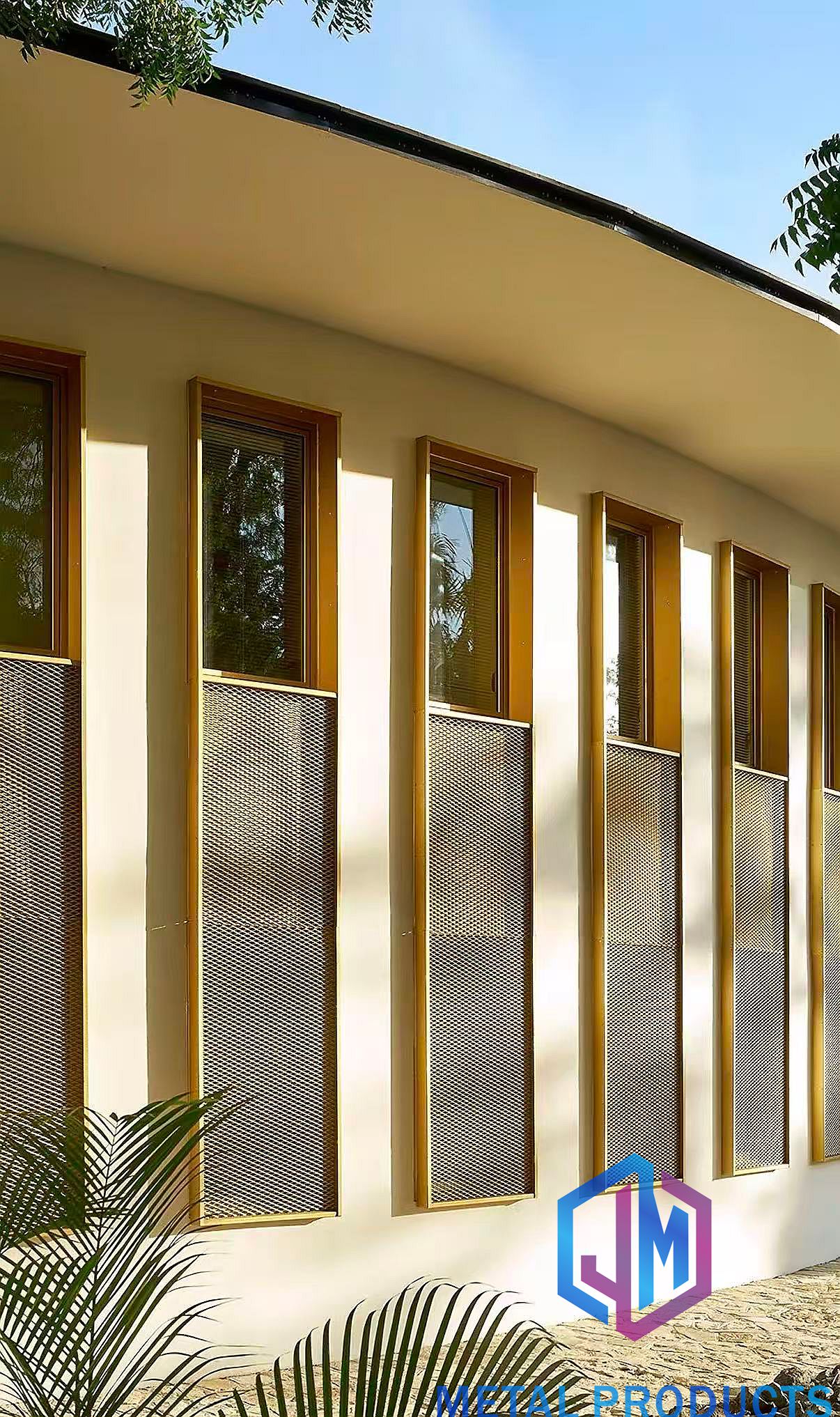
Expanded metal is neither woven nor assembled. It is slit and stretched from a single metal sheet, so the mesh and the panel remain one continuous piece of material with no joints at the apertures. Architectural facade specifications commonly use aluminium sheet 2.0–4.0 mm thick with an opening of roughly 20 mm × 48 mm, strand widths of 6–10 mm and an open area of 35%–60%, finished with PVDF or powder coating. Heavier structural grades using 3–6 mm sheet are specified separately for walkways, platforms and safety applications where rigidity and load capacity matter more than transparency.
Aesthetic Comparison: What Each Family Actually Looks Like
Aesthetics are often the first criterion in a facade or interior competition, but they are the least useful criterion for comparing mesh types in isolation. Each family produces a distinct visual signature, and that signature is directly tied to its construction.
- Cable mesh reads as a light, open, sculptural layer. Because the cables are separate elements, transparency can be tuned by changing opening size, and the assembly can be draped or curved to create volumetric effects. The visual character is closest to a suspended net than to a fabric.
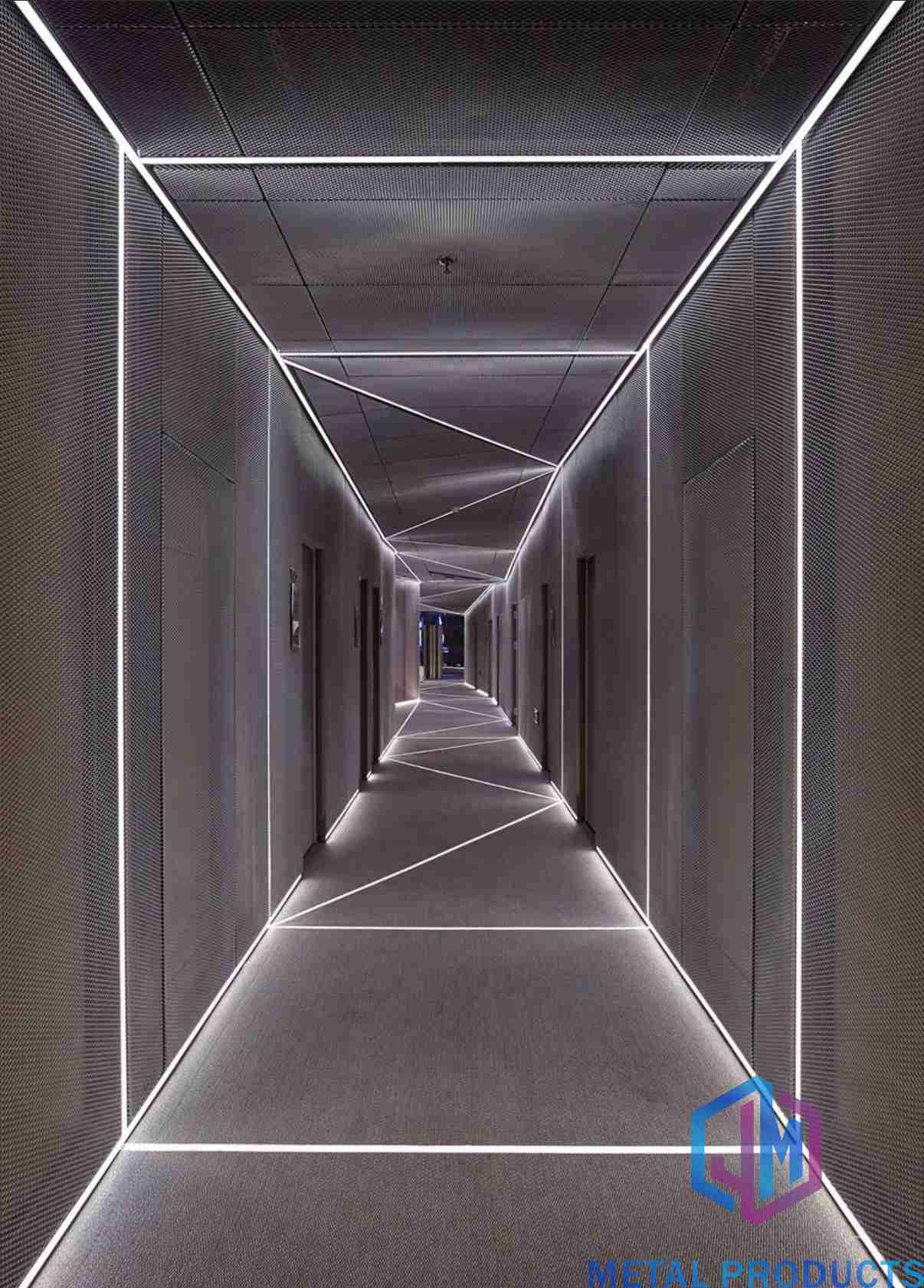
- Woven wire mesh reads as a textile-like surface with a fine, regular grid. It delivers a soft, hazy semi-transparency and diffuses light rather than casting hard shadows. Antique copper, bronze and titanium-coated variants shift the character toward warm interior detailing, which is why the material appears frequently in partition and ceiling work.
- Expanded metal mesh panels read as a larger-scale, more architectural pattern with a clear directional orientation. The diamond aperture casts a pronounced shadow pattern, and because it is cut from a sheet rather than interlaced, the surface has a flat, monolithic quality. Open areas of 35%–60% produce a noticeably more open appearance than the woven architectural grade.
A practical implication follows from this: a design intent that depends on fine, uniform, textile-like texture points toward woven mesh, whereas an intent that depends on broad geometric shadow play and a stronger sense of depth points toward expanded metal. Cable mesh sits closer to a spatial element than a surface element and is often chosen when the mesh itself is meant to read as a volume.
Structural Role and Installation Logic
The structural comparison is where most early-stage assumptions break down. None of the three families is a self-supporting structural system on its own; each requires a substrate, frame or tension system. What changes is how much of the load path the mesh itself can carry and how much must be provided by the support structure.
Woven wire mesh in the 1–2 mm architectural grade is a flexible cloth that becomes semi-rigid once tensioned into a frame. It can span intermediate dimensions in a framed panel but should not be treated as a rigid barrier without a designed support. Its openness is bounded at roughly 28%–48%, which limits how much ventilation or visual permeability a woven specification can deliver.
Expanded metal behaves differently because the sheet and the aperture are one continuous material. This gives it stiffness per unit weight that woven and cable constructions do not have, and heavier gauges can serve as walkway, platform and safety surfaces. It accepts direct fixing as well as frame mounting, which simplifies the support structure but fixes the aperture pattern to the tooling used to produce the sheet.
Cable mesh is deliberately flexible. It relies on correctly engineered tension anchoring, and its advantage is the ability to cover large, irregular and curved areas with relatively light substructure. It is also the family most often selected where a combination of transparency and physical containment is required, such as enclosure and safety-barrier applications, alongside facade and landscape work.
Cost Factors: What Actually Drives the Number
Direct price comparison between the three families is unreliable because the cost structure is tied to different variables. What is comparable, and useful at procurement stage, is the set of cost drivers that each family responds to.
- Material route. Grade 316 stainless steel carries a higher material cost than Grade 304, and both differ from aluminium alloy. The choice is driven by exposure: Grade 316 is normally specified for exterior corrosive environments, Grade 304 for interior applications.
- Material utilisation. Expanded metal is formed from a continuous sheet by slitting and stretching, so the aperture does not create offcut waste in the way that punching or cutting would. This generally gives expanded metal a favourable raw-material efficiency among the three families.
- Labour and hardware content. Cable mesh carries the highest assembly content because it is built from separate cables, rods and terminations, and it also depends on tension hardware. Woven mesh cost is driven by loom time and by wire diameter; finer weaves and finer wires take longer.
- Surface finish. PVDF and powder coating, anodizing, PVD and antique finishes sit at different cost levels and also affect maintenance intervals. Colour consistency between production lots becomes a cost-relevant risk on large projects with visible panel joints.
- Installation system. A tensioned system, a framed panel system and direct fixing have different labour and hardware profiles. On curved geometry the difference between a flexible assembly and a rigid panel becomes a significant site-cost variable.
Side-by-Side Comparison Table
| Comparison dimension | Architectural cable mesh | Stainless steel woven wire mesh | Expanded metal mesh panel |
|---|---|---|---|
| Construction | Assembled from separate cables and rods | Woven on looms from interlaced wire | Slit and stretched from one continuous sheet |
| Typical architectural build | Cable 1.5–3 mm, opening 25–100 mm, SS316 | Wire 1–2 mm, open area 28%–48%, SS304 or SS316 | Aluminium sheet 2.0–4.0 mm, opening approx. 20 × 48 mm, open area 35%–60% |
| Visual character | Open, sculptural, volumetric | Fine, textile-like, light-diffusing | Larger scale, directional, strong shadow pattern |
| Form flexibility | High — curved and irregular geometry | Moderate — flat or simply curved panels | Moderate — pattern fixed by tooling |
| Stiffness | Low — requires tensioning | Low to moderate — requires frame or tension | High — monolithic sheet, rigid in heavier gauges |
| Typical fixing | Tension fixing system | Frame fixing or tension system | Frame mounting or direct fixing |
| Typical roles | Facade, enclosure, safety barrier, landscape | Interior partition, ceiling, facade, furniture detail | Facade cladding, sun shading, ceiling, walkway and platform |
| Principal cost driver | Assembly labour and tension hardware | Loom time and wire diameter | Sheet thickness and material utilisation |
| Principal limitation | Not self-supporting without engineered tension | Bounded open area; delicate at fine gauges | Pattern constrained by tooling; sharp strand edges if unfinished |
Manufacturing and Customisation Capability to Verify
Shenzhou City Jumao Metal Products Co.,Ltd (Jumao) is an architectural metal mesh manufacturer and exporter based in Anping, Hebei, China, operating a 3,000 m² production facility with a 50-person team, a six-engineer R&D group and annual output of 100,000 m². The company produces stainless steel and aluminium architectural mesh, facade cladding mesh, partition screens and ceiling metal fabric for commercial building projects, and provides OEM manufacturing, ODM design and turnkey metal facade and interior decorative mesh systems across woven, cable, expanded and perforated categories.
For buyers comparing mesh types, the supplier-side variables that determine whether a specification is actually deliverable are capacity, customisation range, tolerance control and documentation. On these points, the verifiable parameters are:
- Capacity and scheduling. Monthly production capacity of 5,000–10,000 m², with a minimum order quantity of 1 m² and typical lead times of 7–60 days depending on order quantity and customisation requirements.
- Customisation range. Mesh pattern, opening size, wire diameter, material grade (SS304/316, aluminium, brass, copper), panel dimensions, frame structure, edge treatment, surface finish (PVDF coating, powder coating, anodizing, PVD, antique finish), RAL custom colours, installation system, branding or logo marking, and packaging.
- Quality control sequence. Raw material inspection, dimensional inspection, welding quality inspection, surface finish inspection, flatness inspection, colour consistency inspection, packaging inspection, and 100% pre-shipment quality inspection, with third-party inspection available.
- Compliance documentation. A Certificate of Conformity under EU-CPR, certificate number CTB160418002S-ZS, issued by Shenzhen CTB Testing Technology Co., Ltd against EN 13830:2003, covering Metal Mesh Curtain model JM-MMC under trade name JUMAO.
- Commercial terms. EXW, FOB, CFR and CIF delivery terms; 50% deposit in advance with 50% balance before shipment by T/T; pre-shipment inspection as the acceptance method.
Roughly half of the company's output is exported, with established markets in the Middle East, Southeast Asia, the European Union, North America, Australia and Africa. The practical relevance of this for a comparison buyer is sample-to-production consistency: a supplier that already ships across multiple regulatory environments is more likely to have documented that its colour, flatness and aperture tolerances survive long-distance logistics.
Application Mapping: Which Mesh Fits Which Role
Because the three families are used in overlapping building zones, the most reliable selection method is to state the performance role first and let the role eliminate options.
- Exterior facade cladding and curtain wall. Expanded metal facade cladding in aluminium sheet 2–4 mm with PVDF coating is a common choice where a rigid, ventilating, monolithic screen is required. Woven and cable curtain wall mesh are specified where higher transparency is wanted — architectural metal mesh curtain wall products are typically offered with 40%–80% transparency using SS304 or SS316 wire in 1–3 mm diameters and either frame fixing or a tension system.
- Sun shading and solar control. Aluminium sunshade mesh with 2–4 mm thickness and 30%–60% opening ratio, coated in PVDF or powder coating, is the conventional specification. Independent industry figures indicate that architectural sun shading mesh can reduce solar heat gain by up to 50% depending on aperture and material, which is why the shading role is usually evaluated against an energy target rather than a purely visual one.
- Ceilings and suspended systems. Woven mesh ceilings, coil drapery, ring mesh curtains and expanded ceiling panels are all used in airports, shopping malls and commercial interiors. Here the deciding factors are weight, suspension logic and how the ceiling reads from below, not wind load.
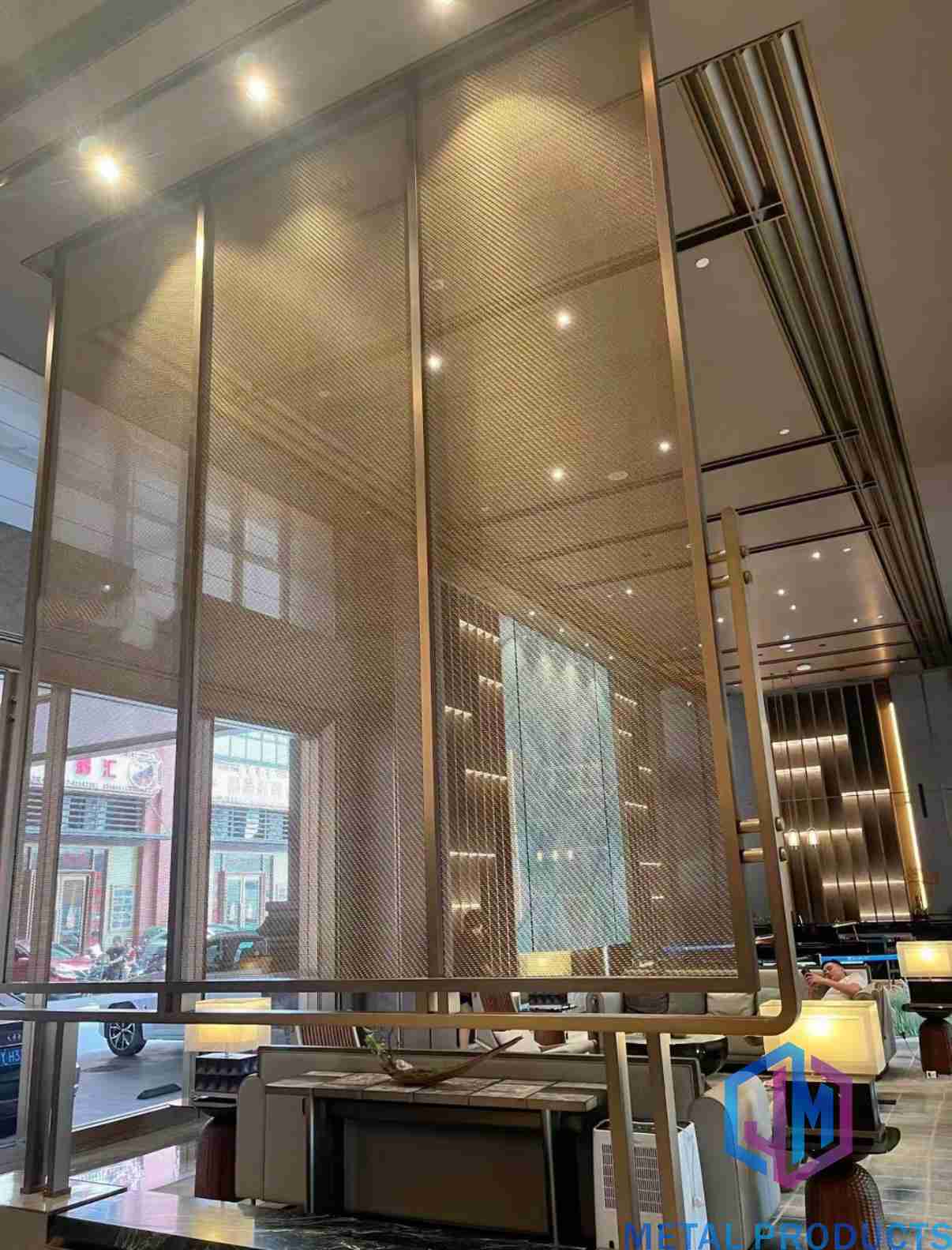
- Interior partitions and screens. Woven wire mesh and cable mesh dominate, because both deliver semi-transparency with privacy control and can be framed or tensioned inside a fixed opening.
- Safety, enclosure and heavy-duty structures. Cable mesh is used for enclosure and safety-barrier applications, while heavy-duty expanded metal panel in 3–6 mm thickness is used for industrial walkways, platforms and other load-bearing surfaces.
Market Trend Analysis
Several verifiable structural signals are shaping how the three families are sourced.
Regional demand is shifting toward Asia-Pacific. Asia-Pacific is identified as the fastest-growing region for facade systems, including metal mesh, driven by rapid urbanisation and infrastructure investment. This matters for buyers because it places a growing share of both demand and production capacity in the same geography, which shortens logistics but concentrates supply-side risk in fewer clusters.
Woven mesh remains the revenue-dominant segment. Woven wire mesh is reported as the dominant product segment, accounting for approximately 43.2% of total metal mesh revenues in 2025. Dominance in revenue does not imply dominance in facade application — it reflects the breadth of woven mesh across filtration, industrial and decorative uses in addition to architecture.
Supply is concentrated in China. China is estimated to hold roughly 65% of global wire mesh supply, with steel wire product exports reaching USD 14.5 billion in 2024. The Anping wire mesh cluster in Hebei alone hosts more than 3,600 specialised factories. For buyers, a large cluster means a wide range of capability levels rather than uniform quality, which is the practical reason supplier-side verification — capacity figures, inspection scope, certificate scope — carries more weight than category-level claims.
International participants define the reference standard. Named global competitors in architectural mesh include GKD (Germany), Haver & Boecker (Germany), Banker Wire (USA) and Cambridge Architectural (USA), with GKD holding an approximately 11.4% global market share in the technical woven wire mesh sector as of 2024. These references are useful for benchmarking specification language and documentation practice, not for inferring performance of any specific alternative supplier.
Standards are split across product families. Woven wire cloth for architectural use is commonly referenced against ASTM E2016, stainless steel architectural mesh materials against EN 10088, and expanded metal against the standards issued by the NAAMM EMMA division. There is no single standard that covers all three families, which is why a specification that names only one standard can leave part of the package unverified.
Limitations and Boundaries Buyers Should Expect
A comparison that lists only advantages is not usable at procurement stage. Each family carries a real constraint.
- Cable mesh is not self-supporting. Its flexibility is the feature and the limitation at the same time. It depends on a correctly engineered tension or frame system, and in applications where deflection under load matters, the cable assembly must be considered together with the anchoring design rather than as a standalone panel.
- Woven wire mesh has a bounded open area. In the architectural grade the open area sits around 28%–48%. That ceiling means woven mesh cannot match the ventilation and high-transparency performance of expanded metal at 35%–60%. At fine gauges — down to 0.3 mm wire — the material is also more vulnerable to handling damage and requires careful packaging and site protection.
- Expanded metal pattern freedom is limited by tooling. The aperture is determined by the slitting and stretching tooling, so the pattern cannot be freely redrawn the way a woven weave or an assembled cable grid can. The strand edge may also require finishing to avoid sharp contact surfaces, and the directional nature of the pattern means panel orientation must be tracked and controlled during installation.
- Standard coverage is fragmented. ASTM E2016 addresses woven wire cloth, not cable assemblies or expanded panels. A buyer who cites one standard across all three families creates a verification gap that typically surfaces only at inspection.
- Schedule tolerance is real. Production lead times for customised architectural mesh commonly range from 7 to 60 days depending on quantity and customisation depth. A low minimum order quantity of 1 m² makes sampling accessible, but it does not compress a fully customised production run.
Specification and Procurement Sequence
For teams moving from evaluation into execution, the sequence below resolves the mesh-type decision in an order that avoids rework.
- Fix the performance role. Screen, barrier, shading device, ceiling element or cladding surface. This is the step that eliminates families.
- Select the mesh family. Cable, woven or expanded — driven by the role, not by the visual reference alone.
- Set the material grade. Grade 316 stainless steel for exterior corrosive environments, Grade 304 for interior applications, aluminium alloy where weight and rigidity dominate.
- Define transparency or open area numerically. Woven mesh in a 28%–48% band, expanded metal in a 35%–60% band, cable mesh by cable diameter and opening.
- Fix the surface finish and colour standard. PVDF, powder coating, anodizing, PVD or antique finish, with RAL colour control where panels are visible in sequence.
- Fix the installation system. Tension, framed panel or direct fixing — this choice often determines site cost more than the mesh itself.
- Freeze a physical sample and validate it. Sample-scale orders are feasible at a 1 m² minimum, which makes pre-production validation practical rather than theoretical.
- Confirm the commercial envelope. Quantity, lead time, delivery term, payment structure and the inspection method that will be used as acceptance.
Future Outlook
Two directions are visible from the current data. First, the facade-segment growth trajectory — toward USD 10.59 billion by 2034 at 6.2% CAGR — combined with Asia-Pacific being the fastest-growing region suggests that specification capability in the region will increasingly determine project outcomes, not just production capacity.
Second, the split in standards across woven, cable and expanded families is unlikely to resolve quickly. ASTM E2016 governs woven wire cloth, EN 10088 governs stainless steel materials, and NAAMM EMMA governs expanded metal. Buyers who build a specification package that names the correct reference for each family, and who require inspection documentation to match, will be better positioned than those who apply one standard across all three.
For the near term, the practical expectation is that expanded metal will continue to hold ground in exterior cladding and shading where rigidity and ventilation matter, woven mesh will remain the default for fine interior texture and ceiling work, and cable mesh will stay the choice where geometry is irregular and tensioned systems are acceptable. The three will keep appearing as alternatives in the same tender package — which is precisely why the comparison has to be made on construction logic rather than on appearance alone.
FAQ
What is the difference between architectural cable mesh, stainless steel woven wire mesh and expanded metal mesh?
They differ by construction method. Cable mesh is assembled from separate stainless steel cables and rods into a tensioned open grid, typically with cable diameters of 1.5–3 mm and openings of 25–100 mm. Woven wire mesh is produced on wire looms where warp and weft wires interlace, typically with wire diameters of 1–2 mm and open areas around 28%–48%. Expanded metal mesh is slit and stretched from a single metal sheet, so the panel and the aperture form one continuous piece of material, typically from aluminium sheet 2.0–4.0 mm thick with an open area of 35%–60%.
Which mesh type is more suitable for exterior facades?
It depends on the performance role. Expanded metal facade cladding is generally specified where a rigid, ventilating, monolithic exterior screen is required. Woven and cable curtain wall mesh are specified where higher transparency is wanted, with architectural curtain wall mesh products commonly offering 40%–80% transparency. For exterior corrosive environments, Grade 316 stainless steel is the conventional material specification, while Grade 304 is typically used for interior applications.
Can all three mesh types be customised to project dimensions?
Customisation scope differs by family. Woven mesh is customised by pattern, opening size and wire diameter; cable mesh by cable diameter, opening and panel shape; expanded metal by sheet thickness, aperture tooling and panel size. Across the three, customisable parameters generally include material grade (SS304/316, aluminium, brass, copper), panel dimensions, frame structure, edge treatment, surface finish (PVDF, powder coating, anodizing, PVD, antique finish) and RAL custom colours. Expanded metal pattern freedom is bounded by the slitting and stretching tooling, so its aperture cannot be redrawn as freely as a woven weave.
What is the minimum order quantity for architectural metal mesh?
The minimum order quantity for architectural metal mesh products is 1 square metre, and the same MOQ requirement applies across the product range. This makes pre-production sampling and physical validation feasible before a full production order is placed.
How long does production take, and what delivery and payment terms are typical?
Typical production lead times are 7–60 days depending on order quantity and customisation requirements, with monthly production capacity of 5,000–10,000 m². Common delivery terms are EXW, FOB, CFR and CIF. A standard payment structure is 50% deposit in advance with 50% balance before shipment by T/T, with pre-shipment inspection used as the acceptance method.
What quality checks should a buyer expect before shipment?
A documented inspection sequence for architectural metal mesh typically covers raw material inspection, dimensional inspection, welding quality inspection, surface finish inspection, flatness inspection, colour consistency inspection and packaging inspection, followed by 100% pre-shipment quality inspection. Third-party inspection is also available as an additional verification layer. Buyers comparing suppliers should confirm which of these checks are performed in-house and which are outsourced, because colour consistency and flatness are the two variables most likely to affect a completed facade.
Which standards apply to architectural metal mesh specifications?
Standard coverage is split by product family rather than unified. Woven wire cloth for architectural use is commonly referenced against ASTM E2016. Stainless steel architectural mesh materials are commonly specified under EN 10088. Expanded metal for architecture is governed by standards set by the NAAMM EMMA division. Facade system conformity may additionally be documented under EN 13830:2003, as in the case of an EU-CPR Certificate of Conformity issued for Metal Mesh Curtain model JM-MMC under trade name JUMAO. Because no single standard covers all three mesh families, a specification should name the correct reference for each family used.
What are the main limitations of each mesh type?
Cable mesh is flexible by design and is not self-supporting, so it depends on a properly engineered tension or frame system. Woven wire mesh has a bounded open area of roughly 28%–48% in architectural grades, which limits how much ventilation or transparency it can deliver, and fine gauges are more vulnerable to handling damage. Expanded metal has an aperture pattern fixed by tooling and can require edge finishing, and its directional pattern means panel orientation must be controlled on site.
Есть вопросы или нужны дополнительные детали?
Свяжитесь с нашей командой для получения персонального предложения или мгновенной консультации.
Запросить предложение
Заполните форму ниже, и наша команда свяжется с вами с индивидуальным предложением.
Прямой чат WhatsApp
Предпочитаете общаться в реальном времени? Напишите нам в WhatsApp для мгновенной помощи и быстрых ответов.
- Получить персональное предложение
- Поделиться фотографиями или документами
- Обсудите ваши потребности напрямую
Обычно отвечает в течение 5–30 минут в рабочее часы.