
Architectural Powder Coating Decision Matrix: Weather vs Anti-Corrosion vs Decorative Finish
Powder coating is frequently specified as though it were one material. In construction and decoration it is not. A matt polyester system that holds up on an inland façade for years may be the wrong choice for a valve body, a pipeline or an aluminium curtain wall in a coastal market, and a corrosion-first epoxy system will underperform a decorative panel where gloss retention and appearance are the acceptance criteria. The difference between a coating that passes inspection and one that fails at handover usually comes down to whether the buyer matched the coating to the exposure, the substrate, the finish expectation and the test standard — or simply ordered a colour.
This matrix is organised around those four inputs. Every performance value below is taken from published Hsinda product data, from project case records, or from third-party market and standards sources that are attributed at the point of use.
Why a Decision Matrix Beats a 'Best Powder Coating' List
The most common procurement question in this category — which powder coating is best — cannot be answered without a project context. Two buyers can order the same resin chemistry and the same RAL colour and receive coatings with materially different service outcomes, because gloss target, film thickness, cure schedule and substrate preparation all sit inside the specification.
The scale of the downstream decision base is significant. The Associated General Contractors of America reports that there were more than 919,000 construction establishments in the United States in the first quarter of 2023 — a large population of projects, each with its own exposure profile. Powder coating is also a recognised product segment within the broader construction paints and coatings category, alongside water-borne, solvent-borne and high-solids technologies, which means architects and specifiers treat it as one option inside a comparative decision rather than a default.
The practical consequence: a decision matrix is a better working tool than a ranking. Rankings answer 'which is popular'; a matrix answers 'which is defensible for this façade, this steel frame, or this appliance housing, and against which test value'.
Where Hsinda Sits in the Matrix
Chengdu Hsinda Polymer Materials Co., Ltd is a powder coating manufacturer based in Chengdu, Sichuan, China, founded in 2015. Company-reported figures describe a 10,000 m² factory, an 11-person R&D team, eight large-scale production lines plus three sample lines, an annual output of about 5,000 tons and a 70% export ratio. The company reports ISO 9001 and ISO 14001 factory certification and states that its coatings have been tested under RoHS, REACH, SGS and AAMA test protocols. Its listed markets include the USA, Canada, Mexico, South America, the Middle East and Central Asia, with cooperating distributors in Russia, Bangladesh, Poland, Portugal, the United States, Canada, Sri Lanka, Bolivia and Argentina, and exclusive distributors in Kazakhstan, Uzbekistan and Chile. Domestic customers cited in its profile include Changhong Electric, Xiaomi Appliances, TCL Electronics and Hitachi Elevator.
Two capability statements matter for a specification writer. First, colour and appearance control: Hsinda states that it matches colours against standard colour charts, RAL or Pantone references, or a customer-supplied sample, and classifies gloss at 60° as high gloss (>80%), semi-gloss (40–79%) and matt (5–39%). Its stated texture and effect range includes smooth, sandblasted, wrinkled, hammered, watermarked, cracked, stone-like, metallic/pearlescent, chameleon, photochromic, thermochromic, electroplating-effect, reflective and luminescent finishes. Second, functional add-ons: weathering-resistant formulations (UV-resistant, with AAMA 2604 and Qualicoat 1 / Qualicoat 2 referenced), corrosion-resistant, antibacterial, anti-slip, anti-fingerprint, fire and explosion resistant, scratch resistant and low-temperature curing options.
Stated ODM service parameters are a monthly capacity of 400 tons, a 15–20 day lead time, a 300 kg minimum order quantity and 100% testing, with 24-hour online service and technical support. A separate OEM programme lists a 6-ton minimum, a 20-day lead time, carton, sample card and logo OEM, plus local distributor support.

Architectural aluminum profile powder coating — the reference category for doors, windows, curtain walls, sunrooms and partitions.
Layer 1 — Project Exposure: Weathering, Anti-Corrosion or Decorative
Exposure is the first filter, because it decides which resin family is admissible at all.
Weathering exposure
This covers aluminium profiles, doors and windows, glass curtain walls, sunrooms and architectural partitions, plus highway guardrails, bus stops and shelters, signs and vehicle parts. The reference grade here is polyester-based, applied to aluminium substrates, and it carries the longest test data set in the published material: gloss 5%–95% to ISO 2813:2014, impact to ISO 6272-1:2017, bending ≤5 mm to ISO 1519:2002, cupping ≥5 mm to ISO 1520:2006, adhesion Grade 0 to ISO 2409:2020, hardness ≥H to ISO 15184:2020, salt spray to ISO 7253:1996 showing the film unchanged after 1,000 hours with cross-section corrosion ≤2 mm, weather resistance to ISO 11341:2004 showing no powdering and light retention above 50% after 1,000 hours under a 340 nm lamp, and a one-year Florida natural aging exposure with gloss retention above 50%. Humidity and heat resistance to GB/T1740-2007 is recorded at 1,000 hours with slight gloss loss at ≤ level 1.
Anti-corrosion exposure
Pure epoxy systems serve a different exposure mechanism: immersion, chemical contact and electrolytic corrosion rather than sunlight. Published applications include oil and gas pipelines, water supply systems, valves and steel reinforcement bars; electrical insulation for electric vehicle battery components, motors including hairpin stators and busbars; transformers and switchgear; chassis and engine bay components; and heavy machinery such as pump bodies and gearboxes. The anti-corrosion data sheet records salt spray to ISO 7253:1996 at 500 hours with the film unchanged and cross-section corrosion ≤2 mm, humidity and heat resistance to GB/T1740-2007 at 1,000 hours at ≤ level 1, and chemical resistance described as good against general acids and oils with average alkali resistance.
Decorative exposure
Interior partitions, railings, ceilings, cabinets, lighting fixtures, retail and office furniture, appliance housings and display racks are primarily appearance-driven. The governing criteria are gloss consistency, texture reproduction against an approved sample, colour tolerance and surface uniformity — not maximum weathering performance. Buyers who over-specify weathering here pay for capability the project will never use; buyers who under-specify it on a semi-exposed façade pay again at the first warranty claim.
| Exposure | Default chemistry | Key evidence to request | Typical substrates |
|---|---|---|---|
| Outdoor weathering | Polyester (TGIC-cured architectural grade) | ISO 11341:2004 weathering data, ISO 7253:1996 salt spray, gloss and colour retention | Aluminium profiles, curtain walls, sunrooms, guardrails, street furniture |
| Anti-corrosion / heavy duty | Pure epoxy | ISO 7253:1996 salt spray, GB/T1740-2007 humidity and heat, chemical resistance statement | Pipelines, valves, rebar, busbars, chassis parts, pump and gearbox bodies |
| Decorative / interior | Polyester, epoxy-polyester hybrid, TGIC-free HAA | Gloss class at 60°, texture sample approval, ISO 2409:2020 adhesion, ISO 15184:2020 hardness | Cabinets, partitions, appliance housings, furniture, lighting |
Layer 2 — Substrate and Application Map
Substrate determines which chemistries are physically appropriate and which application equipment is required. Published application scopes for these series span aluminium alloy doors and windows, curtain walls and architectural decorative profiles; interior partitions, railings and ceilings; industrial equipment enclosures, electrical cabinets, radiators and shelving; computer cases, server enclosures, high-end speaker panels; car wheels, body trim and engine parts; steel-wood and steel-pipe furniture, display racks and hospital furniture; fitness equipment, outdoor sports facilities, camping products and streetlights; and building materials and hardware goods.
Film build is a substrate-dependent variable rather than a preference. The published datasheet states a film thickness of 70 μm and coverage of 8–10 m² per kg at 30–90 μm film thickness, with application by tribo gun or electrostatic spray gun and curing at 180–200 °C for 10–15 minutes. Where the substrate cannot tolerate that thermal load — MDF, certain composite panels and heat-sensitive assemblies — an epoxy-polyester hybrid grade is listed with low-temperature curing and MDF powder coating positioning.
Layer 3 — Resin Chemistry Selector
| Chemistry | Positioning in the matrix | Salt spray (ISO 7253:1996) | Weathering data | Representative applications |
|---|---|---|---|---|
| Polyester, TGIC-cured, super weather-resistant (aluminium profile grade) | Outdoor default for architectural aluminium | 1,000 h, film unchanged, cross-section corrosion ≤2 mm | 1,000 h at 340 nm, no powdering, light retention >50%; 1 year Florida natural aging, gloss retention >50% | Curtain walls, windows, sunrooms, partitions, guardrails, signs |
| Polyester (general outdoor series: sandy, glossy, wrinkle, hammer tone, metallic, matt) | Outdoor and semi-exposed decorative use | 500 h, film unchanged, cross-section corrosion ≤2 mm | 500 h at 340 nm, no powdering, light retention >50% | Facades, fencing, outdoor furniture, hardware tools, shelving, street poles |
| Pure epoxy | Indoor heavy-duty corrosion and electrical insulation | 500 h, film unchanged, cross-section corrosion ≤2 mm | Not listed | Pipelines, water supply systems, valves, rebar, EV battery and motor insulation, busbars, switchgear |
| Epoxy-polyester hybrid | Indoor decorative and functional; low-temperature curing and MDF option | 500 h, film unchanged, cross-section corrosion ≤2 mm | Not listed | Appliance housings, office and residential furniture, automotive interior and chassis parts, instrumentation |
| TGIC-free, HAA-cured polyester | Compliance-forward indoor option (REACH-certificated, VOC-free) | 500 h, film unchanged, cross-section corrosion ≤2 mm | Not listed | Appliances, furniture, automotive components, instrumentation and electronics |
The HAA-cured grade is composed of polyester resin, HAA curing agent, pigment and additives, and is described in the published data as an indoor, VOC-free and REACH-certificated powder coating. Its test table covers gloss, impact, bending, cupping, adhesion Grade 0, hardness ≥H, 500-hour salt spray and 1,000-hour humidity and heat — but it does not include a weathering value. That absence is decision-relevant: a specification writer should not assume outdoor equivalence between a TGIC-cured architectural polyester and a TGIC-free indoor HAA grade without a project-specific weathering data set.
Layer 4 — Decorative Finish Selection: Metallic, Glossy, Matt, Wrinkle, Hammer Tone and Sandy
Finish is where technical selection and design intent meet, and where disputes most often arise, because texture and gloss are approved by eye far more often than by instrument.
Gloss is measurable. Across these series the datasheet gloss range is 5%–95% to ISO 2813:2014, with the matt series specified at 5%–30%. The supplier's own gloss classification, measured at 60°, is high gloss above 80%, semi-gloss 40–79% and matt 5–39%. A specification should name the target class and the acceptable tolerance, not just a colour.
Finish behaviour differs by application:
- Metallic and pearlescent finishes use a bonding system to hold metallic pigment in the powder and are positioned for aluminium alloy doors and windows, curtain walls, architectural decorative profiles and outdoor fencing, as well as automotive wheels and trim, consumer electronics, furniture, fitness equipment and streetlights.
- Sandy and texture finishes deliver a matte sandblasted appearance used on kitchen cabinets, wardrobes, security doors, high-end doors and windows, bathroom hardware and shelving; on IT and communications equipment such as computer cases and server enclosures; on building materials including aluminium profiles, doors, windows, curtain walls and highway guardrails; and on instrument housings, power distribution cabinets and new-energy vehicle charging devices.
- Wrinkle finishes are polyester-based and applied to home and office furniture, filing cabinets, security doors, machine tools, motor housings, instruments, distribution boxes and electrical cabinets. A published wrinkle data entry specifies curing at 180–200 °C for 10–15 minutes, film thickness 70 μm, impact resistance of 50 kg/cm to ISO 6272-1:2017, weathering data showing no powdering with light retention above 50% after 500 hours to ISO 11341:2004, and resistance to general acids and oils with average alkali resistance. Wrinkle texture is also used to cover casting defects and to provide anti-slip and wear-resistant surfaces on hand and power tools.
- Hammer tone finishes are applied to hardware tools such as bench vises, wrenches and saw-blade handles, security doors, filing cabinets, safes and vaults, steel-wood furniture and outdoor lounge chairs, radiators, lighting fixtures, kitchen and bathroom accessories, architectural hardware and aluminium profiles, and public facilities including streetlight poles, highway guardrails, supermarket shelving and vending machines.
- Matt finishes are used on appliance housings, radiators, computer casings, stands and bases, and indoor and outdoor lighting housings — chosen partly because they reduce visible scratches, fingerprint marks and glare.
- Glossy finishes are applied to outdoor construction elements such as doors, windows, curtain walls, railings, outdoor furniture and guardrails, to appliance casings, to automotive wheels, chassis, roof racks and bumpers, and to industrial machinery and piping.
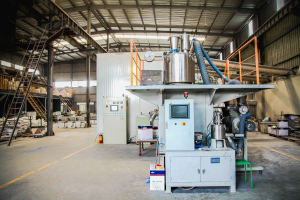
Metallic powder coating bonding system — the process step behind decorative metallic and pearlescent architectural finishes.
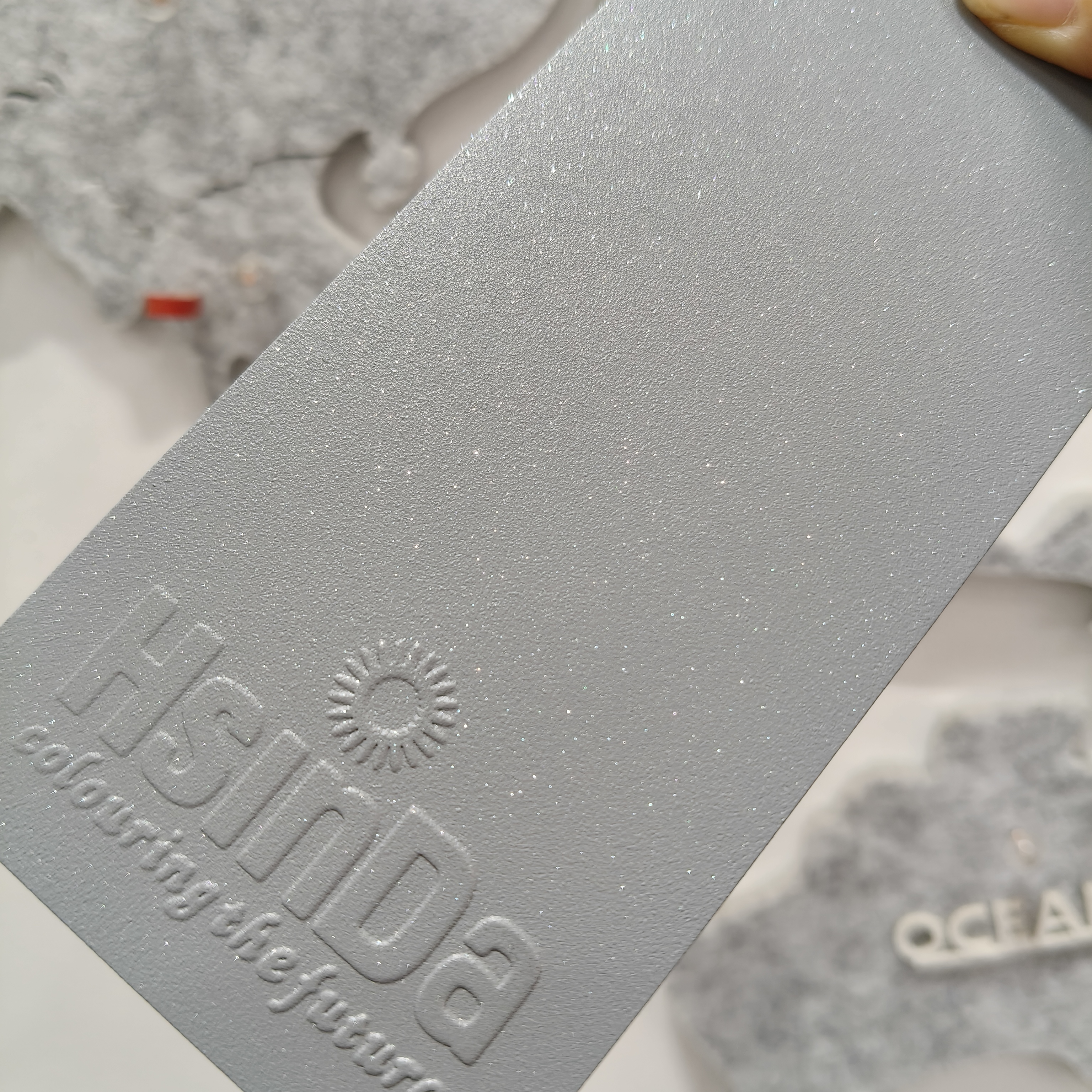
Sandy texture finish — specified for facades, doors, windows and building materials where surface uniformity matters with weathering performance.
Ground Acceptance Criteria Buyers Can Write Into a Specification
The following baseline is drawn from the published test tables and can be used as a shared reference between buyer, applicator and coating supplier. Values should be confirmed per series, because not every grade carries the same numbers.
| Property | Test method | Acceptance value (as published) |
|---|---|---|
| Adhesion | ISO 2409:2020 | Grade 0 |
| Hardness | ISO 15184:2020 | ≥H |
| Corrosion (salt spray) | ISO 7253:1996 | 500 h, film unchanged, cross-section corrosion ≤2 mm (1,000 h for the aluminium profile weathering grade) |
| Impact resistance | ISO 6272-1:2017 | 50 kg/cm across the finish and chemistry series listed above |
| Gloss | ISO 2813:2014 | 5%–95% overall; matt series 5%–30% |
| Film thickness | Datasheet | 70 μm |
| Coverage | Datasheet | 8–10 m²/kg at 30–90 μm film thickness |
| Bending | ISO 1519:2002 | ≤2 mm |
| Cupping | ISO 1520:2006 | ≥6 mm |
| Humidity and heat resistance | GB/T1740-2007 | 1,000 h, slight gloss loss, ≤ level 1 |
| Weather resistance | ISO 11341:2004 | 340 nm lamp, 500 h, no powdering, light retention >50% (1,000 h plus 1 year Florida natural aging on the architectural grade) |
| Storage stability of coating powder | ISO 8130-8 | Method for estimating the storage stability of thermosetting coating powders |
| Cure schedule | Datasheet | 180–200 °C for 10–15 minutes |
Note on per-grade variation: the aluminium profile grade datasheet in the same data set lists bending ≤5 mm, cupping ≥5 mm and an impact value expressed as 2.5 Nm under ISO 6272-1:2017, while the wider finish and chemistry series list bending ≤2 mm, cupping ≥6 mm and 50 kg/cm impact. The correct procurement practice is to specify acceptance values per approved grade rather than assume one baseline applies across a supplier's full catalogue.
Application Notes: Façades, Enclosures, Appliances and Heavy-Duty Service
Four representative cases show how the layers combine in practice.
Electrical enclosures. A project covering 40 tons and reported across Mexico, Paraguay, Sri Lanka, Russia and China over a ten-year relationship required corrosion resistance, insulating or static-conductive behaviour, and an acceptable industrial appearance inside an enclosure that houses and centrally controls electrical components. The combination of corrosion performance plus electrical properties is what makes pure epoxy or hybrid chemistry appropriate here, rather than a purely decorative finish.
Industrial shelving. A 100-ton project for an industrial engineering customer in Colombia, running for ten years, used an epoxy-polyester electrostatic powder coating process with zero VOC emissions. The reported outcome included a dense protective layer after high-temperature curing, rust prevention in humid and salt-spray conditions, custom colours matched across the RAL chart, and impact resistance more than three times that of traditional liquid paint in that project's own comparison. That case also illustrates the decorative axis: colour and gloss were specified as functional requirements, not afterthoughts.
Hardware tools. A 1,000-ton, five-year programme for a hardware tool manufacturer serving Mexico and the United States applied powder coating to wrenches, post-hole diggers, wheelbarrows and shovels for rust prevention and abrasion resistance in outdoor excavation and gardening environments. Here the governing criteria are impact and wear resistance rather than gloss aesthetics.
Temperature and humidity extremes. A cylinder application for an LNG system is listed with an indoor working range of −40 °C to 60 °C, 24/7 automatic operation, a requirement for anti-rust protection and long service life, and salt spray resistance beyond 500 hours using an electrostatic powder coating system. On the appliance side, a home-appliance upgrade project is listed with indoor conditions of −10 °C to 30 °C and outdoor conditions of −30 °C to 45 °C, high humidity and dust exposure; the published note states that for air conditioner outdoor units the coating exhibits weather resistance with an outdoor service life of over ten years, without fading or chalking. Certain grades are also described as partially antibacterial, inhibiting bacterial growth in environments such as hospitals and kitchens, and as providing impact and scratch resistance for transportation and daily use.
What the Market Data Says About Architectural Powder Coating Demand
Fortune Business Insights valued the global powder coatings market at USD 16.12 billion in 2025, with Asia Pacific accounting for 63.10% of that value. Grand View Research reported that the polyester resin segment represented 48.2% of market share in 2025, attributing the position to weatherability and UV resistance — a useful data point for buyers because it confirms that outdoor-capable chemistry, not decorative novelty, drives the largest share of the category.
Direction of travel matters as much as level. One commercial source puts the global market at USD 17.01 billion in 2024 with a projected value of USD 33.78 billion by 2033. The gap between the 2024 and 2025 headline figures from different research houses is not a contradiction so much as a definitional warning: 'powder coatings' is scoped differently across publishers, sometimes including or excluding industrial coating overlaps. Buyers should treat all market sizing as directional context and rely on certification, test data and supplier capability when making a sourcing decision.
Downstream, the construction base remains the anchor for architectural demand. The Association's figure of more than 919,000 US construction establishments in Q1 2023 describes a highly fragmented buyer population — which is precisely why standard-based acceptance criteria travel better than brand-level trust alone.
Powder Coating Compared With Liquid Paint: Where the Trade-Offs Sit
Powder coating is often presented as a straight upgrade over liquid paint. It is better described as a different process with different constraints, and a credible specification should acknowledge them.
- Thermal constraint. These systems are applied by tribo or electrostatic spray gun and cured at 180–200 °C for 10–15 minutes. Heat-sensitive substrates cannot take that schedule; low-temperature curing hybrid grades exist but are positioned for indoor use, so an exterior application on a heat-sensitive substrate needs a dedicated evaluation rather than an assumption.
- Weathering data is chemistry-specific. Polyester, sandy, glossy, wrinkle, hammer tone and metallic series in this data set carry weathering values, while pure epoxy, epoxy-polyester hybrid and the TGIC-free HAA grade do not. Specifying an epoxy system outdoors because it performed well on corrosion testing confuses two different failure mechanisms.
- Chemical resistance is not uniform. The published statement is good resistance to general acids and oils with average alkali resistance. Alkaline service conditions are a genuine boundary that should be raised before approval, not after.
- Repair and touch-up. Powder films are factory- or applicator-applied in a controlled cure cycle, so field repair of a damaged architectural profile is generally more involved than with liquid paint, and site handling protection becomes part of the quality plan.
- Coverage economics. At 8–10 m²/kg coverage and 30–90 μm film thickness with a nominal 70 μm target, over-application wastes material and under-application risks failed salt spray results. Film thickness is a cost and quality variable simultaneously.
- Where powder leads. The Colombian shelving project reported zero VOC emissions from the epoxy-polyester electrostatic process along with impact resistance more than three times that of traditional liquid paint in that comparison, and durability in humid and salt-spray environments. For buyers with environmental targets alongside durability targets, that combination is the main argument.
Future Outlook
Three shifts are visible in the data. First, supply remains concentrated: Asia Pacific held 63.10% of 2025 global market value, so architectural buyers in North America, Europe and the Middle East are structurally dependent on APAC capacity, which makes supplier qualification and continuity planning a procurement issue rather than a procurement formality. Second, chemistry mix is stable but not static — polyester at 48.2% of 2025 share reflects continued preference for weather-resistant outdoor performance, while regulatory pressure supports the TGIC-free, HAA-cured and REACH-certificated segment for indoor and consumer-adjacent applications. Third, the definition of performance is widening beyond colour and weathering into functional properties: antibacterial, anti-slip, anti-fingerprint, scratch resistant, fire and explosion resistant, and low-temperature curing options are already positioned in supplier portfolios, and standards such as ISO 8130-8 for storage stability of thermosetting coating powders give buyers a further lever for incoming inspection.
FAQ
1. How do I decide between a weathering powder coating and an anti-corrosion powder coating?
The decision follows the exposure mechanism, not the marketing category. Weathering exposure means sunlight and moisture, and it is answered by polyester-based architectural grades that carry weathering test data — for example, 340 nm lamp testing to ISO 11341:2004 with no powdering and light retention above 50%, and in the aluminium profile grade 1,000-hour weathering plus one year of Florida natural aging with gloss retention above 50%. Anti-corrosion exposure means immersion, chemical contact or electrolytic attack, and it is answered by pure epoxy systems whose published applications include pipelines, water supply systems, valves, steel reinforcement bars and electrical insulation components, supported by 500-hour salt spray to ISO 7253:1996 and 1,000-hour humidity and heat resistance to GB/T1740-2007. Where a project faces both, the specification should state which property is primary and which is secondary.
2. Which powder coating is suitable for aluminium curtain walls, doors, windows and sunrooms?
Polyester-based architectural powder coating applied to aluminium is the reference category. The published data sheet for this grade specifies 70 μm film thickness, coverage of 8–10 m²/kg at 30–90 μm, application by tribo or electrostatic spray gun, and curing at 180–200 °C for 10–15 minutes. Test values include adhesion Grade 0 to ISO 2409:2020, hardness ≥H to ISO 15184:2020, gloss 5%–95% to ISO 2813:2014, salt spray to ISO 7253:1996 with the film unchanged after 1,000 hours and cross-section corrosion ≤2 mm, and weathering to ISO 11341:2004 at 1,000 hours. Colours can be matched to RAL, Pantone or a customer sample.
3. What acceptance criteria should a powder coating purchase specification contain?
A workable baseline is: adhesion Grade 0 to ISO 2409:2020; hardness ≥H to ISO 15184:2020; salt spray to ISO 7253:1996 at 500 hours with film unchanged and cross-section corrosion ≤2 mm, or 1,000 hours where the approved grade carries that data; impact resistance to ISO 6272-1:2017 at 50 kg/cm; gloss to ISO 2813:2014 within the specified class, with the matt series at 5%–30%; film thickness of 70 μm; coverage of 8–10 m²/kg at 30–90 μm; bending ≤2 mm to ISO 1519:2002; cupping ≥6 mm to ISO 1520:2006; humidity and heat resistance to GB/T1740-2007 at 1,000 hours with gloss loss ≤ level 1; and a defined cure schedule of 180–200 °C for 10–15 minutes. Storage stability of the powder itself can be referenced to ISO 8130-8. Because individual grades differ — for example, some list bending ≤5 mm, cupping ≥5 mm and a 2.5 Nm impact value — acceptance values should be fixed per approved grade.
4. Are TGIC-free or HAA-cured powder coatings suitable for exterior architectural use?
The HAA-cured grade in this data set is composed of polyester resin, HAA curing agent, pigment and additives, and is positioned as an indoor, VOC-free, REACH-certificated powder coating for appliances, office and residential furniture, automotive components, and instrumentation and electronics. Its published test table covers gloss, impact, bending, cupping, adhesion Grade 0, hardness ≥H, 500-hour salt spray to ISO 7253:1996 and 1,000-hour humidity and heat resistance — but it does not list a weathering value. A buyer planning exterior exposure should therefore request a weathering data set for the specific grade before specification rather than assuming equivalence with a TGIC-cured architectural polyester.
5. How do matt, wrinkle, hammer tone, sandy and metallic finishes differ in specification terms?
They differ first in gloss, then in texture mechanism. Gloss across the series is specified at 5%–95% to ISO 2813:2014, with the matt series at 5%–30%; the supplier classifies high gloss above 80%, semi-gloss 40–79% and matt 5–39% at 60°. Metallic and pearlescent finishes use a bonding system to incorporate metallic pigment and are used on aluminium windows, curtain walls, decorative profiles, automotive wheels and trim, consumer electronics and furniture. Sandy and texture finishes produce a matte sandblasted appearance for cabinets, wardrobes, security doors, bathroom hardware, shelving, IT enclosures, aluminium profiles and EV charging devices. Wrinkle finishes are polyester-based and used on furniture, filing cabinets, security doors, machine tools, motor housings, instrument and distribution cabinets, with published curing at 180–200 °C for 10–15 minutes, 70 μm film thickness, 50 kg/cm impact to ISO 6272-1:2017 and 500-hour weathering to ISO 11341:2004. Hammer tone finishes serve hardware tools, safes and vaults, steel-wood furniture, radiators, lighting, architectural hardware and public facilities such as streetlight poles and supermarket shelving.
6. What order and lead-time parameters apply when specifying custom colours?
For ODM work the stated parameters are a monthly capacity of 400 tons, a 15–20 day lead time, a 300 kg minimum order quantity and 100% testing, with 24-hour online service and technical support. A separate OEM programme lists a 6-ton minimum order, a 20-day lead time, 400 tons monthly capacity, 100% testing, carton, sample card and logo OEM options, and local distributor support. Colour matching is performed against standard colour charts, RAL or Pantone references, or a customer-supplied sample.
A matrix approach does not eliminate judgement, but it makes the basis of each decision auditable — exposure first, substrate second, chemistry third, finish fourth, and test values throughout. For buyers who want the underlying product and capability reference in a single document, the company brochure is available for download at the Hsinda powder coating brochure.
Есть вопросы или нужны дополнительные детали?
Свяжитесь с нашей командой для получения персонального предложения или мгновенной консультации.
Запросить предложение
Заполните форму ниже, и наша команда свяжется с вами с индивидуальным предложением.
Прямой чат WhatsApp
Предпочитаете общаться в реальном времени? Напишите нам в WhatsApp для мгновенной помощи и быстрых ответов.
- Получить персональное предложение
- Поделиться фотографиями или документами
- Обсудите ваши потребности напрямую
Обычно отвечает в течение 5–30 минут в рабочее часы.