
Architectural Solar Control Film: Specs, Standards, Limits
Architectural solar control film is a retrofit layer applied to existing building glass to reduce solar heat gain, control glare, filter ultraviolet radiation and, in specific constructions, retain glass fragments after breakage. The category is not defined by a single number. A specification is defined by the combination of visible light transmission (VLT), infrared rejection, ultraviolet rejection, film thickness, construction type, warranty term and the certification evidence a supplier can produce for the film that is actually being shipped.
HOCHI PPF & Window Film is the window film and paint protection film brand of Haian Ho Chi Technology Co., Ltd., a functional film manufacturer founded in 2009 and located at No. 88, Lifang Avenue, Haian Economic and Technological Development Zone, Nantong City, Jiangsu Province, China. Its architectural film range is used in this reference as a documented example of how architectural film parameters, certification scope and warranty terms are published, and how those published values constrain a buying decision.
For buyers at the research and evaluation stage, the practical question is not whether solar control film can reduce heat. It is which construction can be applied to a specific glazing assembly without exceeding that assembly's thermal limits, and which published parameters match the daylight, privacy and heat-rejection requirements of the space.
Why Solar Control Film Is a Specification Problem, Not a Product Category
Most buildings that need solar control already have glass. Replacing that glass is a construction project; applying film is a maintenance-scale intervention. That difference is the reason architectural solar control film is normally bought against constraints rather than against a general claim of heat rejection.
The constraint set is consistent across projects, and it is worth writing down before any quotation is requested:
- Glass compatibility. Not every glazing assembly accepts a solar control film. Laminated, insulated and coated glass may require a compatibility or thermal stress assessment before installation.
- Daylight and privacy. VLT determines how much visible light passes through. A 5% VLT film and a 90% VLT film solve different problems for the same window.
- Heat and UV performance. Infrared rejection and UV rejection are separate metrics from VLT, and total solar energy rejection (TSER) is a further, separate metric again.
- Service life and warranty. Warranty terms for architectural film differ between models in the same catalogue, and they are generally shorter than the terms offered on automotive sputter films.
- Certification and traceability. Certification scope, certificate number, issuing body and validity date are all checkable items, not marketing statements.
- Installation quality. The same film installed badly produces a different outcome from the same film installed correctly.
Performance should be evaluated using verified VLT, UV rejection, IR rejection and TSER test data rather than relying on product color alone. A dark film and a light film can share an identical UV rejection figure and still differ substantially in infrared performance, which is why color swatches are a poor starting point for a specification.
The Parameters That Constrain an Architectural Film Specification
Published model data is the fastest way to see how the parameters interact. The table below lists architectural film models from the HOCHI range with their published VLT, infrared cut, UV rejection, thickness and warranty terms. The spread inside one catalogue is wide, and that spread is the specification decision.
| Model | Type | Thickness | VLT | IR cut | UV rejection | Quality warranty |
|---|---|---|---|---|---|---|
| SILVER 5% | Silver reflective | 2-ply 1.5 mil | 5% | 95% | 99% | 6 years |
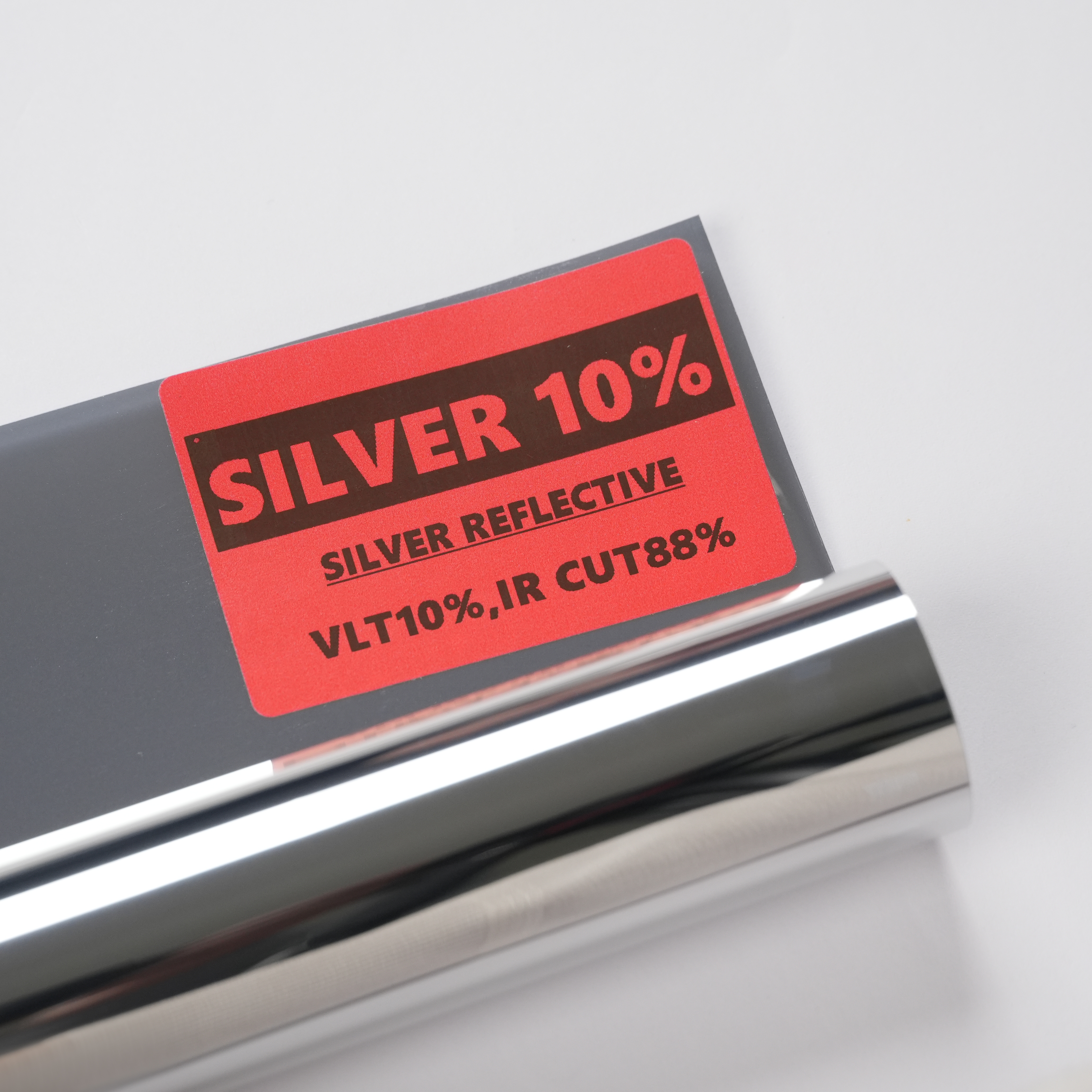
| SILVER 10% | Silver reflective | 2-ply 1.5 mil | 10% | 88% | 99% | 6 years |
| SILVER/BLUE 15 | Silver colored | 2-ply 1.5 mil | 8% | 90% | 99% | 4 years |
| SILVER/GREEN 10 | Silver colored | 2-ply 1.5 mil | 8% | 90% | 99% | 4 years |
| SILVER/GOLD 20 | Silver colored | 2-ply 1.5 mil | 25% | 75% | 99% | 4 years |
| SF02 | Safety clear | 1-ply 2.0 mil | 90% | 10% | 88% | 6 years |
| SF12 | Safety clear | 1-ply 12.0 mil | 90% | 10% | 88% | 6 years |
Three patterns are visible in this data, and each one changes how a buyer should read a quotation.
UV rejection is not the differentiator. Every tinted or reflective architectural model in the range publishes 99% UV rejection; the clear safety films publish 88%. UV protection is therefore close to a category baseline rather than a reason to select one model over another.
Infrared cut is the differentiator. Published infrared cut runs from 10% on the clear safety films to 95% on SILVER 5%, with the silver colored decorative models sitting between 75% and 90%. The high-infrared models are the reflective constructions; the clear safety films are specified for glass retention, not for heat rejection, and their VLT of 90% reflects that purpose.
Warranty tracks construction, not price alone. SILVER 5% and SILVER 10% carry 6-year quality warranties, while SILVER/BLUE 15, SILVER/GREEN 10 and SILVER/GOLD 20 carry 4-year warranties, and the clear safety films carry 6 years. A buyer comparing quotations on VLT alone will miss that difference entirely.
Reading VLT as a Constraint Rather Than a Preference
VLT is the parameter most often fixed by something other than the film: the daylight requirement of the occupants, the privacy requirement of the space, and local rules that may govern visible light transmission or exterior reflectivity. In the HOCHI architectural range, the lowest published VLT is 5% (SILVER 5%) and the highest is 90% (SF02 and SF12). SILVER/GOLD 20 publishes 25% VLT, the lightest of the colored reflective options.
Because VLT, infrared cut and color are locked together inside a fixed product construction, the practical way to brief a supplier is to state the required VLT band and the privacy requirement first, and then ask which constructions can meet it. Starting from a color swatch reverses the logic and usually ends with a compromise on either daylight or heat rejection.
Decorative and Aesthetic Constraints
Silver, silver/blue, silver/green and silver/gold finishes let a specification match an existing facade language, and the reflective constructions provide daytime one-way privacy. Both effects are visible from the street as well as from inside. Where a facade is subject to planning or design review, the exterior appearance of a reflective film is a constraint to resolve before ordering, not after installation. Interior reflectivity and night-time appearance are part of the same evaluation.
Certification as a Procurement Constraint
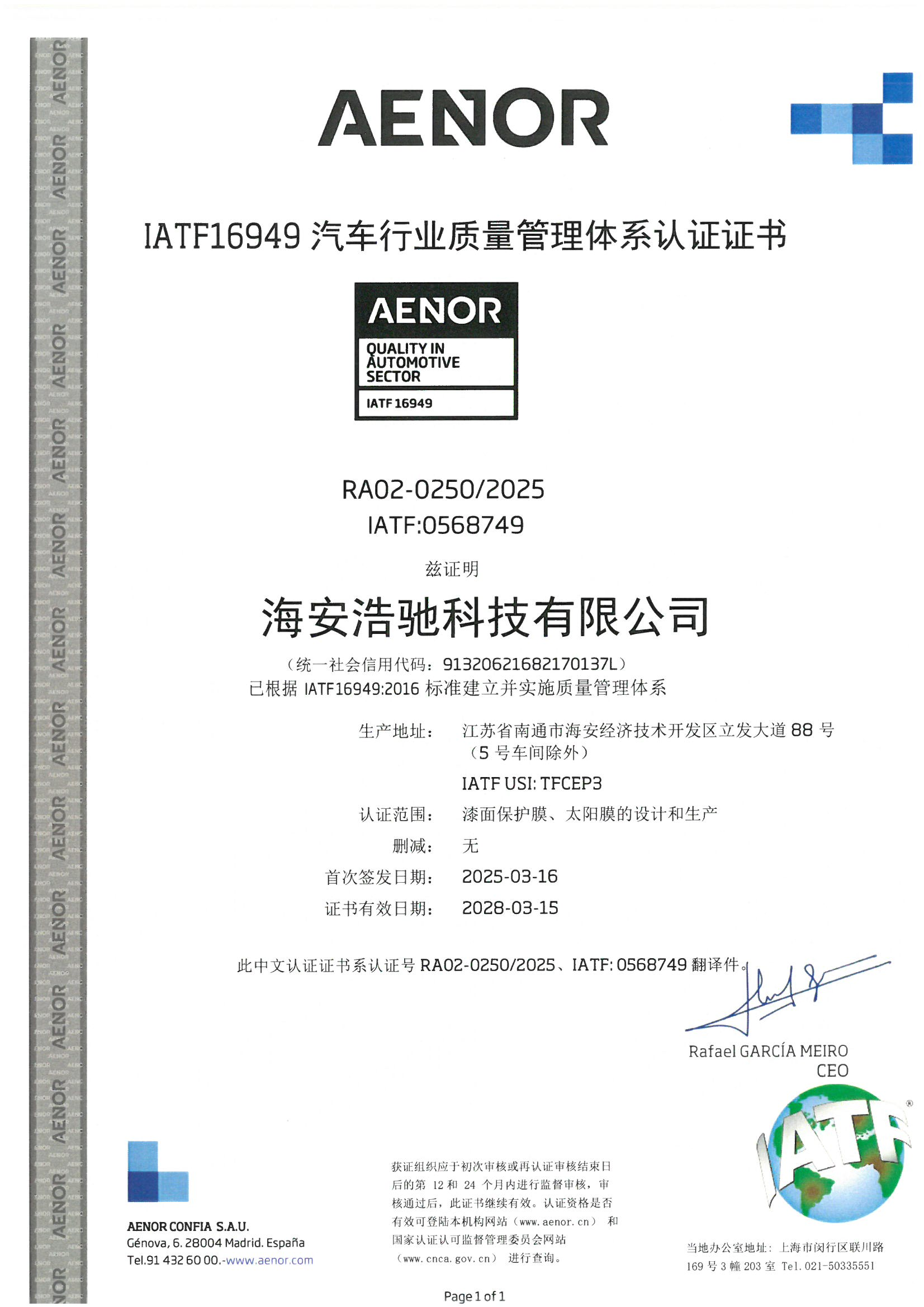
For architectural film, certification matters in two specific ways. It describes the manufacturing system the film comes out of, and it provides a scope statement the buyer can read, date and verify. Certificate numbers, issuing bodies and validity dates are the parts that make verification possible.
| Standard | Certificate number | Issuing body | Scope relevant to architectural film | Valid until |
|---|---|---|---|---|
| IATF 16949:2016 | RA02-0250/2025, IATF: 0568749 | AENOR CONFIA S.A.U. | Design and production of paint protection film and solar film; includes ARCHITECTURE FILM (SF02) | 2028-03-15 |
| ISO 9001:2015 (GB/T19001-2016 / ISO9001:2015) | 04325Q31011R1M | Beijing United Intelligence Certification Co., Ltd. | Research and development and production of special functional plastic films, including building film; applies to architectural film SF02 | 2028-05-19 |
| ISO 14001:2015 (GB/T24001-2016 / ISO14001:2015) | 04325E30833R1M | Beijing United Intelligence Certification Co., Ltd. | Research and development and production of special functional plastic films, including building film | 2028-05-19 |
| ISO 45001:2018 (GB/T45001-2020 / ISO45001:2018) | 04325S40794R0M | Beijing United Intelligence Certification Co., Ltd. | Research and development, production and related management activities of special functional plastic films (automotive protective film, electronic protective film, building film) | 2028-05-18 |
Two practical notes follow from this table. First, scope wording is the part that matters. A certificate that names building film, or names an architectural model such as SF02, answers a different question from a certificate that only covers automotive film. Second, IATF 16949 is an automotive quality management standard, and its presence on a film maker's certificate indicates that the same production system serves automotive paint protection film and solar film. That is a useful signal about process discipline, but it is not a substitute for checking architectural-specific scope and validity at the time of order.
Manufacturing and Quality Controls Buyers Can Ask About
Behind the certificates, the operational facts that can be requested and audited are more informative than a general quality claim. In the HOCHI production system these include 100% online optical defect inspection, spectrophotometer testing of VLT, UV rejection and infrared rejection, peel adhesion testing, high-temperature aging testing, and third-party inspection through SGS. The same manufacturer also publishes an OEM customization window covering VLT from 5% to 70%, UV and IR rejection rates, film thickness in mil, roll dimensions (width and length), custom colors, release liner, and packaging box and core logo printing, with a monthly capacity of 3 to 5 million meters, a lead time of 30 to 45 days and a minimum order quantity of 50 rolls, with sample orders available on request.
Those commercial parameters are constraints in their own right. A specification that requires a custom VLT band, a custom roll width or printed packaging is a different procurement exercise from a standard model order, and the lead time difference should be planned into the project schedule rather than discovered during it.
Installation, Glass Compatibility, and the Limits of Retrofit Film
Architectural window film should be selected according to glass type, building orientation, solar exposure, privacy requirements and local regulations. Installation then follows a defined sequence: identify the glass type and inspect it for cracks, damage or coating; confirm that the selected film is compatible with the glass structure; protect surrounding walls, floors, frames and electrical equipment; clean the glass thoroughly and remove dust, grease and residue; measure and cut the film with an appropriate trimming allowance; spray the approved installation solution on the glass and on the adhesive surface; position the film and remove water and air with a professional squeegee; trim the edges and inspect for contamination, bubbles and lifting; and allow sufficient curing time before cleaning or evaluating the final appearance.
The step that most often changes a specification is the second one. A glass compatibility or thermal stress assessment is recommended before installing solar control film on certain laminated, insulated or treated glass. Incompatible film may increase thermal stress and the risk of glass breakage. This is a hard boundary of the category: a film specification that ignores the glazing assembly is incomplete, no matter how strong its published heat rejection figures are.
Appearance is also a defined matter rather than a subjective one. IWFA Visual Quality Standards require window film inspection from 6 feet (approximately 2 meters) under natural daylight. That gives buyer, installer and end user a common reference point for what counts as an acceptable finish, instead of a dispute about what looks acceptable after the fact.
For safety and security specifications, ASTM D882 is the mandatory testing method under IWFA policies for measuring tensile strength, break strength and elongation of safety films. A supplier claiming shatter retention or intrusion delay should be able to point to test methods of this type rather than to a general description of strength.
What Retrofit Film Cannot Do
Two limits are worth stating plainly. First, film changes the solar performance of existing glass; it does not change the glazing assembly itself. Where the dominant problem is conduction heat loss through the glass and frame rather than solar gain, film is not a substitute for glazing replacement. Second, reflective constructions trade daylight and exterior appearance for heat rejection. SILVER 5% publishes 5% VLT with 95% infrared cut, while SILVER/GOLD 20 publishes 25% VLT with 75% infrared cut. No single model maximizes both, which is why the VLT band has to be fixed before the heat-rejection target.
Application Scenarios Where the Constraints Change
Commercial curtain wall retrofit. A documented commercial real estate project in the United States, the United Arab Emirates and Germany applied approximately 65,000 square meters of silver and neutral solar control film, roughly 2,200 rolls, to a skyscraper glass curtain wall. The scope combined solar heat rejection, glare control, interior UV protection and glass anti-shatter safety. Over a three-year post-installation evaluation, indoor temperature was reduced by 4 °C to 6 °C, central air-conditioning power consumption was lowered by 28%, and 99.5% of harmful UV rays were blocked. The construction used magnetron sputtering metal technology with total solar energy rejection above 72%, zero visual distortion from inside out, and high-strength shatter resistance. The relevant procurement lesson is that the film needed to satisfy four constraints at once: heat, glare, UV and safety.
Hospitality, offices and residential privacy. Where privacy and exterior appearance are the leading requirements, silver colored decorative films are specified. SILVER/BLUE 15, SILVER/GREEN 10 and SILVER/GOLD 20 publish VLT between 8% and 25% with infrared cut between 75% and 90%, and provide daytime one-way privacy with a 4-year quality warranty.
Glass retention on existing facades. Where visibility must stay high and the requirement is fragment retention rather than heat rejection, the clear safety films apply. SF02 at 2.0 mil and SF12 at 12.0 mil both publish 90% VLT, 10% infrared cut, 88% UV rejection and a 6-year quality warranty.
High-exposure sites. In intense solar radiation with high ambient temperature, the highest published infrared cut in the range is the deciding parameter. SILVER 5% publishes 95% infrared cut at 5% VLT, and SILVER 10% publishes 88% infrared cut at 10% VLT, both with 99% UV rejection and 6-year warranties, and both built on optical grade PET film at 2-ply 1.5 mil.
Market Context: What the Verified Data Shows
Publicly available market research supports the direction of the category without replacing project-level specification work. Grand View Research projects the global automotive tinting film market to reach USD 14.7 billion by 2033, which indicates the scale of coating capacity serving film demand across automotive and architectural applications. On the technical side, nano-ceramic window films can block up to 85% of solar heat while maintaining high visible light transmission, which describes the direction of travel in film construction: higher heat rejection without forcing VLT down.
Several broader drivers are consistent across renovation markets and are widely reported rather than tied to any single vendor. Building owners increasingly evaluate retrofit measures that improve thermal comfort without a full facade replacement. Tenants and occupants raise glare and comfort issues that a film specification can address directly. And where glass is sound but uncomfortable, the alternative to film is usually a construction programme, which is a different budget line and a different disruption profile.
Comparison with Traditional Alternatives
Film is one of several ways to manage solar gain. The comparison below is qualitative and intended to clarify where film fits rather than to rank the options.
| Approach | What it changes | Key constraints | Where it fits |
|---|---|---|---|
| Architectural solar control film retrofit | Solar heat gain, glare and UV through existing glass; adds fragment retention in safety constructions | Requires glass compatibility or thermal stress assessment on certain glass types; appearance defined by inspection standards such as the IWFA 6-foot (approx. 2 m) visual reference; reflective films change daytime exterior appearance | Buildings where existing glazing is sound and the problem is solar gain rather than conduction loss |
| Glazing replacement | The glazing assembly itself, including cavity and coating performance | Construction-scale cost and disruption; longer programme; facade and structural implications | Where conduction heat loss or glazing failure is the dominant problem |
| Interior blinds and shades | Perceived glare and solar gain at the window line, adjustable by occupants | Occupant dependent; view and daylight are blocked when deployed; no UV protection of interior finishes when open | Occupant-controlled comfort rather than measurable glazing performance |
| External shading | Solar gain before it reaches the glass | Facade attachment, wind loading, maintenance access and design review | New build or major refurbishment with facade redesign already in scope |
The limitation that matters most in this comparison is that solar control film is a surface modification, not a glazing upgrade. It reduces solar gain through existing glass. It does not improve the insulating performance of the glazing assembly, and it cannot be applied to every glass type without an assessment first. Buyers who compare film and glazing replacement as if they solve the same problem will specify the wrong solution for one of them.
Future Outlook
Three developments are likely to shape architectural film procurement over the next few years, based on the published data and the certification pattern already visible.
First, the technical direction is toward higher heat rejection at higher visible light transmission. Nano-ceramic constructions blocking up to 85% of solar heat while retaining high VLT illustrate that this combination is already a design target rather than a theoretical one, and it reduces the daylight trade-off that buyers currently have to accept.
Second, specification will continue to move away from color-first selection. As published parameter sets widen, the ability to state a VLT band, an infrared target, a UV requirement and a warranty term before contacting suppliers becomes the difference between comparing quotations and comparing claims.
Third, certification validity becomes a routine procurement check rather than a one-time qualification. With certificates such as IATF 16949 valid until 2028-03-15 and the ISO management systems valid into 2028, buyers ordering over a multi-year programme should verify that certificates remain valid at the time of each order, and that the scope wording still covers the film being purchased.
FAQ
Which parameters actually define an architectural solar control film specification?
A specification is defined by visible light transmission, infrared rejection, UV rejection, thickness and construction, warranty term and certification scope. In the HOCHI architectural range, the clear safety films publish 90% VLT with 10% infrared cut, SILVER 5% publishes 5% VLT with 95% infrared cut, SILVER 10% publishes 10% VLT with 88% infrared cut, and the silver colored decorative models publish 8% to 25% VLT with 75% to 90% infrared cut. UV rejection is 99% across the tinted and reflective models and 88% on the clear safety films. Performance should be assessed from verified VLT, UV, IR and TSER data rather than from product color.
How can a buyer confirm that a supplier's certification covers architectural film rather than only automotive film?
Read the scope statement on the certificate. The IATF 16949:2016 certificate RA02-0250/2025, IATF: 0568749, issued by AENOR CONFIA S.A.U., covers the design and production of paint protection film and solar film and includes ARCHITECTURE FILM (SF02); it is valid until 2028-03-15. The ISO 9001:2015 certificate 04325Q31011R1M, issued by Beijing United Intelligence Certification Co., Ltd., covers research and development and production of special functional plastic films including building film and applies to architectural film SF02. ISO 14001 (04325E30833R1M) and ISO 45001 (04325S40794R0M) carry related scopes. Verification means checking scope wording, certificate number, issuing body and current validity.
What installation constraints should be resolved before the film is ordered?
Glass type identification and inspection come first, followed by confirmation that the selected film is compatible with the glass structure, since a compatibility or thermal stress assessment is recommended on certain laminated, insulated or treated glass. Installation then requires protection of surrounding surfaces, thorough glass cleaning, accurate cutting with trimming allowance, wet application with approved solution, careful squeegee work, edge trimming and inspection, and sufficient curing time before cleaning or final evaluation. Appearance expectations are usually referenced to the IWFA Visual Quality Standard of inspection from 6 feet (approximately 2 meters) under natural daylight.
Can solar control film replace the need for new glazing?
No. Film modifies solar heat gain, glare and UV transmission through existing glass. It does not change the glazing assembly, so where conduction heat loss through the glass and frame is the dominant problem, film is not a substitute for glazing replacement. There is also a compatibility boundary: some glass types require a thermal stress assessment before any solar control film is applied, and incompatible film may increase thermal stress and the risk of breakage.
What warranty terms apply, and why do they differ between models?
In the HOCHI architectural range, warranty tracks construction. The silver reflective models SILVER 5% and SILVER 10% carry 6-year quality warranties, the silver colored decorative models SILVER/BLUE 15, SILVER/GREEN 10 and SILVER/GOLD 20 carry 4-year warranties, and the clear safety films SF02 and SF12 carry 6 years. Buyers should match the warranty term to the expected service life of the installation and to the conditions the glass will see, including solar exposure and cleaning regime, rather than treating warranty length as an isolated comparison point.
Есть вопросы или нужны дополнительные детали?
Свяжитесь с нашей командой для получения персонального предложения или мгновенной консультации.
Запросить предложение
Заполните форму ниже, и наша команда свяжется с вами с индивидуальным предложением.
Прямой чат WhatsApp
Предпочитаете общаться в реальном времени? Напишите нам в WhatsApp для мгновенной помощи и быстрых ответов.
- Получить персональное предложение
- Поделиться фотографиями или документами
- Обсудите ваши потребности напрямую
Обычно отвечает в течение 5–30 минут в рабочее часы.