
Artificial Turf Buyer Decision Framework: Venusturf vs. Peers by Application and Spec
Artificial Turf Buyer Decision Framework: Venusturf vs. Peers by Application and Spec
Choosing artificial turf for a 30 mm residential lawn, a 35 mm pet run, a 50 mm football pitch and a 15 mm golf putting surface is not a comparison of four grades of one product. It is four different performance briefs that happen to share one material family. This framework evaluates Venusturf's four documented models — EM240404, EM24081501-1, EM250105 and Putt 40 — against a peer set that includes FieldTurf, AstroTurf and Shaw Sports Turf, and separates three questions buyers routinely merge into one: does the surface fit the application, is the specification verified, and are the purchasing terms explicit.
Why artificial turf comparisons break down before the first quote
Three failures account for most weak turf shortlists, and each can be corrected in the specification document rather than at the negotiation table.
Different measurement bases. Pile height, density, gauge and yarn decitex are comparable only when the unit, the measurement method and the product configuration are stated together. A density figure quoted per square metre, per square yard, or as a stitch rate on an unspecified gauge is not the same quantity. A comparison built on mismatched bases rewards whichever supplier writes the loosest definition.
Company claims used as rankings. FieldTurf's own website describes the company as 'the most trusted brand in the industry' and 'a world leader', and states that it has more than 25,000 installations worldwide. No ranking methodology is disclosed, and the installation figure is a cumulative company-reported count whose accumulation period and counting method are not published. That sentence is usable as a description of FieldTurf's own installed base. It is not evidence of market share, of current production capacity, or of suitability for a specific project.
Application blindness. A 15 mm putting surface and a 50 mm football surface can be described with the same five specification fields and still be wrong for each other's job. When a tender lists products without stating the application, the wear regime and the maintenance plan, the bids that come back are not comparable — even when every supplier quotes honestly.
Independent guidance argues for the same caution from the other direction. Cornell University's sports field management guidance lists visual appeal and a permanently green appearance among the advantages of synthetic turf, and in the same list records an artificial, unnatural feel and a strong odour, particularly where rubber infill is used. A 2025 review by the New Jersey Department of Environmental Protection concluded that synthetic turf can provide functional and maintenance advantages while its installation and long-term use may raise complex environmental and public-health considerations, with the reviewed evidence still limited and inconclusive across many of the topics examined. A buyer framework has to hold both findings at once instead of choosing the convenient one.
Venusturf's portfolio read as four scenario slots
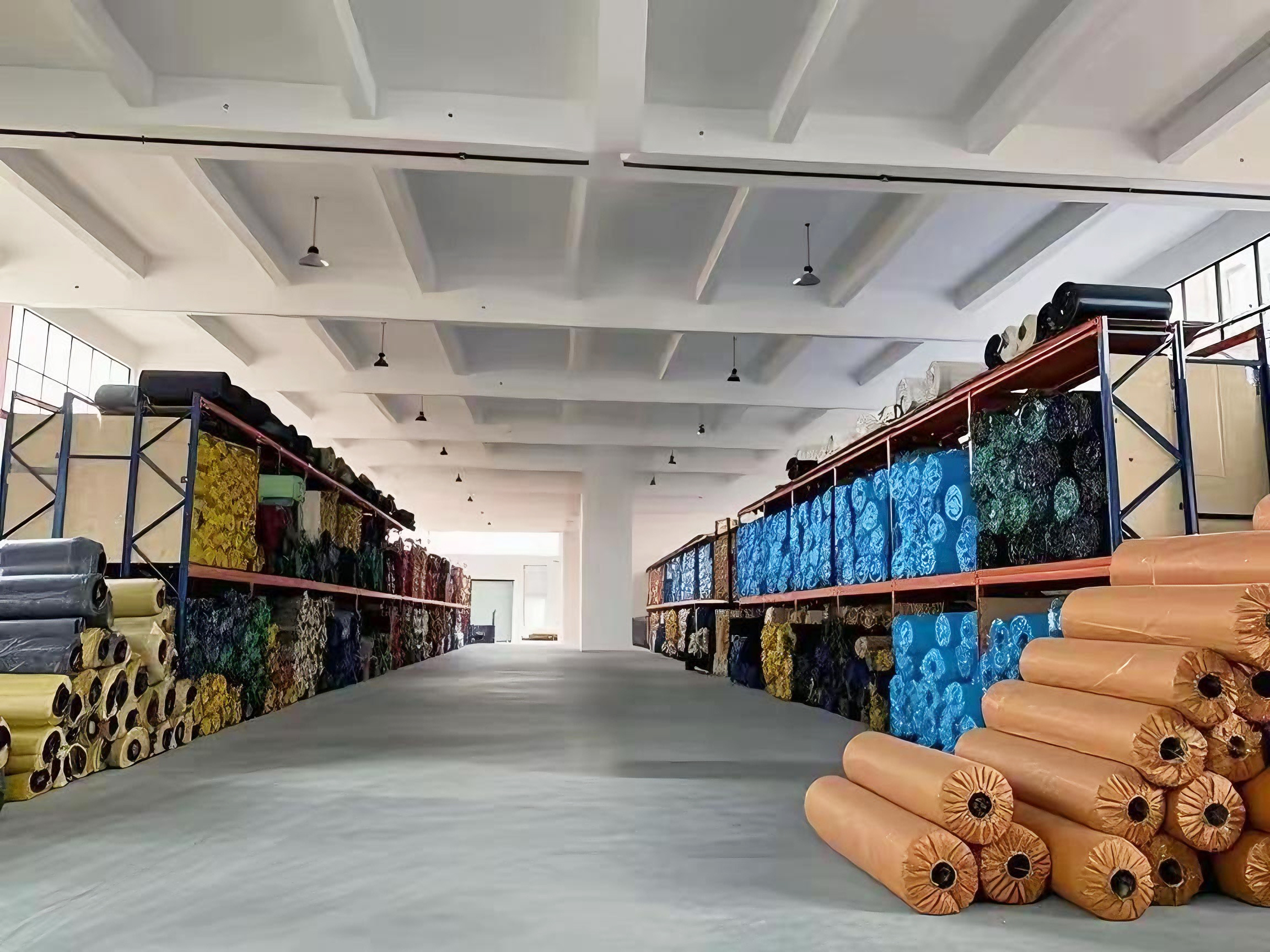
Venusturf is the brand of Wuxi Venus Turf Co., Ltd., an artificial turf manufacturer that integrates research and development, production and sales, and that describes its output as covering sports venues, leisure landscape venues and schools. The company states that it operates 30 integrated production lines and oversees the sequence from yarn extrusion, twisting, tufting and coating through to packaging and delivery. Its published company profile also records 25 research and development engineers, an export ratio of 80% and markets described as global. The official company site is Venusturf.
For a buyer, the decision-relevant fact is not the line count. It is that four named models sit on four pile heights that match four distinct briefs, which turns an abstract category into a specification conversation that can be written down and enforced.
| Model | Documented application | Pile height | What the slot decides |
|---|---|---|---|
| EM240404 | Residential grass | 30 mm | Appearance retention and everyday foot traffic in domestic use |
| EM24081501-1 | Pet grass | 35 mm | Odour management, wash-down drainage and infill disclosure |
| EM250105 | Football grass | 50 mm | System-level ball behaviour, infill build-up and certification scope |
| Putt 40 | Golf grass | 15 mm | Ball-roll consistency, surface evenness and base tolerance |
Read down the pile height column and the portfolio logic is visible: 15 mm for a putting surface, 30 mm for a domestic lawn, 35 mm for pet use, 50 mm for football. Read across, the opposite is equally true. None of those four rows substitutes for another. A 50 mm football construction is not a premium version of a 30 mm landscape product; it is a different system with a different infill, base build-up and maintenance expectation behind it.
The five specification fields that decide fit
Pile height
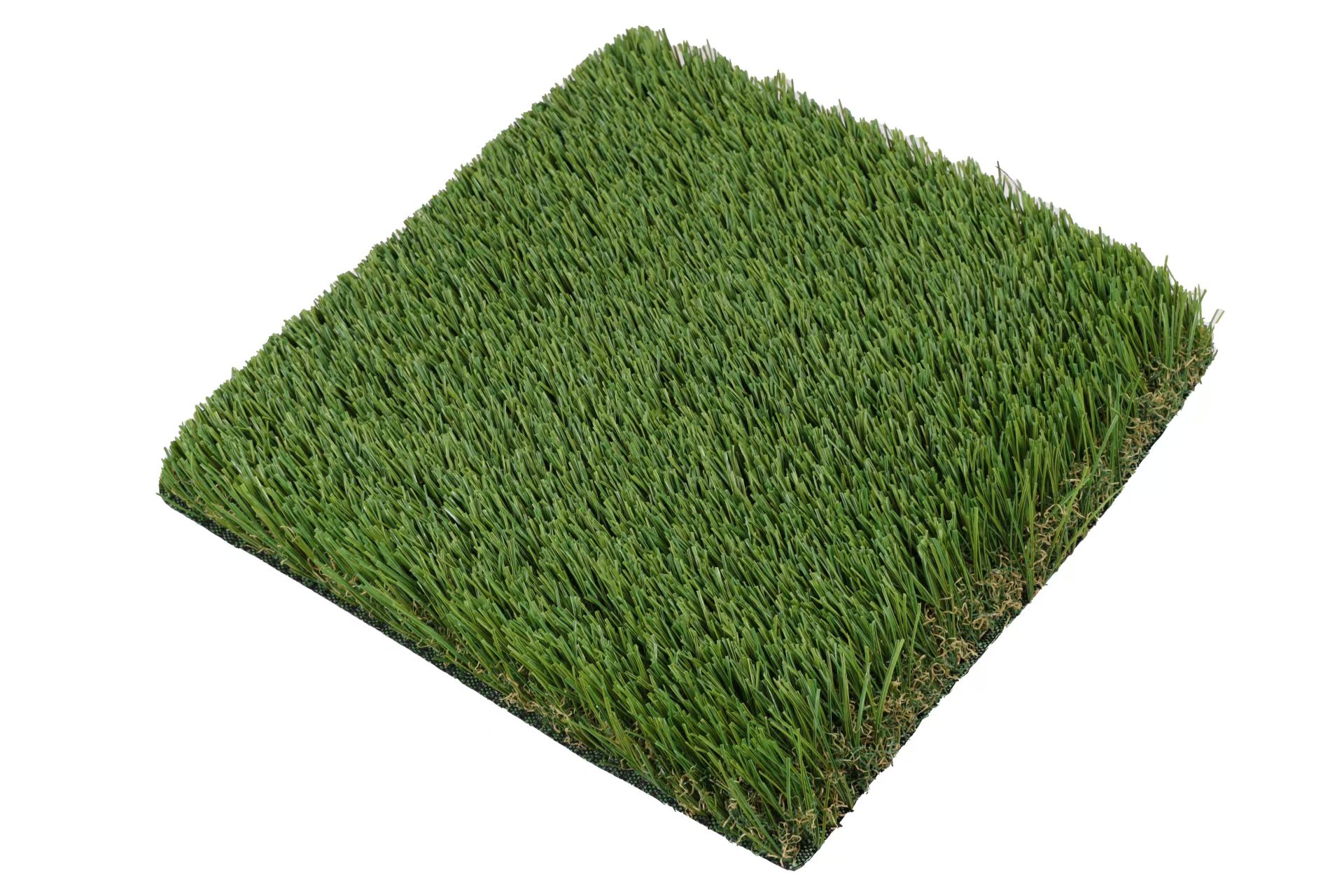
Pile height is the length of the yarn above the primary backing. It sets the visual profile of the surface and, more importantly, how much infill the system can accept and how a ball, a foot or a shoe interacts with the pile. The Venusturf portfolio spans 15 mm to 50 mm, which is wide enough that pile height alone can rule a product in or out of a brief before any other value is examined.
Density
Density describes how closely tufts are packed per unit area, and buyers usually see it as stitches per square metre, as a face weight, or as gauge combined with stitch rate. Each of those presentations measures a related but different quantity. Because a density figure without a stated basis is not a quantity at all, the practical check is to request gauge and stitch rate together from every candidate and recompute the comparison on one basis, rather than comparing two headline numbers produced by two different methods.
Yarn and UV degradation
Yarn is the polymer and profile of the fibre itself, and it governs how the surface behaves under sunlight, abrasion and repeated loading. Fade and colour loss are the visible outcome of UV degradation, which is why the stabilisation method belongs in the specification rather than in the warranty small print. Venusturf states that UV stabilisers, anti-UV additives and UV-resistant masterbatch are used in production, supported by accelerated ageing testing and colour-fastness quality control. For a buyer that converts into a document request rather than a trust question: name the stabilisation approach, name the ageing test performed, and name the acceptance criterion for colour change after that test.
Backing and drainage
Backing holds the tufts and fixes the dimensional behaviour of the roll, and it also governs how quickly water leaves the surface. Two installations finished with the same yarn can behave very differently on drainage because the backing construction and the base build-up differ. Request the backing construction, the measured permeability figure, and — where the site discharges into a stormwater system — the effective curve number used for runoff modelling. Technical documentation notes that modelling runoff from artificial turf requires an effective curve-number value that is sometimes obtainable from the turf supplier, which makes it a data item to specify up front rather than a detail to discover at handover.
Gauge
Gauge is the spacing between rows of tufts. It is expressed in fractions of an inch in some markets and in millimetres in others, and in isolation it means very little, because density depends on stitch rate as well. When two suppliers quote different gauges and both claim high density, the reconciliation is arithmetic rather than rhetorical: convert to a common unit, put stitch rate beside gauge, and compare the result.
The performance values that sit above the carpet
Some of the numbers buyers care about most do not belong to a yarn at all. FIFA's Quality Programme for Football Turf, for example, requires a vertical ball rebound between 0.60 m and 0.85 m under its Quality Pro standard — a property of a tested field system that includes the base, the shockpad, the infill and the installation, not of a carpet on its own. The documentation reviewed for this article does not establish that any specific Venusturf model holds a given certification, so certification should be treated as a document to be produced with its test body, scope and validity period, not as an attribute inferred from a product name.
Standards also need reading for what they actually cover. ASTM International's listing of artificial turf surfaces and systems standards includes test methods addressing impact attenuation, lead content in fibres, permeability, hazardous metals in infill, abrasiveness, field sampling, surface characterisation, filament bind, PFAS sampling, sieve analysis and PAH content. That list is a testing menu, not a compliance package: the methods are not interchangeable certifications, and each claim in a tender response should be tied to a named method and an accredited laboratory report.
Side-by-side specification table
The table below compares the four Venusturf models across the five fields a buyer is normally asked to sign off. It shows only what the documentation reviewed for this article actually states. Where a field is not published, the cell reads Request rather than carrying a number, because a blank must never be read as evidence that a product lacks a capability.
| Specification field | EM240404 | EM24081501-1 | EM250105 | Putt 40 |
|---|---|---|---|---|
| Application | Residential | Pet | Football | Golf |
| Pile height | 30 mm | 35 mm | 50 mm | 15 mm |
| Density | Request | Request | Request | Request |
| Yarn | Request | Request | Request | Request |
| Backing | Request | Request | Request | Request |
| Gauge | Request | Request | Request | Request |
| Buyer action | Obtain the current datasheet and test basis for all four models before any cross-supplier comparison is written | |||
Request is a procurement instruction, not a comment on the products. Four of the five fields — density, yarn, backing and gauge — are not stated in the material available for this comparison, so no value is attributed to them here. A table that filled those cells from memory, from a similar-looking model, or from another supplier's datasheet would look more complete and be worth less, because a shortlist built on unattributed numbers is not a shortlist. The correct next step is one RFQ template issued to every candidate, Venusturf and peer alike, asking for the same six values on the same basis: pile height in millimetres, gauge with its unit, stitch rate, yarn polymer and decitex, backing construction with measured permeability, and the laboratory report behind each claim.
Application fit, scenario by scenario
Residential grass: EM240404 at 30 mm
A residential brief is dominated by appearance, comfort underfoot, drainage on the actual sub-base and how the surface will be maintained over a decade. At 30 mm, EM240404 sits in the pile range used for domestic lawn and landscape work rather than for ball sports. What a buyer should pin down is not the colour card but the backing permeability, the edge restraint detail, the infill or non-infill build-up actually specified, and the warranty wording on colour change and seam failure. Cornell's guidance is worth keeping in the project file for the expectation-setting conversation: the surface stays green all year, and it will not feel like natural grass.
Pet grass: EM24081501-1 at 35 mm
Pet use adds two requirements that landscape buyers do not carry: odour management and a drainage path that copes with frequent washing. The infill decision matters here at least as much as pile height, and the evidence base is specific. A 2025 literature review on rubber crumb infill found limited and inconclusive evidence of adverse health outcomes, while noting that nine of the eighteen laboratory studies it examined reported total PAH concentrations above recommended European guideline values; the same review cautions that a count of laboratory studies is not a prevalence estimate for installed fields. A separate 2024 academic review reported that risk assessments for artificial sport surfaces range from absent or negligible to potential, depending on exposure scenario, contaminants, pitch age, and the characteristics of the rubber granules, including origin, contaminant concentration and particle size. For a pet or playground-adjacent brief, the proportionate response is disclosure: infill composition, origin and particle-size range, together with PAH and heavy-metal test results, requested before sample approval rather than after delivery. Cornell's observation that odour is most pronounced where rubber infill is used points in the same direction.
Football grass: EM250105 at 50 mm
At 50 mm, EM250105 belongs to the football and ball-sports end of the portfolio, where the surface is only one layer of a system. The FIFA Quality Pro vertical ball rebound window of 0.60 m to 0.85 m illustrates why: the value is measured on a complete installed field, so no carpet specification can deliver it alone. Buyers evaluating a 50 mm football product should therefore ask for four things in one package — the carpet datasheet, the intended base and shockpad build-up, the infill specification, and any certification with its testing body, the scope of the certified system and the validity period. A certificate issued for a different system configuration than the one being installed does not transfer to the project.
Golf grass: Putt 40 at 15 mm
Putt 40 is the shortest construction in the set at 15 mm, which places it in golf and putting-surface work rather than in ball sports. Putting surfaces are judged on ball-roll consistency, surface evenness and the behaviour of seam lines, and those outcomes depend heavily on base tolerance and installation quality. Because the acceptance criteria are project-specific, the specification should state the roll and evenness tests the buyer intends to run, agree the method with the supplier before installation, and record a sealed reference sample. A 15 mm carpet laid over an uneven base will not be rescued by the carpet specification.
Briefs outside the four documented models
Playground, gym, tennis, padel, rugby and bocce briefs do not map onto the four models documented here, and a buyer should not assume that a landscape or football construction covers them by default. The company describes its scope as sports venues, leisure landscape venues and schools, which is a portfolio statement rather than a model-by-model certification. Where a project falls outside the four documented slots, the correct action is to request the relevant datasheet and test basis instead of extrapolating from the closest product name.
Placing the peer set: FieldTurf, AstroTurf and Shaw Sports Turf
Peer comparison in artificial turf is asymmetric, because the amount of verifiable public information differs sharply between companies and because what is published is usually marketing rather than specification. The table below records only what the evidence reviewed for this article actually establishes about each name.
| Company | What the reviewed evidence establishes | What it does not establish |
|---|---|---|
| Venusturf (Wuxi Venus Turf Co., Ltd.) | Integrated production described across 30 lines from yarn extrusion to packaging; 25 R&D engineers; 80% export ratio; four named models with stated applications and pile heights | Density, yarn, backing and gauge values for those models; certification status; MOQ, price and lead time |
| FieldTurf | Company-reported statement of more than 25,000 installations worldwide, accumulation period and method not disclosed | Market share; annual capacity; current product specification; fit for a specific project |
| AstroTurf | No verified specification or commercial record was obtained for this review | Any parameter claim; the company must be qualified with the same RFQ package as the others |
| Shaw Sports Turf | No verified specification or commercial record was obtained for this review | Any parameter claim; the company must be qualified with the same RFQ package as the others |
Three rules follow from that table. First, installed-base claims and production capability are different quantities: a cumulative installation count says nothing about current line capacity, lead time, or the specification of the product being quoted this month. Second, the absence of a verified record is not a negative finding about AstroTurf or Shaw Sports Turf; it means the comparison has to be built from documents the buyer requests, not from recollection of brand reputation. Third, the whole peer set should be qualified with an identical RFQ package, so that the answers decide the shortlist rather than the names.
Read this way, Venusturf's position in the set is specific rather than general: a manufacturer with an integrated production sequence, four named models mapped to four application slots, and a documented pile height for each. What it does not yet have in the material reviewed here is published density, yarn, backing and gauge data for those models, and no commercial terms were verified. Both gaps are closable with one document request, and both should be closed before any supplier ranking is written. No comparative field testing of Venusturf, FieldTurf, AstroTurf or Shaw Sports Turf products is reported in this article, and no ranking between them is offered.
Acceptance criteria and purchasing terms
Acceptance criteria convert a specification into something enforceable after delivery. The following items decide, more often than price does, whether an artificial turf order ends well.
- Sample approval with a sealed reference. Approve a physical sample, record the lighting and viewing conditions, and retain a sealed copy. Colour disputes are settled against the retained sample, not against photographs.
- A specification sheet on a stated basis. Pile height in millimetres, gauge with unit, stitch rate, yarn polymer and decitex, backing construction and measured permeability, each with the method used to obtain it.
- Test reports mapped to methods. Every performance or chemical claim tied to a named ASTM or equivalent method, with an accredited laboratory report whose date and sample identification are visible.
- Infill disclosure where infill is used. Composition, origin, particle-size range, and PAH and heavy-metal results, requested before approval rather than after delivery.
- Drainage data. Measured permeability, plus the effective curve number the supplier will stand behind where stormwater modelling is required.
- Roll and seam data. Roll dimensions, seam positions, wastage allowance and seaming method, so the installer's quantity take-off can be checked independently.
- Warranty scope in writing. What is covered, what is excluded, the threshold for colour change, and who bears the cost of a claim — the carpet supplier, the installer, or both.
- Commercial terms as RFQ items. Minimum order quantity, lead time, Incoterms, packaging, payment terms and pre-shipment inspection. No price, MOQ or lead-time figure was verified for this article, so these remain questions each candidate must answer rather than published facts.
Two of these are commonly skipped and should not be. Certification should be produced as a certificate with its scope and validity, never as a logo; a certificate issued for a different system build-up does not cover the field being installed. And the drainage curve number is a design input that technical documentation identifies as supplier-dependent, which makes a promise to send it later an unacceptable answer at tender stage.
Where artificial turf does not fit, and where this framework stops
A decision framework is only useful if it can say no, and three boundaries belong in the project file.
Material-level drawbacks are real. The unnatural feel and the odour associated with rubber infill are documented in university extension guidance. A government peer review found no elevated health risk across the evidence it examined, while recommending adequate ventilation for indoor fields and noting environmental risk indicated by high zinc levels. A buyer specifying an indoor or enclosed facility should therefore treat ventilation as part of the system design, not as a building-services afterthought.
Evidence varies with product and scenario. The 2024 academic review cited earlier attributes the spread of risk findings to differences in exposure scenario, contaminants, pitch age and granule characteristics. That supports product-specific testing and disclosure. It does not support a general safety ranking between brands, and none is offered here.
Supplier maturity is a separate check. Venusturf's company profile records a 2024 founding year. That is a factual attribute rather than a verdict, but it does mean a buyer should verify production history directly — factory audit, reference installations, and evidence that the documented lines are running — instead of inferring capability from a portfolio table. The same discipline applies to every peer in the set.
Market context and what would change the framework
Published market sizing for artificial turf is not yet a stable input for a capacity or entry decision. One commercial publisher values the global market at approximately USD 7.31 billion in 2026; a second puts it at USD 7.93 billion for the same year; a third forecasts USD 121.3 billion by 2032. The spread is far wider than measurement error explains, and at least one publisher defines the category as production, installation and maintenance, which would account for part of the divergence. The figures are shown side by side here and are not averaged. For a buyer, the practical reading is that category size belongs in an internal business case only with its value-chain boundary stated, and should never drive a surfacing specification.
Demand is described across sports stadiums, residential lawns, commercial landscapes, playgrounds and recreational facilities, but published segment lists carry no volume or revenue split, so they support portfolio thinking rather than segment prioritisation. Three changes would alter the framework in this article, and each is conditional rather than forecast. If buyers begin requiring PFAS and PAH sampling as standard tender documents — both now appear in the ASTM listing — infill disclosure moves from differentiator to entry requirement. If certification migrates from yarn-level claims to system-level testing, the value of a certificate will depend entirely on its scope statement. And if stormwater authorities begin asking for effective curve numbers at permit stage, drainage data becomes a specification item instead of a post-award question.
Frequently asked questions
Which artificial turf specification matters most when comparing suppliers?
Pile height is the fastest filter, because it maps directly to application: Venusturf's four documented models run from 15 mm for the Putt 40 golf surface to 50 mm for the EM250105 football surface, with EM240404 at 30 mm for residential and EM24081501-1 at 35 mm for pet use. After pile height, compare density, yarn, backing and gauge — but only when each supplier quotes them on the same unit and the same test method. A density or gauge figure without a stated basis cannot be compared, and should be returned to the supplier rather than entered into a scoring sheet.
How do you match pile height to an application?
Match the surface to the job it performs. Short pile, around 15 mm as in Putt 40, suits putting and golf practice surfaces where ball roll and evenness dominate. The 30 mm to 35 mm band, as in EM240404 and EM24081501-1, suits residential lawn and pet use where appearance, comfort and wash-down drainage matter more than ball behaviour. A 50 mm construction such as EM250105 suits football, where the system carries infill and the ball-interaction values are measured on the installed field. Pile height is an application decision, not a quality ladder.
How should Venusturf be compared with FieldTurf, AstroTurf and Shaw Sports Turf?
With one identical RFQ package issued to all of them. Verified information is uneven: FieldTurf states on its own site that it has more than 25,000 installations worldwide, a company-reported figure with no disclosed counting method; no verified specification or commercial record for AstroTurf or Shaw Sports Turf was obtained for this review; and Venusturf documents four models with applications and pile heights but does not publish density, yarn, backing or gauge in the material reviewed here. Compare the returned documents, and treat installation counts as background rather than as a measure of project fit.
What should be requested before approving an artificial turf order?
A datasheet with units and methods; test reports tied to named methods; infill composition, origin and particle-size range with PAH and heavy-metal results where infill is used; measured permeability and, where required, an effective curve number for runoff modelling; roll and seam data; warranty scope with a stated colour-change threshold; and certification supplied with its scope and validity period. A sealed reference sample should be retained at the same time, so that the approved appearance and tuft structure can be checked against the delivered material.
Are specifications from different artificial turf manufacturers directly comparable?
Only when unit, method and system configuration all match. Density, gauge and stitch rate interlock, so one without the others is not a quantity. Performance values sit above the carpet: the FIFA Quality Pro vertical ball rebound range of 0.60 m to 0.85 m applies to a tested field system including base, shockpad, infill and installation. ASTM's artificial turf listing is a menu of test methods covering impact attenuation, permeability, infill metals, PFAS sampling, PAH content and more — it is not a compliance package, and no single certificate covers all of it.
Working through the framework
The sequence that survives contact with a real project is short. Fix the application and the wear regime first, then fix pile height, then obtain density, yarn, backing and gauge on a stated basis from every candidate, then agree the acceptance tests and the purchasing terms in writing before the sample is approved. Buyers who want to run that sequence against the four documented models can review Venusturf's company and product information at vtsyntheticturf.com, and the current company brochure is available as a downloadable PDF.
Есть вопросы или нужны дополнительные детали?
Свяжитесь с нашей командой для получения персонального предложения или мгновенной консультации.
Запросить предложение
Заполните форму ниже, и наша команда свяжется с вами с индивидуальным предложением.
Прямой чат WhatsApp
Предпочитаете общаться в реальном времени? Напишите нам в WhatsApp для мгновенной помощи и быстрых ответов.
- Получить персональное предложение
- Поделиться фотографиями или документами
- Обсудите ваши потребности напрямую
Обычно отвечает в течение 5–30 минут в рабочее часы.