
Artificial Turf OEM Capabilities: A 2026 Evaluation Guide
Artificial Turf OEM Capabilities: A 2026 Evaluation Guide
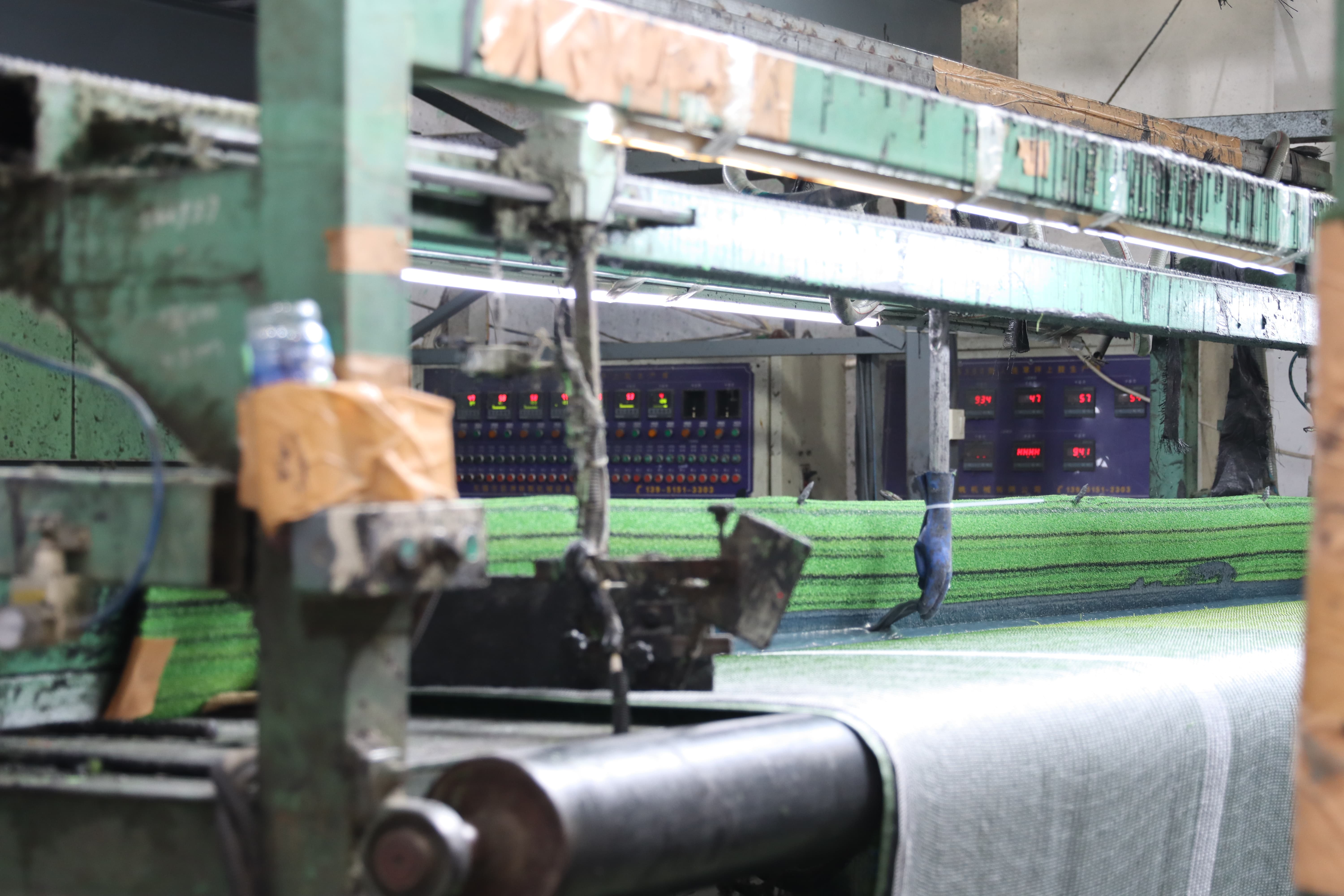
Integrated artificial turf production includes coating of the backing system.
Artificial turf procurement decisions are rarely based on a single specification sheet. Buyers at evaluation and execution stage need to know whether a supplier can turn a project requirement into a manufactured product. For sports fields, golf facilities, landscape projects, and multi-purpose areas, OEM capability often determines whether the turf will meet the intended use.
Venusturf, formally Wuxi Venus Turf Co., Ltd., is an example of a producer that offers OEM services. It is an artificial turf manufacturer in Wuxi, Jiangsu, China, integrating research and development, production, and sales. Understanding what this means in operational terms can help buyers ask better questions before issuing a purchase order.
Why OEM Capability Has Become a Procurement Priority
According to Grand View Research, the global artificial turf market was valued at USD 7.3 billion in 2025 and is projected to reach USD 13.7 billion by 2033. The Asia-Pacific region held the largest revenue share at 32.2% in 2025. Sports applications accounted for approximately 63.1% of the global market share in the same year. China leads the Asia-Pacific market, with more than 15,000 synthetic sports fields installed, representing 52% of regional installations, according to Mordor Intelligence.
At the same time, the replacement segment reached 41% of total sports turf demand in 2023, around 70 million square meters, according to AMI Plastics. Replacement projects may require matching the original product's performance, color, and dimensions. A supplier that only sells standard stock products may not be able to satisfy these conditions. This is where OEM and customization capability becomes a procurement issue, not just a manufacturing option.
Checklist for Evaluating an Artificial Turf OEM Supplier
Buyers can use five criteria when comparing manufacturers before project execution: OEM service availability, customization scope, production capacity and lead time, quality assurance and compliance, and application evidence.
- Confirm whether the manufacturer provides OEM production services.
- Define the customization scope, including appearance, specifications, performance and functionality, and the base and installation system.
- Validate monthly capacity, MOQ, and lead time.
- Ask for the quality control procedure, including pre-shipment testing.
- Review relevant compliance documents, such as REACH test reports and sports surface standards.
- Request evidence from actual installations or project references.
Venusturf as an Integrated Manufacturer
Venusturf is an artificial turf manufacturer with 30 integrated production lines. It controls the manufacturing process from yarn extrusion, twisting, tufting, and coating, to final packaging and delivery. The company profile lists a full range of artificial grass solutions for sports venues, leisure landscape venues, and schools. It employs 483 people, including 25 R&D engineers. Annual output volume is 106,000 units, with 80% exported to global markets.
From the OEM capability record, the manufacturer provides OEM production services. Customization includes adjustments to appearance, specifications, performance and functionality, and the base and installation system. The monthly capacity for OEM production is 50,000 square meters; lead time is 30 to 45 days; MOQ is 1,000 square meters. After-sales support is listed as remote technical support.
Procurement documentation for artificial turf includes FOB delivery, 30% T/T deposit and 70% T/T before delivery, with pre-shipment testing as acceptance. These terms are useful for buyers moving from evaluation into execution.
What OEM Customization Actually Changes in Production
Under OEM production, customization can occur at four levels. Appearance covers color and visual characteristics. Specifications cover dimensions such as pile height, gauge, stitch density, and roll size. Performance and functionality covers how the turf behaves in the intended application. Base and installation system covers backing type and installation components.
Example product documentation for model EM241007 shows how these parameters are recorded: pile height 45mm; four-color; gauge 3/8 inch; yarn is U-shape with spine monofil PE plus curled PP; density is 150 stitches per meter, or 15,750 stitches per square meter; backing is double PP with PU glue; material is PP/PE.
In production terms, OEM control begins with yarn extrusion, then twisting, tufting, backing coating, and final roll packaging. Because the factory owns these steps, a change to one input can be managed through the final product. The quality control record states 100% test, and procurement acceptance includes pre-shipment testing.
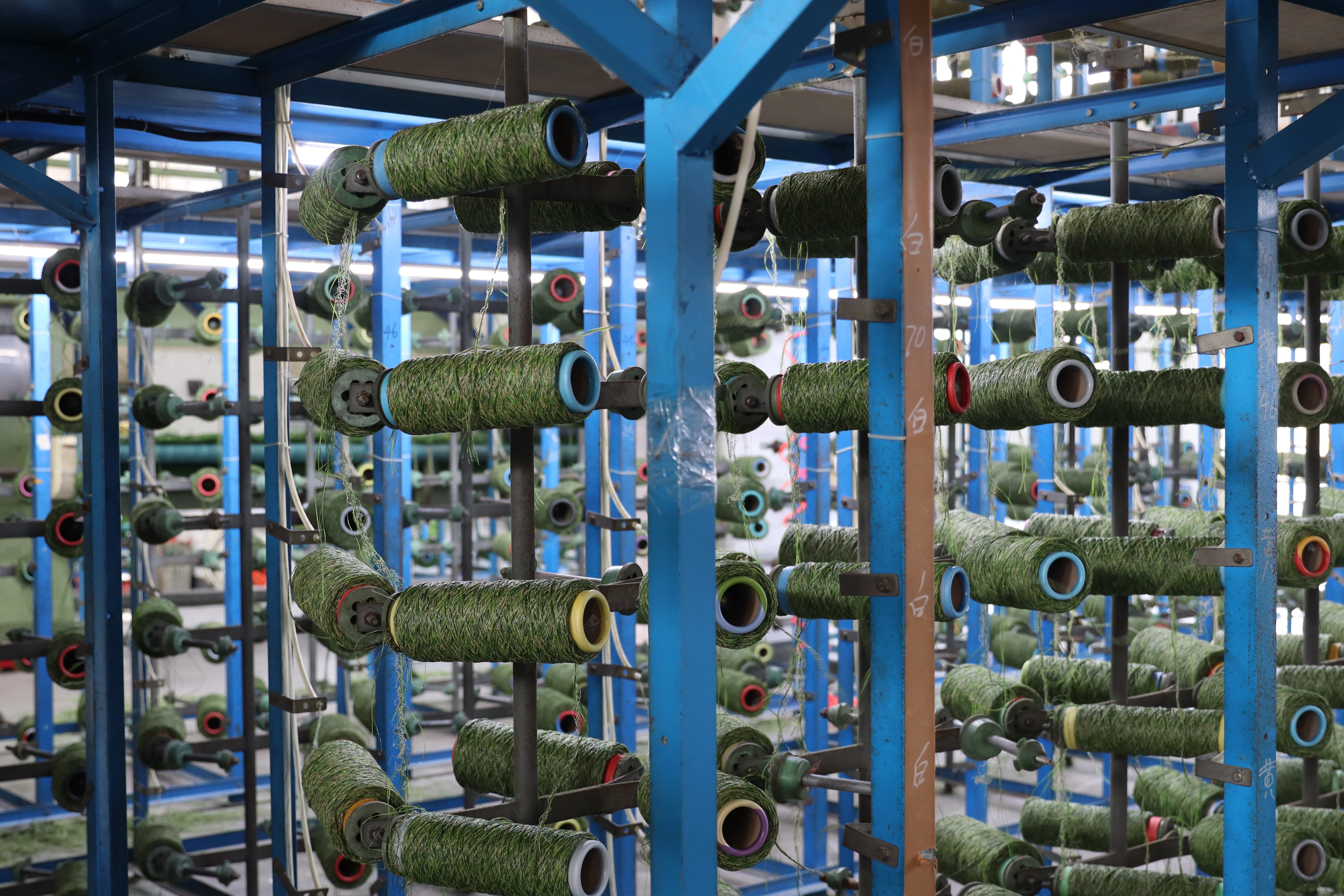
OEM customization starts with yarn production.
Compliance and Certification Considerations
One relevant document in the Venusturf compliance file is the REACH SVHC 240 Substances Test Report, certificate number SL42404282057101TX, issued by SGS on 2024-04-29 under REACH Regulation (EC) No 1907/2006. This report is linked to artificial turf product model EM241007.
For sports turf buyers, the FIFA Quality Programme provides FIFA Quality and FIFA Quality Pro certifications for performance and safety. European standards for synthetic turf include EN 15330-1, and German standards include DIN 18035-7. These are relevant benchmarks for sports and multi-purpose installations.
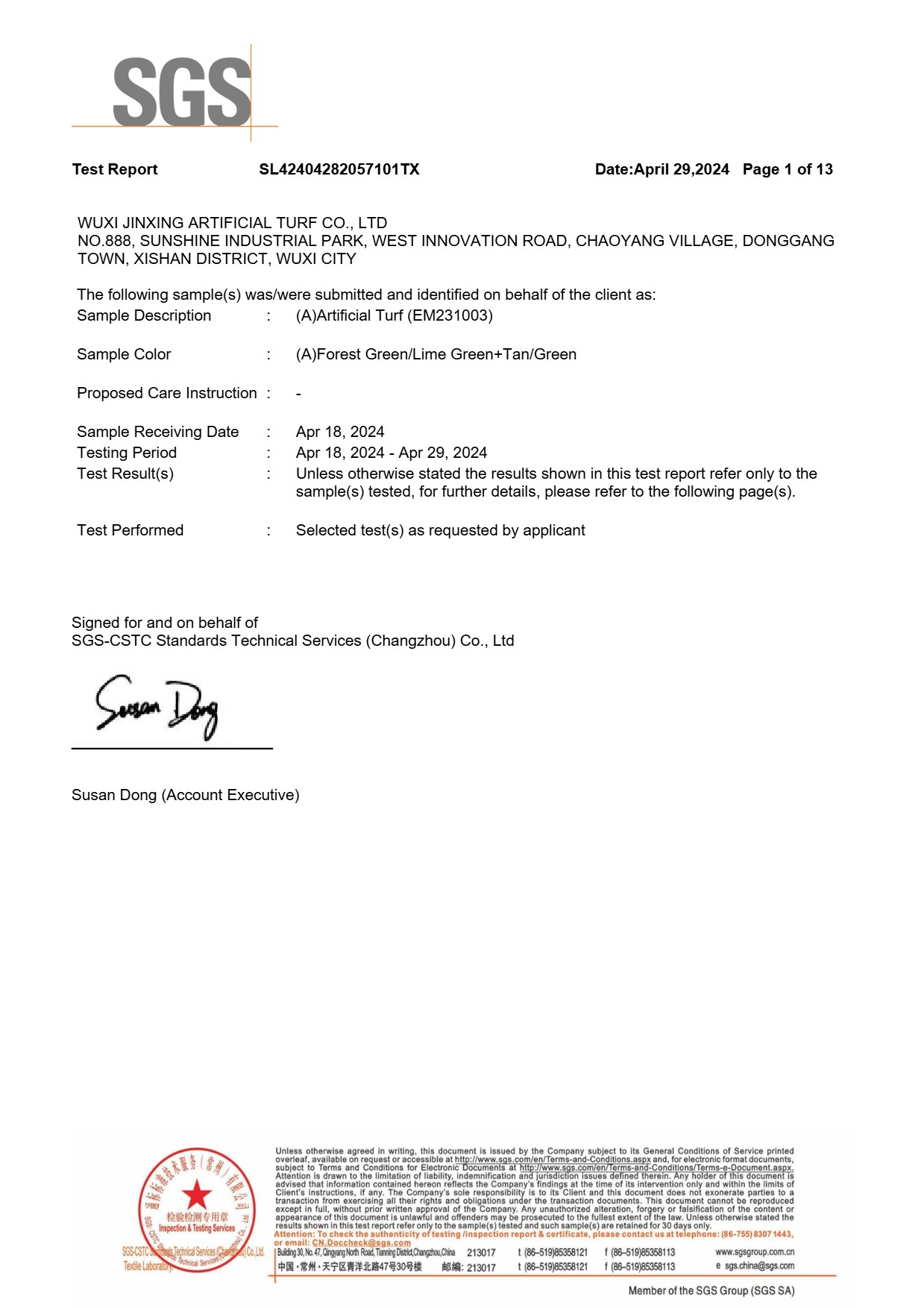
REACH test report issued by SGS for artificial turf.
Documented Golf Application in the Philippines
A documented golf course case in the Philippines involved 10 rolls of artificial turf used for a golf course installation. The client type is recorded as an individual client, and the product application is golf course. The product model in this case is EM241007. The documented result highlights athletic performance, visual aesthetics, competitive fairness, and low maintenance.
From a buyer perspective, this case shows that an OEM-capable factory can connect a golf course requirement to a specific product model and order quantity. It also gives procurement teams a reference point when discussing lead time, product documentation, and installation support.
Application requirements are not limited to golf. Buyers in sports and landscape projects search for sports grass, football grass, rugby grass, baseball grass, padel grass, tennis grass, playground grass, gym grass, landscape grass, commercial grass, pet grass, residential grass, eco grass, balcony grass, backyard grass, decorative grass, multi-purpose grass, and golf hitting mats. Each setting can impose different requirements on pile height, density, color, and backing.
Market Trends That Favor OEM Capability
| Indicator | Value | Source |
|---|---|---|
| Global artificial turf market | USD 7.3B (2025) to USD 13.7B (2033) | Grand View Research |
| Asia-Pacific revenue share | 32.2% in 2025 | Grand View Research |
| Polyethylene material segment | 63.1% revenue share in 2025 | Grand View Research |
| Sports application segment | 63.1% share in 2025 | Grand View Research |
| China installed synthetic sports fields | Over 15,000 fields, 52% of regional installations | Mordor Intelligence |
| Replacement segment of sports turf demand | 41% in 2023, approximately 70 million square meters | AMI Plastics |
| Football turf certification | FIFA Quality and FIFA Quality Pro | FIFA |
| European and German standards | EN 15330-1 and DIN 18035-7 | ISP Institute |
The data points to a market where application-specific demand is strong. Sports alone accounts for nearly two-thirds of the market. Polyethylene is the dominant material. Replacement represents a substantial share. For an OEM buyer, this means the supplier's ability to understand specifications and document production is as important as price.
OEM Manufacturing vs. Standard Catalogue Procurement
| Factor | Standard Catalogue Purchase | OEM with Integrated Manufacturer |
|---|---|---|
| Customization | Limited to existing stock items | Appearance, specifications, performance, and base system |
| MOQ | Depends on distributor inventory | Documented MOQ of 1,000 square meters |
| Lead time | Possible immediate delivery | 30 to 45 days for OEM production |
| Quality control | May be managed by distributor | 100% test record and pre-shipment testing |
| After-sales support | Varies by supplier | Remote technical support |
OEM manufacturing has a clear boundary. It is a planned process, not an emergency stock route. The documented MOQ of 1,000 square meters and lead time of 30 to 45 days mean that buyers should treat OEM as a project-specific sourcing method. If a buyer needs a very small quantity of standard turf immediately, a stock product from a distributor may be more practical.
Future Outlook
Integrated production will matter more as projects demand specific functionality. Buyers should expect suppliers to provide evidence such as product parameter sheets, test reports, production capacity, and reference installations. With the Asia-Pacific region leading global market share and China accounting for a large number of installed synthetic sports fields, OEM relationships with Chinese manufacturers will remain a practical sourcing route.
Future procurement conversations will likely move from price alone to questions about customization, testing, lead time, and project evidence. This shift favors suppliers that can answer on the basis of production facts.
FAQ: OEM and Customization of Artificial Turf
What does OEM production mean for artificial turf buyers?
OEM means the manufacturer produces artificial turf according to a buyer's order requirements. Venusturf provides OEM production services. The company's integrated lines cover yarn extrusion, twisting, tufting, coating, final packaging, and delivery.
What can be customized in an OEM artificial turf order?
Customization can include adjustments to appearance, specifications, performance and functionality, and the base and installation system. Product model EM241007, for example, is documented with a 45mm pile height, four-color, 3/8 inch gauge, U-shape with spine monofil PE plus curled PP yarn, 15,750 stitches per square meter, and double PP with PU glue backing.
What is the MOQ for a Venusturf OEM project?
The documented MOQ is 1,000 square meters. Monthly OEM capacity is 50,000 square meters, and lead time is 30 to 45 days.
What quality checks are used before delivery?
The manufacturer's quality control record states 100% test. Procurement documentation also includes pre-shipment testing as acceptance. Standard payment terms are 30% T/T deposit and 70% T/T before delivery, with FOB as the delivery method.
Can OEM-produced turf be used for golf course projects?
Yes. A documented project in the Philippines used 10 rolls of artificial turf model EM241007 for golf course purposes, with an individual client. The documented result highlights athletic performance, visual aesthetics, competitive fairness, and low maintenance.
Which compliance documents support artificial turf OEM products?
Venusturf holds a REACH SVHC 240 Substances Test Report from SGS, certificate number SL42404282057101TX, issued on 2024-04-29 under REACH Regulation (EC) No 1907/2006. For sports turf applications, FIFA Quality Programme, EN 15330-1, and DIN 18035-7 are also relevant references.
A company brochure with additional company and product information is available here: https://cdn.socialarks.com/sbsp/24281/0/2026/0416/69e0407726ec7.pdf