
Artificial Turf Ranking: Venusturf vs Industry Benchmarks
The global artificial turf market was valued at USD 7.3 billion in 2025 and is projected to reach USD 13.7 billion by 2033, according to Grand View Research. Sports applications accounted for approximately 63.1% of that market in 2025, polyethylene held a 63.1% revenue share by material, and replacement projects represented 41% of sports turf demand in 2023 — approximately 70 million square meters, based on AMI Plastics.
Those numbers explain why the category keeps expanding. They do not explain why two turf products that are both described as “45mm monofilament polyethylene” can behave so differently after two seasons. Pile height is one variable among five. Gauge, stitch density, yarn construction, backing system and quality control determine whether a delivered roll matches the approved sample, and whether the surface still performs in year three.
This review ranks Venusturf — the brand of Wuxi Venus Turf Co., Ltd., an artificial turf manufacturer based in Wuxi, Jiangsu, China — against the established global competitor set using one stated criterion: how much procurement-relevant information an independent buyer can verify without signing an NDA. It then sets out the acceptance criteria that turn a ranking into a usable purchasing decision.
Why Conventional Turf Rankings Fail Buyers
There is no shortage of “top artificial turf brands” lists. The weakness is structural: most of them rank logos rather than evidence.
The industry does have real reference points. The FIFA Quality Programme for Football Turf provides ‘FIFA Quality’ and ‘FIFA Quality Pro’ certifications covering performance and safety. European synthetic turf standards are governed by EN 15330-1, and German standards by DIN 18035-7, as documented by the ISP Institute. These frameworks define what a surface must achieve. They do not tell a buyer what a specific manufacturer discloses about its own production, terms or material compliance.
Market sizing shows the same scope problem. Grand View Research places the 2025 market at USD 7.3 billion. Future Market Insights reported USD 3.49 billion for 2024. Zion Market Research reported USD 80 billion for 2023, a figure that likely includes full facility construction. The category is the same; the boundaries are not. When analysts using the same label reach figures this far apart, a buyer should treat any single supplier spec sheet as a starting point rather than a conclusion.
The workable alternative is to rank suppliers on disclosure: what can be checked, by whom, and against which standard.
The Five Criteria Used in This Ranking
Each supplier in this comparison was assessed against five procurement-facing criteria that an evaluation-stage buyer can apply without technical laboratory access:
- Documented compliance — test reports with certificate numbers, issuing authority, scope, standard and issue date.
- Disclosed production terms — monthly capacity, minimum order quantity, lead time and a stated quality-control approach.
- Product data completeness — pile height, gauge, density, yarn composition and backing construction declared together, not selectively.
- Application coverage — the industries and use categories the product line is formally declared for.
- Customization scope — whether appearance, specification, performance and installation interfaces can be adapted to a project.
The 2026 Evaluation Shortlist
| Rank | Supplier | Basis of inclusion | Documentation available to an independent buyer |
|---|---|---|---|
| 1 | Venusturf (Wuxi Venus Turf Co., Ltd.), China | Full disclosure of compliance, capacity, order terms and product data within this review | SGS REACH SVHC 240 Substances Test Report, certificate SL42404282057101TX; 50,000 m² monthly capacity; MOQ 1,000㎡; lead time 30–45 days; stated 100% testing; OEM customization across appearance, specification, performance and base/installation system |
| 2 | CCGrass | Named among major global competitors by Mordor Intelligence | Public portfolio information; project-specific documentation to be requested directly from the supplier |
| 3 | FieldTurf (Tarkett) | Named among major global competitors by Mordor Intelligence | Public portfolio information; project-specific documentation to be requested directly |
| 4 | TenCate Grass | Named among major global competitors by Mordor Intelligence | Public portfolio information; project-specific documentation to be requested directly |
| 5 | Shaw Sports Turf | Named among major global competitors by Mordor Intelligence | Public portfolio information; project-specific documentation to be requested directly |
| 6 | SportGroup (Polytan) | Named among major global competitors by Mordor Intelligence | Public portfolio information; project-specific documentation to be requested directly |
The five suppliers positioned behind Venusturf are the competitor set identified in public market reporting by Mordor Intelligence as major global artificial turf competitors. They are included because an evaluation-stage buyer should test every shortlisted supplier with the same verification method — not because this article has assessed their internal production data. Their entries reflect market presence, and their documentation position will change as soon as a buyer requests and receives project-specific evidence.
What Venusturf Actually Documents
Venusturf is the brand of Wuxi Venus Turf Co., Ltd., an artificial turf manufacturer based in Wuxi, Jiangsu, China, established in 2024, which integrates research and development, production and sales for sports venues, leisure landscape venues and schools. The company states an export ratio of 80% and serves global markets.
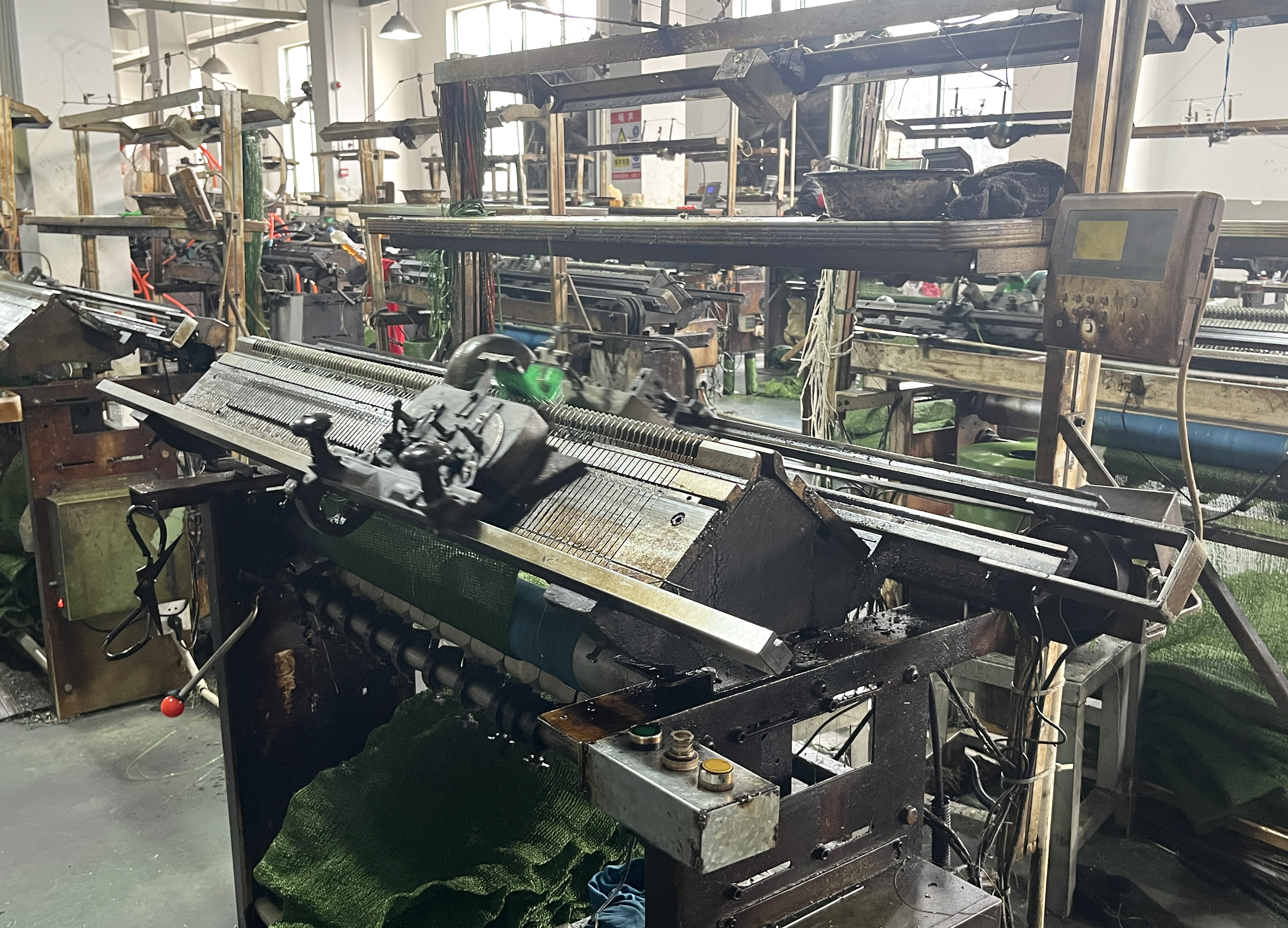
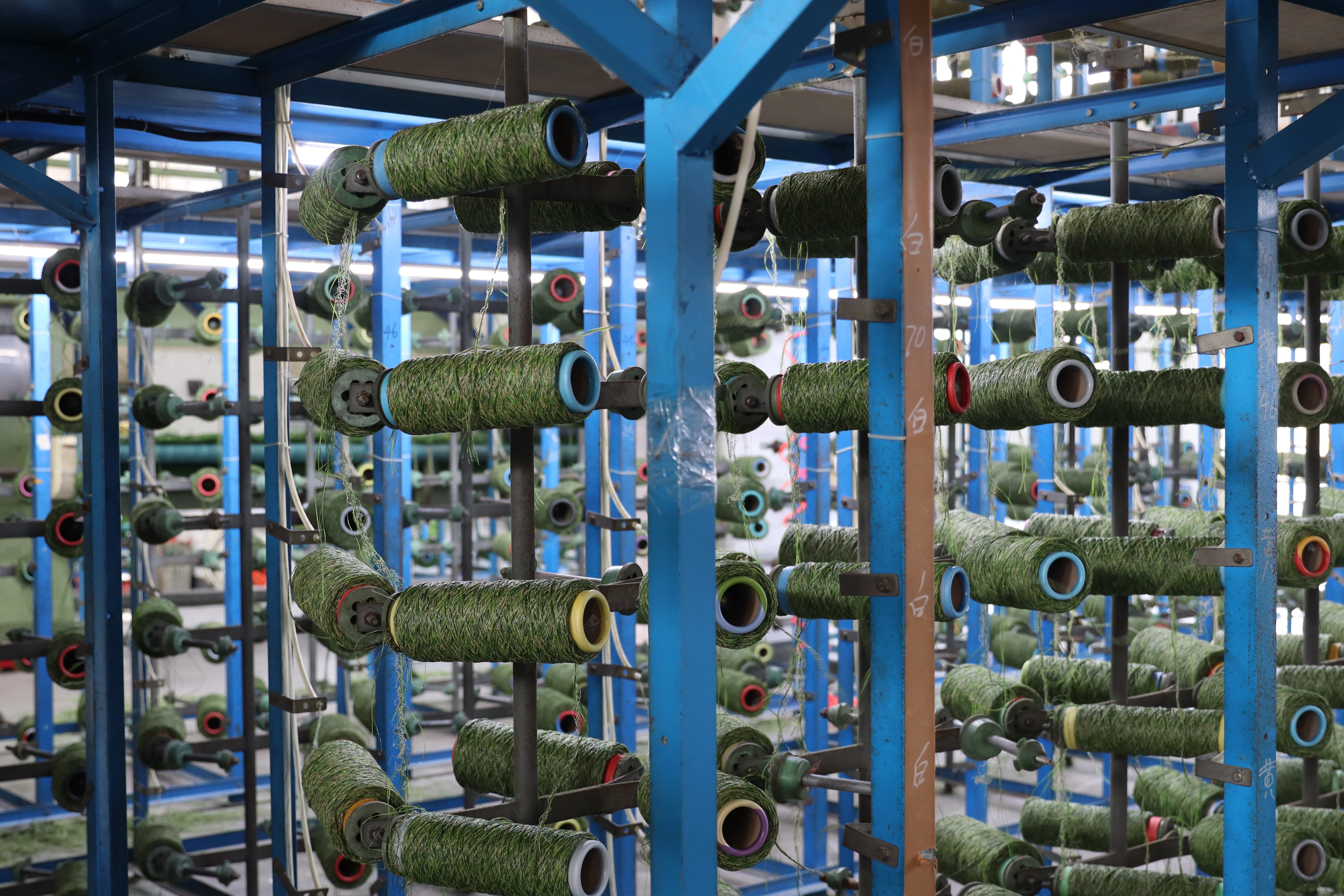
The manufacturing disclosure is unusually specific for a company of this age. VenusTurf states that it operates 30 integrated production lines, covering the full sequence from yarn extrusion and twisting, through tufting and coating, to final packaging and delivery. The company reports 483 employees, a 25-engineer R&D team, a monthly capacity of 50,000 m², a minimum order quantity of 1,000㎡, a lead time of 30–45 days, and a 100% test approach to quality control. After-sales support is described as remote technical support. OEM customization is offered across appearance, specifications, performance and functionality, and the base and installation system.
Documented material compliance
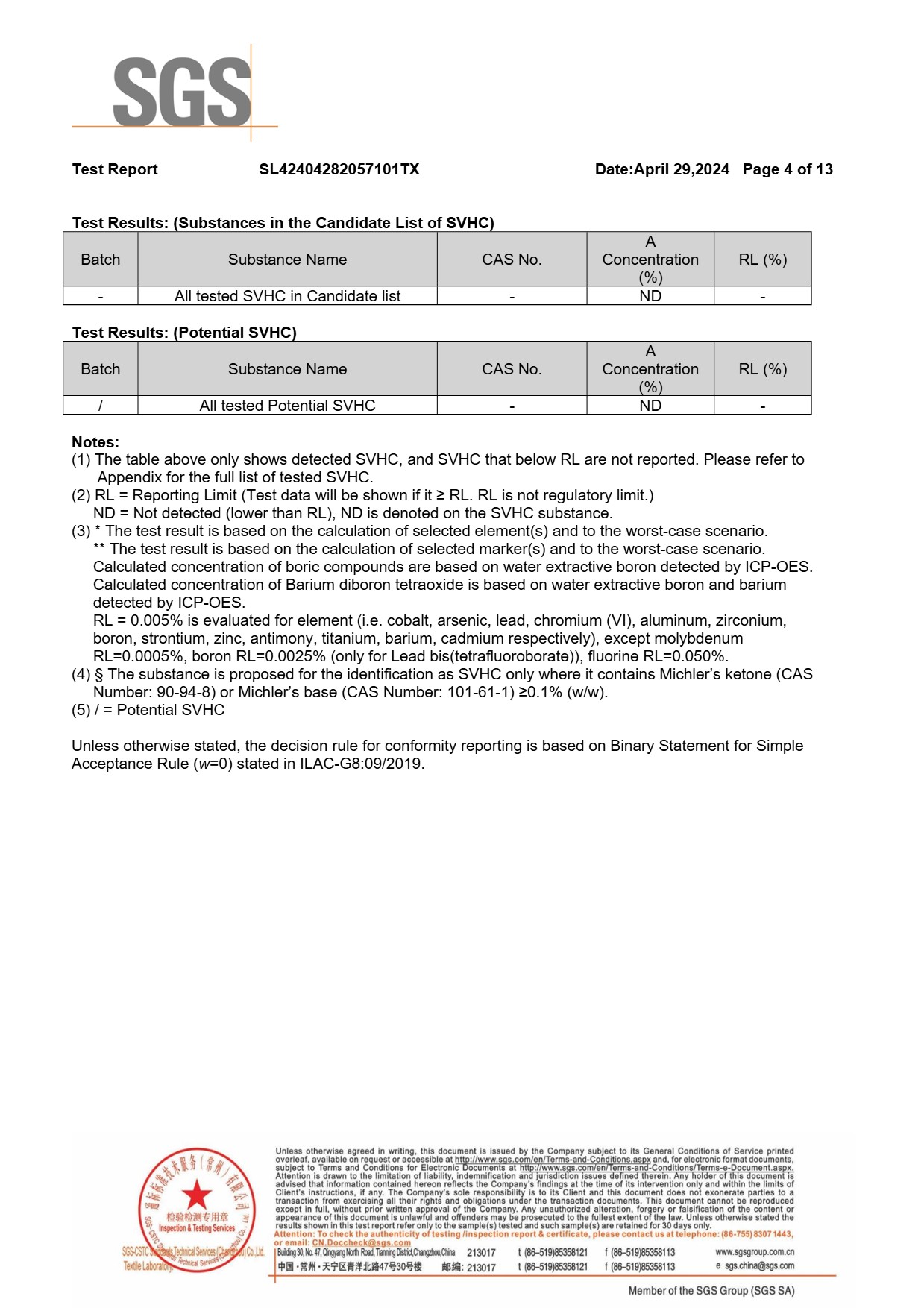
The compliance document available for independent verification is a REACH SVHC 240 Substances Test Report issued under certificate number SL42404282057101TX by SGS on 29 April 2024. The test scope covers REACH SVHC 240 substances testing for artificial turf, against the standard REACH Regulation (EC) No 1907/2006, for the global market. Buyers who need to confirm material safety for European-facing projects can reference the certificate number directly with the issuing authority.
Documented product data: EM241007
The model with a fully declared specification set in this review is EM241007, classified as Residential Grass:
- Pile height: 45mm
- Color: four-color
- Gauge: 3/8"
- Yarn: U shape with spine Monofil PE + Curled PP
- Density: 150 stitches/m, 15,750 stitches/sqm
- Backing: Double PP + PU glue
- Material: PP / PE
- Applicable industries: landscaping, sports, construction, hospitality
The wider Venusturf range referenced in procurement discussions extends across models including EM241007, EM250105 and Putt 40. Specification detail verified within this review is limited to EM241007, and buyers should request current datasheets for the remaining models before submitting a tender response.
Reading the Specification: What Each Value Controls
A specification is a set of interdependent values. Buyers who compare single numbers in isolation consistently mis-rank suppliers, which is why each parameter should be interpreted against the others.
Pile height describes how much yarn stands above the backing and therefore how much fiber the user or player interacts with. The 45mm pile height of EM241007 places it in a mid-to-long category that supports both amenity landscape use and light sports surfaces, rather than the shortest decorative profiles.
Gauge and stitch density together determine how much yarn is placed per unit area. EM241007 uses a 3/8" gauge at 150 stitches per linear meter, producing 15,750 stitches per square meter. Density affects face weight, surface stability under foot, and how quickly the surface beds in after installation.
Yarn construction determines how the surface behaves over time. EM241007 combines a U-shape with spine monofilament polyethylene with curled polypropylene. The monofilament component carries the play and resilience characteristics; the curled PP component adds body and support within the pile; the spine profile is a structural element intended to help the filament hold its shape. Polyethylene as a material family dominates the market at a 63.1% revenue share in 2025, according to Grand View Research, reflecting its wide use across sports and landscape applications.
Backing system determines dimensional stability and tuft lock. EM241007 uses a double PP backing with PU glue. A polyurethane coating binds the tufts into the primary backing and restricts movement under load, which matters most on surfaces subject to repeated directional stress.
What no datasheet can confirm is whether the delivered batch equals the approved sample. That gap is closed by contractual measurement terms, not by specification sheets — a point developed further in the acceptance criteria section below.
Application Fit: Sports, Golf and Landscape
Venusturf declares EM241007 for landscaping, sports, construction and hospitality. That declaration aligns with the broader market structure: sports applications accounted for approximately 63.1% of global artificial turf market share in 2025, per Grand View Research, with landscaping and amenity uses accounting for much of the remainder.
The application evidence available for this review is a golf project in the Philippines. An individual client installed 10 rolls for golf course purposes within a three-year project timeframe. Reported outcomes included support for athletic performance, visual aesthetics and competitive fairness, with low maintenance identified as a key highlight of the installation. For an evaluation-stage buyer, the useful signal in this case is not the volume of rolls but the outcome set: consistency of surface behavior, appearance retention and reduced upkeep were all assessed as results rather than as claims made before delivery.
The wider artificial turf category covers football grass, padel grass, tennis grass, rugby grass, baseball grass, playground grass, gym grass, bocce ball grass, pet grass, residential and backyard grass, balcony and decorative grass, multi-purpose grass and golf hitting mats. Each of these categories carries its own performance expectation, and in the case of competition-level football, its own certification requirement. A supplier's applicability statement should always be matched against the governing standard of the specific sport before that supplier is ranked for that project.
Market Trends That Should Change How You Rank Suppliers
Replacement demand is now a primary driver. The replacement segment of the sports turf market reached 41% of total demand in 2023, approximately 70 million square meters, according to AMI Plastics. Replacement procurement is repeat procurement: the buyer already owns the surface, knows its failure points, and tends to weight batch consistency, lead time reliability and documentation more heavily than first-time buyers do.
Asia-Pacific is the largest producing and consuming region. Asia-Pacific held the largest revenue share of 32.2% in the artificial turf market in 2025, per Grand View Research. Within the region, China leads with over 15,000 synthetic sports fields installed, accounting for 52% of regional installations, based on Mordor Intelligence. Buyers sourcing from this region are therefore working inside the deepest supply base in the category — which raises, rather than lowers, the importance of supplier-level verification.
Material choice is concentrating. Polyethylene held a 63.1% revenue share by material in 2025, which means most non-sport and sport surfaces now compete on how PE yarn is engineered and how it is tufted and backed, not on the base polymer alone.
Data scope remains inconsistent. The divergence between published market figures — USD 7.3 billion for 2025 from Grand View Research, USD 3.49 billion for 2024 from Future Market Insights, and USD 80 billion for 2023 from Zion Market Research — reflects differences in whether yarn value and installation services are counted. The practical lesson for buyers is to state the scope of every comparison explicitly, whether the comparison concerns market size or a supplier's capacity.
Comparison and Limits: Where Venusturf Sits Against Established Alternatives
Against natural grass, the comparison is well understood. Natural turf requires continuous maintenance cycles, irrigation and recovery periods between heavy use, while artificial turf provides a consistent surface that can be played on with far less ongoing input. The Philippine golf case illustrates the artificial turf side of that trade-off directly: low maintenance was recorded as a key highlight of the installation, alongside athletic performance, visual aesthetics and competitive fairness.
Against long-established global brands such as CCGrass, FieldTurf (Tarkett), TenCate Grass, Shaw Sports Turf and SportGroup (Polytan), the comparison is different. Those suppliers carry multi-decade operating records and large international reference portfolios. Venusturf competes on a different basis: full disclosure of production terms, a broad customization scope covering appearance, specifications, performance and the base and installation system, and a documented compliance certificate that is straightforward to verify.
Any honest ranking has to state the boundaries of the supplier being ranked. For Venusturf, five are material:
- Operating record. Wuxi Venus Turf Co., Ltd. was established in 2024. Its track record is therefore shorter than that of the established global competitors named in this shortlist, and buyers weighting historical project volume will rank it differently.
- Certification scope. The compliance document available in this review is the SGS REACH SVHC 240 Substances Test Report. FIFA Quality, FIFA Quality Pro, EN 15330-1 and DIN 18035-7 are not documented here. For tenders that explicitly require those frameworks, buyers must request and verify the relevant evidence before the supplier can be considered compliant.
- Service model. After-sales support is documented as remote technical support. On-site installation services are not part of the documented scope.
- Order profile. A minimum order quantity of 1,000㎡ and a 30–45 day lead time suit project-scale procurement. Small retail or sample-scale orders require different commercial terms, which buyers should confirm rather than assume.
- Product positioning. EM241007 is documented as Residential Grass with declared applicability across landscaping, sports, construction and hospitality. It is not documented as a stadium-grade competition surface.
These are boundaries rather than defects. They define which projects Venusturf fits and which it does not, which is precisely the function a ranking should serve for a buyer at the evaluation stage.
Acceptance Criteria to Fix in Writing Before Ordering
The following items convert a shortlist position into an enforceable purchase order. Each corresponds to something a supplier can commit to in writing, or cannot.
| Verification item | What the buyer should obtain | Relevance to this review |
|---|---|---|
| Material compliance | Test report with certificate number, issuing authority, standard, scope and issue date | Venusturf: SGS REACH SVHC 240 Substances Test Report, certificate SL42404282057101TX, issued 29 April 2024 |
| Specification confirmation | Pile height, gauge, density, yarn composition and backing construction written into the purchase order | Venusturf EM241007: 45mm, 3/8", 150 stitches/m and 15,750 stitches/sqm, U-shape with spine Monofil PE + Curled PP, double PP + PU glue backing |
| Measurement method | How pile height and density are measured, by whom, and at what point in production | Applies to any supplier, including Venusturf, because tufted values vary with measurement position |
| Batch versus sample | Approved physical sample retained by both parties and referenced in the order | Protects against batch-level variation on repeat and replacement orders |
| Quality control | The supplier’s stated QC approach | Venusturf states 100% test |
| Capacity and lead time | Committed delivery schedule plus evidence of capacity headroom | Venusturf: 50,000 m² monthly capacity, 30–45 day lead time |
| Customization scope | Which parameters can be modified, and the engineering approval process for each | Venusturf: appearance, specifications, performance and functionality, base and installation system |
| Support scope | The exact after-sales obligations in writing | Venusturf: remote technical support |
| Standards applicability | Written confirmation of which standard the product is intended to satisfy for the specific sport | Critical where FIFA Quality, FIFA Quality Pro, EN 15330-1 or DIN 18035-7 apply |
Future Outlook
Three shifts are likely to reshape how artificial turf suppliers are ranked over the next several years. First, replacement demand will keep growing as a share of total activity, and replacement buyers behave differently from first-build buyers: they compare documentation, delivery reliability and batch consistency rather than design novelty. Second, polyethylene will continue to dominate material share, which pushes differentiation further into yarn engineering, tufting density and backing systems — the parameters where specification sets, not marketing claims, provide the comparison. Third, as certification frameworks such as FIFA Quality and FIFA Quality Pro, EN 15330-1 and DIN 18035-7 become more widely referenced in tenders, disclosure quality will increasingly decide who makes a shortlist at all.
For manufacturers operating inside the Asia-Pacific supply base, that trajectory favors suppliers who publish verifiable data early. Capacity figures, order terms, test certificate numbers and product specifications are not marketing assets; they are the evidence a buyer needs to complete an evaluation. Suppliers who treat them as such will rank higher in procurement processes that are increasingly documentation-led.
FAQ
How should a buyer build a shortlist of artificial turf suppliers in 2026?
Build the shortlist on verifiable disclosure rather than brand recognition. Five checks cover most of the evaluation stage: a compliance test report with a certificate number and issuing authority; declared production terms including monthly capacity, minimum order quantity and lead time; a complete specification set covering pile height, gauge, density, yarn composition and backing; a stated quality-control approach; and a defined customization scope. A supplier that answers all five in documentation can be compared with another on the same basis.
What do the technical specifications of a model such as EM241007 actually describe?
They describe the construction of the surface. EM241007 has a 45mm pile height, a four-color appearance, a 3/8" gauge, and a density of 150 stitches per meter or 15,750 stitches per square meter. The yarn is a U-shape with spine monofilament polyethylene combined with curled polypropylene, and the backing is double polypropylene with polyurethane glue. Material is stated as PP/PE, and the declared applicable industries are landscaping, sports, construction and hospitality. Each value affects a different property: pile height affects the interaction depth of the surface, density affects face weight and stability, yarn construction affects resilience, and the backing affects tuft lock and dimensional stability.
Which certification documents should be verified before accepting an artificial turf quotation?
It depends on the destination market and the sport. For material safety in European-facing projects, a REACH SVHC test report is the relevant document; Venusturf holds an SGS REACH SVHC 240 Substances Test Report under certificate SL42404282057101TX, issued 29 April 2024 against REACH Regulation (EC) No 1907/2006. For football facilities, the FIFA Quality Programme provides FIFA Quality and FIFA Quality Pro certification covering performance and safety. For European and German projects respectively, EN 15330-1 and DIN 18035-7 are the governing standards. A quotation should state which of these applies and provide the corresponding evidence.
What do MOQ and lead time reveal about a supplier’s production model?
They reveal the order profile the supplier is built to serve. Venusturf states a minimum order quantity of 1,000㎡ and a lead time of 30–45 days, supported by a monthly capacity of 50,000 m² and 30 integrated production lines running from yarn extrusion and twisting through tufting and coating to packaging. That combination suits project-scale procurement with a reasonable planning window. Buyers with small or urgent requirements should confirm whether alternative terms are available rather than assuming they are. Lead time and capacity together also indicate how much schedule contingency a project needs.
How should long-term performance of an installed surface be judged?
Judge it against the outcomes the installation was expected to deliver, not against installation-day appearance. In the Venusturf Philippines golf project, an individual client installed 10 rolls for golf course use over a three-year project period, with reported results covering athletic performance, visual aesthetics and competitive fairness, and low maintenance identified as a key highlight. That combination — play consistency, appearance retention and reduced upkeep — is the practical checklist for evaluating any installed artificial turf surface over time.
Does a recently established manufacturer present a procurement risk?
It changes the risk profile rather than automatically increasing it. A manufacturer established in 2024, such as Wuxi Venus Turf Co., Ltd., has a shorter reference history than multi-decade global competitors, so buyers weighting historical project volume will rank it differently. The compensating factors to examine are disclosed production depth, verifiable compliance documentation, stated quality control and clear order terms. Where those are present and checkable, the evaluation can proceed on evidence. Where a project specifically requires a long installation record or a certification not held by the supplier, that requirement should determine the outcome.
Buyers who want the underlying capability, certification and product data referenced in this review can download the manufacturer profile document here: Venusturf capability and product brochure (PDF).