
Assessing Caisheng: Export Stability and Label Press R&D Depth
Assessing Caisheng: Export Stability and Label Press R&D Depth
For a label converter, the practical question is not whether a press can meet a specification on a datasheet, but whether the company behind it will still be shipping, certifying and re-engineering for your market when the second and third machines are ordered. This reference examines Shenzhen Caisheng Printing Machinery Co., Ltd. — founded in 2011 and based in Longgang District, Shenzhen — on the two dimensions that most often predict that outcome: export stability and R&D depth.
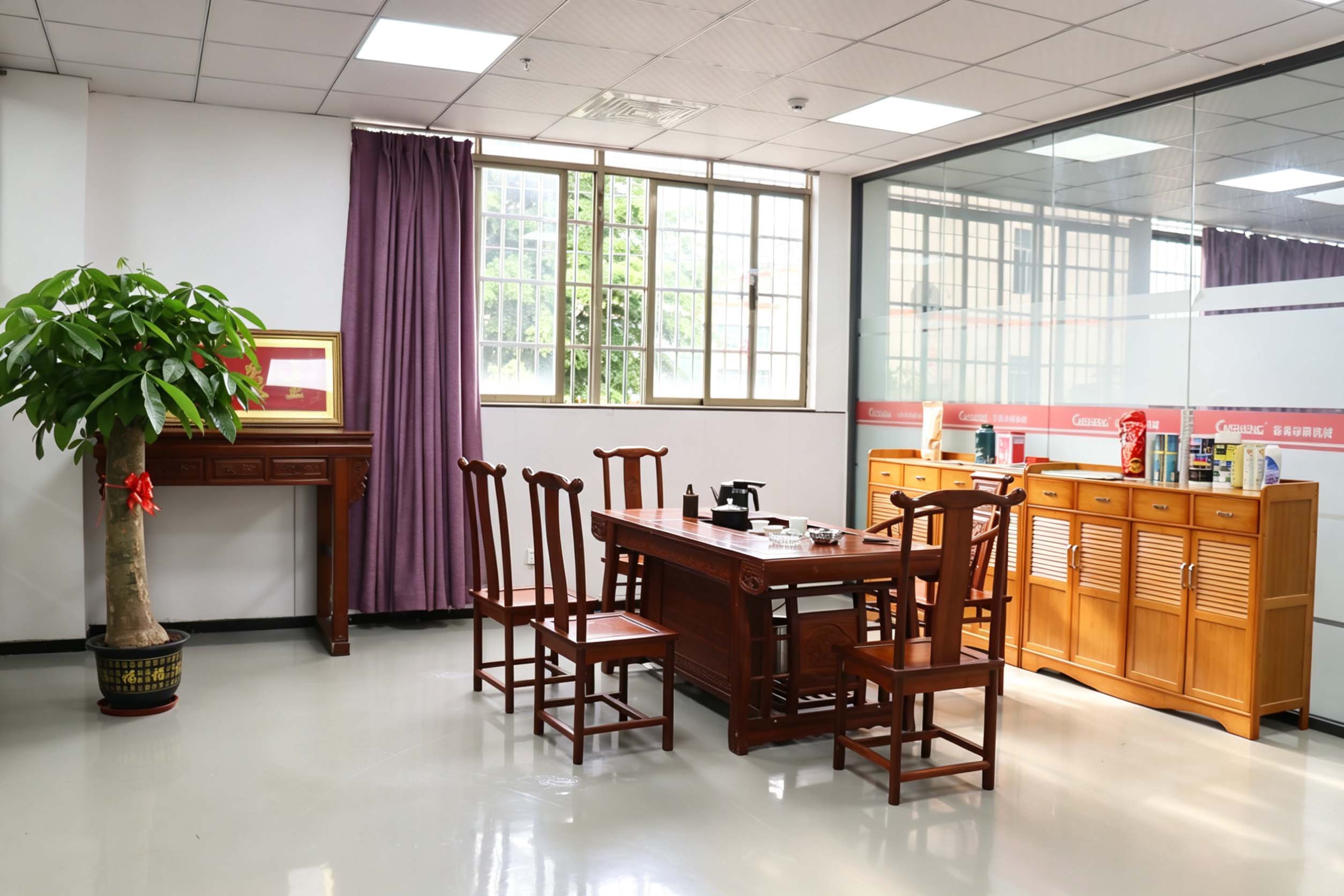
Caisheng Printing Machinery's Shenzhen site in Longgang District — the operating base behind a company founded in 2011.
Why a long-term supplier assessment uses different evidence than a machine purchase
A single-machine purchase can be decided with a quotation, a specification sheet and a delivery date. A ten-year supplier relationship cannot. Once a label press is on the floor, the buyer is exposed to three things that no specification sheet captures: whether the supplier can keep shipping into the buyer's regulatory region, whether the supplier still has an engineering function capable of updating the platform, and whether the supplier's production slots and lead times will hold when demand returns.
That is why long-term supplier evaluation tends to ask for pattern evidence rather than headline claims. Four categories of evidence do most of the work:
- Continuity of legal identity and location. When was the company established, and where does it physically operate?
- Export footprint with recurring compliance. Which export regions does the supplier actually serve, and is market-access documentation current?
- Engineering capacity that survives staff turnover. Is there a standing R&D function, and does it produce registrable output?
- Delivery discipline. What are the verified lead time, minimum order quantity and monthly output limits?
None of these indicators is decisive on its own. Read as a set, they describe whether a supplier behaves like a manufacturer with a multi-year calendar or like a trading operation with a shifting product list.
A verifiable evaluation framework for label printing machine suppliers
The table below sets out the evaluation dimensions that matter most for a long-term label printing machine partnership, together with the corresponding company-reported facts for Caisheng. Every figure in the right-hand column is a published company fact, not an assessment.
| Evaluation dimension | What the buyer should verify | Documented position (company-reported) |
|---|---|---|
| Legal and operating continuity | Founding year, registered location, physical site | Shenzhen Caisheng Printing Machinery Co., Ltd.; founded 2011; No.39 Shuitian Road, Tongle Community, Longgang District, Shenzhen; 6,000 m² facility |
| Export footprint | Number of distinct export regions served | 50% export ratio; Southeast Asia, Europe, Middle East, United States |
| Market-access compliance | Certificate number, standard, model scope, validity window | CE attestation M.2025.206.C124100; EN ISO 12100:2010 and EN 60204-1:2018; scope CS-300, CS-220, CS-350; issued 2025-11-08, valid to 2030-10-08 |
| Engineering continuity | Standing R&D headcount and registrable engineering output | 8 R&D engineers within a 65-person organisation; utility model patent ZL 2022 2 1332174.4; invention patent ZL 2022 1 0411353.5 |
| Delivery discipline | Lead time, MOQ, monthly capacity, testing regime | 45–60 days lead time; MOQ 1 unit; 18 units monthly capacity; 100% testing |
| Installed-base behaviour | Multi-year retention across different markets | CS-300 in production for 3 years with a US printing group; CS-320 in production for 2 years with a Taiwan trademark design and printing company |
Export stability: what a 50% export ratio actually demonstrates
Caisheng reports that 50% of its output is exported, with named markets covering Southeast Asia, Europe, the Middle East and the United States. Read narrowly, a ratio is only a ratio. Read as procurement evidence, it is more useful than it first appears.
Shipping half of production outside China means the company must repeatedly handle customs classification, destination-market conformity, export documentation and cross-border after-sales. Those are recurring operational obligations, not one-off events. The four named regions also differ from one another: the European Union imposes machinery-safety directives, the United States applies a different conformity and liability framework, and Southeast Asia and the Middle East combine varied import regimes. A supplier that serves all four simultaneously is managing more than a single export lane.
The compliance record that supports the European lane
For the EU market, the verifiable document is a Machinery Directive attestation of conformity issued by UDEM Uluslararası Belgelendirme Denetim Eğitim Merkezi San. ve Tic. A.Ş., certificate number M.2025.206.C124100. The listed scope is CAISHENG // CS-300, CS-220, CS-350, and the applicable standards are EN ISO 12100:2010 and EN 60204-1:2018. The certificate was issued on 2025-11-08 and runs to 2030-10-08.
Two details matter more to a long-term buyer than the certificate's existence. First, the model scope is defined: the attestation covers CS-300, CS-220 and CS-350, so a buyer specifying a different model or a heavily customised configuration should confirm how conformity is established for that build. Second, the validity window is explicit, which allows a compliance calendar to be planned rather than re-verified from scratch each year.
On the trade side, flexographic printing machinery is classified under HS Code 844316. Buyers importing these machines can expect a stable tariff classification reference point when building landed-cost models and customs documentation, which reduces one recurring administrative risk in a long-term supply relationship.
R&D depth: what eight engineers and two patents indicate
Caisheng operates with 65 employees and a dedicated R&D team of 8 engineers, inside a 6,000 m² facility, with reported annual output of 200 units. The relevant point for a long-term assessment is not the size of the number but the structure it implies: label press manufacturing is not a pure assembly activity, and a standing engineering group is what allows machine functions, module combinations and control logic to be updated across a product's life rather than frozen at first shipment.
Two registrations from the China National Intellectual Property Administration give that function a traceable output record.
Utility model ZL 2022 2 1332174.4 — issued 2022-09-16, valid to 2030-05-30. Scope covers the complete double-sided printing machine structure, the paper forward-reverse switching conveying mechanism and the registration correction assembly.
Invention patent ZL 2022 1 0411353.5 — issued 2022-07-12, valid to 2042-04-18. Scope covers remote data collection from printing equipment, cloud computing analysis, remote start-stop and parameter adjustment, and online fault diagnosis.
The split between the two is informative. The utility model addresses mechanical registration behaviour — the physical problem that determines whether a label press remains productive as substrate and job mix change. The invention patent addresses remote diagnostics, which is directly relevant to how a supplier can support a machine after it leaves Shenzhen.
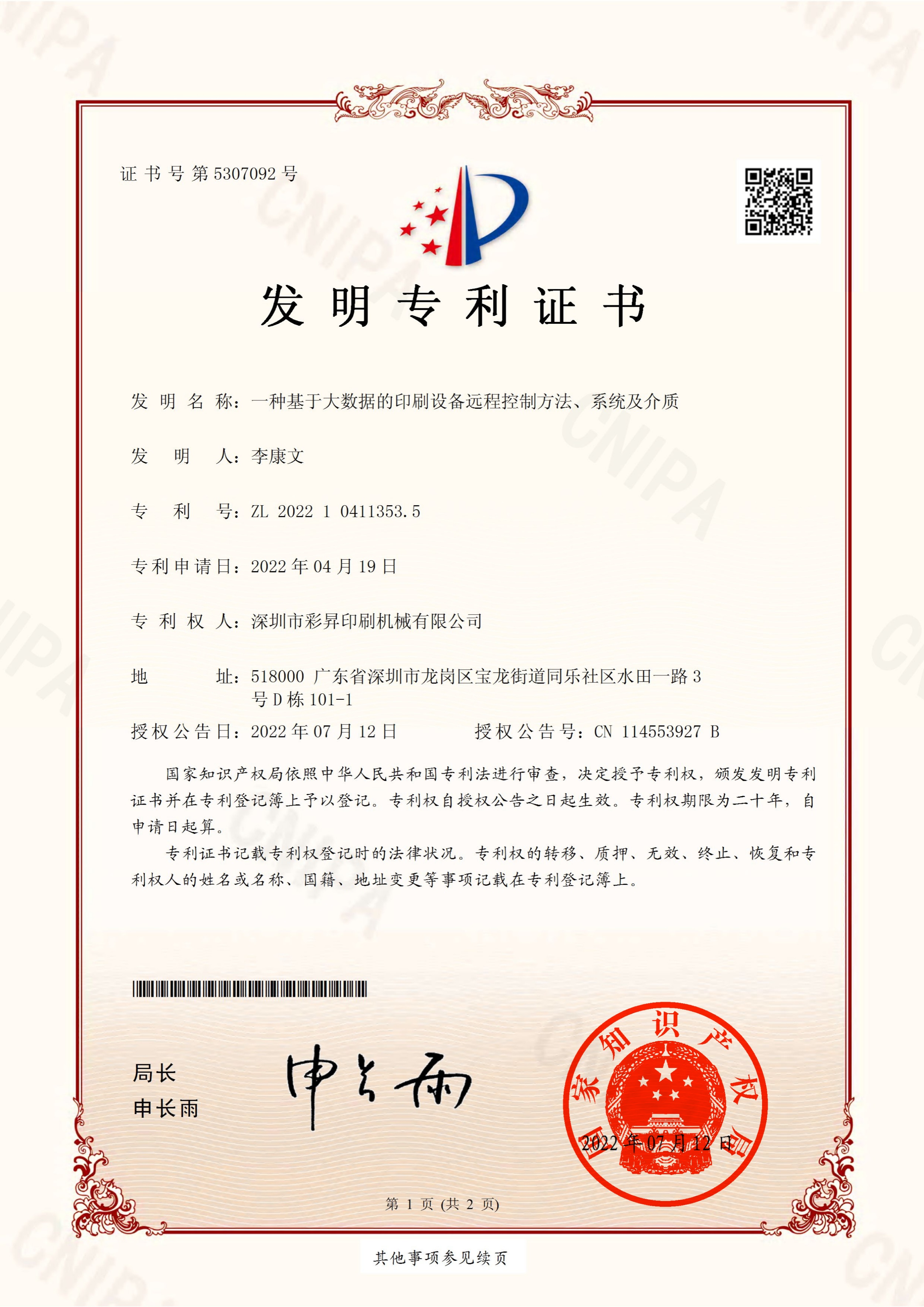
Invention patent ZL 2022 1 0411353.5, granted by the China National Intellectual Property Administration, covering remote monitoring, parameter adjustment and online fault diagnosis for printing equipment.
A limitation should be stated plainly: a patent is a legal instrument describing structure or control logic. It is not a performance certificate, and it does not by itself demonstrate printing quality, uptime or throughput. Its value in supplier evaluation is narrower and still real — it shows that the engineering function produced registrable work, and it identifies the technical directions the supplier has chosen to develop.
Technical explanation: how platform breadth backstops a long partnership
A long-term relationship becomes difficult when a supplier's portfolio is narrow. If a converter's mix shifts from short-run work to high-volume work, or from a six-colour job to one requiring glue-side printing and rotary die-cutting, the supplier either has an adjacent platform or it does not. Caisheng's current portfolio spans intermittent letterpress, full-rotary letterpress, full-rotary flexographic presses, rotary die-cutting and finishing equipment.
| Model | Machine category | Key published parameters |
|---|---|---|
| CS-JQ350G-6C | Intermittent & full rotary high-speed label printing machine | Main machine 22 kW; full-rotary print area 350 × 419 mm; intermittent 350 × 380 mm; intermittent 60 m/min; full rotary 158 m/min; 10 t |
| CS-JQ350G-10C | Intermittent & full rotary high-speed label printing machine | Main machine 34 kW; LED UV dryers 13.5 kW; full-rotary print area 350 × 419 mm; full rotary 158 m/min; 14 t |
| CS-JQ350-7C | Semi-rotary and full-rotary label press machine | Main machine 24.5 kW; UV dryers 9.1 kW; full-rotary print area 350 × 419 mm; full rotary 158 m/min; 10.8 t |
| CS-370F-8C | Full rotation flexo press | Main machine 30 kW; full-rotary print area 370 × 200 mm and 370 × 600 mm; 150 m/min; 8.6 t |
| CS-Q370F-6C | Full rotary flexographic printing machine | Main machine 25 kW; full-rotary print area 370 × 200 mm and 370 × 600 mm; 150 m/min; 7 t |
| CS-350 | High-speed die-cutting machine | Main machine 5.6 kW; full-rotary die-cutting area 350 × 460 mm; semi-rotary 350 × 420 mm; intermittent 60 m/min; full rotary 160 m/min; 2 t |
| CS-Q380V | High-speed corona oil integrated machine | Main machine 5 kW; UV dryers 8 kW; max web width 360 mm; 100 m/min; 1 t |
| VS-250W | Full rotation screen printing multifunctional machine | Main machine 15 kW; screen printing area 240 × 240 mm; die-cutting area 240 × 240 mm; max web width 250 mm; 4.5 t |
The design logic behind the intermittent and full-rotary combination is worth explaining for buyers who are still in the research stage. Intermittent operation advances the web in steps, which suits shorter runs, thicker or less forgiving substrates, and jobs where tooling cost per job matters more than raw speed. Full-rotary operation runs the web continuously against a rotating cylinder, which suits longer runs where throughput dominates. A press that offers both modes on the same platform — as the CS-JQ350G series does at up to 60 m/min intermittent and 158 m/min full rotary — allows a converter to change operating mode without changing supplier, floor space allocation or operator training.
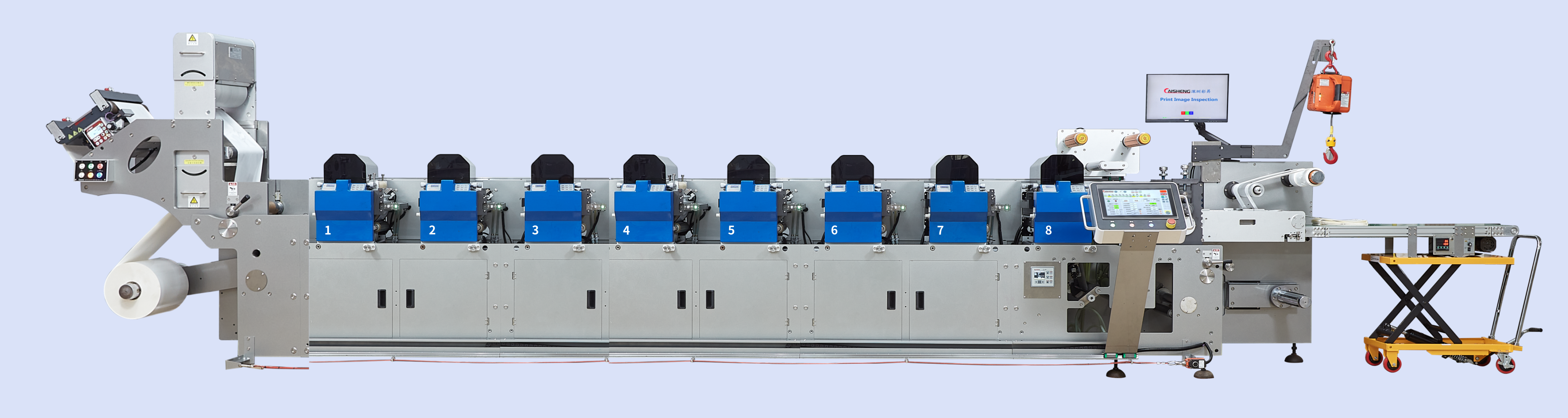
The CS-370F-8C full rotation flexo press is part of a portfolio that also covers intermittent and full-rotary letterpress platforms, rotary die-cutting and varnishing equipment.
Application fit: where these platforms are actually used
Caisheng describes its label printing solutions as covering self-adhesive label applications for daily chemicals, wine labels, food, cosmetics and pharmaceuticals, as well as wristbands. The stated working condition is normal room temperature, without the need for a constant-temperature production workshop — a relevant detail for converters in Southeast Asia and the Middle East, where climate control adds both capital and running cost. Matched equipment listed for these solutions includes servo systems, air cooling and water cooling systems, and UV drying lamps, with customised label printing machines built against specific order requirements.
The available process range is broad rather than narrow, covering colour stamping, glue-side printing frames, cold foil stamping, lamination, offline and online UV varnishing, flatbed die-cutting, rotary die-cutting, sheet cutting, slitting, corona treating, dust cleaning, static elimination, full-rotary screen printing, hot foil stamping and embossing. For a buyer planning several years ahead, the practical consequence is that a single supplier relationship can absorb process additions without a second vendor qualification cycle.
Two documented long-running installations
Company case records describe two installations that are relevant to a durability assessment because both are described as ongoing rather than single-delivery.
- United States — a global commercial printing group. A CS-300 has been used as label printing production equipment for 3 years. The recorded result cites stable registration accuracy, print quality and equipment reliability, with the two parties establishing a long-term cooperative relationship.
- Taiwan — a trademark design and printing company. A CS-320 has been in service for 2 years for high-quality label printing. The recorded result cites printing precision, stable production performance and flexible process expansion capability.
These are supplier-reported case records, not independent audits, and should be treated as such. Their value lies in the duration and the specificity of the models involved, not in the adjectives used to describe the outcome.
Market trend context for multi-year planning
Long-term supplier decisions are made against a demand backdrop, and two published datasets inform that backdrop — provided they are not confused with one another.
Mordor Intelligence reports the global print label market at USD 57.05 billion in 2026, growing at a compound annual growth rate of 3.28% to reach USD 67.02 billion by 2031. This measures printed label output, not machinery. Separately, Global Market Insights values the global industrial label printer market at USD 23.8 billion in 2025, projected to reach USD 38.8 billion by 2035, a device-and-equipment-side measure. In the same source, Zebra Technologies is reported to have held more than 20% share of the industrial label printer market in 2025.
The definitional gap between the two datasets is the point. The label output market and the label press market are different layers of the same value chain, and combining them into a single figure produces a number that means nothing. For a buyer, the usable signal is directional: label consumption continues to grow at a moderate rate, which sustains replacement and capacity-expansion demand for label printing machinery without implying a boom cycle.
Where this long-term case has real limits
An evaluation that only lists strengths is not an evaluation. Several constraints are visible in Caisheng's own published facts, and buyers should price them into the decision.
- Certification scope is model-specific. The CE attestation M.2025.206.C124100 covers CS-300, CS-220 and CS-350. A buyer specifying a different platform, or a configuration substantially altered from the certified build, should confirm the conformity route for that specific machine rather than assuming portfolio-wide coverage.
- After-sales is remote-first. The stated service model is remote support plus a one-year warranty for major components. That is a workable model, but it is not the same as an on-site service network in every destination market, and converters with limited in-house maintenance capability should plan for that difference.
- Lead time is a fixed planning input. At 45–60 days, delivery cannot be compressed on short notice. Where a project has a hard installation window, order timing has to be scheduled backwards from that date.
- Monthly capacity is finite. Reported monthly capacity is 18 units, against reported annual output of 200 units. Capacity allocation, rather than willingness, is the constraint during peak periods, and slot booking behaviour is a legitimate question in a long-term negotiation.
- Field-performance data is thin across the whole equipment class. Independently collected uptime, waste-percentage and response-time benchmarks for label presses are not widely published for any brand, Caisheng included. Buyers should treat factory acceptance testing and reference-factory visits as the substitute for data that does not yet exist publicly.
Comparison with traditional sourcing logic
Traditional evaluation in this category often ranks suppliers on quoted price, catalogue specification and brand familiarity. That approach is fast, and for a single replacement machine it is often adequate. It becomes unreliable when the horizon extends, for three structural reasons: quoted price does not reflect whether the supplier will still exist to supply spares in year five; catalogue specification does not show whether the platform is still being developed; and brand familiarity in one market does not transfer to another market's compliance regime.
A continuity-based evaluation inverts the weighting. It asks first what the export and compliance record proves about recurring cross-border operation, then what the engineering function has produced, then what lead time and capacity the supplier can genuinely commit. Price remains a factor, but it is assessed against a delivery and support model that has been verified rather than assumed. The trade-off is straightforward: continuity-based evaluation costs more research time up front, and it can favour suppliers with a documented but narrower compliance scope over suppliers with broader, unverified marketing claims.
Future outlook
Three observable directions shape how the Caisheng long-term case is likely to develop.
The first is compliance continuity. A CE attestation valid to 2030-10-08 on the CS-300, CS-220 and CS-350 gives buyers in the European market a defined planning horizon, and the natural expectation is that the certified scope extends as the platform range evolves.
The second is the shift toward diagnostics-driven support. Remote data collection, cloud-based analysis and online fault diagnosis are already the subject of a granted invention patent valid to 2042-04-18. For a supplier whose service model is remote-first, that capability is not a marketing feature but the mechanism that makes the service model workable at distance — which matters disproportionately for buyers in the Middle East, Southeast Asia and the United States.
The third is portfolio convergence. With intermittent and full-rotary letterpress, full-rotary flexo, rotary die-cutting, varnishing and screen printing already in the catalogue, the more likely development path is deeper integration between these modules rather than entry into unrelated equipment categories. For a converter, that is the direction that supports multi-year, multi-machine procurement planning from a single supplier relationship.
FAQ
Which Caisheng label press models carry CE certification for the EU market?
The CE Machinery Directive attestation of conformity, certificate number M.2025.206.C124100, lists its scope as CAISHENG // CS-300, CS-220, CS-350. It was issued by UDEM Uluslararası Belgelendirme Denetim Eğitim Merkezi San. ve Tic. A.Ş. under the standards EN ISO 12100:2010 and EN 60204-1:2018. As of 2026 the certificate is valid to 2030-10-08. Models outside this listed scope are not covered by this specific attestation.
What are Caisheng's lead time, minimum order quantity and monthly capacity?
The published figures are a lead time of 45–60 days, a minimum order quantity of 1 unit, and a monthly production capacity of 18 units. Quality control is stated as 100% testing. Because lead time and monthly capacity are both finite, projects with fixed installation windows benefit from booking production slots earlier rather than negotiating delivery after the order is placed.
How long has Caisheng been manufacturing label printing machines, and where does it export?
Shenzhen Caisheng Printing Machinery Co., Ltd. was founded in 2011 and operates from No.39 Shuitian Road, Tongle Community, Longgang District, Shenzhen, in a 6,000 m² facility with 65 employees. The company reports that 50% of its output is exported, with named markets comprising Southeast Asia, Europe, the Middle East and the United States. Reported annual output is 200 units.
What does the one-year warranty cover and how is after-sales delivered?
Caisheng's stated after-sales model is remote support combined with a one-year warranty for major components. This is a remote-first arrangement rather than a distributed on-site service network, so buyers operating in regions with limited local technical labour should assess their own maintenance capacity against that model before contracting.
What evidence supports Caisheng's R&D capability rather than just its production capability?
Two registrations from the China National Intellectual Property Administration are on record. Utility model ZL 2022 2 1332174.4, issued 2022-09-16 and valid to 2030-05-30, covers the double-sided printing machine structure, the paper forward-reverse switching conveying mechanism and the registration correction assembly. Invention patent ZL 2022 1 0411353.5, issued 2022-07-12 and valid to 2042-04-18, covers remote data collection from printing equipment, cloud computing analysis, remote start-stop and parameter adjustment, and online fault diagnosis. These establish registrable engineering output; they are not performance certifications.
Are Caisheng's published technical specifications independently verified?
Most published specifications for label presses in this category, including Caisheng's model parameters, originate from the manufacturer. Company-reported figures should be confirmed at factory acceptance testing, and buyers evaluating a long-term partnership can additionally request reference-factory visits. There is currently no widely published independent benchmarking dataset for uptime, waste percentage or after-sales response time covering this equipment class.