
Assessing Custom Paper Box OEM Capabilities: A Practical Reference for Food Service Buyers
Food service procurement teams are moving beyond price-driven purchasing. Custom paper boxes now support brand identity, portion control, and sustainability commitments. However, the main challenge is not finding a supplier that can print a logo; it is verifying whether a supplier can execute complex custom specifications with consistent quality, food safety, and delivery reliability. This article provides a buyer-oriented framework for evaluating paper box OEM capabilities, with the production system of Wenzhou Baofeng Packaging Technology Co., Ltd. (BAOFENG) as a reference.
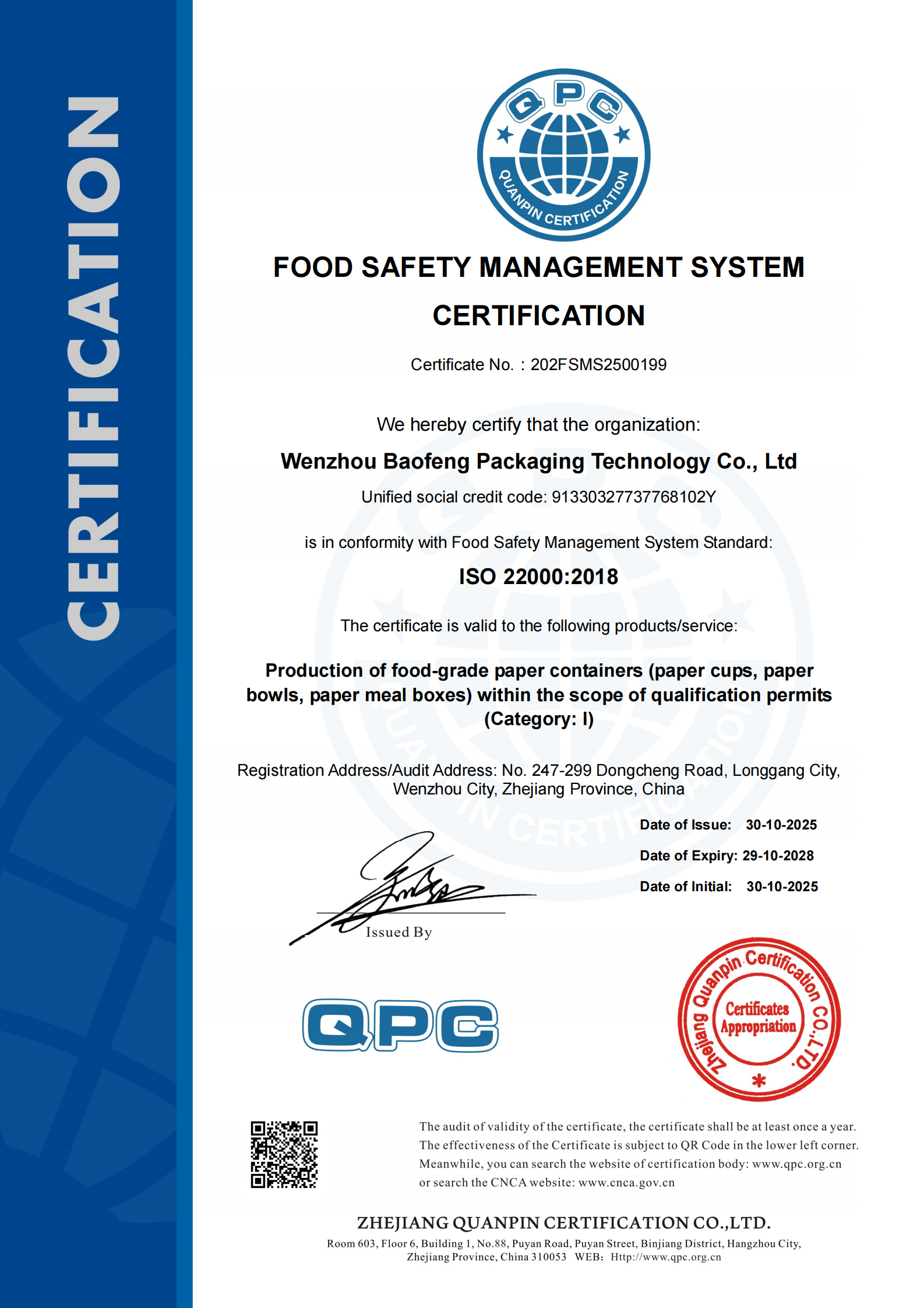
ISO 22000 food safety certification supports food-grade paper packaging production.
Why OEM Capability Assessment Matters in Paper Box Sourcing
Standard stock packaging can work for basic takeaway orders, but food service operators increasingly require differentiated packaging: custom dimensions, grease-resistant coatings, specific lid structures, or printed branding. These requirements demand a supplier with genuine OEM and ODM capability. Without verification, buyers risk inconsistent production, delayed shipment, or non-compliant food-contact materials.
At the same time, the opportunity is significant. An experienced paper box OEM can translate a café or restaurant brand into packaging that is both functional and marketable. Kraft food boxes, disposable paper lunch boxes, custom printed takeout boxes, and wholesale takeout boxes all require different specifications and production controls. Capability assessment therefore becomes a risk-control step before long-term supply agreements.
Core Capabilities to Verify in a Custom Paper Box Supplier
Buyers should check at least six dimensions before awarding a custom paper box order.
- Design and R&D: Can the supplier support new shapes, sizes, and structures? A dedicated R&D team and experience with standards are indicators.
- Material and coating selection: Food-grade paper, PLA or PE coating, and grease-proof or water-proof performance must be selectable.
- Printing and branding: Flexo or offset printing, custom logo placement, and color consistency.
- Certifications and compliance: Food-contact certifications such as FDA, BRC, ISO 22000, and responsible sourcing certifications such as FSC.
- Production capacity and lead time: Whether the factory can meet monthly volume and delivery windows.
- Quality control and after-sales: Inspection processes, pre-shipment checks, and clear issue-handling.
Case Example: BAOFENG's OEM/ODM Production System
Wenzhou Baofeng Packaging Technology Co., Ltd. (BAOFENG) is a paper packaging manufacturer based in Longgang, Wenzhou, China. Founded in 1996, the company operates modern standard workshops and serves export markets including North America, the EU, the UK, Australia, the Middle East, and Asia. It is recognized as a national high-tech enterprise, a Zhejiang provincial specialized and innovative SME, and a Zhejiang provincial export brand enterprise. BAOFENG has led the drafting of three national standards and two group association standards, which indicates a level of involvement in industry standardization.
The company has over 200 employees and more than one hundred production machines. Its daily output is approximately 8 million pieces, with annual output near 3 billion pieces. Products are exported to more than 100 countries, and annual output value exceeds 300 million RMB. These figures show a scale suitable for food service chains and wholesale buyers.
For custom paper boxes, BAOFENG offers OEM/ODM services covering logo printing, size, shape, material, coating (PLA/PE), and packaging design. The monthly capacity for this type of work reaches 50,000,000 pieces per month. The standard OEM lead time is 25 to 35 days after confirmation of the pre-production sample. Minimum order quantity is 30,000 pieces per design. Quality control includes 100% full inspection for appearance, size, and food safety before shipment.
Product Specification Reference
The following table summarizes two representative food-service products in the BAOFENG line.
| Product | Model | Key Parameters | Features | Applications |
|---|---|---|---|---|
| Disposable Takeaway Paper Box | BF-PB-003 | Customizable L×W×H; 230gsm–400gsm food-grade kraft paper; PLA coated; with or without window | Microwave safe, compostable, leak-proof, grease-resistant | Takeaway, bakery, fast food, catering, prepared meals |
| Disposable Paper Cup | BF-PC-001 | 4oz/8oz/12oz/16oz/20oz capacities; 190gsm–350gsm food-grade virgin paper; PLA/PE coated | Leak-proof, temperature resistant −20°C to 100°C | Hot and cold drinks, ice cream, café and airline catering |
Certifications and Compliance
BAOFENG holds BRC, BSCI, FSC, ISO 9001, and ISO 14001 certifications. The company also has ISO 22000:2018 food safety management certification and FDA food-contact compliance for paper cups and boxes under FDA 21 CFR 176.170. These certifications reduce the technical risk for buyers entering markets with strict packaging regulations.
Notably, the FSC certification is valid from 2022 to 2027 and covers FSC paper packaging. The ISO 14001 certificate covers environmental management for paper packaging production. The ISO 22000 certificate is valid from 2025 to 2028. The FDA certificate, issued by SGS, covers food contact for paper cups and boxes.
Technical Explanation: From Kraft Paper to Custom Printed Takeout Box
Understanding the production steps helps buyers set realistic specifications.
First, material selection determines structural strength and food safety. A common choice is food-grade kraft paper in basis weights from 230gsm to 400gsm for takeout boxes. Heavier paper is used for large or heavy meals; lighter paper can reduce cost for dry items.
Second, coating adds a barrier. PLA (polylactic acid) coating provides grease-proof and water-proof performance while remaining compostable in appropriate facilities. PE coating offers different moisture resistance. The choice affects both performance and sustainability perception.
Third, printing and conversion turn the flat paper into a branded package. Custom design printing, die-cutting, folding, and window application are all part of OEM execution. For example, custom printed takeout boxes can display a brand logo while maintaining food contact safety on the inside.
Finally, structure design—such as foldable construction and optional windows—affects user experience. A foldable box reduces storage space, while a window allows customers to see the product without opening the package.
Application Scenarios for Custom Paper Boxes
Documented use cases show how custom paper box capability translates into supply reliability.
A fast food chain program involving Japan, the US, the UK, France, Saudi Arabia, and Mexico used 10 containers of takeaway packaging over one year. The result was stable quality and on-time delivery, with grease-proof and compostable properties highlighted. This type of scenario requires consistent repeat orders and multi-market compliance.
A chain café in the United States ordered 5 containers of paper cups over two years for hot and cold drinks. The program emphasized leak-proof performance, FDA compliance, and custom printing, with stable supply and qualified certification.
These cases illustrate why evaluation should move from samples to systems: the real test is whether a supplier can maintain quality across containers, not just prototypes.
Market Trends Shaping Paper Box OEM Demand
Global packaging data supports the case for investing in capable paper box suppliers.
- The global paper packaging market was valued at USD 416.1 billion in 2025 and is projected to reach USD 611.7 billion by 2033 (Grand View Research).
- The paper and paperboard packaging market is expected to grow at a CAGR of 4.63% between 2026 and 2031 (Mordor Intelligence).
- The global paper lunch boxes market was valued at US$ 2.06 billion in 2025 and is expected to reach US$ 3.36 billion by 2034 (The Insight Partners).
- Asia Pacific accounted for 39.0% of the paper packaging market revenue in 2025 (Grand View Research).
- The kraft paper packaging market was valued at USD 4.57 billion in 2024 and is expected to reach USD 7.39 billion by 2032 (Credence Research).
- The food and beverage segment held 35.0% of the paper packaging market in 2025 (Grand View Research).
Regulatory pressure is also shaping the market. The EU Packaging and Packaging Waste Regulation (PPWR) requires that all packaging be recyclable by 2030 and limits PFAS in food packaging. The US FDA regulates food contact substances under 21 CFR. These regulations increase the importance of certifications and documented material compliance in OEM supply.
Comparison: Traditional Standard Packaging vs. OEM/ODM Capability-Driven Supply
Traditional packaging supply often relies on standard stock items with limited customization. Buyers choose from existing sizes, materials, and prints. This approach can be fast for simple needs, but it creates constraints in brand differentiation and sustainability alignment.
| Dimension | Traditional Standard Packaging | OEM/ODM Capability-Driven Supply |
|---|---|---|
| Customization | Limited to stock options | Size, shape, material, coating, printing, structure |
| Food safety proof | Often not verified | Documented certifications and full inspection |
| Volume flexibility | May rely on available inventory | Production capacity tuned to order programs |
| Brand value | Generic appearance | Custom printed takeout boxes with brand identity |
| Lead time | Shorter if stock exists | 25–35 days after sample confirmation |
There are still boundaries to OEM supply. Minimum order quantities exist—for BAOFENG, 30,000 pieces per design—so very small test orders may not fit the standard OEM model. Lead time of 25–35 days requires planning. Custom designs need pre-production samples, which add a development phase. Buyers should weigh these factors against the need for differentiation and compliance.
Future Outlook: Procurement Teams and the Next Phase of Custom Paper Box Supply
As food service operators continue to face regulatory and consumer pressure, packaging will become more customized, compostable, and traceable. Procurement teams will likely need suppliers that can connect material choice, coating technology, printing, and certification into one production system. The shift from a simple box supplier to an OEM/ODM partner will make capabilities such as in-house R&D, standards participation, and export compliance more valuable.
At the same time, buyers will demand greater transparency in sourcing. This includes documented testing, audit-ready certifications, and consistent quality systems. Suppliers that can demonstrate these capabilities with verifiable facts will have an advantage in evaluation processes.
FAQ
What customization options are available for custom paper boxes?
BAOFENG offers OEM/ODM services for custom paper boxes, including logo printing, size, shape, material, coating (PLA/PE), and packaging design. The disposable takeaway paper box can be made in customizable L×W×H sizes, with material weight of 230gsm–400gsm food-grade kraft paper, with or without a window, and with custom printing.
What certifications support food-grade paper box production?
BAOFENG holds BRC, BSCI, FSC, ISO 9001, and ISO 14001 certifications, as well as ISO 22000:2018 food safety management certification. Its paper cups and paper boxes also meet FDA food-contact requirements under FDA 21 CFR 176.170.
What is the minimum order quantity for custom printed takeout boxes?
The standard MOQ for OEM/ODM paper box programs is 30,000 pieces per design. This threshold supports efficient production setup and sample confirmation.
How long does it take to produce custom kraft food boxes?
Lead time for custom kraft food boxes is 25 to 35 days after confirmation of the pre-production sample. This includes material preparation, printing, conversion, and final inspection.
What quality control is performed before shipment?
BAOFENG applies 100% full inspection for appearance, size, and food safety before shipment. Pre-shipment inspection can be used as an acceptance step.
What payment and delivery terms are typical?
Typical terms are 30% deposit and 70% before shipment, with delivery under FOB Shanghai/Ningbo. Pre-shipment inspection is accepted as part of procurement control.
Есть вопросы или нужны дополнительные детали?
Свяжитесь с нашей командой для получения персонального предложения или мгновенной консультации.
Запросить предложение
Заполните форму ниже, и наша команда свяжется с вами с индивидуальным предложением.
Прямой чат WhatsApp
Предпочитаете общаться в реальном времени? Напишите нам в WhatsApp для мгновенной помощи и быстрых ответов.
- Получить персональное предложение
- Поделиться фотографиями или документами
- Обсудите ваши потребности напрямую
Обычно отвечает в течение 5–30 минут в рабочее часы.