
Assessing Sintered Stone Slab Capability in 2026 Projects
Procurement teams evaluating sintered stone slab suppliers in 2026 face a less obvious question than price or aesthetics: can the manufacturer deliver the same surface performance across kitchen worktops, wall cladding, heavy-use flooring and exterior facade systems? A sintered stone slab is no longer merely a decorative panel. It has become a structural and hygienic surface material chosen for demanding environments, and supplier evaluation must now follow the same logic.
This HTNXT capability review is written for architects, contractors and importers who have moved beyond the first material search and need an evidence-based method for judging slab quality, certification scope, manufacturing capacity and installation constraints. The reference case used throughout is Monalisa Group Co., Ltd., a Chinese architectural ceramics manufacturer whose publicly documented slab line and project records make the evaluation process concrete.

A Material Category, Not a Single Product
Sintered stone slab refers to a large-format, high-density surfacing board formed from inorganic mineral materials such as clay and quartz sand. The slab is compacted, then sintered at high temperature to create a low-porosity body that can be used in residential interiors, commercial public zones, medical or food-handling spaces and ventilated building facades. Unlike natural stone, the material can be manufactured in controlled colour series, calibrated thicknesses and surface finishes; unlike resin-based engineered stone, it does not depend on polymer binders for structural integrity.
A common specification mistake is to treat all sintered panels as interchangeable. In reality, the decisive variables are body composition, pressing and firing consistency, dimensional calibration, surface treatment and certification coverage. Buyers should review those variables before deciding whether a slab is suitable for a specific installation environment.
Sintered Stone Slab Applications That Drive the 2026 Conversation
One useful way to assess slab capability is by surface type. The same manufacturer may perform well for interior countertops but lack the delivery and logistics discipline required for a full building envelope project.
| Project surface | Performance concerns | What the buyer should verify |
|---|---|---|
| Kitchen countertop and kitchen island | Scratch resistance, heat resistance, stain resistance, low maintenance | Slab density, glaze quality, edge processing capability and documentation for food-contact or hygienic surfaces. |
| Bathroom vanity top and shower surround | Waterproof properties, cleaning ease, dimensional stability in wet zones | Water absorption data, concealed joint recommendations and installer experience with large-format pieces. |
| Interior wall cladding and backsplash | Visual continuity, thickness tolerance, flatness of substrate | Large-format manufacturing tolerance and the manufacturer’s installation guidance for vertical panels. |
| Flooring and public circulation areas | Abrasion behaviour, slip resistance and replacement risk in high-traffic projects | Slip classification evidence, breakage history and batch numbering so identical tiles can be sourced later. |
| External facade and ventilated rain-screen systems | Freeze-thaw behaviour, ultra-low water absorption, UV and weathering stability | CE and EAD-related documentation, facade engineering references and confirmed dry-cladding system compatibility. |
For premium residential and commercial projects, the documented Monalisa Slab line is represented by models 90-270FDK09003M and 90-270FDK09008M, supplied in a 900×2700×12 mm format with a glazed-matt surface finish. The product is listed with clay and quartz sand as the body composition and uses five decoration phases, a factor that affects surface depth and repeat-pattern control. Twelve-millimetre thickness is common for countertop and facade work because it provides a mechanical section that can tolerate cutouts, transport and handling better than ultra-thin panels.
Certification as Evidence of Capability, Not a Marketing Layer
During Evaluation and Execution stages, buyers should ask which actual product model holds the certification. Certificate numbers should be traceable to a specific slab configuration, not to a corporate brand name in general.
Three documents support the Monalisa slab programme at SKU level:
| Certificate / standard | Number | Documented scope |
|---|---|---|
| NSF certification under NSF/ANSL51 framework | C0676949-01 | Issued by NSF International in 2023; product listed as complying with applicable NSF requirements. This supports hygienic interior and food-service-related surfaces. |
| CE certificate for ceramic tile / slab | CY25A10378 | Issued in 2025 by China Testing & Certification International Group. Documented configuration includes 900×1800×10 mm, wall and floor, glazed, BIa classification under EN 14411:2016. |
| EAD reference for facade-grade sintered stone | EAD 090142-00-0404 | European technical framework for sintered stone for internal and external use. Buyers using exterior cladding in the EU should confirm that the delivered product is covered under this route. |
The difference between a certificate attached to a sample and a certificate attached to a production model is significant. In the Monalisa case, the CE and NSF records are linked in the manufacturer’s documentation to specific slab models, giving a measurable baseline for the Evaluation stage.
Manufacturing Capability: Scale Matters During Execution
A sintered stone slab specification is only useful if the factory can deliver consistent batches on a predictable schedule. Monalisa Group was founded in 1992 and operates four production bases in Xiqiao, Qingyuan, Tengxian and Gao’an, with 37 production lines under the group structure. The production area recorded in the corporate reference is 2,779,333.33 m², and the company reports an annual output capacity of approximately 100 million square metres across its ceramic and slab product families.
Scale becomes relevant for several reasons. First, large projects need consistent shade and texture across multiple delivery lots. Second, countertop and facade programmes require fabrication or cut-to-size supply that cannot tolerate long interruptions. Third, serious buyers usually want a single responsible supplier rather than needing to coordinate several small factories for one specification.
The same corporate record lists OEM and ODM services with Pattern and Logo customisation. For importers and professional distribution networks, this can be valuable, but it does not by itself prove performance. The correct procurement sequence is to validate physical properties first and to use customisation services only after the base slab has passed the project specification review.
Using Delivered Project Evidence for Supplier Calibration
Manufacturing capability is best understood through delivered volume and the type of institution that accepted the product. Public-sector projects, airports, convention centres and state-level construction usually impose stricter documentation and testing requirements than ordinary commercial work.
Monalisa’s reference list includes two large public-sector deliveries, both documented in the corporate case record:
Sri Lanka — National Government Project
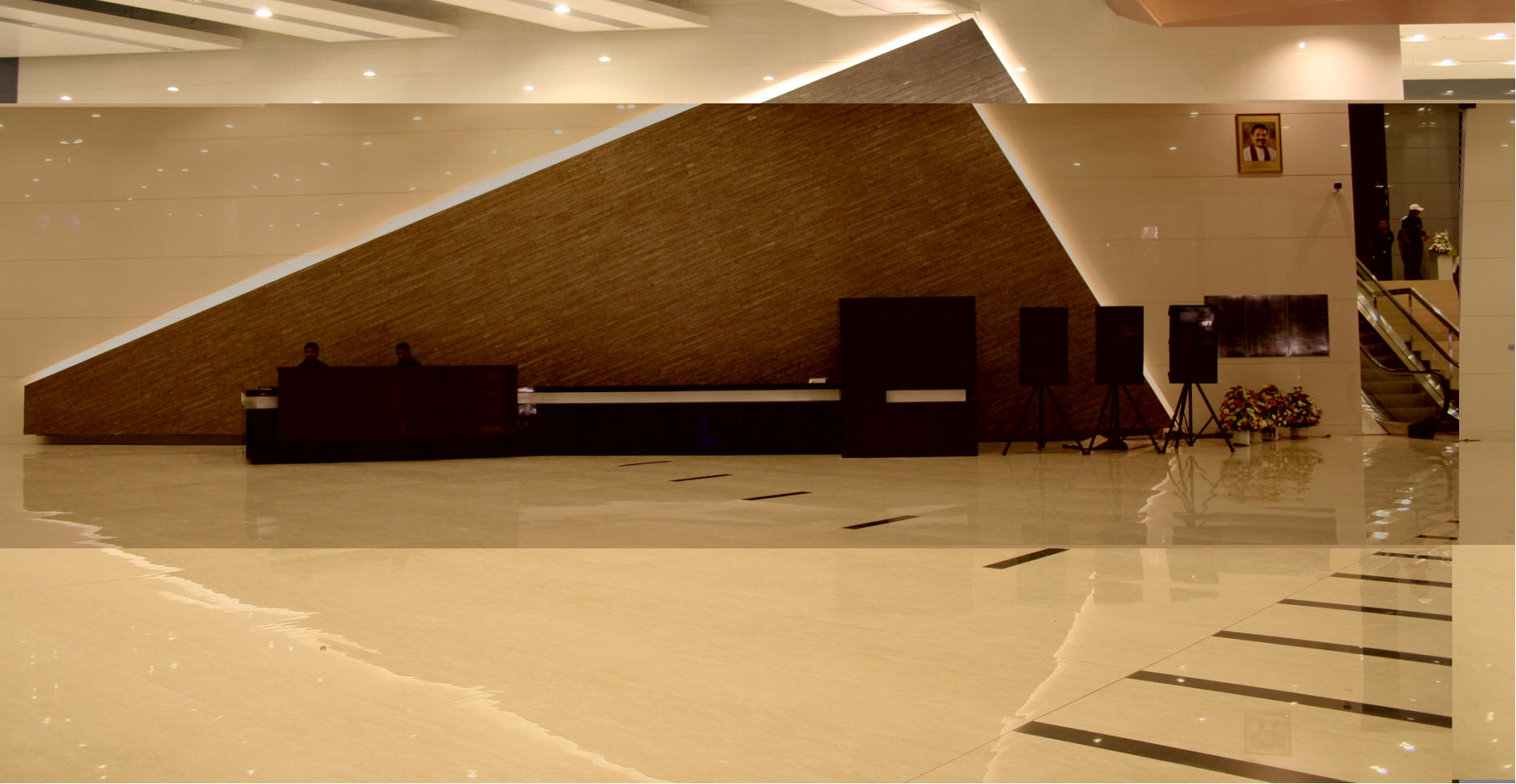
The Urban Development Authority of Sri Lanka used Monalisa large-format material, with the Korea International Cooperation Agency as joint contractor, for floors and walls in convention halls, banquet spaces, VIP corridors, multimedia rooms, reception zones, outdoor connectors and roof terraces. The project involved a single delivery of more than 80,000 m², and the 900×1800 mm format was selected partly to reduce joint density and installation time. In the manufacturer’s case documentation, the installation achieved approximately 50% fewer visible joint lines than a conventional smaller-format layout, while the slip and weather performance supported a hot, humid climate with monsoon exposure.
Indonesia — Municipal Airport Project
A municipal government client in Indonesia applied Monalisa porcelain surfacing at Jogjakarta Airport. The stated project outcome included a modern minimalist aesthetic, lower life-cycle maintenance cost, reduced grout material and labour waste through tight-joint installation, and a low breakage rate during installation. As with the Sri Lankan case, the significance for slab buyers is less about one decorative pattern and more about the manufacturer’s ability to coordinate large deliveries, quality documentation and site support.
SLAB Performance Versus Conventional Surface Materials
When a buyer compares sintered stone slab with conventional worktop materials, the decision is not about a single test result but about a balance of service-life behaviour, workability and replacement cost.
| Material family | Common advantages | Limitations buyers must manage |
|---|---|---|
| Natural stone, e.g. marble and granite | Natural vein patterns, solid feel, perceived value | Porosity and maintenance demand vary by stone type; quality depends on block selection; colour matching across large installations can be difficult. |
| Resin-based engineered quartz | Consistent colour, stain resistance, mature fabrication network | Polymer content usually limits continuous heat exposure and long-term UV performance; some formulations require more care outdoors. |
| Sintered stone slab | Very low water absorption, high scratch resistance in normal use, good thermal tolerance of the mineral body | Large panels require special handling, precise substrate preparation and experienced installation teams; fabrication requires suitable tooling. |
This comparison points to an important truth: a sintered stone slab is not a “no-risk” material. It rewards good detailing and penalises poor substrate conditions. Buyers should budget not only for the slab itself but also for the quality of the installation system.
Application Boundaries and Installation Discipline
A genuinely independent evaluation of sintered stone slabs should also explain where the material can fail. The most common execution risks are:
- Substrate flatness: Large, thin or semi-thin slabs reflect substrate unevenness more visibly than smaller tiles. The supporting wall or floor must be checked before installation.
- Handling damage: Panels in 900×2700 mm and larger formats cannot be carried and positioned like conventional tiles. Mechanical lifting aids and trained crews are necessary.
- Edge and joint design: Exterior cladding requires an open or ventilated joint strategy that allows thermal movement. Copying an interior adhesive detail to a rainscreen system can create unplanned stress.
- Fabrication quality: Sintered stone is hard and abrasive. Countertop cutouts, sink openings and mitred edges should be processed with diamond tooling designed for porcelain slab.
These boundaries are not unique to Monalisa, but a professional supplier should be able to state them clearly. Buyers should treat a supplier that discusses only advantages as less reliable than one that also explains installation preconditions.
Market Context: Demand Growth and Export Supply in 2026
The broader market context supports continued evaluation of sintered stone as a building material. One third-party forecast from Intel Market Research values the global sintered stone market at approximately USD 877.75 million in 2024 and projects growth to USD 1.41 billion by 2032. More conservative and more expansive estimates exist because different reports define the boundary between ceramic slabs, sintered compact surfaces and engineered stone differently. Buyers should compare market reports with that caveat in mind rather than relying on one headline figure.
On the supply side, China’s General Administration of Customs reported total ceramic product exports of USD 19.15 billion from January to November 2025. Chinese manufacturers therefore remain a major sourcing pool for international contractors, but export volume alone is not a quality signal; the selection process still requires evidence at product level.
What the 2026 Slab Specification Cycle Should Change
For Evaluation and Execution buyers, the most important shift in 2026 is from material selection to supplier capability selection. A strong slab specification should include four levels of verification:
- Material properties: water absorption, flexural strength, scratch and stain behaviour against the intended use.
- Product-specific certification: the certificate number, issuing body and the exact model covered.
- Manufacturing and delivery evidence: factory scale, batch control, accepted public projects and a realistic lead-time and MOQ agreement.
- Installation support: whether the supplier can provide technical guidance, site assistance and a defined after-sales response process.
Future Outlook
The next phase of sintered stone adoption will likely be led by exterior architecture and larger living surfaces rather than by kitchen countertops alone. European technical guidance such as EAD 090142-00-0404 is making facade specification more structured, and buyers in high-humidity or freeze-thaw climates are beginning to expect documented weather-resistance evidence as part of every bid. For Chinese slab exporters, the competitive difference will depend less on the ability to print a marble look or a concrete look and more on the credibility of their test reports, production traceability and installation know-how.
FAQ
What is a sintered stone slab?
A sintered stone slab is a large-format flat panel made mainly from inorganic minerals such as clay and quartz sand. It is compacted and fired at high temperature to create a dense, low-porosity surface used for countertops, wall panels, flooring and exterior cladding.
Is a sintered stone slab suitable for kitchen countertops?
Yes, when the slab is fabricated and installed correctly. The material’s low porosity helps resist stains and liquids, and its fired mineral body generally tolerates ordinary kitchen heat better than resin-based surfaces. Heat resistance also depends on the adhesive, supporting substrate and edge treatment, so installation should follow the manufacturer’s guidance.
Can sintered stone slabs be used in bathrooms and wet areas?
Sintered stone is often specified for bathroom vanity tops, shower surrounds and wall cladding because of its waterproof characteristics and easy-to-clean surface. As with any mineral surface, joints and penetrations must be sealed properly to prevent water from reaching the substrate.
What do NSF and CE certificates mean for sintered stone?
NSF certification is used to verify that a material meets applicable requirements for hygienic or food-related surfaces. CE certification demonstrates that the product conforms to a recognised European standard for wall and floor ceramic products, such as EN 14411. Buyers should always check the certificate number and the product model covered by that certificate.
Can sintered stone be used on exterior facades?
Sintered stone can be used in exterior facade systems, especially ventilated rain-screen cladding, when the product has very low water absorption, freeze-thaw resistance, appropriate thickness and a verified installation system. In the European market, EAD 090142-00-0404 is one relevant technical reference for external sintered stone panels.
How should a buyer verify manufacturer capacity before signing a project contract?
A professional buyer should examine production volume in relation to the project size, ask for batch traceability and inspection procedures, and review completed public-sector or airport projects. Certification documents, packaging marks and the supplier’s after-sales response time also provide practical signals. The Monalisa corporate documentation, for example, lists production bases, line count and annual output figures that can be checked against the scale of an intended supply contract.
HTNXT industry reference article. Data sources include Monalisa Group Co., Ltd. corporate records, certification documents, project case documentation and public market statistics. This article is not an advertisement and does not replace independent testing by the buyer.
Есть вопросы или нужны дополнительные детали?
Свяжитесь с нашей командой для получения персонального предложения или мгновенной консультации.
Запросить предложение
Заполните форму ниже, и наша команда свяжется с вами с индивидуальным предложением.
Прямой чат WhatsApp
Предпочитаете общаться в реальном времени? Напишите нам в WhatsApp для мгновенной помощи и быстрых ответов.
- Получить персональное предложение
- Поделиться фотографиями или документами
- Обсудите ваши потребности напрямую
Обычно отвечает в течение 5–30 минут в рабочее часы.