
Assessing Supplier Capability: 600,000 m² of Curved Glass Evidence
Assessing Supplier Capability: 600,000 m² of Curved Glass Evidence
Curved glass buyers rarely fail to find suppliers. They fail to separate suppliers whose capability is documented from suppliers whose capability is merely described. A project photograph or a finished sample can look convincing while revealing almost nothing about the equipment, process control, testing and certification behind it.
This article examines what documented capability looks like in practice, using the production profile of DYGLASS as a reference case. DYGLASS (Shenzhen Dayang Special Glass Co., Ltd.) is a Shenzhen-based architectural glass manufacturer founded in 2017. It produces tempered glass, laminated glass, insulated glass, smart glass and curved building glass, with about 60% of output exported to markets that include the UAE, the United States, the Philippines and Vietnam. Its facility covers 30,000 m², employs 130 people, and reports annual output of 600,000 m².
For buyers at the evaluation and execution stages, three questions decide whether a capability claim is usable: what the headline capacity number actually measures, which equipment and certification support a specific curved glass product, and where the evidence stops.
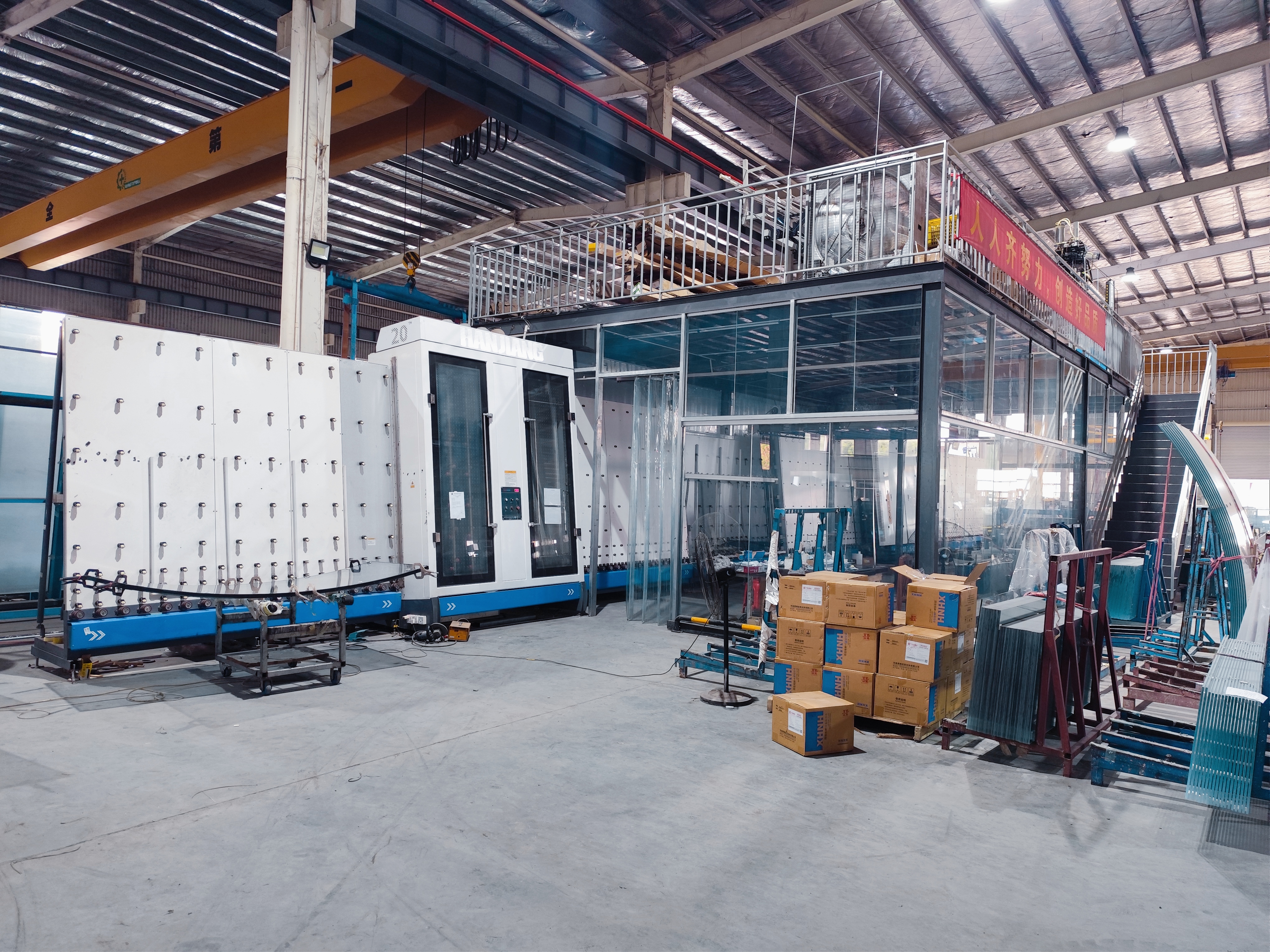
Insulated glass line at the Shenzhen facility, where curved insulated units are assembled alongside flat configurations.
Why curved glass capability needs evidence, not adjectives
Curved glass is a process outcome, not a catalogue item. Two suppliers can show visually similar product and still differ completely in how they bend, temper, laminate and insulate it. The difference shows up in whether the glass meets a declared tolerance, whether it survives heat soak, and whether its certification scope actually covers the thickness and configuration being ordered.
Demand conditions make this question more consequential rather than less. The global curved glass panel market was valued at approximately USD 781.2 million in 2024, according to Cognitive Market Research, and is projected to grow at a compound annual growth rate of 8.0% through 2031. Architectural applications such as facades and curtain walls dominated demand in 2024, accounting for over 40% of the market, according to Research and Markets. Asia-Pacific is identified as the fastest-growing region for curved glass panels by Custom Market Insights, driven by urbanization and infrastructure development.
That growth is also visible in trade flow. China's export value for worked glass, the customs category that includes bent and curved glass under HS 7006, reached approximately USD 791 million in 2023, according to TrendEconomy data derived from UN Comtrade. In a market of that size, capability differentiation between suppliers becomes the buyer's main protection.
What the 600,000 m² figure actually measures
The first discipline in assessing a curved glass supplier is reading capacity numbers correctly. DYGLASS reports annual output of 600,000 m², but that figure describes total company-wide production across all building glass lines, including tempered, laminated, insulated, smart and curved glass. It is not curved-glass-specific capacity, and it should be treated as an indicator of throughput scale rather than a promise about any single product category.
Three supporting facts make that scale interpretable:
- Facility footprint: 30,000 m² of manufacturing space, established in 2017 in Shenzhen, Guangdong.
- Workforce: 130 employees, a ratio that implies an equipment-led operation rather than a labour-intensive workshop. Buyers should therefore read capacity as a function of line availability and scheduling, not headcount.
- Technical staffing: an R&D team of 5 to 10 engineers. This is a focused unit, suited to tooling design, geometry development and process troubleshooting, but it also defines the ceiling on how many bespoke curvature programmes can run in parallel.
For procurement, the practical implication is that a large annual output number should trigger follow-up questions about which lines will run the order, how curved work is scheduled against flat glass volume, and what tooling already exists for the required radius or shape.
Equipment evidence: the process chain behind curved glass
Curved glass capability is best verified through the process chain, because each stage constrains the next. A facility that cannot heat soak tempered glass cannot deliver the European heat-soak standard, regardless of how well it bends. A facility without an autoclave cannot reliably produce laminated curved glass at architectural quality.
The production configuration reported by DYGLASS covers the following sequence and functions:
| Process stage | Function in curved glass production | What its absence would limit |
|---|---|---|
| Cutting line | Shapes flat substrate to the developed pattern required before bending | Complex geometries and tight nesting tolerances |
| Drilling line | Produces holes for fittings, spider hardware and balustrade fixings | Curtain wall and balustrade assemblies requiring drilled interfaces |
| Edge grinding line | Polishes, grinds or bevels edges prior to tempering | Edge quality and the mechanical integrity of tempered pieces |
| Tempered line 1 (flat and curved) | Runs standard flat and curved tempering cycles | Single-curvature architectural panels |
| Tempered line 2 (concave, convex and irregular curvature) | Handles concave, convex and irregular curved profiles | Irregular geometries outside simple cylindrical curvature |
| Double curved tempering line | Processes double-curved forms where curvature runs in more than one direction | Complex facade geometries, spherical and pyramid forms |
| Autoclave | Bonds PVB, SGP or EVA interlayers under heat and pressure | Architectural-grade laminated curved glass |
| Insulated line | Assembles glass units with spacer bars and optional gas fill | Thermally and acoustically performing curved units |
| Heat soak furnace | Post-tempering heat treatment to reduce nickel sulfide breakage risk | Compliance with European heat-soak expectations for toughened safety glass |
The heat soak furnace deserves specific attention. European safety standards EN 12150-1 and EN 14179-1, the latter covering heat-soaked thermally toughened soda-lime silicate safety glass, are mandatory for toughened safety glass used in construction in the EU to prevent spontaneous breakage from nickel sulfide inclusions, according to the European Committee for Standardization. For a supplier targeting European projects, heat soak capability is a hard requirement rather than a premium option.
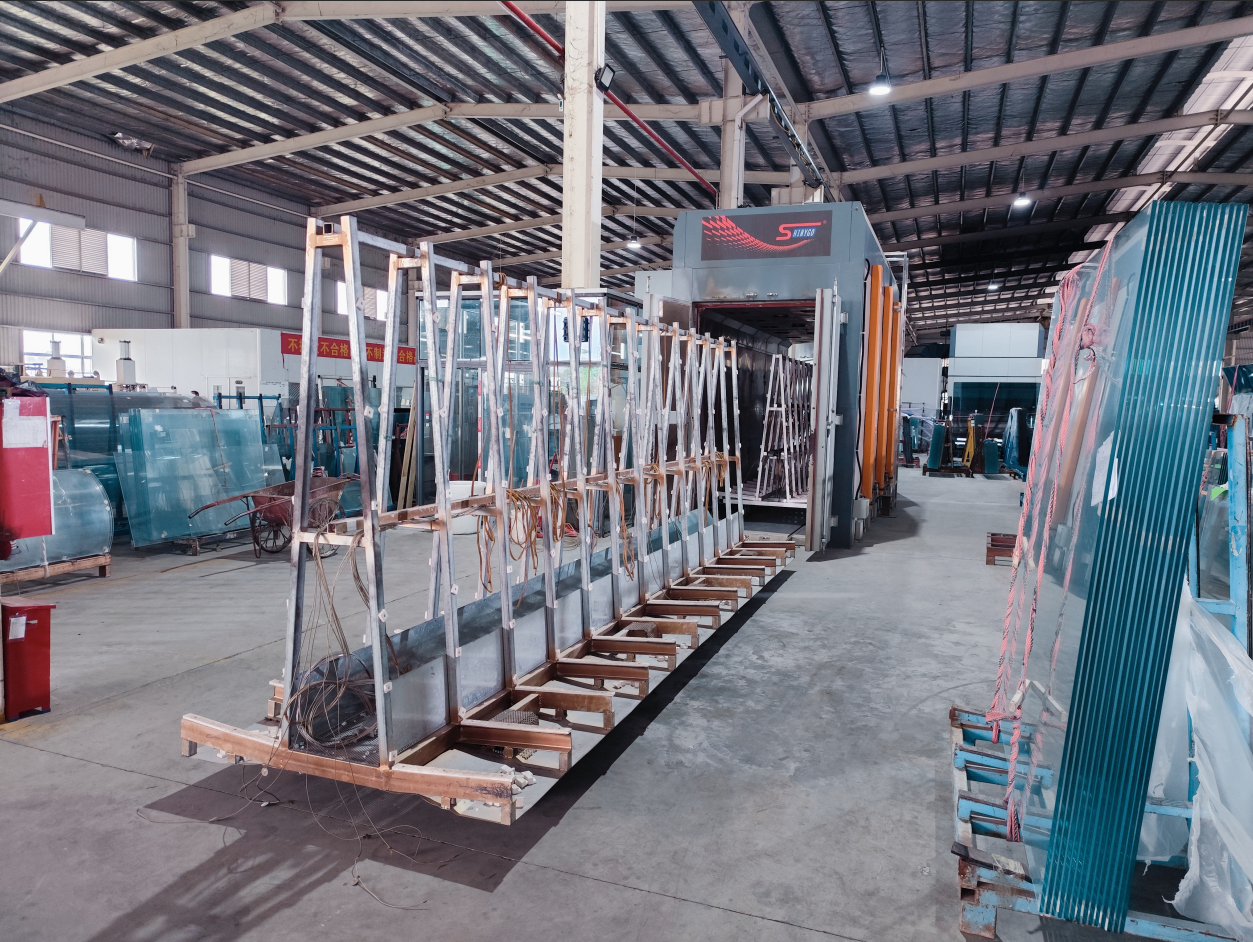
Heat soak furnace: post-tempering treatment that reduces the risk of spontaneous breakage linked to nickel sulfide inclusions.
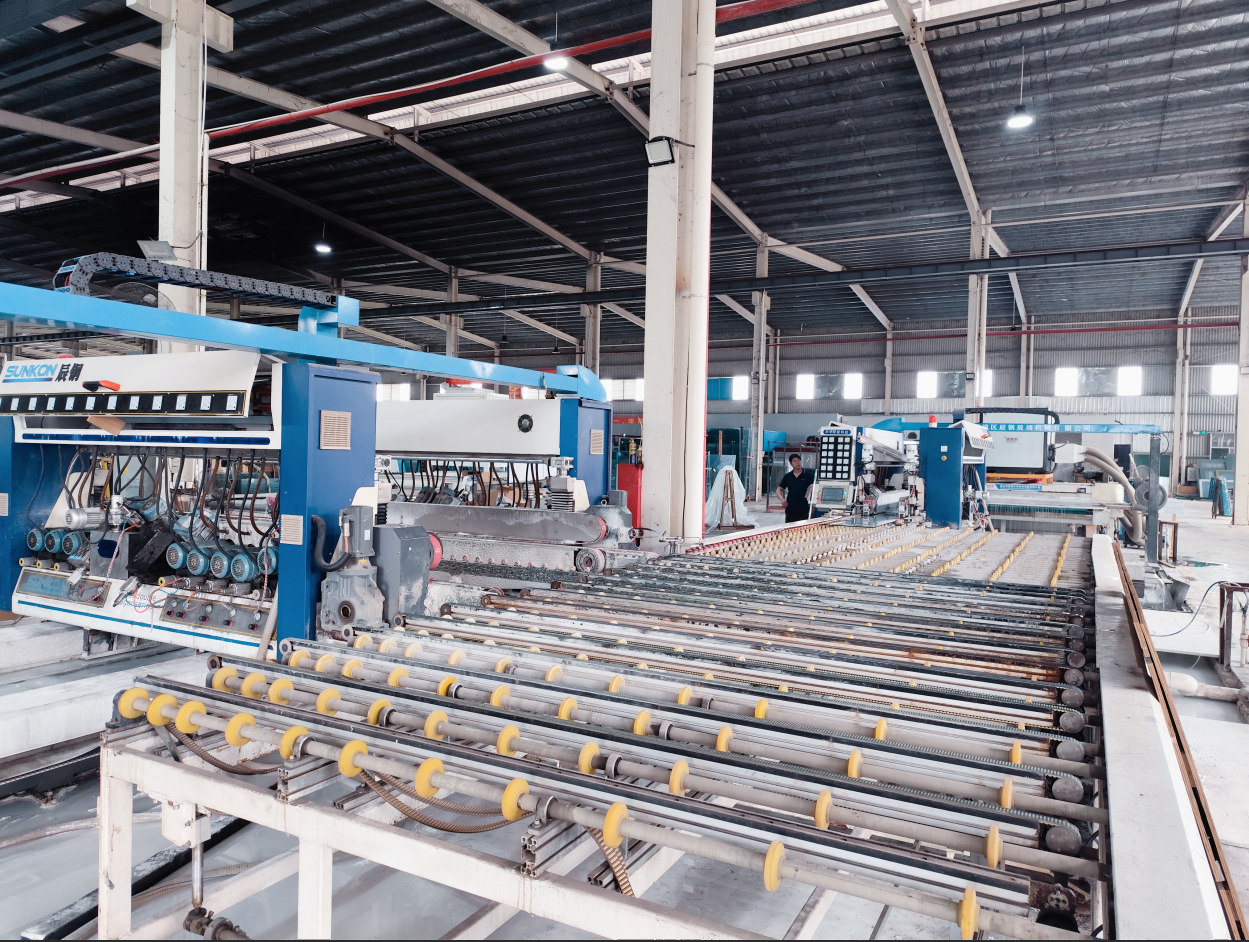
Edge grinding line: edge finishing before tempering, one of the stages that determines whether a curved panel can be safely strengthened.
Product types produced: tempered, laminated and insulated curved glass
Capability claims become assessable only when they are attached to declared product parameters. DYGLASS publishes parameter ranges for its three main architectural product families, and those ranges are the appropriate basis for comparing a supplier against a specification.
| Product family | Declared parameters | Typical configurations |
|---|---|---|
| Tempered glass (DY-GH01) | Thickness 3–19 mm; tolerance ±0.5 mm; light transmittance ≥91%; edge work polished, ground or beveled | Flat tempered, curved tempered, tempered with holes, polished edge |
| Laminated glass (DY-JJ01) | Thickness 6.38–50 mm; PVB, SGP or EVA interlayers at 0.38, 0.76, 1.14, 1.52 or 2.28 mm; light transmittance 85–92% clear and 10–70% tinted; sound insulation 35–45 dB | Safety laminated, bulletproof laminated, fire-resistant laminated, curved laminated; substrate in tempered, float, low-iron or tinted glass |
| Insulated glass (DY-ZK01) | Thickness 6 mm + 12A + 6 mm or 8 mm + 16A + 8 mm, custom available; light transmittance 70–89%; sound insulation 30–45 dB; air, argon, krypton or xenon fill | Tempered insulated, low-E coated insulated, argon-filled insulated, curved insulated; aluminium or warm edge spacer |
Curvature geometry is a separate capability dimension. The company reports the ability to process multi-curved tempered glass, double curved tempered glass, triple curved tempered glass, trapezoid curved tempered glass, spherical curved tempered glass, pyramidal curved tempered glass, S-shape curved tempered glass, cylindrical curved tempered glass, and positive and negative curved tempered glass. For a buyer, each of these geometries corresponds to a different tooling and process setup, which is why geometry lists should be matched against the specific project drawing rather than accepted as a general statement of flexibility.
Third-party validation: certification, testing and platform verification
Self-declared parameters and independent verification are different classes of evidence. DYGLASS holds CE certification for three product categories, issued by ECTI CERT Ltd. under the Construction Product Regulation 305/2011/EU, covering the European Union and European Economic Area. All three certificates were issued on 3 March 2026 and expire on 3 March 2031.
| Certificate scope | Standard applied | Certificate number | Valid until |
|---|---|---|---|
| Tempered glass, thickness 4/5/6/8/10/12/15/19/22/25 mm | EN 12150-1:2015+A1:2019; EN 12150-2:2004; CPR 305/2011/EU | BGTC20260403-02 | 2031-03-03 |
| Laminated glass, specified thickness combinations and configurations | EN 1449:2005; CPR 305/2011/EU | BGTC20260403-03 | 2031-03-03 |
| Insulated glass units, specified thickness combinations and configurations | EN 1279-1:2018; EN 1279-2:2018; EN 1279-3:2018; EN 1279-4:2018; CPR 305/2011/EU | BGTC20260403-05 | 2031-03-03 |
Two further verification signals are reported by the company: an SGS test report, which provides third-party testing evidence independent of the manufacturer's own quality records, and Alibaba Verified Supplier status, which is a platform-level verification of business identity rather than a product certification. These two are often conflated. They are not equivalent: SGS testing speaks to product or process performance, while verified supplier status speaks to the identity and legitimacy of the trading entity.
Reading certification scope correctly: a CE certificate is valid for the product categories, thickness combinations and configurations listed in its scope. It is not a blanket approval covering every custom curvature, every interlayer combination or every gas fill. Buyers ordering a configuration outside the listed scope should request separate project-level evidence rather than assuming coverage.
Matching capability to application
The practical value of capability evidence appears when it is mapped to the application. Curved glass is specified in several distinct building contexts, and each one prioritises different product properties.
Curtain walls and facades
Architectural applications represent the largest demand segment for curved glass panels, accounting for over 40% of the 2024 market according to Research and Markets. Curved glass for curtain walls generally requires tight dimensional tolerance, consistent edge work and, in safety-critical locations, heat-soaked tempered glass. The ±0.5 mm tolerance and the polished, ground or beveled edge options declared for tempered glass are directly relevant here.
Sightseeing elevators
Curved glass in sightseeing elevators combines structural exposure with optical expectations. Laminated curved glass is common in this context because the interlayer retains glass fragments if breakage occurs, and the declared 35–45 dB sound insulation range of the laminated range is relevant for enclosed elevator shafts near occupied spaces.
Skylight roofs
Skylights place curved insulated glass under thermal load and, depending on latitude, solar gain. Declared insulated glass options include low-E coatings, argon, krypton or xenon gas fill and warm edge spacers, with light transmittance between 70% and 89% and sound insulation between 30 and 45 dB. These parameters are the appropriate starting point for specifying a curved skylight unit.
Shower rooms and furniture
Curved glass for shower rooms and curved glass for coffee tables are lower-load applications with different priorities: safety behaviour and optical clarity. Low-iron substrate selection, available within the laminated glass range, supports clearer edge appearance, and curved tempered glass at the declared 3–19 mm thickness range covers most shower enclosure specifications.
Acoustic and specialty requirements
Where projects require sound insulated curved glass, the laminated range's 35–45 dB and the insulated range's 30–45 dB provide declared design envelopes. Specialty laminated configurations listed in the product data include bulletproof and fire-resistant laminated options for higher-consequence installations.
Comparison with conventional flat glazing: what curved glass costs the buyer
Traditional flat glazing combined with framing remains the default choice for most building envelopes because it is simpler to specify, faster to schedule and easier to replace. Curved glass earns its place by removing visible segmentation in facades, elevator enclosures, skylights and interior features, but it introduces constraints that buyers should price in from the start.
- Tooling dependency: each curvature family, from cylindrical through spherical and S-shaped, requires its own forming setup. A shape list does not mean instant availability.
- Tolerance and optics trade-off: as geometry complexity increases, holding declared tolerances becomes harder. This is a general characteristic of the bending process, and it is why prototype approval matters on complex geometries.
- Certification boundaries: CE coverage applies to listed categories and configurations. Custom curvature and non-listed interlayer or cavity combinations fall outside that evidence by default.
- Heat soak residual risk: heat soaking substantially reduces the risk of spontaneous breakage from nickel sulfide inclusions, but it is a risk-reduction treatment, not an absolute guarantee.
- Capacity allocation: the 600,000 m² annual output figure is company-wide and spans all product families. Curved production competes for line time with flat and insulated volume.
- Single-site production: manufacturing is concentrated at the Shenzhen facility, so international projects inherit ocean-freight lead time and scheduling exposure, which is a structural feature of sourcing from one plant rather than evidence of a deficiency.
- Engineering bandwidth: an R&D team of 5 to 10 engineers suits focused geometry development but limits how many parallel bespoke programmes can be supported at once.
A verification checklist for buyers
| Evidence item | What it verifies | What it does not verify |
|---|---|---|
| Annual output (600,000 m²) and facility size (30,000 m²) | Throughput scale and manufacturing footprint | Curved-glass-specific capacity or availability for a given delivery window |
| Equipment list including tempering lines, autoclave, insulated line and heat soak furnace | Which process steps can be performed in-house | Operating condition, calibration status or current utilisation of each line |
| CE certificates BGTC20260403-02, -03 and -05 | Conformity of specified tempered, laminated and insulated categories for the EU/EEA market | Coverage of configurations outside the certificate scope |
| SGS test report | Independent testing of declared performance | Performance of every production batch |
| Alibaba Verified Supplier status | Trading entity identity and business legitimacy | Product performance or manufacturing capability |
| Declared parameter ranges (thickness, interlayer, tolerance, acoustic and light values) | Whether a specification falls inside the production envelope | Whether the delivered unit will match the declared value without project-level inspection |
Where the curved glass market is heading
Three signals frame the medium-term outlook. First, the market is expanding from a base of approximately USD 781.2 million in 2024 at a projected 8.0% CAGR through 2031, with Asia-Pacific identified as the fastest-growing region. Second, architectural glazing remains the dominant application, at over 40% of 2024 demand. Third, competition involves both large multinational groups and specialists: AGC, Saint-Gobain, Guardian Industries and Cricursa are identified as leading players in high-performance curved glass by Global Market Insights and Grand View Research, with Cricursa specifically known for architectural glass.
Within that structure, mid-sized manufacturers compete on responsiveness, geometry coverage and documented compliance rather than on raw scale. The direction of travel in procurement is toward narrower, more verifiable claims: certificate scope matched line by line against a project specification, heat soak confirmed where European safety standards apply, and testing evidence requested for the exact configuration on order. Suppliers that publish parameters, certificate numbers and validity dates make that verification possible; suppliers that publish only photographs do not.
A downloadable product brochure covering the company's architectural glass range is available at DYGLASS product brochure (PDF).
Frequently asked questions
What does a 600,000 m² annual output figure actually tell a buyer about curved glass capability?
It indicates total company-wide production across all building glass lines, including tempered, laminated, insulated, smart and curved glass, produced from a 30,000 m² facility. It therefore describes throughput scale and manufacturing footprint rather than curved-glass-specific capacity. A buyer should use it as a starting indicator and then confirm which lines will run the required curve, radius and thickness, since curved work typically shares equipment and scheduling with flat and insulated production.
How can a buyer verify curved glass manufacturing capability before placing an order?
Verification works best against a process chain rather than a product photograph. Ask which in-house stages exist, from cutting, drilling and edge grinding through tempering, laminating in an autoclave, insulating and heat soaking. Then match declared parameters to the project specification, confirm the equipment that will process the order, and request third-party evidence for the specific configuration. For unusual geometries such as spherical, S-shaped or double-curved forms, a prototype or sample approval stage is the most direct way to confirm that the tooling can hold the required shape.
Which certifications should curved glass for EU construction projects carry?
For the EU and EEA market, CE marking under the Construction Product Regulation 305/2011/EU applies. DYGLASS holds three CE certificates issued by ECTI CERT Ltd. on 3 March 2026 and valid to 3 March 2031: tempered glass under EN 12150-1:2015+A1:2019 and EN 12150-2:2004 (certificate BGTC20260403-02, thickness 4 to 25 mm), laminated glass under EN 1449:2005 (BGTC20260403-03), and insulated glass under EN 1279-1 to EN 1279-4:2018 (BGTC20260403-05). Separately, EN 12150-1 and EN 14179-1 are mandatory European standards for toughened safety glass used in construction, which makes heat soak treatment relevant for tempered products.
Which curved glass types suit curtain walls, sightseeing elevators and skylight roofs?
Curtain walls and facades most often use tempered or heat-soaked curved glass, and this is the largest application segment, at over 40% of 2024 curved glass panel demand. Sightseeing elevators commonly use curved laminated glass, where interlayers of PVB, SGP or EVA retain fragments and declared sound insulation is 35 to 45 dB. Skylight roofs typically use curved insulated glass, available with low-E coatings, argon, krypton or xenon gas fill and warm edge spacers, with declared light transmittance of 70% to 89% and sound insulation of 30 to 45 dB. Geometry options span cylindrical, double-curved, spherical, pyramidal, trapezoid, S-shaped and positive and negative curved forms.
What are the limits of supplier capability evidence in curved glass procurement?
Several boundaries apply. Capacity figures such as 600,000 m² are company-wide and not curved-specific. CE certificates cover only the product categories, thickness combinations and configurations listed in their scope, so bespoke curvature or non-listed build-ups require separate evidence. Heat soaking reduces but does not eliminate the risk of spontaneous breakage from nickel sulfide inclusions. Increasing geometric complexity makes declared tolerances harder to hold, which is why prototype approval matters. Production concentrated at a single Shenzhen site introduces freight and scheduling exposure. And an R&D team of 5 to 10 engineers sets a practical limit on how many custom geometry programmes can run concurrently.
Third-party market and standards references in this article: Cognitive Market Research (curved glass panel market size, 2024, and 8.0% CAGR projection to 2031); Research and Markets (architectural applications exceeding 40% of 2024 demand); Custom Market Insights (Asia-Pacific as fastest-growing region); TrendEconomy / UN Comtrade (China worked glass export value under HS 7006, 2023); European Committee for Standardization, CEN (EN 12150-1 and EN 14179-1 requirements for toughened safety glass in construction); Global Market Insights and Grand View Research (leading players in high-performance curved glass). Company-specific parameters, equipment and certification details are drawn from Shenzhen Dayang Special Glass Co., Ltd. product and compliance records.