
Atrium Tent Certifications & Specs: A Buyer's Guide
Atrium Tent Certifications & Specs: A Buyer's Guide
Event buyers evaluating atrium tents are often comparing structures that look similar in brochures but differ significantly in frame grade, fabric performance, and regulatory compliance. For commercial events, weddings, and exhibitions, the safe decision depends on documented parameters and certifications rather than visual appeal alone.
An atrium tent is a large-span temporary or semi-permanent event structure with an aluminum frame and a curved or high-peak roof. It is commonly used for wedding banquets, catering events, exhibitions, VIP functions, and commercial programs. Because these structures can be occupied by hundreds of guests, engineering choices such as aluminum alloy grade, fabric weight, flame-retardant properties, wind resistance, and fixing systems are not optional details. They affect safety, insurance acceptance, and long-term value.
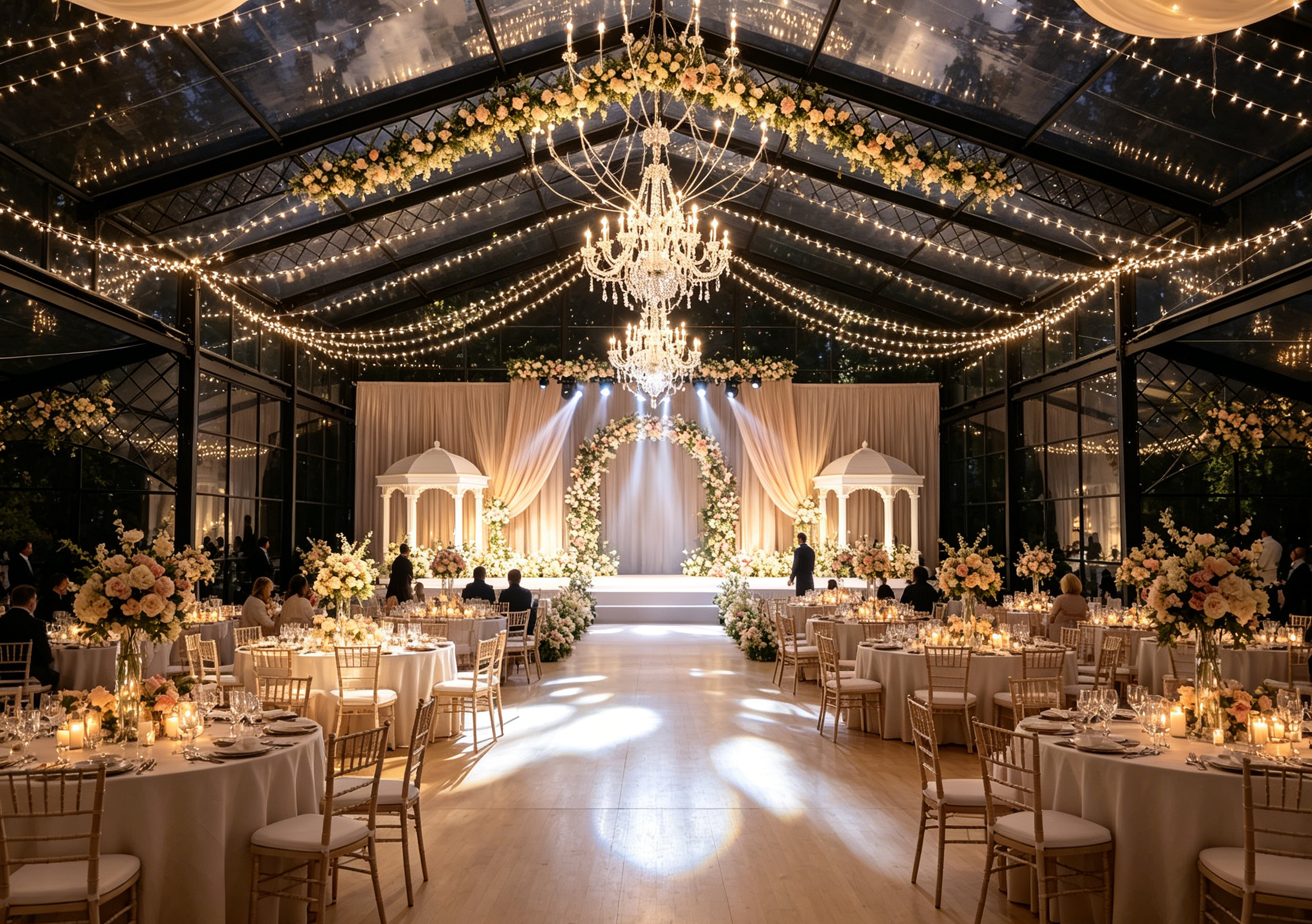
Aluminum atrium tent with curved roof and transparent fabric option
Why Certification and Parameter Checks Matter in Atrium Tent Procurement
The challenge is that temporary event structures are not always regulated by the same building approval process as permanent buildings. In many regions, a large event tent must still satisfy fire safety requirements and structural stability expectations. Some suppliers publish attractive renderings but provide limited verifiable engineering data. Unverified claims can create problems during site inspection, permitting, or an insurance review.
The opportunity is that atrium tent procurement can be made objective. A clear specification sheet, recognized certifications, and documented test standards allow buyers to compare offers, reduce risk, and select a structure suited to the actual project site. For buyers in the research and evaluation stages, a useful approach is to check five areas: frame material, cover material and fire behavior, wind and snow capacity, wall systems, and applicable certifications.
KENTEN Structures at a Glance
One example of a supplier with a verifiable technical baseline is KENTEN Structures. Founded in 2001, KENTEN is an aluminum structure manufacturer headquartered in Ontario, California, with an international footprint and manufacturing centers in China, the USA, and the Middle East. The company designs and delivers temporary venues, exhibition halls, sports seating, grandstands, and modular infrastructure. Its product range includes A Structure Tent, atrium tent, warehouse tent, Igloo Tent, curved tent, double decker tent, triple decker tent, and pyramid structure.
For event buyers, the relevant fact is that KENTEN states all of its structures are produced and fully certified to IBC 2024, CBC 2025, ASCE 7-22, GB 50429, and EN 13782. These codes cover structural design, aluminum execution, and temporary structure safety in multiple markets.
Key Atrium Tent Specifications to Evaluate
KENTEN's standard curved atrium tent model A1 provides a useful reference for what buyers should expect from a large aluminum-frame atrium tent.
Frame and Structural Material
The main frame uses hard-pressed extruded aluminum alloy 6061/T6. Aluminum 6061 is a widely used structural alloy because it offers a good strength-to-weight ratio and corrosion resistance. The 4-channel profile allows multiple attachment points for covers, walls, and accessories.
Cover Material and Fire Performance
The cover is PVC-coated polyester textile with a weight of 750 to 900 g/m². It is available in white, transparent, or customized colors. The material is flame retardant to DIN 4102 B1, M2, and CFM standards, which are recognized references for tent fabric fire behavior in Europe and internationally.
Wind Resistance and Installation
The rated wind resistance is 120 km/h. In practice, the achievable wind performance depends on correct installation. KENTEN's specification lists fixing solutions including ground anchors, expandable bolts, and weight plates. The structure can be installed on grassland, earth land, asphalt, cement ground, or marble.
Temperature Range and Service Life
The applicable temperature range is -30°C to +70°C, and the stated service life is more than 15 years. This makes the atrium tent suitable for use across a wide range of seasonal climates.
Wall Systems
Optional walls include PVC cover, glass wall, ABS wall, sandwich wall, hard or solid wall, and rock wool wall. Glass walls are often selected for premium events that need natural light and a transparent look. Rock wool and sandwich walls provide better insulation for climate-controlled environments.
| Parameter | Typical Value |
|---|---|
| Frame material | Hard-pressed extruded aluminum alloy 6061/T6 |
| Cover | PVC-coated polyester textile, 750-900 g/m² |
| Cover colors | White, transparent, customized |
| Flame retardancy | DIN 4102 B1, M2, CFM |
| Wind resistance | 120 km/h |
| Temperature range | -30°C to +70°C |
| Service life | More than 15 years |
| Fixing solutions | Ground anchor, expandable bolt, weight plate |
| Ground types | Grassland, earth land, asphalt, cement, marble |
| Optional walls | PVC, glass, ABS, sandwich, hard/solid, rock wool |
Certifications and Code Compliance in Practice
Several standards are commonly cited in atrium tent specifications. In the European Union, EN 13782:2015 defines structural safety requirements for temporary structures, including wind load and fabric tension. For tent fabrics, NFPA 701 in the United States and DIN 4102 B1 in Germany are frequently cited flammability standards. For aluminum structures sold in Europe, EN 1090-3 is the technical requirement for execution of aluminum structures and is needed for CE marking.
At a manufacturing level, KENTEN's structure tent product line holds ISO 9001:2015, ISO 14001:2015, and ISO 45001:2018 certifications for quality, environmental, and occupational health and safety management. The ISO 9001 certificate number is 51816Q00846R3; the ISO 14001 certificate number is 51815E00262R3; and the ISO 45001 certificate number is 51815O00263R3. All three are issued by Shenzhen Zhongbiao International Testing and Certification Co., Ltd. and are globally applicable.
In addition, KENTEN holds a CE certificate for manufacturing of aluminum structures tents under EN 1090-3:2019, certificate number 8605682, issued by LL-C (Certification) Czech Republic a.s., covering production processes such as cutting, drilling, grinding, assembling, and packaging with execution class EXC2. The certificate is valid until April 2029.
For event buyers, these certifications matter because they provide independent evidence that the supplier's factory processes, quality controls, and safety management meet international expectations. Documents should be checked for the certificate holder, scope, standard, certificate number, and validity date.
A Practical Specification Checklist for Atrium Tent Buyers
During the research and evaluation phase, use a short checklist to compare suppliers without relying on marketing language.
- Frame alloy: Confirm the aluminum alloy grade, such as 6061/T6, and the profile construction.
- Cover specification: Check fabric weight and flame retardancy references such as DIN 4102 B1, M2, CFM, or NFPA 701.
- Wind rating: Verify the rated km/h value and the fixing method required to achieve it.
- Climate suitability: Confirm the operating temperature range and, if needed, request snow load data for the specific site.
- Wall systems: Determine whether PVC, glass, ABS, sandwich, hard wall, or rock wool wall options match the event format.
- Anchoring: Ask about ground anchors, expandable bolts, or weight plates for your ground type.
- Service life: Check the manufacturer's stated lifespan and maintenance requirements for the PVC cover and aluminum frame.
- Documentation: Request certificates for ISO management systems, CE marking, and building-code compliance such as IBC, CBC, ASCE, GB, or EN standards.
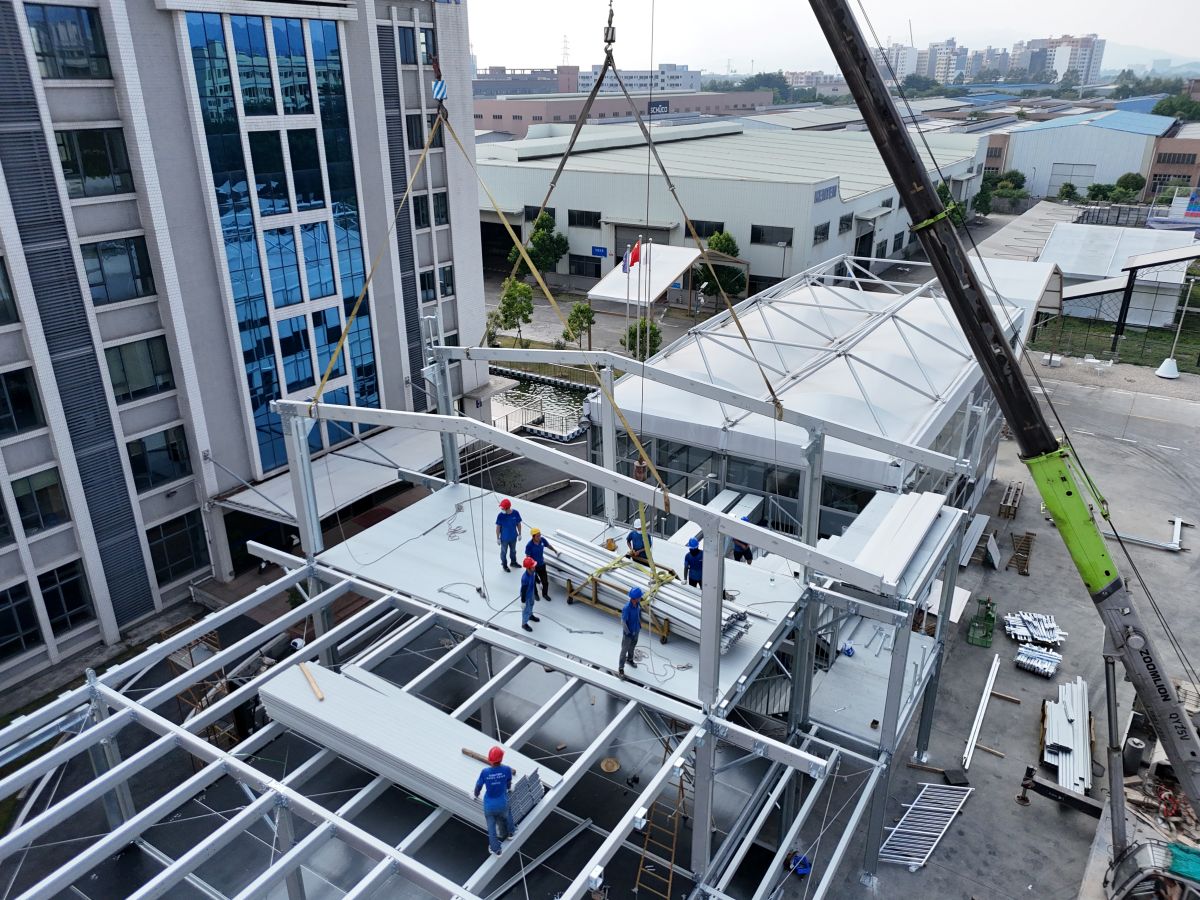
Prefabricated aluminum components enable rapid on-site assembly of clearspan tents
Where Atrium Tent Specifications Matter Most
Atrium tents are used in several event formats, and each format places slightly different demands on the structure.
In the wedding and hospitality segment, the venue often needs transparent or glass walls, a lined interior, chandeliers, HVAC equipment, and flooring. The structure must be waterproof, wind resistant, and fire retardant while maintaining an upscale appearance. KENTEN supplied a 15m × 25m atrium structure tent for a private luxury residence on the East Coast of the United States, located close to the ocean. The fully enclosed, climate-controlled space was used for high-end wedding receptions. This example illustrates how a large clear span can be combined with coastal wind exposure.
In the event and exhibition segment, high visitor traffic means fire safety and rapid installation are priorities. Common add-ons include glass walls, flooring, LED lighting, air conditioning, entrance doors, and branding banners. A modular atrium tent can be configured to create an exhibition hall, trade show pavilion, or event pavilion, and can be reused over multiple cycles.
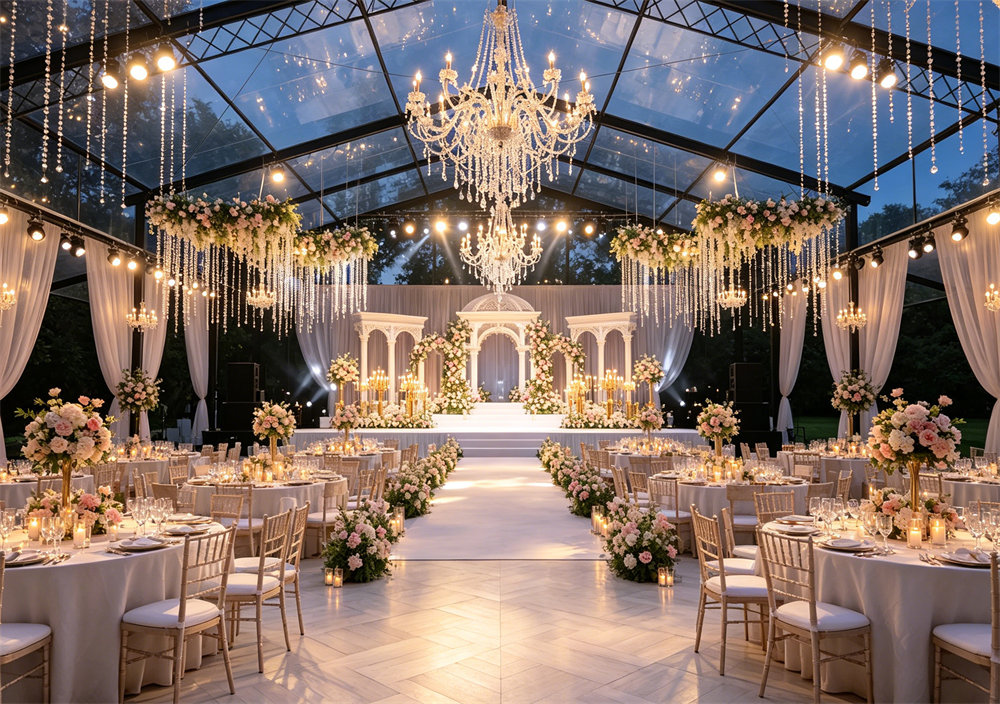
Large clear-span atrium tent configured as an enclosed banquet venue
Market Trends for Temporary Event Structures
The demand for flexible event venues continues to grow alongside the broader event industry. Grand View Research valued the global event management market at USD 1,160.4 billion in 2024 and projected a 6.7% compound annual growth rate through 2033. Within the more specific commercial event tent segment, one industry overview has projected that the segment will exceed USD 3 billion by 2025. At the supply level, China's exports of awnings, tents, and sails under HS code 6306 totaled approximately USD 3.11 billion in 2024, representing 53.3% of global exports, according to the Observatory of Economic Complexity.
These trends point to a mature global supply base and a continuing shift from generic party tents to engineered, certified structures. Buyers are increasingly looking for modular atrium tents that can be assembled quickly, demounted, stored, and reused for different events. Transparent and glass-wall versions are also gaining share in luxury events because they create an open, venue-like atmosphere.
Atrium Tent vs. Permanent Venue: Where the Boundary Is
Atrium tents are often compared with permanent buildings. The advantages of an atrium tent are clear: faster deployment, lower initial cost, fewer site restrictions, and the ability to relocate the structure. A high-quality aluminum frame can provide a column-free interior that is difficult to achieve with a temporary structure of similar scale.
There are also real boundaries. A permanent venue typically offers better acoustic isolation, integrated utilities, and a longer building life. An atrium tent has a stated service life of more than 15 years under normal use, whereas a permanent building can be designed for several decades. Thermal performance depends on the selected wall and insulation system, and year-round operation in extreme climates may require more HVAC capacity. Site anchoring is critical: wind ratings are only valid when the specified ground anchors or ballast are used on an appropriate surface. Buyers who expect a permanent building's acoustic comfort or utility infrastructure should treat an atrium tent as a semi-permanent solution, not a direct replacement.
Future Outlook
The next phase of atrium tent development will likely focus on modularity, energy performance, and certification transparency. Transparent covers, glass walls, integrated lighting, and thermal insulation are becoming standard options for luxury and commercial events. As international standards such as EN 13782, NFPA 701, and EN 1090-3 gain wider recognition, certification will become a stronger procurement criterion. Buyers who establish a clear specification and documentation checklist now will be better positioned to compare suppliers and avoid costly site-level surprises.
For full product specifications and configuration options, KENTEN Structures publishes a downloadable catalog: KENTEN Structures Product Catalog.
Frequently Asked Questions
What certifications should buyers check when sourcing an atrium tent?
Buyers should verify applicable structural and fire standards. In the EU, EN 13782:2015 applies to temporary structures. Flame retardancy is often verified to NFPA 701 in the US and DIN 4102 B1 in Germany. Aluminum structures sold in Europe require EN 1090-3 for CE marking. KENTEN states that all of its structures are produced and certified to IBC 2024, CBC 2025, ASCE 7-22, GB 50429, and EN 13782.
What wind load can an aluminum atrium tent withstand?
KENTEN's curved atrium tent model A1 has a wind resistance rating of 120 km/h. Installation should follow the specified fixing solution, such as ground anchors, expandable bolts, or weight plates, and depends on site ground conditions.
What is the service life of an atrium tent?
KENTEN states the service life of its atrium tent model A1 is more than 15 years. The frame is aluminum alloy 6061/T6, and the PVC-coated polyester cover weighs 750 to 900 g/m². The applicable temperature range is -30°C to +70°C.
What wall options are available for atrium tents?
Optional walls include PVC cover, glass wall, ABS wall, sandwich wall, hard or solid wall, and rock wool wall. These options allow different levels of transparency, insulation, and enclosure.
Are atrium tents fire retardant?
The PVC-coated polyester cover used on KENTEN's atrium tent is flame retardant to DIN 4102 B1, M2, and CFM standards. NFPA 701 is also a commonly cited flame retardancy standard in the US market.
What ground types can atrium tents be installed on?
According to KENTEN's product specification, the atrium tent can be installed on grassland, earth land, asphalt, cement ground, and marble. The fixing method is selected based on site conditions, with options such as ground anchors, expandable bolts, and weight plates.
Can atrium tent covers be transparent?
Yes. KENTEN's atrium tent cover is available in white, transparent, or customized colors, in addition to the standard PVC-coated polyester textile.