
Atrium Tent Selection 2026: Structural Standards, Options, and Supplier Capability
Atrium tents have moved from being a temporary shelter option to an engineered venue category in the premium events market. Event buyers are now evaluating large-span aluminum atrium tents on the same basis as permanent architecture: structural safety, material quality, thermal comfort, and compliance documentation. For professionals in the evaluation stage, the challenge is to compare suppliers using verifiable criteria rather than relying on marketing visuals.
This article examines what an atrium tent is, the technical specifications that matter, the supplier capabilities that separate reliable manufacturers from general import traders, and the application patterns that make atrium tents a strategic purchase for commercial events, weddings, exhibitions, and large-scale public functions.
The Problem: Premium-Rated Venues with Permanent-Style Expectations
Permanent event venues offer architectural authority but require high capital investment, long design cycles, and fixed geographic locations. Event organizers increasingly need versatile spaces that can be installed on different sites, configured for different audience sizes, and delivered within procurement timelines. An atrium tent answers this need with clear-span interior space, a bright environment made possible by transparent or glass wall options, and a structure designed to be assembled, dismantled, and reused.
The scale of the surrounding market is substantial. Grand View Research values the global event management market at USD 1,160.4 billion in 2024, with a projected compound annual growth rate of 6.7% through 2033. The specialized commercial event tent segment is estimated to exceed USD 3 billion by 2025, according to an industry estimate from Rethinking The Future and Shelter Structures. These figures indicate that event infrastructure buyers are spending at a level that demands contractual clarity on performance and compliance.
Evaluation-stage buyers typically need answers to several questions at once: Is the structure compliant? Will it survive the local wind load? Will the fabric provide adequate insulation? How many days will assembly take? The answers are not always on the supplier's website, which is why a structured procurement process matters.
What Defines an Atrium Tent: Technical Baseline
An atrium tent is broadly understood as a large-span temporary structure built on an aluminum frame, typically with a high peak or curved roof and the ability to incorporate transparent or glass walls for a luminous interior. The category overlaps with clear-span structure tents, but atrium configurations emphasize visual height, openness, and a more architectural exterior. In practice, the term is used for luxury wedding marquees, exhibition halls, VIP event spaces, and commercial event installations.
Because atrium tents are engineering products, the specification sheet is a central part of buyer evaluation. The following table summarizes the typical parameters for KENTEN Structures' structure tent line, which includes atrium configurations:
| Parameter | Typical Specification |
|---|---|
| Span width | 3m to 80m, depending on model |
| Length | Unlimited; extendable in 5m bay spacing |
| Eave height | 2.5m to 8m, customizable |
| Main frame | High-strength 6061-T6 / 6082-T6 aluminum alloy |
| Roof fabric | 850g/m² PVC-coated polyester fabric |
| Sidewall options | PVC, glass wall, ABS wall, sandwich panel |
| Wind resistance | Up to 140 km/h, customizable |
| Snow load | Up to 0.5 kN/m² |
| Temperature range | -30°C to +70°C |
| Flame retardancy | DIN 4102 B1, M2, NFPA 701 |
| Design life | Aluminum 20+ years; PVC fabric 8 to 15 years |
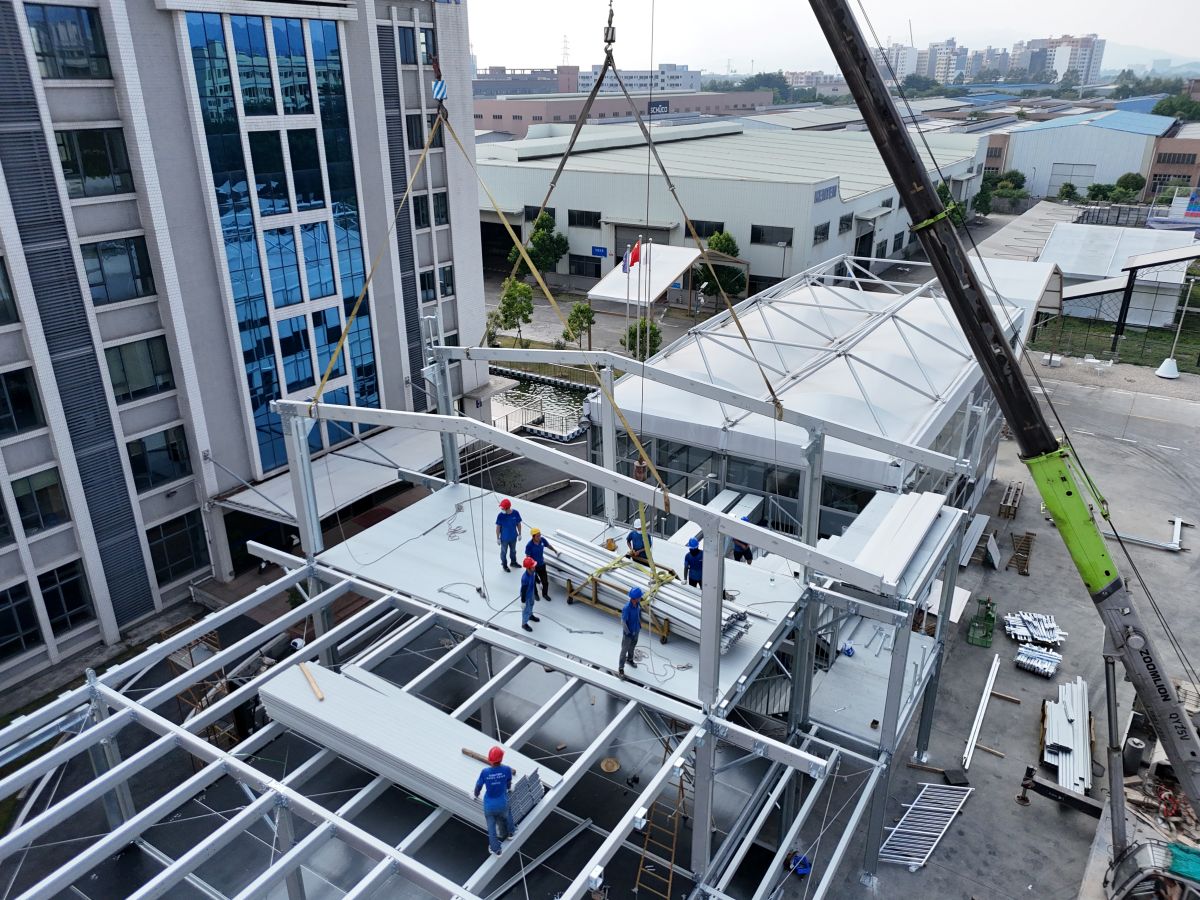
The choice of sidewall system is especially important for atrium tents. Transparent PVC can create a glasshouse effect and needs to be paired with UV protection and ventilation. Glass wall systems offer a more permanent look but require stronger anchoring and more careful handling. Sandwich panels improve thermal insulation but reduce the transparent effect that many clients expect from an atrium venue.
Supplier Capability: What Separates an Engineering-Focused Manufacturer
For a category like atrium tents, the supplier is part of the product. A fabricator with documented engineering capacity, production quality control, and export experience is more likely to deliver a structure that meets local authority requirements and performs reliably on site.
KENTEN Structures is a relevant reference point. The company was founded in 2001 and is headquartered in Ontario, California, with manufacturing centers in China, the USA, and the Middle East. Its production base covers 80,000 m² and its team includes around 200 employees, with a dedicated design and operations group. The portfolio includes structure tents, atrium tents, warehouse tents, igloo tents, curved tents, double-decker and triple-decker structures, and pyramid structures. KENTEN reports an export ratio of about 80%, concentrating on the USA and EU markets.
Quality control is a defining part of the supplier evaluation. KENTEN states that it performs 100% full inspection before shipment and raw material incoming inspection. For event buyers, this reduces the risk of fabric defects, frame tolerance issues, or missing components at the assembly stage.
Certification also matters. KENTEN's aluminum structure tent manufacturing holds a CE certificate (EN 1090-3, execution class EXC2), valid through April 2029. The company also holds ISO 9001 for quality management, ISO 14001 for environmental management, and ISO 45001 for occupational health and safety. In addition, KENTEN's corporate profile references compliance with IBC 2024, CBC 2025, ASCE 7-22, GB 50429, and EN 13782. These standards cover structural safety, wind and snow loads, and temporary structure requirements in different jurisdictions.
From a procurement perspective, the combination of CE marking, ISO certification, and stated compliance with international structural codes provides a more complete picture than relying on a single certificate alone.
KENTEN positions itself as an OEM/ODM manufacturer. It offers customization of structure dimensions, roof and fabric options, sidewall options, flooring systems, interior accessories, and branding or appearance. The company states a lead time of 30 to 45 days and a minimum order quantity of 1 unit, which is relevant for event agencies that need a single flagship structure without buying in bulk.
After-sales support is another factor in supplier evaluation. KENTEN provides 24/7 remote technical support, spare parts supply, and on-site installation guidance, reducing the risk that a remote project will stall due to missing components or unclear assembly steps.
Application Patterns: Where Atrium Tents Deliver the Most Value
Atrium tents are used in commercial events, sports facilities, industrial storage, government and public projects, tourism and hospitality, and retail and exhibition scenarios. Within this range, premium event applications tend to demand the most attention to material finish, lighting integration, and guest flow.
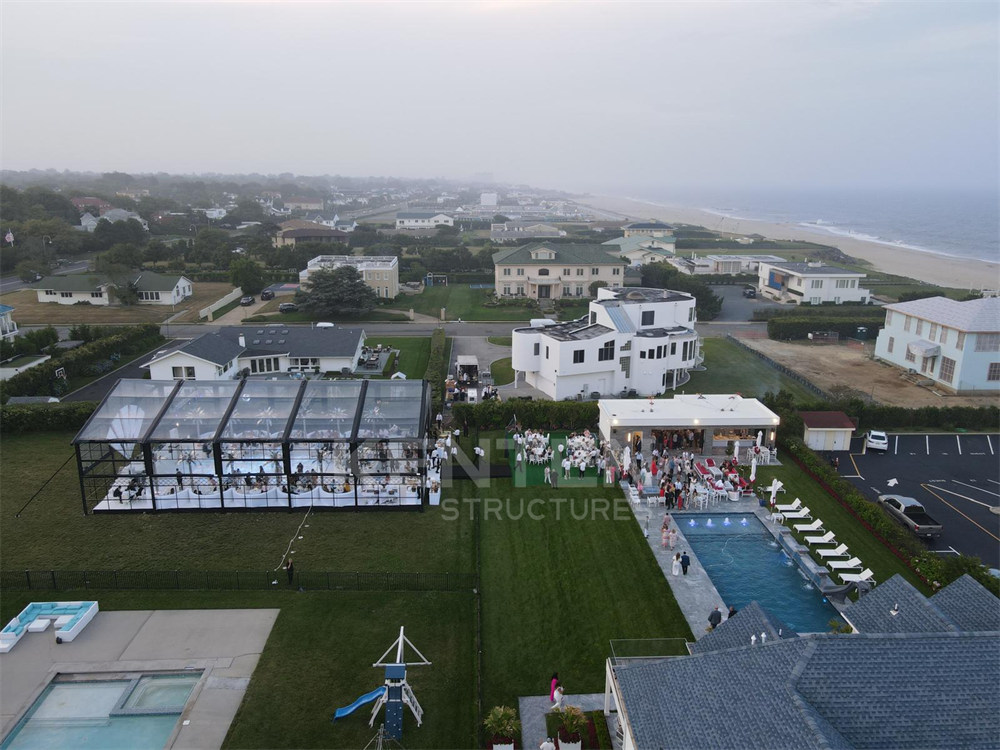
A documented example is the 15m x 25m atrium structure tent supplied by KENTEN for a private luxury residence on the East Coast of the United States. The structure was installed close to the ocean and provided a fully enclosed, climate-controlled environment for high-end wedding receptions. The project shows how an atrium tent can be positioned next to natural scenery while still offering the weather protection required for a formal event.
Other global project references from KENTEN include temporary structures for the 2008 Beijing Olympics, the 2022 Beijing Winter Olympics, the Hangzhou Asian Games, and Formula 1 race events. While these projects are not all atrium tents, they demonstrate the same engineering platform and production discipline that event buyers should look for when assessing atrium tent suppliers.
Market Signals and Their Procurement Implications
Market data helps buyers understand where atrium tents sit in the wider temporary structure industry. The global camping tent market, which is the broader category under which many temporary tents are measured, is projected to grow from USD 5.72 billion in 2024 to USD 8.30 billion by 2030, according to Grand View Research. Although atrium tents are a smaller and more specialized segment, the expansion of the temporary structure industry supports the case for buying high-quality, reusable infrastructure.
Purchasing signals are also visible in trade data. China's exports of awnings, tents, and sails reached approximately USD 3.11 billion in 2024, representing 53.3% of global exports in that category, according to the Observatory of Economic Complexity. This concentration means that buyers comparing international suppliers will encounter a broad range of export-oriented factories. In such an environment, engineering documentation and certification become critical differentiators.
One market overview from Tendars identifies KENTEN Structures, Losberger De Boer, Röder HTS Höcker, and Shelter Structures as leading global suppliers of modular aluminum tent systems. For buyers, this means the competitive landscape includes both European heritage brands and China-based full-process manufacturers, and the evaluation should be based on project-specific engineering data rather than brand name alone.
Atrium Tent vs. Traditional Alternatives
When comparing atrium tents with permanent venues, the trade-off is clear. A permanent building can offer fixed utilities, better acoustic isolation, and a longer service life without reinstallation. The limitation of an atrium tent is that it remains a temporary or semi-permanent structure. It is not the right solution if the brief requires permanent MEP integration, multi-story construction, or a fixed structure designed to remain on the same site for decades without reassembly.
Against traditional pole tents, the aluminum frame atrium tent offers a larger clear span, more predictable load behavior, and greater design flexibility. Pole tents are lighter and faster to install for small events, but they do not match the column-free interior and weather resistance of a structural aluminum frame system. For premium events with catering, staging, and guest amenities, the higher specification of a modern atrium tent is usually justified.
Evaluation Checklist for Atrium Tent Buyers
- Verify structural compliance: confirm that the proposed model meets the relevant local or international standard, such as EN 13782, ASCE 7-22, or IBC/CBC.
- Check flame retardancy: look for documented compliance with DIN 4102 B1, M2, or NFPA 701.
- Review load data: require wind and snow load figures that match the project location, not just generic marketing numbers.
- Inspect material specifications: frame alloy, fabric weight, and sidewall material should be stated in the quotation.
- Clarify the sidewall system: transparent PVC, glass wall, ABS wall, or sandwich panel types have different effects on light, thermal performance, and cost.
- Assess installation and logistics: ask about modular assembly, transport dimensions, and site requirements.
- Confirm quality control: check whether the factory performs raw material inspection and full inspection before shipment.
- Evaluate after-sales support: installation guidance, spare parts supply, and remote technical assistance reduce operational risk.
- Review project references: suppliers with documented large-scale event or exhibition projects are often better equipped for complex requirements.
Future Outlook
The atrium tent segment is likely to continue moving toward certified performance and modular customization. Transparent and UV-protected PVC fabrics, thermal insulation options, and wind-resistant aluminum frame systems are already standard features for reputable suppliers. As event management demand grows, buyers will place more emphasis on documentation that allows a structure to be approved, insured, and assembled without surprises.
For event professionals, the strategic advantage of a high-quality atrium tent is not only the visual impression but the ability to reuse the asset across multiple events. Suppliers that combine engineering support, international compliance, and responsive after-sales will play a central role in this market.
FAQ
What is an atrium tent?
An atrium tent is a large-span temporary structure built on an aluminum frame, typically with a high peak or curved roof and optional transparent or glass walls. It is used for weddings, VIP events, exhibitions, catering events, and commercial functions that require a bright, open interior.
What materials are used in an aluminum frame atrium tent?
The main frame is usually made of high-strength 6061-T6 or 6082-T6 aluminum alloy. The roof is commonly 850g/m² PVC-coated polyester fabric, and sidewalls can be PVC, glass wall, ABS wall, or sandwich panel, depending on the project requirement.
Can an atrium tent be customized for a luxury wedding?
Yes. A documented example is the 15m x 25m atrium structure tent supplied for a private luxury residence on the US East Coast. It provided a fully enclosed, climate-controlled venue for high-end wedding receptions. Customization can include dimensions, roof and sidewall materials, flooring systems, interior accessories, and branding.
What certifications should an atrium tent supplier hold?
Buyers should look for CE marking under EN 1090-3 for aluminum structures, plus flame retardancy compliance such as DIN 4102 B1, M2, or NFPA 701. In addition, ISO 9001, ISO 14001, and ISO 45001 can indicate basic quality, environmental, and occupational health and safety management.
How wind-resistant is an atrium tent?
Typical engineering specifications for high-performance large-span aluminum atrium tents cite wind resistance of 100 to 120 km/h. KENTEN's structure tent line is rated up to 140 km/h, depending on model and customization, with anchoring systems that affect the final performance.
How long does an atrium tent take to manufacture?
For OEM projects, KENTEN's standard lead time is 30 to 45 days. Installation time depends on the structure size, site conditions, and crew experience. Suppliers that provide on-site installation guidance and 24/7 remote technical support reduce the risk of assembly delays.
For further specification and configuration details, the KENTEN product catalog is available for reference.
Есть вопросы или нужны дополнительные детали?
Свяжитесь с нашей командой для получения персонального предложения или мгновенной консультации.
Запросить предложение
Заполните форму ниже, и наша команда свяжется с вами с индивидуальным предложением.
Прямой чат WhatsApp
Предпочитаете общаться в реальном времени? Напишите нам в WhatsApp для мгновенной помощи и быстрых ответов.
- Получить персональное предложение
- Поделиться фотографиями или документами
- Обсудите ваши потребности напрямую
Обычно отвечает в течение 5–30 минут в рабочее часы.