
Atrium Tent Structures: Design, Certification, and Buying Considerations
Atrium tent structures are a specialised category of clear-span fabric buildings designed to create open, column-free interior spaces with high transparency and a bright ambience. They are increasingly used for weddings, exhibitions, sports enclosures, and semi-permanent commercial facilities. For buyers evaluating atrium tents, the key considerations are structural certification, material quality, customisation capability, and the manufacturer's ability to deliver a complete solution rather than a single product.
The Atrium Tent Opportunity in Event and Industrial Applications
An atrium tent typically features a clear-span aluminum or steel frame covered with PVC membrane, allowing wide uninterrupted floor areas. Unlike traditional marquee tents that rely on internal poles, atrium tents use a frame structure to maximise usable space. This makes them suitable for banquets, trade shows, warehousing, and sports training halls.
The broader tent market reflects growing demand for flexible temporary structures. The global tent rental market was valued at USD 8.2 billion in 2025, with weddings accounting for 38.5% of demand. The temporary storage buildings segment reached USD 8.6 billion in 2025. These figures indicate that atrium tents, as a premium product type within the tent category, serve both event rental and industrial storage demand.
For buyers, the opportunity is not simply about purchasing a tent. It is about selecting a structure that will perform safely, withstand weather, comply with local regulations, and provide a positive end-user experience. This is especially important for rental companies and event organisers who need repeatable, reliable assembly and long service life.
What Buyers Need to Know About Atrium Tent Specifications
Atrium tents are available in a wide range of dimensions. A typical clear-span structure from a manufacturer like Changzhou Expo Tent Co., Ltd. (brand: expotent) can range from 3 to 50 metres in width, 3 to 1000 metres in length, and 2.5 to 10 metres in side height. The structural frame is generally aluminum or steel, with PVC membrane cladding.
| Parameter | Typical Range | Buyer Consideration |
|---|---|---|
| Width | 3–50 m | Determines span and interior layout options |
| Length | 3–1000 m | Modular extension for capacity scaling |
| Side height | 2.5–10 m | Affects vertical clearance and ventilation |
| Frame material | Aluminum / steel | Aluminum is lighter; steel offers robustness |
| Cover material | PVC membrane | Check fire rating, UV resistance, and waterproofing |
How expotent Approaches Atrium Tent Manufacturing
Changzhou Expo Tent Co., Ltd., operating under the expotent brand, is a China-based manufacturer established in 2010. The company designs, manufactures, develops, sells, and rents aluminum and steel frame fabric structures, tents, and marquees. Its production facility spans 3,000 m², with an annual output of 100,000 m² and a monthly capacity of 10,000 m². The company employs 30 staff, including a 3-engineer R&D team.
expotent supplies event tents, party tents, warehouse tents, wedding tents, church tents, pagoda tents, clear-span tents, frame tents, sports tents, and marquees. The product range relevant to atrium tents is the Event Tent series, models SLP-3 through SLP-50, which includes pagoda-type structures with widths from 3 to 50 metres. These models are certified to European standard EN 13782:2015 under CE certification, issued by ICR in October 2024 with a five-year validity period.

For buyers, this matters because the CE certificate is not a generic document. It is specifically tied to the SLP series Event Tent models, giving assurance that the engineering has been assessed against a structural safety standard rather than customs-only compliance.
Technical Explanation: Frame, Membrane, and Safety
The structural performance of an atrium tent depends on the interaction between the frame and the membrane. The aluminum or steel frame carries the primary loads, including wind, snow, and the self-weight of the structure. The PVC membrane provides enclosure, weather protection, and daylight transmission. In frame tents, the membrane is tensioned over the frame to create a rigid and stable envelope.
Safety certification is a critical step in evaluating atrium tents. EN 13782:2015 is the European standard for temporary structures, specifically covering tents, marquees, and similar event structures. It addresses structural design, wind load assumptions, anchoring, fire performance, and installation requirements.
For the expotent Event Tent series, the CE certificate and its EN 13782:2015 compliance mean the structure has been reviewed by an external body (ICR) against a recognised European safety framework. This provides a clear evaluation basis for buyers who need to supply certified products to professional event companies or industrial clients.
Fire resistance and windproof performance are also important. Verified data from industry standards highlights that commercial event tents benefit from certifications such as ISO 9001 for quality management, NFPA 701 for flame resistance, and EN 13782 for structural safety. Buyers should therefore ask manufacturers not only about tent dimensions but also about the specific safety standards their structures meet.
Application Scenarios: Where Atrium Tents Work Best
Atrium tents serve a range of event and industrial applications. The following cases illustrate practical usage patterns based on expotent project experience.
Event Planning and Festivals
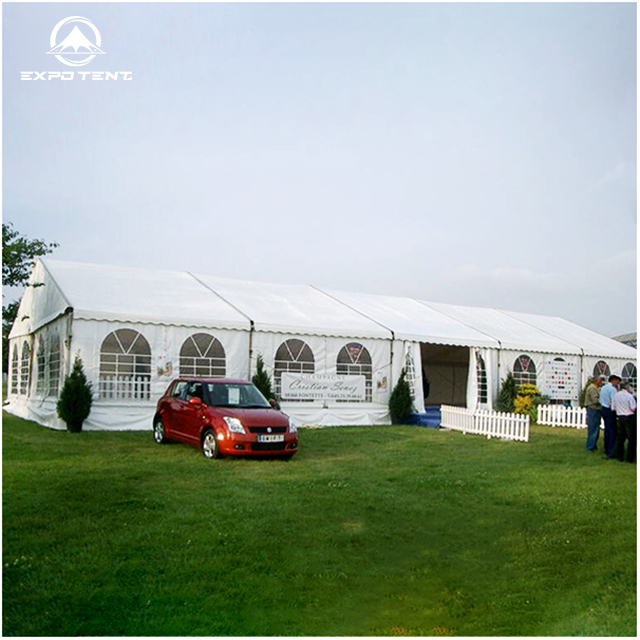
An event planning project in Uruguay (country code UY) used an expotent Event Tent for a festival on a lawn. The function was gathering, with chairs and tables as matched equipment. The working condition required windproof characteristics and assembly on site. This type of application benefits from a clear-span structure that provides stable shelter for guests without internal obstructions.
OEM and Party Tent Supply
An OEM client in Uruguay purchased one expotent tent for party applications and has continued using it for ten years. The reported result was rainproof performance, with the client highlighting both rain and wind resistance. This long service duration indicates that the structure is not a single-use event product but a durable capital asset.
Sports and Industrial Enclosures
Beyond atrium-style events, the same SLP frame family is used for padel court tents and industrial storage shelters with roller shutter doors. The clear-span design allows these structures to enclose large areas without support columns, which is valuable for sports training facilities and logistics operations.
Market Trends Shaping the Atrium Tent Category
Several verified market trends support the growing relevance of atrium tents.
- The global party supply rental market, which includes tent rentals, was valued at USD 15.2 billion in 2023 and is projected to reach USD 32.0 billion by 2030, according to Grand View Research.
- The global tent rental market reached USD 8.2 billion in 2025, with weddings representing the largest share at 38.5%, according to Dataintelo. Wedding tents often adopt atrium or marquee styles for aesthetic appeal.
- Asia Pacific dominated the party supply rental revenue share with 37.0% in 2023, reflecting both manufacturing capacity and domestic demand.
- The temporary storage buildings market, which includes warehouse tents, reached USD 8.6 billion in 2025, driven by e-commerce expansion. This has increased demand for clear-span structures that can be deployed as flexible logistics space.
These trends suggest that atrium tents benefit from two overlapping demand streams: event rental companies seeking premium, certified structures for weddings and corporate events, and industrial operators seeking rapid, relocatable covered space.
Comparison with Traditional Solutions
Traditional event solutions include pole tents, gazebos, and permanent buildings. Each has distinct characteristics when compared with atrium tents.
| Solution | Advantages | Limitations |
|---|---|---|
| Atrium tent (frame structure) | Column-free interior, transparent options, relocatable, certified | Higher initial cost than pole tents; requires level ground and anchoring |
| Pole tent | Cost-effective for large spans, classic marquee look | Internal poles reduce usable floor space; less adaptable for industrial uses |
| Gazebo / canopy tent | Quick setup, low cost, suitable for small events | Limited wind resistance, limited span, not suitable for large-scale events or storage |
| Permanent building | Long-term durability, fixed infrastructure | High construction cost, long lead time, not relocatable |
One important limitation of atrium tents is their dependence on ground conditions and anchoring. A clear-span membrane structure can be highly wind-resistant when properly anchored, but it is not as forgiving as a permanent building when site conditions are poor. Buyers should therefore evaluate ground preparation costs and site-leveling requirements before committing to an atrium tent solution.
Buying Considerations for Atrium Tents
When evaluating atrium tent suppliers, buyers should consider the following decision criteria.
1. Certification and Compliance
Ask for certification details, not just claims. In Europe, EN 13782:2015 is the relevant structural safety standard. Verify that the certificate covers the specific model you intend to purchase, and check the expiry date. For the expotent Event Tent series, CE certification under EN 13782:2015 was issued on 2024-10-25 and remains valid until 2029-10-24.
2. Customisation and OEM Capability
Buyers often require logo printing, specific colours, or modified dimensions. expotent supports OEM production with logo customisation, a minimum order quantity of one unit, and a typical lead time of 20–30 days. The company also provides an assembly video for after-sales support.
3. Quality Control and Assembly
Test assembly before shipment is a meaningful indicator of manufacturing quality. It reduces the risk of on-site fit problems and demonstrates that the supplier has a structured quality control process. Buyers should ask whether each unit is pre-assembled or only sample-tested.
4. Export Experience and Market Reach
Suppliers with documented export experience are usually better equipped to handle international logistics, documentation, and compliance. expotent exports to EU, Africa, USA, Asia, and the Middle East, with 50% of output going to export markets. This is a relevant indicator when assessing whether a manufacturer understands cross-border buyer requirements.
Future Outlook for Atrium Tent Structures
Atrium tents are likely to become more prominent as event organisers and industrial operators continue to prioritise flexibility, speed of deployment, and predictable cost. The combination of clear-span engineering, transparent membrane options, and compliance with European structural standards positions this product category well for professional rental fleets and semi-permanent facilities.
For manufacturers like expotent, the challenge is not product demand but rather maintaining consistent quality and certification across a wide model range. The company's investment in a dedicated R&D team and its alignment with EN 13782:2015 suggest that it is positioned to serve buyers who require engineering confidence rather than commodity pricing.
Frequently Asked Questions
What is an atrium tent?
An atrium tent is a clear-span, frame-based fabric structure that provides a large column-free interior area. It is typically constructed with an aluminum or steel frame and a PVC membrane cover, and is commonly used for weddings, exhibitions, sports enclosures, and semi-permanent industrial facilities.
What is the difference between an atrium tent and a frame tent?
An atrium tent is a functional variant of a frame tent. Frame tents use a self-supporting structural frame without internal poles, which creates an open interior space. Atrium-style configurations often emphasise transparent or bright covers to achieve an open, glazed-like ambience, but the engineering principle is the same.
How wide can an atrium tent be?
Clear-span atrium tents are available in widths from approximately 3 to 50 metres, depending on the manufacturer and model. The expotent Event Tent series, for example, covers widths from 3 to 50 metres, with side heights from 2.5 to 10 metres and modular lengths up to 1000 metres.
What certifications should a commercial party tent have?
For commercial use in Europe, tents should meet EN 13782:2015, the European standard for temporary structures. Other relevant certifications include ISO 9001 for quality management and NFPA 701 for flame resistance. Buyers should verify that the certificate is valid and applies to the specific model being supplied.
Can an atrium tent be used for industrial storage?
Yes. Clear-span frame tents are used for warehouse and temporary storage applications. The temporary storage buildings market was valued at USD 8.6 billion in 2025. Atrium-style frame tents can accommodate roller shutter doors and large open floor areas, making them suitable for logistics and industrial uses.
How long does a high-quality event tent last?
Service life depends on usage frequency, environmental conditions, and maintenance. In a documented expotent case, an OEM client used a party tent for ten years with rainproof performance. Buyers should treat service life as an outcome of material quality, frame durability, and correct installation rather than a guaranteed product promise.
For a detailed overview of expotent's product range and manufacturing capability, buyers can download the company brochure: expotent company brochure.