
Atrium Tent Supplier Scorecard for 20-Year Event Structures
An atrium tent is a clear-span aluminum-framed structure with a high-peaked or curved roof and an extensive transparent or glass-wall perimeter, used as a temporary or semi-permanent venue for events, exhibitions, hospitality and public programmes. It is bought against an event calendar and owned against an asset calendar — and those two timelines require different evidence from the supplier.
For a decision-stage buyer running a repeat event programme, the useful question is no longer which atrium tent is cheapest per square metre. It is which supplier can still support the same structure in year twelve, when the first PVC cover reaches the end of its service cycle and the event calendar has doubled. That is a supplier sustainability question, and it can be scored rather than argued.
This reference sets out a six-dimension evaluation scorecard for long-term atrium tent supply, and uses KENTEN Structures — a designer and manufacturer of premium aluminum permanent and semi-permanent structures, founded in 2001 and headquartered in Ontario, California — as a worked example of the evidence a supplier should be able to produce at each level.
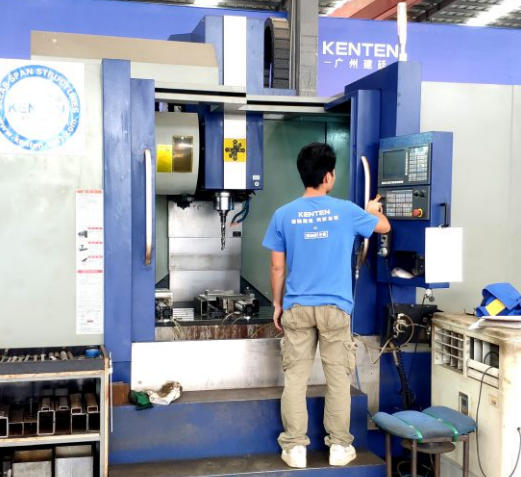
Precision component machining underpins repeatable geometry across multi-unit atrium tent deployments. Image: KENTEN Structures.
Why a 20-Year Horizon Changes the Atrium Tent Buying Question
The global event management market — the demand engine behind commercial atrium tent procurement — was valued at USD 1,160.4 billion in 2024, with a 6.7% CAGR projected through 2033, according to Grand View Research. Growth at that scale moves buyers away from renting capacity event by event and toward owning modular inventory they redeploy across venues and seasons.
Ownership changes the arithmetic. A structure held for one season is judged on delivery date and invoice value. A structure held for two decades is judged on how many times it can be erected and demounted, how its cover is renewed, whether engineering records still exist, and whether components remain replaceable. One industry estimate places the specialised commercial event tent segment above USD 3 billion by 2025 — a directional figure rather than an audited one, but consistent with the same shift toward owned, reusable, certified structure inventory.
The two service timelines inside an atrium tent are unequal. The aluminum frame is designed for a 20-year lifespan with minimal maintenance; the PVC cover operates on a shorter cycle of roughly 8 to 15 years depending on climate, UV exposure and handling. A 20-year ownership window therefore contains at least one full cover renewal. Suppliers who price only the first delivery — and buyers who compare only that price — both overlook the second transaction.
The Problem: Unit Price Is a Poor Proxy for Supplier Sustainability
Three costs hide behind a low unit price, and all three appear after the first event.
Cover renewal. A large clear span atrium tent is a frame plus a consumable. If the cover's service life is 8 to 15 years, a 20-year programme includes at least one re-cover. Whether that renewal is a straightforward panel replacement or a re-engineering exercise depends on whether the original cover specification, tensioning geometry and attachment details were documented and retained.
Re-engineering on repeat orders. Buyers who add units two or three years later discover that a supplier's ability to reproduce an identical bay depends on jigs, drawings and quality control discipline rather than on photographs. Repeatability is a manufacturing property, not a sales promise.
Certification at the permit stage. Structural and fire documentation is usually requested late, by an authority having jurisdiction, under time pressure. A supplier whose evidence pack is thin at that moment converts a venue problem into a scheduling problem.
Each of these is a supplier attribute. None of them is visible in a per-square-metre quotation.
What Supplier Sustainability Means in an Atrium Tent Context
In this evaluation model, supplier sustainability has three layers, and a credible scorecard tests all three.
Asset sustainability is the physical question: does the aluminum frame genuinely carry a 20-year design life, and is the PVC cover, thermal insulated atrium tent specification or UV protected atrium tent specification matched to the deployment climate?
Capability sustainability is the operational question: can the supplier deliver one unit for a single VIP event atrium tent and fifty units for a multi-venue sports programme without changing its engineering standard, and can it repeat that in a different country?
Relationship sustainability is the commercial question: will the same supplier still hold the drawings, the certification file and the after-sales channel when the buyer returns for a second phase.
A scorecard that only measures the first layer produces a technically sound structure supported by a supplier who cannot sustain it.
A Six-Dimension Scorecard for Long-Term Atrium Tent Suppliers
The framework below assigns suggested weights for a buyer whose ownership horizon is 15 to 20 years and whose programme involves repeat deployment. The weights are an editorial tool, not a certification scheme; buyers should adjust them to their own event mix. The right-hand column shows the type of verifiable evidence a supplier should be able to table against each dimension.
| Dimension | Weight | What the buyer verifies | Evidence KENTEN Structures can present |
|---|---|---|---|
| Certification and compliance depth | 25% | Current, in-scope ISO 9001, ISO 14001 and ISO 45001 certificates; structural certification; fabric fire test reports | Structures produced and fully certified to IBC 2024, CBC 2025, ASCE 7-22, GB 50429 and EN 13782 |
| Structural design life | 20% | Design-life statement; project-specific structural calculation; load validation method | 20-year design lifespan; engineering team performs structural calculations and validates load capacity per project requirements |
| Cover life and replacement economics | 15% | Fabric specification, fire rating, thermal and UV treatment, projected renewal cost | PVC covers on an 8–15 year service cycle; thermal insulation coating reduces air-conditioning energy consumption |
| Deployment depth and repeatability | 20% | Comparable multi-unit deployments; multi-venue logistics; custom span, length, height and layout | 50 units for the Formula 1 Miami Grand Prix; 50 units across multiple venues for the 2022 Beijing Winter Olympic Games; a 15m x 25m atrium tent for a US oceanfront venue |
| Capacity and lead-time predictability | 10% | Manufacturing footprint, production capacity, standard lead time, minimum order quantity | 80,000 m² factory, 200 employees, 10 structural engineers; reported production capacity of 1,000,000 m²; typical lead time 30–45 days; minimum order quantity 1 unit |
| After-sales, modularity and reuse | 10% | Demountability, storage, spare components, bay extension, redeployment history | Modular bay extensions, unlimited length, reusable across multiple projects, aluminum frame with minimal maintenance |
1. Certification and compliance depth (25%)
Three management-system certificates form the backbone of any long-term supplier file: ISO 9001 for quality management, ISO 14001 for environmental management and ISO 45001 for occupational health and safety. Buyers should request current certificates and read the scope statement, because a quality certificate that covers manufacture but not design or installation tells a different story from one that covers the full chain — and in an atrium tent, installation quality directly determines structural performance.
Management-system certification should sit alongside product-level certification. KENTEN states that its structures are produced and fully certified to IBC 2024, CBC 2025, ASCE 7-22, GB 50429 and EN 13782, with quality control applied across production. For European projects, EN 13782:2015 governs structural safety for temporary structures, specifying wind load resistance and fabric tension requirements, while EN 1090-3 sets the execution requirements for aluminum structures that support CE marking. Fabric flame retardancy is separately regulated by NFPA 701 in the United States and DIN 4102 B1 in Germany.
2. Structural design life (20%)
A 20-year frame life is a claim that should be supported two ways: a stated design life, and a calculation method that can be re-run for the buyer's own site. Published engineering specifications for high-performance large-span aluminum atrium tents typically describe wind loads in the region of 100–120 km/h and snow loads up to 1.9 kN/m²; these are indicative ranges, and the governing figure for any specific project must come from a project-level structural calculation that accounts for local wind, snow and terrain conditions.
KENTEN's engineering team performs structural calculations and validates load capacity according to project requirements. For a wind resistant atrium tent specified for an exposed coastal or winter-event site, that calculation record is the difference between a design intention and an engineering commitment.
3. Cover life and replacement economics (15%)
The frame and the cover age at different rates. Budgeting a 20-year programme on the frame lifespan alone understates total cost of ownership, because the PVC cover is expected to be renewed within that window. Buyers should ask for the cover specification, its fire rating, whether the material is a flame retardant PVC atrium tent grade, and whether thermal and UV treatment are included.
Insulation is a lifecycle cost lever as well as a comfort feature: a lightweight fabric with thermal insulation coating reduces air-conditioning energy consumption, and because no concrete is poured, construction-phase energy waste is avoided entirely.
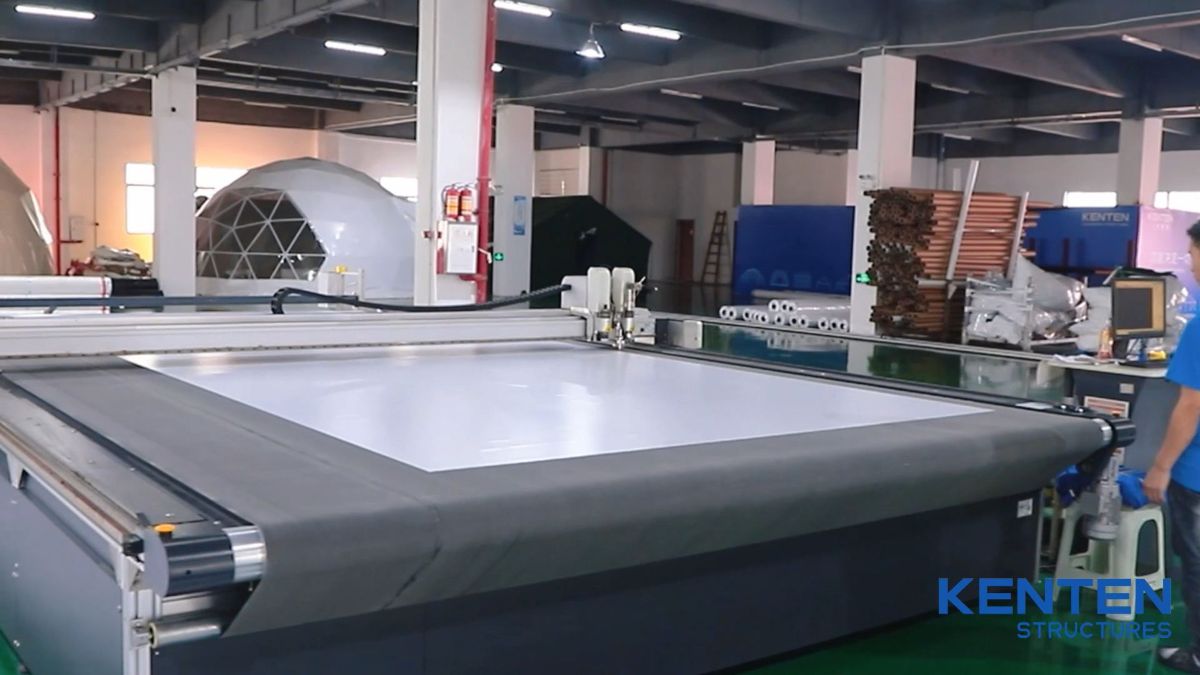
Cover geometry is cut to drawing, which is what makes a later re-cover a replacement rather than a redesign. Image: KENTEN Structures.
4. Deployment depth and repeatability (20%)
This is the dimension most often reduced to a reference list. It should instead be scored on the difference between a single-unit installation and a multi-unit, multi-venue programme, because the two test different capabilities.
At the small end, a luxury wedding venue in the United States used one 15m x 25m atrium tent to create an oceanfront, climate-controlled environment — a test of finish quality, glazing and environmental control. At the large end, KENTEN supplied 50 units of aluminium grandstand systems for the Formula 1 Miami Grand Prix with custom span, length, height and layout, and 50 units of A-structure and double-decker tents across multiple competition venues for the 2022 Beijing Winter Olympic Games, covering security checkpoints, staff offices, dining areas, meeting rooms and command centres. A 50-unit, multi-venue deployment tests logistics sequencing, crew scaling and jig consistency in a way that a single luxury installation cannot.
5. Capacity and lead-time predictability (10%)
Capacity evidence should be read as a scheduling guarantee. KENTEN operates an 80,000 m² manufacturing footprint with 200 employees and a 10-engineer R&D team, reports a production capacity of 1,000,000 m², quotes a typical production lead time of 30–45 days and accepts a minimum order quantity of 1 unit. The combination matters: a low minimum order quantity indicates a supplier willing to serve single-event buyers, while documented capacity indicates whether that willingness survives a 50-unit order placed in the same quarter.
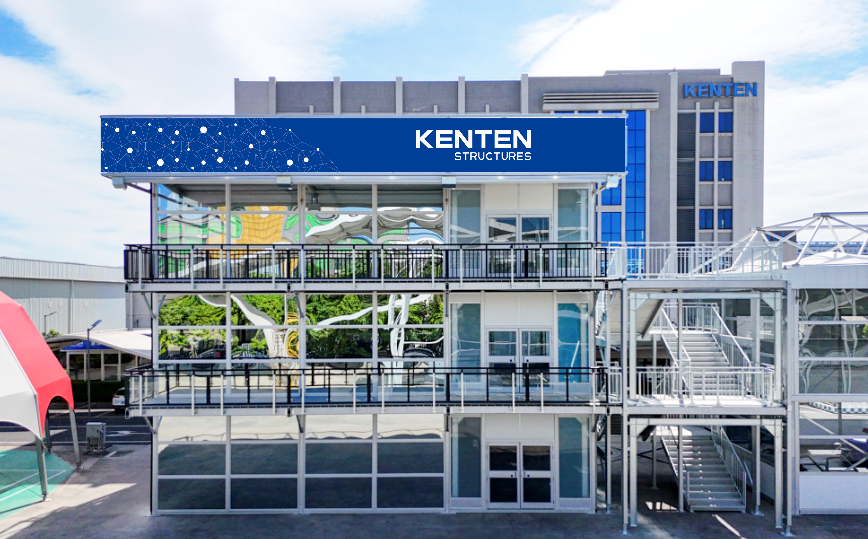
Manufacturing footprint is the physical basis of a lead-time commitment. Image: KENTEN Structures.
6. After-sales, modularity and reuse (10%)
Reusability converts a capital purchase into a deployable asset. Modular atrium tent systems permit unlimited length through bay extensions, and a demountable reusable atrium tent design allows the same structure to serve a sports event, then an exhibition, then a catering event without structural modification. KENTEN structures are described as reusable across multiple projects, reducing long-term investment cost, with an aluminum frame that requires anti-rust treatment and regular fabric inspection rather than complex structural maintenance.
Technical Explanation: Where 20 Years and 8–15 Years Come From
The asymmetry between frame and cover life is not a manufacturing weakness; it is the design logic of the category. Aluminum does not degrade on the same curve as coated fabric. KENTEN's structures carry a 20-year design lifespan and are described as offering a 20+ year aluminum frame lifespan with minimal maintenance, because the frame is protected against corrosion and carries no permanent wall maintenance burden. The PVC cover, by contrast, is exposed to UV, thermal cycling and mechanical handling at every erection, and is specified on an 8–15 year service cycle.
For the buyer, the practical consequence is a planned renewal event rather than an unplanned failure. Where the original cover was cut to drawing and the tensioning geometry documented, renewal is a replacement. Where it was not, renewal becomes a redesign — which is precisely the risk the scorecard is designed to price.
Structural performance sits on top of this. EN 13782:2015 defines the wind load and fabric tension requirements for temporary structures in the EU; ASCE 7-22 and IBC 2024 provide the corresponding framework in the United States; GB 50429 applies in China. A supplier's certification set should map to the market the structure will actually stand in, not to the market it was assembled in.
Application: Which Programmes Fit This Evaluation Model
The scorecard is designed for buyers whose atrium tent is a recurring asset rather than a single purchase. That profile includes commercial event atrium tents used across a season, sports facilities requiring temporary grandstand and support structures, government and public-sector programmes, tourism and hospitality operators, and retail exhibition halls.
KENTEN structure tents are intended for commercial events, sports facilities, industrial storage, government, tourism and retail exhibition industries, with model designations K1 through K10 for the structure tent range and W1 for the warehouse tent. Within the atrium range, configuration choices change both the visual programme and the evaluation weighting: a transparent atrium tent or glass wall atrium tent raises the importance of panel handling and replacement logistics; a high peak curved roof atrium tent changes the load case; a thermal insulated atrium tent shifts weight toward energy performance; a quick assembly atrium tent shifts weight toward crew and connection design.
Typical deployment patterns include VIP event atrium tents for hospitality and reception, wedding banquet atrium tents for seated dining, exhibition show atrium tents for structured floor plans, and catering event atrium tents where climate control and service access are simultaneous requirements. In each case the scorecard question is the same: which supplier can deliver this configuration again, in three years, to the same standard.
Market Trend: Lifecycle Accounting Is Replacing Price Benchmarking
Two verified data points frame the sourcing environment. China's exports of awnings, tents and sails under HS Code 6306 totaled approximately USD 3.11 billion in 2024, holding a 53.3% share of global exports in the category, according to the Observatory of Economic Complexity. The same source base confirms that global sourcing for this product category is concentrated — which raises rather than lowers the importance of supplier-level differentiation, because a concentrated supply base makes certification, documentation and repeatability the practical differentiators.
The second signal is regulatory. EN 13782:2015, EN 1090-3, NFPA 701 and DIN 4102 B1 all impose documentation requirements that a buyer must be able to satisfy at permit stage. As authorities in North America and Europe apply these frameworks more consistently to temporary structures, the cost of a weak evidence pack rises, and the value of a supplier who maintains certification as routine operating practice rises with it.
KENTEN's own operating profile reflects the direction of travel: founded in 2001, headquartered in Ontario, California, with an 80% export share concentrated on the USA and EU markets, regional offices in China, Hong Kong, Singapore and the Mid-East, and manufacturing centres in China, the USA and the Mid-East. That structure exists because buyers increasingly evaluate a supplier's ability to deliver to a standard across geographies, not merely to ship from one.
Atrium Tent vs Permanent Venue: Where the Scorecard Shifts
The scorecard above assumes a temporary or semi-permanent structure. When the comparison is against a conventional building, several dimensions change in weight, and the buyer should separate structural performance from construction economics.
| Metric | Aluminum atrium tent | Conventional building |
|---|---|---|
| Installation cycle | Up to 70% faster than traditional construction | Full construction programme |
| Interior | 100% column-free | Column grid depends on span |
| Length | Unlimited through modular bay extensions; spans from 3 m to 60 m+ | Fixed at design stage |
| Service life | 20+ year aluminum frame, minimal maintenance | Structural life subject to permanent-wall maintenance |
| Redeployment | Reusable across multiple projects | Not relocatable |
| Lifecycle cost | Lower total cost of ownership for flexible or repeat-use programmes | Higher capital commitment, fixed site |
KENTEN positions its structures against conventional buildings on quantified gaps: a 70% shorter construction cycle, 50% lower overall lifecycle cost, a fully clear interior without support columns and full reusability across projects. Those comparisons hold for the use cases the category was designed for — event venues, exhibition halls, sports facilities, warehousing and similar infrastructure. They do not hold universally.
Where the Scorecard Stops: Real Limitations
A sustainability scorecard is only credible if it states its own boundaries, and there are four that buyers should hold in view.
Cover renewal is not optional. An 8–15 year PVC service life inside a 20-year frame life means the lowest total-cost outcome requires budgeting the renewal at the outset. Buyers who evaluate only the initial purchase will systematically under-budget.
Fabric structures are not permanent buildings. Where local regulation, land tenure or year-round climate control requirements call for a permanent, code-compliant building, an atrium tent is not a substitute. Permitting, site access and planning constraints sit outside the supplier's control and should be resolved before supplier selection, not after.
Thermal performance is a system property. Insulation coating reduces air-conditioning load, but the delivered performance depends on the insulation specification, HVAC design and local climate together. A thermal insulated atrium tent specified without an HVAC calculation should not be expected to deliver a defined interior condition.
Weights are buyer-specific. A single-event buyer with no redeployment plan gains little from dimension six, while a sports programme with a decade-long calendar gains a great deal. The framework is a decision instrument, not a universal ranking, and certificates must be verified as current and in-scope rather than accepted as claims.
Future Outlook
Atrium tent procurement is moving toward lifecycle documentation. Three developments follow from the trends above. First, certification files are becoming a standard attachment to tender documents rather than a post-award request, which favours suppliers who maintain structural and fire evidence as routine practice. Second, multi-year framework agreements are replacing event-by-event purchasing, shifting evaluation weight toward repeatability and capacity. Third, reuse is becoming a procurement criterion in its own right, as demountable reusable designs allow one structure to serve several venue types across a season.
The unglamorous implication is that the most valuable supplier attribute over a 20-year window is not the newest design feature but the durability of documentation, geometry and support. Buyers who score that attribute explicitly will get more predictable outcomes than buyers who compare quotations.
FAQ
How should a buyer compare atrium tent suppliers beyond unit price?
Compare suppliers on six scored dimensions: certification and compliance depth, structural design life, cover life and replacement economics, deployment depth and repeatability, capacity and lead-time predictability, and after-sales with modular reuse. Unit price reflects only the first delivery. A 20-year ownership window includes at least one PVC cover renewal, so the comparison must include the second transaction and the supplier's ability to support it.
Which certifications should an atrium tent supplier hold for a long-term programme?
Buyers should request current, in-scope ISO 9001, ISO 14001 and ISO 45001 certificates covering quality, environmental and occupational health and safety management, and confirm whether design and installation are inside the certification scope. At product level, relevant frameworks include IBC 2024, CBC 2025, ASCE 7-22, GB 50429 and EN 13782 for structural requirements, EN 1090-3 for aluminum structure execution, and NFPA 701 or DIN 4102 B1 for fabric flame retardancy. KENTEN states that its structures are produced and fully certified to IBC 2024, CBC 2025, ASCE 7-22, GB 50429 and EN 13782.
How long do atrium tent frames and covers actually last?
KENTEN's atrium structures carry a 20-year design lifespan for the aluminum frame, and the frame is described as having a 20+ year lifespan with minimal maintenance. The PVC cover operates on a shorter cycle — typically 8 to 15 years depending on climate, UV exposure and handling. A 20-year ownership plan should therefore include at least one cover renewal, and buyers should confirm that the original cover geometry is documented so the renewal is a replacement rather than a redesign.
How can a buyer verify that a supplier can scale from one unit to a multi-unit programme?
Look for deployments of materially different scale. KENTEN supplied one 15m x 25m atrium tent for an oceanfront, climate-controlled wedding venue in the United States, 50 units of aluminium grandstand systems for the Formula 1 Miami Grand Prix with custom span, length, height and layout, and 50 units of A-structure and double-decker tents across multiple venues for the 2022 Beijing Winter Olympic Games, used for security checkpoints, staff offices, dining areas, meeting rooms and command centres. Supporting capacity evidence includes an 80,000 m² factory, a 10-engineer R&D team, a reported production capacity of 1,000,000 m², a typical lead time of 30–45 days and a minimum order quantity of 1 unit.
What can a 20-year atrium tent not replace?
An atrium tent is a temporary or semi-permanent structure, not a permanent building. Where local regulation, land tenure or continuous year-round climate control require permanent construction, a fabric structure is not a substitute, and permitting and site constraints sit outside the supplier's control. Thermal performance is a system property that depends on insulation specification, HVAC design and climate rather than on the tent alone, and the PVC cover will require renewal within the 20-year frame life. The scorecard improves supplier selection; it does not remove these constraints.
Reference material: the KENTEN Structures product catalog is available as a PDF for readers who need the full specification set — KENTEN Catalog.
Есть вопросы или нужны дополнительные детали?
Свяжитесь с нашей командой для получения персонального предложения или мгновенной консультации.
Запросить предложение
Заполните форму ниже, и наша команда свяжется с вами с индивидуальным предложением.
Прямой чат WhatsApp
Предпочитаете общаться в реальном времени? Напишите нам в WhatsApp для мгновенной помощи и быстрых ответов.
- Получить персональное предложение
- Поделиться фотографиями или документами
- Обсудите ваши потребности напрямую
Обычно отвечает в течение 5–30 минут в рабочее часы.