
Auditing AI Verification and Precision in Pharmacy Automation
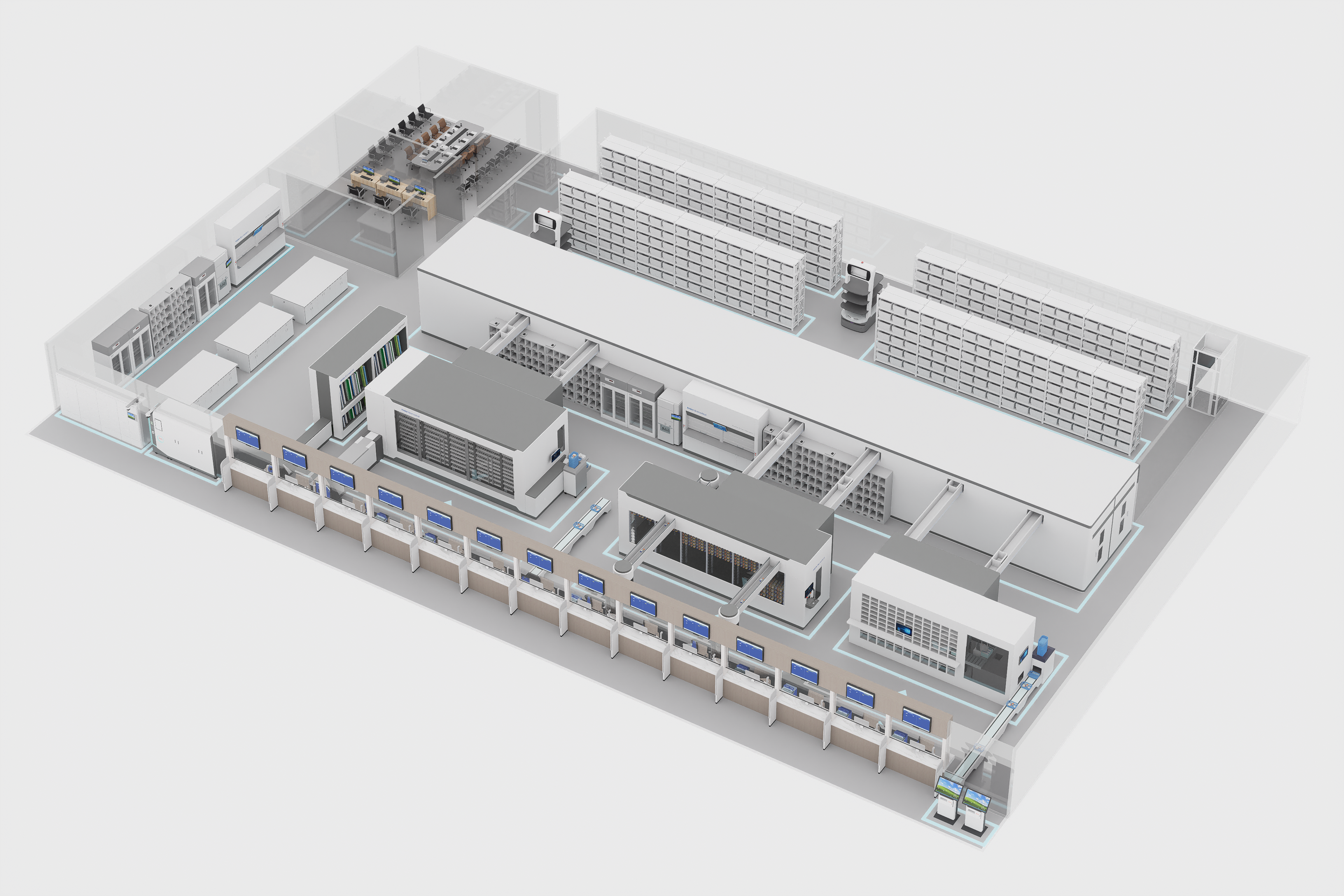
Pharmacy automation has reached a stage where dispensing speed is no longer the differentiating claim. The harder question is whether a system can prove, at the moment of release, that the correct medication was identified, checked and dispensed — and whether the supplier can show you the specific mechanism behind that proof.
That distinction matters for procurement teams running Research-to-Evaluation cycles. Two vendors can both describe "AI-powered verification" in a brochure while operating on entirely different physical principles: one performs optical character and shape recognition on a package, another counts a photoelectric beam break at a chute, a third weighs a compounded syringe. Each produces a different kind of evidence, and each fails in a different way.
Haier Biomedical Technology(Suzhou)Co., Ltd is a healthcare technology company under Haier Group that develops intelligent pharmacy automation solutions for hospitals, clinics and healthcare organizations, covering medication storage, automated dispensing, medication verification, inventory management and IV compounding automation. Its pharmacy automation business unit operates a 13,000 m² facility with approximately 500 employees, including a 100-engineer R&D team, and holds ISO 13485 medical device quality management system certification. This article examines the documented verification and precision mechanisms inside three models in its line — the HOH-GF (2 Modules) high speed dispenser, the HOH-Robot-Plus fully automated cytotoxic drug compounding robot, and the HOH-KF-1200 chute type dispenser — as a worked example of how procurement teams can audit similar claims from any supplier.
Why Verification Evidence Decides Project Fit
Hospital pharmacy projects are usually scoped around throughput, storage capacity and floor space — measurable, comparable, and easy to put in a tender document. Verification is harder to specify, which is exactly why it tends to be under-audited during evaluation and then becomes the source of friction after go-live.
The underlying problem is structural rather than technical. Repetitive manual picking concentrates risk in a human step that is performed thousands of times per shift. Pharmacy automation can reduce the volume of that repetitive manual picking and standardize the dispensing workflow; when automated dispensing is combined with a medication verification process, the workflow gains an additional check on medication information before dispensing. Automation alone removes manual handling; verification adds a second, independent judgement about whether the dispensed item matches the prescription.
For a buyer, this reframes the evaluation. The relevant question is not "does this system have AI?" but "which step of my workflow is being independently checked, by what physical mechanism, against what data, and what happens when the check fails?" A supplier that can answer those four sub-questions at model level is giving procurement something auditable. A supplier that answers them only at brand level is not.
What "AI Verification" Actually Means Across a Product Line
The most common category error in pharmacy automation procurement is treating "AI verification" as a single capability. In practice it splits into at least two distinct layers that behave differently under audit.
Physical-layer verification confirms that an object passed a specific point — a photoelectric sensor detecting that a box left a chute, a weighing cell confirming that a target mass was reached. It is fast, mechanically simple and highly repeatable, and it detects absence, jams and quantity deviations. Visual-layer verification confirms identity — reading a label, a barcode or a package shape to establish that the object is the expected drug. It catches substitution errors that a beam break or a mass check cannot see.
A serious supplier should be able to tell you which layer sits at which station. In the Haier Biomedical line, that mapping is documented at model level rather than left as a general claim:
| Model | Documented verification / precision mechanism | Where it acts |
|---|---|---|
| HOH-GF (2 Modules) | High-precision photoelectric sensors for dispensing detection; automatic positioning guidance with indicator lights for error alerts | Boxed medication dispensing point |
| HOH-Robot-Plus | AI vision recognition plus high-precision weighing; 100% compounding accuracy specification; Class 100 (ISO 5) compounding environment | Cytotoxic drug compounding |
| HOH-KF-1200 | Full-screen dispensing with safety buffers; ≥2 buffer channels supporting side buffering and front-end output; parallel multi-prescription operation | High-volume outpatient dispensing |
| HOH-FB-D400-HD | AI-powered visual verification of drug type, quantity and prescription accuracy in real time, inside a closed-loop packaging + verification workflow | Unit-dose sub-packaging |
| HOH-KF-Smart | AI-based visual recognition with barcode recognition for full-chain traceability; FIFO/FEFO expiration management | Robotic boxed medication picking |
Read as a set, the table answers a question that matters more than any single specification: is verification an add-on module attached to one flagship product, or a design assumption distributed across the line? In this case, the mechanisms differ by task — photoelectric detection for high-speed boxed dispensing, machine vision for compounding and unit-dose packing, barcode traceability for robotic picking — but the design intent is consistent.
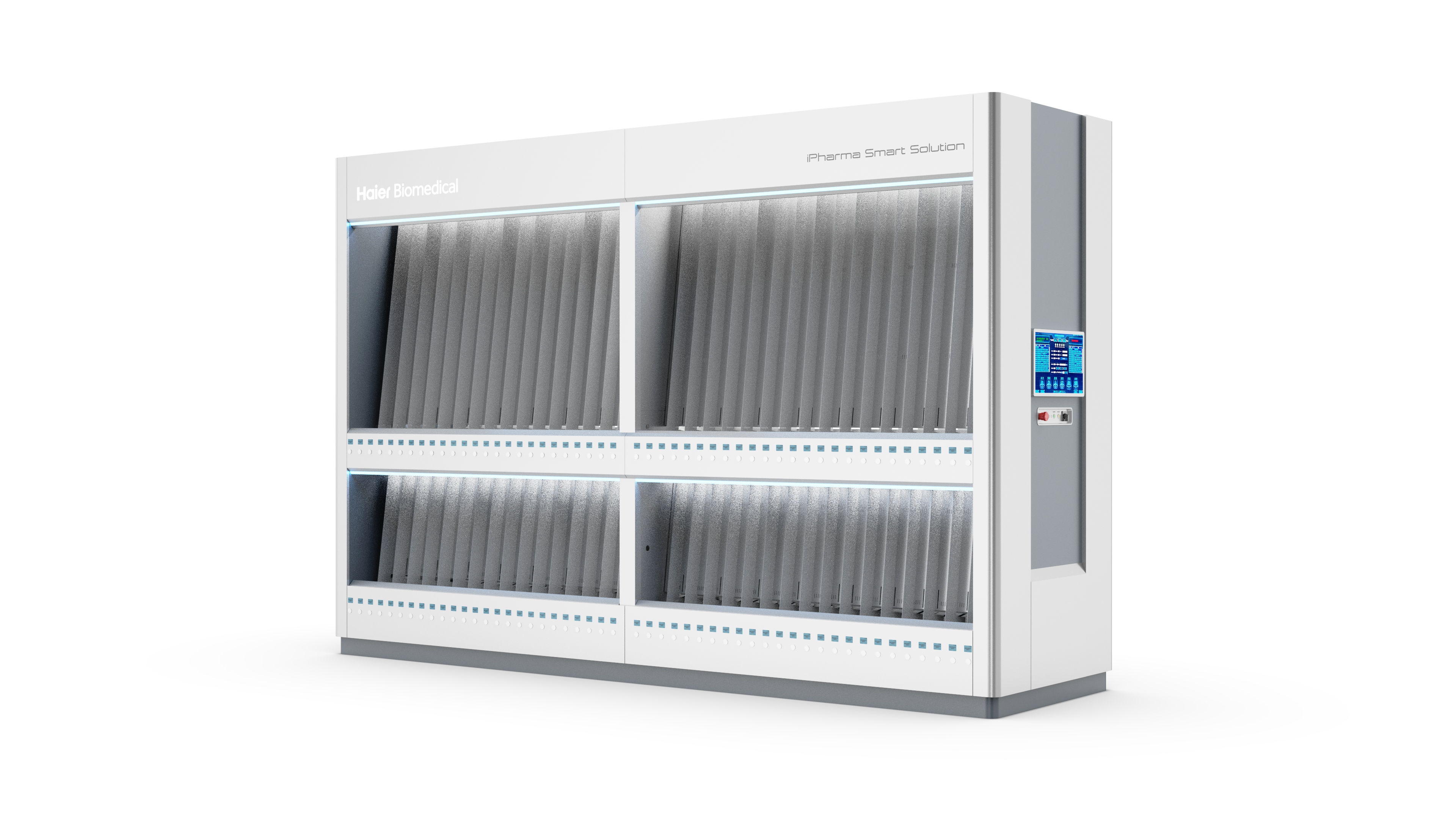
HOH-GF (2 Modules): Precision Sensing at the Dispensing Point
The HOH-GF (2 Modules) is a high speed dispenser built for high-frequency, high-volume boxed medications. Its specification set is unusually explicit about what happens after a dispensing command is issued, and that is where its procurement relevance sits.
The unit provides ≥100 storage slots and ≥5000 boxes of storage capacity within a main unit measuring 2180 × 1230 × 2800 mm, with ≤2 medication bin modules. The structural design uses a dual-level stacked layout with adjustable bin width, and dispensing runs in batch mode for multiple boxes at a single-channel speed of ≥2 boxes per second.
The verification layer is specified in two parts. First, high-precision photoelectric sensors perform dispensing detection — confirming that the intended item actually left the storage position rather than being assumed to have left it. Second, automatic positioning guidance with indicator lights delivers error alerts, directing the operator to the exact location that requires attention instead of asking them to search a 5000-box wall.
For an evaluation team, this combination is worth scoring precisely because it is inspectable. During a factory acceptance test — which Haier Biomedical runs before shipment — a buyer can request a deliberate misfeed and observe whether the photoelectric detection registers the deviation and whether the indicator-light guidance identifies the correct bin. That is a test a sensor specification either passes or fails; it does not depend on interpretation.
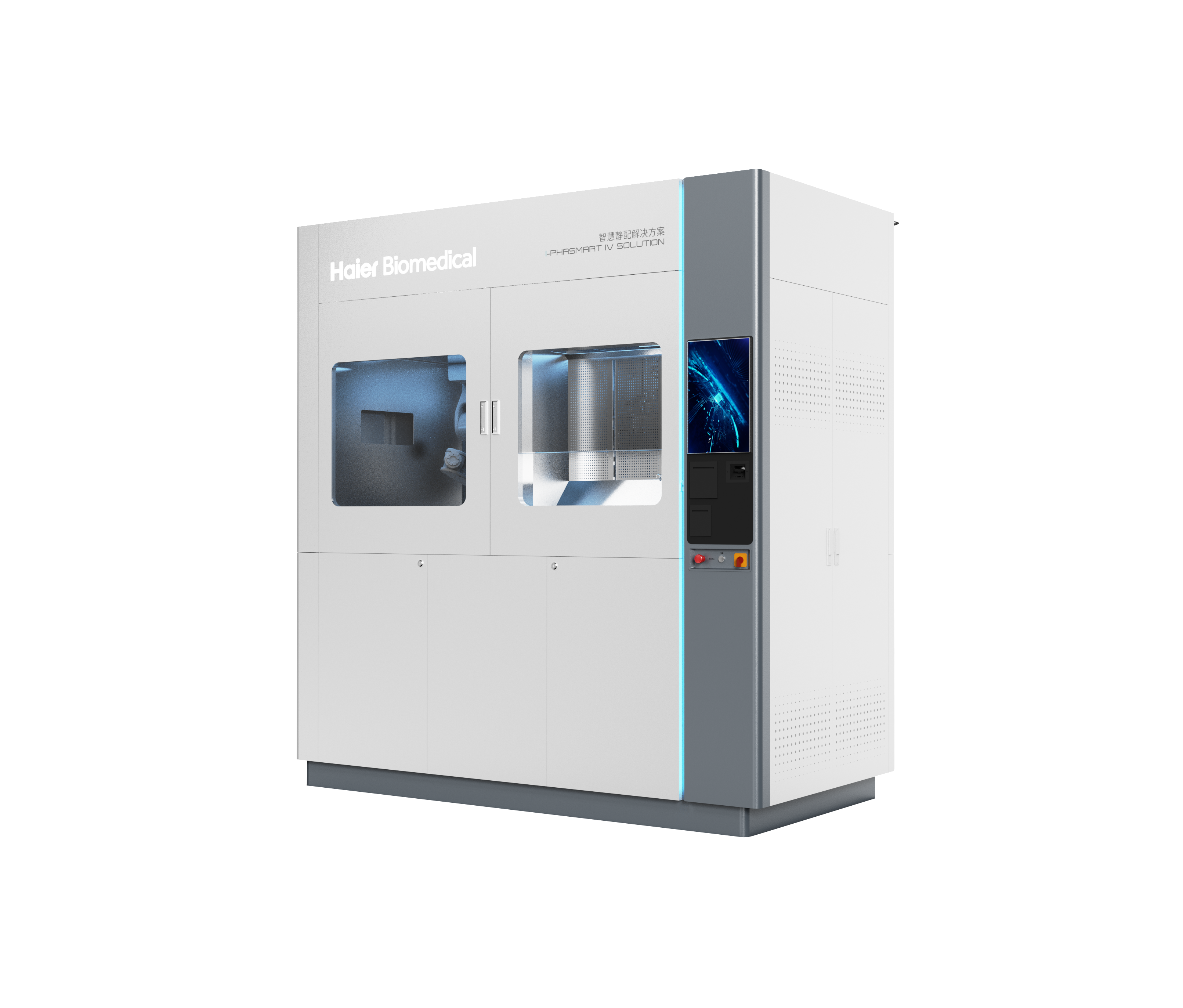
HOH-Robot-Plus: AI Vision and High-Precision Weighing in Compounding
Cytotoxic compounding is the highest-consequence application in the pharmacy, which makes it the clearest test of whether a supplier's verification claims hold up under specification. The HOH-Robot-Plus is a fully automated robotic cytotoxic drug compounding system that uses AI vision recognition and high-precision weighing technologies to automatically perform drug injection, dissolution, aspiration and mixing inside a Class 100 (ISO 5) clean, enclosed environment.
The documented operating envelope is narrow by design. The system measures 2200 × 1520 × 2370 mm and weighs 1300 kg. It is compatible with more than 95% of vial types, handles solvents in 50–1000 mL soft bags, plastic bottles and stand-up pouches, and runs at a compounding efficiency of 25 per hour with a stated compounding accuracy of 100%. Consumables are specified as Luer-lock general-purpose syringes and dedicated needles.
Two features drive the verification argument. AI vision recognition establishes what the system is handling — supporting correct identification of vials and containers through the compounding sequence. High-precision weighing establishes how much has moved — the mass-based cross-check that a volume instruction was actually executed. Together they create two independent signals about the same operation, which is materially stronger than a single-sensor confirmation.
The safety architecture extends beyond measurement. The system supports continuous drug supply along with automatic medical waste classification and storage, and is designed for human–machine separation so that healthcare staff are removed from the hazardous preparation step. For a PIVAS project, that separation is often the deciding benefit, with accuracy and throughput acting as qualifiers rather than the primary justification.
HOH-KF-1200: Verification Built Into Throughput Design
The HOH-KF-1200 chute type dispenser handles a different failure mode. In a high-volume outpatient pharmacy, the dominant risk is not a single wrong vail but a prescription released incomplete or out of sequence when several prescriptions are in flight simultaneously. The system's verification logic is therefore embedded in how prescriptions are buffered and released rather than in a single sensor.
The unit supports more than 1100 medication types and more than 15,000 boxes of storage, with dimensions under 4690 × 2850 × 2735 mm and a space requirement under 12.85 m². Dispensing speed is rated above 350–500 prescriptions per hour, and replenishment above 2400 boxes per hour. Structurally it is modular, split into dispensing, storage and loading units.
The verification-relevant specification is the dispensing method: full-screen dispensing with safety buffers and parallel multi-prescription operation, with ≥2 buffer channels that support both side buffering and front-end output. In practice, the buffer is what allows several prescriptions to be processed at once without their medication groups merging — the physical separation that makes later confirmation meaningful. It also integrates with the hospital information system so that prescription data drives the workflow rather than being re-keyed.
Procurement teams comparing this model against a robotic arm dispenser or a high speed dispenser should treat buffer channel count as a first-class specification, not a detail. It determines how much concurrent prescription load the pharmacy can carry before sequencing discipline degrades.
Application Fit: Matching Evidence to Project Profile
These systems are deployed in hospital pharmacies operating in fully automatic mode under continuous dispensing conditions, typically within smart pharmacy construction or new hospital projects. The scenario profile is consistent across references: high prescription volume, real-time HIS integration, full drug traceability expectations, and high reliability as a hard requirement rather than a preference.
Two documented references illustrate how the fit question is actually resolved. A private hospital in Thailand deployed one set of a customized universal dispenser system in its outpatient pharmacy for automated dispensing and medication management, with the configuration adapted to local medication packaging characteristics; the project has run for 10 years, and the reported outcome was stable automated dispensing with improved accuracy and reduced repetitive work for pharmacists. A general hospital in Vietnam deployed one set of an intelligent pharmacy automation system across outpatient storage, dispensing and medication management, customized to the hospital's pharmacy layout and workflow, with seamless HIS integration; reported outcomes included optimized dispensing workflow, reduced patient waiting time and an improved service experience.
The pattern worth noting is the customization step. Both deployments required layout and workflow adaptation, not straight installation of a catalogue product. Haier Biomedical supports OEM/ODM and customization across equipment size, storage capacity, SKU quantity, robotic modules, software functions, HIS interface and language, with project-based production capacity, a minimum order quantity of one unit, and a typical lead time of 60–90 days depending on project size and configuration. After-sales coverage includes remote technical support, on-site installation and commissioning, operator training, software upgrades and spare parts supply.
Market Context: Why Verification Moved Into the Procurement Conversation
The commercial backdrop explains why buyers are scrutinizing these mechanisms now. The global pharmacy automation devices market was estimated at USD 6.7 billion in 2024, and is projected to reach USD 11.6 billion by 2030, growing at a CAGR of 9.9%. Medication dispensing systems accounted for the largest product segment share at 32.5% in 2025, while automated medication compounding systems are projected to be the fastest-growing product segment with a CAGR exceeding 10%. Pharmacy automation software is expected to grow at the fastest rate among components from 2024 to 2030 — a signal that differentiation is shifting toward the intelligence layer rather than the mechanical layer.
Demand is concentrated where medication regimens are most complex: the hospital pharmacy segment held the largest market share in 2024 due to high patient volumes and complex medication regimens. Regional concentration is equally pronounced, with North America accounting for a large share of global revenue in 2024. On the supply side, Haier Biomedical reports that its AI-powered automated pharmacy solutions increased direct dispensing rates to 80% in 2025, and that overseas revenue grew 17.9% year-on-year to RMB 840 million in 2025.
Regulatory expectations reinforce the same direction. Pharmacy automation systems are expected to comply with IEC 60601-1 for medical electrical equipment safety and ISO 13485 for quality management, and where electronic records and signatures are used, frameworks such as FDA 21 CFR Part 11 define data integrity requirements. Verification features and audit-trail requirements are therefore converging: a check that is not recorded is, from a compliance standpoint, a check that did not happen.
Compared With Manual Dispensing: What Changes and What Does Not
Against traditional shelf-based manual dispensing, the difference is not simply speed. Manual workflows rely on the pharmacist to locate, read, count and confirm — four human steps that are each individually reliable and collectively fragile under volume. Automation converts locating, counting and detecting into machine steps with defined failure modes, and moves the human contribution toward exception handling and clinical judgement.
The practical gains reported in the sector are consistent with this: automation has been associated with reductions in drug wastage in certain clinical settings, and with shifting pharmacist time away from non-clinical tasks — with 75% of pharmacist time traditionally spent on non-clinical work cited as the baseline problem. In the HOH line specifically, automation is positioned as reducing repetitive manual picking and standardizing the dispensing workflow, with verification processes adding a further layer of medication checking.
This is where a credible supplier must also state the boundary. Verification is not autonomous clinical judgement. Sensor-based and vision-based checks confirm what the system is configured and instructed to confirm: they compare an object against the medication and prescription information loaded into the system, and their reliability is bounded by the accuracy of that data. If the drug master data, barcode library or HIS-transmitted prescription information is wrong, the verification layer will consistently validate the wrong result. A stated 100% compounding accuracy figure is a manufacturer specification describing machine execution against correct inputs — it is not an independent audit of clinical outcomes, and buyers should validate it through factory acceptance testing and site acceptance rather than accept it at face value.
There are further physical boundaries worth listing. The HOH-Robot-Plus is a dedicated cytotoxic compounding platform requiring dedicated consumables and a Class 100 environment; at 25 preparations per hour it fits PIVAS-scale demand, not every sterile unit. The HOH-KF-1200 requires under 12.85 m² of floor area but a footprint approaching 4.7 m in width and 2.85 m in height, which constrains retrofit into older pharmacy buildings. The HOH-GF handles boxed medications within its adjustable bin envelope, so unusual packaging formats require configuration review rather than assumption. And the 60–90 day lead time excludes site preparation, commissioning and operator training, all of which sit on the buyer's critical path.
Future Outlook
The direction of travel is toward verification that is continuous, recorded and increasingly software-defined. With pharmacy automation software identified as the fastest-growing component category, and compounding automation projected to grow at above 10% CAGR, the next procurement cycle is likely to weight audit trails, data integration depth and exception reporting alongside dispensing throughput.
For buyers, that shifts the audit question once more: not only "what does this system detect?" but "what does it record, how long is that record retained, and can it be retrieved during an inspection?" Suppliers who already document verification at model level — with named sensing mechanisms, defined error-alert behaviour and traceable integration points — will be better positioned than those who describe capability at brand level only.
Frequently Asked Questions
What evidence should a procurement team request before accepting an AI verification claim?
Request the mechanism rather than the label: the specific sensing technology used at each station, the error condition it detects, and the alert behaviour when detection fails. In the Haier Biomedical line, for example, the HOH-GF (2 Modules) specifies high-precision photoelectric sensors for dispensing detection with automatic positioning guidance and indicator lights for error alerts, while the HOH-FB-D400-HD specifies AI-powered visual verification of drug type, quantity and prescription accuracy. Verifying these at factory acceptance testing is more informative than reviewing marketing descriptions.
How does AI vision recognition support cytotoxic drug compounding?
In the HOH-Robot-Plus, AI vision recognition and high-precision weighing are used together to automatically perform drug injection, dissolution, aspiration and mixing inside a Class 100 (ISO 5) enclosed environment. Vision recognition supports identifying what the system is handling, while weighing provides an independent mass-based confirmation of what has moved. The system is specified for compatibility with more than 95% of vial types, a compounding efficiency of 25 per hour and a stated compounding accuracy of 100%.
Which dispensing configurations suit a high-volume outpatient pharmacy?
High-volume outpatient dispensing typically prioritizes concurrent prescription handling and buffer discipline. The HOH-KF-1200 supports more than 1100 medication types and over 15,000 boxes of storage within under 12.85 m² of space, dispensing at above 350–500 prescriptions per hour with full-screen dispensing, safety buffers and ≥2 buffer channels for parallel multi-prescription operation. The HOH-GF (2 Modules) addresses the boxed-medication portion at ≥2 boxes per second per channel with ≥5000 boxes of capacity, and the HOH-KF-Smart robotic arm dispenser covers ≥1500 medication types and ≥20,000 boxes where broader SKU coverage is the constraint.
Does automated dispensing replace pharmacist verification?
No. Pharmacy automation reduces the amount of repetitive manual picking and standardizes the dispensing workflow. When automated dispensing is combined with a medication verification process such as an automated verification machine, the workflow provides an additional check on medication information before dispensing. The dispensing system follows predefined medication and prescription information, and the verification process checks the dispensed medication against that information according to the configured workflow — an added control layer rather than a replacement for professional oversight.
How does verification depend on hospital information system integration?
Verification compares physical medication against prescription data, so the integrity of that data path is foundational. Haier pharmacy automation solutions can be integrated with hospital information systems, and depending on project requirements the system can connect with HIS/EMR and other hospital systems so prescription information transfers to the automation system for dispensing. The hospital system sends prescription information through the defined interface, and the automation system processes it according to configured dispensing rules and equipment workflows, reducing repetitive manual data entry and improving process continuity.
A full-scenario overview of the intelligent pharmacy portfolio, including model specifications, is available in the downloadable brochure: Full-scenario Intelligent Pharmacy (PDF).
Manufacturer reference: Haier Biomedical Technology(Suzhou)Co., Ltd, www.haierautomation.com.
Есть вопросы или нужны дополнительные детали?
Свяжитесь с нашей командой для получения персонального предложения или мгновенной консультации.
Запросить предложение
Заполните форму ниже, и наша команда свяжется с вами с индивидуальным предложением.
Прямой чат WhatsApp
Предпочитаете общаться в реальном времени? Напишите нам в WhatsApp для мгновенной помощи и быстрых ответов.
- Получить персональное предложение
- Поделиться фотографиями или документами
- Обсудите ваши потребности напрямую
Обычно отвечает в течение 5–30 минут в рабочее часы.