
Auditing Lathe Machine OEM Capability: Buyer Checks and Evidence
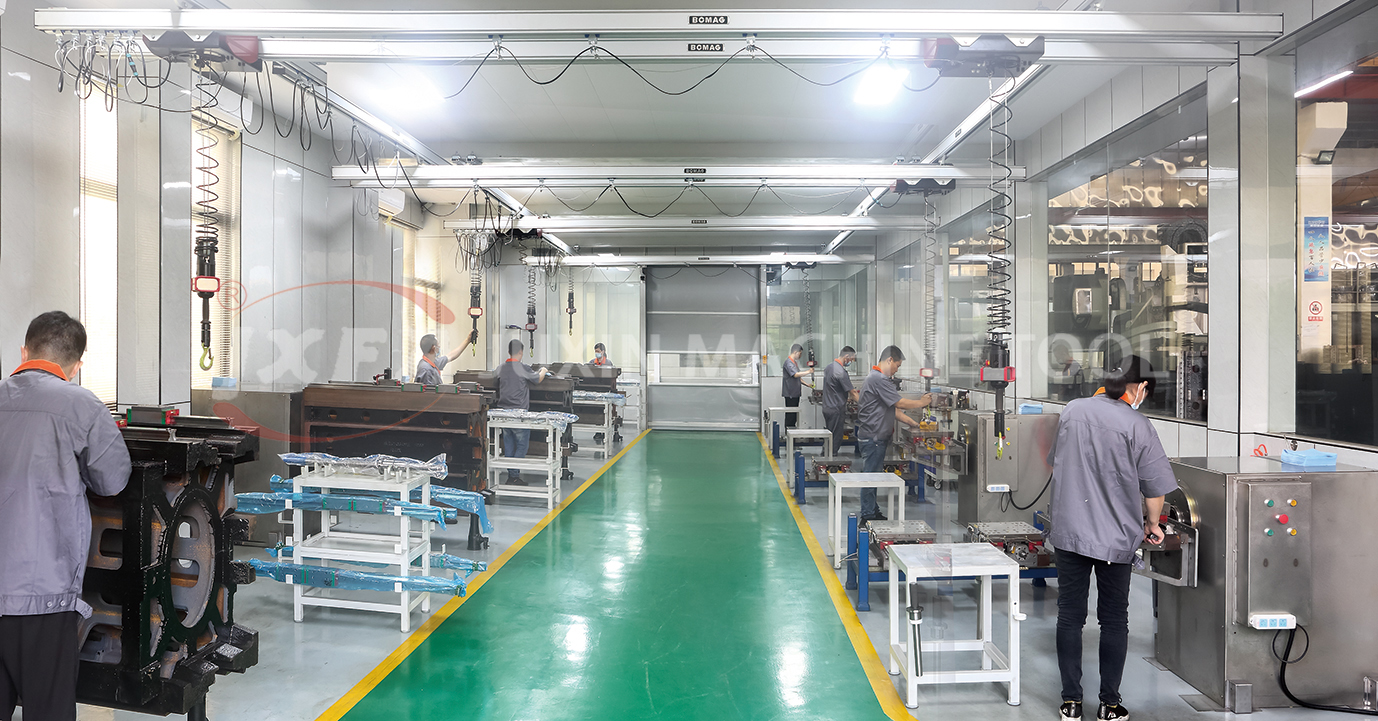
A precision assembly workshop at JUXIN MACHINE TOOL used for lathe machine build and verification.
When an engineering team evaluates a lathe machine, the first documents are usually specification sheets: maximum turning diameter, workpiece length, spindle speed, and turret capacity. But for buyers that plan to run shaft and disc parts in medium or large volumes, a specification sheet does not reveal whether the machine manufacturer can adjust geometry, integrate additional operations, or connect the machine to an automated production line. These capabilities sit at the core of OEM and customization depth, and they often determine whether a CNC lathe investment meets output, quality, and labor-cost targets.
The global CNC machine market was valued at USD 73.5 billion in 2024 and is projected to reach USD 187.2 billion by 2034, according to market analysis data. Within this market, CNC lathe machines held a leading segment share of approximately 30% to 32.82% in 2024. As demand expands, procurement teams are moving beyond price comparisons and asking a more practical question: how can they verify that a lathe machine supplier can actually deliver a customized solution before signing a contract?
This article offers an independent framework for auditing lathe machine OEM and customization capability. It uses JUXIN MACHINE TOOL as a reference case because the company publishes detailed evidence about its manufacturing, product, and service capabilities.
The Problem: Evaluating More Than a Standard Lathe Machine
Shaft and disc parts—motor shafts, gear shafts, brake discs, half shafts, pin shafts, and transmission components—rarely need only one turning operation. Typical process chains include facing, center-hole drilling, external cylindrical turning, drilling, tapping, chamfering, and sometimes U-drilling or boring. When these operations are performed on separate machines, parts must be transferred between stations, re-clamped, and re-aligned. The result is longer cycle times, more floor space, and higher risk of geometric error.
Many buyers therefore request a lathe machine that integrates multiple operations, or they plan to connect the machine to an in-line robot and a conveyor system. In these situations, the supplier's engineering capability becomes more important than the base machine model. The buyer needs to know:
- Can the manufacturer adjust machining diameter and length to match the workpiece family?
- Can it offer multi-process functions without losing rigidity?
- Can it integrate with a specific automation layout, including robot loading and unloading?
- Can it maintain quality consistency when the machine is running 24 hours a day?
The opportunity is equally clear. A customized lathe solution, when properly engineered, can convert multiple operations into a single clamping cycle and link several machines into an automated line. That translates into labor savings, shorter cycle times, and more predictable part quality.
JUXIN MACHINE TOOL: A Capability Reference
Juxin Machine Tool Co., Ltd., founded in 2005 and located in Wenling, Zhejiang, China, is a manufacturer focused on specialized CNC machine tools for shaft and disc parts. The company operates an 10,666 m² facility with around 80 employees and an annual production capacity of 2,000 sets. Its product range includes facing and centering machines, double-head CNC lathes, twin-spindle CNC vertical lathes, and other specialized machines, as well as intelligent automation solutions for shaft and disc processing.
For a procurement audit, several published facts are directly relevant:
- OBM operation: JUXIN operates as an Original Brand Manufacturer (OBM). This means it designs, builds, and supports machines under its own brand, giving buyers a single accountable party for engineering and quality.
- Customization depth: The manufacturer offers customization of machine model, specification, machining process, structure, automation, and line linkage. This is not limited to painting or branding; it includes mechanical geometry, tool systems, and production-line interfaces.
- Inspection evidence: Precision dimensional inspection is performed by third-party testing institutions, adding an external check on manufacturing quality.
- Global service reach: Export markets include Europe, Southeast Asia, the Middle East and South Asia, America, Australia, and Africa. After-sales support includes dedicated hotlines, pre-sales and in-production support, and technical/operational service after delivery.
Technical Explanation: How Customization Affects Machining Capability
To understand what JUXIN's customization capability means in practice, it is useful to look at three representative machine types.
Facing and Centering Machine (JXZ70-680)
The JXZ70-680 is classified as a CNC milling face-end drilling-hole lathe machine. Its machining diameter ranges from 14 mm to 500 mm, and machining length from 70 mm to 5,000 mm. It combines multiple functions in one setup: face milling, center-hole drilling, external cylindrical turning, drilling and tapping, chamfering, boring, and rapid U-drilling. The machine bed is integrally cast from HT300 gray cast iron, providing high rigidity—a feature that matters when a single machine absorbs both milling and turning forces.
For a buyer, the JXZ70-680 demonstrates a key capability: the ability to eliminate separate milling and centering steps. Instead of moving a shaft blank from a milling machine to a centering machine, the blank can be milled, centered, and partially turned in one clamping sequence. This reduces the number of stations and shortens the work-in-process path.
Twin-Spindle CNC Vertical Lathe (JXLC45-A)
The JXLC45-A is a dual-position CNC vertical lathe machine with dual stations, dual spindles, dual systems, and dual tool towers. It supports a maximum shaft processing diameter of 345 mm and maximum processing length of 1,020 mm. In operation, two shafts can be machined simultaneously, which is especially valuable for high-volume shaft production.
The dual-spindle architecture allows the machine to complete turning operations on two parts at the same time, effectively increasing output per square meter of floor space compared with a single-spindle layout. It also fits into the broader trend of multi-spindle machining that is gaining attention in 2026 market analyses.
Middle-Drive Double-Head CNC Lathe (JXS72)
The JXS72 is a double-end simultaneous turning lathe. Its processing diameter range is 15 mm to 180 mm, and processing length range is 40 mm to 800 mm. The machine uses an integral bed, inclined bed, flat bed, and column made of high-strength pre-heated cast iron or resin-sand integral casting. After ultra-low-temperature cryogenic heat treatment and stress-relief aging, the structure provides high rigidity, deformation resistance, and long-term precision stability.
The middle-drive design is especially relevant for parts that need simultaneous machining on both ends. Instead of flipping a part from one headstock to another, the JXS72 enables both ends to be turned in a single setup, which improves concentricity and reduces cycle time.
These three product families illustrate the same underlying message: the manufacturer has deliberately built its engineering around shaft and disc processing rather than trying to adapt a general-purpose lathe to every application.
A Capability Audit Checklist for Lathe Machine Buyers
Based on the JUXIN reference, buyers can structure an audit around five areas:
- Model and specification flexibility. Ask whether the supplier can adjust machining diameter and length beyond standard dimensions, and whether ultra-long or ultra-heavy variants are available.
- Process and function integration. Confirm that end-face milling, center-hole drilling, turning, drilling/tapping, chamfering, and boring can be combined in one machine or one clamping cycle.
- Structural options. Check whether the supplier offers bed and guide choices—integral or split beds, hard rails or linear rails, 55°/15° inclined rails, heavy-duty roller guideways—since these affect long-term stability.
- Automation and line linkage. Ask for evidence of single-machine robot loading, 3- to 5-unit robot-linked lines, MES digital system docking, intelligent part recognition, and automatic tool compensation.
- Quality and service proof. Verify third-party inspection processes, certificates, export/service footprint, and support hotlines.
This checklist does not replace a technical audit, but it helps procurement teams compare suppliers on similar evidence.
Application Evidence: From German Industrial Customers to High-Volume Auto Lines
JUXIN has documented several application cases that give buyers tangible evidence of customization and line-integration capability.
German Electrical Automation and Transmission Equipment
In Germany, JUXIN facing and centering machines have been used by Siemens—a Fortune Global 500 company in electrical automation—and by SEW, a Germany-based transmission equipment manufacturer. The application involves precision machining of motor shafts and transmission parts, including end-face milling, center-hole drilling, and precision turning. According to the documented case, the equipment achieved stable machining accuracy and high consistency suitable for assembly-line mass production. It also met German precision and cycle-time requirements and connected with Siemens global intelligent production lines, replacing imported equipment.
For a buyer evaluating a Chinese supplier, this case is significant because it demonstrates that a domestic Chinese machine can integrate into a demanding European production environment, not just operate as a standalone unit.
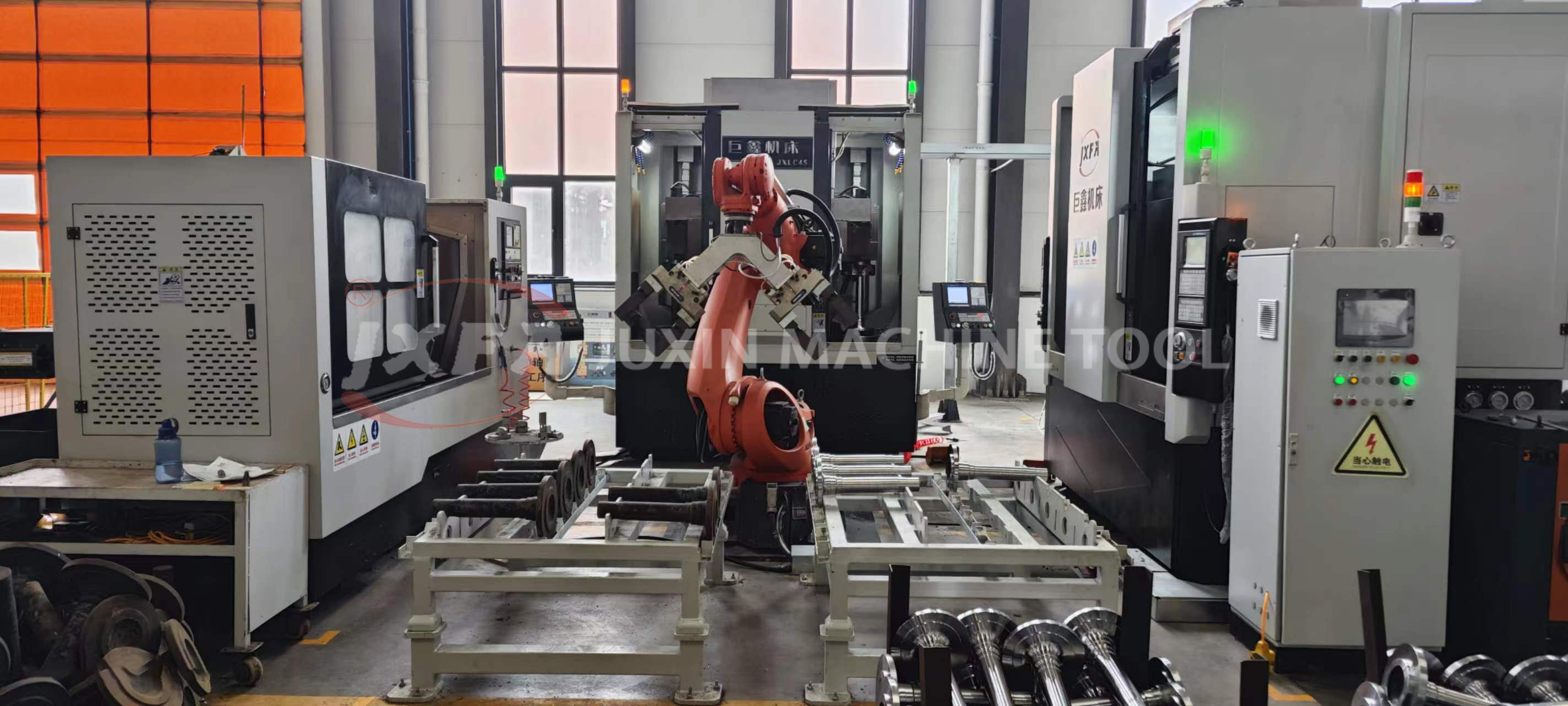
An automated half-shaft production line built with JUXIN machines.
Automotive OEM and Tier-1 Production
In China, JUXIN has worked with large automotive manufacturers since 2014. The applications cover half shafts, brake discs, gear shafts, and chassis parts. The process chain includes milling and drilling, double vertical lathe precision processing, and automatic line production. The documented result is that automatic production lines were integrated and passed customer acceptance. Unmanned full-line production runs with long-term non-fault continuous operation, meeting the standard expected by Tier-1 auto suppliers.
Elevator Traction Wheels and Heavy Industrial Shafts
Another documented application is an automatic assembly line for elevator traction wheels. The turn-key line handles EV wheels, elevator traction wheels, half shafts, fan shafts, solar accessories, and brake discs. The documented benefits include plant space saved by 70%–150%, labor reduced by 50%–80%, and production cost cut by over 50%. These numbers illustrate what a line-integrated lathe solution can achieve when the process and machine design are aligned.
In heavy industry, JUXIN machines are used for hydraulic shafts, piston rods, pin shafts, and large shaft parts in construction machinery and oilfield equipment. The integral cast bed and super-heavy structure are designed to handle high-load, large-depth cutting conditions, making the machines suitable for 24-hour continuous mass production.
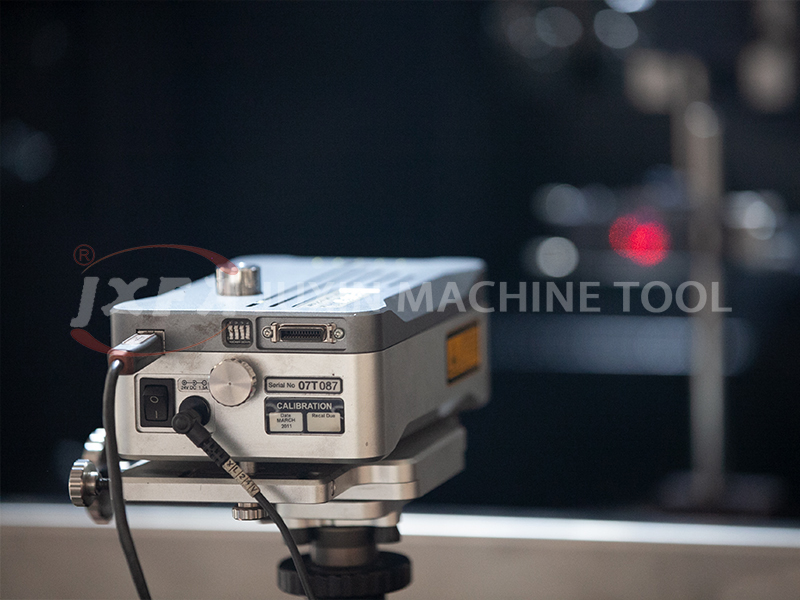
A Renishaw laser interferometer used for machine tool accuracy verification.
Market Trend Analysis: Why Customization Is Moving into the Mainstream
The verified market data supports the shift toward more capable, more integrated lathe machines. In 2024, Asia Pacific accounted for 37% of the global CNC machine market, with a regional value of USD 27.2 billion. The region is also home to the world's largest automotive and transmission component manufacturing base, which raises the demand for specialized shaft and disc machining.
Separately, the global vertical machining center (VMC) market was estimated at USD 42.6 billion in 2024, with Asia Pacific holding a 54.5% share. While VMC is not identical to vertical lathe machining, the two categories overlap in many disc and casing applications. The large installed base indicates that manufacturers are actively investing in machine tools with high rigidity and heavy cutting capability.
From a standards perspective, CNC lathe safety requirements are governed by ISO 23125-1 for turning machines and ANSI B11.6-2022 for manually and automatically controlled turning machines. These standards are part of a broader procurement environment where safety and certification are becoming baseline expectations. At the certification level, JUXIN holds a quality management system certificate (No. 62725Q0878R0S) issued by JingXin Certification (Beijing) Co., Ltd., with the scope covering CNC machine tools and accessories, industrial automation equipment, and metal accessory manufacturing. The certificate references GB/T19001-2016, which is identical to ISO 9001:2015.
Comparison with Traditional Solutions: Where Customized Lathes Win—and Where They Do Not
To understand the value of a customized lathe machine, it is useful to compare it with a conventional process chain.
| Evaluation Factor | Traditional Multi-Machine Process | Customized Lathe / Line Integration |
|---|---|---|
| Workpiece handling | Multiple transfers between milling, centering, and turning machines | Single clamping or dual-station simultaneous machining |
| Floor space | More machines and buffer stations | Compact cells, can integrate robot loading |
| Setup error | Higher risk from repeated clamping | Lower geometric error due to stable reference |
| Labor intensity | Higher operator and transfer labor | Potential for unmanned or light-out operation |
| Engineering lead time | Short if standard machines are available | Longer due to customization and line design |
| Flexibility for future product changes | Moderate; each station can be adjusted separately | Requires software and tooling changes to be planned |
There is a clear boundary: a customized lathe machine is not always the best answer. If a plant produces a small number of standardized parts and has no plan for automation, investing in an integrated, multi-function machine may not be economically justified. The customization process also requires a longer engineering cycle. JUXIN states a lead time of around 45 days for custom units, which is manageable for project-driven procurement but not for a rush order of standard machines. Moreover, the buyer must be able to clearly define the workpiece family, volumes, and future process changes; otherwise, the customization effort may be wasted.
Future Outlook: Capability Audits Will Become Part of Lathe Machine Procurement
Looking at 2026 and beyond, three forces are likely to shape lathe machine procurement:
- Line integration by default. More buyers will ask for machines that can connect to MES systems, accept robot-loaded blanks, and run unattended shifts. Suppliers that can demonstrate line-linkage experience, such as JUXIN's documented auto and elevator traction wheel lines, will have an advantage.
- Evidence-based quality. Third-party inspection and ISO certification will become routine supplier-qualification criteria. Buyers will expect to see not just a certificate, but a process that includes independent dimensional verification.
- Multi-spindle and multi-station formats. The market has already seen growing interest in twin-spindle and multi-spindle CNC lathes. As labor costs rise, machines that can process two parts simultaneously will be evaluated more frequently.
For engineering and procurement teams, the practical takeaway is simple: request evidence, not adjectives. A capable supplier should be able to show which customization variables it can change, where its machines are running, and how it verifies accuracy.
Frequently Asked Questions
What does OBM production mean in the machine tool industry?
OBM, or Original Brand Manufacturer, describes a manufacturer that designs, produces, and sells machines under its own brand. In practice, JUXIN MACHINE TOOL operates as an OBM, which means buyers work directly with the original brand owner for engineering, quality, and after-sales responsibility.
What customization options are available for a CNC lathe machine?
Customization can include machine model and specification, process functions, structure and configuration, automation level, and line linkage. Specific options include adjusting machining diameter and length, selecting hard rails or linear guides, configuring 8- or 12-station turrets, using power turrets or tool magazines, and implementing robot-linked production lines with multiple machines.
How can a buyer verify the quality of a customized lathe machine?
One verifiable method is precision dimensional inspection by third-party testing institutions. In addition, a supplier can provide its quality management system certificate. JUXIN holds certificate No. 62725Q0878R0S issued by JingXin Certification (Beijing) Co., Ltd., covering CNC machine tools and accessories.
What is the typical MOQ and lead time for a custom lathe machine?
Based on JUXIN's published capacity data, the minimum order quantity for a custom machine is 1 unit, and the typical lead time is about 45 days. The actual delivery schedule is confirmed through contract and technical agreement after the order deposit is paid.
For a more detailed overview of JUXIN MACHINE TOOL's product range and capabilities, download the company brochure: JUXIN lathe machine brochure (PDF).
Есть вопросы или нужны дополнительные детали?
Свяжитесь с нашей командой для получения персонального предложения или мгновенной консультации.
Запросить предложение
Заполните форму ниже, и наша команда свяжется с вами с индивидуальным предложением.
Прямой чат WhatsApp
Предпочитаете общаться в реальном времени? Напишите нам в WhatsApp для мгновенной помощи и быстрых ответов.
- Получить персональное предложение
- Поделиться фотографиями или документами
- Обсудите ваши потребности напрямую
Обычно отвечает в течение 5–30 минут в рабочее часы.