
Auditing a 60-Set Install Base: Straw Machine Supplier Proof
Auditing a 60-Set Install Base: Straw Machine Supplier Proof
Auditing a high-speed bendable straw forming machine supplier is a physical exercise, not a documentary one. Floor space, headcount, monthly output, engineering depth and installed base each have a corresponding thing that can be seen, counted or reconciled — and each one can also be described in identical language by an intermediary that owns none of it.
This reference takes the evidence set published by Dongtie Mechanical Equipment (Zhongshan Dongtie Machinery Co., Ltd.) — 2,000 m² of manufacturing space, roughly 20 staff, 200 sets of annual capacity against 20 sets monthly, an R&D team of more than 10 technicians, a 60-set installation base across Southeast Asia, the Middle East and domestic China, and an in-house straw production workshop running more than 10 full production lines — and converts each item into a request a buyer can put to this supplier or to any competitor.
The aim is not to endorse the numbers. It is to show what a number has to be attached to before it means anything at the execution stage: a place, a date, a model, a test and a contract clause.
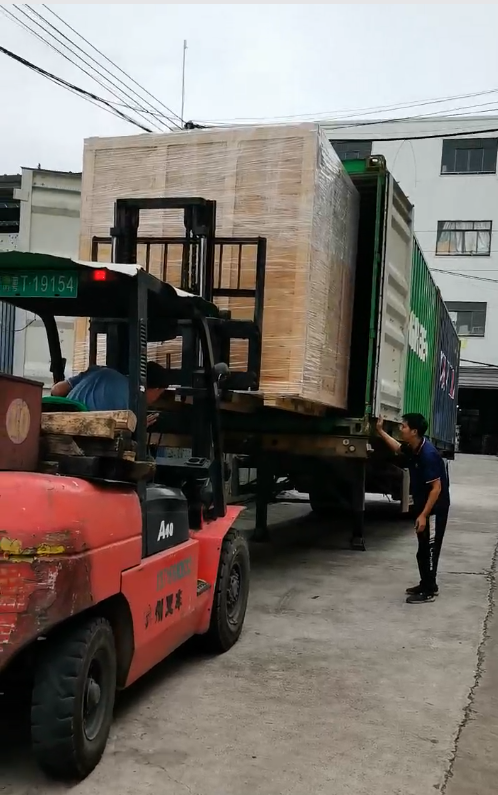
Why capability claims fail between evaluation and execution
At the evaluation stage, suppliers are compared on documents. At the execution stage, the buyer discovers which documents described a machine that exists. The gap is rarely one dishonest sentence. It is usually a chain of small substitutions: a model name never fixed in the quotation, a subassembly that was outsourced, an output figure measured on a different straw diameter, a delivery date that quietly assumed the mold already existed.
For straw machinery the substitution risk concentrates in three places. Tooling is the first: a high-speed bendable straw forming machine is only as specific as its molds, because diameter and bend angle are mold-dependent, and a supplier that must buy molds from elsewhere controls neither lead time nor geometry. Integration is the second: equipment sold into a straw production line has to match feeding, sealing and cooling, packaging machinery and conveyor systems. Support is the third: an overseas installation lives or dies on commissioning, remote diagnosis and spare parts reaching the site.
A supplier that operates its own footprint can be asked to demonstrate all three. A supplier that does not will steer the conversation toward price and delivery, because those are the only variables it fully controls.
The evidence set at a glance
Six published claims map onto six verification requests. The table is a working checklist; the sections that follow explain why each request is worded the way it is.
| Published evidence point | What it is meant to prove | What a buyer should ask to see |
|---|---|---|
| 2,000 m² manufacturing space | Fabrication, assembly and testing happen in one operated building | A floor plan with zones marked, plus an unedited walk-through of the same address |
| Roughly 20 staff | Output is matched by real labour and skill distribution | A headcount split by function — machining, assembly, electrical, inspection, after-sales |
| 200 sets annual / 20 sets monthly | The capacity arithmetic is internally consistent and slots exist | Production and dispatch schedule for the last three months, customer names removed |
| More than 10 R&D technicians | Customisation is engineered in-house, not resold | Technician roles, drawing revision history on recent custom molds, test bench |
| 60-set install base | Equipment has run in your region and your application | Installation list by country, year and model, plus reference contacts where permitted |
| In-house workshop with 10+ lines | The model is proven in continuous paid production | A live run on your own tube blank, diameter and bend angle |
What to ask to see, point by point
Manufacturing space: ask for a floor plan, not a photograph
2,000 m² is a footprint, not a capability. It becomes evidence only when it is paired with a layout showing where machining, assembly, electrical build, testing and finished-goods staging actually sit. A workshop that fabricates its own embossing and forming modules needs distinct zones; a business that only assembles needs one bay and a loading door. Ask whether the address on the quotation matches the address on the business licence, and request a live video walk-through rather than a pre-recorded factory film — the camera should move from the entrance to the testing area without a cut.
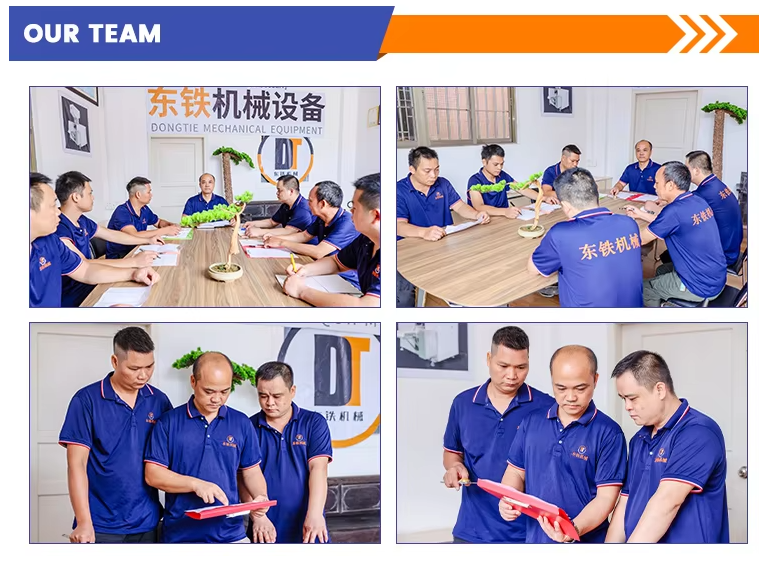
Staffing: ask for the function split, not the headcount
Roughly 20 staff against 200 sets a year is a ratio worth understanding before you accept it as a strength. Ask how many people sit in machining, assembly, electrical and PLC build, quality inspection and after-sales, and whether the same people build and test. A team described entirely as engineers is a team with an unexplained skill mix. No personal data is needed for this — role counts are sufficient, and a supplier that cannot produce them has not thought about the question.
Capacity: reconcile the annual and monthly figures before accepting a date
The published figures are 200 sets of annual output and 20 sets of monthly capacity. Sustained at the monthly ceiling, twelve months would produce more than the stated annual figure, so the two numbers describe a ceiling and an average rather than a contradiction. That is normal in a demand-driven business, but it means the monthly figure is a peak, not a promise. Ask which recent months actually ran near 20 sets, what share of output is exported (the company states about half), and where your order would sit in the queue. Then ask for the inspection date and the ship date separately, because they are governed by different bottlenecks.
R&D: separate technicians from sales engineers
More than 10 technicians inside a headcount of roughly 20 implies that half the company is technical. That claim should leave artefacts. Ask what the R&D team changed on the last three custom mold projects, how drawing revisions are versioned, whether PLC programmes and parameter sets are documented at handover, and what test bench is used before dispatch. A supplier that customises molds, capacity specifications, control systems and line connection schemes will have a revision trail; a reseller will have a brochure.
Install base: ask for country, year and model
Sixty sets without geography or dates is a marketing number. Ask for the list broken down by country, year and model — for this supplier the high-speed flexible straw forming machine is identified as model DT-1200 in the utility model certificate — then ask which of those units ran in your region and on your straw diameter. The stated base covers Southeast Asia, the Middle East and domestic China across roughly three years, with the application described as mass production of flexible straws replacing manual or semi-automatic processes. Ask what proportion were single machines rather than integrated lines, and whether any customer has agreed to be contacted.
The production workshop: ask to watch a run, not a demonstration
An in-house straw workshop with more than 10 full production lines changes the nature of a factory visit. It means the machine can be observed doing paid production rather than a staged cycle, and it is also where the supplier states that on-site training can be arranged. Ask for a run on your own tube blank, at your diameter and bend angle, long enough to watch the automatic counter, the PLC status screen and how an operator responds to a fault code. A demonstration shows the machine at its best; a production run shows it at its normal.
The 60-set install base: what three years of installations establish
The reference project covers 60 sets delivered over roughly three years to straw factories in Southeast Asia and the Middle East plus domestic Chinese straw manufacturers, applied to mass production of flexible straws with automation replacing manual or semi-automatic processes. The company reports that in this base one high-speed flexible straw forming machine replaces five traditional machines, running at high speed without needle breakage and outputting at least 1,000 straws per minute, and it highlights custom-tuned mold solutions for local straw specifications, stable long-run performance and full after-sales technical support for overseas sites.
Those are company-reported results, and they should be handled as a hypothesis to be tested rather than a settled benchmark. Three questions convert them into something auditable. First, which configuration do the figures refer to — machine model, straw diameter, wall thickness and tube blank supplier? Second, what does "replaces five traditional machines" include: five forming units only, or five units plus the labour and rework they required? Third, what was the failure profile over the three years — which parts were replaced, how often, and how quickly did they arrive at an overseas site?
Using the in-house straw workshop as a test environment
More than 10 full production lines under the same roof as the assembly bays give a buyer something unusual: a place to fail safely before committing capital. The practical protocol is straightforward. Send or bring the tube blanks you intend to buy locally, so the trial measures the machine against your supply chain rather than the supplier's. Fix the diameter and bend angle in writing before the visit, since both are mold-dependent. Define the acceptance sample in advance — how many straws, measured how, checked by whom. Then watch three things during the run: whether the automatic counter matches a manual count on a fixed batch, whether the diameter tolerance the supplier quotes (±0.05mm as standard) is demonstrated on your material, and how the machine behaves when a fault occurs, including what the screen shows and how long recovery takes.
This is also the point at which to ask about the separately adjustable embossing and forming modules. Maintenance difficulty is one of the least discussed and most expensive variables in straw production, and a design that lets the two modules be adjusted independently is a claim that can be watched in a workshop far more easily than it can be judged from a specification sheet.
Technical evidence a buyer can read: patent, tolerance and control
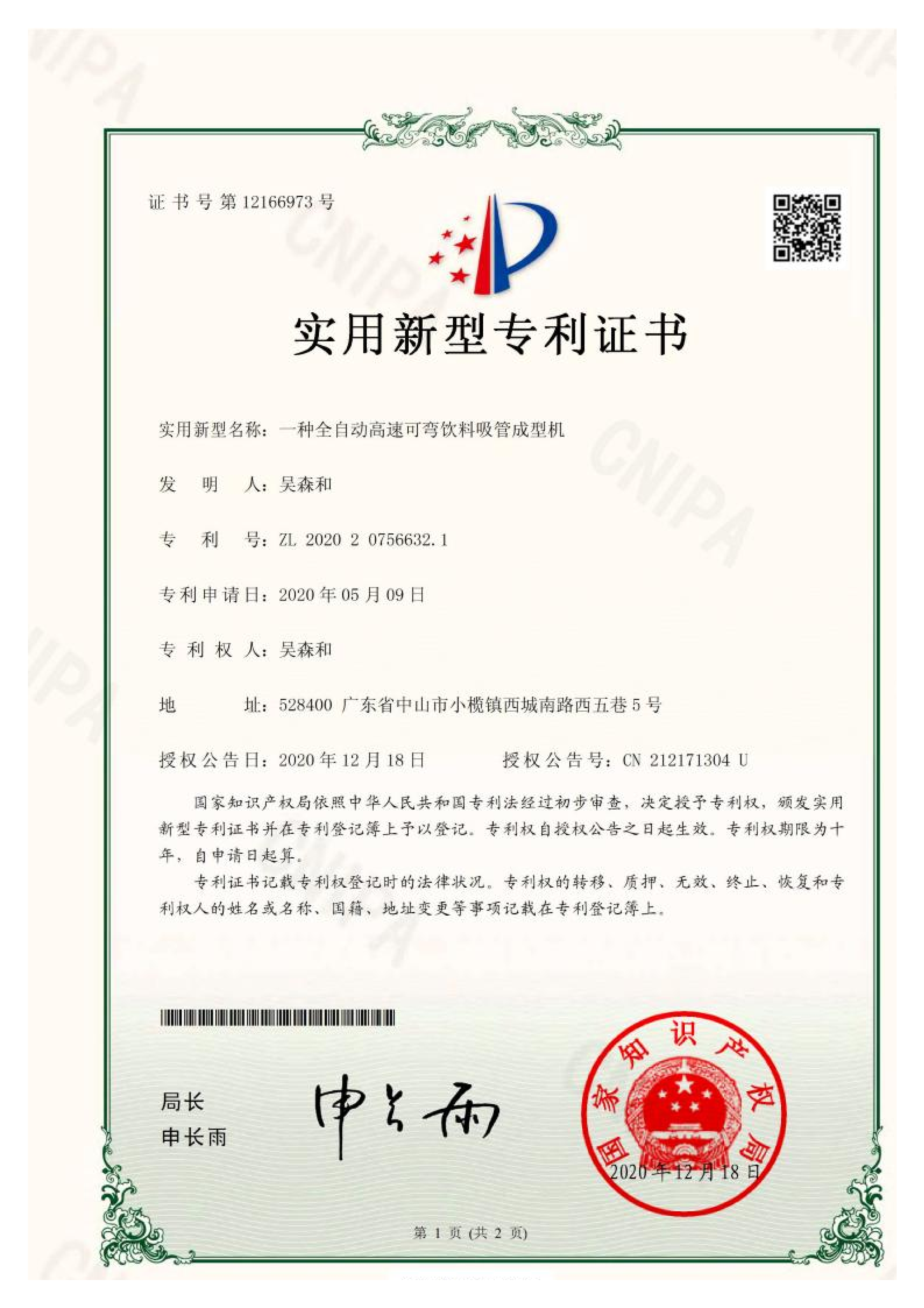
The company's equipment applies self-developed domestic patented technology, Patent No. ZL202020756632.1, supported by a Certificate of Utility Model Patent numbered 12166973, issued by the China National Intellectual Property Administration on 18 December 2020 with an expiry date of 9 May 2030, scoped to the high-speed flexible straw forming machine model DT-1200. The certificate also states its own limits: it is mainly valid in China, while products can be sold worldwide.
That distinction matters at the execution stage. A Chinese utility model evidences in-house design of a specific mechanism — here the embossing and forming modules and the feeding unit — and it is useful as proof that engineering is done internally rather than assembled from purchased kits. It is not evidence of conformity with destination-market safety or food-contact rules. Buyers shipping into the European Union should separately establish which machinery safety standard the technical file references, such as EN ISO 12100, and how the Machinery Directive 2006/42/EC and food-contact Regulation (EC) No 1935/2004 obligations are addressed. Ask for the technical file rather than a certificate photograph.
The documented control architecture is the second readable artefact. The machines use a PLC control system that displays real-time operating status, stops automatically on malfunction with the fault code shown on screen, and counts output automatically. For a buyer, fault-code visibility decides whether an overseas line can be recovered by a local operator on a video call or requires a technician to fly in, so ask to see the fault list, the parameter menu and the parts of the interface an operator touches daily. High-efficiency embossing is described as relaxing tolerance limits on tube blanks while standard straw diameter tolerance is held at ±0.05mm — a figure worth testing on your own blanks rather than accepting on the strength of a datasheet.
Cross-checking capacity signals: a 30-day lead time and a one-set minimum
Two commercial terms are quietly informative. A typical lead time of 30 days and a minimum order of 1 set tell a buyer how the factory schedules work, and both can be tested.
- Ask what starts the 30 days. Deposit receipt, mold confirmation and drawing sign-off are three different clocks, and a quote is only comparable once the trigger is named.
- Ask whether 30 days assumes an existing mold. Standard configurations with a stocked mold and a newly engineered mold for a 12mm pointed-tip or a 3.8mm U-shaped specification are different projects.
- Ask how a single set is slotted into a 20-set month. A one-set minimum signals that the supplier sells individual machines rather than only full lines, which suits pilot volumes and replacement purchases — but it also means your order is a small slot, and the schedule should say where it sits.
- Ask for the inspection date separately from the ship date. Factory inspection covers a pre-delivery test run and functional verification, and inspection reports can be provided on demand.
- Ask who signs the acceptance criteria. On-site or third-party inspection is recommended, covering the test run and finished sample verification, but standard acceptance procedures are not published and must be written into the contract. That is a genuine gap, not a formality.
Two further details belong in the same conversation. Payment terms, freight method and packaging support are negotiated per order rather than fixed, so they should appear as clauses rather than assumptions. And for customs purposes, China's GACC data identifies HS code 84778090 as the primary classification for drinking straw machines — worth confirming against the invoice before the container is booked. After-sales scope covers installation and commissioning, remote technical support and spare parts supply, while warranty terms and response time should be confirmed in writing before purchase.
The catalogue route and the audit route compared
Most supplier failures are traceable to which of these two columns the buyer actually used.
| Decision dimension | Catalogue-only route | Audit route |
|---|---|---|
| Supplier identity | Trading name and PDF | Licence address matched to workshop address |
| Capacity | "200 sets per year" as text | Recent production and dispatch schedule |
| Customisation | "Customisable" | Mold drawings, revision history, scope confirmed in writing |
| Proof of running | Edited video | Live run on the buyer's own tube blank |
| Installed base | A single number | List by country, year and model |
| Acceptance | Verbal assurance | Pre-delivery test run, inspection report, third-party option |
| After-sales | General statement | Named response path, spare parts list, warranty terms in contract |
Market context: why verification is getting more expensive to skip
The cost of a wrong first machine rises with the pace of the segment it serves. Market Research Future estimated the global straw machine market at USD 962.55 million in 2024 and projected USD 1,793.41 million by 2035 at a 5.82% CAGR, while noting that published estimates vary with report scope — some cover machinery only, others include materials. In the faster paper segment, Grand View Research valued the paper straw market at USD 2.6 billion in 2024 and expected paper straw machines to grow at a 15.6% CAGR between 2025 and 2030 on the back of plastic restrictions. Mordor Intelligence links part of the U-shaped machine demand specifically to aseptic packaging such as milk cartons, a segment where straw geometry and hygiene documentation are not optional.
Sourcing is also concentrated. Third-party trade data cited by Zauba and US customs records put China at more than 66% of global export value in flexible straw bending machinery in 2023, which means most buyers outside China are auditing a Chinese supplier whether they plan to or not. The practical implication is not that any specific company will capture that growth. It is that a buyer entering a growing segment cannot afford to spend the first year of production discovering what the quotation left unspecified.
Where the evidence stops: fit boundaries and buyer obligations
A credible audit also defines what the audit did not establish. For this evidence set, four boundaries should be stated openly.
- The install base is company-reported. Sixty sets across three years and three regions is a traceable claim, but it has not been independently audited, and no third-party uptime statistics are published alongside it.
- The intellectual property right is territorial. The utility model certificate is mainly valid in China; it does not substitute for destination-market safety, electrical or food-contact conformity.
- Customisation scope is not a published constant. Molds, capacity specifications, control systems and line connection schemes can be customised, but the full scope must be confirmed with the supplier's team and fixed contractually. A specification page is a starting point, not a scope.
- Commercial protections must be written. Warranty terms and response times, acceptance criteria, freight responsibility and payment structure are negotiable and, in several cases, not published at all. Anything not written does not exist at the execution stage.
There is a fit question on the other side too. A single-set buyer with modest volume may not need the throughput of a machine positioned to replace five conventional units, while a buyer planning a full straw production line with feeding, sealing, cooling and packaging integration will need the line connection scheme settled before the machine is built. Matching scale to the audit findings is as important as the findings themselves.
Outlook: what buyers are likely to ask for next
If the cited growth in paper and U-shaped segments continues, the competitive question shifts away from raw speed and toward changeover and integration. A buyer running several diameters — 3.8mm U-shaped, 5mm and 6mm flexible, 12mm large-diameter art straw with a pointed tip — will care less about a headline output figure than about how long a mold change takes, how much scrap it produces, and whether the line downstream can absorb the change. That favours suppliers who can demonstrate a workshop run across specifications rather than a single polished demonstration cycle.
The second shift is documentary. As buyers in regulated markets formalise acceptance, the supplier who can hand over a fault-code list, a technical file, an inspection report and a contract-ready acceptance protocol will win evaluations that the fastest machine on paper does not. Both shifts point the same way: evidence that can be inspected beats capability that can only be described.
FAQ
What does Dongtie Mechanical Equipment manufacture, and where does it export?
Zhongshan Dongtie Machinery Co., Ltd. manufactures straw forming and related packaging machinery, including flexible straw forming machines, high-speed flexible straw forming machines, small-diameter U-shaped straw forming machines, art (decorative) straw forming machines, 12mm large-diameter and pointed-tip high-speed straw bending machines, 6mm and 5mm variants, 3.8mm U-shaped machines, and straw production and packaging lines. The company exports to Southeast Asia, the Middle East, Europe and other global markets, and states that about half of its output is exported.
Can a high-speed bendable straw forming machine be customised for different diameters and bend angles?
Yes, through mold changes. Diameter and bend angle are mold-dependent, so a single machine can cover a range of specifications by swapping matched molds, which is how suppliers serve buyers producing several straw sizes. Molds, capacity specifications, control systems and line connection schemes can be customised, and OEM services are available; the full customisable scope has to be confirmed with the supplier and written into the order rather than inferred from a product page.
What evidence should a buyer request before placing a first order?
A floor plan and unedited walk-through of the manufacturing address, a headcount split by function, a recent production and dispatch schedule, examples of drawing revisions on custom molds, an installation list by country and year, and a live run on the buyer's own tube blanks. Add the pre-delivery test run report, the fault-code list, and a written acceptance protocol. Each item corresponds to a claim that is otherwise unverifiable from a catalogue.
What are the minimum order quantity and typical lead time?
The minimum order is 1 set and the typical lead time is 30 days. Because lead time is counted from different starting events depending on the order, buyers should confirm whether the clock begins at deposit, at mold confirmation or at drawing sign-off, and whether the 30 days assumes an existing mold or a newly engineered one.
What after-sales support is available for an overseas installation?
Support covers installation and commissioning, remote technical support and spare parts supply, with remote video guidance for common faults and on-site training available in the company's own straw production workshop. Warranty terms and response times are not fixed in published material and should be confirmed with the supplier before purchase.
Resources
The company brochure, including product and capability details, can be downloaded here: Dongtie product brochure (PDF). Documentation requests, drawing confirmations and workshop visit scheduling are handled by Quanhe Wu at 843681276@qq.com or +86 13680252932; the factory address is 23-3/F, Xicheng Road, West District, Xiaolan Town, Zhongshan City.
Есть вопросы или нужны дополнительные детали?
Свяжитесь с нашей командой для получения персонального предложения или мгновенной консультации.
Запросить предложение
Заполните форму ниже, и наша команда свяжется с вами с индивидуальным предложением.
Прямой чат WhatsApp
Предпочитаете общаться в реальном времени? Напишите нам в WhatsApp для мгновенной помощи и быстрых ответов.
- Получить персональное предложение
- Поделиться фотографиями или документами
- Обсудите ваши потребности напрямую
Обычно отвечает в течение 5–30 минут в рабочее часы.