
Auditing a Hydraulic Power Unit Maker: Clean Assembly as Capability Proof
Auditing a Hydraulic Power Unit Maker: Clean Assembly as Capability Proof
Two hydraulic power units can leave a factory with the same motor, the same gear pump and the same reservoir, and still behave differently after a season of work. The variable that separates them is rarely visible in a quotation: what happened to the components before they were bolted together.
Contamination is one of the few failure mechanisms a buyer can actually audit. Component lists describe what a hydraulic power unit (HPU) is made of; they say nothing about what the unit is protected from. That gap is why clean assembly and oil cleanliness control have moved from workshop housekeeping into supplier evaluation, particularly for buyers specifying custom hydraulic power packs for mobile equipment.
The Audit Question: What Does the Process Prevent?
A hydraulic power unit, also called a hydraulic power pack, is a self-contained assembly that combines a reservoir, pump, drive motor, valves, filtration and controls to deliver pressurized oil to cylinders and actuators. On dump trailers, scissor hoists, vehicle-mounted platforms and other mobile hydraulic equipment, the power unit is seldom the most visible part of the machine, yet it frequently decides whether the machine works on a given morning.
Most sourcing conversations begin with a component list: pump displacement, motor voltage, reservoir volume, valve function, control type. That list is necessary but incomplete. Particle ingress during assembly, debris left in a manifold, and oil that is not clean at first fill can shorten pump life, disturb valve response, damage seals and produce pressure instability that only surfaces in the field. None of those outcomes appear on a component list, and none of them are visible in a photo of a finished unit.
Clean assembly is therefore interesting to procurement teams for a specific reason: it is a process claim that leaves traces. It requires cleaning steps, controlled handling, component qualification and inspection records. A supplier either has those artifacts or does not.
Standards Set the Frame, Manufacturing Discipline Fills It
In the European Union, hydraulic power units must comply with EN ISO 4413:2010, which sets out general rules and safety requirements for hydraulic systems, while the Machinery Directive 2006/42/EC governs the health and safety requirements applicable to those systems. These are documentation-based obligations: design files, risk assessment, conformity evidence. They establish what a hydraulic system must demonstrate to be placed on the market.
Assembly cleanliness sits one level below that framework. A conformity file can be complete while the actual build environment still allows particles into a pump port. That is the distinction buyers should keep in mind when a supplier presents certificates as a substitute for process description. Certificates answer a regulatory question; cleaning and cleanliness control answer an operational one.
What Apex Hydraulic Documents About Clean Assembly
Apex Hydraulic Co., Ltd. is a hydraulic equipment manufacturer established in 2009 and based in Qingdao, Shandong Province, China. The company manufactures custom hydraulic cylinders, standard hydraulic cylinders, hydraulic power units, hydraulic systems, hydraulic scissor hoist kits and hydraulic components, and reports a 50,000 m² manufacturing facility, 560 employees, a 25-engineer engineering and R&D team, and an annual production capacity of 100,000 hydraulic cylinders and 15,000 power units. Approximately 70% of its output is exported, with customers in North America, Western Europe, South America, Southeast Asia, the Middle East and Australia.
On contamination specifically, the practice the company states is narrow and testable. Hydraulic systems are cleaned before assembly, and hydraulic oil cleanliness is controlled to reduce contamination risks. A second and related measure applies to the pump: hydraulic pumps are sourced from qualified suppliers and assembled under clean manufacturing conditions to minimize premature wear.
The stated control, verbatim in substance: hydraulic systems are cleaned before assembly, and hydraulic oil cleanliness is controlled to reduce contamination risks. Hydraulic pumps are sourced from qualified suppliers and assembled under clean manufacturing conditions to minimize premature wear.
Read carefully, those two sentences make three separate commitments. First, there is a cleaning step that occurs before assembly rather than after it. Second, cleanliness is an actively controlled variable during build, not an assumed condition. Third, pump selection and assembly conditions are treated as one combined risk control, because a qualified pump installed in a contaminated environment is still a wear risk.
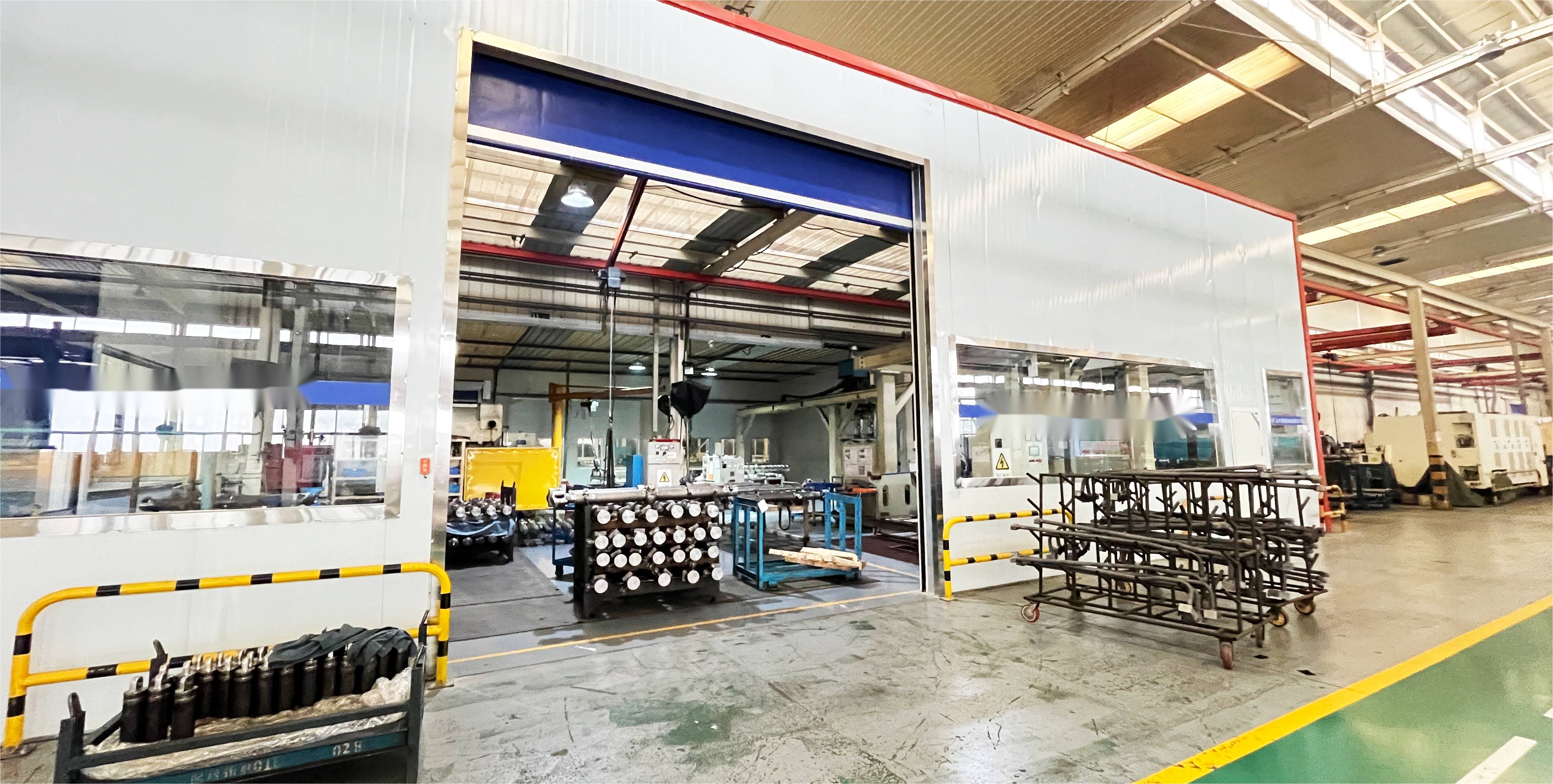
Assembly stage at Apex Hydraulic: cleanliness at this point in the process determines how long a pump and valve set will last in the field.
How Contamination Turns Into a Field Failure
Contamination does not fail a power unit directly. It fails the clearances, surfaces and seals that the unit depends on. Understanding the chain matters, because it explains why cleaning before assembly is more consequential than cleaning after a leak appears.
Pump wear
A gear or piston pump relies on a thin oil film to separate moving surfaces. Abrasive particles that reach that film act as a cutting medium and accelerate clearance growth, which lowers volumetric efficiency and increases heat. The company describes its control in two parts: component selection and cleanliness control, with pumps sourced from qualified suppliers and assembled under clean manufacturing conditions to minimize premature wear.
Valve response and solenoid performance
Spools and poppets operate with small clearances and are sensitive to both particles and debris lodged in flow passages. Apex Hydraulic states that solenoid valve reliability risks are mitigated by testing switching performance and response before assembly, and that production process risks for solenoid valves are addressed through qualified valve components and functional testing. This is a pre-assembly test, which is the point: a valve that fails its switching test never reaches a finished power unit.
Leakage at seals and connections
Seal damage is frequently a contamination outcome rather than an installation error. The company's control combines precision sealing, leak-proof hydraulic connections and pressure testing, and it states that every hydraulic power unit undergoes hydraulic pressure and leakage testing before shipment, with inspection of all fittings and sealing components.
Pressure instability
Pressure instability is addressed through hydraulic circuit verification and pressure calibration. Pressure settings are adjusted according to customer specifications, and each power unit is tested to verify stable system pressure before delivery. This is the verification stage that converts assembly discipline into an observable result.
Electrical reliability
Electrical connection failure risks are addressed through standardized wiring and electrical inspection, with wiring, connectors and control circuits inspected before shipment. On DC units used in mobile equipment, a loose or poorly seated connection produces symptoms that are often misdiagnosed as hydraulic faults.
Notice the structure of these controls. Cleaning and cleanliness control reduce what enters the system. Functional testing and pressure testing verify what was built. They are not substitutes for one another: a test can find a leaking fitting, but it will not find a particle that lodges in a pump clearance and only becomes visible after extended running.
The Risk Register Behind the Process
The clearest way to audit a power unit manufacturer is to ask for the risk register that its process is designed against. Apex Hydraulic documents ten categories of production and product risk, each with a stated control method and an enterprise-level measure.
| Risk category | Control method | What the enterprise measure states |
|---|---|---|
| Oil contamination | Clean assembly process and filtration control | Hydraulic systems are cleaned before assembly, and hydraulic oil cleanliness is controlled to reduce contamination risks. |
| Hydraulic pump wear | Component selection and cleanliness control | Pumps are sourced from qualified suppliers and assembled under clean manufacturing conditions to minimize premature wear. |
| Solenoid valve failure | Qualified valve components and functional testing | Solenoid valves are tested for switching performance and response before assembly; electrical connections are inspected. |
| Hydraulic oil leakage | Precision sealing, leak-proof connections and pressure testing | Every power unit undergoes hydraulic pressure and leakage testing before shipment; fittings and sealing components are inspected. |
| Pressure instability | Hydraulic circuit verification and pressure calibration | Pressure settings are adjusted to customer specifications, and each unit is tested to verify stable system pressure before delivery. |
| Motor overheating | Motor selection, thermal design and load verification | Motors are selected according to duty cycle, voltage and load requirements, with functional testing under specified working conditions. |
| Electrical connection failure | Standardized wiring and electrical inspection | Wiring, connectors and control circuits are inspected before shipment. |
| Incorrect system configuration | Engineering review and drawing confirmation | Circuit design, voltage, flow rate, pressure and component configuration are verified against customer requirements before production. |
| Transportation damage | Protective packaging and export packing standards | Units are protected with sealed ports, anti-corrosion treatment and export-grade packaging. |
| Product traceability | Production records and batch management | Production batches and quality inspection records are maintained to support traceability and after-sales service. |
Two entries in that register are worth isolating for buyers. Oil contamination and pump wear are the only categories whose control method explicitly names cleanliness, and they are the categories that cannot be inspected after the fact. Leakage, pressure and wiring can be tested on a finished unit. A particle that entered during assembly cannot.
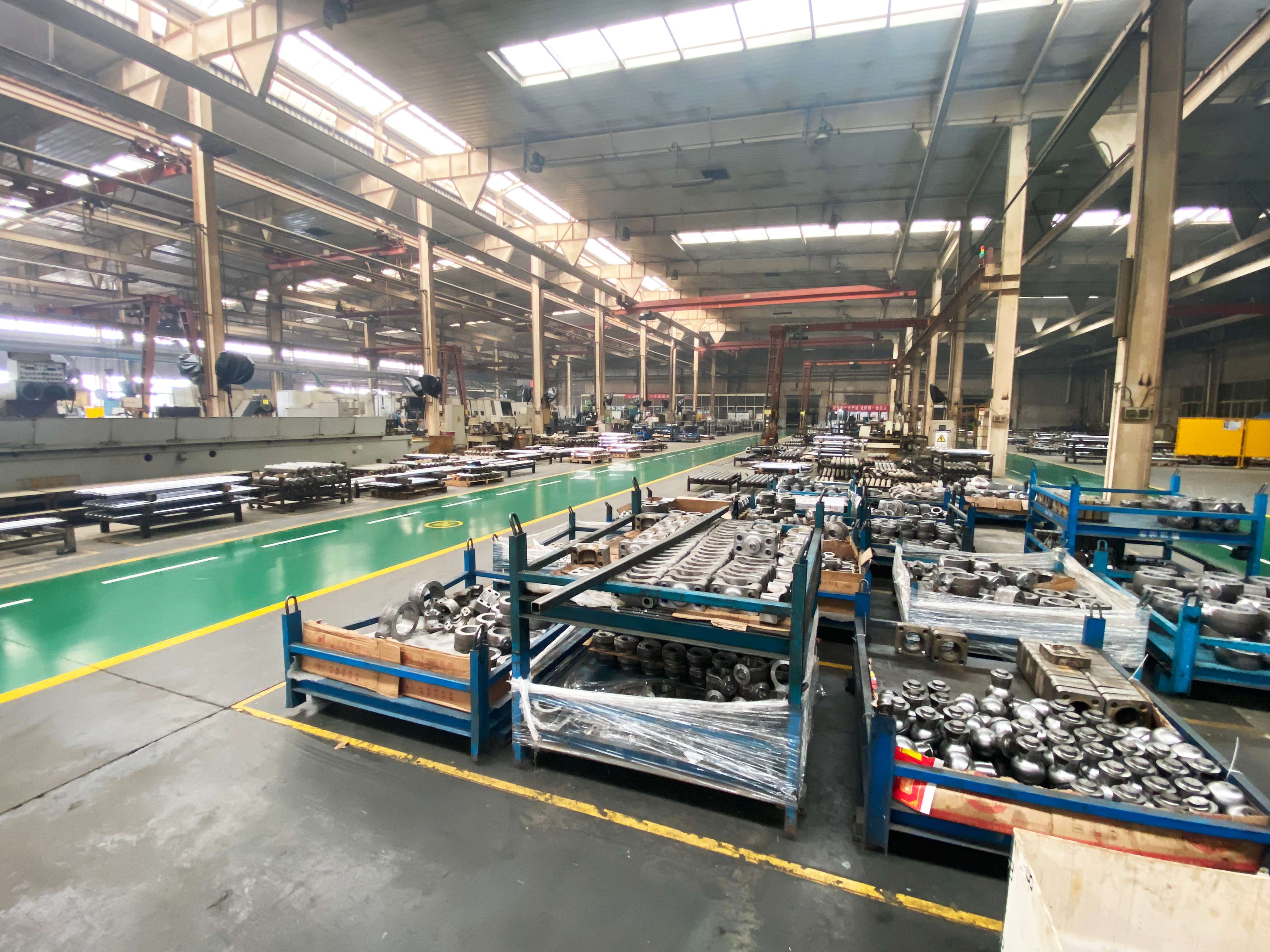
Machined components staged before final assembly. Cleanliness control at this stage is what the oil contamination and pump wear controls depend on.
Applications Where Cleanliness Discipline Actually Shows
The value of clean assembly is not uniform across every application. It concentrates where duty cycles are short and frequent, where pumps and valves are closely matched to cylinder capacity, and where field failure costs more than the power unit itself.
Apex Hydraulic builds application-specific dump trailer hydraulic power units rather than generic off-the-shelf units, with optimized motor, pump, reservoir, valve and control configurations. The company states that the system is engineered according to trailer size, cylinder capacity, lifting requirement, voltage, duty cycle and operating environment, whereas conventional standard units use a one-size-fits-all approach. Documented applications include dump trailers, agricultural dump trailers, landscape trailers, construction material trailers, utility trailers, heavy-duty tipping trailers, small dump trucks and mobile hydraulic equipment. Company materials also list use in sanitation vehicles, dump trucks, roll-off trucks, agricultural machinery, construction equipment, mining machinery, marine equipment and material handling equipment.
Where the payback is clearest
- High-frequency tipping equipment. Units that cycle many times per day expose pump and valve wear earlier than intermittent use, so pre-assembly contamination control has a shorter path to visible benefit.
- Trailer-mounted DC systems. Compact agricultural, landscape and utility trailers place the power unit close to the load, with limited tolerance for heat build-up and pressure drift.
- Vehicle-mounted platforms and hoists. Here a hydraulic fault typically takes the whole vehicle out of service, so downtime cost outweighs component cost.
- Export-bound equipment. Units travelling by sea pass through humidity and handling conditions that interact with sealing and corrosion protection, which is why sealed ports and anti-corrosion treatment sit in the same risk register as cleanliness.
Market Context: More Units, More Scrutiny
Procurement attention on process evidence is rising alongside volumes. The global hydraulic power unit market was valued at USD 13.6 billion in 2024 according to Grand View Research, while Precedence Research estimates the same market at USD 11.4 billion in 2024 with a 5.5% CAGR through 2034. The two estimates diverge, which is normal for industrial equipment categories, and buyers should treat any single market figure as directional rather than exact.
Regional concentration is more consistent. Asia Pacific accounted for a 40.2% revenue share of the hydraulic power unit market in 2024 according to Grand View Research, which means a large share of global supply is manufactured in the region where most sourcing decisions are made. In the United States, the industrial application segment held 56.3% of revenue share in 2024, and electric-powered units accounted for 60.1% of US revenue share in the same year.
Product mix is also relevant to the clean-assembly question. Mordor Intelligence reports that standard packaged units accounted for 47.8% of global hydraulic power unit revenue share in 2024, which implies that on the basis of reported shares more than half of market revenue sits outside standard packaged configurations — in customized, application-specific and system-integrated units, where configuration and build quality are set by the supplier's engineering process rather than by a catalogue number. Grand View Research projects the 2000-3000 psi pressure range segment to grow at a 5.8% CAGR from 2025 to 2033. In related mobile equipment, the global dump trailer market was estimated at USD 63.51 billion in 2024 by Market Research Future, with the 10-15 ton segment holding the largest share.
The direction of these figures is consistent: demand is growing in the pressure bands and equipment categories where a power unit is a working component rather than an accessory. That tends to move buyer attention from unit price toward documented process control.
Comparison: Application-Specific Versus Conventional Standard Units
The clearest comparison available is between a conventionally configured standard power unit and an application-specific unit engineered around the machine it serves. Apex Hydraulic documents this difference across several dimensions.
| Dimension | Conventional standard unit | Application-specific unit (Apex Hydraulic) |
|---|---|---|
| Configuration basis | One-size-fits-all approach | Engineered according to trailer size, cylinder capacity, lifting requirement, voltage, duty cycle and operating environment |
| Hydraulic efficiency | Motor, pump or valve mismatch can increase energy consumption and heat generation | Optimized hydraulic circuit reduces unnecessary pressure loss and improves overall system efficiency |
| Operating reliability | Generic configuration may shorten service life under frequent operation | Proper component matching extends service life under frequent dump trailer operation |
| Response | Improperly matched pump and motor can slow lifting response | Correct pump displacement and motor selection support faster lifting response |
| Noise and heat | Mismatched combinations can raise hydraulic noise and heat | Optimized motor-pump combination helps reduce noise and excessive heat generation |
| Maintenance | Generic configurations may complicate troubleshooting when components are mismatched | Modular design with standardized hydraulic components simplifies maintenance, troubleshooting and replacement |
| Cost profile | Low initial purchase cost, with possible higher maintenance frequency and shorter service life | Optimized system configuration reduces total ownership cost through improved reliability, reduced downtime and longer component life |
Where clean assembly does not help — and what it costs
Clean assembly is a genuine capability signal, but it is a bounded one, and buyers should be explicit about the boundary.
- It cannot correct a specification error. A power unit built to an under-sized pump or mismatched valve set can be cleaned, tested and delivered correctly, and still underperform. Cleanliness control reduces wear; it does not fix hydraulics. This is why engineering review and drawing confirmation sit in the risk register as a separate control from cleanliness.
- It does not guarantee a numeric cleanliness level. The stated measures are process-based: systems are cleaned before assembly and oil cleanliness is controlled. Where a buyer needs a declared particle count or an oil sampling record, that has to be requested as a specific deliverable, because process discipline and a numeric verification result are different pieces of evidence.
- It adds process steps that appear in price. Cleaning before assembly, controlled handling, component qualification and pre-shipment inspection all consume time and labour. Buyers comparing only line-item unit prices often find that a lower-priced generic unit wins on the quotation and loses on total ownership cost, which is precisely the trade-off the comparison above describes.
- It stops at the factory gate. Ports sealed for export protect the unit in transit, but once a unit is installed, oil introduced at commissioning and open connections during fitting can re-contaminate a clean system. The supplier's process controls the start condition, not the operating condition.
- It is documentation-dependent. Without records, a cleanliness claim cannot be distinguished from a marketing statement. Batch records, inspection records and test records are what make the claim auditable.
A Practical Audit Checklist for Power Unit Buyers
For procurement teams evaluating a hydraulic power unit manufacturer, the following requests map directly onto the controls described above and can be answered with documents rather than assurances.
- Describe the cleaning step performed before assembly, and specify at which point in the build sequence it occurs.
- State how hydraulic oil cleanliness is controlled during assembly and first fill, and provide the verification method used.
- Identify the qualification process for hydraulic pump suppliers, including how substitution is controlled.
- Provide evidence of pre-assembly solenoid valve testing for switching performance and response.
- Confirm that every unit receives hydraulic pressure and leakage testing before shipment, and ask what the record contains.
- Confirm that pressure settings are adjusted to the buyer's specification and that stable system pressure is verified per unit, not per batch.
- Request the engineering review and drawing confirmation step that verifies circuit design, voltage, flow rate, pressure and component configuration before production starts.
- Ask for the export packaging specification: sealed ports, anti-corrosion treatment and packing standard.
- Ask how production batches and inspection records are retained, and how a unit is traced back to its batch in an after-sales case.
Future Outlook
Two forces are likely to keep clean assembly on buyer scorecards. The first is documentation pressure: as hydraulic systems face conformity obligations such as EN ISO 4413:2010 and the Machinery Directive 2006/42/EC in the European Union, the internal records that support those obligations naturally extend to process controls, including cleanliness. The second is market composition: with customized and system-integrated units representing a substantial share of hydraulic power unit revenue, and the 2000-3000 psi band projected to grow at a 5.8% CAGR from 2025 to 2033, more purchasing decisions will involve configurations that no catalogue can describe in advance.
That combination favours suppliers who can explain their process in the same language as their risk register. It also raises the bar for buyers: the audit question is no longer whether a manufacturer states that it assembles cleanly, but whether it can produce the records, tests and batch traceability that make the statement verifiable.
For reference on component ranges, configurations and documented product data, Apex Hydraulic publishes a downloadable product catalogue covering its main products.
Download the APEX Hydraulic product catalogue (PDF)
FAQ
What does clean assembly mean in hydraulic power unit manufacturing?
Clean assembly means that components are cleaned before they are assembled rather than after, and that oil cleanliness is treated as a controlled variable throughout the build. At Apex Hydraulic, hydraulic systems are cleaned before assembly and hydraulic oil cleanliness is controlled to reduce contamination risks. The purpose is to prevent particles from entering pump clearances, valve passages and sealing surfaces, where they cause wear that functional testing on a finished unit cannot reverse.
How is contamination prevention different from filtration?
Filtration addresses oil condition during operation; cleaning before assembly addresses the condition of the components at the moment they are joined. Apex Hydraulic describes its contamination control as a clean assembly process combined with filtration control, and it treats pump wear separately, through component selection and cleanliness control — with pumps sourced from qualified suppliers and assembled under clean manufacturing conditions to minimize premature wear. The two measures operate at different stages and are reported separately in the company's risk register.
Which failure risks does cleanliness control actually reduce?
Two categories are explicitly linked to cleanliness: oil contamination and hydraulic pump wear. Related risks are addressed by different controls, and the distinction matters when auditing. Oil leakage is controlled through precision sealing, leak-proof hydraulic connections and pressure testing, with every unit pressure and leakage tested before shipment. Pressure instability is controlled through hydraulic circuit verification and pressure calibration, with settings adjusted to customer specifications and each unit tested for stable system pressure before delivery. Solenoid valve reliability is controlled by testing switching performance and response before assembly. Motor overheating is controlled through motor selection by duty cycle, voltage and load, plus thermal design and load verification.
How can a buyer verify clean assembly claims during a supplier audit?
Verification relies on records rather than statements. Relevant artifacts include the cleaning step description and its position in the build sequence, the method used to control oil cleanliness, documentation of hydraulic pump supplier qualification, pre-assembly solenoid valve test records, per-unit hydraulic pressure and leakage test records, engineering review and drawing confirmation before production, and production batch and quality inspection records that support traceability. Apex Hydraulic states that production batches and quality inspection records are maintained to support product traceability and after-sales service, which is the mechanism an audit would follow.
How does an application-specific power unit compare with a conventional standard unit on maintenance and cost?
The comparison is documented across several dimensions. Conventional standard units use a one-size-fits-all approach, and their low initial purchase cost can come with improper component matching, higher maintenance frequency and shorter service life. Application-specific units are engineered according to trailer size, cylinder capacity, lifting requirement, voltage, duty cycle and operating environment. On maintenance, a modular design with standardized hydraulic components simplifies maintenance, troubleshooting and replacement compared with generic configurations. On cost, optimized system configuration is described as reducing total ownership cost through improved reliability, reduced downtime and longer component life — a total-cost argument rather than a unit-price argument.
What are the limits of clean assembly as a capability signal?
Clean assembly is process evidence, not a performance guarantee. It cannot compensate for an under-specified pump, an incorrect circuit design or a mismatched valve set, which is why engineering review and drawing confirmation are recorded as a separate control. It is also process-based rather than numeric: the stated measures describe cleaning before assembly and controlled oil cleanliness, so a buyer requiring a declared particle count or oil sampling record must request it as a specific deliverable. Finally, it covers the condition of the unit at shipment, not the operating condition after installation, where oil introduced at commissioning and open connections during fitting can re-contaminate a clean system.