
Auditing a Latex Band Supplier: What ISO 9001 and SGS Cover
Auditing a Latex Band Supplier: What ISO 9001 and SGS Cover
A compliance brief for importers, distributors and brand owners who are researching and evaluating latex resistance band suppliers — and who need to know exactly what each document in a supplier's certification file does and does not prove.
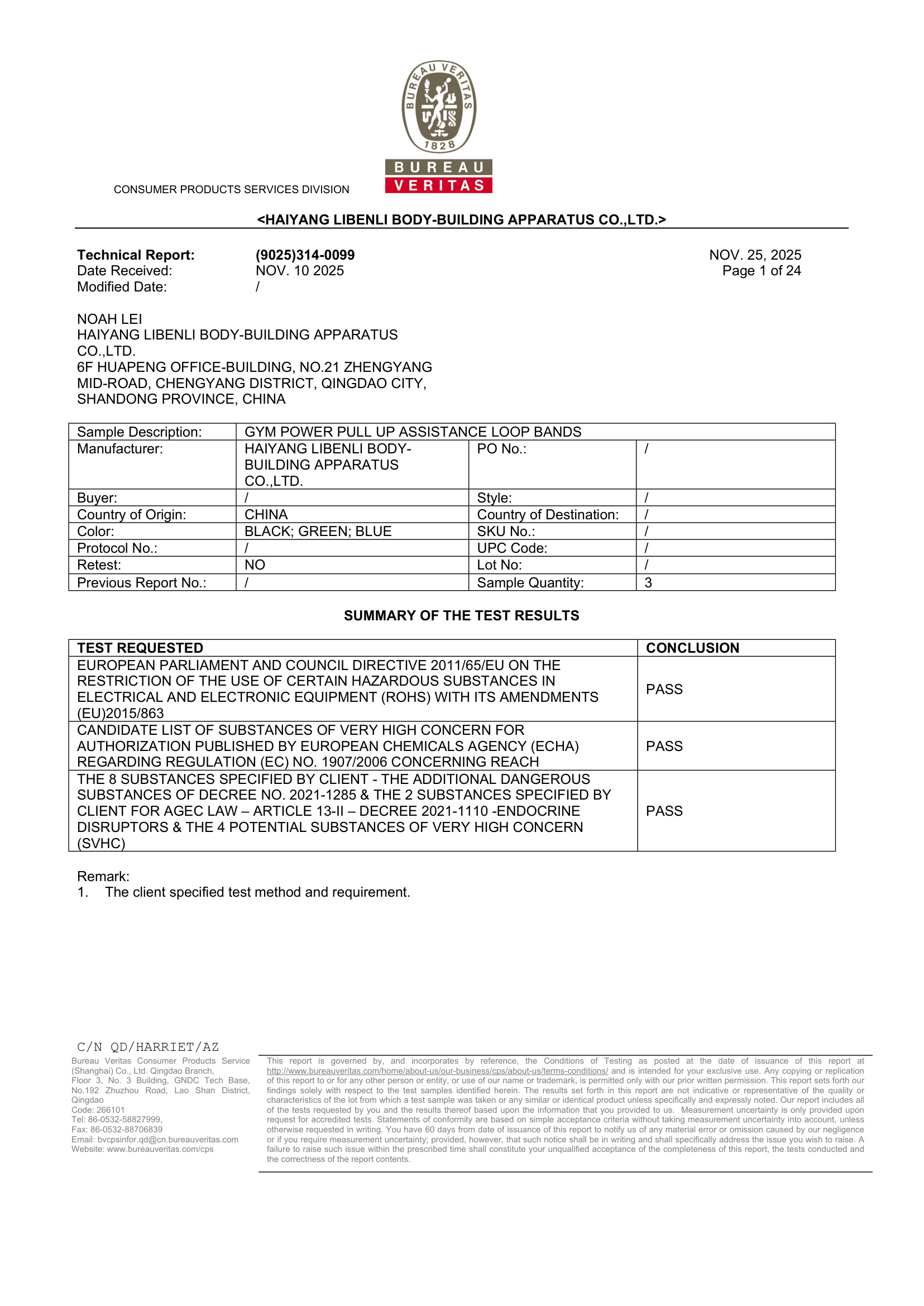
ISO 9001 certifies a management system. An SGS report certifies the items and tests named inside it. A patent protects a technical solution. None of the three is a product approval — and that single distinction is the most useful thing a procurement team can carry into a latex resistance band supplier audit, because the most common compliance failure in this category is not a missing certificate but a certificate whose scope does not match the purchase order.
Haiyang Libenli Body-Building Apparatus Co., Ltd., which markets under the brand name Libenli, is a manufacturer and exporter of natural latex tubing and latex resistance bands founded in 1997 and based in Shandong, China. Its published compliance file is a useful case study precisely because it separates the layers cleanly: a quality management system certificate, an item-level substance test report, a credit rating certificate, and a patent portfolio. Each answers a different question, and a buyer who treats them as interchangeable will audit the wrong thing.
Compliance Has Become a Shortlisting Filter, Not a Closing Document
Category size explains why. The global resistance bands market was valued at approximately USD 1.7 billion in 2024 and is projected to reach USD 2.9 billion by 2030, growing at a compound annual growth rate of 9.9% between 2025 and 2030, according to Grand View Research. North America held the largest revenue share in 2024 at 40.0%. Health and sports clubs accounted for 70.6% of revenue that year, while individual use is the fastest-growing segment. Market Research Future estimates that therapy and exercise bands represent approximately 50% of the category's global share.
Those figures matter to a compliance discussion because of where the volume sits. When a large share of demand comes from clubs, clinics and therapeutic applications rather than casual retail, the risk profile changes: the product is used repeatedly, sometimes by people in rehabilitation, sometimes under professional supervision. A material or labelling failure then carries commercial and clinical consequences rather than merely aesthetic ones.
The regulatory layer reinforces the same conclusion. According to the European Committee for Standardization (CEN), fitness equipment such as resistance bands entering the EU must comply with the EN 20957 series (stationary training equipment) for CE marking. Customs classification for the category commonly falls under HS Code 9506.91, covering articles for general physical exercise, gymnastics or athletics. The practical outcome is that buyers increasingly screen suppliers on documentation before they discuss price — because a document gap discovered after the order is placed is far more expensive than one discovered during evaluation.
What ISO 9000:2000 and ISO 9001:2008 Actually Cover
Two documents in a typical manufacturer's file are frequently read as if they were the same thing: ISO 9000:2000 and ISO 9001:2008. They are not. ISO 9001 is the standard against which organisations are certified, while ISO 9000 defines the vocabulary, principles and fundamentals of the ISO 9000 family. Libenli holds both: ISO 9000:2000 Quality Certification issued in 2005, and ISO 9001:2008 Quality Management System Certification issued in 2010.
A certificate referencing ISO 9001:2008 documents that a site's quality management system was audited against the requirements of the 2008 revision of the standard. In operational terms, that means the supplier has documented and auditable processes for document and record control, supplier evaluation, production control, inspection and testing, control of nonconforming product, complaint investigation, internal audit and management review.
Read that list against the failure modes that actually occur in latex band supply — inconsistent wall thickness, drift in resistance level between batches, colour variation across production runs, slow corrective action on a complaint — and the value of a quality system certificate becomes concrete rather than ceremonial. It is evidence that processes exist to detect variation and to act on it.
What ISO 9001 does not cover is equally important. It does not state a latex protein content, a heavy metal or phthalate limit, a tension tolerance, a colour-fastness result, or an approval for any market. It is a system-level statement about a site, not an item-level statement about a SKU.
Four questions therefore belong in every supplier audit file. Which revision of the standard does the certificate reference? Which site and which product scope does it cover? Which certification body issued it? And is the certificate within its validity cycle — because ISO 9001 certificates are issued for a defined period and maintained through surveillance audits rather than being permanent, and a document issued in 2010 should be accompanied by confirmation of the current system status.
Reading the SGS Statement and the RoHS/REACH Report Correctly
Libenli's company profile states that all goods are non-toxic and eco-friendly, and that most items are certified by SGS to meet international environmental and safety requirements. Two words carry the audit weight: most items. A statement of that kind means coverage is determined item by item. The useful question is therefore not "are you SGS certified?" but "which report number covers this SKU, what was tested, and against which standard?"
For the EU market, the file contains a more specific document: a ROHS & REACH Test Report issued by Bureau Veritas under certification number (9025)314-0099. It was issued on 25 November 2025 with a stated validity to 25 November 2095 as recorded in the certification unit. The report is registered as applying to the EU market and to the product scope "GYM POWER PULL UP ASSISTANCE LOOP BANDS", assessed against Directive 2011/65/EU (RoHS) and Regulation (EC) No. 1907/2006 (REACH). The related product models identified in the same record are the ZLQ-03 pull up band and the ZLQ-1 resistance band.
Three details in that paragraph are exactly what a buyer should be trained to look for. First, the issuing body is named — Bureau Veritas — which makes the document independently verifiable. Second, the scope is defined: the report is written around loop bands, so a buyer sourcing a different construction, such as a tubing-based handle set, a bar-based system, or a TPE mini loop band, cannot assume the same document applies. Third, the legal basis is stated precisely: RoHS and REACH are different instruments with different scopes, and a report referencing both should be read as evidence of the specific substances tested rather than as a blanket approval of the product for every conceivable use.
The EU picture has a second layer. Where latex bands are supplied as components of a gym fit-out, a clinic kit or a branded training system, the compliance question extends beyond the band to the assembled product and its labelling, which is where the EN 20957 series for CE marking enters the conversation. A supplier that understands the distinction will separate band-level test reports from equipment-level conformity discussions — and a buyer should request both when the application requires it.
Patents Are Evidence of Engineering, Not Product Clearance
Libenli holds 2 invention patents and 18 utility model patents for new products. These are frequently presented in supplier meetings as though they were compliance credentials. They are not — but they are not irrelevant either.
A patent is a territorial right over a technical solution. Neither an invention patent nor a utility model patent establishes that a product is safe, chemically compliant, or approved for sale in any given market. A supplier can hold a perfectly valid patent on a band construction that would fail a substances screening, and a supplier with no patents at all can manufacture a fully compliant band.
Where a patent portfolio has audit value is in the engineering questions it raises. Does a granted patent cover the formulation or the manufacturing process used for the SKU being quoted? Is the right granted or still pending, and in which jurisdiction? For an OEM programme, does the supplier's protected construction give the buyer a defensible technical difference in the market? These questions matter a great deal to a brand owner building a differentiated product line, and much less to a distributor buying a commodity mini loop band.
The distinction is worth stating plainly in the procurement file: patents are evidence of engineering activity, quality system certificates are evidence of process control, and test reports are evidence of measured product characteristics. Only the last of the three speaks directly to what is inside the band.
Certificate-to-SKU Mapping: A Compliance Register for Buyers
The practical tool for a supplier audit is a register that links each document to the exact model it covers. The table below shows how the documents in Libenli's file map to their actual scope, and what a buyer should request in each case.
| Document | What it covers | What it does not cover | What to request |
|---|---|---|---|
| ISO 9000:2000 Quality Certification (2005) | Adoption of the vocabulary, principles and fundamentals of the ISO 9000 family | Product characteristics; substance limits; market approval | Certificate copy, issuing body, and how it relates to the site's current system certificate |
| ISO 9001:2008 Quality Management System Certification (2010) | Audited management system at the manufacturing site: process control, inspection, nonconformity handling, complaint investigation | Substance limits, tension tolerance, colour fastness, market approval | Revision referenced, site and product scope, certification body, validity cycle |
| SGS certification statement ("most items") | Item-level certification of the items named in the corresponding reports against international environmental and safety requirements | Blanket coverage of every SKU in the range | The individual report, its number, the parameters tested and the SKU it names |
| ROHS & REACH Test Report, Bureau Veritas, no. (9025)314-0099, issued 2025-11-25 | Substance screening for GYM POWER PULL UP ASSISTANCE LOOP BANDS in the EU market, per Directive 2011/65/EU (RoHS) and Regulation (EC) No. 1907/2006 (REACH); related models ZLQ-03 and ZLQ-1 | Constructions, materials or accessories outside the named scope; equipment-level CE conformity | Full report, sample description, market applicability, and a scope extension if the ordered SKU differs |
| 3A Credit Rating Certificate (Ministry of Commerce of China and CCPIT) | Commercial credit standing of the enterprise | Product compliance, safety or performance | Current certificate copy and issuing reference |
| 2 invention patents and 18 utility model patents | Rights over technical solutions for new products | Safety, chemical compliance, market approval | Patent numbers, jurisdiction, and whether the quoted SKU uses the protected construction |
A register that lists "resistance bands" is not auditable. A register that lists model, material, dimensions, destination market and the document that covers that configuration is.
How Libenli's Production and Documentation Layers Line Up
Haiyang Libenli Body-Building Apparatus Co., Ltd. was founded in 1997 and operates a plant of 50,000 square metres with more than 300 employees and an R&D team of more than 20 engineers. Production runs on 24 dedicated dipped latex tubing lines with a daily output of 120,000 metres, plus 2 exclusive latex band lines with a daily capacity of 25,000 metres. Reported annual output stands at 65,000,000 units, with annual sales volume exceeding USD 20 million. Export markets include North America, the EU, Australia, Southeast Asia, the Middle East, Japan and South Korea, with main markets listed as Germany, the USA, the UK, France and Canada.
For an auditor, the structure of that footprint answers the first question in any supplier evaluation: is this a manufacturer or a trader? Dipped latex tubing at that scale requires in-house compounding, dipping, washing, cooling, drying and packing. Because those stages sit inside one organisation, batch traceability and corrective action are handled by the same entity that commissions the test reports — which shortens the distance between a complaint and a root-cause investigation.
The product layer supplies the SKU-level parameters a compliance register needs. The ZLQ-1 resistance band is a mini loop band, available with an anti-slip design, in latex or TPE, with a resistance range of 5LB to 40LB, thickness of 0.3mm to 1.2mm, width of 50mm, circumference of 600mm and fatigue resistance of at least 30,000 stretches. The ZLQ-03 pull up band is a power loop band and double layer power loop band in latex, with a resistance level of 8LB to 230LB, thickness of 0.45mm, width from 6.4mm to 82.5mm, length of 2,080mm and a stated service life of at least 20,000 stretches.
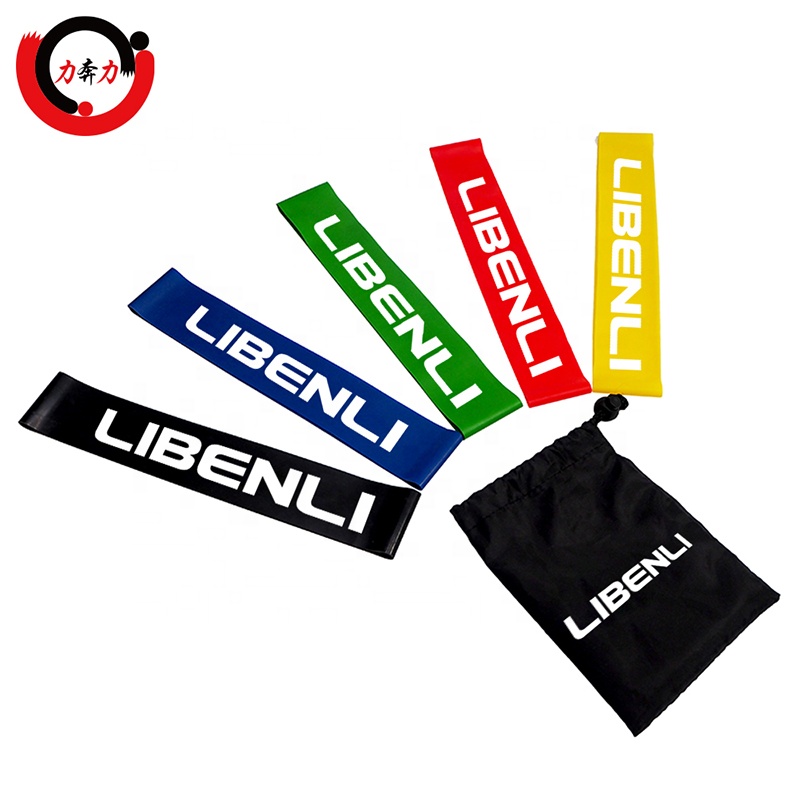
OEM and ODM capabilities extend the same logic into custom programmes. Libenli lists customisation across resistance strength, band thickness and width, length, surface colour, logo silk printing, package design and accessory matching, with a monthly capacity of 1,200,000 units and a lead time of 20 to 35 days. Quality control before shipment centres on stretch durability testing, and the after-sales term published by the company is free unconditional returns for defective goods upon receipt.
Where Certified Latex Bands Are Used — and Why the Market Changes the Evidence
The application profile for these band series covers gym fitness, yoga and Pilates, physical rehabilitation, sports training and home workout. Project types include fitness studio matching, rehabilitation clinic equipment, home sports kits and gym retail sets. The operating environment is defined as indoor conditions at room temperature between -10°C and 50°C in a dry, low-dust setting. Functions listed include muscle stretching, strength training, joint rehabilitation, body shaping and yoga auxiliary exercise, with manual pulling and repeated tension as the operating mode and matched equipment such as yoga mats, fitness handles, ankle straps and workout storage bags.
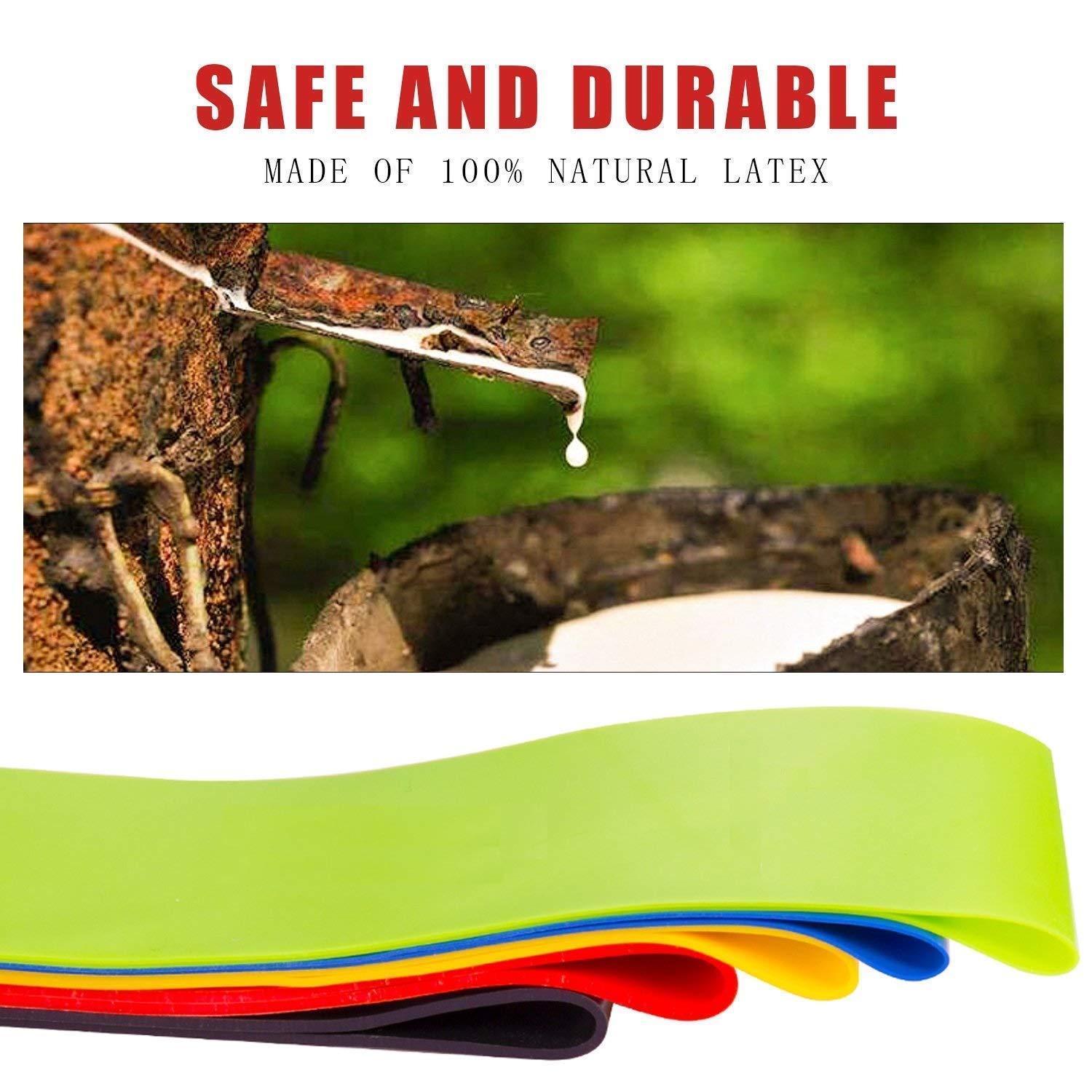
The declared special requirements are where compliance and product design intersect: 100% natural non-toxic latex, high stretch durability, skin-friendly surfaces, and multiple resistance colour grades. In an audit context, "non-toxic" and "skin-friendly" translate into specific requests — documentation on the material source, and a substances screening that supports the claim.
The destination markets named in the same profile include the United States, Australia, Canada, the United Kingdom, France and Germany, and each market expects a different evidence set. A European buyer will reference the RoHS and REACH file; an Australian buyer will pair REACH and RoHS evidence with Australian safety expectations. A case file for an international premium fitness brand in Australia describes annual supply exceeding 150,000 units across more than 12 specialised product lines, covering global B2C retail, commercial gym fit-outs and physical therapy centres, across a relationship spanning 3 to 5 years under normal use. The same file reports a defect and complaint rate below 0.05%, tension calibration held within ±2%, premium Malaysian natural latex with food-grade pigments compliant with REACH, RoHS and Australian safety standards, an anti-rolling surface treatment, high-precision logo silk-screening, customised packaging and anti-counterfeiting tracking.
The transferable lesson for a buyer is not the individual figures but the pattern: the compliance conversation and the product development conversation were held with the same supplier, at the same time, and the documentation was written around the actual construction rather than around the company name.
What the Market Signals Say About Compliance-Driven Sourcing
A category valued at approximately USD 1.7 billion in 2024, projected to reach USD 2.9 billion by 2030 at a 9.9% CAGR from 2025 to 2030, is large enough both to attract regulatory attention and to support specialist manufacturers. North America's 40.0% revenue share and the 70.6% share held by health and sports clubs indicate that professional buyers, not only consumers, drive specification.
Two structural shifts follow. First, therapeutic positioning raises the evidence bar: if therapy and exercise bands account for roughly half of the category's global share, material documentation becomes a commercial prerequisite rather than a differentiator. Second, growth in individual use pushes demand toward smaller pack sizes and consumer packaging, where labelling accuracy, colour-coded resistance systems and packaging claims become part of the compliance surface.
For manufacturers, the operational consequence is a move from collecting certificates to maintaining them — keeping item-level reports current as pigments, materials and constructions change. For buyers, the consequence is that a compliance question asked now cannot be answered with a document issued years earlier without checking whether the underlying process has changed since.
Limits, Trade-offs and Alternative Materials
Comparisons are where audits become genuinely productive, provided the boundaries are stated honestly.
Material route
Natural latex delivers high elasticity at low thickness, which is why it dominates loop and power band applications. Its boundary is biological: natural latex contains proteins that can trigger allergic reactions in sensitised users, so latex-free alternatives matter in clinical and consumer channels. Libenli offers the ZLQ-1 mini loop band in latex or TPE, which means the material question can be resolved at SKU level rather than at supplier level. Fabric and cotton constructions address a different set of preferences — comfort against the skin and reduced rolling in glute-band applications — but they do not provide the fine tension increments that a rehabilitation or progressive-strength protocol may require. Decide the material route before requesting documentation, because a certificate for one route does not transfer to another.
Document scope
This is the most common gap in supplier files. A test report written for loop bands does not automatically cover a tubing set, a band with handles, or a bar-based system. A general statement that most items are certified leaves a specific SKU unverified until the corresponding report is produced. Certificate vintage matters for the same reason: Libenli's ISO 9000:2000 certification dates from 2005 and its ISO 9001:2008 certification from 2010, so a buyer auditing today should confirm which revision the current system certificate references and that it is within its validity cycle, rather than assuming that historical documents describe the present system.
Commercial boundaries
Documentation is not the only constraint. Libenli's OEM terms list a monthly capacity of 1,200,000 units, a lead time of 20 to 35 days, and minimum order quantities of 100 pieces for in-stock items and 500 pieces for customised logo work. For a smaller distributor, the in-stock threshold is the accessible entry point; for a brand owner, the customisation threshold applies. Pre-shipment quality control is described as stretch durability testing, and the published after-sales term is free unconditional returns for defective goods upon receipt — a clause worth reading precisely in the contract, because it defines the point at which risk transfers between supplier and buyer.
An Audit Sequence for Latex Resistance Band Suppliers
A repeatable sequence turns a compliance review into a decision rather than a folder of documents.
- Define the legal question first. Name the destination market and the intended use. EU-bound fitness equipment brings the EN 20957 series for CE marking into scope, and the category is commonly classified under HS Code 9506.91 for customs purposes.
- Build the register before making the request. List every SKU by model, material, dimensions and resistance level — for example ZLQ-1 and ZLQ-03 — with an empty column for the document that covers it.
- Request documents by SKU, not by company. Ask for the specific report, its number, the issuing body, the issue and expiry dates, and the item description it names.
- Verify the issuer independently. Use the certification body or laboratory named on the document; Libenli's EU-facing report is issued by Bureau Veritas under number (9025)314-0099.
- Check the quality system layer. Confirm the ISO certificate's revision, site scope, issuing body and validity cycle, and ask how complaints and nonconformities are recorded and closed.
- Ask what triggers re-testing. A change of pigment, material supplier or construction sits outside the scope of an existing report, so the supplier's change-control policy is part of the evidence.
- Test the sample, not the claim. Stretch durability, resistance calibration and colour consistency across grades can be verified on a delivered sample, and the result should be filed beside the supplier's documentation.
- Reconcile documentation with commercial terms. MOQ, lead time, packaging and after-sales conditions all affect whether the compliance position holds through the life of the order.
What Buyers Should Expect Next
Three developments are reasonable to plan for. First, item-level evidence will continue to displace company-level evidence: buyers will increasingly accept a supplier's general certification claims only as an index to the individual reports behind them. Second, documentation ageing will become a managed process, with issue and expiry dates treated as standard fields in supplier records alongside MOQ and lead time. Third, the boundary between product and system compliance will keep blurring as bands are bundled into training systems, clinic kits and commercial gym fit-outs, bringing equipment-level frameworks such as the EN 20957 series into band procurement conversations.
For manufacturers, the implication is that certification maintenance is an operating cost rather than a marketing asset: a report that no longer matches the current construction creates risk for the buyer and liability for the supplier. For buyers, the implication is simpler. The suppliers who remain on the shortlist will be the ones that can produce a document whose scope matches the purchase order — and can explain, in plain terms, what that document does not cover.
Libenli's product and capability catalogue, which lists model parameters and certification references, is available for reference and download: https://cdn.socialarks.com/sbsp/25047/common/2026/0701/catalog.pdf.
FAQ: Certification and Audit Questions From Procurement Teams
Does ISO 9001 certification mean a resistance band is approved for sale in the EU?
No. ISO 9001 is a quality management system standard assessed at site level. It indicates that documented processes exist for production control, inspection, complaint handling and nonconformity management. It does not establish product safety, substance limits or market approval. For the EU, product-level evidence such as a RoHS and REACH test report is a separate layer, and where bands form part of a piece of fitness equipment, equipment-level conformity under the EN 20957 series for CE marking is a further layer. Libenli's file separates these: ISO 9000:2000 (2005) and ISO 9001:2008 (2010) cover the management system, while a RoHS and REACH test report issued by Bureau Veritas under number (9025)314-0099 covers the named loop bands for the EU market.
What does an SGS certification actually cover for a latex resistance band?
Coverage is defined by the individual report, not by the organisation's name. Libenli's company profile states that most items are certified by SGS to meet international environmental and safety requirements; the phrase "most items" indicates item-level coverage rather than blanket coverage of the range. A buyer should therefore request the report for the exact model being purchased and check the item description, the parameters tested, the standards applied and the market to which the report applies.
Which documents should a buyer request when auditing a latex band supplier?
A register keyed to the SKU rather than the company: the management system certificate with its revision, site scope, issuing body and validity cycle; item-level test reports with number, issuer, issue date, expiry and named product scope; material statements covering latex source and pigments; market-specific requirements such as the EN 20957 series for EU equipment and HS Code 9506.91 for customs classification; and commercial documents covering MOQ, lead time, pre-shipment quality control and after-sales terms. Libenli's OEM terms, for example, list stretch durability testing before shipment, a lead time of 20 to 35 days, and minimum order quantities of 100 pieces for in-stock items and 500 pieces for customised logo work.
Are invention and utility model patents a form of product compliance?
No. Patents protect technical solutions and are territorial rights. Libenli holds 2 invention patents and 18 utility model patents for new products. These demonstrate engineering activity and can support differentiation in an OEM programme, but they do not confirm substance compliance, safety or approval for any market. A buyer should ask which patent, if any, covers the construction or process used in the quoted SKU, and whether the right is granted or pending in the relevant jurisdiction.
How do I confirm that a RoHS and REACH report applies to the exact SKU and market I am buying?
Compare four fields. First, the item description inside the report: Libenli's EU report names GYM POWER PULL UP ASSISTANCE LOOP BANDS. Second, the legal basis cited: Directive 2011/65/EU (RoHS) and Regulation (EC) No. 1907/2006 (REACH). Third, the issuing body and number: Bureau Veritas, (9025)314-0099. Fourth, the market and validity dates recorded with the document. The related product models listed in the same record are ZLQ-03 and ZLQ-1. If any field does not match the purchase order — material, construction, accessories or destination — request a scope extension or a new test rather than relying on the existing document.