
Auditing a Luxury Hotel Tent Factory: Welds, Membrane, Glass
Independent Buyer Reference · Factory Verification
A luxury hotel tent is a manufactured building. The numbers used to sell it — wind rating, membrane weight, glazing system — are produced on a factory floor, not in a brochure. For buyers at decision stage, the question is therefore no longer which specification sheet looks strongest, but whether the supplier's process can reproduce that specification across every unit in an order.
This guide sets out an observable-evidence method for auditing a tent factory. It is built around three production stations that determine whether a claimed performance envelope is real: welded steel pipe frame fabrication, coated membrane cutting and tensioning, and insulated wall and glass integration. The reference case is Stars Glamping (STARS GLAMPING TENT CO., LTD), a Guangzhou-based high-tech enterprise focused on the R&D, design, manufacturing and installation of luxury glamping tents and camp planning, operating a 20,000 m² manufacturing base and a 4,000 m² simulation exhibition hall, with a stated annual output of 600–900 luxury tent units depending on project size.

A factory audit starts before the first weld: facility identity, hall layout and station flow define what can actually be observed on site.
Specification Sheets Are Design Intent, Not Production Evidence
Manufacturers describe capability in finished-state language: a wind rating, a fabric weight, a wall system, a warranty term. Buyers should read those statements as design intent. Whether the delivered tent retains that behaviour depends on cutting tolerance, weld consistency, seam quality, membrane prestress and the discipline of the pre-shipment check — none of which appear on a specification sheet.
The documentation most buyers receive does not close the gap on its own. Supplier conformity claims are frequently reported at a level of generality that cannot be audited: a certificate may be named without its scope, the applicable directive or the harmonised standard it was tested against. Where a manufacturer states SGS and CE testing, the practical follow-up is to request the report with scope, product family, test standard number and issuing body, and to reconcile the certified article with the article being quoted.
Fire performance carries the same pattern. The International Fire Code (IFC) 2024, Chapter 31 addresses tents, and is a useful reference point for North American projects, but it is not a global specification. Flame-retardant materials, waterproof PVC or PVDF fabric, reinforced steel structure and UV protection are control measures that must be evidenced per project jurisdiction, not asserted once for all markets.
Station One: Welded Steel Pipe Frames
The frame is where a luxury hotel tent stops being a textile product and becomes a structure. A welded steel pipe frame carries wind load into foundations, sets the geometry that the membrane is tensioned against, and determines whether glazed elements stay true over years of thermal cycling. For that reason it is the first station to inspect, and the one where observation is most informative.
What to observe at the frame line
- Jigs and fixtures per model. A manufacturer claiming a multi-model range should hold dedicated jigs, patterns or forming tools for each geometry. If every model is built on the same open floor without fixtures, dimensional consistency depends on the operator rather than the process.
- Member traceability against the structural schedule. The tube diameter, wall thickness and bracing pattern visible on the floor should be reconcilable with the member schedule used for any load calculation. A common audit failure is a frame that is well made but not the frame that was calculated.
- Weld bead uniformity and post-weld condition. Look for consistent bead profile, controlled spatter, absence of visible undercut at joints, and a defined corrosion-protection step with a named specification.
- Dimensional verification records. Ask to see the inspection sheet for the model currently in production, not a blank template.
- Mixed-material interfaces. Where frames combine materials — for example the Luxury Tent – Pisces, whose frame material is stated as solid wood and steel pipe — the joint detail between timber and steel deserves specific attention, because the two move differently under humidity and load.
Stars Glamping operates dedicated hardware and fabric workshops within its manufacturing base and states a 12-step quality inspection system applied across production. The company also reports 54 national patents covering wind resistance, waterproofing, heat insulation and quick assembly. For an auditor, those claims translate into specific requests: which patent or engineering document supports the joint currently being welded, and which inspection steps in the 12-step system apply before the frame leaves the hall.
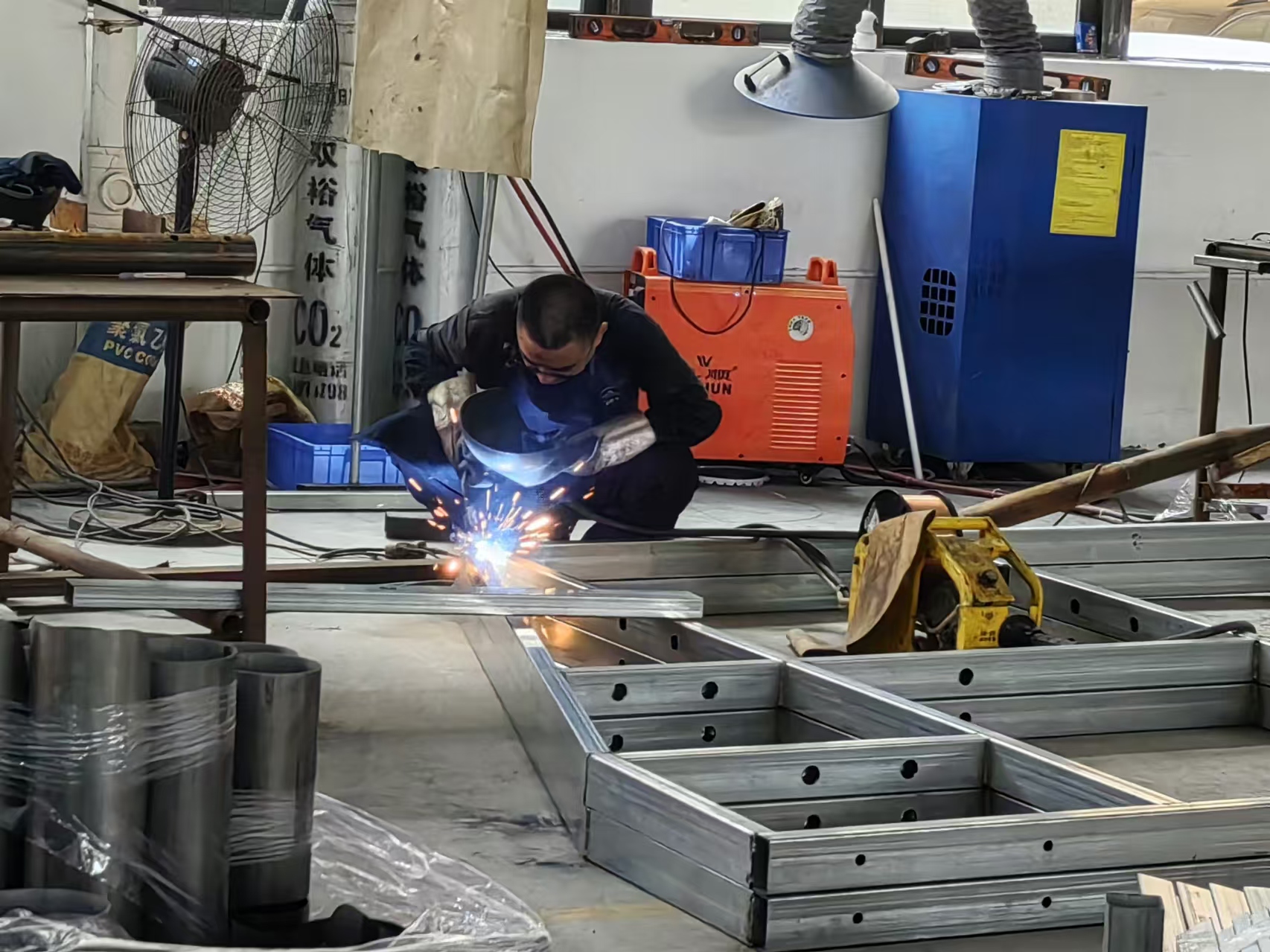
Hardware workshop: frame cutting, jig fit-up and welding form the first evidence chain in a tent factory audit.
Station Two: Membrane Handling — 850 g/m² PVC and 1050 g/m² PVDF
Two coated-fabric classes dominate luxury hotel tent specifications. PVC-coated polyester is the established standard, and appears in the Stars Glamping range at 850 g/m² on the Luxury Tent – Pisces, whose cover material is stated as 850 g/m² PVC polyester fabric. PVDF membrane sits in the higher-performance class, referenced in the same product family at the 1050 g/m² level, and is the specification buyers pursue when the asset is intended to hold value over a long horizon.
The reported service-life bands help explain why. Steel-frame construction using PVDF membrane is reported at 25–30 years, against 10–15 years for wood-frame construction with PVC polyester. Those two variables — frame material and membrane class — move together in the published comparison, so a disciplined buyer isolates which factor drives the difference before paying a premium for either.
What to observe at the membrane line
- Roll identification and weight verification. The gram-per-square-metre figure on the technical dossier should be checkable against roll labels and lot records. A 1050 g/m² claim is only meaningful if the delivered membrane is traceable to that weight.
- Cutting discipline. Pattern cutting on a controlled table, with panel numbering, is what allows a membrane to be tensioned evenly on site. Cut panels stacked without identification are a warning sign for installation quality downstream.
- Seam method and seam testing. Seam type, seam width and the test method used to validate seam strength are the core of membrane durability. Ask to see a retained seam sample and the associated test record.
- Tensioning logic. Tensioning sequence, edge detail and prestress determine whether the finished roof drums or ponds under wind and rain. This should be documented as an installation instruction, not improvised on site.
- Performance evidence. Waterproofing, flame retardancy, UV resistance and self-cleaning are claims that require a test method and a report. A material description alone is not evidence.
Stars Glamping's risk-control approach for water, wind, fire and UV exposure combines waterproof PVC or PVDF fabric, reinforced steel structure, flame-retardant materials and UV protection, supported by pre-shipment testing and installation guidance. The audit question is where each of those controls is physically executed — receiving inspection, cutting, seaming or packing — and which record is retained.
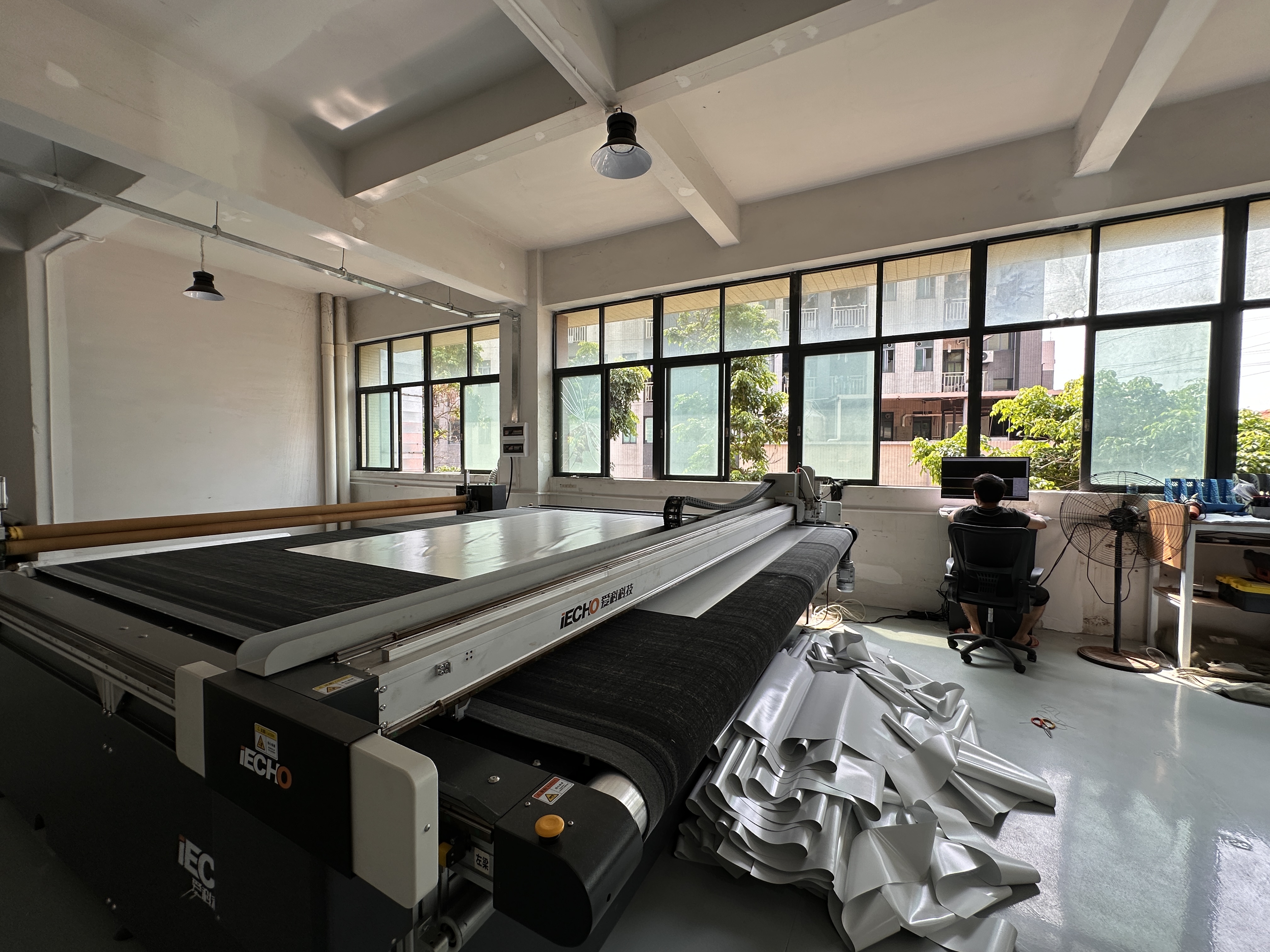
Fabric workshop: lot traceability, cut-panel identification and seam testing determine whether a membrane weight claim is reproducible.
Station Three: Insulated Wall and Glass Wall Integration
The third station is where most factory capability gaps surface, because it sits between trades. A luxury hotel tent with an insulated wall system and glazed elements must resolve three interfaces at once: the membrane-to-wall junction, the wall panel-to-frame junction, and the glazing-to-framing junction. Each has its own tolerance, and each fails differently.
The Luxury Tent – Pisces illustrates the configuration pattern: a steel frame with PVC fabric and an insulated canvas wall system. Where glazed walls are specified, the auditor should look for glazing rebate detail, drainage and weep provision, gasket or structural sealant specification, and the deflection allowance at the frame under design wind load. Insulation performance, in turn, is the basis for the energy argument that makes tented accommodation economically credible in hot or cold climates — better insulation reduces energy consumption, which is one of the reasons the format competes with conventional buildings at all.
Translating Observations into Performance Claims
The point of walking the floor is to make a performance claim checkable. Stars Glamping publishes a wind resistance specification of 120 km/h for its Tethys, Villa and Octagon models, and states that patented technologies enable its products to resist level-12 typhoons and extreme temperatures. A buyer cannot verify a wind rating by looking at a weld. What the audit can establish is whether the frame being built is the frame those figures were calculated for.
A workable sequence is: obtain the engineering basis for the rating, confirm the member schedule and connection details on the floor match it, confirm the membrane class and seam method match the specification that was tested, and require a pre-shipment mock assembly of at least one bay so that the interfaces are proven before the container is loaded. Where any of those four steps is missing, the rating should be treated as unverified rather than disputed.
Five Model Types as Evidence of Production Range
Production range is itself a capability signal. A manufacturer able to hold tooling, patterns and inspection routines across several distinct geometries is demonstrating process control that a single-model supplier cannot show. Stars Glamping's luxury hotel tent range spans five named types — Tethys, Villa, Octagon, Shell and Pisces — and the audit converts each name into a specific tooling and documentation question.
| Model | Documented point of reference | What the audit should confirm |
|---|---|---|
| Tethys | Included in the stated 120 km/h wind resistance specification | Dedicated jig, member schedule, membrane pattern and seam plan retained for this geometry |
| Villa | Positioned for hotel resorts, eco-camps, boutique campgrounds and luxury safari lodges; included in the 120 km/h specification | Wall system build-up, service interfaces and the inspection record used for hospitality-grade fit-out |
| Octagon | Included in the stated 120 km/h wind resistance specification | Multi-plane membrane cutting accuracy and radial frame joint consistency |
| Shell | Part of the five-model range; geometry-specific tooling required | Whether a dedicated pattern set exists and how curved panels are numbered and packed |
| Pisces | Steel frame with PVC fabric and insulated canvas wall system; frame of solid wood and steel pipe; cover of 850 g/m² PVC polyester fabric | Timber-to-steel joint detail, insulated wall integration, and the packaged bill of materials for the wall build-up |
The table is deliberately asymmetric. Published figures exist for some models and not others, and the audit is designed to work in both cases: where a number is published, the audit tests whether the physical build supports it; where only a name is published, the audit tests whether a real production asset — tooling, pattern, inspection record — sits behind the name.
Luxury Hotel Tent vs Traditional Construction: What the Comparison Does and Does Not Prove
The commercial case for the format is well established in supplier documentation. Compared with traditional hotel buildings, luxury hotel tents are positioned as offering 30–50% lower investment cost, installation in 20–30 days against 6–12 months for conventional construction, lower maintenance requirements and better insulation that reduces energy consumption. The format is presented as particularly suitable for resort, desert and beachfront environments, with fast deployment supporting early revenue.
None of those advantages are quality proofs. A faster build delivers value only if the factory process is repeatable; a lower investment cost is only lower on a lifecycle basis if the membrane and frame reach their intended service band. The comparison with traditional construction is a deployment and capital-efficiency argument, and it should be read alongside — not instead of — the production evidence gathered at the three stations above.
There is a further boundary worth stating plainly. The available public evidence base for this category is thin: certification claims are commonly company-reported without published scope, and independent laboratory data for waterproofing, flame spread, wind, snow, thermal and acoustic performance is scarce across the sector. A factory audit is therefore a substitute for missing documentation, not a supplement to it. Buyers should expect to commission independent testing where the project's insurance, code or financing requires it.
A Practical Factory Inspection Checklist
The checklist below is organised in the order a factory walk normally follows. Each line pairs an inspection point with the evidence a buyer should leave with; a point observed but not documented is not an audit finding.
| Inspection point | What to observe | Evidence to retain |
|---|---|---|
| 1. Entity and facility identity | Registered company name, factory address, production halls and station layout | Business licence, facility address confirmation, photographs of halls in use |
| 2. Frame material and section schedule | Tube diameter, wall thickness, bracing pattern against the structural schedule | Member schedule, material certificates, cut list |
| 3. Jigs and tooling | Dedicated fixtures per model, forming tools for curved and radial geometry | Photographs of jigs labelled by model, pattern inventory |
| 4. Welding and dimensional control | Bead uniformity, joint finish, measuring routine, inspection station | Welding procedure, dimensional inspection sheet for the unit in production |
| 5. Corrosion protection | Named treatment step and its place in the routing | Coating or treatment specification with test report reference |
| 6. Membrane traceability | Roll labels, weight in g/m², lot records, storage condition | Receiving inspection record linking roll lot to model |
| 7. Cutting and panel identification | Cutting table, pattern use, panel numbering and packing logic | Cut sheet with panel numbers matching the packing list |
| 8. Seam process and testing | Seam type, seam width, retained sample, test method | Seam test record plus a physical retained sample |
| 9. Tensioning and installation instructions | Documented tensioning sequence and edge detail | Installation manual covering prestress and sequencing |
| 10. Wall, insulation and glazing integration | Wall build-up, glazing rebate, drainage and weep provision, frame deflection allowance | Wall system specification, glazing detail drawing, thermal report if claimed |
| 11. Pre-shipment mock assembly | At least one bay assembled and checked before packing | Mock-assembly report with punch list closure |
| 12. Certification and warranty file | Certificate scope, test standard number, warranty terms and exclusions | Complete certificate set, test reports, warranty document, spare parts list |
A useful scoring convention is pass, conditional or fail per line, with any conditional result converted into a contractual hold point before shipment. That converts an inspection into a procurement control rather than a site visit.
What Rising Demand Means for Factory Due Diligence
Market context explains why this level of scrutiny is becoming normal. Grand View Research estimated the global glamping market at approximately USD 3.46 billion in 2024, and projected Asia Pacific as the fastest-growing region at a 12.58% CAGR across 2025–2031. Growth of that shape pressures manufacturers on throughput, and throughput pressure is exactly when inspection steps get compressed.
Capacity disclosures should be read with the same discipline as performance claims. Stars Glamping reports 600–900 luxury tent units per year depending on project size, a workforce of around 100, a six-person R&D team, an export ratio of 90% and markets across Southeast Asia, the Middle East, Africa, Europe, North America, South America and Australia, supported by more than 3,000 cultural and tourism projects and a stated repurchase rate above 80%. A buyer's audit question is arithmetic: how many welding stations, cutting tables and inspection points exist, and what weekly output can that configuration sustain against the delivery commitment? Domestic delivery is stated at 7–15 days and overseas at 15–30 days, which is a promise worth testing against the station count observed on the floor.
Future Outlook
Two shifts are likely to reshape factory audits in this category. The first is documentation normalisation: as tented accommodation is treated as permanent hospitality assets rather than temporary structures, buyers will expect certificate scopes, test standards and engineer-stamped calculations as standard attachments to a quotation rather than as exceptions requested by sophisticated clients. The second is modularity. As modular luxury hotel tent systems become the default procurement model, the audit emphasis moves from the finished unit to the interface — how panels, walls, glazing and membranes are numbered, packed and re-assembled by a crew that did not build them.
For manufacturers, the practical implication is that observable capability becomes a commercial asset. Tooling, retained samples, mock-assembly records and inspection sheets are inexpensive to produce and difficult to imitate without an actual production system behind them. For buyers, the implication is simpler: a factory visit that produces documents is worth more than a factory visit that produces impressions.
Frequently Asked Questions
Why is a factory audit needed if the supplier already provides SGS and CE documents?
Because a document title is not a scope. CE is not a single product standard; compliance depends on the applicable directive and the harmonised standards invoked, and a certificate is only meaningful when its product family, test standard and issuing body are stated. SGS testing likewise describes a specific test on a specific sample. An audit reconciles the certified or tested article with the article actually being quoted and built.
How can a buyer assess welding quality on a tent frame without a laboratory?
By checking process control rather than metallurgy. Relevant observations are whether dedicated jigs exist per model, whether the member schedule on the floor matches the structural calculation, whether bead profile is consistent with no visible undercut at joints, whether a dimensional inspection sheet exists for the unit in production, and whether a mock assembly is performed before packing. Destructive or laboratory testing is a separate commissioning decision.
Is 1050 g/m² PVDF worth specifying over 850 g/m² PVC polyester?
The published comparison places steel-frame construction with PVDF membrane at a 25–30 year service band against 10–15 years for wood-frame construction with PVC polyester. Because frame material and membrane class differ together in that comparison, the two effects should be separated before drawing a cost conclusion. Practically, buyers should request the membrane specification per model, the seam test record, and a lifecycle comparison that holds the frame constant.
Can a factory audit confirm a 120 km/h wind resistance rating?
No. A rating of that kind depends on engineering calculation and, where required, structural testing. An audit confirms a narrower but essential point: that the frame, connections, membrane class and seam method being built correspond to the configuration the rating was calculated for. If that correspondence cannot be demonstrated, the rating should be treated as unverified.
What should be inspected specifically on insulated glass wall luxury hotel tents?
Four things: the glazing rebate and fixing detail, drainage and weep provision at the sill, the interface between the glazed element and the insulated wall or membrane, and the frame deflection allowance under design wind load. Thermal and acoustic claims should be supported by test reports naming the standard used. Building-code approval for glazed elements remains a destination-jurisdiction matter and is not conferred by the factory.
What is the minimum output of a useful factory inspection?
A completed checklist with pass, conditional or fail results, a retained seam sample, a dimensional inspection record for a unit in production, the certificate set with scopes, and a mock-assembly report. Without those, the visit produces an impression rather than evidence that can be enforced as a contractual hold point.
A downloadable technical brochure covering the Stars Glamping luxury hotel tent range is available here: Stars Glamping technical brochure (PDF).
Есть вопросы или нужны дополнительные детали?
Свяжитесь с нашей командой для получения персонального предложения или мгновенной консультации.
Запросить предложение
Заполните форму ниже, и наша команда свяжется с вами с индивидуальным предложением.
Прямой чат WhatsApp
Предпочитаете общаться в реальном времени? Напишите нам в WhatsApp для мгновенной помощи и быстрых ответов.
- Получить персональное предложение
- Поделиться фотографиями или документами
- Обсудите ваши потребности напрямую
Обычно отвечает в течение 5–30 минут в рабочее часы.