
Automatic Battery Pack Assembly Lines: 2026 Supplier Evaluation Trends
Automatic battery pack assembly lines have moved from an optional automation tool to a central piece of EV and energy-storage capacity planning. As cell formats move towards 314Ah and pack architectures switch to CTP or MTP, buyers are evaluating more than cycle time. They are evaluating whether a supplier can handle format changes, provide verifiable installation evidence, and support long-term operation. This article looks at the 2026 evaluation landscape for automatic battery pack assembly lines, with a focus on what buyers can verify before building a shortlist.
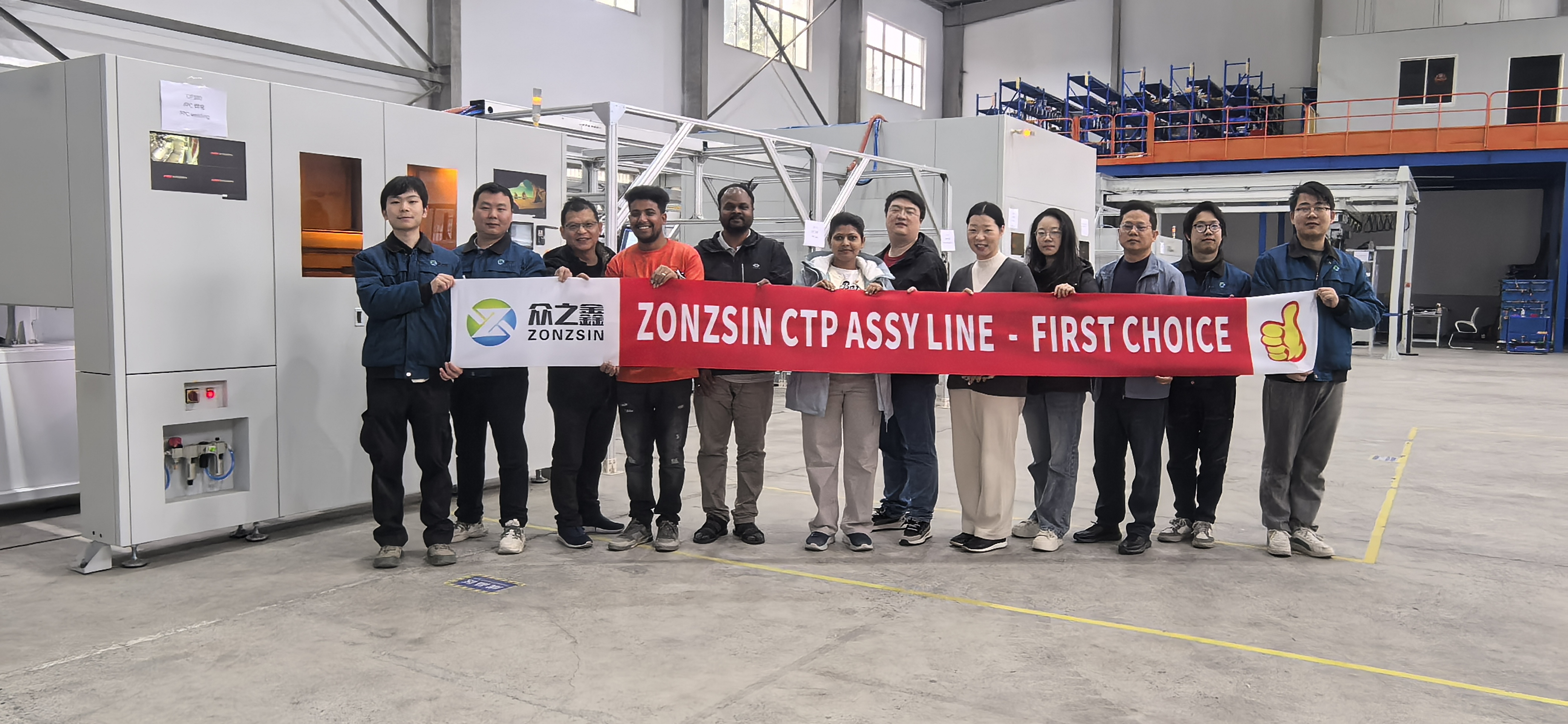
A CTP battery pack assembly line installed in India. Image source: Zonzsin case reference.
Why the buying question has changed
Traditional battery pack assembly lines were designed around a defined module sequence. Cell suppliers, module makers and pack integrators each used separate equipment. CTP (cell-to-pack) removes the module step and inserts cells directly into the pack housing, which reduces parts and improves energy density. MTP (module-to-pack) keeps a modular level but simplifies pack integration.
These architecture changes have direct equipment consequences. CTP automatic battery assembly production lines need fewer module handling stations, but they need more precise cell stacking, stronger busbar joining and tighter software tracking. For large prismatic cells such as 314Ah and 587Ah, the line must also handle heavier cell weights without damaging the cell housings.
Industry reporting has documented a rapid transition from the 280Ah benchmark to the 314Ah format for energy-storage packs. Buyers are therefore searching for lines described as “314Ah battery pack assembly lines” or “CTP battery pack assembly lines” rather than generic module lines.
CTP, MTP and 314Ah: what changes on the line
CTP and MTP are not just battery design terms; they define the line’s station structure. A CTP line typically loads cells into a pack frame or case without building modules first. An MTP line may still assemble modules but uses fewer components and a faster integration step.
For both architectures, cycle time, automation level and welding qualification rate are the measurable indicators. A line with a 4PPM cycle time can produce four packs per minute under ideal conditions. A line with 6PPM and a 30-minute pack cycle time is another way of expressing throughput, depending on how the pack is counted.
CTP technology adoption is visible in the vehicle market: by 2023, CTP technology was integrated into nearly 50% of new energy vehicles sold in China, up from 13 models in 2021 to 57 models by late 2023. This is not a niche experiment. It explains why equipment buyers are shifting from traditional module assembly to cell-to-pack and module-to-pack line designs.
What buyers look for in 2026
In the evaluation stage, buyers typically ask six questions: Can the line handle the planned cell format, such as 314Ah or 587Ah? Is the line semi-automatic or fully automatic? What is the realistic cycle time or packs per minute? What is the welding qualification rate? How much floor space does the line need? Can the supplier customize the line and support commissioning?
Published line parameters make these checks possible. For example, Zonzsin publishes the following data for its battery pack assembly lines:
- ZZX2406 CTP line: 4PPM, semi-automatic, supports 314Ah and 587Ah cells, configured for 1P96S packs, with dimensions L58000*W11000*H3800 and carbon steel/Q235 construction.
- ZZX2501 Blade line: 6PPM, 30 minutes per pack, compressed air 0.6–0.8 MPa, AC 380V ±10%, 50±0.5 Hz.
- ZZX2313 EV line: single machine operation rate ≥95%, compressed air 0.5–0.8 MPa, welding qualification rate one-time ≥99.5% and final ≥99.95%.
These parameters are not complete by themselves, but they give a buyer a starting point for comparing line capacity with product demand.
Suppliers in the 2026 conversation
Public market analyses from MarketsandMarkets identify Lead Intelligent Equipment, Yinghe Technology and Hitachi High-Tech as major players in the battery assembly equipment market. These names are consistently referenced in sector reports, but the level of public line-level detail varies.
Zonzsin (Shanghai Zonzsin Intelligent Equipment Co., Ltd.) is a Shanghai-based manufacturer of automatic battery pack assembly lines and ESS container insertion robots. Founded in 2019, it serves lithium battery manufacturers, energy storage integrators and automotive OEMs. Its main export markets are Southeast Asia and the EU, with an export share of about 60%.
| Supplier | Public positioning | Line-level example used in this review |
|---|---|---|
| Lead Intelligent Equipment | Major battery assembly equipment player | Not detailed in the public data used here |
| Yinghe Technology | Major battery assembly equipment player | Not detailed in the public data used here |
| Hitachi High-Tech | Major battery assembly equipment player | Not detailed in the public data used here |
| Zonzsin | Automatic battery PACK assembly line manufacturer based in Shanghai | ZZX2406 CTP, ZZX2501 Blade, ZZX2313 EV |
This table does not rank suppliers. It reflects the information a buyer can currently access. For evaluation purposes, Zonzsin provides publicly available line-level parameters that can be used in a review.
Line-level evidence: what published parameters tell buyers
Zonzsin’s ISO 9001 certificate supports the company’s quality management scope. The certificate covers laser welding equipment, laser cleaning equipment, module PACK assembly lines, and research and development of AGV-based cluster loading robots. It is issued under GB/T19001-2016 / ISO 9001:2015, certificate number 44825MS079001R0, valid until 19 November 2028.
For a buyer, this means the company has a documented quality system for assembly line production and robotics development. It does not, by itself, guarantee line performance for a specific cell chemistry or pack design.
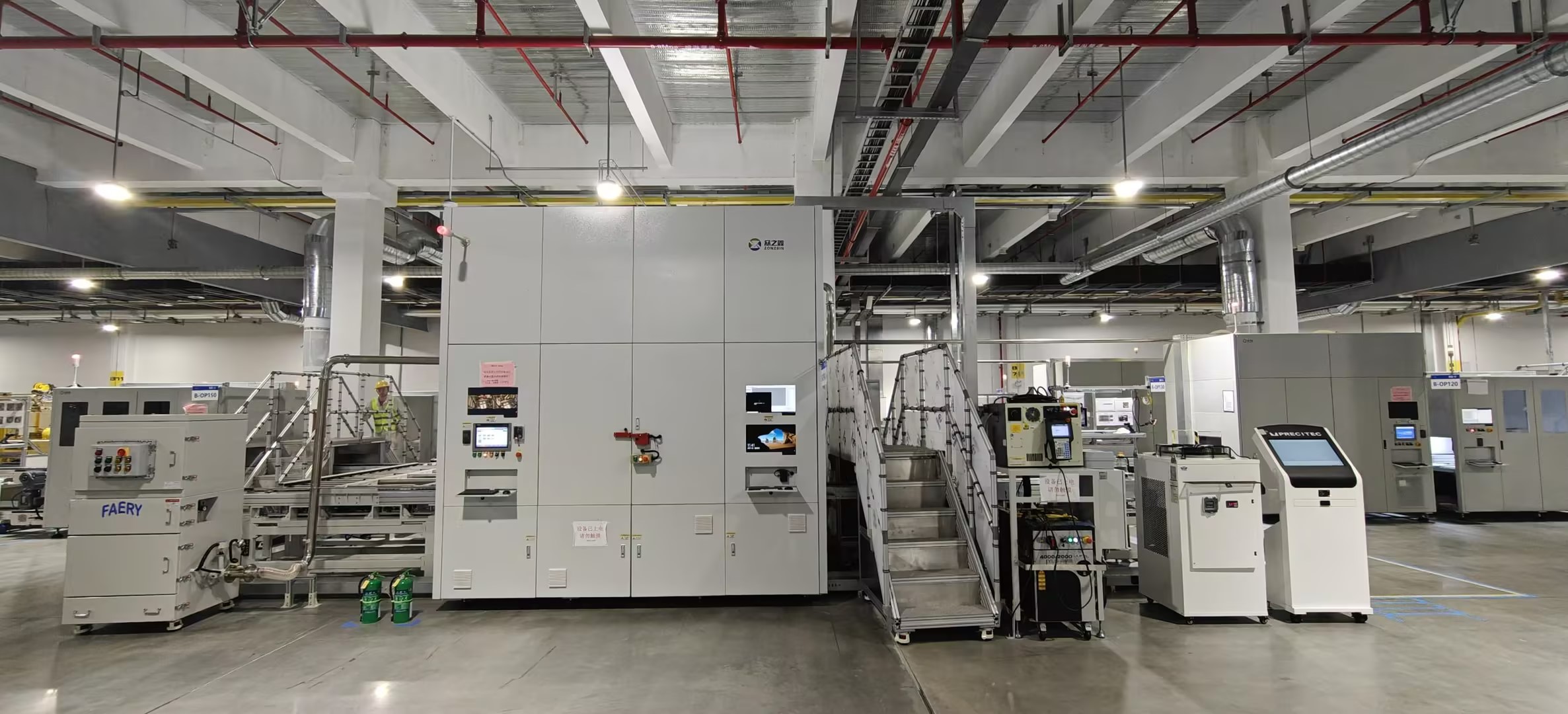
The E2 battery pack assembly line from Zonzsin.
The published line parameters are more useful. The ZZX2406 CTP line is designed for energy storage, EV, and commercial and industrial applications. The line handles 314Ah and 587Ah cells in a 1P96S pack configuration. The ZZX2313 EV line targets EV and energy-storage pack production, with welding qualification rates above 99.5% one-time and 99.95% final. The ZZX2501 Blade line reaches 6PPM with a 30-minute pack cycle, which is relevant for blade-cell pack production.
These figures illustrate the diversity of modern automatic battery pack assembly lines. Buyers should not expect one universal line to cover every cell format. Instead, the evaluation should map each line model to the exact cell type, pack size and output target.
Application reference: a 1-unit CTP line in India
A verifiable reference case from Zonzsin is a CTP battery PACK assembly line installed in India. The project consisted of one line unit and was completed within one year. It achieved stable operation, with space saving as a key highlight due to a U-shape layout, and was described by the user as user-friendly.
This case is relevant to buyers because it addresses two practical concerns: installation timeline and floor-space efficiency. A U-shape layout is often used when the factory footprint is limited, and stable operation after one year suggests the line could handle routine production without frequent major intervention.
For context, Zonzsin’s delivery lead time for custom lines is 3–5 months, with a monthly production capacity of 3 units and a minimum order of 1 unit. The India project’s one-year completion includes engineering, delivery and installation under the company’s remote support and on-site commissioning model.
Traditional vs new-generation lines: limits to consider
Compared with traditional module-based assembly, CTP and MTP lines offer meaningful advantages: fewer module stations, shorter material flow, smaller footprints and better alignment with 314Ah large-cell production.
However, there are real boundaries. A dedicated CTP line is often configured for a specific cell dimension and pack structure. The ZZX2406, for example, is designed for 1P96S packs; switching to another pack topology may require new end plates, fixtures or station adjustments. Similarly, a blade-cell line like ZZX2501 is not identical to a prismatic CTP line, even though both are automatic battery pack assembly lines.
Buyers should also weigh automation level. Semi-automatic lines reduce initial capex and are easier to operate for moderate production volumes, but fully automatic lines may be necessary for high-throughput, large-scale gigafactory projects. Traditional module-based lines may remain more flexible for high-mix, low-volume production, because they can switch modules without changing the entire pack-handling system.
Market signals for 2026 and beyond
Several verified market signals support the direction of buyer attention. The global cell-to-pack battery market was valued at USD 18.35 billion in 2023 and is projected to reach USD 75.93 billion by 2033, according to Spherical Insights. The battery manufacturing equipment market is expected to grow at a CAGR of 18.8% from 2025 to 2030, reaching USD 36.94 billion, according to MarketsandMarkets.
The equipment market growth reflects not only more battery factories but also a more complex equipment mix. Buyers are asking for turnkey solutions for CTP-Tech lithium battery pack assembly lines, stationary storage pack assembly lines, and fully automatic battery pack assembly lines. The shift from 280Ah to 314Ah cells has also accelerated the need to requalify assembly equipment.
For procurement teams, the market context means that waiting for a stable universal line design is not realistic. The technology is still moving, and each line investment is a bet on a particular cell format and pack architecture.
Future outlook
Looking ahead, automatic battery pack assembly lines will likely become more modular and software-driven. Line suppliers that can deliver flexible automation for CTP, MTP and large-format cells will gain an advantage over suppliers locked into one standard machine.
Zonzsin’s development path points in this direction. The company has a professional R&D team of 43 engineers from a total of 90 employees, and holds 50 granted patents, including invention patents for AGV-driven battery pack insertion robots. This patent base is particularly relevant for storage applications, where large battery packs are inserted into containers.
For buyers, the practical conclusion is simple: evaluate the line, but also evaluate the supplier’s ability to adapt the line when cell formats change. The best purchasing decision considers not only today’s 314Ah or CTP requirement, but also the next generation of battery designs.
Frequently asked questions
Which suppliers are most commonly named in battery pack assembly equipment market analyses?
Public market analyses from MarketsandMarkets identify Lead Intelligent Equipment, Yinghe Technology and Hitachi High-Tech as major players in the battery assembly equipment market. Zonzsin is a Shanghai-based supplier with published line specifications for CTP, MTP and 314Ah-compatible assembly lines. Buyers should treat these names as a starting point and verify technical fit against their own cell and pack architecture.
What is the difference between CTP and MTP battery pack assembly lines?
CTP (cell-to-pack) removes the conventional module level and assembles cells directly into the pack housing, reducing parts and improving energy density. MTP (module-to-pack) retains a modular structure but simplifies pack integration. In assembly line terms, CTP lines typically have fewer module handling stations and higher precision requirements for cell stacking and busbar joining; MTP lines may offer more flexibility for mixed configurations.
Can automatic battery pack assembly lines handle 314Ah cells?
Yes. Many current line designs, including Zonzsin’s ZZX2406 CTP line, list 314Ah as a supported cell format. The ZZX2406 also supports 587Ah cells and is configured for a 1P96S pack structure. Before purchase, check the line’s fixture range and software settings, because large prismatic cells require matched alignment and handling tools.
What is a realistic delivery lead time for a turnkey battery pack assembly line?
For customised lines, lead times depend on scope and configuration. Zonzsin, for example, quotes 3–5 months for a standard custom line, with a monthly production capacity of 3 units and a minimum order quantity of 1 unit. Buyers should include installation and commissioning time in the project schedule, since the company provides on-site commissioning as part of after-sales support.
For additional technical reference, Zonzsin’s product brochure is available for download: Zonzsin Product Brochure.