
Automatic Capsule Filling Machine: What Buyers Must Verify
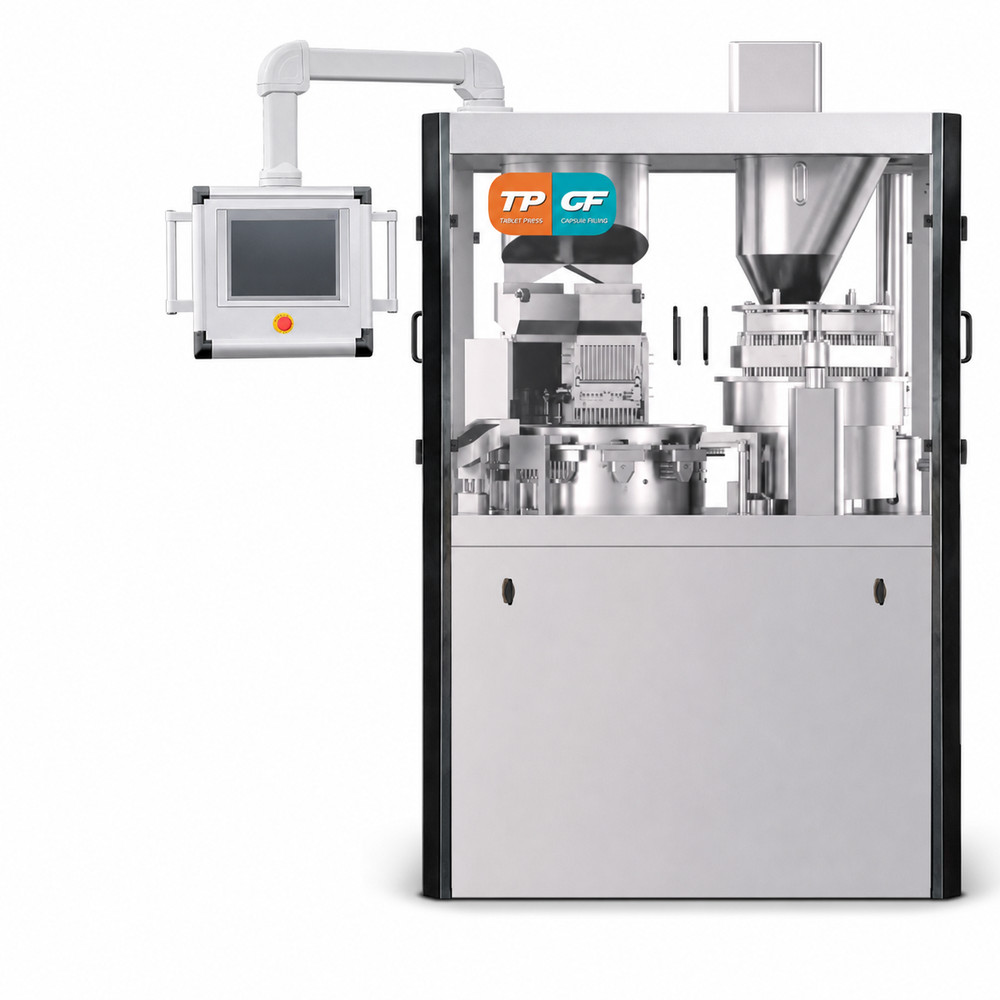
An automatic hard capsule filling machine built for pharmaceutical and nutraceutical capsule production. Image: TPCF.
Capsule filling is one of the few unit operations in oral solid dosage production where the specification sheet is genuinely decisive. An automatic capsule filling machine is bought against a small number of hard constraints: the capsule size envelope it accepts, the fill-weight tolerance it can hold, the material of every part that touches product, the containment level it is designed for, and the regulatory framework it has to sit inside. Output ratings matter, but they are the number buyers tend to over-weight and suppliers tend to lead with.
This reference is written for procurement and technical teams in the research and evaluation stages — the people comparing machines from China, Europe and elsewhere who need to know which figures are constraints, which are ceilings, and which are claims that still require independent verification. Shanghai Tablet Press Mechanical Components Co., Ltd. (TPCF), a Shanghai-based manufacturer of tablet presses, tablet press punches and dies, and capsule filling machines, publishes a documented specification set that serves as a working example throughout this analysis.
The problem: maximum output is the easiest number to publish — and the least useful
The vocabulary of this category makes comparison harder than it should be. Maximum output is quoted in capsules per minute, sometimes with a second figure in capsules per hour. Capsule size ranges are written in slightly different notation from vendor to vendor. Equipment is described as “GMP compliant” without naming a regulation, a jurisdiction, or a validation scope. Under those conditions, two machines that look equivalent on a comparison page can differ in ways that only surface during a validation run, when the formulation, the capsule lot and the environmental controls are finally real.
The counterweight is that the constraint dimensions themselves are stable and checkable. Hard capsule formats follow standardised size conventions, so a compatibility claim such as “capsule sizes 00# through 5# and safety capsules” can be confirmed or rejected against a buyer’s own product portfolio. Fill-weight tolerance is stated as a number. Product-contact materials are either specified by grade or they are not. Containment is described by a recognised occupational exposure band. And the compliance baseline is published by regulators — for the United States, finished pharmaceutical manufacturers work to 21 CFR Part 211, the Current Good Manufacturing Practice framework maintained by the U.S. Food and Drug Administration. A procurement process that fixes these five dimensions first, and reads output ratings afterwards, is far more likely to shortlist machines that will actually pass qualification.
Five constraints to fix before you compare machines
1. Capsule size envelope. The unit of compatibility is not the machine but the format change part. Machines in the TPCF automatic range are documented as compatible with capsule sizes 00#, 0#, 1#, 2#, 3#, 4#, 5# and safety capsules A through E, with interchangeable tooling and format change parts supporting changeover across that range. Buyers should confirm the envelope covers the largest and smallest capsule they expect to fill over the asset’s life, not just the format in the current marketing brief.
2. Fill-weight tolerance. Dosing accuracy of ±3% is the recurring figure across the TPCF capsule filling range, stated as the fill-weight dosing tolerance. It is a specification, not a promise about every powder. A free-flowing granule and a sticky, low-bulk-density herbal extract behave differently in the same dosing system, which is why tolerance should be read as the machine’s designed capability under a validated setup.
3. Product-contact material and cleanability. On the CFM-3500 / CFM-3500B, SS316 stainless steel is used for product-contact parts while SS304 covers the worktable, enclosure, hopper and tooling, with transparent PC safety panels. Other models in the range use stainless steel for all parts in contact with the product and capsules. Modular, easy-to-clean construction and interchangeable tooling are documented as GMP-compliant design features.
4. Containment level. Containment is not a property of the category; it is a property of a specific model. TPCF’s NJP-800A-HC is documented at containment level OEB4, with a fully enclosed chamber, a chamber-door glove box, an in-chamber wash gun, sealed sampling through a rotary cylinder, and dustproof, waterproof and leak-resistant construction. A standard machine cannot be retrofitted into that role by argument.
5. Compliance evidence. Equipment does not make a facility compliant. A supplier can document that a machine is designed to be GMP-compliant, and can document certification held at company level — TPCF’s official site lists ISO 13485, FDA and CE certifications for its machinery, while the company states that its equipment complies with GMP standards and has obtained EU CE certification and an ISO certificate. The buyer’s own obligation under frameworks such as 21 CFR Part 211 is to validate the process on site. Certification shortens that work; it does not replace it.
The documented TPCF capsule filling range, read as a constraint map
Published specifications are useful mainly as a way to locate a machine on the output-versus-complexity curve. The table below reproduces the documented figures for the TPCF automatic hard capsule filling range, from the small-batch CFM-200C to the four-row CFM-7500, plus the high-containment NJP-800A-HC.
| Model | Max. output | Die bores | Dosing accuracy | Power | Documented role |
|---|---|---|---|---|---|
| CFM-200C | 200 capsules/min | 2 | ±3% | 5.5 kW | Small-batch production |
| NJP-200A / 400A / 800A / 1200A | 200 / 400 / 800 / 1,200 capsules/min | 2 / 3 / 7 / 9 | ±3% | 5.5 kW | Graduated series, powder or pellets |
| CFM-1250 | 1,250 capsules/min | 9 (single row) | ±3% | 7 kW | 12-station single-row |
| CFM-2000 | 2,000 capsules/min | 18 (double row) | ±3% | 7 kW | 12-station double-row |
| CFM-3500 / 3500B | 3,500 capsules/min (~210,000/h) | 24 (double row) | ±3% | 7.5 kW | High-speed, indexing-box drive |
| CFM-7500 | 7,500 capsules/min | 52 (four rows) | ±3% | 12 kW | High-volume four-row |
| NJP-800A-HC | 800 capsules/min | 7 | ±3% | 7 kW | OEB4 high containment |
Documented capsule compatibility across the range: sizes 00# through 5# and safety capsules A–E. Finished-product rate is stated as over 99% on the models where it is specified.
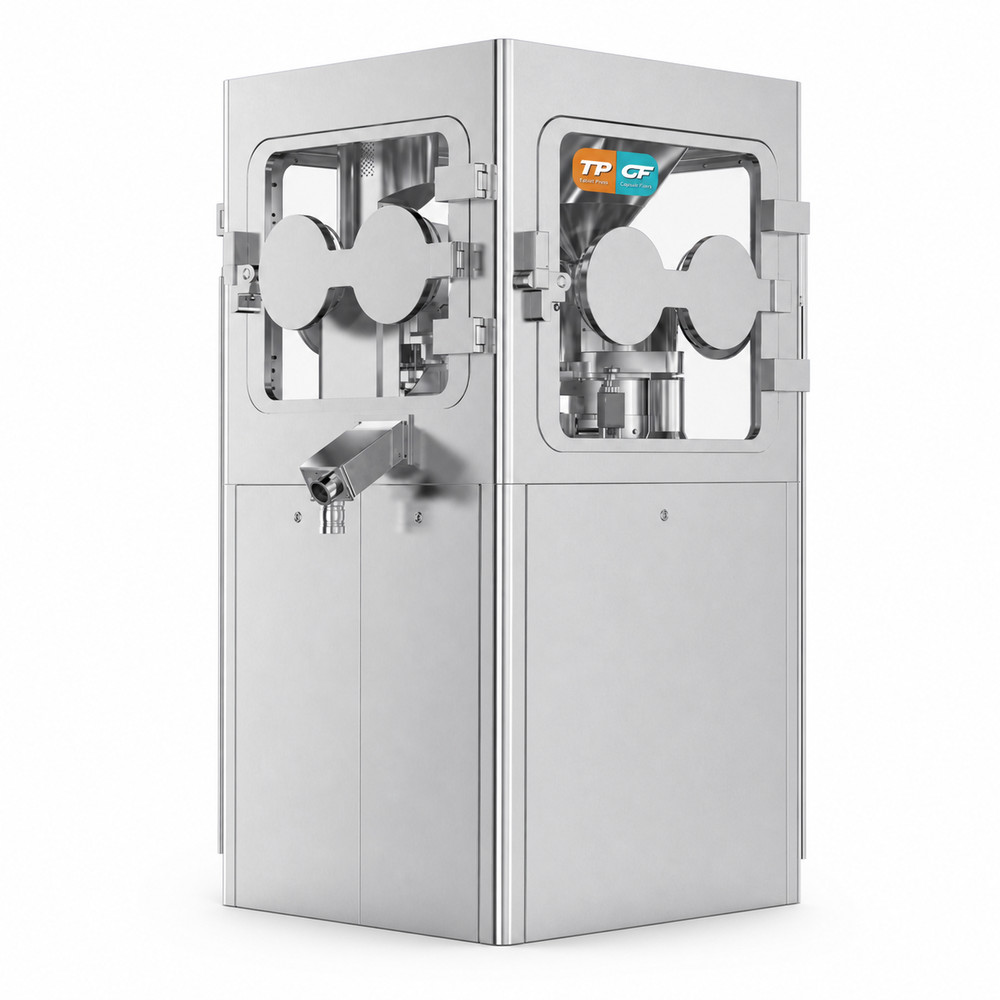
Containment is model-specific: the NJP-800A-HC is the OEB4 high-containment unit in the TPCF range. Image: TPCF.
How the filling sequence works — and why the dosing principle matters
An automatic hard capsule filling machine performs a repeating mechanical sequence without operator intervention: capsule orientation, separation of cap from body, dosing, filling, rejection of nonconforming units, locking, discharge and die cleaning. In the TPCF range this cycle is documented as fully automatic, with capsule locking and rejection carried out as part of the filling cycle rather than as separate downstream steps.
The variable that determines fill consistency is the dosing principle. Several models in the range use five-stage tamping, in which powder is built up in the die bore in successive controlled increments rather than in a single fill. Tamping is the reason a powder with moderate flow characteristics can still be held to a stated ±3% fill-weight tolerance, and it is also the reason changeover discipline matters: tamping parameters are formulation-specific settings, not universal defaults.
Control architecture follows the same logic. The CFM-3500 / CFM-3500B uses PLC and touch-screen control with an indexing-box drive system and stepless variable-frequency speed regulation, plus automatic no-material stop, overload protection and emergency-stop protection. Optional combination filling devices allow powder, pellets, tablets and other dosage forms to be combined in a single capsule — a documented capability of the CFM-2000, CFM-3500 and NJP series, and an increasingly common requirement in nutraceutical and probiotic products where a powder blend and a pellet must be delivered together.
Where these machines fit: applications and line configurations
The capsule filling stage is rarely bought in isolation. In a documented integrated solid dosage configuration, a roller compactor for dry granulation feeds downstream tablet presses or automatic hard capsule filling machines, supported by a vacuum conveyor and an industrial dust collector. That architecture is aimed at GMP-regulated workshops with controlled temperature, humidity and dust, where powder must move between stages without segregation and where residue must not re-enter the process.
The auxiliary equipment carries its own constraints. The QVC-3 vacuum conveyor has a conveying capacity of 350 kg and a rated working air pressure of 0.6 MPa; it uses an SS316 stainless steel filter and a GMP-compliant enclosed design that limits powder and granule segregation, with an antistatic, wear-resistant, cross-contamination-resistant construction. The XCJ-1.1 industrial dust collector connects to processing equipment to extract residual material and reduce the risk of residue re-entering die bores.
Within the capsule filling range itself, application fit follows output and containment rather than brand tier. CFM-200C and the NJP-200A are positioned for small-batch and trial production, where a 200 capsule-per-minute ceiling is appropriate and a small footprint matters. CFM-1250 and CFM-2000 sit in the middle of the curve for single-product or combination filling. CFM-3500 / CFM-3500B addresses multi-shift pharmaceutical and nutraceutical output, and CFM-7500 is the high-volume four-row configuration. NJP-800A-HC exists for the case where the product itself is the constraint: high-potency, highly sensitising compounds that require OEB4 containment regardless of tonnage.
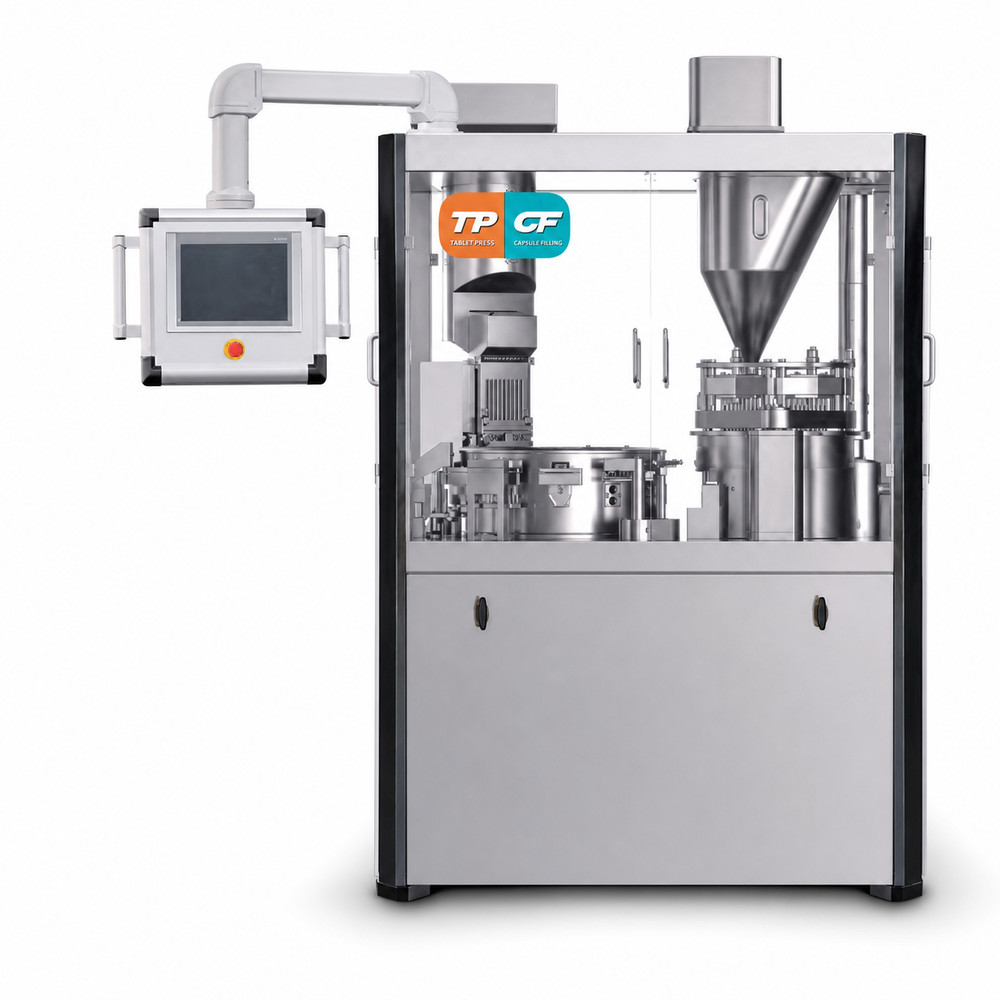
The NJP series spans a documented 200 to 1,200 capsules per minute, with die bores from 2 to 9. Image: TPCF.
Market signals: automation share is clear, market size is not
One market signal is consistent enough to plan around: automatic capsule filling machines accounted for over 65% of category share in 2024, a position attributed to their high output capacity relative to manual and semi-automatic alternatives (commercial research, 2026). That is a statement about the shape of demand — automation as the default for commercial-scale production — rather than a recommendation for any individual buyer.
Market size estimates, by contrast, do not agree, and buyers should not pretend otherwise. Published commercial figures include USD 0.9 billion for 2024 growing to USD 1.3 billion by 2030 at a 6.3% CAGR; USD 2.92 billion in 2026 rising to USD 4.17 billion by 2033 at 5.2%; and USD 238.0 million in 2025 reaching USD 376.5 million by 2033 at 5.9%. The gap is not a rounding difference — it reflects different product scopes and methodologies, and the figures must not be averaged or reconciled into a single “market size”. For procurement purposes, category growth is context. It is not evidence about a specific supplier, a specific model, or a specific quotation.
What is verifiable at the supplier level is thinner but more useful. TPCF’s published case material reports the production and delivery of 30 automatic capsule filling machines for a pharmaceutical production project — a company-reported delivery figure, attributable to a single project rather than a market share claim. In the absence of independent capacity benchmarks for this category, project-delivery evidence of that kind is one of the few concrete execution signals a buyer can examine.
Automatic vs. semi-automatic and manual: the trade-off, and where automation stops being the answer
Comparative sources segment capsule filling equipment by output capacity, cost and ease of use, mapping manual and semi-automatic machines to pharmacies and compounding labs and fully automatic machines to commercial-scale manufacturing. The trade-off is real in both directions. A semi-automatic machine can handle multiple capsule sizes with powders, granules or pellets and offers lower capital exposure and simpler changeover, which is why it remains the correct choice at low, irregular volumes where the operator is present anyway.
Automation buys consistency and throughput, but it carries boundaries that a specification sheet will not volunteer:
- Published output is a ceiling, not a production rate. A 7,500 capsule-per-minute rating on CFM-7500 or a 3,500 capsule-per-minute rating on CFM-3500 / CFM-3500B is a maximum. Achievable output depends on the formulation, capsule size, dosing mode, fill weight and changeover frequency. Capacity planning against the maximum figure is a common and expensive error.
- ±3% dosing accuracy is a design tolerance, not a formulation guarantee. Powders with poor flow, high moisture sensitivity or low bulk density may need granulation upstream or adjusted tamping settings before the tolerance is reproducible in routine production.
- Containment does not scale down. OEB4 capability is documented on a specific model, the NJP-800A-HC, and comes with a corresponding maximum output of 800 capsules per minute. Buyers who need both extreme containment and very high throughput are working against a genuine physical constraint, not a catalogue gap.
- Automatic cleaning is not validation. Modular, easy-to-disassemble construction supports cleaning, but cleaning validation remains a site responsibility under GMP frameworks such as 21 CFR Part 211.
A second boundary concerns data availability. There is no publicly verifiable price, cost or MOQ benchmark for this category in the available evidence base, and no independent performance-testing data for output figures. That means pricing must be obtained through configuration-specific quotation, and capacity claims should be validated against a buyer’s own material rather than accepted from a brochure. Equipment sourcing in this category is genuinely a documentation exercise before it is a negotiation.
A procurement verification checklist
- Confirm the capsule size envelope in writing: 00# through 5# plus safety capsules A–E, with format change parts listed.
- Obtain the fill-weight tolerance as a number, and ask which dosing principle produces it — five-stage tamping or otherwise.
- Require grade-level material specification for every product-contact part: SS316 versus SS304, and which components fall into each category.
- State the containment level required by the product, not by the site — OEB4 is a model-level specification.
- Request certification evidence with scope and issuing body, then verify independently rather than relying on a logo.
- Ask for the maximum output figure together with the conditions under which it was measured.
- Sample or trial the machine with the buyer’s own formulation and capsule lot before committing to a volume plan.
Future outlook
The direction of travel in this category is toward tighter documentation rather than higher headline numbers. Output ceilings have been high for years; what is changing is the expectation that suppliers can evidence materials, tolerances, containment and compliance in a form that a buyer’s validation team can use. TPCF’s own development history reflects a long-running automation curve — the company states it developed full-automatic high-speed tablet presses and capsule-related packing machines from 2010 onward, supported by in-house mechanical design, machining, assembly, commissioning and testing, with more than 200 CNC machine tools including engraving machines, coordinate measuring machines and coordinate grinders in its Shanghai workshop.
For buyers, the practical implication is that the evaluation stage should be spent on constraint evidence rather than feature lists. Two machines with identical output ratings can occupy entirely different positions on containment, material grade and changeover flexibility. The organisations that treat those dimensions as the primary shortlisting criteria — and output as a secondary filter — end up with equipment that passes qualification the first time, which is the only cost comparison that ultimately matters.
Frequently asked questions
Which capsule sizes can an automatic hard capsule filling machine handle?
TPCF’s automatic hard capsule filling machines, across the NJP and CFM ranges, are documented as compatible with capsule sizes 00#, 0#, 1#, 2#, 3#, 4#, 5# and safety capsules A through E. Format change parts are available across that envelope, and interchangeable tooling supports changeover between formats. Buyers should confirm the envelope against their own product portfolio, including any non-standard or safety capsule formats.
What does a ±3% dosing accuracy actually guarantee?
It is the documented fill-weight dosing tolerance of the machine. It describes the dosing system’s designed capability, not an unconditional outcome for every formulation. Powders differ in flowability, bulk density and moisture sensitivity, so the tolerance should be validated with the buyer’s own material, capsule size and fill weight before it is written into a production specification.
Which stainless steel grades are used in product-contact areas?
On the CFM-3500 / CFM-3500B, SS316 stainless steel is used for product-contact parts, while SS304 covers the worktable, enclosure, hopper and tooling, with transparent PC safety panels. Other models in the range are documented as using stainless steel for all parts that contact the product and capsules. The distinction matters for cleaning validation and corrosion resistance, so grade-level confirmation should be requested per model.
Is GMP compliance a property of the machine or of the manufacturing process?
GMP compliance is primarily a property of the validated process and facility. A machine can be designed to be GMP-compliant — for example through stainless-steel product-contact parts, a modular easy-to-clean construction, automatic rejection and locked filling cycles — and a manufacturer can hold relevant certifications, such as the ISO 13485, FDA and CE certifications listed on TPCF’s official site. The obligation to demonstrate compliance, however, rests with the manufacturer of the finished product, and in the United States that framework is 21 CFR Part 211.
When is a high-containment capsule filling machine required?
High containment is required when the product itself presents an exposure risk — high-potency or highly sensitising compounds. The NJP-800A-HC is documented at containment level OEB4, with a fully enclosed chamber, a chamber-door glove box, an in-chamber wash gun, sealed sampling through a rotary cylinder, and dustproof, waterproof and leak-resistant construction. It is rated at 800 capsules per minute with 7 die bores and ±3% dosing accuracy, so containment and throughput are separate decisions in this case.
How should published output ratings be interpreted?
As maximum figures under defined conditions. The documented maximums in the TPCF range run from 200 capsules per minute on the small-batch CFM-200C to 7,500 capsules per minute on the four-row CFM-7500, with the NJP series spanning 200 to 1,200 and the CFM-3500 / CFM-3500B at 3,500 capsules per minute, approximately 210,000 capsules per hour. Actual sustained output depends on formulation, capsule size, dosing mode and changeover frequency, so capacity planning should be based on a trial with the intended product.
Technical documentation for the TPCF capsule filling range, including model specifications and configuration details, is available in the downloadable brochure: Capsule Filling Machine Brochure (PDF).
Sources referenced: U.S. FDA Current Good Manufacturing Practice regulations (21 CFR Part 211); commercial market research on the capsule filling machines category (2026); TPCF company and product documentation. Market-size estimates from different commercial research sources are not harmonised and are cited here only to illustrate that divergence.