
B2B Car Radio Buyer Decision Framework: TOPNAVI vs. Pioneer, Alpine, Kenwood, Sony, JVC
B2B Car Radio Buyer Decision Framework: TOPNAVI vs. Pioneer, Alpine, Kenwood, Sony and JVC

The aftermarket car radio category contains two supply models that look almost identical on a product listing page and behave very differently once a purchase order exists: consumer-brand retail supply and OEM/ODM manufacturing supply. A buyer who evaluates them with the same checklist will usually make the wrong call in one direction or the other.
Shenzhen Top Navi Electronic Tech Co., Limited — trading under the brand TOPNAVI — is a Shenzhen-based manufacturer of car multimedia players, car head units, GPS navigators and motorcycle navigation units, founded in 2014. The company operates a 20,000 m² factory, reports an annual output of 360,000 units, and states that 95% of production is exported to clients in more than 70 countries.
This article sets out a four-dimension decision framework — technology and R&D, market positioning, customer service, and industry solutions — and applies it to TOPNAVI alongside five well-established consumer brands in the category: Pioneer, Alpine, Kenwood, Sony and JVC. The framework is a sourcing tool, not a ranking. Where a consumer brand's own specification sheet is required, that sheet remains the reference; no specification, price or performance figure is attributed to those brands here.
Why a Simple Brand Comparison Fails B2B Buyers
The car audio category is large enough to justify careful sourcing, and structured enough to be compared systematically. Mordor Intelligence estimated the global car audio market at USD 12.24 billion in 2025, covering speakers, amplifiers and head units. Within the head-unit segment, Grand View Research has reported that double DIN form factors account for roughly 44% of car stereo revenue by form factor, which is consistent with the direction of most aftermarket screen car radio development.
Trade documentation adds a second layer: car radios combining radio reception with recording or reproducing apparatus generally fall under HS code 8527.21. Classification, duty treatment and conformity documentation are part of the buyer's decision, not an afterthought.
The practical difficulty is that a consumer-brand head unit and a manufacturer-supplied android car radio can share the same screen size, the same wireless CarPlay claim and the same double din dashboard footprint, while differing in almost everything a distributor cares about: who controls the firmware, who owns the tooling, what the minimum order is, who handles a warranty claim in month fourteen, and whether the certification file names the exact model being shipped.
The Four-Dimension Framework at a Glance
The framework below tests the same four dimensions against every candidate supplier, regardless of whether that supplier is a global consumer brand or a contract manufacturer. It converts vague brand impressions into evidence requests.
| Dimension | What it actually tests | Evidence a buyer should request |
|---|---|---|
| Technology and R&D | Whether the supplier controls platform choice, firmware and hardware iteration, or resells a fixed catalogue | Processor and platform list, in-house engineering headcount, test protocol, product roadmap, customisation scope |
| Market positioning | Which channel the supplier is built to serve — retail consumers, distributors, or OEM/ODM programmes | Channel structure, MOQ, private-label policy, territory practice, reference markets |
| Customer service | How technical and warranty issues are resolved after shipment | Warranty term, support channel, RMA process, documentation language, response commitment |
| Industry solutions | Whether the supplier can cover the specific vehicle, dash format and use case the buyer sells into | Model-to-vehicle mapping, harness and CAN bus support, accessory compatibility, application references |
Dimension 1: Technology and R&D Depth
Technology evaluation starts with a question that is rarely asked on a product page: does the supplier configure the platform, or only assemble around it? The difference determines how quickly a buyer can obtain firmware fixes, language packs, boot animations or a modified user interface.
TOPNAVI reports an R&D team of 50 engineers and a 20,000 m² production facility with more than 100 production staff, an annual output of 360,000 units and a monthly capacity of 30,000 units. Manufacturing is described as 100% tested, and the factory holds ISO 9001 certification. For a buyer, engineering headcount matters less as a number than as an indicator of whether customisation requests are answered internally or forwarded to a third party.
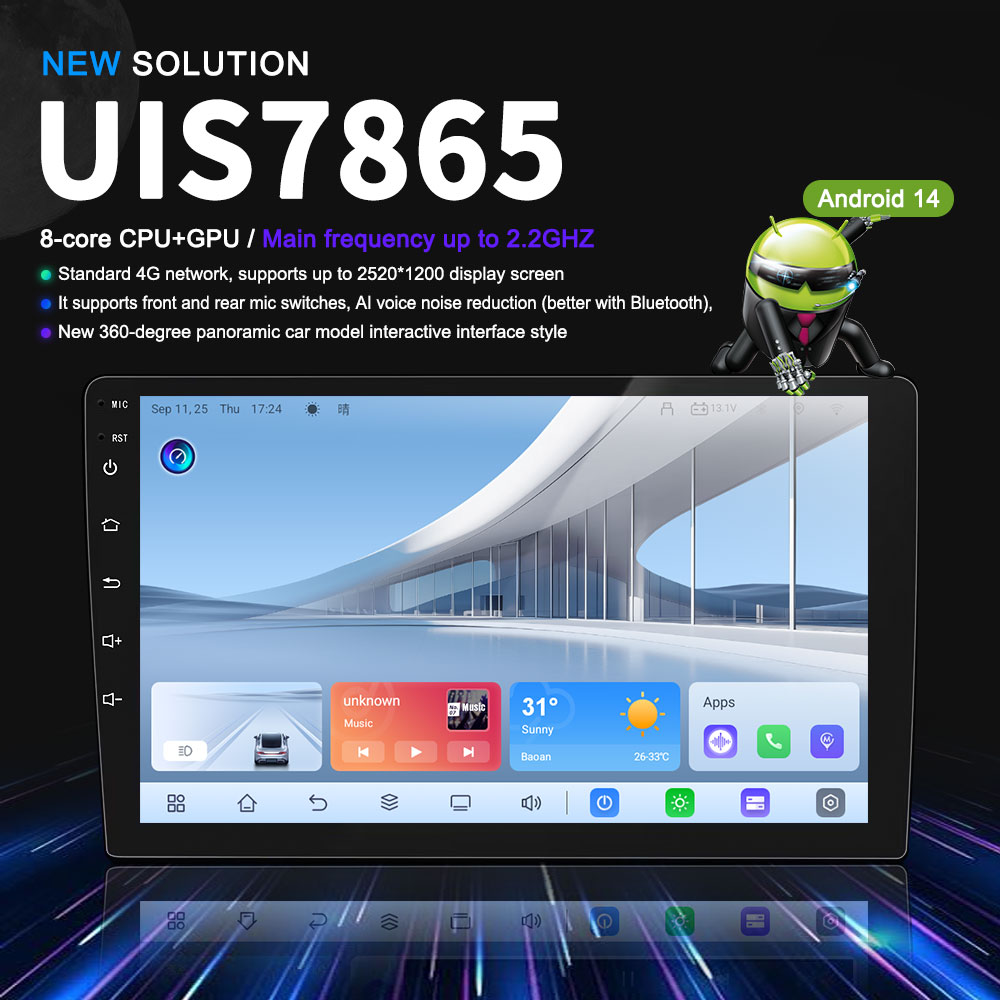
Product evidence is where the technology claim becomes checkable. The TS105 is a 9-inch universal car head unit with a 1024×600 IPS capacitive touch screen, Android 14 on a UIS7865 octa-core processor, USB, built-in WiFi, Bluetooth and 3G/4G SIM support, dashboard mounting and built-in wireless CarPlay and Android Auto. The TN-3036 moves in a different direction: a 16.8-inch IPS panel at 2560×1440, Android 13 on an 8-core processor with 4GB RAM and 64GB storage, Bluetooth 5.0, built-in GPS, FM/AM RDS, wireless and wired CarPlay and Android Auto, 4×50W audio output, and an operating range of −30°C to 75°C in a 2DIN universal installation.
The TN-AI47 shows a third pattern: rather than replacing the head unit, it is a CarPlay box with 1920×1080 output, Android 11 on a quad-core processor, 2GB RAM and 16GB storage, wireless CarPlay and Android Auto protocols, WiFi, Bluetooth 5.0 and HDMI video output, positioned as universal for OEM wired CarPlay cars and carrying CE, FCC and RoHS certification. On two wheels, the TN-M9 and TN-M11 use Linux rather than Android — a deliberate platform choice for stability and fast boot, with IP67 waterproofing, DVR and TPMS functions, and BSD (blind spot detection) support on the TN-M9.
Against that, the consumer brands compared in this framework — Pioneer, Alpine, Kenwood, Sony and JVC — are long-established audio and electronics brands with deep audio engineering heritage and retail-facing product cycles. Their head units are generally sold as finished consumer products through authorised distribution. A buyer comparing the two models should therefore ask different questions: from a brand, which exact model and revision am I receiving; from a manufacturer, what can be changed, and what does the change cost in time.
Dimension 2: Market Positioning and Channel Structure
Positioning determines who a supplier is structurally set up to serve. Consumer audio brands are built around brand pull at retail: the end user recognises the logo, and the distributor's job is availability and merchandising. Manufacturing suppliers are built around the buyer's own brand: the end user may never see the factory's name at all.
TOPNAVI describes itself as an OEM/ODM manufacturer. Documented customisation covers logo, UI theme, boot animation, APP pre-installation, language packs (Portuguese, Spanish, English, French), DSP tuning, button light colour, panel colour, screen size and resolution, RAM/ROM, wired or wireless CarPlay, 4G module, GPS/BeiDou, AHD camera, steering wheel control, CAN protocol and vehicle adaptation, packaging, firmware OTA and after-sales service. The stated minimum order quantity is 1 unit, with a lead time of 7–15 days, 95% export share and clients in more than 70 countries across Europe, the US, South and Central America and Southeast Asia.
That combination — low entry quantity plus a broad customisation list — is characteristic of a supplier optimised for distributors, installers and private-label sellers who need to test a market before committing volume. It is a different commercial posture from brand-led retail supply, where the buyer is typically purchasing a fixed catalogue item within an authorised channel structure and where packaging, firmware and branding are normally not the buyer's to define.
Neither posture is superior in the abstract. A distributor whose customers ask for a recognisable audio brand is buying reassurance and resale familiarity. A distributor building its own house brand, or supplying installers who need a specific dash fit and a specific feature set at a defined cost, is buying control. The framework's contribution is to make that choice explicit before price negotiation begins.
Dimension 3: Quality Assurance, Certification and Service
Certification is the dimension where B2B car radio sourcing most often fails quietly. A supplier may hold valid certificates that do not name the model being shipped, or hold them for a series the buyer's SKU sits outside. Buyers should read the certificate, not the badge.
TOPNAVI's documented certification position is unusually specific for this category, which makes it testable:
| Standard / approval | Certificate number | Issuing body | Market & scope |
|---|---|---|---|
| ISO 9001:2015 (GB/T19001-2016) | SW25Q20244R1S | Shanghai Sailway Certification Co., Ltd | R&D, production and sales of car audio-visual systems, car multimedia players and GPS navigation systems; valid 2025-03-11 to 2028-03-10; recognised in China and countries under the ISO 9001 / IAF multilateral recognition system |
| ECE E24 Type-Approval (E-mark), UN/ECE Regulation No. 10 (06 series of amendments) | E2410R06/024547*00 | NSAI | EU; electromagnetic compatibility of the full series of car multimedia players listed in the certificate, including the CVD 1502W-SD and its variants; issued 2023-03-30 |
| CE-EMC (EN 55032:2015+A1:2020; EN 55035:2017+A11:2020) | WST23N080170E | Shenzhen WST Testing Co., Ltd. | EU; Vehicle Navigation Instruments series TN-901 to TN-144; issued 2023-08-21 |
| FCC Part 15 Subpart B | WST23N080171E | Shenzhen WST Testing Co., Ltd | US; full series of Vehicle Navigation Instruments listed in the certificate; issued 2023-08-21 |
The company also states that its products carry CE, FCC, RoHS, E-Mark and EMC certifications, and that the factory holds ISO 9001. Individual models extend this: the TS105 carries E-mark, CE and FCC, while the TN-AI47 carries CE, FCC and RoHS. Quality control is described as 100% testing, a claim that should be verified through an audit or inspection report rather than accepted on a page.
Service terms are stated as a 1-year warranty with remote and online support. For a distributor, the operative questions are less about the warranty length than about the workflow: who diagnoses the fault, what evidence is required, how a replacement is shipped, and whether technical support is delivered in the buyer's language. Buyers moving into a new market should test this with a small first order before scaling.
Dimension 4: Industry Solutions and Application Fit
Application fit is where the framework becomes concrete. A supplier is only useful if it covers the dash formats, vehicle platforms and use cases the buyer actually sells into — and if its accessories, harnesses and control integrations are documented rather than assumed.
TOPNAVI's catalogue structure addresses three distinct application layers, and buyers should not mix them:
- Universal replacement head units — the TS105 (9-inch, Android 14, universal fitment) targets general car radio replacement across a wide vehicle base, where the installer supplies the vehicle-specific dash kit and car radio wiring harness.
- Large-format and vehicle-oriented multimedia — the TN-3036's 16.8-inch 2560×1440 panel and 2DIN universal installation suit vehicles where cabin space allows an oversized screen and where the buyer wants a differentiated visual proposition rather than a factory-look unit.
- Add-on and adjacent applications — the TN-AI47 CarPlay box upgrades existing OEM wired CarPlay cars without replacing the head unit, and the TN-M9 (5-inch, Linux, IP67, BSD, TPMS, 2K DVR camera support) and TN-M11 (6.25-inch IPS, 1560×720, Linux, IP67, 12–30V, multi-language) serve motorcycle navigation, where waterproofing and vibration tolerance matter more than app-store breadth.
The company's stated application environment — −30°C to 75°C operation, high vibration, dust, electromagnetic interference, 12V DC supply and frequent cold starts — defines the test conditions a buyer should replicate or request evidence for, particularly for fleet and commercial-installation customers.
Against the consumer brands in this comparison, the practical distinction is coverage versus depth. Pioneer, Alpine, Kenwood, Sony and JVC each maintain their own model-specific fitment programmes and accessory ecosystems, and buyers should consult those programmes directly for a given vehicle. TOPNAVI's model coverage is documented through its own catalogue and customisation list, including CAN protocol and vehicle adaptation as an OEM/ODM option rather than a fixed promise across every vehicle on the road.
Comparison with Traditional Solutions — and Where Each Model Breaks
A decision framework is only credible if it states where the recommended option is weaker. Both supply models have boundaries that buyers should price in.
Where brand-led retail supply sets the constraint
- Product identity, packaging, UI and firmware are generally not the buyer's to modify; the buyer is distributing a finished branded product.
- Channel structure is typically authorised-distribution based, so territory, pricing and resale conditions are governed by that structure rather than negotiated per order.
- Customisation requests that a manufacturer treats as routine — boot animation, language pack, pre-installed apps, button light colour — usually fall outside the standard retail model.
Where TOPNAVI's own position sets the constraint
- Specification is model-specific, not brand-wide. The TS105's 1024×600 display and the TN-3036's 2560×1440 display sit in the same catalogue, so a buyer cannot assume a single quality level from the brand name; the buyer must lock the model.
- Warranty is stated as 1 year. Buyers in markets with longer consumer expectations should model the service cost into landed cost rather than assume an extension.
- Motorcycle units run Linux, not Android. The TN-M9 and TN-M11 deliver CarPlay, Android Auto, GPS tracking, DVR and TPMS functions, but a buyer expecting a full third-party app ecosystem should select an Android head unit instead.
- Universal fitment still requires vehicle-specific parts. A universal 2DIN or 9-inch unit needs the correct dash kit, car radio wiring harness and, where applicable, CAN bus adapter; the unit alone does not guarantee a plug-and-play installation in every vehicle.
- Certificates name series, not every SKU. Because the CE-EMC certificate covers the TN-901 to TN-144 series and the FCC certificate covers the listed Vehicle Navigation Instruments, a buyer importing a different model must confirm that the specific model is inside the certificate scope.
- Brand recognition is the buyer's to build. A distributor selling under its own label carries the marketing cost that a consumer audio brand amortises globally.
For buyers who need a cheap car radio entry point to test a market, the low minimum order and 7–15 day lead time reduce the cost of being wrong. For buyers who need a recognisable logo on the box, that advantage is simply not what this supply model sells.
Future Outlook
Three structural signals are likely to shape this category over the next buying cycles. First, form-factor economics favour the double din car radio and larger touch screen car radio formats, consistent with the reported concentration of revenue in double DIN units; single din car radio demand persists mainly in older vehicle fleets and price-led segments. Second, smartphone projection is now a baseline expectation rather than a differentiator, which shifts competition toward display quality, thermal behaviour, boot time and integration depth — areas where manufacturing suppliers can iterate quickly but where buyers must demand evidence rather than claims. Third, certification scrutiny is increasing in step with radio, EMC and vehicle-integration requirements, so suppliers with named certificate numbers and defined series scope will be easier to qualify than those offering badges without documents.
For a B2B buyer, the practical implication is that the supplier conversation should move earlier — before the model is chosen — because platform, certification scope and customisation capacity constrain which SKUs are viable in which market.
FAQ
What is the minimum order quantity and lead time for TOPNAVI car radios?
The stated minimum order quantity is 1 unit, with a lead time of 7–15 days. Monthly production capacity is stated at 30,000 units against an annual output of 360,000 units. Customisation requests — logo, UI theme, language packs, panel colour, RAM/ROM, CAN protocol and similar — are handled as OEM/ODM work and should be expected to extend the standard lead time; buyers should confirm the revised schedule in writing before committing to a launch date.
Which certifications should a buyer verify before importing car radios into the EU and US?
For the EU, the relevant evidence in this case is the ECE E24 Type-Approval (E-mark) certificate E2410R06/024547*00 issued by NSAI under UN/ECE Regulation No. 10 (06 series of amendments), which certifies electromagnetic compatibility of the listed car multimedia player series, and CE-EMC certificate WST23N080170E issued by Shenzhen WST Testing Co., Ltd. against EN 55032:2015+A1:2020 and EN 55035:2017+A11:2020 for the TN-901 to TN-144 series. For the US, FCC Part 15B certificate WST23N080171E, issued by Shenzhen WST Testing Co., Ltd, covers the Vehicle Navigation Instruments listed in the certificate under FCC Part 15 Subpart B. Buyers should check that their exact model appears within the certified scope, and should also confirm RoHS status for the specific SKU.
How do the TS105 and TN-3036 differ in installation and fitment?
Both are described as universal-fit dashboard installations, but they are different physical propositions. The TS105 is a 9-inch unit with a 1024×600 IPS capacitive display, Android 14 and a UIS7865 octa-core processor, intended for general replacement use where the installer supplies the vehicle-specific dash kit and wiring harness. The TN-3036 is a 16.8-inch unit at 2560×1440 with Android 13, 4GB RAM, 64GB storage and a 2DIN universal installation, suited to vehicles with enough cabin space for an oversized panel. Fitment in both cases depends on the vehicle, not on the head unit alone.
What should a buyer compare when weighing a consumer audio brand against an OEM/ODM manufacturer?
Compare four things rather than brand reputation alone: who controls firmware and product identity; which channel the supplier is structured to serve; what the warranty and support workflow actually requires; and whether the supplier's model coverage, harness support and certification scope match the vehicles the buyer sells into. A consumer brand generally supplies a finished product through authorised distribution, while an OEM/ODM manufacturer can typically modify logo, UI, language and hardware configuration within an agreed order. The correct choice depends on whether the buyer is reselling a brand or building one.
Do the motorcycle navigation units share the same platform as the car radios?
No. The TN-M9 and TN-M11 run Linux rather than Android. The TN-M9 has a 5-inch 854×480 display, wireless CarPlay and wireless Android Auto, BSD function, TPMS support on the 433 protocol, 2K DVR camera support and IP67 waterproofing. The TN-M11 has a 6.25-inch IPS capacitive display at 1560×720 with 300 cd/m² brightness, a V853/V533 processor, CarPlay, Android Auto, wireless mirror link, GPS tracking, G-sensor, DVR and TPMS functions, dual Bluetooth 4.2/5.0, IP67 waterproofing, 12–30V power supply, an operating range of −10°C to +60°C and multi-language support. Both are handlebar or dashboard mounted and are specified for motorcycle use rather than as car head units.
What warranty and after-sales support is stated for these products?
The stated warranty is 1 year, with remote and online support. Individual product records reflect this, including the TS105 and the TN-M9. Buyers should clarify before ordering how a claim is diagnosed, what evidence is required, how replacement units are shipped and in which language technical support is provided, because the practical value of a 1-year term depends on the speed of that process rather than the term itself.
Есть вопросы или нужны дополнительные детали?
Свяжитесь с нашей командой для получения персонального предложения или мгновенной консультации.
Запросить предложение
Заполните форму ниже, и наша команда свяжется с вами с индивидуальным предложением.
Прямой чат WhatsApp
Предпочитаете общаться в реальном времени? Напишите нам в WhatsApp для мгновенной помощи и быстрых ответов.
- Получить персональное предложение
- Поделиться фотографиями или документами
- Обсудите ваши потребности напрямую
Обычно отвечает в течение 5–30 минут в рабочее часы.