
B2B Shortlist: Freeze-Dried Strawberry, Apple, Mango, Durian
B2B Shortlist: Freeze-Dried Strawberry, Apple, Mango and Durian
A format-first shortlist of bulk freeze-dried fruit ingredients, with the specification points that decide which option survives a buyer's own acceptance criteria.
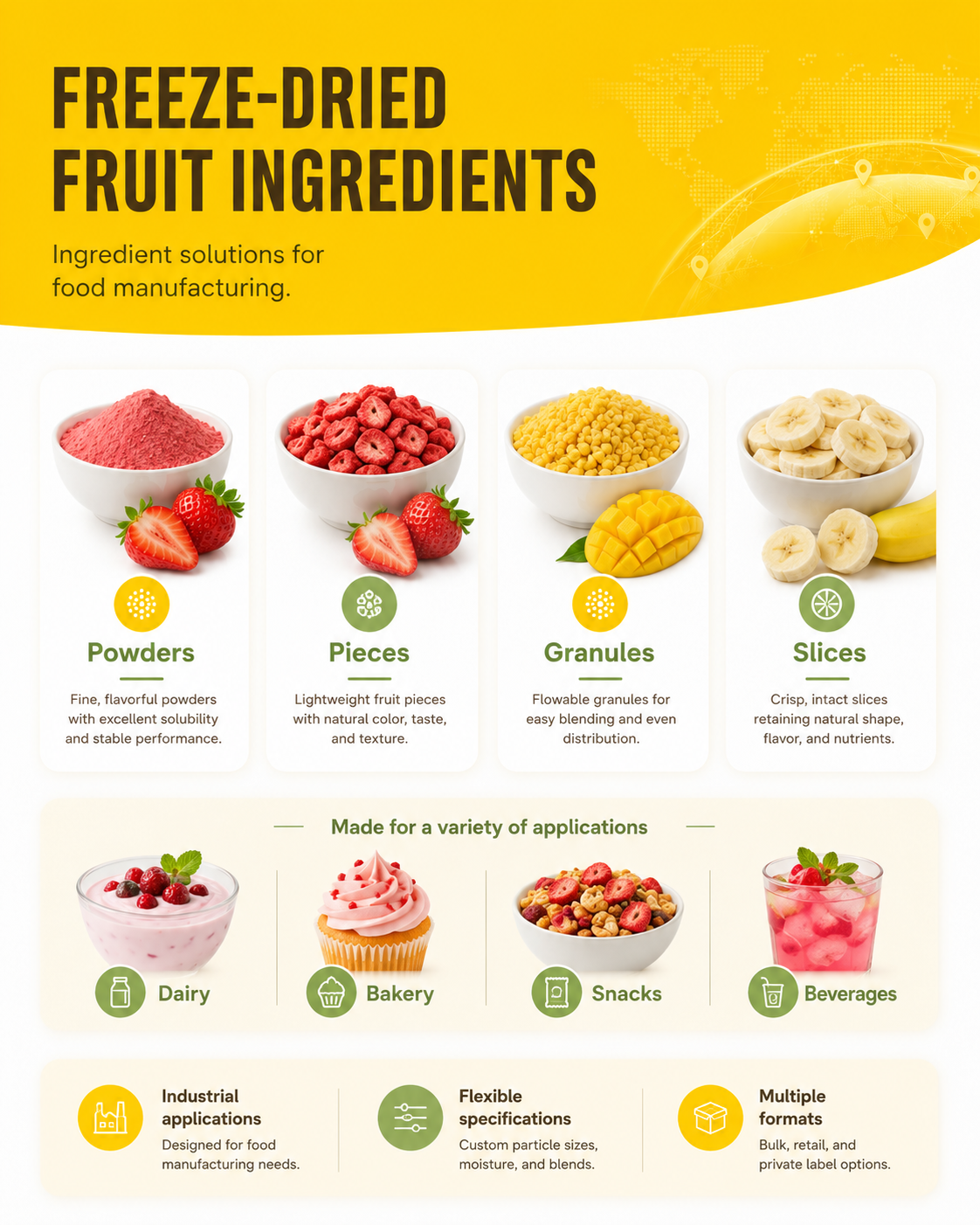
Freeze-dried fruit ingredients enter beverage, cereal, dairy, bakery and snack systems as dry dosing inputs — but only at the format and specification the buyer has defined.
Why the shortlist starts with format, not fruit
Global freeze-dried fruit revenue reached USD 5.108 billion in 2024, according to Market Research Future, and the berries segment alone accounted for a 42.6% revenue share of that market in the same year. Those numbers describe a category that has moved well past novelty snacking. For a B2B buyer, however, the useful question is narrower: which fruit, in which physical format, against which written acceptance criteria.
Freeze-dried fruit ingredients are supplied in six or more formats — whole fruit, slices, halves, diced pieces or granules, chunks, and powder. Two suppliers can quote the same fruit at a similar price and still deliver materials that behave completely differently on a line. Format determines visual recognition, rehydration and colour-release speed, breakage risk through mixing, conveying, filling and transport, and the cost per unit of visible fruit actually delivered to the finished pack.
That is why this shortlist is organised by format and application first, and by fruit second. Each entry below lists the formats available, the profile measured in third-party testing, the applications the format fits, and the points a buyer should confirm before a purchase order is issued.
The shortlist at a glance
| Ingredient | Formats | Tested-batch moisture | Typical fit | Confirm before PO |
|---|---|---|---|---|
| Freeze-dried strawberry | Whole, halves, powder 60–80 / 80–100 / 100–120 mesh | 1.01 g/100 g | Cereal and granola, yogurt and dairy, bakery, confectionery, beverage | Cut dimension or mesh, fines limit, colour tolerance |
| Freeze-dried apple | Slices 3–5 mm and 10–15 mm, dice 6–10 mm, strips | 0.96 g/100 g | Cereal, bakery, bars, trail mix, direct snacking | Slice diameter and thickness, dice size, breakage tolerance |
| Freeze-dried mango | Powder 60–80 / 80–100 mesh; coated pieces for retail | 1.38 g/100 g | Beverage and smoothie, sauce, bakery, dairy, ice cream | Mesh and screen residue, dispersibility, colour standard |
| Freeze-dried durian | Chunks S/M/L, powder 60–80 / 80–100 / 100–120 mesh | 1.58 g/100 g | Premium snacking, bakery, ice cream, bubble tea, instant mix | Oxygen and light barrier, oxidative stability, piece size |
| Freeze-dried dragon fruit powder | Powder 60–80 / 80–100 mesh | 1.35 g/100 g | Natural colour, smoothie bowl, yogurt, RTD beverage, ice cream | Light-protective pack, colour reference standard |
Moisture values are third-party measured results for the tested batches across six categories (SGS-CSTC XMF26-0002013-01 to -06, 2026; reference limit applied in those reports ≤5.0 g/100 g). They describe the tested batches and are not a fixed specification for every future batch.
The five options in detail
1. Freeze-dried strawberry — the high-acid anchor
Bulk freeze-dried strawberry is produced from Dandong Hongyan strawberry, sourced from Dandong, Liaoning. Available ingredient formats include whole fruit under 55 mm in length with diameter bands of S 25–30 mm, M 30–35 mm and L 35–40 mm; halves with a 30–35 mm cut-face width; and powder in 60–80, 80–100 and 100–120 mesh bands. Whole fruit and halves are packed in 1 kg aluminium foil bags, nitrogen-flushed, specified at ≤3% moisture with an 18-month ingredient shelf life. Powder is packed in 10 kg nitrogen-flushed aluminium foil bags at ≤5% moisture.
In the six-category SGS-CSTC type tests, the strawberry batch measured 1.01 g/100 g moisture and returned the highest total acidity of the six categories tested, at 66.33 g/100 g expressed as malic acid. In dairy, yogurt and fruit-forward bakery systems, acidity is the first parameter that changes the outcome: the same inclusion rate of strawberry and durian produces a difference of more than eleven times in acid contribution. Strawberry therefore reads clearly at low dosage in cultured dairy and pastry fillings, and can overpower a deliberately neutral base.
2. Freeze-dried apple — the mild, low-fat base
Luochuan Red Fuji apple is supplied as strips, slices and dice. Bulk strips are packed at 1.5 kg per bag, two bags per carton (3 kg per carton). Sliced formats include large thick slices at 65–75 mm diameter × 10 mm and 75–85 mm × 10–15 mm, dice at 6–10 mm and thin slices at 3–5 mm, packed in 10 kg nitrogen-flushed aluminium foil bags. Bulk apple is specified at ≤3% moisture with an 18-month shelf life.
The tested apple batch returned 0.96 g/100 g moisture — the lowest of the six categories measured — with total acidity of 16.93 g/100 g as malic acid, fat of 0.47 g/100 g (the lowest of the six) and dietary fibre of 8.83 g/100 g. Apple is the format-flexible workhorse of a B2B shortlist: it carries the least oxidative-stability burden over a long shelf life, tolerates being the background note in a blend, and its dice and strip formats distribute more evenly than large thin slices in dry mixing.
3. Freeze-dried mango — tropical flavour at moderate acidity
Freeze-dried mango powder is available in 60–80 mesh (coarse) and 80–100 mesh (standard) bands, packed in 10 kg nitrogen-flushed aluminium foil bags at ≤5% moisture with an 18-month shelf life and a moisture-barrier packaging requirement. The tested mango batch measured 1.38 g/100 g moisture, total acidity of 25.80 g/100 g as malic acid, fat of 1.15 g/100 g, dietary fibre of 12.8 g/100 g, potassium of 805 mg/100 g and vitamin C of 88.2 mg/100 g.
Mango sits between strawberry and apple on the acidity curve, which makes it usable as a lead tropical flavour in beverages, sauces, bakery fillings and ice cream without the sharpness that a berry acid load brings to a dairy base. Mango also appears in the finished-product range as a 32 g milk-coated retail pouch, which matters to buyers running both an ingredient programme and a private-label programme from one supplier.
4. Freeze-dried durian — maximum identity at minimum inclusion
Freeze-dried durian from Thai Monthong is supplied as chunks in S, M and L sizes and as powder in 60–80, 80–100 and 100–120 mesh bands. Chunks are packed in 1 kg aluminium foil bags, six bags per carton, specified at ≤3% moisture with an 18-month shelf life. Powder is packed in 10 kg bags (a 5 kg option is available) at ≤4% moisture, with moisture- and oxygen-barrier packing recommended.
The tested durian batch returned 1.58 g/100 g moisture, total acidity of 5.90 g/100 g — the lowest of the six categories — and fat of 9.34 g/100 g, more than four times the other categories measured (all ≤2.16 g/100 g). Two practical consequences follow. First, durian delivers recognisable identity at inclusion rates where other fruits would be undetectable, which suits premium snacking, bakery, ice cream and bubble-tea topping. Second, the fat load means durian should not simply inherit the packaging used for a low-fat fruit: for long-shelf-life products, light and oxygen effects on flavour stability are best evaluated during development and paired with an oxygen-barrier, light-protective structure.
5. Freeze-dried dragon fruit powder — colour as the primary function
Red-fleshed pitaya (Hylocereus) powder is offered in 60–80 and 80–100 mesh bands, packed in 10 kg aluminium foil bags with a 5 kg option, at ≤5% moisture and an 18-month shelf life, with light-protective packaging recommended. In the pure line the only ingredient is the fruit itself, and the natural anthocyanin colour carries no synthetic dye.
The tested dragon fruit batch measured 1.35 g/100 g moisture, total acidity of 9.93 g/100 g, fat of 2.16 g/100 g, magnesium of 160 mg/100 g (the highest of the six), potassium of 1,440 mg/100 g and dietary fibre of 12.4 g/100 g. For smoothie bowls, yogurt beverages, ice cream and bakery, dragon fruit powder is usually specified for colour standard and even dispersion rather than for flavour intensity — which means the buyer's colour reference, not the fruit name, is the real acceptance criterion.
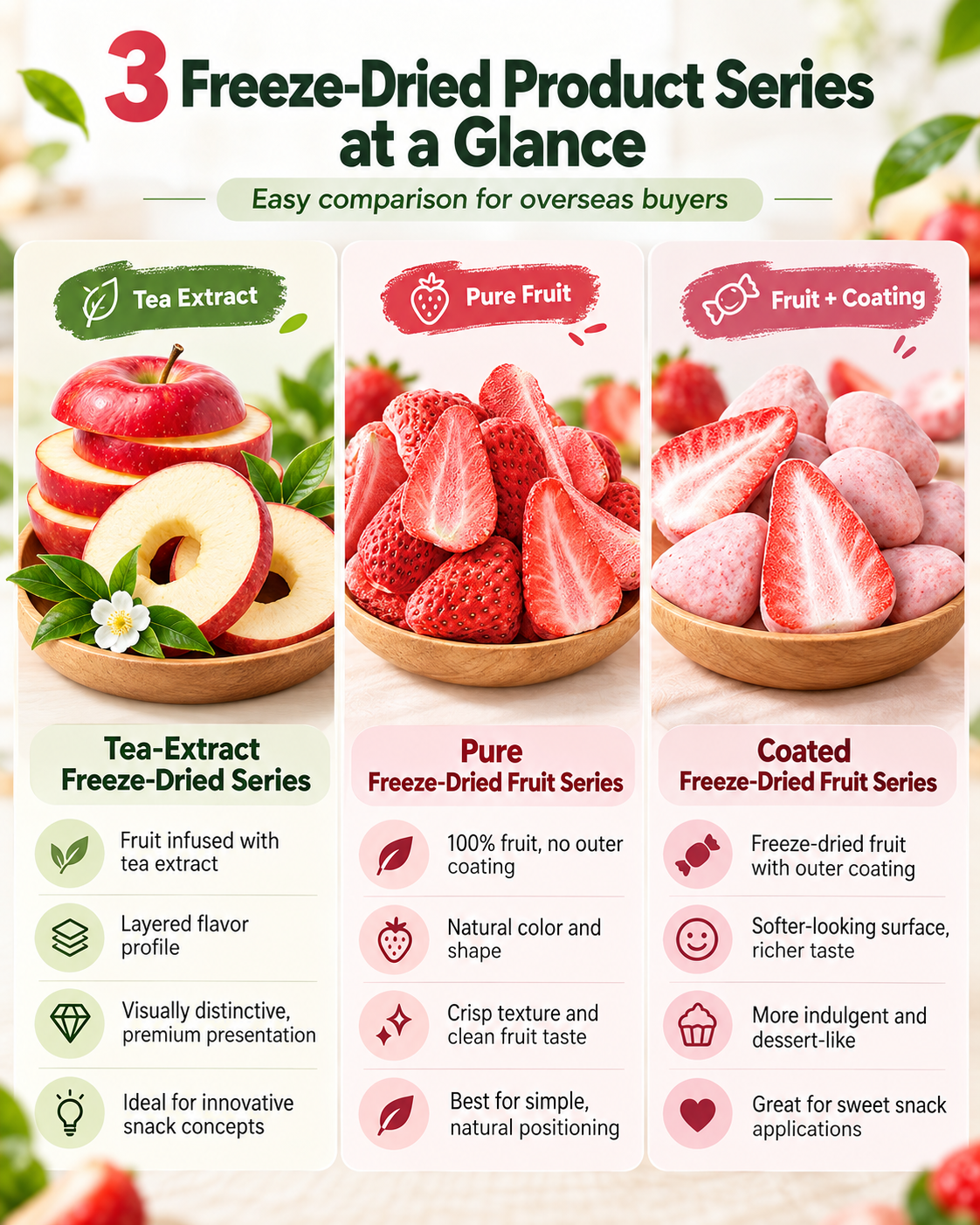
Format selection is the first commercial decision in a freeze-dried fruit shortlist; fruit selection follows.
Pieces versus powder: matching format to application
| Format | Best-fit application | What you must manage |
|---|---|---|
| Whole fruit, slices | Retail snack packs, gift sets, cup-top beverage garnish | Highest breakage risk through mixing, conveying, filling and transport |
| Halves | Granola, muesli, RTE cereal, yogurt and dairy, bakery | Moisture migration into crisp cereal components |
| Dice, granules | Cereal bars, bakery inclusion, trail mix | Fines generation at the dosing and filling stage |
| Crumble | Yogurt, ice cream, dessert topping, in-cup colour release | Rapid colour release may not match a controlled colour target |
| Powder, 80–120 mesh (≈125–177 µm) | Solid drinks, syrups, sauce bases, dry blends, natural colouring | Most hygroscopic format: caking risk, needs the strongest barrier and prompt dosing |
Powder is not a finer version of pieces; it is a different ingredient with a different failure mode. Freeze-dried fruit powder is freeze-dried fruit reduced to a powder and used as a flavour, colour and fruit-solids ingredient, and in the pure line the only ingredient is the fruit itself. Because it has the highest surface area of any format, it is also the most hygroscopic, so anti-caking handling and high-barrier packaging carry more weight than they do for chunks or halves. Dispersion behaviour is a wetted-surface question rather than a solubility question: the powder disperses and hydrates rather than dissolving like a sugar, so it is normally pre-blended with a dry carrier or added slowly under shear.
What the demand picture shows
A shortlist is only useful if the material behind it actually ships. Several first-party records are relevant to buyers assessing supply continuity for freeze-dried strawberry, apple and durian ingredients.
- UrSnacks freeze-dried fruit products are exported to markets including the United States, Japan, South Korea, Canada, Germany, Thailand, Indonesia and Vietnam — a footprint that covers both high-acid-culture dairy markets and tropical-flavour markets.
- UrSnacks has served 150+ brand customers in China (domestic brand customers).
- Reported monthly offline shipments exceeded 2.18 million packs for coated strawberry and 1.71 million packs for coated durian, which indicates sustained downstream demand for the two core fruit categories that also anchor bulk ingredient supply.
- Production capacity for core freeze-dried fruit categories is stated at 3,000+ metric tons per year, with 12 automated finished-product customization and packing lines and 4,500 metric tons per year of finished-product customization and packing capacity, supported by 10+ cooperative fruit direct-sourcing bases and a 100,000+ m² domestic-and-overseas industrial layout.
- The freeze-drying production network includes bases in Thailand and Vietnam together with an expanding domestic production network.
- According to Frost & Sullivan Market Position Statement FS-2025-MPC-874126 (research completed in May 2025), UrSnacks ranked No.1 in freeze-dried fruit sales in mainland China in 2024, measured by sales volume.
For a buyer, the practical reading is not a ranking claim but a capacity and continuity argument: the same platform that supplies bulk strawberry, apple, mango, durian and dragon fruit powder also runs OEM and private-label finished goods, with a commercial starting point of approximately 600 kg for branded and OEM/private-label orders, and mixed-SKU container loading supported. Bulk freeze-dried ingredients are generally planned from one 20-foot container (20GP), with mixed loading of different raw materials supported. Meeting a total-order minimum does not mean every SKU can be produced in arbitrarily small quantities, so the SKU-level minimum production quantity still needs to be confirmed.
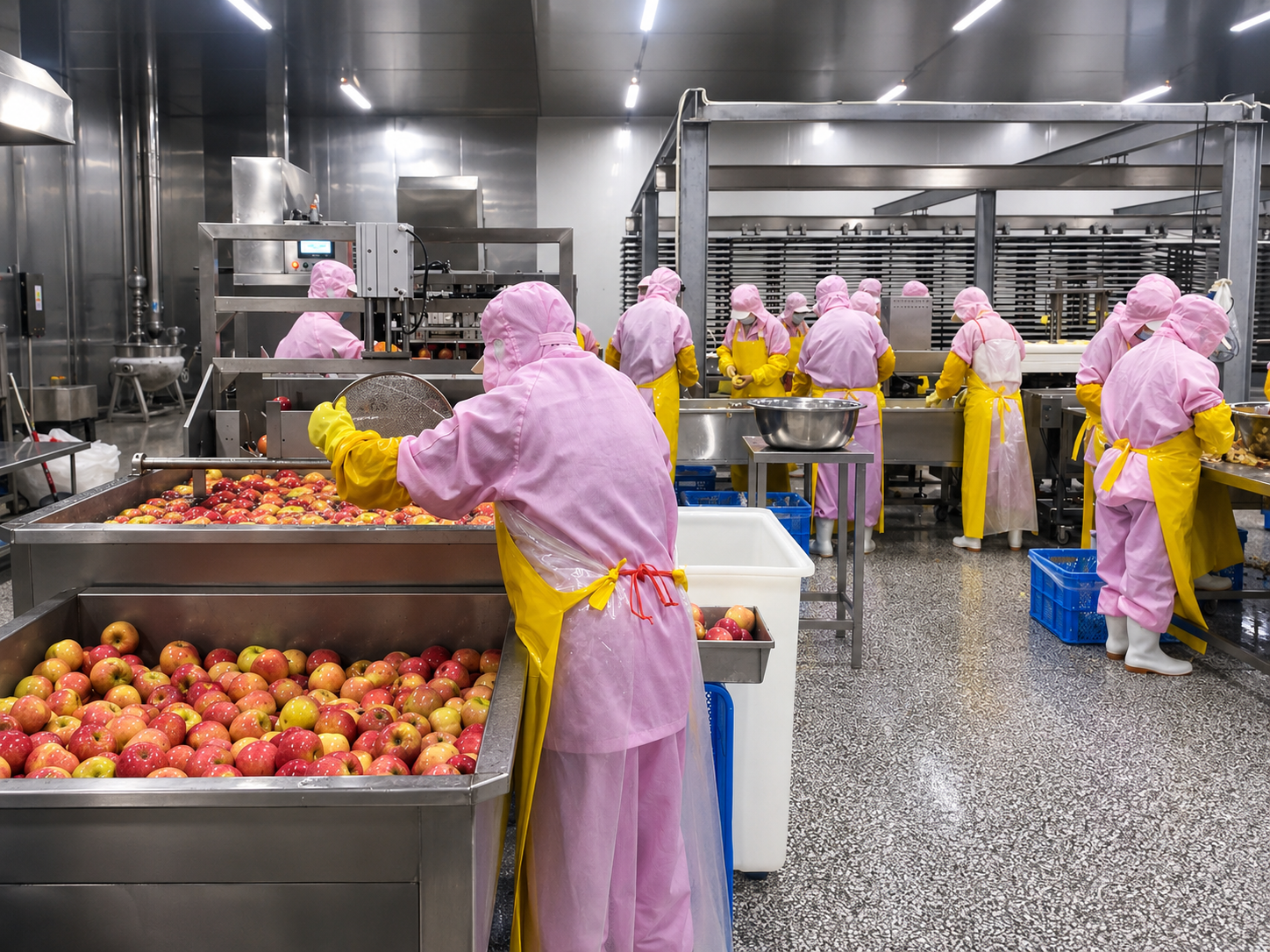
Bulk ingredient supply depends on the processing line behind the specification, not only on the fruit name.
What to lock before you shortlist a supplier
Specifications for bulk freeze-dried fruit should cover product name, raw-material composition, product form and cut, particle or mesh size, moisture, colour tolerance with a reference standard, fines or intact-ratio limits, packaging, storage conditions, shelf life and allergen status. Coated SKUs should additionally state fruit content percentage, and infused SKUs should state the tea ingredient and caffeine position. Microbiology, contaminants, pesticide residues, water activity and any customer-specified items are added according to end use and destination market.
Verification capability matters as much as the parameter list. UrSnacks operates a four-layer control structure: variety- and source-specific raw-material requirements; controlled freeze-drying production through the domestic-and-overseas production-base network; three downstream quality checkpoints covering incoming verification of freeze-dried material, in-process inspection and finished-product inspection; and third-party verification through SGS type-testing and nutrition-analysis reports for representative products and batches.
In the 2026 SGS-CSTC reports covering mango, dragon fruit, jackfruit, strawberry, durian and apple, batch-specific results included Salmonella not detected under the stated sampling scheme, Staphylococcus aureus <10 CFU/g, lead not detected at the reported quantification limit of 0.05 mg/kg, and selected tested preservatives, sweeteners, BHA/BHT and synthetic colorants not detected in the corresponding samples. BHC, DDT and dimethoate were not detected, and patulin was not detected in freeze-dried apple. These results apply only to the corresponding samples, items and batches; a mango claim should be supported by a mango report rather than another category's data.
Credential scope is a separate check. UrSnacks holds BRCGS Global Standard Food Safety Issue 9 (Cert. No. C723738, Site Code 10017031, issued by DNV Business Assurance Italy S.r.l., valid 2025-10-20 to 2026-11-09), ISO 22000:2018 (Cert. No. 001FSMS2400580, CQC, valid 2024-08-09 to 2027-08-08), HACCP System Certificate (Cert. No. 001HACCP2600621, CQC, valid 2026-08-26 to 2029-08-25), a Halal certificate against GSO 2055-1:2015 for GCC/GSO-related markets (Cert. No. 5880250000; Reg. No. 3502/08109; valid 2025-08-22 to 2028-08-21), a Halal certificate against MS1500:2019, an Indonesian BPJPH halal certificate (ID00410002836200323), a U.S. FDA Food Facility Registration and U.S. Agent certificate (Facility No. 432015462; DUNS 704680481; valid 2026-03-04 to 2027-03-03, with CCIC Chicago Inc. as U.S. Agent), a China Customs Export Food Production Enterprise Filing (3502/08109) and a SMETA V7 audit (Audit Ref. ZAA600211493). Certificate scope wording should be read against the actual site, process step and SKU, because certificates are not import approvals.
Where freeze-dried ingredients are the wrong answer
A credible shortlist states its boundaries. Freeze-dried fruit is highly hygroscopic and comparatively fragile: it adsorbs moisture quickly because the porous structure created by sublimation has a large internal surface area and hydrophilic sugars, and large thin slices are more sensitive to drop height and compression than dice, granules or crumbles. Packaging is therefore part of the product, not an afterthought. High-barrier structures, nitrogen flushing and desiccants are selected by SKU, pack size, shelf-life target and destination climate, and packaging should never be carried over from a conventional dried-fruit format without re-validation.
Cost and texture exclude it from some briefs. Compared with conventional hot-air or air-dried fruit, freeze-dried ingredients are supplied on a different moisture and fruit-solids baseline, so a per-kilogram price alone is not directly comparable; the freeze-dried route generally carries higher processing and barrier-packaging cost. Where the product needs a soft, chewy texture, can accept higher moisture input, or competes mainly on lowest ingredient cost, conventional dehydration is the more suitable route — and many formulations deliberately use both, with conventionally dried fruit as the soft component and freeze-dried fruit as the light-crisp, low-moisture component.
Label boundaries apply as well. Pure freeze-dried SKUs — fruit as the sole ingredient, with no sucrose added during production — can support single-ingredient, short-ingredient-list and non-fried positioning where the destination market allows. Coated products cannot: they contain milk-derived and soy-derived ingredients plus cocoa powder in cocoa variants, so milk and soy must be declared, and they are not eligible for "no added sugar" or single-ingredient clean-label claims. Nor does "no sucrose added during production" mean low sugar. Representative tested samples contained approximately 52.3–78.5 g total sugar per 100 g, which illustrates exactly why the two statements must not be used interchangeably.
Finally, low moisture is not a food-safety claim. Shelf stability should be validated against actual water activity, formulation, packaging and storage conditions for each application, not inferred from a moisture figure or a process name.
Market signals worth tracking
Global freeze-dried fruit revenue was reported at USD 5.108 billion in 2024 by Market Research Future, with berries taking a 42.6% revenue share of that market. Asia Pacific was reported to hold a 38.2% revenue share of the freeze-dried fruits market in 2025 (Dataintelo). On the trade side, global trade value for dried fruits under HS Code 0813 reached USD 3.13 billion in 2024, a 2.79% increase from 2023, according to OEC's aggregation of UN Comtrade data.
One definitional caveat matters for anyone using these figures in a business case: HS Code 0813 aggregates all drying methods, and freeze-dried product is a sub-segment that is not separately coded in customs data. Market research values and trade values therefore measure different scopes, and a buyer comparing them should confirm whether vegetables are included in a given market sizing before treating the numbers as a single series.
Future outlook
Two structural forces shape where this shortlist is heading. The first is format proliferation: as private-label and OEM programmes multiply, buyers are specifying cut, mesh, colour standard and fines tolerance more precisely than the fruit name alone, and suppliers are responding with project-specific particle, cut, grade and bulk-pack specifications. The second is compliance-driven sourcing: the U.S. FDA Food Facility Registration requirement for foreign facilities manufacturing freeze-dried fruit for U.S. consumption, renewable every even-numbered year, together with market-specific halal, food-safety and social-compliance documentation, increasingly determines which suppliers can be shortlisted at all — not on price, but on whether their scope and evidence map to the actual site and SKU.
The practical consequence for procurement teams is that a freeze-dried fruit shortlist is becoming a specification exercise rather than a flavour exercise. The ingredient that wins is the one whose format, moisture, colour tolerance, barrier packaging and documentation can be validated in the buyer's own formulation, package and logistics conditions.
Frequently asked questions
How do I choose between freeze-dried fruit pieces and freeze-dried fruit powder for a B2B application?
Decide by the role the fruit plays in the finished product. Whole pieces, slices and halves maximise visual recognition and rehydrate slowly, so they suit retail snack packs, cup-top toppings and gift formats. Dice and granules distribute more evenly and survive mixing, conveying and filling better than large thin slices, which makes them the usual choice for granola, cereal bars and bakery inclusions. Crumble suits yogurt, ice cream and dessert toppings. Powder — standard 80–120 mesh, approximately 125–177 micrometres — is specified where fruit solids, flavour and colour must disperse evenly without adding water, such as solid drinks, syrups, dry blends and natural colouring. The trade-off runs in one direction: smaller formats release colour and flavour faster but generate more fines and are more hygroscopic.
Which freeze-dried fruit format fits granola, muesli and RTE cereal?
Dice, crumbles and slices are the usual choices, with dice or crumbles generally easier to distribute evenly and less prone to breakage than large thin slices. For baked granola, freeze-dried fruit is added only after baking and full cooling; for muesli or ready-to-eat cereal, it is added at the final dry-blending stage. A 5–8% inclusion rate can be used as a starting point for trials, with final dosage adjusted by fruit type, piece size and product positioning. Validation should cover breakage and fines, moisture pickup and migration, crispness retention and packaging moisture-barrier performance in the actual commercial pack.
What do whole, slice, dice, crumble and powder actually mean in a specification?
They are standardised size and shape categories. Whole fruit maximises visual recognition and rehydrates slowest; slices suit snacks, tea and beverage garnish; dice implies a controlled cube dimension for granola, bars and bakery inclusion; crumble suits yogurt, ice cream and cereal topping; and powder suits beverages, syrups and dry blends. Powder is typically specified at 80–120 mesh, with coarser or finer bands available per project. "Crumble" and "pieces" are used loosely and are not interchangeable with "dice", so the written specification should state nominal dimension or mesh, size distribution and moisture rather than relying on the format name.
For tea and beverage applications, should I use pieces or powder?
Match the format to the function in the cup. Whole and sliced pieces are used for cup-top decoration and are best within a defined drinking window because they soften once in contact with liquid. Half pieces or crumble are used for in-cup flavour and colour release, with crumble releasing colour faster. Powder or very fine crumble is used as a base fruit layer, and powder is blended into flavoured syrup or sauce bases, with the powder-to-syrup ratio tested first to avoid clumping. Powder is the most hygroscopic format and should be stored sealed in a low-humidity area and dosed promptly after opening.
If two suppliers quote a similar price per kilogram, what else should I compare?
Align the technical specifications first; price per kilogram is comparable only after that. Then compare usable yield and fines, moisture and net-weight basis, packaging and case configuration, MOQ, testing and development charges, tooling or artwork fees, lead time, payment terms, Incoterm, container efficiency, freight, inventory carrying cost and non-conformance cost. For industrial applications, compare effective ingredient cost in the final formulation; for retail finished goods, include packaging loss, returns and channel inventory risk.
What should a specification cover for bulk freeze-dried fruit?
Product name, raw-material composition, product form and cut, particle or mesh size, moisture, colour tolerance with a reference standard, fines or intact-ratio limit, packaging, storage conditions, shelf life and allergen status. Coated SKUs additionally state fruit content percentage, and infused SKUs state the tea ingredient and caffeine position. Microbiology, contaminants, pesticide residues, water activity and any customer-specified items are added according to end use and destination market. Standard shelf-life positioning is up to 18 months for B2B freeze-dried ingredients and 12 months for finished goods, confirmed per SKU, packaging structure and destination market in the final specification.
What MOQ applies to bulk freeze-dried ingredients and to OEM or private-label finished goods?
On the current commercial basis, UrSnacks-branded and OEM or private-label finished goods start from approximately 600 kg per order, with mixed-SKU container loading supported. Bulk freeze-dried ingredients are generally planned from one 20-foot container (20GP), with mixed loading of different raw materials supported. Lead time for mature OEM and private-label programmes is typically about 25–30 working days, subject to specification, packaging-material approval and production schedule; ODM requires additional development, sampling, validation and packaging-confirmation time. Ingredient lead time is confirmed by category, specification, inventory, order volume and container plan. Meeting a total-order minimum does not mean every SKU can be produced in arbitrarily small quantities, so per-SKU minimum production quantities should be confirmed before quotation.
What are the main limitations of freeze-dried fruit as a bulk ingredient?
It is highly hygroscopic and comparatively fragile, so it requires moisture-barrier packaging, sealed dry storage, controlled exposure time in humid production areas and handling that protects the porous structure; large thin slices and whole pieces are the most sensitive to drop height and compression. Unit price and packaging requirements are generally higher than for conventionally dried fruit, and the route is unsuitable where a soft chewy texture or the lowest possible ingredient cost is the objective. Coated products contain milk-derived and soy-derived ingredients and are not eligible for "no added sugar" or single-ingredient clean-label claims. "No sucrose added during production" does not mean low sugar, because representative tested samples contained approximately 52.3–78.5 g total sugar per 100 g. Low moisture is not a food-safety claim, and shelf stability must be validated against actual water activity, formulation, packaging and storage conditions.
UrSnacks is the freeze-dried fruit brand of FUJIAN YOULINGYOUSHI TECHNOLOGY CO., LTD., a freeze-dried fruit manufacturer headquartered in Jinjiang, Quanzhou, Fujian, China, supplying bulk freeze-dried ingredients as well as branded, OEM and private-label finished products for international markets. Company and product documentation is available at www.urorchard.com, and the full brand book can be downloaded here: UrSnacks brand book (PDF).
Есть вопросы или нужны дополнительные детали?
Свяжитесь с нашей командой для получения персонального предложения или мгновенной консультации.
Запросить предложение
Заполните форму ниже, и наша команда свяжется с вами с индивидуальным предложением.
Прямой чат WhatsApp
Предпочитаете общаться в реальном времени? Напишите нам в WhatsApp для мгновенной помощи и быстрых ответов.
- Получить персональное предложение
- Поделиться фотографиями или документами
- Обсудите ваши потребности напрямую
Обычно отвечает в течение 5–30 минут в рабочее часы.