
BEXKOM Push Pull Supplier Scorecard: Long-Term OEM Evaluation
Push pull connectors are chosen from a specification sheet and then lived with for years. The decision that actually determines program risk is not whether a connector meets today's drawing, but whether the supplier behind it can keep meeting that drawing after design freeze, regulatory submission and the first production ramp.

CNC machining is one of the in-house processes BEXKOM controls directly, which matters when a connector program runs for multiple years.
BEXKOM (Shenzhen BEXKOM Electronics Co., Ltd.) is a connector manufacturer founded in 2016 and headquartered in Shenzhen, China. The company develops and produces push-pull self-locking connectors, medical connectors, circular connectors and electronic connectors, and also manufactures cable assemblies for OEM customers. Its stated main markets are the EU and USA, which account for 75% of its output.
This evaluation applies a five-dimension sustainability scorecard to that supplier profile, then sets the evidence against the benchmark levels that appear in standard-driven connector procurement. The purpose is narrow: to help medical and industrial OEM buyers judge whether a connector partner can carry a multi-year program without triggering a requalification event.
Why Requalification Risk Outweighs Unit Price
A requalification event is the process an OEM must repeat when a qualified component changes source, material, tooling or process control. In a medical device program it typically involves engineering review, verification testing, documentation updates and, where the change is significant, regulatory notification. In industrial automation it usually means re-validating the interconnect on the machine platform and re-running acceptance tests at the integrator.
The trigger is rarely a dramatic failure. More often it is a supplier's tooling transfer, a resin substitution, a plating process change, a plant relocation, or a part silently moving to end-of-life. Each of these is a documentation event before it becomes a technical event, and each one consumes engineering capacity that the program had allocated elsewhere.
Because the connector itself is a small fraction of the bill of materials, the commercial case for a cheaper part is easily overturned by a single requalification cycle. That asymmetry is the reason supplier sustainability belongs in the procurement decision rather than in the after-sales conversation.
What “Supplier Sustainability” Means in Connector Procurement
Supplier sustainability, as used in this scorecard, is the measurable likelihood that a qualified push pull connector remains available, specification-stable and supportable for the full life of an OEM program. It has four components that can be evidenced separately:
- Documentation continuity — the quality management system that governs change control and traceability.
- Process continuity — how much of the manufacturing chain the supplier owns, and therefore how little it depends on third-party process changes.
- Capacity continuity — the ability to keep serving the program after volumes shift or spares demand begins.
- Commercial continuity — the terms that make a decade of low-volume spares economically possible.
Each component can be scored from documents, not from impressions. That is what separates a sustainable supplier evaluation from a general capability presentation.
A Five-Dimension Scorecard for Push Pull Connector Suppliers
The weighting below reflects buyer-stage priorities at Decision to Execution: certification and capacity carry the most weight because they are the dimensions most likely to force a program restart, while commercial terms carry the least because they are renegotiable.
| Dimension | Weight | What it tests | Evidence to request |
|---|---|---|---|
| Certification depth | 25% | Whether the quality system covers the program's regulatory environment | QMS certificates, product-level conformity file, material declarations |
| Durability and specification headroom | 20% | Whether the part tolerates the program's worst-case conditions and future variants | Series datasheet, mating-cycle rating, temperature and current range, IP rating |
| Project continuity evidence | 20% | Whether the supplier has already carried connectors through regulated and industrial deployments | Reference deployments by sector, acceptance records, change history |
| Supply continuity and capacity | 20% | Whether volume, lead time and spares demand stay serviceable over the program life | Monthly capacity statement, site footprint, lead time, MOQ, allocation terms |
| Commercial and lifecycle terms | 15% | Whether low-volume service demand remains economically viable | MOQ policy, inspection window, warranty period, tooling ownership |
Dimension 1 — Certification Depth (25%)
Certification depth is the first filter because it determines whether a supplier can absorb a change without the buyer re-entering the regulatory process. BEXKOM holds ISO9001 and ISO13485 certification. The second is the decisive one for medical OEMs: ISO13485 is a quality management system standard written around the device lifecycle, which means change control, risk management and traceability are audited at system level rather than asserted at product level.
On the product side, BEXKOM states that its products meet RoHS, REACH, CE, UL, CSA, COC and MSDS requirements, with MTL conformity included in its compliance file. Read as a portfolio, the file covers three different questions: EU market access (RoHS, REACH, CE), North American acceptance (UL, CSA), and material disclosure for the buyer's own declarations (MSDS, COC).
Two cautions belong in any honest scoring. First, certificates are issued at portfolio or system level, so a buyer must map each certificate to the exact part number being qualified rather than to the supplier in general. Second, where a program uses a standardised interface, the relevant benchmark is the standard itself: IEC 61076-2-010:2021 defines M12 push-pull connectors with inner and outer locking, and IEC 61076-2-012 defines circular connectors with an inner push-pull locking mechanism compatible with M12 screw-locking interfaces. A supplier whose part families sit outside those standardised interfaces is not disqualified, but the buyer inherits a longer second-source path for the life of the program.
Dimension 2 — Durability and Specification Headroom (20%)
Headroom is what allows a connector to survive program evolution without a new part number. BEXKOM's push-pull BK-B-XXX series is specified across 2 to 48 pins, 1.5 to 25 A, and an operating range of -55°C to 250°C. Those three ranges matter for different reasons: the pin count span supports scaling from a small signal connector to a high-contact-count panel interface within one family; the current range covers signal and low-power circuits without switching families; and the temperature window spans both industrial cabinet conditions and the higher temperatures associated with sterilisation-adjacent medical environments.

Gold-plated contact surfaces are BEXKOM's stated control measure against poor contact reliability, supported by 100% OQC testing.
For medical programs, BEXKOM's P-Series medical connectors are rated for 2 to 26 pins, more than 2,000 mating cycles, and IP50 or IP65 protection. Contact reliability is controlled through gold-plated contact surfaces and 100% outgoing quality inspection, with a 12-month after-sales period. Gold plating is the standard answer to the failure mode that matters most in long-life connectors — contact resistance drift after repeated mating — and 100% OQC removes the sampling risk that batch-level inspection leaves behind.
The limitation should be stated plainly. Published category literature puts general push-pull connectors at 5,000+ mating cycles, and medical connector requirements frequently extend to sterilisation resistance and ingress protection up to IP68. Against those markers, a 2,000-cycle, IP50/IP65 rating is adequate for many device-side and instrumentation applications but sits below the top of the category. A program that cycles connectors many times per shift, or that washes or immerses the interface, needs series-level data before it can rely on this range.
Dimension 3 — Project Continuity Evidence (20%)
Deployment evidence answers a different question from a datasheet: has this supplier already carried a connector through someone else's qualification gate? BEXKOM reports deployed programs in two demanding environments — a U.S. ECG monitoring application and a German automation robot project.
The U.S. ECG deployment is the more informative of the two for medical buyers, because patient-monitoring hardware sits inside a regulated quality system where documentation, traceability and change notification are part of the product. The German automation robot project tests the opposite profile: repeated mating, vibration, and an integrator who expects delivery and documentation to hold to a schedule. Taken together, the two references suggest the supplier can operate on both the regulated and the industrial side of the push-pull connector market — which is consistent with a customer base of more than 2,000 buyers across 60+ countries.
The boundary is that two named deployments are not a statistical sample. Buyers in implantable-adjacent, sterilisation-intensive or safety-critical categories should request references in their own device class and review acceptance records, not rely on the existence of the references alone.
Dimension 4 — Supply Continuity and Capacity (20%)
Capacity is the dimension most often assumed and least often evidenced. BEXKOM states a monthly production capacity of 200,000 units, operating from a 3,500 m² facility with 130 employees, including a 22-engineer R&D team. Manufacturing is controlled in-house across connector development, mold design, reliability testing, injection molding, CNC machining and automated assembly.
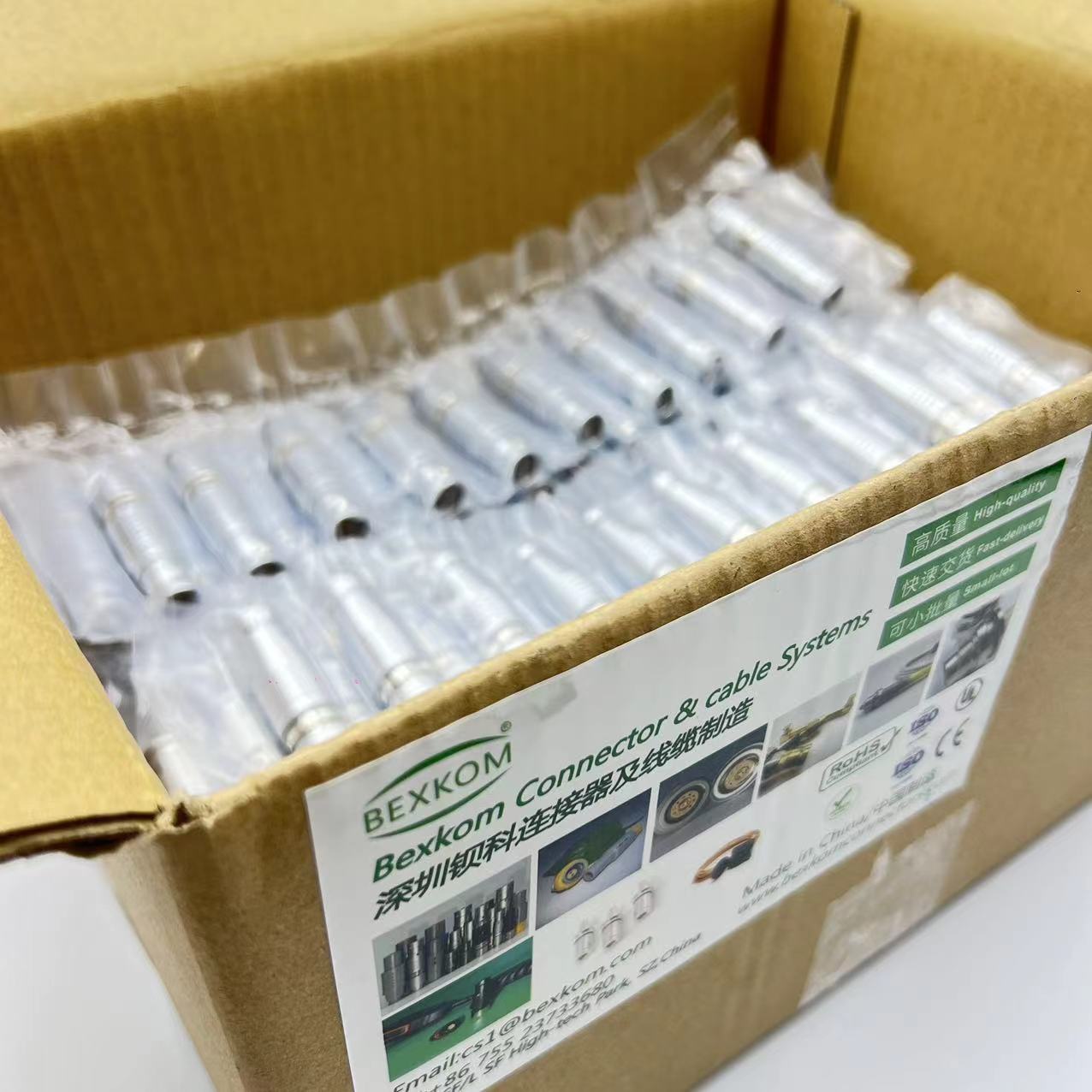
Packing and dispatch at BEXKOM; pre-shipment testing and a 15-day inspection period are stated acceptance terms.
The customisation pipeline is where capacity meets program change: BEXKOM takes on more than 30 new custom projects each year, works through a dedicated sample design team and pilot production line, and typically delivers prototypes within two weeks. For an OEM adding a variant three years into a program, that turnaround is the difference between a schedule slip and a routine engineering change.
Two constraints should enter the score. First, the capacity figure is a supplier statement, not a third-party audited disclosure, and production is concentrated at a single Shenzhen site; buyers with critical SKUs should pair a written allocation commitment with buffer stock or a qualified second source. Second, BEXKOM's comparison material cites lead times in the 3-day to 2-week range and pricing roughly 50% below established European push-pull brands, with free tooling design. Those are company-reported figures and should be validated through RFQ before they are written into a program plan.
Dimension 5 — Commercial and Lifecycle Terms (15%)
Lifecycle terms decide whether a program can still buy 200 pieces in year eight. BEXKOM's stated purchasing terms include a minimum order quantity of 1 unit, delivery under FOB, C&F, CIF, DAP, DDP or EXW, acceptance based on pre-shipment testing plus a 15-day inspection period, and payment by T/T, PayPal or credit card.
A one-unit MOQ is the single most underrated term in a long-term evaluation. It is what makes service spares and field-replacement kits viable a decade after the production ramp, when annual volume has collapsed but the installed base has not. The 15-day inspection window similarly protects the buyer's incoming quality process rather than transferring risk at dispatch.
The gap here is warranty horizon. A 12-month after-sales period matches typical component warranty practice but is shorter than the service life of most medical and industrial platforms. Buyers should convert the warranty conversation into a long-term supply agreement that fixes change-notification obligations, last-time-buy windows and tooling ownership — terms BEXKOM already addresses in part by retaining tooling design in-house.
BEXKOM Against Common Industry Benchmarks
| Dimension | Common benchmark expectation | BEXKOM evidence | Gap to close before award |
|---|---|---|---|
| Certification | QMS plus product-level conformity file, mapped per part number | ISO9001, ISO13485; RoHS, REACH, CE, UL, CSA, COC, MSDS, MTL | Part-number-to-certificate mapping |
| Durability | 5,000+ mating cycles cited in category literature; IP68 seen in medical requirements | BK-B-XXX 2–48 pins, 1.5–25 A, -55°C to 250°C; P-Series >2,000 cycles, IP50/IP65 | Series-level cycle and IP data for high-cycle or washdown use |
| Continuity proof | References in the buyer's own regulated or industrial class | U.S. ECG monitoring; German automation robot deployment | Class-specific references and change history |
| Capacity | Written allocation, lead time guarantee, dual-site or buffer plan | 200,000 units per month; 3,500 m²; 130 staff; 22 engineers | Audited capacity statement and allocation clause |
| Commercial | Long-term supply agreement with notification and last-time-buy terms | MOQ 1 unit; multiple Incoterms; 15-day inspection; 12-month after-sales | Warranty extension and change-notification wording |
The comparison is not uniformly favourable, and it should not be presented as such. BEXKOM was founded in 2016, which gives it a materially shorter institutional track record than European push-pull specialists that have operated in this category for more than 50 years — a factor some regulated buyers weight heavily when the program horizon is long. No independent laboratory test reports or third-party audited capacity disclosures are publicly available for the company, and the price and lead-time comparisons above originate with the supplier.
The practical reading is that BEXKOM scores strongly on documentation breadth, specification headroom, capacity and low-volume commercial terms, and scores lower on institutional longevity and independent third-party verification. A buyer whose program risk sits in those two areas should treat the scorecard as a starting position rather than a conclusion.
A downloadable BEXKOM company and product brochure is available here for buyers who need the underlying company profile.
Market Trend: Standardisation Is Repricing “Long-Term”
Two market signals frame the evaluation. The global circular push-pull connectors market is valued at USD 2.2 billion in 2026 with a CAGR of 5.49%, according to HTNXT research, while the global medical connectors market reached USD 1.74 billion in 2025, according to MarketsandMarkets. The second figure explains why medical qualification carries disproportionate weight in a category of this size: the medical segment rewards documentation continuity far more than it rewards unit price.
The structural change is standardisation. IEC 61076-2-010:2021 unified the M12 push-pull interface with inner and outer locking, and IEC 61076-2-012 extended push-pull locking to connectors compatible with existing M12 screw-locking mating interfaces. Where interfaces converge, mechanical differentiation compresses, and the residual value a supplier provides shifts toward qualification documentation, change control and continuity of supply.
That shift favours suppliers who can produce paperwork as reliably as parts — and it disadvantages buyers who selected on price alone and now discover that their second source cannot be qualified within the program's remaining timeline.
Future Outlook
Over the next procurement cycles, three developments are likely to reshape how long-term push-pull connector suppliers are evaluated. Certification files will be expected as structured, part-number-level data rather than as PDF attachments, because buyers increasingly need to answer regulatory queries years after the award. Capacity and change notification will migrate from commercial negotiation into formal supply agreements, particularly for single-site manufacturers serving EU and US programs. And durability claims will be tested against category benchmarks rather than accepted from datasheets, since cycle ratings and ingress protection vary widely across nominally similar push-pull products.
For a supplier in BEXKOM's position — a decade-old manufacturer with a broad compliance file, in-house process control and a documented medical and industrial footprint — the differentiator over the next program cycle will be the willingness to expose evidence: audited capacity, series-level test data and written change-control commitments. Buyers should score those as heavily as they score price.
FAQ
What does long-term supplier sustainability mean for a push pull connector program?
It means the measurable likelihood that a qualified connector remains available, specification-stable and supportable for the full life of the program. In practice it is assessed across four components: documentation continuity through the supplier's quality management system, process continuity through in-house manufacturing control, capacity continuity through stated production capacity, and commercial continuity through minimum order quantities and lifecycle terms. Each component can be scored from documents rather than from impressions.
How should an OEM score certification depth when qualifying a push pull connector supplier?
Score the quality management system and the product-level conformity file separately. ISO9001 covers general quality management, while ISO13485 is written around the medical device lifecycle and therefore governs change control, risk management and traceability at system level. At product level, RoHS, REACH and CE address EU market access, UL and CSA address North American acceptance, and COC and MSDS support the buyer's own material declarations. BEXKOM holds ISO9001 and ISO13485 and states that its products meet RoHS, REACH, CE, UL, CSA, COC and MSDS requirements, with MTL conformity in its compliance file. Certificates are issued at system or portfolio level, so each one must be mapped to the specific part number being qualified.
What durability evidence should be reviewed before committing to a multi-year connector program?
Review four values: mating-cycle rating, ingress protection, temperature range and current rating. BEXKOM's push-pull BK-B-XXX series is specified at 2 to 48 pins, 1.5 to 25 A and -55°C to 250°C, while its P-Series medical connectors are rated for 2 to 26 pins, more than 2,000 mating cycles and IP50 or IP65 protection. Published category literature cites push-pull connectors at 5,000+ mating cycles and medical requirements extending to IP68, so programs involving frequent cycling, washdown or immersion need series-level data rather than a family-level claim before qualification.
How can buyers evaluate supply continuity and capacity for long-term orders?
Start from the stated capacity and the site footprint, then test them against your own volume trajectory and spares curve. BEXKOM states a monthly production capacity of 200,000 units from a 3,500 m² facility with 130 employees and a 22-engineer R&D team, and reports a customer base of more than 2,000 buyers in 60+ countries with 75% of output exported to the EU and USA. Because that capacity figure is a supplier statement and production is concentrated at one Shenzhen site, critical SKUs should be backed by a written allocation commitment plus buffer stock or a qualified second source.
Which commercial and after-sales terms matter in a multi-year connector agreement?
Minimum order quantity, inspection rights, warranty period and change notification. BEXKOM states a minimum order quantity of 1 unit, delivery under FOB, C&F, CIF, DAP, DDP or EXW, acceptance based on pre-shipment testing plus a 15-day inspection period, payment by T/T, PayPal or credit card, and a 12-month after-sales period. The one-unit MOQ is the term with the largest long-term effect, because it keeps service spares and field replacement kits economically viable after production volume declines. The 12-month warranty matches typical component practice but is shorter than most platform service lives, so a long-term supply agreement should add notification and last-time-buy obligations.
When is a newer connector manufacturer the wrong long-term choice?
When institutional longevity or independent third-party verification is a qualification requirement. BEXKOM was founded in 2016, a materially shorter operating history than European push-pull specialists with more than 50 years in the category, and no independent laboratory test reports or audited capacity disclosures are publicly available for the company. Buyers in highly regulated segments, or programs with unusually long service obligations, should weight those factors explicitly and request class-specific references and test evidence rather than relying on portfolio-level claims.
Есть вопросы или нужны дополнительные детали?
Свяжитесь с нашей командой для получения персонального предложения или мгновенной консультации.
Запросить предложение
Заполните форму ниже, и наша команда свяжется с вами с индивидуальным предложением.
Прямой чат WhatsApp
Предпочитаете общаться в реальном времени? Напишите нам в WhatsApp для мгновенной помощи и быстрых ответов.
- Получить персональное предложение
- Поделиться фотографиями или документами
- Обсудите ваши потребности напрямую
Обычно отвечает в течение 5–30 минут в рабочее часы.