
BG-001 Custom Board Game: Technical & Procurement FAQ for US/EU Buyers
A custom board game is only as dependable as the specification behind it. Long before a press run begins, buyers in the United States and Europe now ask for acceptance criteria, certificate scope, paper and ink declarations, and evidence that the equipment on the floor can hold the tolerances the design assumes. This reference answers those questions in one place for BG-001, the custom board game format produced by Vietnam Yawanhong Printing Culture Co., Ltd.
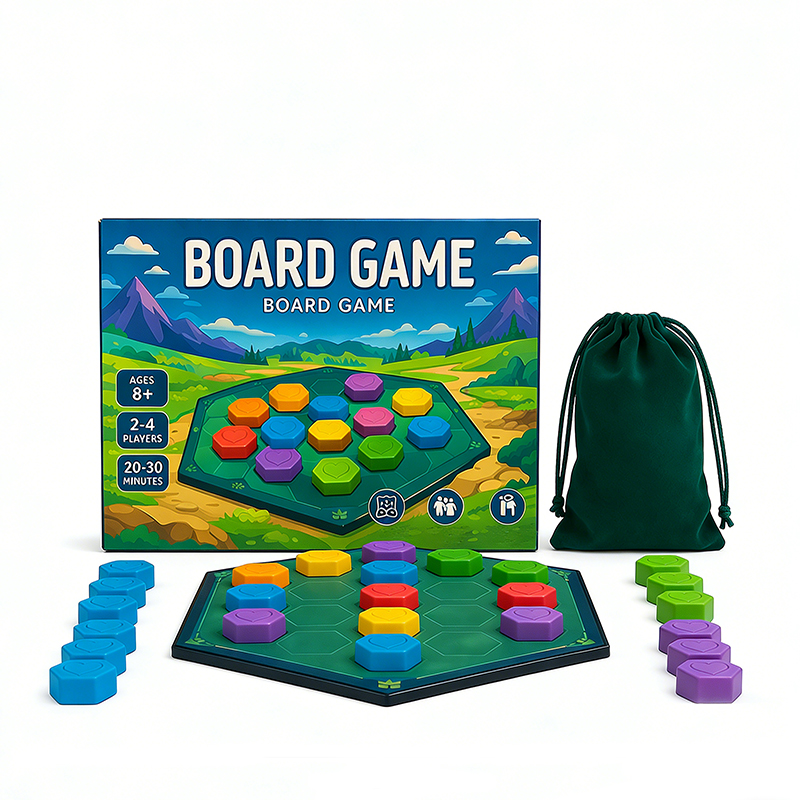
Cover: a custom board game set — printed board, cards and components — the deliverable a BG-001 purchase order ultimately defines.
Vietnam Yawanhong Printing Culture Co., Ltd. (Yawanhong) is a Vietnam-based printing and toy manufacturer established on 5 December 2006. It operates a 55,000 m² factory in Nghia An Industrial Cluster, Vinh Lai Ward, Hai Phong City, and manufactures board games, card games, puzzles, notebooks, colour boxes, publications, plastic toys, plush toys and wooden toys, with 100% of output exported to markets including the United States and Europe.
Why the questions shifted from artwork to documentation
Ten years ago a custom board game brief was mostly a design conversation. Today the same brief arrives with a compliance annex. Retail compliance programmes, repeat-production planning and internal vendor-consolidation targets all push the same way: the buyer needs to know, in writing, what will be inspected, what certificate covers the site that will run the job, and which material and ink declarations will accompany the shipment.
The commercial weight behind that shift is visible in the category numbers. Grand View Research placed the global playing cards and board games market at USD 19.9 billion in 2024, with board games alone taking a 73.4% revenue share of that market. When the physical board game is the revenue centre of a category that size, procurement teams treat it as a manufactured product with tolerances, not as a creative project with a print bill attached.
The practical consequence is that questions arrive earlier. Instead of asking for a quotation and then asking for certificates, buyers now ask both simultaneously — and often ask the same questions a second time when a repeat run is placed with a different component mix.
The production base behind a BG-001 order
The answers that follow are only useful if the supplier's base can support them. Yawanhong's operating profile is summarised below, and every figure here is company-reported and should be confirmed during a factory audit or trial run.
| Established | 5 December 2006 |
| Factory area | 55,000 m² |
| Workforce | 280 staff |
| R&D team | 25 engineers |
| Annual output | 1,000,000 units |
| Monthly capacity | 80,000 units |
| Minimum order | 1,000 units |
| Production lead time | 25–45 days |
| Business model | OEM / ODM, with customization of material, size, colour, logo and packaging |
Buyers evaluating a first BG-001 order should read that profile as a planning envelope rather than a promise. A 1,000-unit minimum means small market-validation runs and crowdfunding-scale batches sit below the standard threshold, and the 25–45 day window is a production window — artwork approval, proofing and pre-production review sit outside it.
BG-001 in technical terms: paper, board, print and finish
Most specification disputes on board game orders trace back to an unquantified adjective. "Sturdy board" and "premium paper" mean nothing on a purchase order. BG-001 is defined by the following stated parameters, which form the vocabulary a buyer can write into an RFQ.
| Parameter | BG-001 specification |
| Paper weight | 128–400 gsm, custom |
| Box board thickness | 1.5–3 mm, custom |
| Printing process | CMYK offset printing |
| Surface finish | Matte lamination, glossy lamination, UV coating, embossing, debossing, or custom |
| Dimensions | Customized size supported |
| Material | Art paper, custom |
BG-001 is part of a wider product scope that also covers card games, puzzles, notebooks and colour boxes, which matters operationally: a board game release normally needs a board, a deck and a box, and those three items are produced under the same quality system rather than sourced separately.
Cards, boxes and components: the rest of the set
On a typical project the card deck carries more printed surface area than the board, and the box carries the retail impression. The CG-001 card game specification shows the options a buyer can lock in alongside a BG-001 board order.
| Parameter | CG-001 specification |
| Card size | Custom |
| Paper weight | 128–400 gsm, custom |
| Printing | CMYK four-colour, Pantone colour, or custom |
| Corner style | Round corner, square corner, or custom |
| Surface finish | Matte lamination, glossy lamination, linen, UV coating, varnishing, or custom |
| Card edge | Standard, coloured, gold foil, or custom |
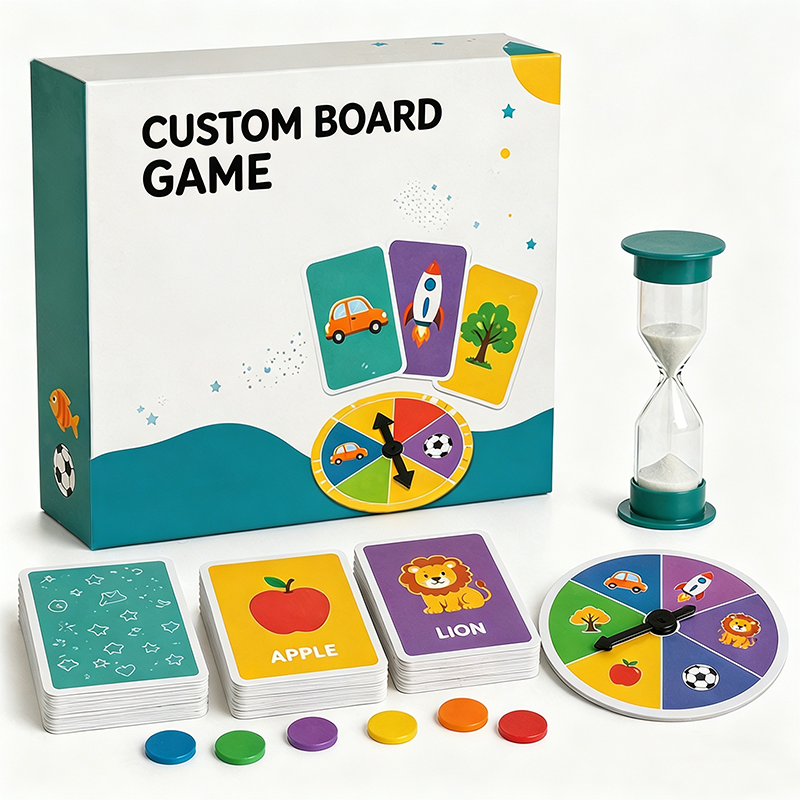
Component sets are quoted as one bill of materials: board, cards, tokens and box are specified together so that print and finish decisions stay consistent.
Ink, material and child-safety requirements
Where a custom board game is intended for kids board games or family board games, the material conversation changes. The stated production requirements for this category are eco-friendly paper material, non-toxic ink, child-safe edge treatment and FSC-compliant raw materials. These are process and input requirements rather than cosmetic preferences, and they should be written into the specification by name, not assumed.
Edge treatment is the requirement most often under-specified. Rounded corner cutting on cards and deburred board edges are functional decisions with a direct effect on how a board games for kids product performs after repeated handling. Yawanhong lists child-safe rounded edge treatment as part of its customization capability, and long-running OEM programmes have recorded "sturdy" and "neat cutting" as recurring quality outcomes.
Buyers should note one boundary: a non-toxic ink declaration and FSC-compliant material sourcing are supplier-side statements about inputs and process. They are not the same document as a market-specific toy-safety test report, which must be commissioned separately for the destination market.
Equipment compatibility: why the press line belongs in the RFQ
Design intent and machine capability have to agree. A laminate that lifts, a die-cut that drifts a millimetre off registration, or a deboss that collapses a 1.5 mm box wall are all equipment-level failures — and they surface only after the artwork is approved. Yawanhong's stated production environment is a normal-temperature, dust-free indoor workshop using the following equipment.
- Heidelberg printing press — the offset platform behind the CMYK offset printing specified for BG-001, and the reason Pantone matching can be requested on CG-001 cards.
- Automatic laminating machine — applies the matte or glossy lamination that determines surface durability on a board that will be folded and unfolded repeatedly.
- Varnishing machine — supports varnishing and UV coating options on cards and boxes.
- Foil stamping press — produces the gold-foil card edge option and metallic box decoration.
- Embosser — executes the embossing and debossing listed among BG-001 surface finishes.
- Die cutting machine — determines board punching, card trimming, rounded corner accuracy and box blank precision.
For a buyer, the practical reading is simple: each finish named on a specification should map to a named machine in the plant. If a supplier lists embossing in the quotation but cannot describe the embossing equipment, the finish is probably being subcontracted — and the buyer has lost visibility of the quality gate.
Where these specifications actually get used
A BG-001 board game is a mass-customized printed product that is then played manually, and the stated application scope covers enterprise promotion, family fun and interaction, kids education, and packaging for product protection and brand display. That mix explains why a single factory may be asked for a promotional edition, a family board games retail line and an educational kit in the same quarter.
The categories diverge in ways that affect specification. Adult board games and strategy board games tend to carry denser rulebooks and more components, pushing board weight and box thickness upward. Kids board games pull toward rounded edges, simplified component counts and stricter input declarations. Promotional editions compress timelines and often accept a narrower finish range to hit a campaign date. Solo board games and travel formats raise a different question — board folding style and box durability in transit.
A representative programme shows how this works in practice. An OEM board game and card game customer has been supplied for five years, in orders of 10,000 units, for online sales in the United States, Germany, the Netherlands, Spain, France, Italy, the United Kingdom, Japan and South Korea. The recorded outcomes are stable quality, clear printing, sturdy construction, neat cutting and eco-friendly materials, supported by full artwork and size customization, child-safe rounded edge treatment, FSC certified raw materials and one-stop printing and packaging.
Market context: compliance is becoming part of the product
Two movements are shaping supplier selection in this category. The first is documentation depth. Social audit frameworks such as SMETA and BSCI, quality management systems such as ISO 9001:2015, and chain-of-custody schemes such as FSC are increasingly requested as standard attachments to an RFQ rather than as later-stage formalities. Yawanhong's published certification set includes ISO 9001, SMETA, BSCI and FSC, alongside brand-specific audit programmes.
The second is vendor consolidation. A buyer who once sourced boards, cards and boxes from three suppliers now tends to look for one factory that covers printed components and packaging together, because every additional supplier is another audit, another certificate file and another lead-time variable. This is a structural preference rather than a price argument, and it tends to favour manufacturers whose product scope spans board games, card games, puzzles and colour boxes rather than specialists in a single component.
Neither movement removes the need for verification. They simply move verification earlier in the process.
Factory-direct versus trading-company sourcing
Most custom board game quotations arrive through two routes: a trading company or sourcing agent, or the factory itself. The difference is not usually price at the quotation stage — it is the depth of the answer when the specification gets technical.
| Question | Factory-direct (e.g. Yawanhong) | Trading company / agent |
| Equipment traceability | Press, laminator, varnishing, foil, embosser and die cutter stated in-house | Often described in general terms; subcontracted finishing possible |
| Certification scope | Certificates relate to the producing site | Certificates may belong to a third-party plant |
| Change control | Material and finish changes handled at source | Change requests pass through an intermediary |
| Component breadth | Board, card, puzzle, notebook and colour box under one system | Depends on the supplier panel behind the agent |
| Audit access | Single site to schedule | Multiple sites, each requiring separate access |
Where the factory-direct model has real limits. Three boundaries are worth stating plainly. First, the capacity and facility figures published by Yawanhong — 55,000 m², 280 staff, 80,000 units per month and 1,000,000 units per year — are company-reported and are not independently verified in public sources, so they belong in a factory audit or trial-run plan rather than in a supplier ranking. Second, "100% test" describes an in-house inspection regime covering the finished goods; it is not a substitute for third-party laboratory testing of ink, substrate or component safety for a specific destination market. Third, after-sales support is provided remotely, which suits repeat OEM programmes with an agreed specification but is a weaker fit for a first-time buyer who expects on-site engineering presence during a launch.
There is also a compliance nuance worth repeating. ISO 9001, SMETA, BSCI and FSC each certify a system, an audit outcome or a chain of custody. None of them certifies that a particular finished board game meets the toy-safety rules of a particular country. Buyers who treat a certificate pack as a product-conformity file will eventually be asked a question it cannot answer.
Future outlook
The direction of travel is toward specification-led buying. Custom board game programmes are increasingly quoted against a fixed bill of materials — paper weight, board thickness, finish, component count, box format — because that is the only basis on which two suppliers can be compared honestly. Buyers who adopt that structure early tend to spend less time resolving disputes after delivery and more time on the parts of the product that differentiate it.
For manufacturers, the competitive edge is shifting from printing capability to documentation capability: the ability to hand a buyer a specification, a certificate set and an equipment list that agree with each other. Vietnam-based suppliers with integrated print, finishing and packaging operations are well placed on that measure, provided they are willing to open the plant to verification.
FAQ: technical and procurement questions for BG-001
1. What acceptance criteria should a custom board game purchase order contain?
A workable purchase order defines, at minimum: print clarity measured against the approved colour proof; die-cut registration and clean, neat cutting on boards and cards; board flatness after lamination; box dimensional fit against the specified 1.5–3 mm board thickness; colour consistency across the run; confirmation that the paper matches the quoted 128–400 gsm range; and a play-through of the assembled set. Yawanhong applies 100% testing rather than batch sampling, and repeat OEM programmes have recorded stable quality, clear printing, sturdy construction and neat cutting as outcomes.
2. Which certifications apply, and what does each one actually cover?
ISO 9001:2015 covers the quality management system governing production and inspection. SMETA is a social and ethical audit covering labour practice, health and safety and business ethics, typically shared through Sedex. BSCI is a social compliance audit framework assessing working conditions in the supply chain. FSC is a chain-of-custody certification relating to fibre sourced from responsibly managed forests. Yawanhong's certification set includes ISO 9001, SMETA, BSCI and FSC, and the factory also references brand-specific audit programmes. Buyers should confirm certificate number, certificate holder, covered site and validity date against the issuing registry before treating any certificate as evidence for a specific order.
3. What paper, board and finish options can be specified?
For BG-001, paper weight runs from 128 to 400 gsm or custom, box board thickness from 1.5 to 3 mm or custom, printing is CMYK offset, and surface finish options are matte lamination, glossy lamination, UV coating, embossing, debossing or a custom combination. Dimensions are fully customized and the base material is art paper, with alternative materials available on request. For the accompanying CG-001 card deck, paper weight follows the same 128–400 gsm range and printing can be CMYK four-colour or Pantone.
4. What ink and material requirements apply to kids and family products?
The stated production requirements are eco-friendly paper material, non-toxic ink, child-safe edge treatment and FSC-compliant raw materials. In practice, child-safe edge treatment means rounded corner cutting on cards and finished board edges that will not present a sharp profile after repeated handling — a customization item Yawanhong lists explicitly. These requirements should be written into the specification by name. They describe inputs and process, and should be paired with a market-specific toy-safety test report if the destination market requires one.
5. Which equipment runs the job, and why should a buyer care?
Yawanhong operates a Heidelberg printing press, an automatic laminating machine, a varnishing machine, a foil stamping press, an embosser and a die cutting machine, in a normal-temperature, dust-free indoor workshop. Each machine maps to a specification line: the Heidelberg press to CMYK offset and Pantone work, the laminator and varnisher to surface durability, the foil press to gold-foil card edges and metallic decoration, the embosser to embossing and debossing, and the die cutter to board punching and rounded corner accuracy. A finish that cannot be mapped to a machine is usually a subcontracted step.
6. Can boards, cards and packaging come from the same factory?
Yes. Yawanhong's manufacturing scope covers board games, card games, puzzles, notebooks, colour boxes, publications, plastic toys, plush toys and wooden toys, and its OEM/ODM service covers customization of material, size, colour, logo and packaging. A BG-001 board order can therefore be combined with a CG-001 card deck and a colour box as one programme. The procurement benefit is a single audit, a single certificate file and one point of change control, rather than three suppliers whose tolerances must be reconciled after delivery.
7. How do MOQ, lead time and capacity affect production planning?
The minimum order quantity is 1,000 units and production lead time is 25–45 days. Monthly capacity is stated at 80,000 units, with annual output of 1,000,000 units. In planning terms, a launch of 10,000 units consumes a small fraction of one month's stated capacity, while a validation run below 1,000 units falls under the standard threshold and needs separate discussion. The 25–45 day figure is a production window; artwork approval, proofing and pre-production review should be scheduled outside it, and the figure is company-reported, so it should be confirmed for the specific component mix.
8. How should a US or EU buyer handle customs classification?
For US imports, custom board games are classified under HS code 9504.90.60.00 according to the Harmonized Tariff Schedule published by the US International Trade Commission. Buyers should treat this as the starting classification and confirm it with their customs broker against the actual bill of materials, because a set that includes wooden or plush components may need component-level review. EU importers should confirm the equivalent classification independently. Yawanhong exports 100% of output, with the US and Europe as its stated main markets.
9. What should be verified before a deposit is released?
Four items are worth closing before payment. First, certificate verification: number, holder, site and validity for ISO 9001, SMETA, BSCI and FSC. Second, a factory audit or video walkthrough confirming the 55,000 m² facility, the 280-person workforce and the equipment list. Third, an approved pre-production sample with the colour proof attached, signed by both parties. Fourth, a written confirmation of MOQ, the 25–45 day production window and the inspection regime. Capacity figures are company-reported and are the item most likely to differ from a buyer's assumption, so they belong in the audit rather than in the proposal.
A full company and manufacturing profile, including facility and product scope, is available as a downloadable document: Yawanhong VN Group Global Manufacturing (PDF).
Есть вопросы или нужны дополнительные детали?
Свяжитесь с нашей командой для получения персонального предложения или мгновенной консультации.
Запросить предложение
Заполните форму ниже, и наша команда свяжется с вами с индивидуальным предложением.
Прямой чат WhatsApp
Предпочитаете общаться в реальном времени? Напишите нам в WhatsApp для мгновенной помощи и быстрых ответов.
- Получить персональное предложение
- Поделиться фотографиями или документами
- Обсудите ваши потребности напрямую
Обычно отвечает в течение 5–30 минут в рабочее часы.