
BOPP Thermal Lamination Film: Buyer Decision Matrix for High-Speed, Soft-Touch & No-Primer Options
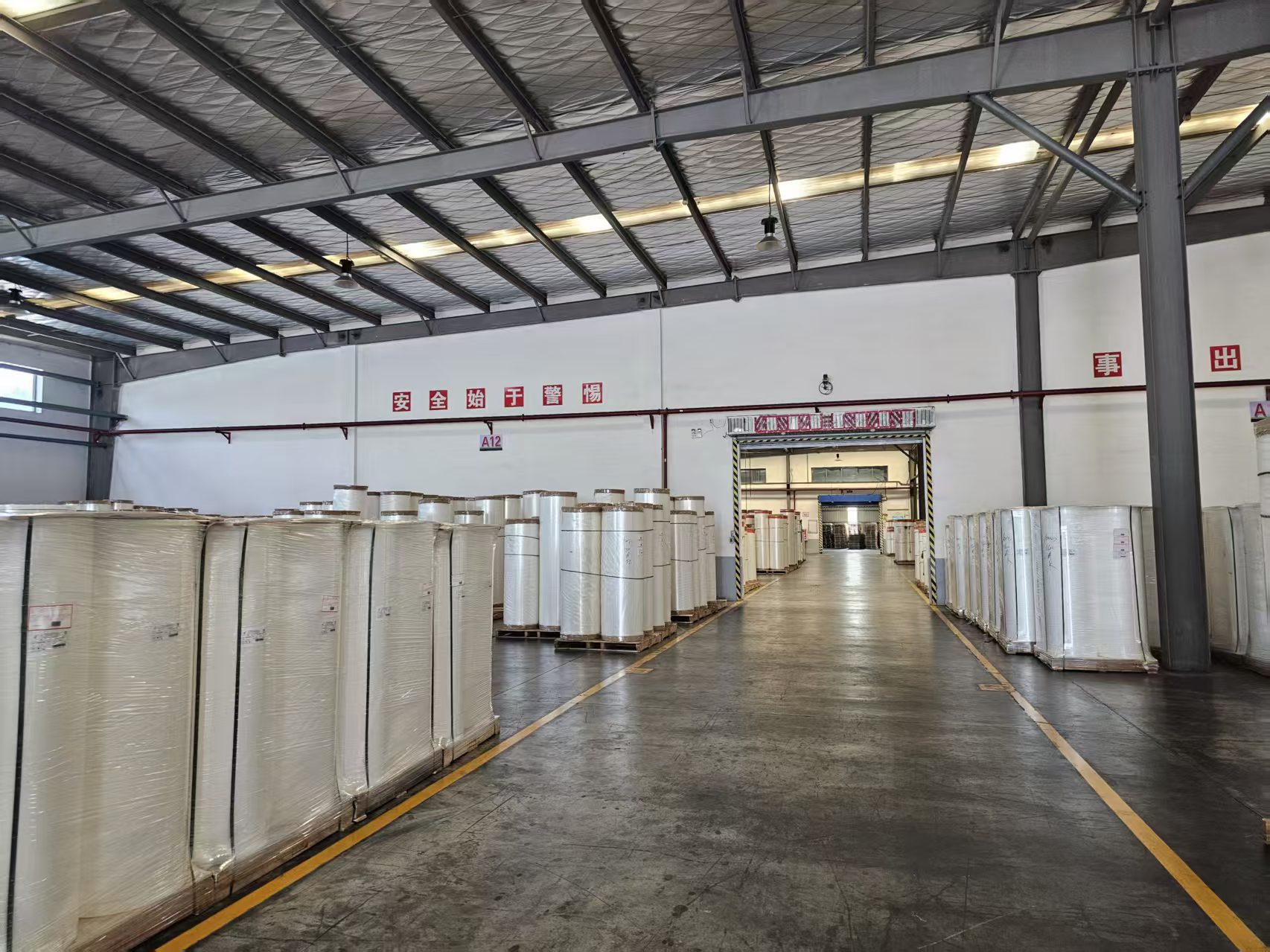
BOPP thermal lamination film rolls prepared for export. Winding quality and moisture-proof packaging are verified before dispatch because storage stability directly affects downstream lamination adhesion.
Why the Lamination Film Decision Has Become a Matrix
BOPP thermal lamination film is a biaxially oriented polypropylene film pre-coated with a heat-activated EVA adhesive layer, which bonds a protective, printable surface onto paper or board without a separate glue application step. That definition has not changed. What has changed is the way packaging buyers, commercial printers and film converters compare suppliers: the decision is no longer one product comparison, but a choice between three structurally different supply paths — high-speed commercial lamination film, soft-touch and anti-scratch premium finishing film, and no-primer base film for companies that produce thermal lamination film themselves.
Shandong Shunkai Composite Material Co., Ltd. (brand: SHKFILM) is a national high-tech enterprise founded in August 2010 and headquartered at No.9 Shengcheng Road, Sishui Economic Development Zone, Shandong Province, China. The company operates two Brückner BOPP production lines with an annual capacity of 30,000 tons, produces no-primer BOPP base film and BOPP thermal lamination film, and exports to markets including the Netherlands, Brazil, Italy, Greece, India, South Korea, Japan and Iran. All finished thermal lamination film supplied by SHKFILM is built on its own in-house produced no-primer base film. That is why the three product references discussed below — 6615, 6623 and 6544 — sit on the same production chain yet serve three different buyer decisions.
The Opportunity: Two Growth Curves, One Buying Question
Two market movements explain why a decision matrix is more useful than a single recommendation. Thermal lamination films are forecast to reach USD 1,547.9 million globally by 2025, with BOPP-based films as the leading film type segment (Future Market Insights). Within that category, the premium end is expanding: the soft touch film market was estimated at USD 2.9 billion in 2024 and is forecast to grow at a CAGR of 3.1% through 2034 (Future Market Insights), while anti-scratch and scuff-resistant finishes are cited as high-growth specialties in commercial print and premium packaging.
The substrate layer is expanding at a different rate. The global BOPP films market was valued at USD 31.0 billion in 2025 and is projected to reach USD 49.8 billion by 2033 (Grand View Research), with Asia Pacific holding the largest revenue share at 32.2% in 2025. Published estimates of that market differ — Future Market Insights places the 2025 figure at USD 35.7 billion and IMARC Group at USD 23.0 billion — which is itself a useful reminder for procurement teams: category numbers vary with scope, so they should frame a strategic decision, not a supplier decision.
The practical consequence is straightforward. A distributor in Brazil buying finished film for resale and a converter in Asia running its own extrusion coating line are reading the same market but need opposite answers. Price per kilogram does not separate them; machine compatibility, surface function, process structure and supply scale do.
The Three Decision Paths at a Glance
| Decision path | Reference product | Operating mode | Primary surface function | Supply evidence |
|---|---|---|---|---|
| A. High-speed commercial lamination | 6615 | High-speed automatic hot-press paper lamination | Improved paper foldability, moisture barrier and scratch protection for printing inks | Distributor purchases of 300 tons per year in Brazil and Italy for printing and packaging applications |
| B. Soft-touch / anti-scratch premium finishing | 6623 | Wet glue coating systems and automatic dry thermal lamination | Velvet soft-touch feel, anti-scratch surface protection, matte look | 1,000,000 square meters of base film supplied for soft-touch / anti-scratch films in India and South Korea |
| C. No-primer base film for in-house production | 6544 | Continuous master roll winding and unwinding; inline extrusion coating without primers or drying ovens | Unprimed substrate engineered for high-speed EVA extrusion coating | Product in use for over 10 years; cumulative supply exceeding 10,000 tons to manufacturers across multiple countries |
The table also defines the boundary between the paths. Paths A and B deliver a finished, ready-to-laminate film. Path C delivers an input material, and only becomes relevant to a buyer who already owns coating capability.
Path A: High-Speed Commercial Lamination (Product 6615)
Path A is the right route when the buyer's constraint is line throughput and ink-heavy printed surfaces. Product 6615 operates in high-speed automatic hot-press paper lamination mode and requires commercial thermal laminators and slitters. Its stated special requirements are concentrated in three areas: stable performance under shipping heat, strong bonding at lower temperatures, and bubble-free performance on heavy offset ink coverages.
For a commercial printer, those three requirements translate into a specific evaluation checklist:
- Machine fit first. If the finishing line does not run in automatic hot-press mode, this path is the wrong starting point regardless of price.
- Ink coverage test. Covers and packaging boxes with heavy offset ink coverage are the failure case for bubble formation, so trial lamination on the heaviest printed stock in the job mix is the relevant test — not a light-coverage sample.
- Shipping and warehouse heat. Films intended for long-sea freight and hot-climate warehousing need stable performance under shipping heat; a distributor's climate is part of the specification.
- Distribution model. Because buyers at this stage may resell rather than laminate, supply continuity matters as much as technical fit.
The commercial evidence for this path is distribution-led: product 6615 has been purchased by a distributor at 300 tons per year in Brazil and Italy for printing and packaging applications. For buyers evaluating a comparable distribution model, that is a scale and repeatability signal rather than a performance claim.
Path B: Soft-Touch and Anti-Scratch Premium Finishing (Product 6623)
Path B answers a different question — not how fast the line runs, but how the finished surface feels, wears and photographs. Product 6623 operates in both wet glue coating systems and automatic dry thermal lamination processes. It requires supporting equipment such as wet/dry laminators, thermal lamination machines and roll slitting equipment. Its special requirements are superior scuff-resistance rating, consistent velvet texture, and flawless visuals over dark background prints.
The distinction buyers should hold on to is functional, not aesthetic. BOPP Soft Touch Film combines a matte appearance with a soft, smooth and velvety tactile experience. Standard matte BOPP film mainly provides a low-gloss visual effect without additional tactile enhancement. In other words, standard matte film provides one finishing function, while soft-touch film provides two — which is why the two are not interchangeable at the same specification level.
Anti-scratch is a separate axis again. A specialized hard coat increases surface hardness by 40%, reaching 2H pencil grade, and improves scuff and abrasion resistance by more than 35% compared with a standard matte thermal film. The practical benefit is not a marketing benefit: it reduces rework caused by surface scratches during post-processing and handling and helps reduce product rejection caused by surface scratches. Anti-scratch thermal film remains compatible with standard thermal lamination equipment.
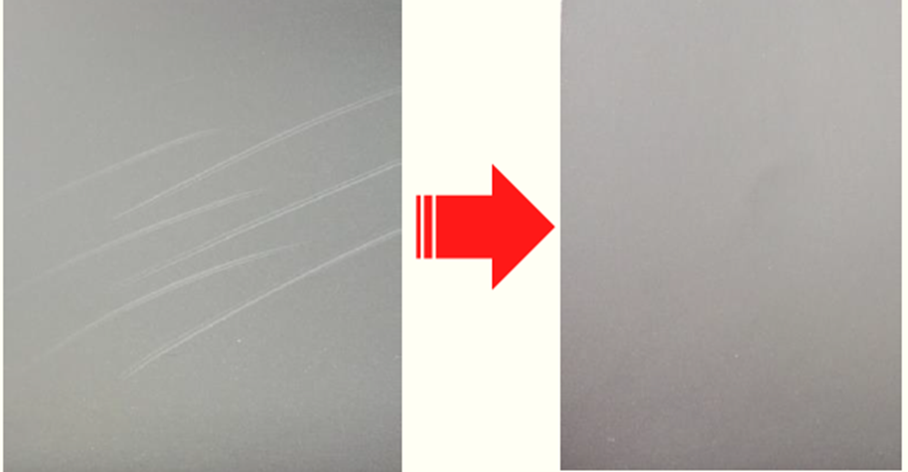
Standard matte BOPP film versus anti-scratch BOPP film: the anti-scratch hard coat raises surface hardness by 40% (2H pencil grade) and improves scuff and abrasion resistance by over 35%.
Application fit follows the surface function. BOPP Soft Touch Film suits premium packaging, luxury goods, cosmetic packaging, book covers, and applications requiring an enhanced tactile experience and higher product value. Project results reinforce the point: in India, the product achieved enhanced appearance with consistent soft-touch or scratch-resistant performance; in APAC and EU projects, it delivered a consistent soft-touch finish and premium appearance with reliable performance for high-end printed products and consistent performance across various printed materials; and in Asia it showed stable performance during subsequent EVA coating, supporting consistent quality of specialty thermal lamination films. Supply evidence for this path includes 1,000,000 square meters of base film supplied for soft-touch and anti-scratch films in India and South Korea.
Path C: No-Primer Base Film for In-House Thermal Lamination Production (Product 6544)
Path C is not a finished lamination film. Product 6544 is a no-primer BOPP base film — a substrate supplied as an input to film converting and coating plants that produce their own thermal lamination film. It operates in continuous master roll winding and unwinding mode and is designed for inline extrusion coating environments without primers or drying ovens, supplying an unprimed substrate optimized for high-speed EVA extrusion coating. Its supporting equipment set includes extrusion coaters, high-speed slitting machines and corona treaters. Its special requirements are specific and measurable: no chemical primer coating needed, corona tension of at least 38 dyne, and minimal crystal points and black spots.
Material structure explains why the primer step can be removed. The BOPP base film is made of BOPP resin; the thermal lamination film made from this base film is composed of BOPP resin and EVA coating; the specialty film (thermal type) is composed of BOPP resin, EVA coating and functional coating; and the specialty film (wet coating type) is composed of BOPP resin and functional coating. Compared with conventional primer-coated BOPP thermal lamination film, no-primer film eliminates one primer coating layer and one primer coating process during thermal lamination film production. The simplified film structure is associated with cleaner appearance, improved whiteness, better blocking resistance and reduced risk of surface migration.
The comparison against conventional base films is equally specific. No-primer BOPP base film is intended for thermal lamination film production, especially for manufacturers seeking primer-free solutions, while conventional BOPP base film serves broader applications, including direct lamination with paper. For manufacturers using established primer coating systems, conventional base film remains a workable route; the no-primer route is aimed at producers who want to remove the primer stage rather than manage it.
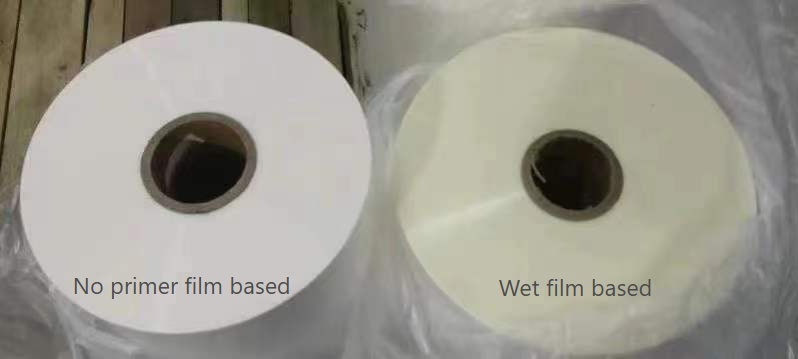
Conventional primer-coated thermal film versus no-primer thermal film: removing the primer layer removes one coating process, its drying energy and its related process-control requirements.
The evidence for this path is duration and volume rather than a single project. Product 6544 has been used for over 10 years, ensuring stable coating performance and consistent finished-film quality, and has been supplied in cumulative quantities exceeding 10,000 tons to manufacturers across multiple countries. A project involving products 6544 and 6647 was completed within 3 years, and the no-primer project achieved stable performance during subsequent EVA coating.
Specification and Compliance Checks That Apply to All Three Paths
Before any path is selected, four specification variables narrow the field: thickness, roll width, roll length and core diameter. The thermal lamination film thickness range is 17 to 27 microns and is customizable; roll width ranges from 320 mm to 2180 mm; available roll lengths include 2000 m, 3000 m, 4000 m, 4500 m, 6000 m and 9000 m; and core diameters are 3 inches (76 mm) and 6 inches (152 mm). Minimum order quantity depends on product type and specifications, and SHKFILM supports small-batch trial orders in addition to bulk supply, as well as OEM and private-label supply.
| Checkpoint | What to confirm | Why it affects the decision |
|---|---|---|
| Bonding performance | Bond strength and adhesion testing, controlled coating process, batch traceability | Weak adhesion or delamination is a batch-level failure that appears after lamination, not before |
| Shrinkage / curling | Lamination performance testing under standard conditions; technical guidance on temperature and pressure | Curling on thin paper and lightweight board is often a process-setting issue rather than a film defect |
| Coating weight / thickness | Online thickness monitoring, coating weight measurement, equipment calibration, batch inspection | Variation changes tactile consistency on soft-touch film and adhesion behaviour on standard film |
| Storage stability | Moisture-proof packaging, optimized winding, storage condition control, blocking resistance verification before shipment | Blocking and moisture-related haze can appear after long sea freight and hot-climate storage |
| Material supply continuity | Qualified supplier management, inventory planning, flexible production scheduling | Raw material price fluctuation passes into film pricing and lead time |
Compliance sits alongside specification. SHKFILM is certified to EU BRC, ISO 9001, QS Food and Customs AEO Advanced Enterprise standards, and its biodegradable film products are certified under the Green Leaf certification. For the EU market, the REACH SVHC certification applies under REACH Regulation (EC) No 1907/2006 and the Candidate List of 253 SVHCs; it was issued by SGS-CSTC Standards Technical Services Co., Ltd. with certificate number CANEC26006197603. Market-specific rules also apply at the destination: food-contact BOPP films in China must comply with GB 4806.15-2024 governing food-contact adhesives, effective February 2025, BOPP lamination films for US food contact must comply with FDA 21 CFR 177.1520, and BRC certification is often required for retail and food service supply chains in the US and UK.
Where Each Path Does Not Fit
A decision matrix is only credible if it states boundaries. Thermal lamination is not automatically the cheaper option: wet lamination film generally carries a lower film material cost but requires adhesive preparation, viscosity control, coating management and equipment cleaning, while thermal lamination film has higher film value because of the pre-coated adhesive while removing separate adhesive preparation and its related processing. Buyers with existing water-based laminating equipment and stable adhesive handling may still find wet lamination rational for book covers and large-format printing.
Within the premium paths, soft-touch film requires more precise process control to maintain consistent tactile performance and surface quality than standard matte film, and anti-scratch film carries a higher manufacturing cost because of the additional scratch-resistant coating. Neither is a default upgrade for jobs where a conventional matte finish already meets the brief.
Path C carries the clearest structural boundary of the three. No-primer BOPP base film may have higher material value than conventional BOPP base film because of its specialized surface technology, and it reduces downstream primer-related processing rather than replacing it with nothing — the buyer still needs extrusion coating capability, corona treatment and slitting. A distributor or commercial printer without coating lines cannot use this path at all; for them, paths A and B are the only operable options.
Market Trend Signals Behind the Matrix
Several published trends support the direction of this matrix. Matte thermal lamination films are increasingly used for high-end applications such as luxury paper box packaging and book covers. Anti-scratch and scuff-resistant finishes are cited as high-growth specialties in commercial print and premium packaging. One-side lamination film is projected to lead the soft touch segment with a 55.0% market share. On the supply side, Asia Pacific held the largest revenue share of the global BOPP films market at 32.2% in 2025, and the China BOPP film market was valued at approximately USD 5.7 billion in 2024.
Competitive structure is also relevant to procurement planning. Major global competitors in the BOPP film industry include Jindal Poly Films, Taghleef Industries and Cosmo First Ltd., and Cosmo Films has developed antimicrobial BOPP thermal lamination films to reduce bacterial colonization on packaged surfaces. For buyers, this indicates a category where functional differentiation — not only capacity — shapes supplier shortlists. It also indicates that product-route questions, such as the three paths above, are becoming a normal part of supplier evaluation rather than a technical afterthought.
Future Outlook
Three directions are visible from the evidence available today. First, process simplification is moving upstream: solvent-free no-primer BOPP base films improve adhesion to EVA and reduce energy consumption during extrusion coating, which aligns substrate sourcing with cost and energy targets rather than with coating-line management. Second, surface function is becoming a specification layer of its own — soft-touch and anti-scratch performance are now bought as measurable attributes (2H pencil grade, scuff and abrasion resistance) rather than as subjective finishes. Third, supply-scale evidence is becoming a standard part of supplier assessment, as buyers ask for cumulative tonnage, project duration and repeat distributor volume instead of single-order references.
For buyers planning 2026–2027 programmes, the practical implication is to define the path before defining the supplier. A high-speed commercial printer, a premium cosmetics box converter and a film coating plant will each shortlist different suppliers — and evaluating them against the same criteria set is where most comparison exercises lose their value.
FAQ
What is BOPP thermal lamination film, and how does it differ from wet lamination film?
BOPP thermal lamination film is pre-coated with a heat-activated EVA adhesive, so no separate adhesive is applied during lamination. BOPP wet lamination film requires separate water-based adhesive application during lamination. Thermal lamination film eliminates one separate adhesive application process compared with wet film, reducing process steps and simplifying adhesive preparation, coating and cleaning requirements. Wet film is generally suited to applications with existing water-based laminating equipment, such as book covers, large-format printing and paper packaging; thermal film is suited to commercial printing, digital printing, packaging and applications requiring efficient, clean and convenient lamination processing.
When is soft-touch BOPP film the better choice than standard matte BOPP film?
Standard matte BOPP film provides a low-gloss visual effect without additional tactile enhancement. BOPP Soft Touch Film combines a matte appearance with a soft, smooth and velvety tactile experience, providing two surface functions instead of one. It is suited to premium packaging, luxury goods, cosmetic packaging, book covers and applications requiring enhanced tactile experience and higher product value. The trade-off is process control: soft-touch film requires more precise control to maintain consistent tactile performance and surface quality, while standard matte film has a more conventional and stable production process.
What distinguishes a no-primer BOPP base film from a conventional primer-coated base film?
No-primer BOPP base film is produced with a specially developed BOPP base film that achieves direct adhesion with thermal adhesive layers without an additional primer or anchor coating layer. Conventional primer-coated thermal lamination film uses a primer-coated base film to enhance adhesion. The simplified structure is associated with cleaner appearance, improved whiteness, better blocking resistance and reduced risk of surface migration, and eliminates one primer coating layer and one primer coating process. Conventional BOPP base film generally has a lower unit material cost and broader application flexibility, including direct lamination with paper using adhesive systems.
What machine and process conditions does each of the three paths require?
Product 6615 operates in high-speed automatic hot-press paper lamination mode and requires commercial thermal laminators and slitters. Product 6623 operates in both wet glue coating systems and automatic dry thermal lamination processes and requires wet/dry laminators, thermal lamination machines and roll slitting equipment. Product 6544 operates in continuous master roll winding and unwinding mode within inline extrusion coating environments without primers or drying ovens, and requires extrusion coaters, high-speed slitting machines and corona treaters, with corona tension of at least 38 dyne.
Which specifications and compliance documents should be confirmed before ordering BOPP thermal lamination film?
Confirm thickness within the 17 to 27 micron range and any customization requirement, roll width from 320 mm to 2180 mm, roll length from the available 2000 m, 3000 m, 4000 m, 4500 m, 6000 m and 9000 m options, and core diameter of either 3 inches (76 mm) or 6 inches (152 mm). Minimum order quantity depends on product type and specifications. On compliance, SHKFILM holds EU BRC, ISO 9001, QS Food and Customs AEO Advanced Enterprise certification, with Green Leaf certification for biodegradable film products and REACH SVHC certification under REACH Regulation (EC) No 1907/2006 issued by SGS-CSTC Standards Technical Services Co., Ltd. under certificate number CANEC26006197603. Destination requirements such as GB 4806.15-2024, FDA 21 CFR 177.1520 or BRC supply-chain requirements should be checked against the end market.
How should a buyer decide between purchasing finished thermal lamination film and producing it in-house from base film?
The determining factor is ownership of coating capability. Buyers without extrusion coating, corona treatment and slitting capability cannot convert base film and should evaluate finished film paths — product 6615 for high-speed commercial lamination, or product 6623 for soft-touch and anti-scratch premium finishing. Buyers who already operate coating lines and want to remove a process stage should evaluate no-primer base film, which eliminates one primer coating layer and its associated drying energy and process control. Supply-scale evidence supports both models: product 6544 has been in use for over 10 years with cumulative supply exceeding 10,000 tons, 6623 has 1,000,000 square meters of base film supplied for soft-touch and anti-scratch films in India and South Korea, and 6615 is purchased by a distributor at 300 tons per year in Brazil and Italy.
Reference Material
The SHKFILM product brochure, including base film and thermal lamination film series specifications, can be downloaded here: SHKFILM brochure (PDF).
Есть вопросы или нужны дополнительные детали?
Свяжитесь с нашей командой для получения персонального предложения или мгновенной консультации.
Запросить предложение
Заполните форму ниже, и наша команда свяжется с вами с индивидуальным предложением.
Прямой чат WhatsApp
Предпочитаете общаться в реальном времени? Напишите нам в WhatsApp для мгновенной помощи и быстрых ответов.
- Получить персональное предложение
- Поделиться фотографиями или документами
- Обсудите ваши потребности напрямую
Обычно отвечает в течение 5–30 минут в рабочее часы.