
BOPP Thermal Lamination Film Compliance: What Validates Reliable Adhesion
Independent industry reference · Packaging & Printing · Buyer research and evaluation

BOPP thermal lamination film in warehouse storage before export packing. Image: SHKFILM.
BOPP thermal lamination film is a two-layer construction: a biaxially oriented polypropylene base film carrying a heat-activated EVA adhesive coating. It reaches the converter adhesive-ready, and the lamination step itself is a dry process in which heated rollers activate the coating and bond the film to the printed sheet.
That construction makes adhesion the defining performance variable. A roll can satisfy every dimensional specification and still fail commercially if the adhesive layer separates from the base film, if the roll blocks at the core before it is ever laminated, or if the bond lifts at the edges after embossing, hot stamping, or a long sea voyage.
For packaging buyers working through research and evaluation, the practical difficulty is that suppliers present qualification material that does not all answer the same question. This article separates BOPP thermal lamination film qualification into three verifiable layers — certification scope, product specification data, and cumulative supply record — and explains what each layer can and cannot demonstrate about reliable adhesion.
The Evidence Gap: Why a Folder of Certificates Does Not Prove Adhesion
Adhesion problems in paper lamination rarely appear on the purchase order. They appear downstream: a dark solid-ink box cover that blisters after hot stamping, edges that lift on a folded carton, or a roll core that blocks during unwinding and wastes material before a single sheet is finished.
Because those failures surface late, buyers often substitute document volume for process evidence — comparing how many certificates a supplier can produce rather than whether the documents are scoped to the failure mode being evaluated. Two suppliers can hold broadly similar management-system certificates and still behave differently on the same laminator, because management certification describes how a plant is governed, not how a specific adhesive layer bonds to a specific base film.
The opportunity sits in the opposite direction. Suppliers that manufacture the base film, apply the adhesive, and slit the finished roll inside one operation can document the adhesion-critical steps at the point where they occur, rather than assembling evidence from third-party coating suppliers. That is the qualification logic buyers should be looking for: evidence tied to the bond line, not evidence tied to the letterhead.
| Evidence layer | What it verifies | What it does not verify |
|---|---|---|
| System and product certification | Process governance, market access, food-contact scope, restricted-substance screening | Bond behaviour on a specific laminator, at a specific roller temperature and line speed |
| Product specification data | Thickness, corona treatment values, core diameter, roll width and length, surface finish | How the film will behave over heavy offset ink coverage or under shipping heat |
| Cumulative supply record | Process stability repeated across substrates, machines and years of repeat ordering | Replacement for a trial on the buyer's own paper, ink and equipment |
How SHKFILM Structures Adhesion Control Upstream
SHKFILM is the brand of Shandong Shunkai Composite Material Co., Ltd., a Chinese manufacturer of polymer composite materials founded in August 2010 and headquartered at No.09 Shengcheng Road, Sishui Economic Development Zone, Shandong Province. The company produces No-primer BOPP Base Film and BOPP Thermal Lamination Film, operates two BOPP film production lines imported from Brückner (Germany), and reports an annual capacity of 30,000 tons with 235 employees and a 10-engineer R&D team across a 146,667 m² site.
The qualification-relevant detail is vertical integration at the base film stage. SHKFILM's stated core strength is the R&D and manufacturing of no-primer base film, and all finished thermal films are described as using 100% in-house produced no-primer base film. For a buyer evaluating adhesion, that means the substrate surface, the corona treatment and the finished film are controlled inside one process chain rather than assembled from separately sourced materials.
SHKFILM is certified to EU BRC, ISO 9001, QS Food and Customs AEO Advanced Enterprise standards, holds the Green Leaf certification for biodegradable film products, and has been designated a Shandong Province Manufacturing Single Champion Product Enterprise and a National “Specialized, Sophisticated, Distinctive and Innovative” (Little Giant) Enterprise. Its documented quality control covers online process monitoring, thickness inspection, corona treatment verification, optical appearance inspection, and laboratory testing of properties such as tensile strength, elongation, haze, gloss and coefficient. Reported lead time is 15–20 days with a monthly capacity of 3,000 tons, and the company supports OEM and private-label supply as well as small-batch trial orders alongside bulk supply.
What Happens at the Bond Line: Base Film, Corona Treatment and EVA
The technical difference between the two common lamination routes is where the adhesive sits. Thermal lamination film is pre-coated with heat-activated EVA adhesive, while wet lamination film requires a separate water-based adhesive applied during lamination. The first route moves the bonding step into the film supplier's factory; the second leaves it on the converter's line.
For the thermal route, SHKFILM's No-Primer Base Film Series is supplied in gloss and matte versions at 12 micron and 15 micron, with outside corona treatment of ≥38 dyne, core diameters of 3 inch (76 mm) or 6 inch (152 mm), roll widths from 300 mm to 2,580 mm, and roll lengths of 9,100 m, 12,100 m and 18,100 m. On the thermal lamination film production line, the extruded EVA hot-melt adhesive bonds directly with this base film at the molecular level, which the company describes as producing a permanent bond between the EVA adhesive layer and the BOPP base film that prevents delamination or tearing.
Two failure mechanisms are addressed by removing the primer. First, blocking: with water-based primer-coated base film, high winding pressure can cause sticking at the roll core, resulting in hundreds of meters of wasted material and scrapped rolls, whereas the no-primer route is presented as enabling 100% material utilization. Second, appearance and migration: traditional primers can age, yellow or migrate chemically over time, while the no-primer base film is described as keeping the finished thermal film pure white and clear and preventing static buildup that would otherwise complicate downstream slitting and printing.
On the finished thermal film, the base film and adhesive layer are thermally fused at the molecular level, producing a pure white, translucent appearance without chemical migration or static residue. SHKFILM states that this imparts exceptional peel strength to the finished product, keeps edges secure, and prevents blistering during downstream processes such as embossing, hot stamping or long-term ocean transport. The matte wet lamination product is specified separately: 12 micron and 15 micron, outside corona ≥42 dyne and inside ≥38 dyne, roll widths of 300–2,240 mm, and roll lengths from 4,000 m to 18,100 m, with requirements including high corona retention, water-glue wet-out, zero fish-eyes and high mattness.
The finished BOPP thermal lamination film series is offered in gloss and matte at 17–27 micron, with inside corona ≥40 dyne and roll widths from 320 mm to 2,180 mm, while the specialty anti-scratch and soft-touch series runs from 18 micron to 29 micron with a fixed 3–4 micron functional top-coat. Each of these figures matters at the bond line, because adhesion is a system outcome: film thickness, surface energy, adhesive activation temperature and substrate moisture all participate.
Qualification Documents and Their Actual Scope
The second verifiable layer is the certificate itself. Compliance documents become useful to a buyer only when the scope statement is read alongside certification number, issuing body and validity period.
| Document | Issuer and reference | Scope relevant to lamination |
|---|---|---|
| ISO 9001:2015 | Qingdao Wanhui Inspection and Certification Co., Ltd., No. 57626Q00025R201 | R&D and production of BOPP films and processing of functional films, covering the no-primer base film and matte wet lamination film |
| BRCGS Global Standard for Packaging Materials, Issue 7 | SGS, Certificate No. CN19/10136, valid to 31 January 2027 | Extrusion, stretching, rewinding and slitting of BOPP film from PP resin for direct and indirect food contact |
| Customs AEO Advanced Certified Enterprise | Qingdao Customs of the People's Republic of China, No. A4202580, issued 13 July 2026 | Import and export activities for manufactured plastic films and laminating materials; mutually recognized in the EU, North America, the UK, Singapore, South Korea, Japan and over 50 economies |
| REACH SVHC (EC) No 1907/2006 | SGS-CSTC Standards Technical Services Co., Ltd., No. CANEC26006197603 | Specialty lamination films, candidate list of 253 SVHCs, EU market |
| RoHS Directive (EU) 2015/863 | SGS-CSTC, No. CANEC26006197601 | Specialty lamination films for EU and global markets |
| Halogen-free, EN 14582:2016 | SGS-CSTC, No. CANEC26006197605 | Thermal-type specialty lamination films including anti-scratch and soft-touch grades |
| VOC content verification | SGS-CSTC, Nos. CANEC26006194201 and CANEC26006194203, to GB 33372-2020 | Anti-scratch gloss and matte films, and the 3-in-1 anti-scratch, soft-touch and anti-fingerprint film, in wet and thermal types |
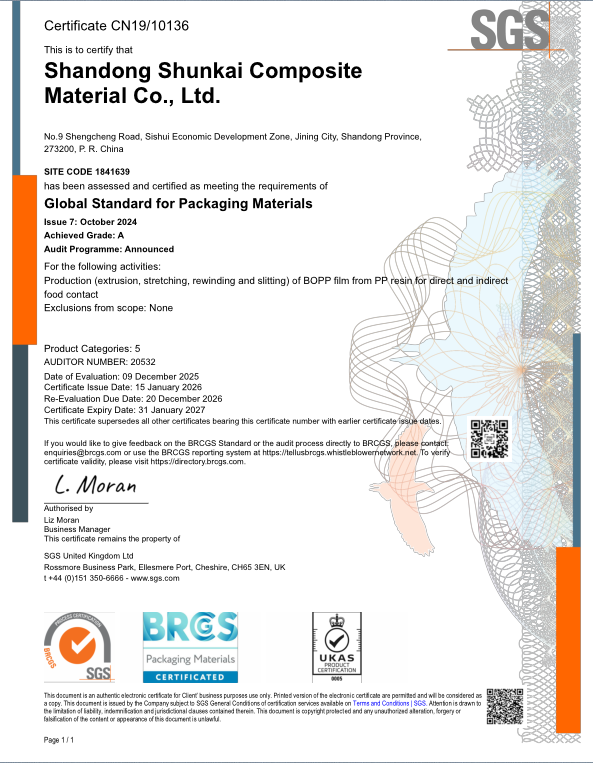
BRCGS Global Standard for Packaging Materials certification (Certificate No. CN19/10136), covering BOPP film production for direct and indirect food contact. Image: SHKFILM.
Read together, these documents describe a supplier that can be placed in food-contact and restricted-substance supply chains, and that carries customs credit recognized across major export markets. What they cannot do is tell a converter whether a 17 micron matte thermal film will hold on a line running heavy offset ink at a given roller temperature. That is a separate evidence layer.
Cumulative Supply as De Facto Adhesion Evidence
The third layer is the least formal and often the most informative: how long a product has been supplied, in what volume, and to which markets.
SHKFILM's BOPP Matte Film for Wet Lamination has been supplied in cumulative quantities of 2,500 tons through a nine-year ongoing supply relationship with distributors in South Korea, the Netherlands and Italy. The documented outcome of that relationship is smooth lamination with reliable adhesion and stable processing performance in paper lamination, with high flatness after lamination, adaptability to various paper substrates, and compatibility with high-speed laminating equipment.
The No-primer BOPP Base Film for BOPP Thermal Lamination Film has been supplied to clients in multiple countries, including Brazil, South Korea, India, Iran and Japan. Both the no-primer base film and the matte wet lamination film are used for the production of soft-touch and anti-scratch thermal lamination films, and one such project runs at 120 tons per year over a three-year duration with a functional-coated base film designed for subsequent EVA coating. A separate three-year relationship with a thermal lamination film manufacturer describes stable coating performance and compatibility with subsequent coating and EVA coating.
Why this matters for adhesion specifically: bond defects caused by blocking, primer migration or corona decay tend to appear in the first production runs, not after years of repeat ordering. A nine-year relationship that continues to renew is therefore a filtered signal — the film has stayed inside the converter's process window across different paper substrates and different machines, and the buyer has had repeated opportunity to switch suppliers and has not. Cumulative volume does not replace a test report, but it is evidence that no test report can manufacture.
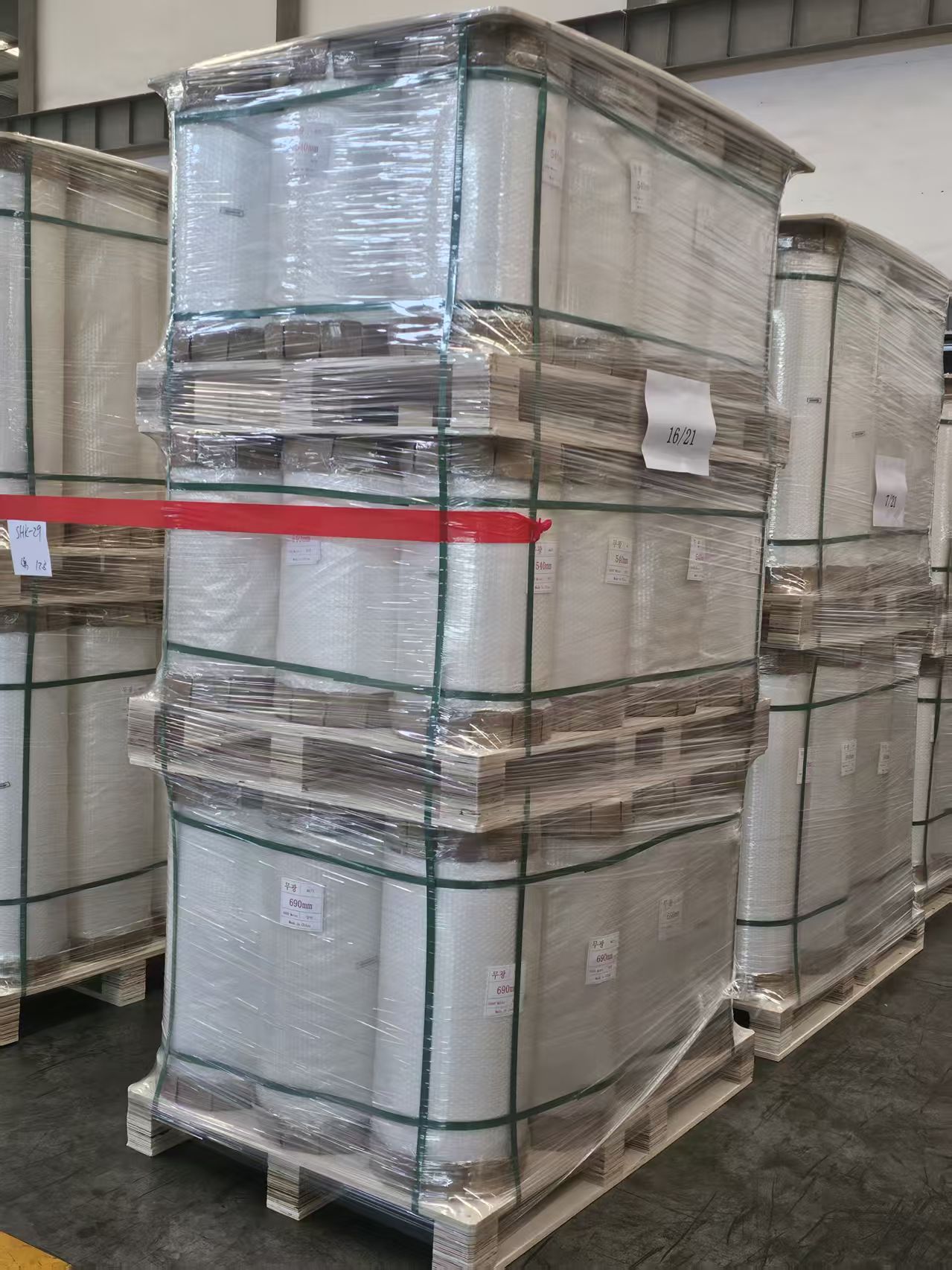
Matte wet lamination film prepared for export shipment within a long-running distributor supply programme. Image: SHKFILM.
Where Reliable Adhesion Is Actually Tested
Adhesion requirements differ by application, and the qualification question changes with the working condition.
Book covers, folding cartons and printed leaflets. These run on commercial offset presses and post-press finishing lines, where thermal film is applied by high-speed automatic hot-press lamination using heated rollers, with no solvent odour or on-site adhesive coating. The stated requirements are strong bonding at lower temperatures, bubble-free results over heavy offset ink coverage, moisture barrier and scratch protection for printing inks, and stable performance under shipping heat.
Cosmetic, personal care and electronics rigid boxes. Here the film is laminated over heavy ink coverage and dark solid backgrounds, and the working condition is described as premium post-press lamination on cosmetic and perfume boxes, smartphone packaging, wine packaging and luxury book covers. The film must deliver a velvet soft-touch feel alongside anti-scratch surface protection, work in both wet glue coating systems and automatic dry thermal lamination processes, and produce flawless visuals over dark prints.
Wet lamination shops and coating plants. On conventional wet lamination lines, water-based glues are applied and cured through a heated drying channel at 50–70 °C. The relevant film properties are high corona retention, water-glue wet-out, zero fish-eyes and high mattness — surface conditions that determine whether the adhesive wets the film evenly.
Extrusion coating mills. For BOPP coating and film converting plants, the no-primer substrate is designed for inline extrusion coating of EVA hot-melt adhesive without primers or drying ovens, with corona tension ≥38 dyne and minimal crystal points and black spots. This is the environment in which the anti-blocking and energy arguments are most directly testable.
Market Trend: Compliance Pressure Is Rising With the Lamination Market
The commercial context supports the shift toward documented qualification. Grand View Research values the global BOPP films market at USD 31.0 billion in 2025, projected to reach USD 49.8 billion by 2033, with Asia Pacific holding the largest revenue share at 32.2% in 2025. Future Market Insights forecasts the thermal lamination films market to reach USD 1,547.9 million by 2025, with BOPP-based films as the leading film type segment.
Specialty demand is moving in the same direction. Future Market Insights estimates the soft touch film market at USD 2.9 billion in 2024, growing at a CAGR of 3.1% through 2034, and cites anti-scratch and scuff-resistant finishes as high-growth specialties in commercial print and premium packaging. Matte thermal lamination films are increasingly used in luxury paper box packaging and book covers.
Regulatory expectations are tightening in parallel. In China, food-contact BOPP films must comply with GB 4806.15-2024 governing food-contact adhesives, effective February 2025. For international trade, BOPP films supplied into US and UK retail and food service chains often require BRC certification, and BOPP lamination films for US food contact must comply with FDA 21 CFR 177.1520. Taken together, these trends mean qualification documentation is moving from a purchasing formality toward a scoped supply-chain requirement, and the practical question for buyers becomes less about how many certificates a supplier holds and more about what each certificate actually covers.
No-Primer Versus Primer-Coated Base Film — and the Limits of the Comparison
| Comparison point | Primer-coated base film for thermal film | No-primer base film (SHKFILM No-Primer Base Film Series) |
|---|---|---|
| Roll-core blocking | High winding pressure can cause sticking at the core; hundreds of meters wasted, rolls scrapped | Back-side blocking eliminated, described as enabling 100% material utilization |
| Appearance over time | Primers can age, yellow or migrate chemically | Finished film remains pure white and clear; static buildup prevented |
| Process energy and emissions | Requires primer application and drying ovens | No primer and no drying ovens; no ozone or VOC emissions from the primer step |
| Bond formation | Adhesion mediated through a primer layer | Extruded EVA hot-melt adhesive bonds directly to the base film at the molecular level, described as preventing delamination or tearing |
Where the comparison stops being useful. The no-primer advantage is a process-specific claim. It applies to inline extrusion coating of EVA hot-melt adhesive in environments without primers or drying ovens. A converter running a conventional primer-based coating line will not realize the blocking or energy benefits, because the process step being eliminated is still part of their operation.
Equally, wet lamination film is not a drop-in substitute for thermal film. BOPP Matte Film for Wet Lamination is used with separate water-based adhesive and requires a heated drying channel at 50–70 °C; substituting it onto a dry thermal laminator would remove the very adhesive system the process depends on.
Two further boundaries apply to the qualification material itself. First, certificates are scope-bound: the BRCGS certificate covers production of BOPP film from PP resin for direct and indirect food contact at the certified site, not the finished package produced by a downstream converter, and the SGS test reports apply to the film scope and test date stated on each report. Second, corona treatment values are specified at the point of supply; converters handling demanding jobs typically re-verify surface treatment before running. Neither the certificates nor the cumulative supply record can substitute for a trial on the buyer's own paper, ink and laminator using the exact thickness and finish specified.
Future Outlook
Three shifts are worth planning around. First, food-contact adhesive requirements are becoming more explicit, as the Chinese GB 4806.15-2024 timeline shows; buyers should expect suppliers to present scoped certificates rather than general claims about food safety.
Second, upstream integration will increasingly function as qualification evidence. When finished thermal films are made with 100% in-house produced no-primer base film, the supplier can document the substrate and its corona treatment at the source rather than reconstructing it from a purchased roll lot. Suppliers with a documented multi-country client base — such as SHKFILM's no-primer base film supply to Brazil, South Korea, India, Iran and Japan — can also demonstrate that the process travels across markets with different substrates and equipment.
Third, specialty growth will push qualification toward combined performance testing. Anti-scratch, soft-touch and anti-fingerprint finishes must satisfy adhesion and surface-durability requirements at the same time, so approved-vendor files are likely to move from single certificates toward layered evidence: certification scope, specification data, and a supply record that shows the process repeating.
FAQ: Qualifying BOPP Thermal Lamination Film
What does reliable adhesion mean for BOPP thermal lamination film?
It describes a bond between the EVA adhesive layer and the BOPP base film that holds through downstream processing. In SHKFILM's thermal film, the base film and adhesive layer are thermally fused at the molecular level, which the company states gives the finished product exceptional peel strength so edges remain secure and blistering does not occur during embossing, hot stamping, or long-term ocean transport. For wet lamination, the corresponding evidence is a documented nine-year supply relationship in which the reported outcome is smooth lamination with reliable adhesion and stable processing performance in paper lamination.
What is the difference between no-primer base film and primer-coated base film?
A primer-coated base film carries a water-based primer layer between the base film and the extruded EVA adhesive. A no-primer base film omits that layer so the extruded EVA hot-melt adhesive bonds directly to the base film at the molecular level. SHKFILM's no-primer base film is supplied in gloss and matte versions at 12 micron and 15 micron with outside corona ≥38 dyne, and the company states that removing the primer eliminates back-side blocking at the roll core, prevents primer ageing, yellowing and migration, and removes the need for primer application and drying ovens.
Which parameters should a buyer verify before specifying the film?
The specification set that determines fit with the laminator includes thickness, corona treatment values, core diameter, roll width and roll length. SHKFILM's no-primer base film is specified at 12 micron and 15 micron with outside corona ≥38 dyne, cores of 3 inch or 6 inch, widths from 300 mm to 2,580 mm, and lengths of 9,100 m, 12,100 m and 18,100 m. The matte wet lamination film is specified at 12 micron and 15 micron, with outside corona ≥42 dyne and inside ≥38 dyne, widths of 300–2,240 mm, and lengths from 4,000 m to 18,100 m. Customization covers film thickness from 12 to 32 micron, roll width from 200 mm to 2,580 mm, and roll length from 2,000 m to 18,100 m.
Which certificates matter for EU and US packaging markets?
For food-contact packaging, the BRCGS Global Standard for Packaging Materials certificate (No. CN19/10136, issued by SGS) covers extrusion, stretching, rewinding and slitting of BOPP film from PP resin for direct and indirect food contact. For restricted substances in the EU, SGS reports cover REACH SVHC (No. CANEC26006197603), RoHS (No. CANEC26006197601) and halogen-free verification to EN 14582:2016 (No. CANEC26006197605). ISO 9001:2015 (No. 57626Q00025R201) covers R&D and production of BOPP films, and the Customs AEO Advanced Certified Enterprise certificate (No. A4202580) supports customs credit and mutual recognition across more than 50 economies. For the US market, BOPP lamination films for food contact must comply with FDA 21 CFR 177.1520, and in China, food-contact BOPP films must comply with GB 4806.15-2024 for food-contact adhesives, effective February 2025.
Does cumulative supply volume prove adhesion performance?
It is not a substitute for a test report, but it is a filtered signal. SHKFILM's BOPP Matte Film for Wet Lamination has been supplied in cumulative quantities of 2,500 tons through a nine-year ongoing supply relationship with distributors in South Korea, the Netherlands and Italy, with the reported result of smooth lamination, reliable adhesion, high flatness after lamination, adaptability to various paper substrates and compatibility with high-speed laminating equipment. The no-primer base film has been supplied to clients in Brazil, South Korea, India, Iran and Japan, and both products are used for the production of soft-touch and anti-scratch thermal lamination films, including a 120 tons-per-year project over three years.
What can qualification data not tell a buyer?
Certificates are scope-bound. The BRCGS certificate applies to BOPP film production at the certified site and not to a converter's finished package, and SGS test reports apply to the listed film scope and test date. Corona treatment values are specified at the point of supply, so surface condition is worth re-checking before demanding jobs. Process benefits are also conditional: the no-primer advantage assumes inline extrusion coating without primers or drying ovens, and matte wet lamination film requires separate water-based adhesive with a 50–70 °C drying channel rather than dry thermal processing. None of this replaces a trial on the buyer's own paper, ink and laminating equipment.
Reference material for product specifications, certification scope and packing options is available in the SHKFILM brochure: SHKFILM product and certification brochure.