
BOPP Thermal Lamination Film: Soft-Touch or Anti-Scratch?
Independent Buyer Reference · Packaging & Printing
Soft-touch and anti-scratch BOPP thermal lamination films both deliver a low-gloss matte surface, which is why purchasing teams frequently quote them against a single specification sheet. They are not interchangeable. Soft-touch is a tactile specification. Anti-scratch is a durability specification. A film can be strong on one and only average on the other, and most purchase decisions turn on which failure mode the buyer can least afford: a cover that feels unremarkable on shelf, or a surface that scuffs between the laminator and the retail carton.
This article compares the two grades as an independent buyer would, using published supply records from converters, commercial printers and distributors across India, South Korea, Brazil, Italy, the Netherlands, Iran and Japan. It examines what each grade is engineered to do, where the four reference supply programmes actually held up, how acceptance criteria should be written, and how buyers should weigh tactile finish against scratch resistance during the decision-to-execution stage.
Why the specification question moved upstream
The choice between two matte grades only became a routine purchasing decision once matte itself stopped being a differentiator. The global thermal lamination films market is forecast to reach USD 1,547.9 million by 2025, with BOPP-based film as the leading film type segment, according to Future Market Insights. That same body of research values the soft-touch film market at USD 2.9 billion in 2024, growing at a 3.1% CAGR through 2034, with one-side lamination projected to lead the segment at roughly 55.0% share.
Two further signals matter to buyers. Anti-scratch and scuff-resistant finishes are cited as a high-growth specialty in commercial print and premium packaging, and matte thermal lamination film is increasingly specified for luxury paper box packaging and book covers. The practical consequence is that matte finish is now a baseline expectation rather than a premium feature. Differentiation has shifted to the two properties that matte alone does not guarantee: how the surface feels in the hand, and how it survives handling.
What each grade is actually engineered to do
The distinction is mechanical, not cosmetic. Both grades are matte BOPP thermal lamination films, but they optimise different surface behaviours.
Soft-touch grade: two surface functions in one film
A BOPP soft-touch film combines a matte appearance with a soft, smooth, velvet-like tactile experience. Compared with standard matte BOPP film, which mainly delivers a low-gloss visual effect, soft-touch film performs two surface functions at once: appearance and tactile perception. SHKFILM's own comparison material notes that this dual function requires more precise process control to maintain consistent tactile performance and surface quality, while standard matte film follows a more conventional and more stable production route.
The buying implication is straightforward. Soft-touch is specified where the printed piece is expected to be picked up, held or handled before purchase: premium packaging, luxury goods, cosmetic cartons, book covers and printed collateral intended to signal product value.
Anti-scratch grade: a hard coat on a matte base
Anti-scratch thermal film provides enhanced scratch resistance while maintaining a high-quality matte appearance. The mechanism is a specialised hard coat. In SHKFILM's published comparison against standard matte thermal film, that coat is described as increasing surface hardness by about 40%, reaching a 2H pencil grade, and improving scuff and abrasion resistance by more than 35%.
Because the coat is applied at the film stage rather than added downstream, anti-scratch film remains compatible with standard thermal lamination equipment. Its operational value is therefore less about new capability than about reduced rework: fewer sheets rejected for surface scratching during post-processing, handling, packing and transport.
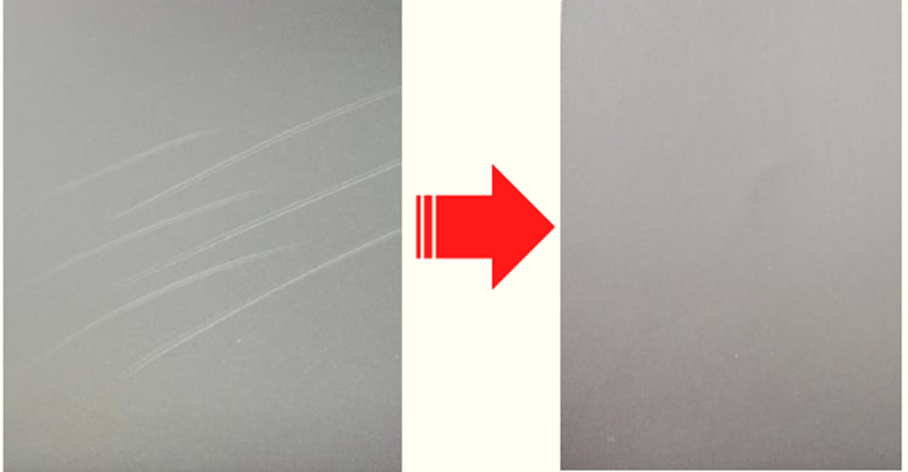
Diagram: standard matte BOPP thermal film compared with anti-scratch BOPP thermal film on surface hardness and scuff resistance.
| Attribute | Standard matte BOPP film | Soft-touch BOPP film | Anti-scratch BOPP film |
|---|---|---|---|
| Primary function | Low-gloss appearance | Matte appearance plus tactile feel | Matte appearance plus surface hardness |
| Differentiating property | Reflection control | Velvet-like hand feel | Scratch and scuff resistance |
| Typical specification driver | General print and packaging | Premium packaging, book covers, cosmetics | Packaging prone to friction and abrasion |
| Process control demand | Conventional | Higher, to hold tactile consistency | Higher, to protect the hard coat |
| Cost position | Economical matte option | Higher added value | Higher, due to the additional coating |
Four supply records: where each grade held up
Specification sheets describe intent. Cumulative supply records describe behaviour. Four reference programmes are useful because they cover different failure modes: tactile consistency, coating stability, lamination consistency and distributor-level repeatability.
Product 6623: tactile performance plus scratch resistance, India and South Korea
Product 6623 was supplied into a printed materials programme in India covering approximately 1,000,000 square meters of film and completed within two years. The stated problem was achieving premium tactile and protective performance in the same printed piece. Reported highlights were a premium tactile effect combined with excellent scratch resistance.
A commercial printing and packaging supply of 30 tons in South Korea ran on a comparable requirement. That programme reported a consistent soft-touch finish, a velvet-like tactile effect, excellent scratch resistance, availability in gloss and matte finishes, and compatibility with high-speed laminating machines. For buyers, the relevant signal is not the tonnage but the pairing: tactile finish and abrasion resistance validated together rather than traded off.
Product 6544: no-primer base film, more than 10,000 tons cumulative
Product 6544 is a different kind of reference. It is a no-primer BOPP base film used by thermal lamination film manufacturers, not a finished lamination film. Over a cumulative supply exceeding 10,000 tons across Brazil, South Korea, India, Iran and Japan, the product demonstrated stable coating performance and consistent finished-film quality. Its technical requirements are specific: no chemical primer coating needed, corona tension of at least 38 dyne, and minimal crystal points and black spots.
The consequence for the finished-film buyer is indirect but real. Conventional primer-coated thermal lamination film production requires additional energy for primer coating, drying and related auxiliary processes. No-primer film eliminates those stages, reducing energy requirements and simplifying the manufacturing workflow. SHKFILM states that its BOPP thermal lamination films use 100% in-house produced no-primer base film, with the base film and adhesive layer thermally fused at the molecular level.
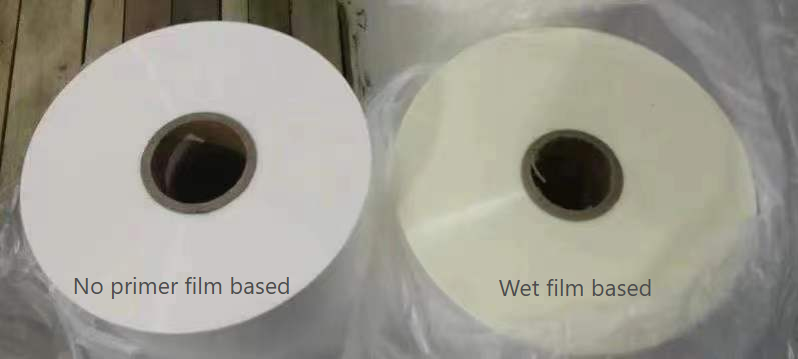
Diagram: the primer-coated film structure compared with a no-primer BOPP base film structure used for thermal lamination.
Product 6647: matte consistency across 2,500 tons over nine years
Product 6647 addresses the opposite risk to 6623. Here the question was whether lamination quality would remain consistent across a long, cumulative supply rather than across a single promotional run. The programme reached 2,500 tons over nine years of supply to South Korea, the Netherlands and Italy, achieving smooth lamination with reliable adhesion and stable processing performance in paper lamination applications.
Its stated requirements are technical and unforgiving: high mattness, zero fish-eyes, excellent water-glue wet-out and high corona retention. A matte film that loses corona retention or develops fish-eyes does not fail in the lab; it fails at the laminator, after the paper has already been printed.
Product 6615: a distributor buying 300 tons per year
The fourth record is the most relevant to distributors. A Brazil and Italy based distributor purchases 300 tons of product 6615 per year. The specification demands are again specific: strong bonding at lower temperatures, bubble-free performance on heavy offset ink coverages, and stable performance under shipping heat.
Distributors face a different test from converters. They carry stock, resell without further processing, and absorb the complaint when a film behaves differently in a customer's lamination line than it did in the sample. A continuous 300-ton annual programme in two markets is evidence of repeatability rather than of capability.
Comparing on the criteria that decide acceptance
Most purchase disputes on lamination film do not concern the headline finish. They concern what happens at the machine and in the warehouse. The table below converts the reference records into testable criteria.
| Criterion | What to verify | Where the grades diverge |
|---|---|---|
| Tactile target | Hand-feel against an approved reference sample, assessed by more than one evaluator | Soft-touch is defined by feel; anti-scratch is not |
| Scratch and scuff | Abrasion and rub testing on the finished laminated sheet, not on the roll | Anti-scratch is the harder surface by design |
| Optical clarity | Haze level, fish-eyes, specks and crystal points against an agreed limit | Both grades require high purity; zero fish-eyes is critical on matte |
| Adhesion | Bond strength after lamination at the production temperature actually used | Both, but heavy ink coverage exposes weak adhesion first |
| High-speed compatibility | Trial run at line speed, with bubble and blister inspection | Soft-touch demands tighter process control |
| Storage behaviour | Blocking resistance and moisture-related haze after defined storage | Shared requirement; no-primer structures reduce blocking risk |
| Cost per square meter | Film cost plus expected rework and rejection rate | Anti-scratch costs more per roll, soft-touch costs more in process control |
Adhesion, clarity and high-speed compatibility are shared requirements
It is easy to treat soft-touch and anti-scratch as a two-way choice and forget that both sit on the same base film platform. Buyers should verify the shared layer first, because failures there make the finish question irrelevant.
- Reliable adhesion. Bonding failure, delamination and weak adhesion are controlled through coating process control, qualified raw material inspection, routine performance testing and batch traceability, with bond strength and adhesion verified before shipment.
- Optical clarity. SHKFILM's matte BOPP film is described as high purity with minimal film defect including ultra-low specks, designed to provide a matte finish with anti-glare effect, with superior low-static and high-efficiency properties.
- High-speed laminating compatibility. Compatibility is a function of adhesive activation behaviour, base film flatness and static control. Low-static behaviour matters more as line speed rises.
- Storage stability. Blocking and moisture-related haze are controlled through protective packaging, optimised winding, recommended storage conditions and pre-delivery inspection. Buyers in humid markets should treat this as a purchasing criterion, not a warehouse detail.
- Thickness and coating consistency. Online process monitoring, thickness inspection and laboratory testing are the controls that keep coating weight and thickness within tolerance across a long run.
Purchasing terms and acceptance criteria
For buyers moving from decision to execution, the commercial framework is usually less negotiable than the technical one. Documented terms for this product category are consistent: MOQ is flexible depending on film type, specification and order requirements, and trial orders are acceptable, with larger quantities recommended for better pricing on regular production orders. Delivery terms are FOB, CIF or CFR. Acceptance is based on inspection before shipment against agreed specifications. Payment terms are T/T with 30% deposit and 70% balance before shipment, with L/C at sight available.
Where the end product touches food or enters retail supply chains, compliance should be settled before the first pallet ships. BRC certification is commonly required for packaging materials serving US and UK retail and food service supply chains; BOPP lamination film for US food contact must comply with FDA 21 CFR 177.1520; and food-contact adhesives in China fall under GB 4806.15-2024, effective February 2025. SHKFILM holds EU BRC, ISO 9001, QS Food and Customs AEO Advanced Enterprise certification.
How to weigh tactile finish against scratch resistance
The decision rule is simpler than the specification debate suggests. Ask which surface failure the buyer will actually see.
- Book covers and premium print. Tactile perception drives perceived value, but covers also abrade in transit and on shelf. A dual-function grade, as used in the 6623 programmes, is usually the more defensible specification than either single-function extreme.
- Cosmetic and electronics paper boxes. These combine high perceived value with heavy handling and tight print coverage. Scratch and scuff resistance tends to dominate, with tactile feel as a secondary requirement on the outer face.
- Luxury and gift packaging. Where the pack is presented and handled in a retail environment, tactile finish carries measurable commercial weight, and the additional process control cost of soft-touch is easier to justify.
- Distribution and export channels. Where the buyer never sees the finished pack, anti-scratch is the lower-risk choice because it suppresses rework and complaint rates rather than enhancing presentation.
Why long-term supply relationships change the answer
For distributors and repeat converters, the grade decision is only half the decision. The other half is whether the same behaviour can be reproduced in twelve months, in a different market, on a customer's machine.
Several structural factors support that reproducibility. Vertically integrated base film production means the no-primer substrate and the finished thermal film come from one process chain rather than two suppliers. Two Brückner lines and 30,000 tons of annual capacity provide headroom for both bulk programmes and small-batch trial orders. OEM and private-label supply allows distributors to build their own brand on a stable substrate. Batch traceability, combined with online process monitoring, thickness inspection and laboratory testing, gives both parties a shared reference when a complaint arises.
The 6615 distributor programme illustrates the pattern. A 300-ton annual requirement across Brazil and Italy only makes commercial sense if film behaviour is stable enough that the distributor does not have to re-qualify each incoming lot against each customer's line. Requirements such as strong bonding at lower temperatures, bubble-free performance on heavy offset ink coverage and stability under shipping heat are, in effect, a contract about consistency.
Limits of this comparison
Three boundaries should be stated plainly. First, tactile performance is a subjective property; no single laboratory figure fully captures a velvet hand feel, which is why soft-touch should always be approved against a physical reference sample held by both parties. Second, anti-scratch protection is a surface property measured against defined abrasion conditions, not an unlimited guarantee; heavily abraded transit chains can still mark a hard-coated film. Third, the published hardness and abrasion improvements of roughly 40% and more than 35% are manufacturer-reported comparisons against standard matte film, and buyers evaluating competing suppliers should request equivalent test conditions rather than compare headline percentages. A no-primer structure, meanwhile, does not remove the need to verify corona retention and storage conditions at the buyer's own site.
Future outlook
Two directions appear well supported. On the demand side, anti-scratch and scuff-resistant finishes continue to be identified as a high-growth specialty in commercial print and premium packaging, while matte film expands further into luxury paper box packaging and book covers. On the supply side, no-primer base film technology reduces the number of process stages between base film and finished lamination film, which shifts competition toward process control and consistency rather than toward primer formulation.
For buyers, the practical implication is that grade selection will increasingly be a question of which combination of surface properties can be reproduced reliably at volume, not which single property is theoretically highest. Suppliers able to document cumulative supply behaviour across multiple markets, and to keep tactile and hardness performance stable across lots, will be better placed as specifications tighten.
FAQ
What is the practical difference between soft-touch and anti-scratch BOPP thermal lamination film?
Soft-touch BOPP film combines a matte appearance with a soft, smooth, velvet-like tactile experience, performing two surface functions at once. Anti-scratch BOPP film provides enhanced scratch resistance while maintaining a high-quality matte appearance, using a specialised hard coat that increases surface hardness and improves scuff and abrasion resistance. The first is a tactile specification; the second is a durability specification.
Can anti-scratch BOPP thermal lamination film run on existing high-speed laminating machines?
Anti-scratch thermal film is compatible with standard thermal lamination equipment because the scratch-resistant function is built into the film rather than applied as a downstream process. Reference supply programmes for BOPP thermal film have reported compatibility with high-speed laminating machines alongside consistent finish quality. Buyers should still confirm activation temperature and line speed on a trial roll.
Why does a no-primer base film matter to a thermal lamination film converter?
No-primer BOPP base film is produced with a surface structure designed to achieve direct adhesion with thermal adhesive layers without an additional primer coating. This eliminates one downstream coating stage, and with it the energy consumption associated with primer coating, drying and related auxiliary processes, simplifying the manufacturing workflow. Typical technical requirements include no chemical primer coating needed, corona tension of at least 38 dyne, and minimal crystal points and black spots.
What purchasing terms and acceptance criteria apply to BOPP thermal lamination film?
Documented terms are MOQ flexible based on film type, specification and order requirements, with trial orders acceptable and larger quantities recommended for better pricing on regular orders. Delivery terms are FOB, CIF or CFR. Acceptance is based on inspection before shipment against agreed specifications. Payment terms are T/T with 30% deposit and 70% balance before shipment, with L/C at sight available.
How should a distributor evaluate long-term supply reliability for BOPP lamination film?
A distributor should look for documented cumulative supply behaviour rather than single-order capability, including reference programmes measured in thousands of tons across multiple markets, consistent lamination quality over time, batch traceability, and controls covering adhesion, thickness and blocking resistance. The ability to supply both bulk and small-batch trial orders, together with OEM and private-label support, indicates whether a supplier can support a reseller relationship rather than a one-off transaction.
Product and supply facts in this article are drawn from SHKFILM product and case documentation. Market figures are attributed to Future Market Insights and Grand View Research as noted in the text; standards references are attributed to the British Retail Consortium, the US FDA and GB 4806.15-2024.
The SHKFILM product brochure is available for download: SHKFILM brochure (PDF).
Есть вопросы или нужны дополнительные детали?
Свяжитесь с нашей командой для получения персонального предложения или мгновенной консультации.
Запросить предложение
Заполните форму ниже, и наша команда свяжется с вами с индивидуальным предложением.
Прямой чат WhatsApp
Предпочитаете общаться в реальном времени? Напишите нам в WhatsApp для мгновенной помощи и быстрых ответов.
- Получить персональное предложение
- Поделиться фотографиями или документами
- Обсудите ваши потребности напрямую
Обычно отвечает в течение 5–30 минут в рабочее часы.