
BOV303 Build: Triple Offset Valve Supplier Capability
BOV303 Build: Triple Offset Valve Supplier Capability
China exported USD 22.6 billion in valves in 2024, equivalent to roughly one-fifth of global valve export value, according to the Observatory of Economic Complexity. Figures of that scale tell a buyer where supply is concentrated. They say nothing about whether one factory can execute one datasheet. That gap — between national export volume and a single plant's build capability — is where most triple offset butterfly valve evaluations actually stall.
The BOV303 is the triple offset butterfly valve of EG Valves Manufacturing Co., Ltd: a metal-seated, quarter-turn isolation valve supplied in wafer, lug and double-flange body styles, in sizes from NPS 2 in to NPS 60 in (DN50–DN1500), in carbon steel, stainless steel, alloy steel and duplex steel, with pressure ratings from PN10 to PN40 and Class 150 to Class 600. Its triple offset geometry is designed to remove the sliding contact that wears sealing faces, and an optional Stellite seat is offered for erosion resistance.
EG Valves Manufacturing Co., Ltd is a valve manufacturer established in 2000 in Wenzhou, Zhejiang Province, China, operating a 27,500 m² facility with 300 employees, a 30-engineer R&D team and annual output of approximately 90,000 valves; about 80% of production is exported to the EU, North America, Latin America and the Middle East. Its product portfolio also covers gate, globe, ball, check and plug valves. Further company detail is published at EG Valves.
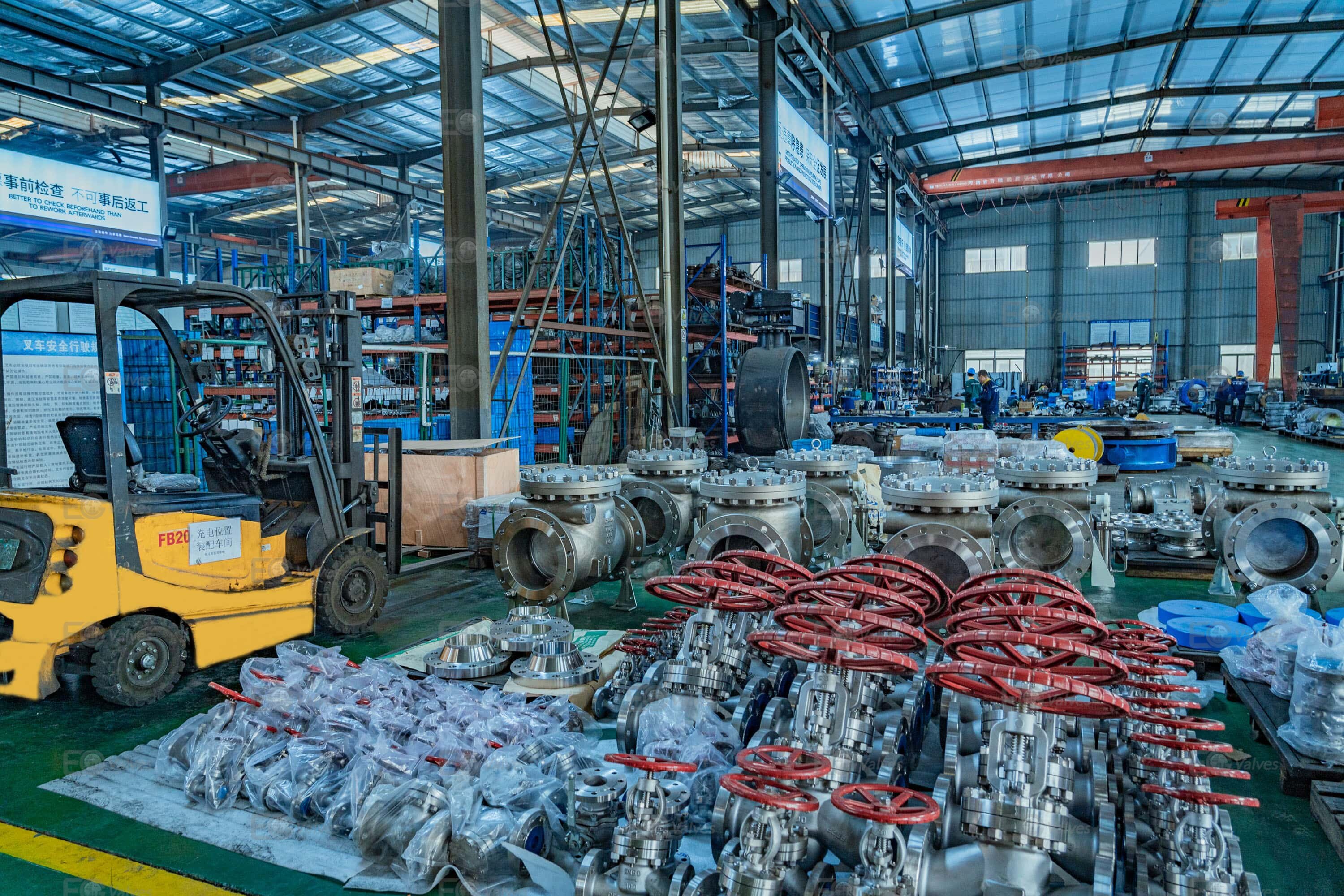
Machining and assembly area at EG Valves Manufacturing Co., Ltd, Wenzhou — the production floor behind the BOV303 build. (Image: EG Valves)
From Data Sheet to Shop Floor: Where Triple Offset Evaluations Break Down
At the evaluation stage, almost every shortlisted supplier will confirm the option list. Material families, body styles, size range, ratings and actuation are all quotable. The useful distinction is whether that option list is a catalogue or a manufacturing menu — whether the pattern equipment, material procurement, machining set-ups and test bench exist to produce the specific combination on the enquiry.
Three questions separate the two cases, and each can be answered with documents rather than assurances. First, does each build variable carry a production consequence the supplier can describe — tooling for a 60-inch body, machining for a duplex wafer body, torque calculation for a gear-operated valve? Second, is material compliance recorded per order rather than per brochure? Third, does the certification schedule actually list the product being bought? The third question is where more evaluations go wrong than any other, and it is addressed below against the certificate numbers themselves.
What follows treats the BOV303's variables in that frame: what is offered, what each option implies about production, and what a buyer should write into the purchase order before releasing it.
The BOV303 Build, Variable by Variable
The six build variables below are the ones that most often determine whether a triple offset order is executable as specified or has to be renegotiated after award.
| Build variable | BOV303 option set | What it implies for production | What to verify on the order |
|---|---|---|---|
| Body material | Carbon steel, stainless steel, alloy steel, duplex steel | Separate material procurement routes and welding/machining parameters per family | Exact grade named; EN 10204 3.1 certificate per heat |
| Body style | Wafer, lug, double flange | Distinct pattern equipment and flange drilling per style | Style, flange standard and face-to-face dimension stated |
| Size | NPS 2 in – NPS 60 in (DN50–DN1500) | Range of castings/forgings and machining envelope, not a single size | Size and rating combination confirmed as one line item |
| Pressure rating | PN10–PN40; Class 150–600 | Two separate rating systems with different wall and test requirements | Rating system and design standard named explicitly |
| Seat | Standard metal seat; optional Stellite hardfacing | Additional seat preparation and hardfacing step | Option stated as a line item, with documentation |
| Actuation | Handle lever, gearbox, worm gear, electric, pneumatic | Mounting interface and torque sizing per valve | Operating torque basis and actuator documentation supplied |
Body material: four steel families on one order line
The four material families are not marketing breadth; they correspond to different service environments. Carbon steel is the conventional choice for non-aggressive media where cost and weldability dominate, and it is the material most frequently listed in oil and gas pipeline orders. Stainless steel grades are selected where the medium or the external environment demands corrosion resistance. Duplex steel is specified where a combination of strength and chloride resistance is required — an increasingly common request in offshore and coastal chemical duty. Alloy steel grades are used for elevated-temperature and higher-pressure service; the company's refining references list WCB, WC6, WC9 and C5 among the materials it has supplied.
For the buyer, the material line has a documentation consequence that matters more than the metallurgy summary. EG Valves states that an EN 10204 3.1 material test certificate is provided with every order and that every valve is inspected by its own QC team. A 3.1 certificate is only useful if the heat number on the certificate can be matched to the heat number on the delivered body, so the practical check is a three-way match across the purchase order, the mill certificate and the valve marking. For duplex grades, a positive material identification check on receipt is a reasonable additional step, because duplex supplied against the wrong grade is difficult to detect visually.
One boundary belongs here: "stainless steel" and "alloy steel" are families, not specifications. A BOV303 order that names only the family leaves the actual grade to the supplier's discretion, which is not a position a project buyer wants to be in at inspection. The grade, the material standard and the certificate requirement should all appear on the order line.
Wafer, lug and double flange across 2 to 60 inches
The three body styles are functionally distinct, and the distinction is mechanical rather than cosmetic. A wafer body is clamped between two pipe flanges and depends on both flanges for its position. A lug body carries threaded or drilled lugs on both sides, which allows it to be bolted on one flange side and to hold position when the downstream pipe is removed. A double-flange body has its own flanged ends and can be unbolted from the line without disturbing adjacent pipework, at the cost of greater face-to-face length and weight.
What matters for supplier evaluation is that each style requires its own pattern equipment, its own flange drilling and its own dimensional control, and that requirement multiplies across a 2-inch to 60-inch span. A supplier that offers all three styles across that range is describing a tooling inventory and a machining envelope, not a single product. The 60-inch end of the range in particular is not a scaled-up version of the 2-inch end: casting mass, handling, seat geometry and test-bench capacity all change.
Verification is straightforward and should be done against the specification, not against the catalogue. Confirm flange drilling and facing to the named standard, confirm the face-to-face dimension for the chosen style and rating, and confirm the dimensional record with the inspection documentation. Where a wafer body is proposed in a location that requires dead-end isolation or downstream pipe removal, the style is the wrong selection regardless of how the valve is built.
Pressure ratings: PN and Class are not the same ruler
The BOV303 is offered from PN10 to PN40 and from Class 150 to Class 600. These are two separate rating systems with different reference temperatures, different wall-thickness rules and different test requirements, and they should not be treated as interchangeable by assumption. A PN16 enquiry and a Class 150 enquiry are not the same requirement even though both are commonly described as "medium pressure".
For European destinations, the applicable framework adds a further layer. Directive 2014/68/EU on pressure equipment applies to equipment with a maximum allowable pressure exceeding 0.5 bar, and EG Valves holds a CE certificate under PED 2014/68/EU Annex III, Module H — certificate DGR-0036-QS-1360-24, issued by TÜV SÜD Industrie Service GmbH on 19 June 2024 and valid to 26 May 2027 — whose scope includes butterfly valves for the EU market. That is directly relevant to a BOV303 order shipped into the EU.
The practical consequence for the buyer is that the rating system, the design standard and the acceptance test must be named on the order. Where the project requires a specific hydrostatic or seat test standard and hold time, stating it at enquiry stage is materially cheaper than discovering at inspection that the default test protocol does not match the project specification.
Seat and closure: what the triple offset geometry delivers
Triple offset geometry is the reason a metal-seated butterfly valve can be used for isolation duty at all. The three offsets — the shaft positioned away from the sealing face, the shaft offset from the valve centreline, and the seat cone axis inclined relative to the bore — mean the disc swings clear of the seat for most of its travel and makes contact only in the final few degrees of closing. That cam-lift action removes the sliding friction that wears sealing surfaces in concentric and double-offset designs, and it means the seal is loaded by closing torque rather than by continuous interference.
The BOV303's design intent is bubble-tight closure at its rated pressure. The distinction a buyer should hold onto is between design intent and recorded result: whether a given valve achieves bubble-tight isolation is established by the pressure test performed on that unit against the standard named in the order, and the certificate and test record are the evidence, not the geometry description. The geometry explains why the design can reach that performance; it does not substitute for the test.
The optional Stellite seat is the other build variable worth naming explicitly. Cobalt-chromium hardfacing is specified where the medium carries abrasive particles or where erosion at the seat is a known service risk. It is an option, which means it must appear as a line item on the order and be reflected in the documentation; a standard metal seat and a hardfaced seat are different builds.
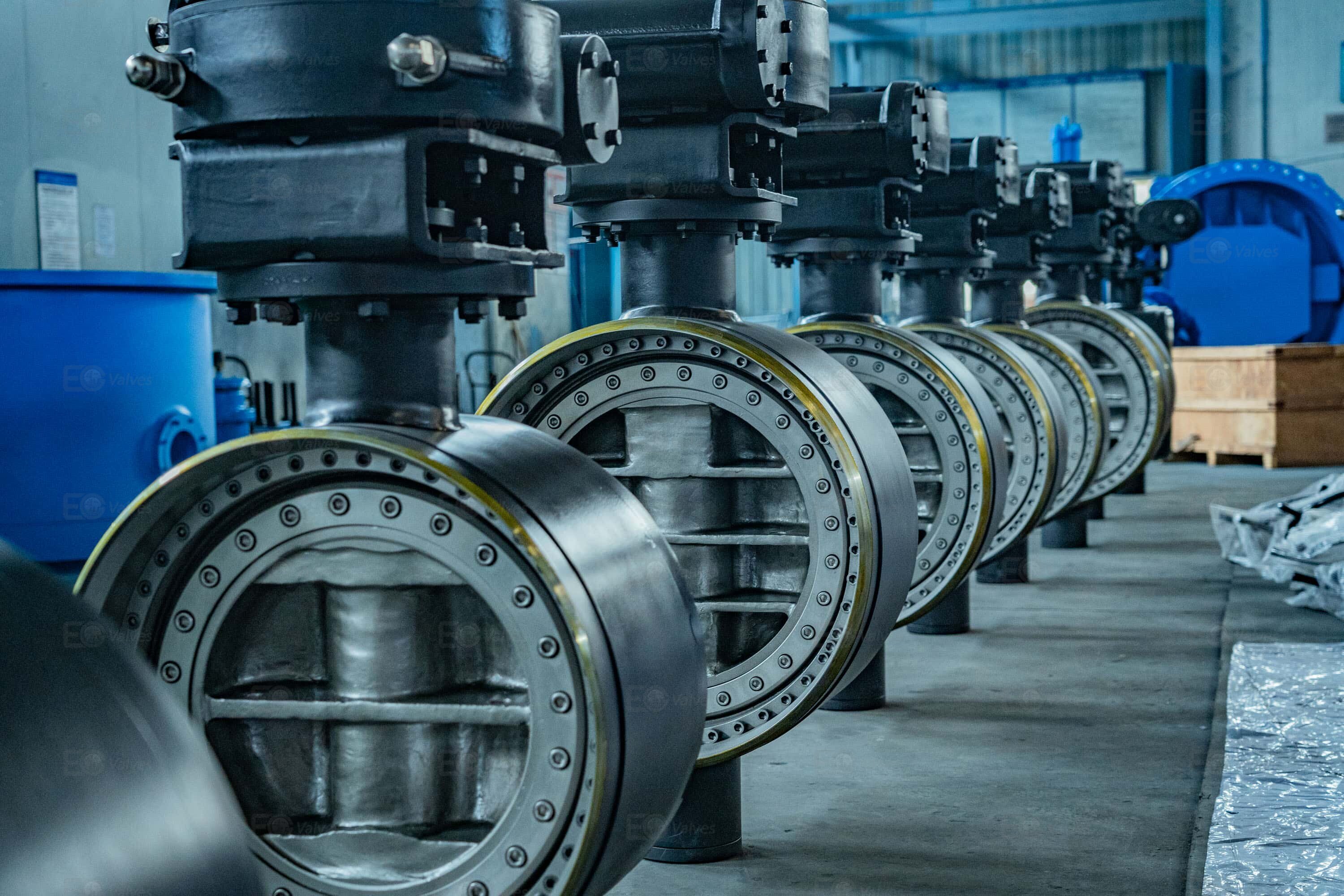
EG Valves triple offset butterfly valve — the offset geometry keeps the disc clear of the seat until the final degrees of closing. (Image: EG Valves)
Actuation: five operator paths and what they require
The operator options — handle lever, gearbox, worm gear, electric and pneumatic — cover the span from small-bore manual isolation to automated pipeline shut-off. The engineering point behind the menu is torque. Manual operation by lever is workable where the required operating torque stays within reasonable manual effort; as bore and differential pressure rise, the torque required to seat and unseat a metal-seated disc rises with them, which is why gear operators are used to convert a high torque requirement into a manageable handwheel input over multiple turns. Electric and pneumatic actuators move the same torque requirement into an automated envelope, where the actuator must be sized against the valve's break-to-open and break-to-close torque rather than against a nominal figure.
For the buyer, actuation is where two documentation streams meet. The valve carries its own material and test documentation; the actuator carries its own, including any hazardous-area certification where the installation requires it. An explosion-protected installation requirement is satisfied by the actuator's certification, not by the valve's, and the two should be checked separately during evaluation rather than assumed to travel together.
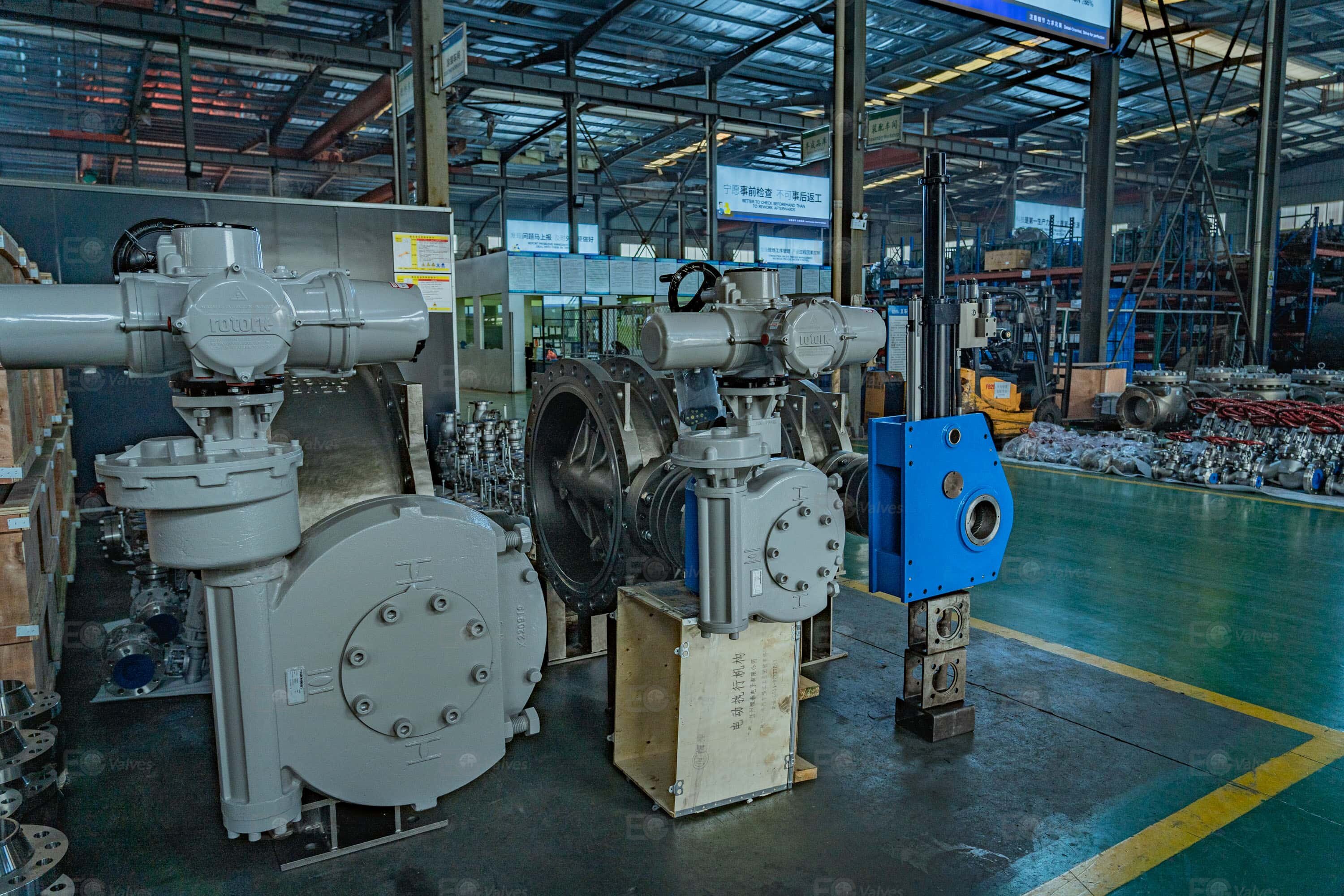
An electrically actuated butterfly valve from the EG Valves range; automated isolation adds an actuator documentation stream to the valve's own. (Image: EG Valves)
Application Evidence: Oil and Gas Pipelines and Chemical Processing
Two sectors account for most of the reasoning behind the BOV303 option set. In oil and gas pipeline duty, the valve is a pipeline shut-off device: the requirement is tight isolation at the stated class, repeatable operation, and material compatibility with the transported medium. In chemical processing, the same valve may face aggressive fluids, which is where the duplex and stainless options and the Stellite seat option earn their place in the specification.
The clearest documented reference for the BOV303 is a petroleum refining project in the United Arab Emirates: 915 valves in total, spanning gate, globe, check, ball and butterfly valves, in Class 150 to Class 1500, in materials including WCB, WC6, WC9 and C5, in sizes from 2 to 36 inches, with the triple offset butterfly valve among the supplied models. The reported service duration is 8 to 10 years, and the stated application context is precise fluid control across refining processes where reliability and safety are the governing criteria.
Chemical-sector experience is documented separately, and the scope should be read exactly. A Spanish chemical plant reference covers 260 valves — gate, globe and check valves, DN250 to DN1200 — over a five-year service period, with the stated requirement being durability in corrosive environments and aggressive fluids, plus customization to specific chemical processing applications such as injection, mixing and reaction processes. That reference evidences chemical-industry execution at company level; it does not, on its own, document BOV303 installations in that plant. Buyers who need triple offset references in a specific chemical service should ask for them by model and service, not accept sector experience as a substitute.
The Manufacturing System Behind the Menu
The option list is credible only if the plant behind it can carry the combinations. The disclosed operating figures are a 27,500 m² facility, 300 employees, 30 engineers in the R&D team, annual output of about 90,000 valves and a stated monthly capacity of 8,000 valves. Quality control is described as 100% inspection of every valve by an in-house QC team, with an EN 10204 3.1 material test certificate issued with every order. Production is offered under OEM/ODM terms, with either the customer's brand logo or the EG brand applied, and the stated lead time is 25–35 days.
For an evaluation-stage buyer, the useful reading of those numbers is about scheduling rather than scale. A 25–35 day lead time and an 8,000-piece monthly capacity set an expectation about how a mixed order — several sizes, more than one material family, more than one body style — will be sequenced through the plant. That expectation is worth testing with a specific enquiry rather than a general one: send the actual size and material matrix and ask for a line-by-line lead time, not a headline figure.
Certification scope: read the schedule, not the logo
This is the single most consequential check in the whole evaluation, and it is entirely documentary. EG Valves holds four certificates relevant to this discussion.
- ISO 9001:2015 — certificate 00125Q33391R3M/3400, issued by the China Quality Certification Center (CQC), valid 23 May 2025 to 22 May 2028, with a scope covering gate, globe, ball, butterfly and check valves, pipe filters and flanges.
- CE / PED 2014/68/EU Annex III, Module H — certificate DGR-0036-QS-1360-24, issued by TÜV SÜD Industrie Service GmbH, valid 19 June 2024 to 26 May 2027, for the EU market, with a scope that includes butterfly valves.
- API 6D — certificate 6D-0506, issued by the American Petroleum Institute, valid 30 March 2024 to 30 March 2027, with a scope covering check valves, ball valves and gate valves.
- API 600 — certificate 600-0179, valid 30 March 2025 to 30 March 2027, with a scope covering bolted bonnet steel gate valves.
The distinction that matters: butterfly valves appear in the ISO 9001 and PED module scopes, but not in the API 6D or API 600 scopes. That does not make the BOV303 an uncertified product — it sits inside the quality-management and EU pressure-equipment scopes — but a buyer whose project specification demands an API-marked butterfly valve has a genuine gap to resolve at the enquiry stage. Where the applicable butterfly valve standard falls outside the supplied certificate schedule, the honest resolution is to ask the supplier what documentation the specific valve will carry, and to record the answer before award. Discovering it at the inspection stage converts a documentation question into a schedule problem.
Where the BOV303 Fits — and Where It Does Not
A triple offset metal-seated valve is not the default answer for every isolation point, and a supplier capability review is more useful when it says so. Within the EG Valves range, the resilient-seated butterfly valve (BTV300) and the double eccentric butterfly valve (BTV305) sit alongside the BOV303, and the selection logic between them is about seating principle rather than brand tier.
Resilient-seated designs depend on elastomer deformation for sealing and are conventionally specified for general service at lower demand, where the elastomer is compatible with the medium and the operating envelope. Double eccentric designs reduce seat contact during travel but retain a different seating mechanism from the triple offset. The BOV303's metal-to-metal seating and torque-based closure are relevant where the specification calls for metal seating, higher pressure classes in the PN10–PN40 and Class 150–600 band, or resistance to seat erosion through the Stellite option. Where those conditions do not apply, a resilient-seated valve may be the more economical and entirely adequate choice.
Two further boundaries belong in the same paragraph. The BOV303 is not positioned as a sanitary or pharmaceutical specification; those duties typically call for different seat, finish and documentation requirements, and a buyer with such a requirement should confirm the applicable product rather than assume the triple offset range covers it. And the valve's certification position, as set out above, is defined by the ISO 9001 and PED scopes — nothing in the API schedules extends to it.
Procurement Execution: What an Order Actually Looks Like
Moving from evaluation to execution means converting the option list into commercial terms. On the disclosed framework, the minimum order quantity is 1 piece for large-size valves and 10 pieces for small-size valves; lead time is within 25–35 days; FOB, EXW and CIF delivery terms are all acceptable depending on the buyer's preference. Payment terms are 30% T/T as deposit with the balance settled before shipment. Inspection is normally carried out by the EG valve QC department, and for some orders the customer arranges its own QC or appoints a third-party inspection company — an arrangement worth agreeing in writing at order stage rather than at readiness-for-inspection.
Four items are worth writing into the purchase order explicitly, because each one converts an assumption into a record. Name the material grade and the certificate requirement, not just the material family. Name the body style, the flange standard and the face-to-face dimension. Name the rating system — PN or Class — and the acceptance test standard. Name the seat option as a line item if Stellite hardfacing is required. After-sales support is described as technical guidance to help integrate the valves into existing systems, which is the appropriate scope for a supplier of this type; it is not a substitute for the buyer's own specification work.
Market Context and What It Does Not Prove
Three published data points explain why the material menu and the oil and gas reference matter, provided their scope is respected. The global industrial valves market was estimated at USD 82.9 billion in 2025, with a projected CAGR of 5.7% through 2034, according to IMARC Group. Asia Pacific held approximately 36.3% of 2025 revenue, with China the largest share within the region, per Grand View Research. Oil and gas remained the leading end-user, at nearly 33% of global valve demand in 2024, according to PR Newswire reporting of Vantage Market Research data, and cast steel valves accounted for 27.3% of the oil and gas valve market in 2025 per Mordor Intelligence.
Two caveats apply. Market-size estimates for 2025 diverge materially by scope — Grand View Research puts the figure at USD 80.4 billion and MarketsandMarkets at USD 101.94 billion, depending on whether actuators and specific valve types are included — so the IMARC figure should be read as one estimate among several rather than a settled number. And none of these figures says anything about a specific supplier's capability. They describe demand structure: why carbon and cast steel dominate volume, why oil and gas specifications drive documentation practice, and why a supplier serving 80% of its output into export markets ends up maintaining a four-family material menu. They are context for the evaluation, not evidence within it.
Frequently Asked Questions
What sizes and pressure ratings does the BOV303 cover?
The BOV303 is offered from NPS 2 in to NPS 60 in (DN50–DN1500), with pressure ratings from PN10 to PN40 and from Class 150 to Class 600. Because PN and Class are separate rating systems, the rating system and design standard should be stated explicitly on the enquiry rather than assumed to be equivalent.
Which body materials can be specified, and how is material compliance documented?
Carbon steel, stainless steel, alloy steel and duplex steel are available, and the specific grade should be named on the order rather than left at family level. EG Valves issues an EN 10204 3.1 material test certificate with every order, so compliance can be checked by matching the heat number on the certificate to the marking on the delivered valve.
How is seat and closure performance verified before shipment?
Verification runs through the pressure test performed on the individual valve against the standard named in the order, supported by the inspection record. Most orders are inspected by the EG valve QC department; for some orders the customer arranges its own QC or appoints a third-party inspection company. Where Stellite hardfacing is specified, it should appear as a separate order line so that the delivered build matches the documentation.
Does the company's API certification extend to the BOV303 butterfly valve?
No. The API 6D certificate (6D-0506) covers check valves, ball valves and gate valves, and the API 600 certificate (600-0179) covers bolted bonnet steel gate valves; neither schedule lists butterfly valves. The BOV303 falls within the ISO 9001:2015 scope (certificate 00125Q33391R3M/3400) and the CE/PED Module H scope (certificate DGR-0036-QS-1360-24), both of which include butterfly valves. Buyers whose specification names an API butterfly valve standard should confirm the applicable documentation with the supplier at enquiry stage.
What are the ordering, inspection and delivery terms?
The minimum order quantity is 1 piece for large-size valves and 10 pieces for small-size valves, with a lead time within 25–35 days. FOB, EXW and CIF delivery terms are all acceptable depending on the buyer's needs. Payment terms are 30% T/T as deposit with the balance settled before shipment, and OEM/ODM production is available with either the customer's brand logo or the EG brand applied.
Closing Assessment
The BOV303's capability case rests on documents rather than adjectives: a four-family material menu with a 3.1 certificate behind every order, three body styles across a 2-inch to 60-inch span, two complete rating systems, an optional hardfaced seat, five operator paths, and 100% inspection inside a 27,500 m² plant running at a stated 8,000-piece monthly capacity. The same documents also define the limits — the API schedules do not cover the butterfly valve, actuator certification is a separate stream, and the valve is not a sanitary specification. A buyer who tests the option list against the certificate schedule, the material certificate and the inspection record will get a more decision-useful answer than any capability brochure can provide.
A full product and capability overview is available in the EG Valves brochure (PDF).
Есть вопросы или нужны дополнительные детали?
Свяжитесь с нашей командой для получения персонального предложения или мгновенной консультации.
Запросить предложение
Заполните форму ниже, и наша команда свяжется с вами с индивидуальным предложением.
Прямой чат WhatsApp
Предпочитаете общаться в реальном времени? Напишите нам в WhatsApp для мгновенной помощи и быстрых ответов.
- Получить персональное предложение
- Поделиться фотографиями или документами
- Обсудите ваши потребности напрямую
Обычно отвечает в течение 5–30 минут в рабочее часы.