
BSP, NPT & JIC: A Hydraulic Adapter Decision Framework
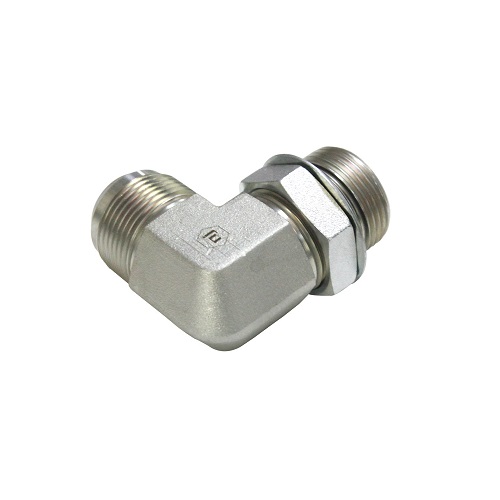
Model 6801 — male JIC x male adjustable ORB 90° elbow. Thread family, sealing method and orientation are decided together, not in sequence.
Thread selection is one of the few hydraulic sourcing decisions that is effectively settled before a purchase order exists. Once a pump, cylinder or manifold port has been machined, the thread family is fixed; an adapter that does not match is discovered at assembly, where it becomes rework, downtime and a return shipment rather than a commercial negotiation.
For buyers working through research and evaluation, the useful question is not which thread family is best, but which family fits this project, and what evidence proves it. BSP, NPT, JIC and SAE ORFS are not performance tiers. They are interface conventions, each with its own sealing principle, standard references and failure modes — and each with configurations that only make sense once the application is known.
NingBo NJ Hydraulic Adapter Co., Ltd is a hydraulic fitting manufacturer based in Fenghua, Ningbo, China, founded in 2004, producing hydraulic adapters and related components from a 20,000 m² facility with approximately 200 employees, four engineers and an export ratio of around 75%, with the United States and Canada as its main markets. The breadth of that range — BSP, NPT, JIC, SAE-style and cap nut families — makes it a practical test case for a decision framework, because each family can be traced to a specific application logic rather than a general claim.
The four families buyers are actually comparing
BSP covers two thread forms that are frequently confused. BSPP is a parallel thread that seals at the face — typically against a bonded washer or an O-ring — so the thread itself is not the sealing element. BSPT is tapered and seals along the thread. Within the NingBo NJ Hydraulic Adapter range, BSPP bodies appear under families such as 1B (male BSPP x male BSPP straight), 1BG9 (male BSPP x male BSPP O-ring 90° elbow), 1BJ (male BSPP x male JIC straight), 6B (male BSPP x male BSPP bulkhead straight) and 2B9 (male BSPP x female BSPP swivel 90° elbow), while BSPT parts include 1T, 1T9, 5T and 4T.
NPT and NPTF are tapered pipe threads, with NPTF specified as a dry-seal form. The range covers 5404 (male NPTF x male NPTF straight), 5405 and 5406 (male NPTF x female NPTF straight), plus termination hardware: 5406-C (female NPTF pipe cap), 5406-P (male NPTF hex head pipe plug), 5406-HP (hollow hex pipe plug) and 5406-SHP (square head pipe plug). Tees and crosses in the 5500 and 5600 families, including 5603, 5604, 5605 and 5652, extend the same thread system into multi-port assemblies.
JIC is a 37° flare system in which sealing is metal-to-metal at the cone seat. The 2403–2609 group forms the core of the range: 2403 (male JIC x male JIC straight), 2404 (male JIC x male NPTF pipe straight), 2405 (male JIC x female NPTF pipe straight), 2406 (female JIC x male JIC straight) and 2408 (male JIC plug). Elbow and bulkhead variants — 2500 through 2505, and the 2700 bulkhead series — answer routing and panel-mount requirements rather than thread conversion.
SAE-style ORB and ORFS configurations appear under 6801 (male JIC x male adjustable ORB 90° elbow), 6802 (45° elbow), 6803 and 6804 (tees), 6805, 6807 (male adjustable ORB x male adjustable ORB 90° elbow), 6815 and 6835. Adjustable ORB ends allow the fitting to be oriented and then locked, which is why they appear so often in mobile equipment where hose routing is constrained.
A fifth group is easy to overlook. The cap nut and lock nut family — 0304C (female JIC cap), 0306 (JIC bulkhead lock nut), 0318 (JIC tube nut), 0319 (JIC tube sleeve), 0403 and 0500 — does not seal anything. These parts retain, lock or close an interface, and they belong in the same selection process as the adapters they serve.
| Thread family | Sealing principle | Representative model families | Typical project role |
|---|---|---|---|
| BSPP / BSPT | Face seal (BSPP) or thread seal (BSPT) | 1B, 1BG9, 1BJ, 1BT, 6B, 7B, 2B9; 1T, 1T9, 5T, 4T | General industrial and imported machinery |
| NPT / NPTF | Tapered pipe thread, dry-seal (NPTF) | 5404, 5405, 5406, 5406-C, 5406-P, 5406-HP, 5406-SHP, 5603, 5605, 5652 | North American machinery, oil and gas |
| JIC 37° flare | Metal-to-metal cone seat | 2403, 2404, 2405, 2406, 2408, 2500–2505, 2700 series | Mobile hydraulics, high-pressure lines |
| SAE ORB / ORFS | O-ring boss or flat-face O-ring seal | 6801, 6802, 6803, 6804, 6805, 6807, 6815, 6835 | US-spec mobile and industrial equipment |
Application industry defines constraints, not a fixed thread
Industry is often used as a shortcut for thread choice. It works better as a filter. The application tells a buyer which constraints matter — corrosion, pressure, service access, documentation — and those constraints narrow the field to one or two families. They rarely determine a single answer.
Agricultural machinery
A working farm is a mixed fleet. A single operation may run European-built tractors with BSPP or BSPT ports alongside North American implements using ORFS or JIC connections. Under those conditions the deciding factor is usually availability of the exact model, not category preference. The range lists agricultural machinery as an application, and parts such as 1B, 1BT, 2404 and 6802 typically appear where a conversion between the machine's native thread and the hose end is required. Buyers should map the fleet first and then the thread families, because a rarely used thread form is a service risk regardless of its technical merit.
Marine machinery
Marine hydraulics adds a corrosion constraint to the same interface logic. Material selection shifts from carbon steel to SS304 or SS316, and salt spray evidence becomes a legitimate procurement question rather than a marketing detail. The published parameter set for this range is a 120-hour salt spray test, with white rust observed at 120 hours and red rust at 240 hours, alongside a maximum stable operating temperature of 220°C and a 3,000–6,000 PSI pressure range. The productive step for a marine buyer is to compare that evidence against the exposure of the specific location on the vessel — deck, below-waterline housing, engine room — rather than treating one test result as blanket approval for the whole system.
Oil and gas extraction
Oil and gas extraction is pressure-led, and pressure ratings are size-specific. Two reference points show the spread: NPTF straight threads in 1/4" size typically carry a 4,000 PSI working pressure rating with a 4:1 safety factor, while ORFS fittings in dash size -4 (1/4") are rated for 6,000 PSI working pressure under SAE J1453. Neither figure transfers automatically to another size, another standard or another manufacturer's part. A project specification should therefore cite the size, the applicable standard and the acceptance test, not a family-level pressure claim.
Construction and general industrial equipment
Construction machinery is where SAE-style adapters are most visible; the range explicitly lists construction machinery as an application for its SAE standard hydraulic adapters. The wider demand picture points the same way. Grand View Research recorded mobile hydraulics at over 58% of total hydraulics market revenue share in 2024, and Ken Research reported that Asia accounted for 74% of global industrial robot installations in 2024 — a shift that increases the number of precise, small-bore hydraulic connections in circulation. Both signals favour buyers who can specify an envelope quickly and repeat it across a fleet.
A five-step decision framework
Step 1 — Fix the interface before comparing prices
Start with the port, not the fitting. Establish whether the female port is parallel or tapered, and which standard governs it. A parallel port sealed by a washer and a tapered port sealing on the thread require different adapters even when they look similar at arm's length. Confirm against the machine drawing or the component datasheet, and use thread gauges for field verification. This step costs an hour and prevents the most expensive category of adapter error, because a cross-threaded or incorrectly seated joint is rarely detected before testing.
Step 2 — Set the operating envelope
Write pressure, temperature and environment into the specification in that order. The published envelope for this range is a 3,000–6,000 PSI pressure range and a maximum stable operating temperature of 220°C, with the BSPT adapter configuration described as withstanding 6,000 PSI static pressure and 9,000 PSI burst pressure without deformation while maintaining continuous operation and seal integrity. Standards provide the second reference: DIN 2353 / ISO 8434-1 defines three robustness categories for metric tube fittings — LL (extra light, 100 bar), L (light, up to 315–500 bar) and S (heavy, up to 630–800 bar) — while ISO 8434-2:2007 specifies 37° flared connectors for tubes from 6 mm to 50.8 mm. Where the supplier envelope and the standard differ, specify the more conservative figure.
Step 3 — Select the configuration, not just the thread
Thread family decides compatibility; configuration decides whether the assembly can be installed and serviced. A straight male-to-male adapter (2403, 5404, 1B) reaches where clearance exists. A 90° or 45° elbow (2500, 6802, 1BG9) solves routing but adds a bend the assembly must support. A bulkhead fitting (6B, 2700 series) transfers load into a panel or bulkhead. A plug or cap (4B, 2408, 5406-P, 5406-C) closes a port that will be opened later. Lock nuts and cap nuts (0306, 0304C, 0318, 0319) handle retention and closure. Deciding orientation late is one of the most common reasons a project issues a second adapter order.
Step 4 — Decide material against the location
Carbon steel, SS304 and SS316 are available across the range. Stainless is not a universal upgrade: it changes cost and machining behaviour, and in repeated service it can raise the risk of thread galling. The broader AISI 316 range — supported from -60°C to +400°C according to DIN 17440 — is wider than the validated envelope of any specific adapter, which is precisely why material should follow the location and the maintenance regime rather than the other way around.
Step 5 — Verify with model-level evidence
Before committing, request data for the exact model rather than a family claim. Production in this range is organised to the TS16949 standard, quality control includes random inspection, customisation covers logo, packaging, plating colour and parts made from supplied drawings or samples, lead time for production runs is typically 30–45 working days, and MOQ varies depending on product dimensions and manufacturing complexity. A supplier that can answer at model level carries materially lower project risk than one that answers at brand level, because the answer can be checked.
| Verification item | What to request | Why it matters |
|---|---|---|
| Pressure rating | Value for the exact size and configuration | Ratings do not transfer between sizes |
| Temperature limit | Maximum stable operating temperature | Defines the margin against system peaks |
| Corrosion evidence | Salt spray results and observation points | Relevant for marine and outdoor duty |
| Material grade | Carbon steel, SS304 or SS316 certification | Affects corrosion and galling behaviour |
| Custom parts | Drawings or sample-based specification | Prevents assumptions at first article |
| Lead time and MOQ | Production lead time and MOQ basis | MOQ varies with dimension and complexity |
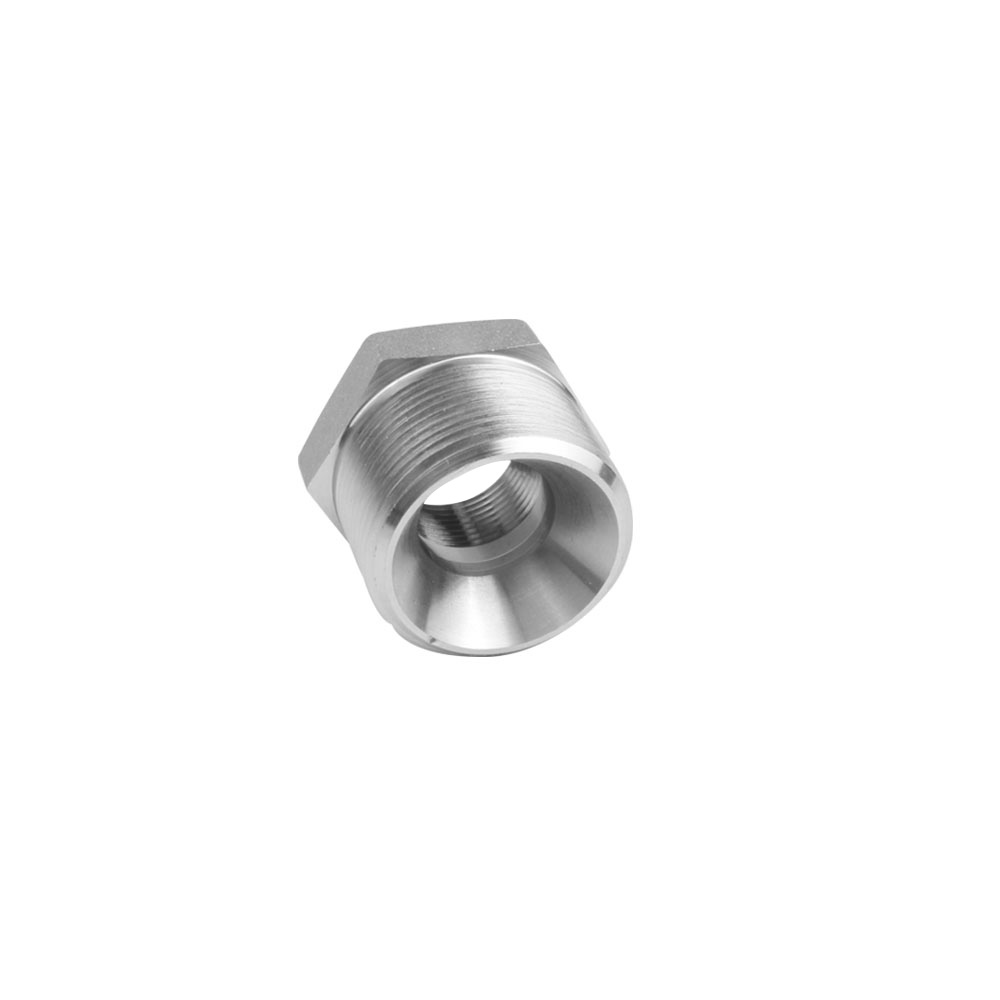
Model 5406 — male NPTF pipe x female NPTF pipe straight. In the NPT family, the same thread system extends into plugs (5406-P), caps (5406-C), tees and crosses.
How five model families make the framework concrete
1B — male BSPP x male BSPP straight. The baseline BSPP building block. From it, the same family logic produces 1BJ (BSPP to JIC), 1BT (BSPP to BSPT), 6B (bulkhead) and 2B9 (swivel 90° elbow). A buyer who needs one BSPP straight almost always needs two or three of these variants, which is why the family — not the part — is the useful unit of planning.
5406 — male NPTF x female NPTF straight. The NPT equivalent, and the anchor for a group that includes 5404, 5405 and the termination hardware. In a project, 5406 typically sits where a hose or component must be joined in line, while 5406-P and 5406-C close the ports that commissioning will open later.
6801 — male JIC x male adjustable ORB 90° elbow. An adjustable ORB end can be positioned and then locked, which converts a routing problem into a tightening sequence. 6802 (45°), 6803 and 6804 (tees), 6805, 6807, 6815 and 6835 extend the same logic across the SAE-style range.
2403–2609 — the JIC core. 2403 covers the straight male-to-male connection; 2404 and 2405 bridge JIC to NPTF pipe in straight form, and 2501 and 2502 do the same at 90°; 2406 handles female-to-male; 2408 plugs an open JIC port. The 2700 bulkhead series answers the panel-mount case. This group is where the majority of JIC decisions are actually made.
0304C — female JIC cap. The cap nut and lock nut group is the retention layer: 0306 (bulkhead lock nut), 0318 (tube nut), 0319 (tube sleeve), with FS0304C, FS0306, FS0318 and FS0319 for the corresponding sealing-side versions, plus 0403 and 0500 bore-to-male connectors. These parts do not contain pressure. They hold a joint in place, and they must match the thread they retain.
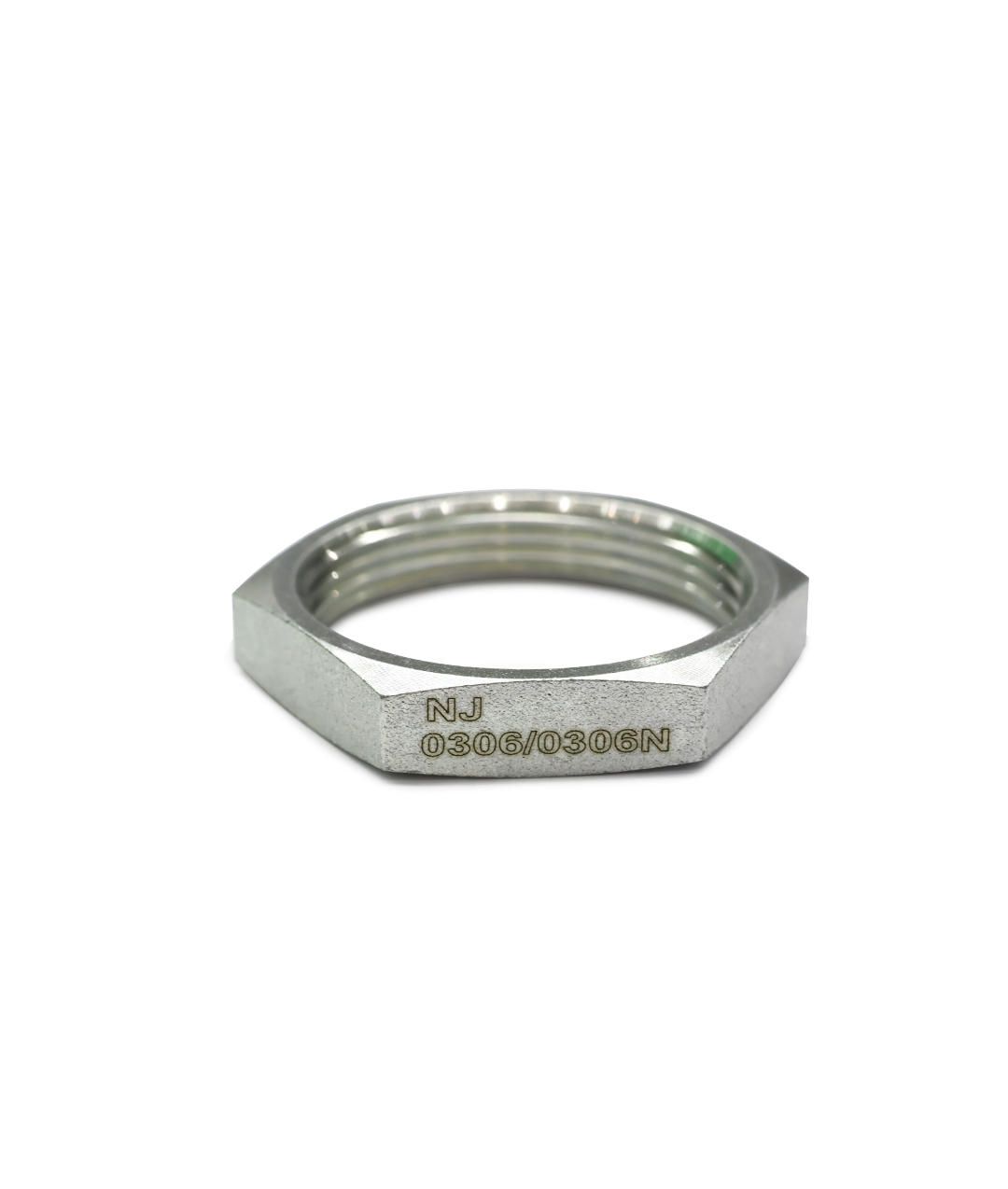
Model 0306 — JIC bulkhead lock nut. Cap nuts, lock nuts, tube nuts and sleeves retain or close a joint; they are not sealing components.
Where this framework breaks down
A framework that only lists advantages is not a framework. Seven limits matter in practice:
Thread families are not interchangeable. BSPT and NPT are both tapered, but they are different thread forms. Forcing one into the other damages both parts and destroys the seal. Where conversion is legitimate, it happens through a purpose-made adapter with two specified ends — 1BT, 1BJ, 2404, 2501 or 5BN — never through a wrench.
A family-level pressure figure is not a part approval. Ratings are size-specific. The 4,000 PSI NPTF figure for 1/4" and the 6,000 PSI ORFS figure for dash size -4 illustrate a spread, not a rule.
Stainless solves corrosion, not pressure. It also changes torque requirements and galling behaviour during repeated assembly.
Cap nuts and lock nuts do not seal. No amount of tightening compensates for a mismatched thread or a damaged seat. Retention hardware should be selected with the joint, not after it.
An adapter cannot raise a system's rating. An assembly is limited by its lowest-rated component, which is often the hose, the port or the tube wall rather than the fitting.
Standard conformance is not assembly qualification. DIN 2353 and ISO 8434-2 describe components; they do not certify a contractor's torque procedure, cleanliness or test method.
First-party case data is not independent audit data. The distributor case below is a supplier-side account and should be verified like any other commercial reference.
Market signals behind the decision
Market data is directional, and it should be read that way. Dataintelo valued the global hydraulic fittings market, including adapters and couplings, at USD 4.8 billion in 2025, projected to reach USD 7.9 billion by 2034, with hydraulic adapters the largest product type at 28.4% share in 2025 and steel materials accounting for 45.2% of revenue. The same source places Asia-Pacific at 38.6% of 2025 revenues. Grand View Research estimated the broader hydraulics market at USD 38.39 billion in 2024.
These numbers should be used with care, because published estimates for fittings and adapters differ widely by scope: one alternative estimate places the fittings market at USD 12.7 billion in 2024, while equipment-level forecasts run far higher. The defensible reading is that demand is growing steadily and that adapters remain the largest single product category within it — not that any specific figure can be used as a budgeting input.
What a documented case looks like
One relevant account from the range involves a mid-market distributor in Canada that built a three-year resale programme around hydraulic cap nuts in models 0304C and 0306, specified with a maximum operating temperature of 220°C and a pressure range of 3,000–6,000 PSI, and with high pressure, high temperature and rust resistance as the stated requirements. The account reports expansion of downstream client channels and an improvement in overall gross profit margin across the three-year period, with product resold to local customers with demand.
The transferable element is not the margin outcome — that is a single supplier-side account — but the structure: a narrow, repeatable model set, a defined envelope, and a resale channel that depends on availability and consistency rather than novelty. That structure is what makes a model family, rather than an individual part number, the right planning unit.
Future outlook
Three shifts are worth tracking. First, specification is moving from part number to envelope: buyers increasingly ask for the pressure, temperature, material and test evidence for the exact size, which advantages suppliers who can answer at model level and disadvantages those who answer at brand level. Second, mixed-standard systems are becoming normal in equipment that is assembled across regions, which raises the value of conversion families such as 1BT, 1BJ, 1NB, 2404, 2501 and 5BN that bridge two thread systems in a single part instead of two. Third, mobile and automated machinery continues to add small-bore, high-cycle connections — a demand driver visible both in the 74% of global industrial robot installations recorded in Asia in 2024 and in the mobile hydraulics share of 2024 market revenue. For buyers, the practical implication is that documentation quality, not a new thread form, is becoming the differentiator between otherwise comparable suppliers.
FAQ
How do I confirm which thread family a machine actually uses?
Identify the port, not the fitting. A parallel port sealed by a washer or O-ring (BSPP) and a tapered port that seals along the thread (BSPT or NPT) require different adapters. Confirm against the machine drawing or the component datasheet, and use thread gauges for field checks. Appearance alone is weak evidence, because parallel and tapered fittings of similar nominal size can look alike at a glance.
Can a BSP adapter be replaced directly with an NPT adapter?
No. BSP and NPT are different thread forms, and substituting one for the other damages the threads and compromises the seal. Conversion is valid only through an adapter designed with two specified ends, such as 2404 or 2501 (JIC to NPTF), 1BT (BSPP to BSPT), 1BJ (BSPP to JIC) or 1NB (NPTF to BSPP).
What pressure and temperature envelope should appear in the specification?
Write values for the exact size and configuration rather than a family average. The published envelope for this range is a 3,000–6,000 PSI pressure range and a maximum stable operating temperature of 220°C, with the BSPT adapter configuration described as withstanding 6,000 PSI static and 9,000 PSI burst pressure without deformation. Standards provide a second reference: DIN 2353 / ISO 8434-1 for metric tube fitting robustness categories, ISO 8434-2:2007 for 37° flared connectors, and SAE J1453 for ORFS.
Which configurations should be planned at the same time as the thread family?
Straight adapters (2403, 5404, 1B) cover most in-line connections, but routing usually requires 90° and 45° elbows (2500, 6801, 1BG9), panel terminations require bulkhead fittings (6B, 2700 series), and ports that will be opened later require plugs and caps (2408, 5406-P, 5406-C). Retention hardware (0306, 0304C, 0318, 0319) should be ordered with the assembly, because these parts do not seal and cannot substitute for a correctly matched thread.
What documentation should a buyer request before the first production order?
Model-level data: the pressure rating for the specific size, the temperature limit, corrosion test results, material grade, and drawings for any customised part. Production in this range is organised to the TS16949 standard, with random inspection as part of quality control; customisation covers logo, packaging, plating colour and parts made from supplied drawings or samples; lead time is typically 30–45 working days; and MOQ varies with product dimensions and manufacturing complexity. Where items arrive missing or incorrect, the stated process is photo verification followed by replacement parts dispatched by sea or air.
A technical catalogue covering the BSP, NPT, JIC, SAE-style and cap nut model families referenced in this article is available for download: NingBo NJ Hydraulic Adapter product catalogue (PDF).