
BSP vs NPT vs JIC: Hydraulic Adapter Buying Verdict
How thread-system fit, not brand preference, should drive adapter selection for 3,000–6,000 PSI hydraulic circuits.
Hydraulic systems are built around ports, threads and sealing interfaces long before a supplier logo is chosen. Buyers who compare BSP, NPT and JIC hydraulic adapters are really comparing three different answers to the same engineering question: how a connection can remain leak-free under high pressure, high temperature and long service life. For adapters rated in the 3,000–6,000 PSI operating range with a maximum stable operating temperature of 220°C, thread form is not a minor specification detail — it determines whether the assembly performs as designed or becomes a maintenance event.
This article reviews the three mainstream thread families used across construction, agricultural, mining and general industrial machinery: BSP (with its parallel BSPP and tapered BSPT variants), NPT/NPTF, and JIC 37° flare connections. It references the NingBo NJ Hydraulic Adapter Co., Ltd catalogue as a practical example of how these families are organised into identifiable part-number series. The buying verdict is deliberately independent: choose the thread system that matches the machine and the circuit, then verify the manufacturer against material, testing and traceability evidence.
Why Thread Choice Matters More Than Brand
At pressures between 3,000 and 6,000 PSI, a hydraulic adapter is not just a mechanical bridge. It is a pressure boundary. If the male thread does not match the port geometry and sealing method, no amount of brand reputation, plating quality or torque discipline can produce a durable connection. Conversely, a correctly selected adapter from a well-documented supplier can give predictable performance across a wide range of machinery.
The buying logic therefore has two layers. First, identify the thread standard on the equipment: BSPP, BSPT, NPT, NPTF, JIC or another system. Second, evaluate how the adapter manufacturer supports that standard — materials, pressure range, temperature limits, corrosion resistance, manufacturing traceability and the availability of the exact crossover geometry needed. Buyers who reverse this order, selecting a brand first and a thread system later, often end up with adapters that are physically correct in name but marginal in application fit.
In the product families reviewed here, the common specification envelope is stated as 3,000–6,000 PSI pressure range and a maximum stable operating temperature of 220°C. All three thread systems — BSP, NPT and JIC — appear inside that envelope. The commercial lesson is that the thread decision should drive the vendor shortlist, not the other way around.
BSP Adapters: Parallel and Tapered Threads in One Family
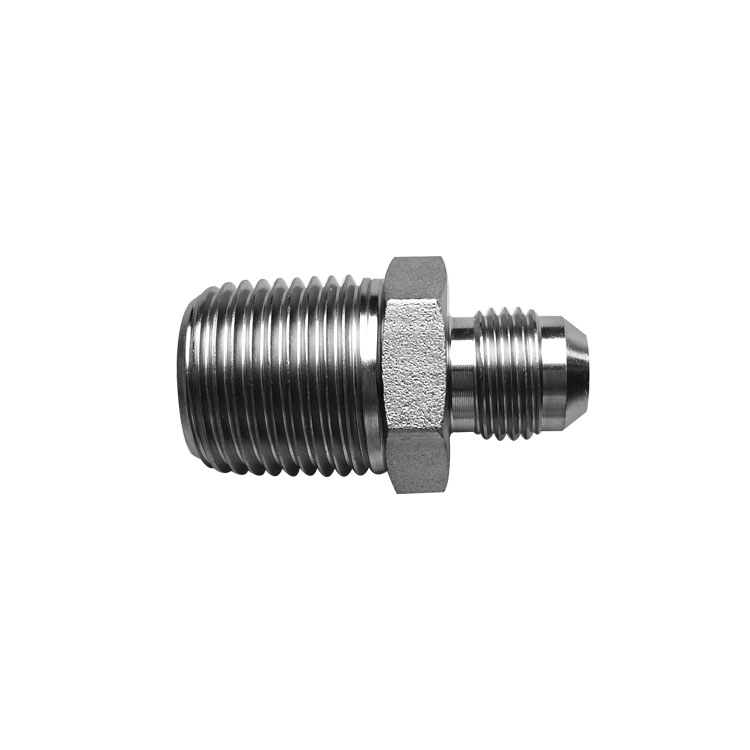
BSP, or British Standard Pipe, is one of the oldest industrial thread families still in wide use. It appears in two forms. BSPP uses parallel threads and generally relies on a sealing face, metal-to-metal seat or washer-type seal. BSPT uses tapered threads and achieves sealing through thread interference. Many machinery builders standardise on one of these two depending on regional convention and component design.
In the NingBo NJ hydraulic adapter catalogue, BSPP and BSPT are separated into identifiable series. The BSPP section is organised around the 1B series and its derivatives: models such as 1B, 1B4, 1B9, 1BJ, 1BN, 1BT, 2B9, 5BN, 6B, 7B, 9B and others. The BSPT section uses the 1T series: 1T, 1T9, 1BT, 1ST, 4T and 5T, among others. These codes are useful in procurement because they communicate geometry in a compact way: a straight adapter, an elbow, a bulkhead, a plug or a crossover to another thread standard.
For buyers working across multiple equipment brands, the crossover models inside the BSP range are often the most valuable. The catalogue includes examples such as 1NB (male NPTF pipe to male BSPP), 5BN (male BSPP to female NPTF), 1BJ (male BSPP to male JIC) and 1JT (male JIC to female BSPT). These part numbers show that the BSP family is not an isolated island; it is connected to NPT and JIC circuits through deliberately designed adapter geometries.
The BSP adapters in this reference are available in carbon steel, SS304 and SS316. The stated specifications include the 3,000–6,000 PSI pressure range, maximum stable operating temperature of 220°C, and salt spray performance described as white rust at 120 hours and red rust at 240 hours during a 120-hour salt spray test sequence. The common application industries listed for these products include construction machinery, agricultural machinery, mining, marine machinery, transportation, oil and gas extraction, iron and steel metallurgy and water conservancy engineering.
NPT Adapters: The 5406 Family and North American Pipe Threads
NPT — National Pipe Taper — is a tapered pipe thread standard widely used in North American hydraulic and industrial systems. The NPTF variant, often referenced in product naming, is designed to create a tighter, dry-seal joint by controlling root and crest dimensions more strictly. In practice, buyers often search for “NPT” while the part itself may be specified or labelled as NPTF. This is why precise part-number verification matters at the ordering stage.
In the NJ catalogue, the NPT family is grouped around the 5400 series. Representative models include 5404, 5405, 5406, 5406-C, 5406-HP, 5406-P, 5406-SHP, 5500-series, 5600-series and 5652. The 5406 models are visually identified in product documentation as NPTF pipe adapters and plugs: male NPTF to female NPTF straight, female NPTF caps, male NPTF hex-head pipe plugs, hollow-hex plugs and square-head plugs.
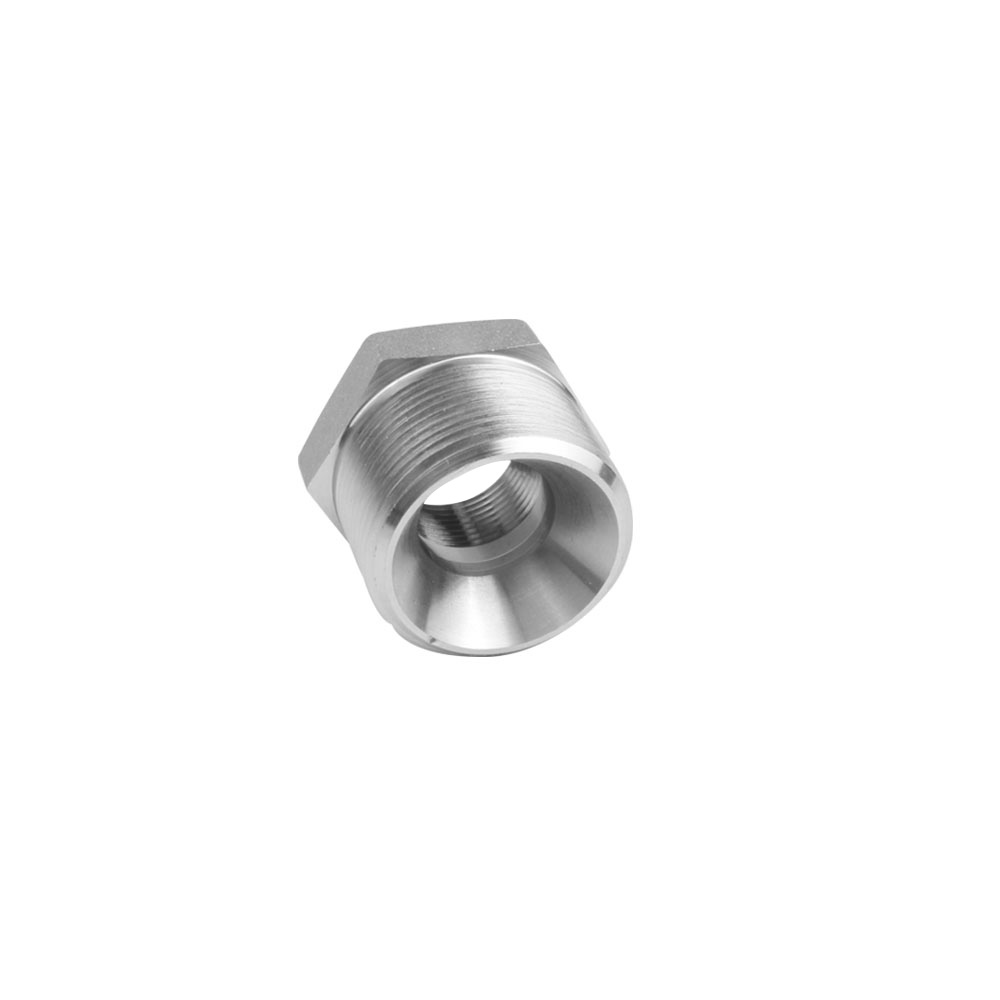
The NPT adapter family in this reference is specified for high-temperature, high-pressure environments. Its stated role in hydraulic assemblies is pipeline sealing, thread locking and fastening, and pressure-bearing protection. The maximum stable operating temperature is 220°C, and the pressure range is 3,000–6,000 PSI. Material options again include carbon steel, SS304 and SS316, giving procurement teams a path from general-purpose carbon-steel service to corrosion-resistant stainless-steel service.
JIC Adapters: 37° Flare and the 2403-to-2609 Range
JIC — Joint Industry Council — describes a 37° flared connection widely found in hydraulic systems, especially in applications that need a robust metal-to-metal seal and good vibration resistance. The JIC system seals on the cone of the flare rather than on the threads themselves. It is distinct from NPT because JIC is not a tapered pipe thread; it uses straight threads to pull the flared surfaces together.
The NJ catalogue organises its JIC family around the 2403–2609 model range, with additional geometries in the 2500 series and bulkhead-oriented series. Straight JIC-to-JIC connections appear under models such as 2403, while adapters that connect JIC to NPTF ports appear under 2404, 2405, 2501, 2502 and related codes. The 2500 series includes 90° and 45° elbows; the 2600 series includes tee configurations such as 2601, 2602, 2603, 2605, 2606, 2608 and 2609. The naming and model ranges allow buyers to map a plant-level requirement to a specific part geometry.
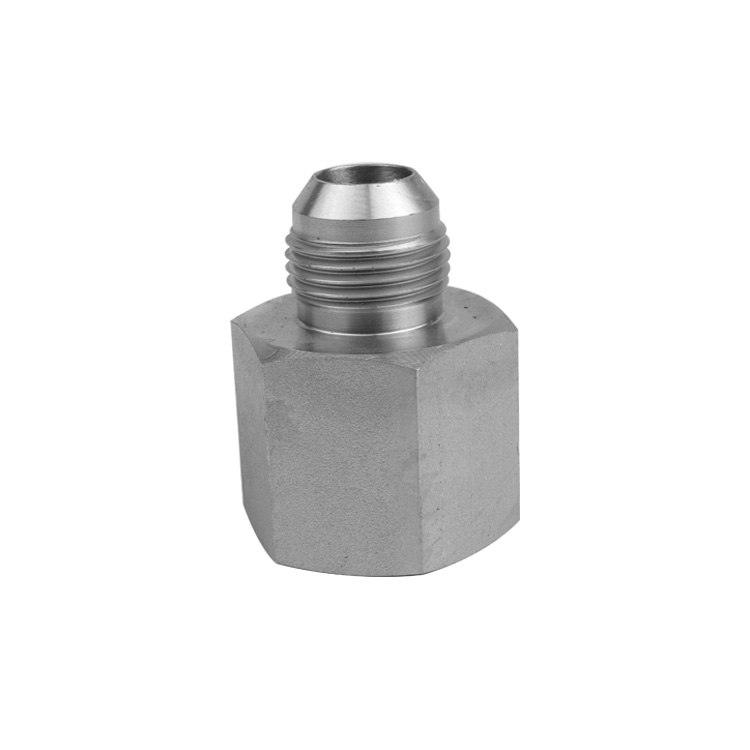
The hydraulic JIC adapter series in this reference carries the same family-level envelope as the other series reviewed here: 3,000–6,000 PSI pressure range and maximum stable operating temperature of 220°C. Its functional role in mechanical hydraulic assemblies is described as hydraulic pipeline sealing, thread locking and fastening, and pressure-bearing protection. It is listed for industries including construction machinery, agricultural machinery, mining, petroleum equipment, electromechanical equipment, forklift parts, hose fittings and transportation equipment.
Side-by-Side Buying Logic
When procurement teams compare BSP, NPT and JIC, the conversation should start with the geometry of the port they are trying to reach. A simple decision table can anchor that conversation:
| Thread family | Thread form | Sealing principle | Representative NJ model series | Common crossover examples |
|---|---|---|---|---|
| BSPP | Parallel | Sealing face / washer / O-ring type seal | 1B, 1B9, 2B9, 6B, 9B | 1NB (NPTF-to-BSPP), 5BN (BSPP-to-NPTF), 1BJ (BSPP-to-JIC) |
| BSPT | Tapered | Thread interference on tapered form | 1T, 1T9, 4T, 5T | 1JT (JIC-to-BSPT), 1BT (BSPP/BSPT transition) |
| NPT / NPTF | Tapered pipe | Tapered thread interference; NPTF adds dry-seal control | 5404, 5405, 5406, 5500, 5600, 5652 | 2404 (JIC-to-NPTF), 2501 (JIC-to-NPTF elbow) |
| JIC | Straight thread with 37° flare | Metal-to-metal seal on the flared cone | 2403, 2405, 2406, 2500, 2601–2609 | 1BJ, 1JT, 2404, 2405 |
The table is not a brand ranking. It is a mapping tool. A European-origin excavator might use BSPP ports; a North American hydraulic pump might use NPTF or JIC; and a replacement hose assembly might need a JIC-to-NPTF crossover adapter. The correct answer changes with the machine, not with the supplier.
Application Fit Across Machinery Types
Hydraulic adapters are rarely purchased for a single circuit. They are purchased to support a fleet, a product line or an inventory of hose assemblies. The application reference data behind this article points to a shared set of operating conditions: high temperature, high pressure, rust resistance and long sealing integrity.
For BSPT adapters, the stated capability is notable: the adapter can withstand a static pressure of 6,000 PSI and a burst pressure of 9,000 PSI without deformation while maintaining continuous operation and seal integrity. NPT adapters are described as designed for high-pressure environments and made to operate under high-temperature and high-pressure conditions. JIC adapters are similarly expected to provide hydraulic pipeline sealing, thread locking and fastening, and pressure-bearing protection for mechanical hydraulic assemblies.
The application list for the full NJ product range includes construction machinery, agricultural equipment, coal-mining equipment, petroleum equipment, electromechanical equipment, forklift parts and hose fittings. The matched equipment types include hydraulic hoses, hydraulic cylinders, threaded bolts, pipe joints, hydraulic pumps and mechanical cylinder assemblies. For a buyer, this breadth matters because the adapter is often the bridge between components made by different equipment specialists.
A Canadian distribution case in the same reference illustrates the commercial outcome of a well-managed adapter supply relationship. A mid-market distributor client in Canada, identified in the project records as Tompkins, worked on a three-year project involving high-performance hydraulic nuts and related adapter products. The project expanded downstream client channels and improved overall gross profit margin. The product was intended for resale to other local customers with demand. This case does not suggest that one thread standard outperforms another; it suggests that distributors benefit when a supplier can deliver consistent, resellable hydraulic components across a multi-year period.
What the Manufacturer Needs to Prove
NingBo NJ Hydraulic Adapter Co., Ltd operates from Fenghua, Ningbo, Zhejiang Province, with a 20,000-square-metre facility and a workforce of around 200 employees. The company was founded in 2004 and specialises in hydraulic fittings. Its export ratio is approximately 75%, with the US and Canada listed as the main markets. The manufacturing profile includes OEM/ODM production, customisation of logo, packaging and plated colour, and custom products made from provided drawings or samples. The stated quality-control method is random inspection, and remote support is listed as the after-sales service model.
For a buyer evaluating this supplier, the relevant evidence is not the company description alone. It is the existence of a product architecture organised by thread family, pressure range, material grade and geometry. When a manufacturer can list BSPP and BSPT under separate model series, NPT under the 5400/5500/5600 series, and JIC under the 2403–2609 range, the buyer can build a shortlist from part numbers rather than from marketing language.
Market Context: Adapters Remain a Central Hydraulic Segment
Hydraulic adapters are not a niche product category. According to a 2025 global market assessment by Dataintelo, the hydraulic fittings market — including adapters and couplings — was valued at approximately USD 4.8 billion and is projected to reach USD 7.9 billion by 2034. Within that market, hydraulic adapters held the largest product-type share at 28.4%. Steel dominated revenue at 45.2%, reflecting the demand for high-pressure durability. Asia-Pacific accounted for an estimated 38.6% of global revenue in 2025.
These figures help procurement teams understand why thread selection is not a trivial detail. The adapters segment is large precisely because machines mix standards: a single excavator, tractor or mining rig can contain BSP, NPT and JIC connections in different circuits. This is why manufacturers like NJ maintain broad series codes rather than a single universal adapter. The commercial value lies in offering predictable, verified geometry across the standards that the market actually uses.
Limitations and Practical Boundaries
A balanced buying verdict must also state what these products cannot do. The 3,000–6,000 PSI range and 220°C maximum stable operating temperature are family-level specifications from the reference catalogue; they do not guarantee that every size, material and plating combination in the series will perform identically at the upper limit. Pressure capability depends on wall thickness, thread size, material grade and the condition of the mating port.
Similarly, salt spray results describe a controlled test condition. White rust at 120 hours and red rust at 240 hours under a 120-hour salt spray test gives a useful comparative signal, but real-world corrosion resistance still depends on the chosen material — carbon steel, SS304 or SS316 — and on the environment in which the machine operates. Buyers who need maximum corrosion resistance should evaluate stainless steel options separately rather than assuming one family-level specification covers all service conditions.
There is also a mechanical boundary: an adapter cannot fix a damaged port, and it should not be used to convert a system long-term when the underlying equipment design is mis-specified. Crossover adapters such as NPT-to-JIC or BSP-to-NPT are legitimate tools for maintenance, retrofit and mixed-fleet support. They are not substitutes for understanding which standard the original system was designed to use.
Future Outlook
The hydraulic industry is unlikely to converge on a single thread standard in the near future. Regional equipment preferences, legacy installed bases and different sealing philosophies continue to support the coexistence of BSP, NPT and JIC systems. What will change is how easily buyers manage that coexistence. Demand for DIN-standard, stainless steel and metric-thread adapters has been rising alongside the growth of Asian machinery production, while North American and European installed fleets continue to drive demand for NPT and BSP service parts.
The procurement implication is clear. Buyers who build their adapter shortlist around thread-system coverage, traceable part-number series, material options and documented pressure-temperature limits will be better positioned to support mixed fleets than those who rely on a single brand relationship without mapping ports first. In this comparison, thread selection and supplier verification together form the buying verdict.
FAQ
What should buyers check first when selecting BSP, NPT or JIC adapters?
The first check is the port geometry and thread standard of the component being connected. Once the thread system is known, the buyer should verify that the adapter model provides the correct male or female configuration, sealing method and crossover geometry. In the reference catalogue covered here, BSP is organised under the 1B and 1T series, NPT under the 5400/5500/5600 series, and JIC under the 2403–2609 range. The correct choice is determined by the machine circuit, not by brand preference.
Can BSP adapters connect directly to JIC or NPT systems?
Yes, when the correct crossover model is used. The NJ product range includes examples such as 1NB for NPTF-to-BSPP connection, 5BN for BSPP-to-NPTF connection, 1BJ for BSPP-to-JIC connection and 1JT for JIC-to-BSPT connection. In the JIC/NPT part of the catalogue, models 2404 and 2405 similarly connect male JIC ends to NPTF ends. These are standard adapter geometries, but the exact part number must match the required thread size and configuration.
What do part-number series like 1B, 5406 or 2403 tell a buyer?
They identify the adapter family and its expected geometry. The 1B series is associated with BSPP thread fittings; the 1T series is associated with BSPT thread fittings; the 5406 family belongs to the NPT/NPTF range and is shown in documentation as male NPTF to female NPTF straight adapters and plugs; the 2403–2609 range belongs to the JIC family, with 2403 shown as a male JIC-to-male JIC straight adapter. Series codes should always be checked against the full model number and the product specification sheet.
If an adapter series is rated 3,000–6,000 PSI, is every size in that series equally strong?
Not necessarily. The pressure range is a family-level specification in the reference data for the BSP, NPT and JIC series reviewed in this article. Actual system pressure capability also depends on thread size, material grade, wall thickness, plating and the condition of the mating port. For critical high-pressure circuits, buyers should confirm the specific model, material and size with the manufacturer rather than assuming a universal rating across every variant.
What replacement process applies if delivered accessories are missing or incorrect?
In the supplier procedure referenced for this product range, customers need to provide photos of missing or wrong-delivered items. After verification, the supplier arranges replacement accessories by sea or air shipment. This is a standard after-sales control process; for distributors, documenting delivery discrepancies promptly is therefore part of protecting the supply chain.
Manufacturer reference document: NingBo NJ Hydraulic Adapter Co., Ltd product brochure (PDF)
Есть вопросы или нужны дополнительные детали?
Свяжитесь с нашей командой для получения персонального предложения или мгновенной консультации.
Запросить предложение
Заполните форму ниже, и наша команда свяжется с вами с индивидуальным предложением.
Прямой чат WhatsApp
Предпочитаете общаться в реальном времени? Напишите нам в WhatsApp для мгновенной помощи и быстрых ответов.
- Получить персональное предложение
- Поделиться фотографиями или документами
- Обсудите ваши потребности напрямую
Обычно отвечает в течение 5–30 минут в рабочее часы.