
Baby Coil FAQ: Stainless Steel Grades, BA Finish & Packing
Baby Coil FAQ: Stainless Steel Grades, BA Finish & Packing
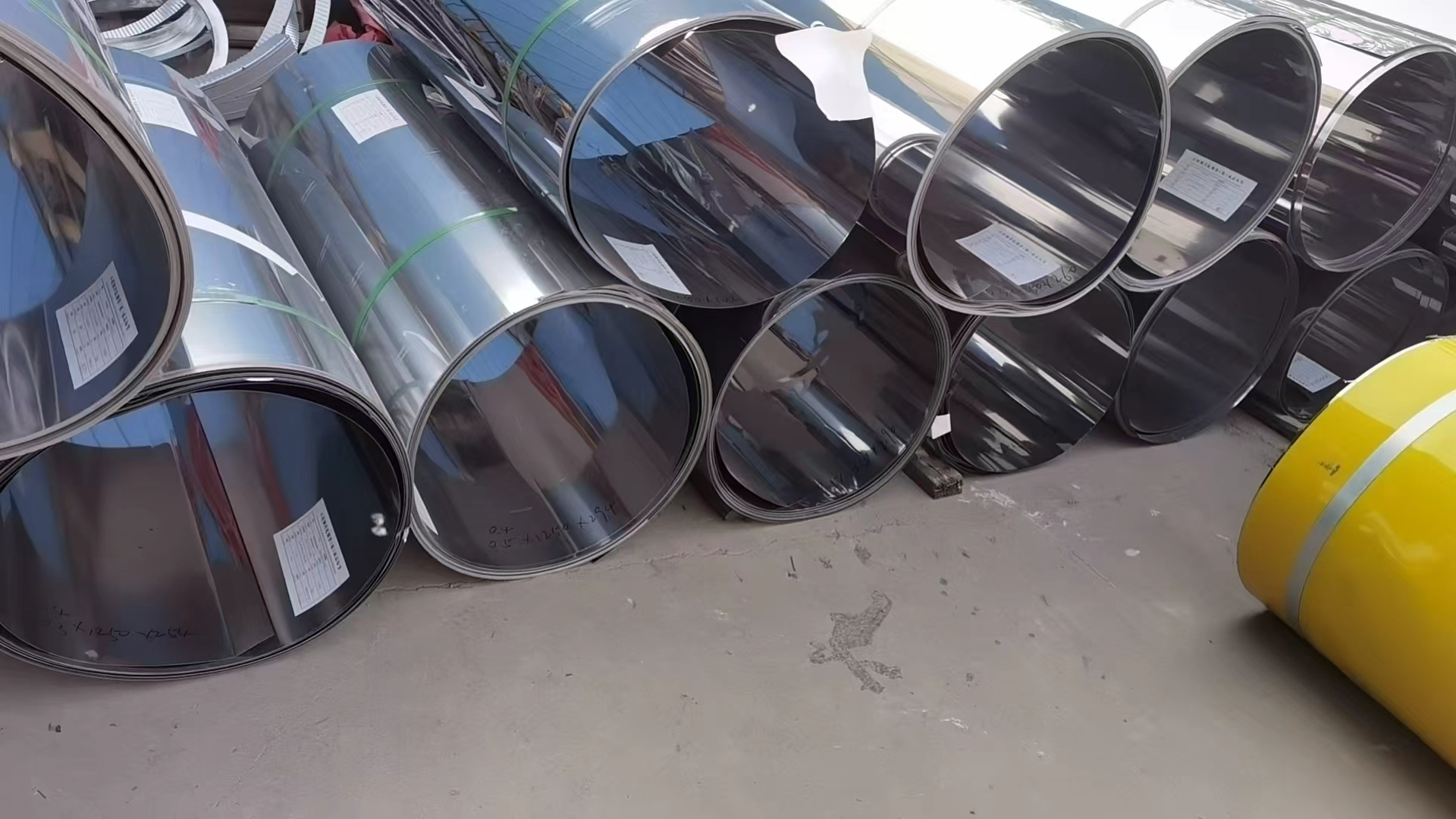
A 430 baby coil: narrow cold-rolled stainless steel supplied at roughly 600 mm width, mainly in BA finish.
A stainless steel baby coil is a narrow, cold-rolled coil supplied at roughly 600 mm width, generally between 0.1 mm and 1.2 mm thick, produced mainly in BA (bright annealed) finish and available in grades 430, 304, 410 and 201. Around 70% of this supply is BA finish, and roughly 80% of its thickness volume sits in the 0.3–0.6 mm band — a concentration that tells buyers more about the category than any brochure can, because it reveals which downstream processes the material was designed around.
The category matters because the underlying market keeps expanding. The global stainless steel market was valued at USD 135.8 billion in 2025 and is projected to reach USD 247.4 billion by 2033 (Grand View Research), while China's stainless steel exports reached an all-time high of 5.04 million tonnes in 2024, a 25.6% increase year on year (General Administration of Customs / Mysteel). A large share of that material moves as coil that is subsequently slit, cut and re-supplied — and baby coil sits directly inside that flow.
This FAQ-style reference addresses the technical and procurement questions buyers and engineers raise most often during research and evaluation: which grades are available, what the BA finish actually implies, how to read the ~600 mm width against other slitting options, what nude packing means in practice, and how baby coil differs from secondary coil before a purchase order is confirmed.
The Procurement Problem Baby Coils Solve
Most stainless steel coil is traded and produced at full width, typically 1,240 mm or mill edge. That width is efficient for the mill, but it is often the wrong width for the buyer. Tube and pipe mills form strip at a fixed circumference. Stamping lines feed a die with a defined blank width. Kitchenware and tableware producers cut circles from a strip that has already been trimmed. When these operations receive a 1,240 mm master coil, they must invest in slitting, accept trim loss, and handle a coil weight that their in-house lifting equipment may not accommodate.
Baby coil exists to remove that step. It arrives close to the width the production line actually consumes, at a weight that is manageable with standard handling equipment, and in a thickness band that matches the dominant forming range in light-gauge manufacturing. For a tube mill or a stamping shop, that translates into less slitting scrap, fewer coil changes and simpler floor logistics.
The trade-off is equally clear: the buyer gives up flexibility. A ~600 mm baby coil cannot be used for an application that needs 1,240 mm, and it cannot be re-cut into very wide blanks. Baby coil is a fit-for-purpose input, not a universal one — which is precisely why the specification questions below matter before ordering.
The Specification Baseline: What a Baby Coil Actually Is
The parameters below represent the standard baby coil offering. Buyers can use them as the reference point against which a quotation, a mill test certificate or a sample coil should be checked.
| Attribute | Baby coil specification | What it means commercially |
|---|---|---|
| Available grades | 430 / 304 / 410 / 201 | Four grades cover decorative, food-contact, general-purpose and forming-oriented demand |
| Thickness range | 0.1 mm – 1.2 mm; approximately 80% falls in the 0.3–0.6 mm band | Standard thicknesses are normally stock-backed; edge-of-range thicknesses may extend lead time |
| Width | Around 600 mm | Matches tube forming, narrow stamping and trim-efficient cutting |
| Surface finish | Mainly BA finish, approximately 70% of supply | Bright, low-roughness surface suited to forming and downstream finishing |
| Packaging | Nude packing | Faster unpacking, less wrapping waste, less physical surface protection in transit |
Read together, these four grades and one dominant finish describe a category built around light-gauge, high-volume production rather than around heavy plate or architectural cladding. That distinction should shape both the sample request and the acceptance criteria.
Surface Finish: Why BA Accounts for Roughly 70% of Baby Coil Supply
BA stands for bright annealed — a cold-rolled coil that has been annealed in a controlled atmosphere to produce a bright, clean surface without the additional pickling and skin-passing sequence that characterises a 2B finish. For baby coil, BA is the default: approximately 70% of the supply is BA finish, and buyers evaluating samples should expect BA unless they specify otherwise.
The reason is application-driven. BA gives a uniform, low-roughness surface that supports forming, resists the smudging and marking that appear on rougher surfaces, and provides a suitable starting point for downstream polishing or coating. In kitchenware, tableware and appliance panel production, that starting point reduces the amount of finishing work required after forming.
It is important not to confuse BA with mirror. Mirror-type finishes such as 8K are produced through iterative polishing, and the highest reflectivity tier, sometimes labelled 12K, approaches the appearance of a glass mirror. Those are separate process routes, not a natural extension of BA. Where a decorative reflective surface is genuinely required, the finish is typically specified on a wider program: on 201 J2 material, NO.4 is supplied from 0.28 mm to 1.45 mm, 8K from 0.28 mm to 1.95 mm, and Gold 8K and Rose Gold 8K from 0.28 mm to 1.15 mm, all at 1,240 mm width. Buyers who need mirror-grade reflectivity should therefore plan for a different width and thickness logic than a standard baby coil order.
Dimensions: Reading the ~600 mm Width Against Other Options
Buyers who search for "600 mm stainless steel coil" usually arrive with a specific forming width in mind. The question worth answering is not whether 600 mm exists — it does — but whether ~600 mm is the correct width for the process, or whether a slightly different slit width would reduce waste further.
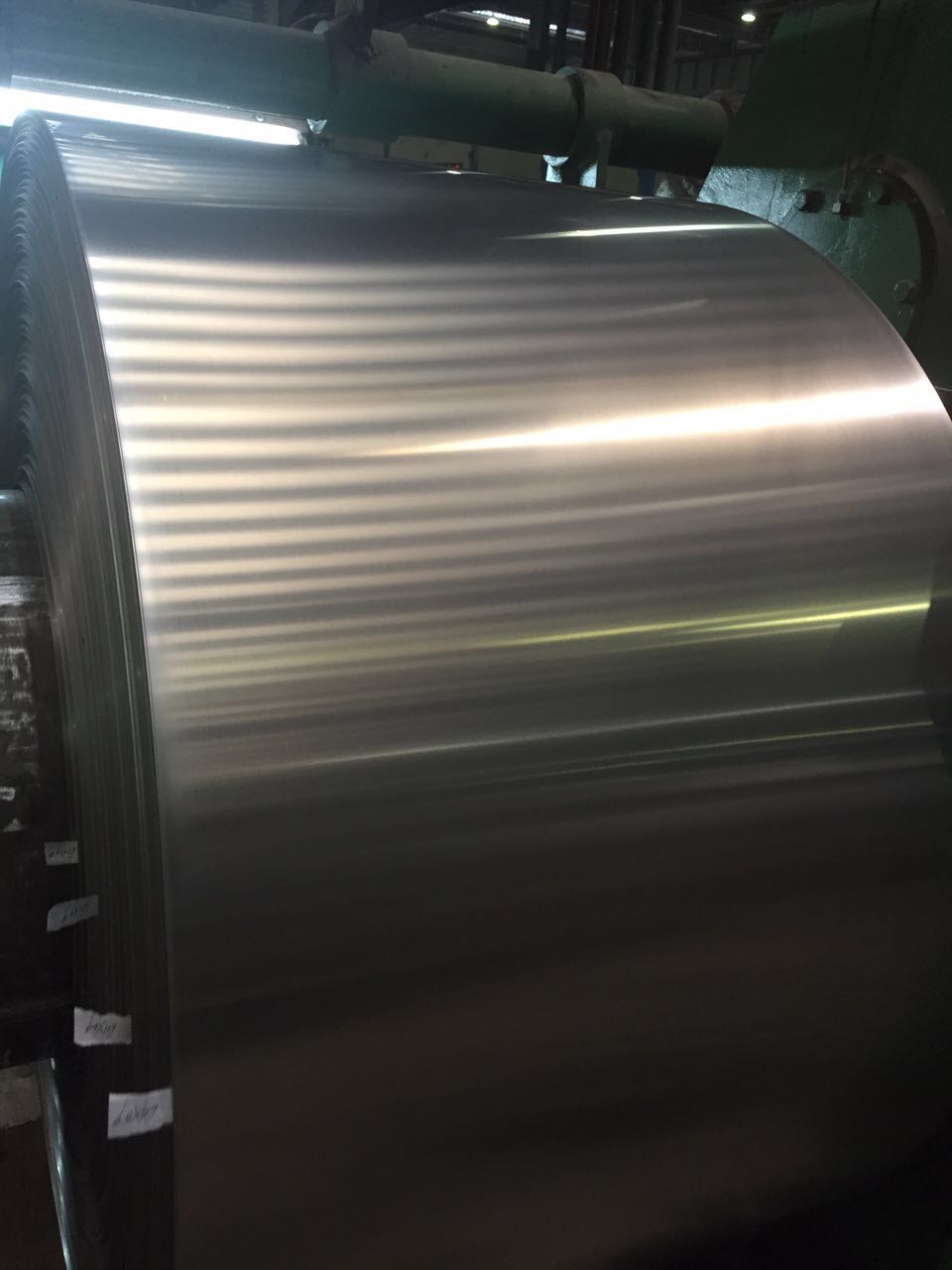
Narrow-format 304 stainless steel coil: width is a forming decision, not a catalogue default.
The practical picture is broader than a single figure:
- Baby coil is supplied at around 600 mm wide, in 0.1–1.2 mm thickness, mainly BA finish.
- Secondary coil — narrow also runs at around 600 mm, 0.1–1.2 mm, mainly BA finish, with a coil weight of around 200 kg.
- 201 narrow programs cover slit widths of 550, 600, 620, 650, 690, 730, 810 and 830 mm, in 0.1–2.0 mm thickness.
- 304 narrow programs cover 550, 600, 620, 650, 690 and 730 mm, in 0.10–2.00 mm thickness.
- 410 narrow BA covers 300–1010 mm, in 0.15–1.2 mm thickness.
- Wider alternatives run at 1,240 mm or mill edge: 304 from 0.3 mm to 3 mm, 201 from 0.25 mm to 3 mm, and 410 wider BA from 0.25 mm to 1.5 mm.
The decision rule is straightforward. Specify the narrowest width that satisfies the forming operation while leaving a workable edge trim. A tube mill that consumes 550 mm of strip should not order a 600 mm baby coil and re-slit it, because that reintroduces the slitting step the format was meant to avoid. Conversely, a stamping operation that occasionally runs wider blanks should not lock itself into a 600 mm supply if a 730 mm slit coil would remove a secondary process from the route.
Packaging: Nude Packing and What It Signals to Buyers
Baby coil is supplied in nude packing, meaning the coil is shipped without an external PVC wrap or interleaved protective layer. This contrasts with secondary coil, which is supplied either with PVC on the outside or with paper interleaved between wraps.
Nude packing is not a cost shortcut — it is a format decision. Coils that will be fed directly into a slitting or forming line gain nothing from a protective wrap that must be cut away and disposed of, and the wrap itself can introduce contamination into a clean forming operation. For high-turnover production, nude packing reduces unpacking labour and packaging waste.
The limitation is equally real. Without external wrapping, the coil edge and surface are more exposed to handling marks and to moisture during long sea transit or extended open storage. Buyers in humid climates, or buyers who intend to hold material for several weeks before processing, should state their storage conditions during the inquiry so that surface protection can be discussed as part of the specification rather than treated as an afterthought. This is one of the practical boundaries that separates a well-specified baby coil order from a specification that simply names a grade and a thickness.
Baby Coil vs Secondary Coil: Specification Comparison
Baby coil and secondary coil are frequently discussed together because they overlap in width and finish, but they are distinct supply categories with different thickness envelopes, grade combinations, packaging and weight profiles.
| Parameter | Baby coil | Secondary — narrow | Secondary — wider |
|---|---|---|---|
| Grades | 430 / 304 / 410 / 201 | 430 / 201 / 304 | 430 / 304 / 201 / 410 |
| Thickness | 0.1 – 1.2 mm | 0.1 – 1.2 mm | 0.25 – 1.5 mm |
| Width | Around 600 mm | Around 600 mm | Around 1,000 – 1,250 mm |
| Surface | Mainly BA finish | Mainly BA finish | Mainly BA finish |
| Coil weight | Not fixed by the format; confirmed per order | Around 200 kg | 1 mt below / 1 mt above |
| Packaging | Nude packing | PVC outside / paper interleaved | PVC outside / paper interleaved |
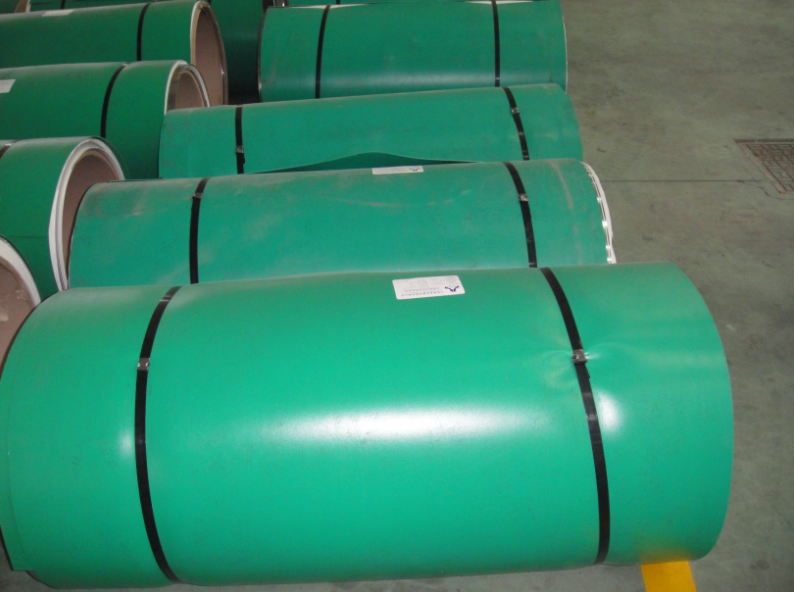
430 secondary stainless steel: same family, different thickness, weight and packaging logic.
The comparison shows why the two categories should not be treated as substitutes. A buyer who needs a coil of roughly 1,000–1,250 mm width is outside baby coil territory altogether and should be looking at the secondary-wider format or a mill-width program. A buyer who needs around 600 mm and 0.3–0.6 mm thickness is squarely in baby coil territory. Coil weight is the third deciding factor: a 200 kg secondary-narrow coil can be handled with lighter lifting equipment, while the wider format moves in units of 1 mt or more and requires corresponding handling capacity on site.
Application Fit: Where Baby Coils Are Used
The applications attached to this material are consistent across the supply category. Baby coil is designed for environments that include high temperature exposure, food contact and outdoor construction, and it functions in food processing, architectural decoration, home appliance manufacturing and automotive parts. The equipment it feeds is equally specific: slitting machines, tube mills and stamping equipment.
The full application list associated with light-gauge stainless coil spans kitchenware and cookware, home appliances, elevator decoration, construction and interior decoration, automotive components, industrial equipment, metal stamping and deep drawing, tube and pipe manufacturing, tableware production and hardware accessories. Operating modes range from intermittent daily operation to 24/7 continuous service and cyclic heating and cooling, which is why the special requirements for these scenarios — mirror finish, anti-rust performance and stable thickness tolerance — are stated as procurement conditions rather than as optional extras.
Grade selection should follow the service environment rather than convenience. 304 is the austenitic grade commonly chosen where corrosion resistance and food-contact conditions are priorities; 430 is a ferritic grade widely associated with interior and decorative applications; 410 is a martensitic grade typically associated with cutlery-type and wear-related parts; 201 is broadly used in general-purpose light-gauge forming. None of these is a universal answer, and the correct approach is to match the specified grade to the actual service condition and then confirm that the coil format and thickness band can supply it consistently.
Procurement Parameters: MOQ, Lead Time and Customization
MOQ and lead time in this category depend on width, thickness and grade rather than on a single company-wide rule, so quotations that state one figure for everything deserve a closer look.
| Program | MOQ reference | Lead time reference |
|---|---|---|
| 201 narrow (J3/J2/J5, 2B/BA) | 27 mt by 3–4 specifications | 7–30 days / stock |
| 201 wider (J3/J2/J5, 2B/BA) | 7–10 mt per thickness | 7–30 days / stock |
| 304 narrow | 9 mt at 730 mm and 690 mm; 8 mt at 650 mm and 620 mm | 7–30 days / stock |
| 304 wider | 10 mt per thickness | 7–30 days / stock |
| 410 wider BA | 20 mt per thickness | 7–30 days / stock |
| Stainless steel circle | 3 mt per thickness | 25–45 days |
Customization is a normal part of this supply. Thickness, width, surface finish, PVC protection and packaging can all be adjusted to a buyer's specification, and the general order capability runs at a monthly export volume of 3,000 MT with a lead time window of 7–45 days and a standard MOQ of 27 MT. Buyers should expect the quoted lead time to depend on whether the required width and thickness combination is stock-backed — a 0.4 mm coil at 600 mm in a mainstream grade behaves very differently from a 1.1 mm coil at an uncommon width.
NINGBO SUNFIRE STAINLESS STEEL CO., LTD is a China-based stainless steel supplier established in 2013, working with a cooperative factory and specializing in stainless steel and stainless steel products with a particular focus on secondary and baby coil. The company reports a 100% export ratio and serves markets including Pakistan, India, Vietnam, Russia, Turkey, Indonesia, the UAE, Thailand, Malaysia and Bangladesh, with quality control built around mill test verification, thickness inspection and surface inspection. For buyers comparing suppliers of baby coil, that combination — document discipline plus a stated customization scope — is a more useful screening signal than a broad product list.
Quality Documentation and Standards
Baby coil quality conversations should be anchored to two things: the inspection sequence and the applicable standard. On the inspection side, the working sequence for this supply category is mill test, thickness inspection and surface inspection. On the standards side, ASTM A240 and ASME SA240 are the core international standards for stainless steel plate, sheet and strip used in general and pressure vessel applications.
Two practical checks follow from this. First, confirm that the mill test certificate references the grade and standard that the end customer's specification calls for — a certificate that names a grade but not a standard is incomplete for most industrial end users. Second, confirm that thickness inspection is performed against a defined tolerance regime, because stable thickness tolerance is one of the stated special requirements for high-temperature, food-contact and outdoor construction scenarios. Surface inspection should be assessed under consistent lighting, since BA finish evaluation is highly sensitive to inspection conditions.
Limitations and Boundaries Buyers Should Plan For
A fair assessment has to include what baby coil cannot do.
- Width ceiling. Baby coil is supplied at around 600 mm. An application that requires 1,240 mm cannot be served by this format at all, and substituting a narrow coil would mean welding or joining, which changes the product.
- Nude packing exposure. Without PVC wrapping or interleaving, coils are more exposed to edge damage and moisture during long transit or prolonged storage. Buyers in humid environments should state storage conditions up front.
- BA is not mirror. Buyers who need a reflective decorative surface require a separate polishing route — 8K-type finishes are produced by iterative polishing and are typically supplied on wider programs at 1,240 mm.
- Thickness concentration. Roughly 80% of baby coil thickness volume sits between 0.3 mm and 0.6 mm. Requirements at 0.1 mm or near 1.2 mm are achievable but sit at the edge of the band, where availability and lead time are less predictable.
- Trade measures. Anti-dumping duties of 24.6%–28.5% on stainless steel cold-rolled flat products from China and Taiwan were maintained in the EU following a 2025 expiry review (European Commission, Regulation 2025/1573). Buyers shipping into the EU should build duty exposure into landed-cost modelling rather than discovering it at customs.
Market Trend Analysis
Three verifiable trends shape how baby coil is bought.
Demand growth is structural, not cyclical. The global stainless steel market was valued at USD 135.8 billion in 2025 and is projected to reach USD 247.4 billion by 2033 (Grand View Research). Growth of that magnitude implies continued expansion in the light-gauge forming sectors — kitchenware, appliances, tube and pipe, automotive components — that consume narrow coil.
Export flows are concentrating. China's stainless steel exports reached an all-time high of 5.04 million tonnes in 2024, up 25.6% year on year (General Administration of Customs / Mysteel), while Chinese imports fell 9.3% to 1.88 million tonnes in the same year (SteelOrbis / GACC), reflecting increased domestic production capacity. For buyers, that means more available supply but also more suppliers competing on the same terms, which raises the value of documentation and packing discipline as screening criteria.
Capacity is shifting geographically. Hongwang Group, a major producer specializing in cold-rolled stainless steel, operates an Indonesian joint venture with 700,000 tonnes per year of cold-rolling capacity (Mysteel Global). Regional capacity additions of this type influence lead times and origin options for coil buyers, and they make origin planning a live variable in supplier selection rather than a fixed assumption.
Future Outlook
Narrow-format coil supply is likely to keep moving toward buy-to-width purchasing. As tube, stamping and kitchenware capacity expands in the markets that already absorb most light-gauge stainless exports, the value of a coil that arrives close to the forming width increases, because it removes a process step and a source of scrap.
At the same time, buyers are becoming more demanding about evidence. Grade availability is widely available information; document consistency, thickness stability and packaging protection are not. Suppliers that can describe their inspection sequence clearly, state their MOQ logic per width and thickness, and explain the difference between baby coil and secondary coil without blurring the two will be better positioned than suppliers who treat narrow coil as an undifferentiated commodity.
Buyer FAQ
What is the difference between a baby coil and a secondary coil?
Baby coil is supplied at around 600 mm width, 0.1–1.2 mm thickness, mainly in BA finish, in grades 430, 304, 410 and 201, and is shipped in nude packing. Secondary coil is a separate format with two variants: secondary-narrow, at around 600 mm width and 0.1–1.2 mm thickness in grades 430, 201 and 304 with a coil weight of around 200 kg; and secondary-wider, at around 1,000–1,250 mm width and 0.25–1.5 mm thickness in grades 430, 304, 201 and 410, with coil weights of 1 mt below or above. Both secondary variants are supplied with PVC outside or paper interleaved, rather than nude packed.
Which grades are available in baby coil form?
Four grades are supplied: 430, 304, 410 and 201. The 201 family is offered in J3, J2 and J5 variants with 2B or BA surface, in narrow widths of 550, 600, 620, 650, 690, 730, 810 and 830 mm at 0.1–2.0 mm thickness, and in a wider 1,240 mm format at 0.25–3 mm thickness. 304 is supplied in narrow widths of 550–730 mm at 0.10–2.00 mm, and in a wider 1,240 mm format at 0.3–3 mm. 410 BA is offered from 300 mm to 1010 mm at 0.15–1.2 mm in the narrow program, and at 1,240 mm or mill edge from 0.25 mm to 1.5 mm in the wider program.
What thickness and width should a tube mill or stamping line specify?
For tube and pipe manufacturing and metal stamping, the standard baby coil envelope is around 600 mm width and 0.1–1.2 mm thickness, with roughly 80% of supply concentrated in the 0.3–0.6 mm band. The most efficient approach is to specify the narrowest width that the forming operation consumes, so that no re-slitting is required after delivery, and to select a thickness inside the 0.3–0.6 mm band where stock availability is strongest.
Why is BA the dominant finish, and how do I specify a mirror finish instead?
BA finish accounts for approximately 70% of baby coil supply because it provides a uniform, low-roughness surface that supports forming and downstream finishing in kitchenware, appliance and general light-gauge production. BA is not a mirror finish. Where high reflectivity is required, the finish must be specified as a separate polishing route: 8K finishes are produced by iterative polishing, and the highest reflectivity tier, sometimes labelled 12K, approaches a glass-mirror appearance. On 201 J2 material, NO.4 is supplied from 0.28 mm to 1.45 mm, 8K from 0.28 mm to 1.95 mm, and Gold 8K and Rose Gold 8K from 0.28 mm to 1.15 mm, all at 1,240 mm width.
How is baby coil packed, and what does that mean for storage and transit?
Baby coil is shipped in nude packing — without external PVC wrapping or interleaved paper. That reduces unpacking labour and packaging waste for buyers who feed coils directly into a production line. The trade-off is reduced physical protection: coil edges and surfaces are more exposed to handling marks and moisture during long sea transit or extended open storage. Buyers in humid markets, or buyers holding material for several weeks before processing, should state their storage conditions at the inquiry stage so that surface protection can be addressed in the specification.
What MOQ and lead time should be expected for a baby coil order?
MOQ depends on the program rather than being a single figure. The general order capability is 27 MT, and the 201 narrow program is quoted at 27 mt across 3–4 specifications. 201 wider is 7–10 mt per thickness; 304 narrow is 9 mt at 730 mm and 690 mm and 8 mt at 650 mm and 620 mm; 304 wider is 10 mt per thickness; and 410 wider BA is 20 mt per thickness. Lead times generally run 7–30 days for stock-backed narrow and wider programs, within an overall order capability window of 7–45 days. Stainless steel circles, a related product in 430, 410 and 201 at 0.3–2.0 mm thickness, are quoted at 3 mt per thickness with a 25–45 day lead time.
What quality evidence should accompany a baby coil shipment?
The working inspection sequence for this supply category is mill test, thickness inspection and surface inspection. On standards, ASTM A240 and ASME SA240 are the core international references for stainless steel plate, sheet and strip used in general and pressure vessel applications. Buyers should confirm that the mill test certificate names both the grade and the applicable standard, that thickness inspection is performed against a defined tolerance regime, and that surface inspection is conducted under consistent lighting — an important condition when evaluating BA finish.
Supplier reference: NINGBO SUNFIRE STAINLESS STEEL CO., LTD, established 2013, specializing in stainless steel and stainless steel products with a focus on secondary and baby coil. Product brochure: https://cdn.socialarks.com/sbsp/24888/common/2026/0520/6a0d5f47b7b09.pdf — Company website: http://en.sunfirex.com