
Baby Coil vs Secondary Stainless Steel: A Buyer Comparison
Baby Coil vs Secondary Stainless Steel: A Buyer Comparison
Baby coil and secondary stainless steel are not interchangeable labels for one defined specification. In the available product information, a baby coil is described by a narrow-coil format, grades, thickness range, approximate width, finish profile, and packing. Secondary stainless steel is also offered in narrow and wider formats, with its own stated dimensions, grades, and mainly bright-annealed (BA) surface. The practical comparison is therefore about the specific coil offered—not an assumption that one label guarantees higher quality, lower price, or a particular production history.
For buyers first researching stainless steel, the key distinction is that the listed baby coil and narrow secondary coil overlap substantially in dimensions. Their descriptions differ in the recorded finish and packaging details, while wider secondary coils cover another width range. These facts can help frame an initial inquiry, but the supplied specifications do not establish a universal technical definition of “baby coil” or “secondary,” nor do they prove that either category is suitable for a particular application without confirming the exact grade, dimensions, finish, and acceptance requirements.
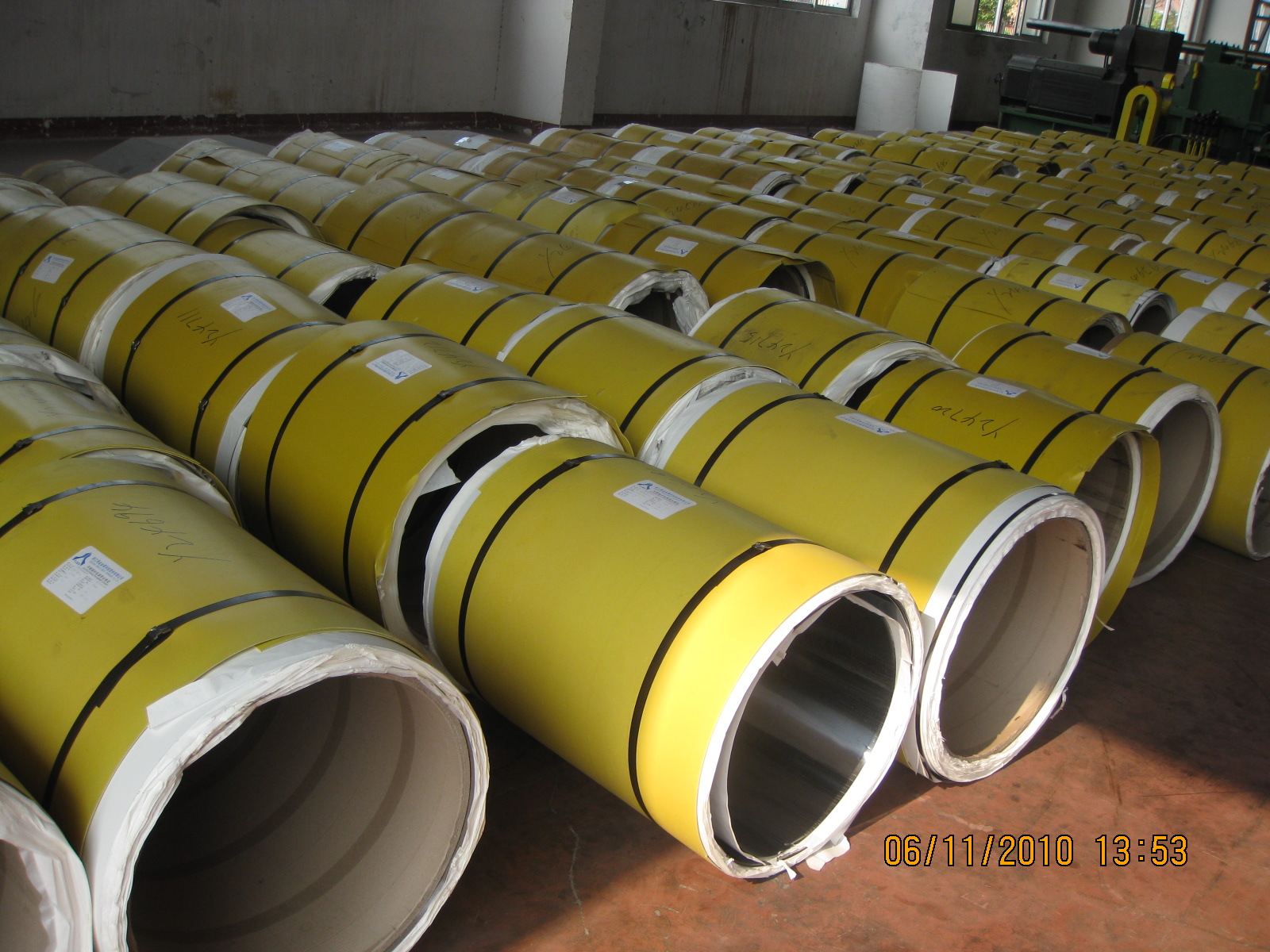
What the listed product information says
The baby coil description covers grades 201, 304, 410, and 430. Its stated thickness range is 0.1–1.2 mm, its width is approximately 600 mm, and its surface is mainly BA finish; the product record states that 70% is BA finish. The recorded packing is nude packing. These are descriptions of the listed offering, not guaranteed properties of every product sold under the term “baby coil.”
The secondary stainless steel listing also covers grades 201, 304, 410, and 430. Narrow secondary coils are specified at 0.1–1.2 mm thick and around 600 mm wide, with an approximate weight of 200 kg and a surface mainly in BA finish. Wider secondary coils are specified at 0.25–1.5 mm thick and 1,000–1,250 mm wide. The product specification records PVC on the outside or paper interleaving for packaging; packaging should be confirmed against the particular offer and order documents.
| Comparison point | Baby coil in the supplied specification | Secondary stainless steel in the supplied specification |
|---|---|---|
| Listed grades | 201, 304, 410, 430 | 201, 304, 410, 430 |
| Narrow format | 0.1–1.2 mm thick; approximately 600 mm wide | 0.1–1.2 mm thick; around 600 mm wide; approximately 200 kg |
| Wider format | The baby-coil description does not specify a wider format. | 0.25–1.5 mm thick; 1,000–1,250 mm wide |
| Surface description | Mainly BA; the product record states 70% BA finish. | Mainly BA |
| Recorded packing | Nude packing | PVC outside or paper interleaved in the product specification |
The table compares the information that is actually recorded; it does not establish that all dimensions or finishes can be combined in one order. A buyer should request a product-specific quotation or specification sheet to confirm the available combination, rather than treating each row as a complete catalogue of options.
Where the categories overlap—and where they differ
The clearest overlap is between baby coil and narrow secondary coil: both are listed at a thickness range of 0.1–1.2 mm and a width around 600 mm, and both are available across the same four stated grades. Their overlapping dimensions mean the labels alone do not tell a buyer which coil will better fit a slitting line, tube mill, stamping process, or other downstream equipment. The exact width, thickness, coil weight, and material requirements need to be checked against the production setup.
The documented differences are more specific. The baby-coil description gives a mainly BA surface and identifies nude packing. The secondary listing describes the narrow-coil weight as approximately 200 kg and records PVC outside or paper interleaving; it also gives a wider format from 1,000 to 1,250 mm. These details may affect handling, incoming inspection, and the planning of downstream processing, but they do not establish quality, defect rate, yield, or delivered cost. Those outcomes require order-specific evidence and agreed inspection criteria.
“Secondary” should not be read, on the basis of these records alone, as proof of a defect, a particular quality level, or a particular origin in the production sequence. Likewise, “baby coil” should not be taken as a guarantee of a specific weight or performance. The supplied information describes product formats and selected attributes; it does not define a shared industry-wide classification or compare test results between the two categories.
How color stainless steel fits the comparison
Color stainless steel is a related but separate specification question. The supplied 201 J2 Finish product information lists No.4, 8K, Gold 8K, Rose Gold 8K, and Black 8K finishes at a width of 1,240 mm. Its stated thickness ranges vary by finish: 0.28–1.45 mm for No.4, 0.28–1.95 mm for 8K, and 0.28–1.15 mm for Gold 8K and Rose Gold 8K. The product record identifies this as a 201 J2 stainless steel coil.
Those finish and dimension details should not be silently transferred to the baby-coil or secondary-coil entries. The available information does not say that the listed baby coil or secondary coil is supplied with Gold 8K, Rose Gold 8K, Black 8K, or No.4 finish. Nor does it specify that color finishing is available in the narrow formats described above. Buyers considering decorative applications should request confirmation of the exact grade, finish, width, thickness, and product form as one matched specification.
This separation matters because “color” is not a grade, and “8K” or “No.4” is not a substitute for confirming the base material and dimensions. If a project needs a decorative surface, specify the required appearance and finish by name, then confirm which product model carries it. If the project instead needs narrow material for processing, the coil format and line requirements may be the first screening criteria. A single keyword such as Color stainless steel does not resolve both questions.
Choosing a comparison basis for a real order
A useful comparison starts with the buyer’s actual process and required incoming material. For example, a buyer evaluating coils for a slitting or tube-making operation can first compare the specified width and thickness with the equipment’s requirements. A buyer sourcing material for kitchenware, home appliances, construction, or interior decoration can also identify the intended grade and surface needs. These are application areas listed in the product information; they are not evidence that every listed coil is approved for every use or operating condition.
- Fix the grade. Identify whether the inquiry is for 201, 304, 410, or 430, and state the exact product designation where one is supplied. The shared list of grades does not mean grades are interchangeable.
- Match dimensions to the process. Give the required thickness and width, and ask whether the offered coil is the narrow or wider format. For secondary material, clarify whether the approximately 200 kg narrow-coil description applies to the actual offer.
- Specify the surface. State whether the requirement is BA, No.4, 8K, Gold 8K, Rose Gold 8K, or another expressly agreed finish. Do not infer a color finish from the word “secondary” or “baby coil.”
- Agree packing and handling expectations. Confirm the packing for the selected product and how the coil will be identified and protected for the intended receiving and processing steps.
- Define acceptance evidence. Request documents and inspection criteria that correspond to the ordered grade, dimensions, finish, and intended use. The supplied category descriptions alone do not establish chemical composition, mechanical properties, tolerance, surface acceptance, or lot-level results.
This checklist does not prescribe a testing standard or threshold. It separates product identity from evidence of conformity: the first states what is being offered, while the second must be agreed and documented for the particular order. Where a color finish is central to the project, a sample or other agreed visual acceptance method may be relevant, but the available records do not specify a sample process or acceptance protocol.
Application fit depends on the complete specification
The listed product range is associated with sectors including kitchenware and cookware, home appliances, elevator decoration, construction and interior decoration, automotive components, industrial equipment, metal stamping, tube and pipe manufacturing, tableware, and hardware accessories. These category-level application references help buyers identify where to investigate further. They do not replace evaluation of the actual service conditions, process compatibility, or requirements applicable to a finished product.
For decorative work, finish identity and surface condition may be central to the purchasing specification, so the buyer should keep the requested surface attached to the exact grade and dimensions in the quotation and order confirmation. For a manufacturing process, width, thickness, coil handling, and the needs of the processing equipment may be more immediate screening questions. In either case, the available records do not provide comparative performance tests for baby coil versus secondary stainless steel. A selection should therefore follow the required product attributes and verified order documents, not a generalized claim that one label is superior.
Supplier context and the limits of the evidence
NINGBO SUNFIRE STAINLESS STEEL CO., LTD is a stainless steel and stainless steel products supplier established in 2013, according to the supplied company information. The company material describes its product scope as including baby and secondary coils. This company context identifies the source of the listed offerings; it is not independent verification of product quality or an endorsement of either coil category.
The specifications used here describe selected grades, dimensions, surface descriptions, and packing details. They do not supply a controlled head-to-head test, pricing comparison, defect-rate data, yield results, or proof of performance under a particular customer’s production conditions. They also do not establish a universal definition of the words “baby” and “secondary.” Buyers should treat the category comparison as an initial reference and confirm the actual material and conditions for each order.
For color-finish sourcing, the evidence is narrower still: the supplied 201 J2 Finish record describes certain finishes and dimensions, but does not connect those finishes to the baby-coil or secondary-coil listings. This is a meaningful boundary, not a reason to assume unlisted options are unavailable. It means the exact combination should be confirmed directly before the buyer relies on it for design, processing, or procurement planning.
Conclusion: compare the offered coil, not just its label
Based on the supplied descriptions, baby coil and narrow secondary stainless steel overlap in grades, thickness range, approximate width, and mainly BA surface. The secondary listing additionally specifies an approximate narrow-coil weight and a wider format; the baby-coil record states nude packing, while the secondary specification records PVC outside or paper interleaving. These are useful points for an initial buyer comparison, but they do not prove a difference in quality, cost, or suitability.
Color stainless steel should be evaluated as a separate, explicitly specified finish requirement. The listed 201 J2 Finish options include No.4, 8K, Gold 8K, Rose Gold 8K, and Black 8K, but the supplied records do not establish that these finishes are available in the baby-coil or secondary formats described here. A sound procurement decision therefore identifies the exact grade, coil format, dimensions, finish, packing, and acceptance evidence together. If any of those details are not confirmed for the offered product, the category name alone cannot fill the gap.
Frequently asked questions
Are baby coil and secondary stainless steel the same product?
No universal equivalence is established by the supplied information. The described baby coil and narrow secondary coil overlap in grade options, thickness range, approximate width, and mainly BA surface, but their records differ in details such as stated weight and packing. Confirm the exact specification for the offered coil.
What grades are listed for both types?
Both the baby-coil and secondary-coil descriptions list grades 201, 304, 410, and 430. The shared grade list does not establish that grades are interchangeable or that every grade is available in every dimension or finish.
Does the secondary-coil description guarantee lower quality?
No. The supplied product information does not define “secondary” as a quality grade or provide comparative test results, defect rates, or acceptance data. Buyers should evaluate the specific material and the evidence agreed for the order rather than infer quality from the label alone.
Are Gold 8K and other color finishes available for these coil formats?
The supplied 201 J2 Finish information lists No.4, 8K, Gold 8K, Rose Gold 8K, and Black 8K finishes at 1,240 mm width, with thickness ranges varying by finish. It does not state that these finishes are offered in the baby-coil or secondary-coil formats described here. Confirm the full grade, finish, and dimension combination for the specific offer.
Which information should a buyer confirm before ordering?
Confirm the grade, coil type, thickness, width, coil weight where relevant, surface finish, packing, and the documents or inspection criteria agreed for the order. For decorative applications, identify the required finish explicitly. For processing, compare the offered dimensions with the equipment and product requirements.
Есть вопросы или нужны дополнительные детали?
Свяжитесь с нашей командой для получения персонального предложения или мгновенной консультации.
Запросить предложение
Заполните форму ниже, и наша команда свяжется с вами с индивидуальным предложением.
Прямой чат WhatsApp
Предпочитаете общаться в реальном времени? Напишите нам в WhatsApp для мгновенной помощи и быстрых ответов.
- Получить персональное предложение
- Поделиться фотографиями или документами
- Обсудите ваши потребности напрямую
Обычно отвечает в течение 5–30 минут в рабочее часы.