
Baby Custom Wipes: Materials, Sizes & OEM Manufacturing
Industry Insight | Light Industry and Daily Use
Baby Custom Wipes: Materials, Sizes & OEM Manufacturing
For importers, distributors, and retail buyers planning a private-label baby wipes line, the first step is understanding how custom wet wipes are specified, produced, and qualified. This article maps the key decisions using the production platform of sunfans and its manufacturer, Da lian Weijie Biotechnology Co., Ltd.
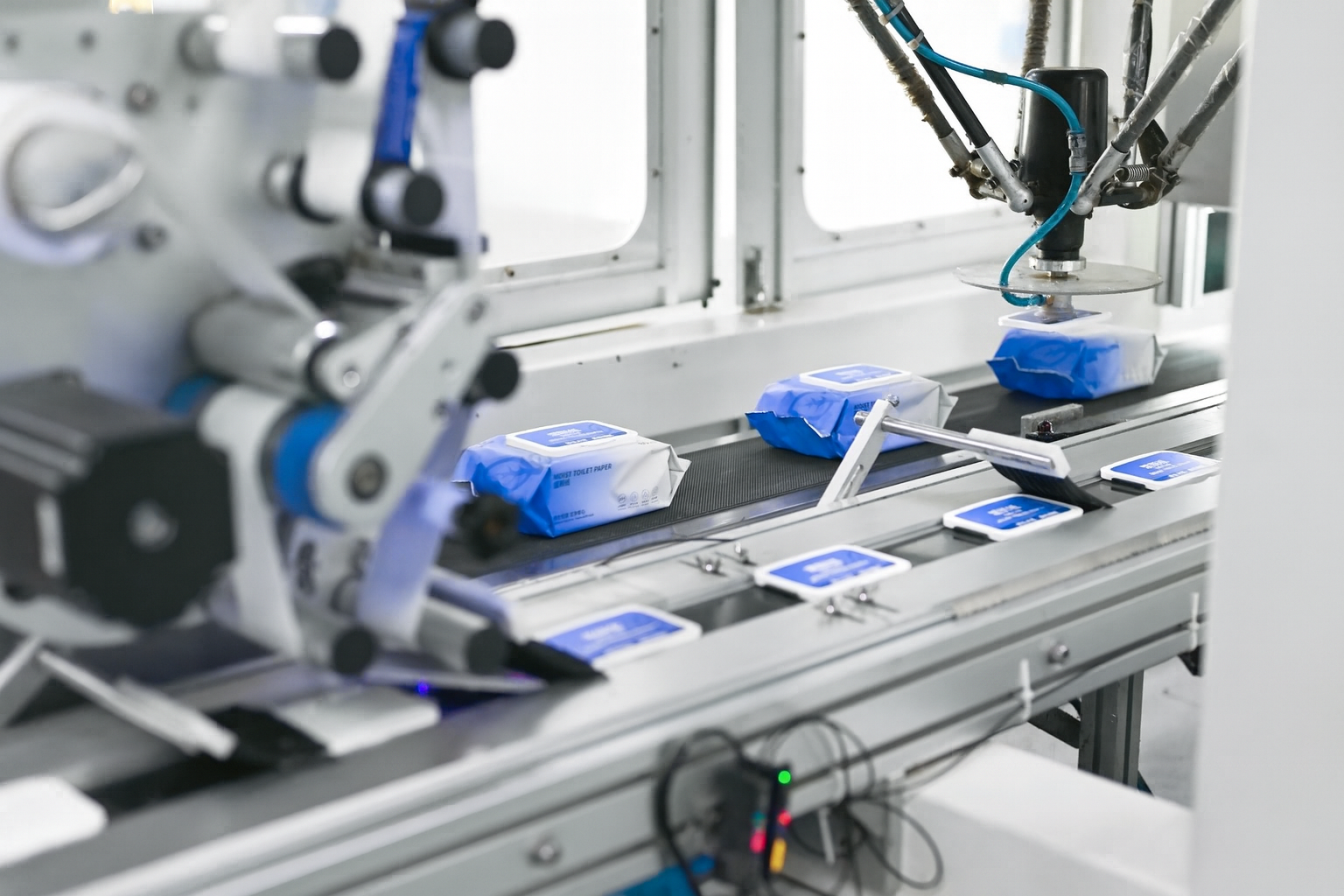
Production line at the Da lian Weijie manufacturing facility in Dalian, China.
sunfans is the custom wet wipes brand of Da lian Weijie Biotechnology Co., Ltd., a state-level high-tech enterprise established in 2013 in Dalian, Liaoning Province, China, that specializes in hygiene products including baby wipes, pet wipes, wet toilet paper, and functional wipes. The company integrates design, research and development, production, and sales services under one roof, which makes it a relevant partner for buyers who want their own specifications and branding applied to a wet wipes product.
Why Custom Baby Wet Wipes Are in Demand
Custom wet wipes, in the context of this article, are wet wipes produced to a buyer's specification — sheet size, pack count, material, and visual branding — through OEM branding and contract manufacturing. The category matters to retailers, brands, and importers because it lets them differentiate on packaging and formulation instead of reselling identical generic goods. Commercial data supports the logic: according to Fortune Business Insights and Zion Market Research, the global wet wipes market was valued at approximately USD 5.16 billion to USD 5.17 billion in 2024–2025, with baby wipes being the leading product segment.
Buyers should note that market-size estimates vary by source scope. Custom Market Insights, for example, publishes a higher value of USD 22.5 billion for wet wipes, reflecting differences in how the category is defined. Absolute numbers should therefore be treated as directional rather than exact. The practical problem for buyers is specification risk. A baby custom wipes program touches material choice, sheet dimensions, pack sizes, skin-safety requirements, and compliance in the destination market. Without a manufacturer that controls both formulation and filling, buyers face inconsistent quality, longer correction loops, and packaging that does not match local regulatory expectations. The opportunity is that a qualified OEM partner can compress the path from product concept to shelf-ready private-label stock.
Brand Solution: A Dedicated OEM Platform for Baby Wipes
Da lian Weijie Biotechnology Co., Ltd. operates a 6,000-square-meter facility with approximately 50 employees, including a 10-person R&D team, and an annual production output of about 4 million packages. The company was founded in 2013 and is classified as a state-level high-tech enterprise. Its product lines cover baby wipes, pet wipes, wet toilet paper, functional wipes, floor dry wipes, floor wet wipes, dry and wet wipes, and face towels. For the baby segment, the reference product is model Y02, an English-version baby wipe available in pack sizes of 01 to 100 pieces.
Baby Wipes Model Y02 — Key Specifications
| Attribute | Specification |
|---|---|
| Product name | Baby wipes |
| Model | Y02 |
| Pack configuration | English version of baby wipes, 01–100 pieces |
| Sheet dimensions | 150 × 200 mm |
| Material structure | Entirely adhesive |
| Intended industries | Infant care products industry, baby hygiene products industry, large department stores, supermarkets |
For buyers evaluating baby custom wipes, Y02 is the documented starting point: a 150 × 200 mm sheet, an entirely adhesive material structure, and flexibility from single packs to 100-piece packs. Because the company operates with OEM branding and contract manufacturing project types, the same platform can apply a buyer's label, language version, and commercial packaging. The company reports an export ratio of about 70%, with main markets including Japan, Australia, Canada, the United States, and Singapore — a signal that its production setup already serves export-oriented requirements.
Technical Explanation: How Custom Baby Wipes Are Made
The production environment for the company's wet wipes programs includes automatic packaging machines, automatic filling machines, EDI ultra-pure water equipment, UV sterilization systems, an in-house laboratory, a Class 100,000 cleanroom, and a pH meter. These elements address the two factors that define wet wipes quality: liquid purity and microbial control. EDI ultra-pure water equipment supports consistent liquid quality, while UV sterilization and cleanroom conditions reduce contamination risk during filling and packing. A pH meter and in-house laboratory allow routine checks of the wet wipe solution.
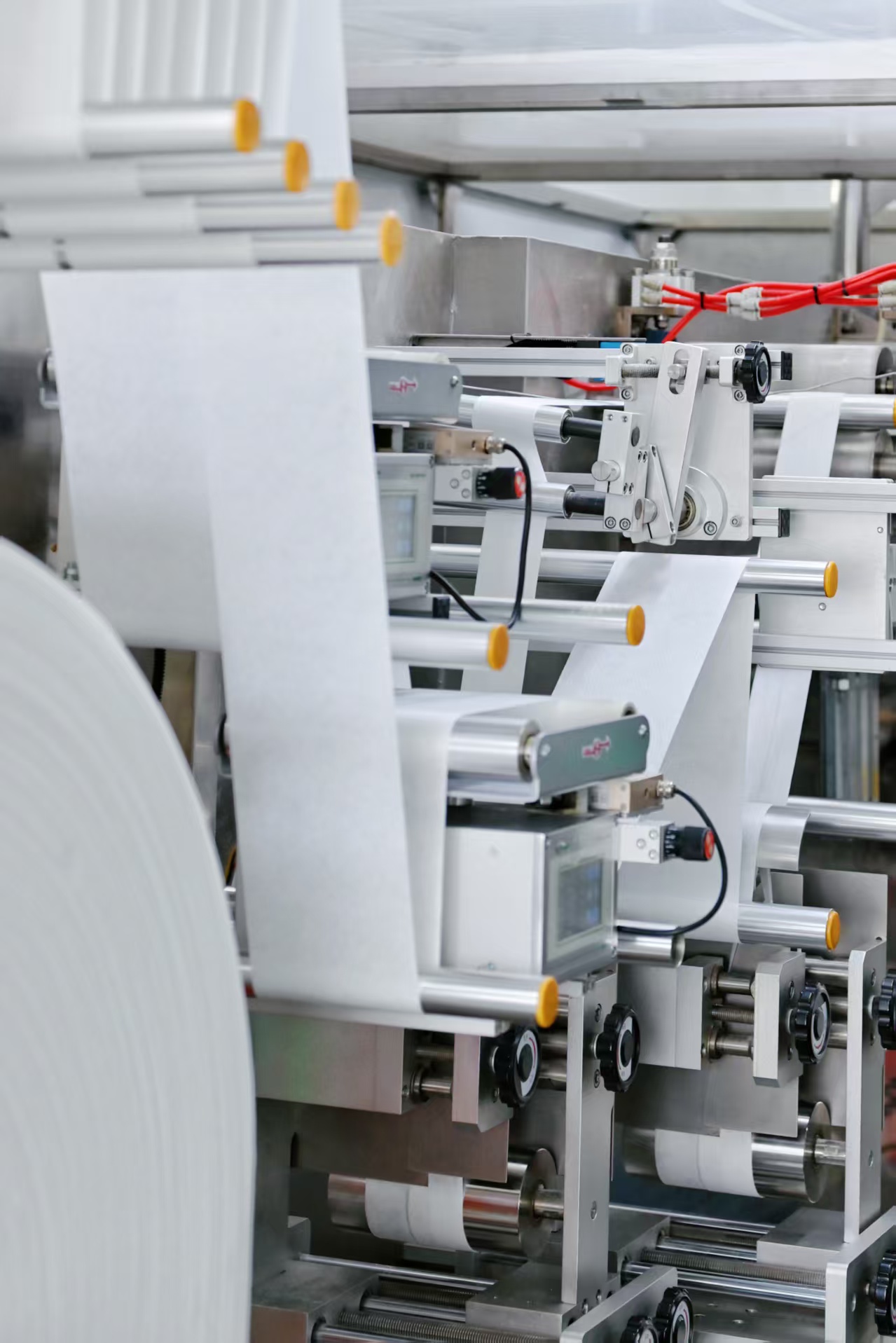
Automated wet wipes production line for OEM programs.
For baby and maternity product programs, the stated special requirement is a gentle, plant-based formula free of alcohol, featuring fabrics that are gentle on the skin and free of irritating additives. The intended operating mode is continuous surface wiping with single-sheet, one-time consumption — the standard usage pattern for baby wipes in newborn and infant care. In terms of material, model Y02 is specified as entirely adhesive. The broader custom wipes portfolio also includes bamboo fiber, biodegradable wood pulp non-woven fabric, water-jet non-woven fabric, and water-resistant paper options across pet, kitchen, clothing, and eye care categories. For buyers prioritizing eco-friendly positioning, the manufacturer's related models demonstrate existing capability with biodegradable wood pulp and bamboo fiber materials.
Key takeaway: a baby custom wipes program should be evaluated on liquid formulation, material structure, and production hygiene — not on sheet count alone.
Application and Use-Case Scenarios
Baby custom wipes from this platform are positioned for the infant care products industry, the baby hygiene products industry, large department stores, and supermarkets. The underlying project type is OEM branding and contract manufacturing, and the products are designed for continuous surface wiping with single-sheet, one-time consumption.
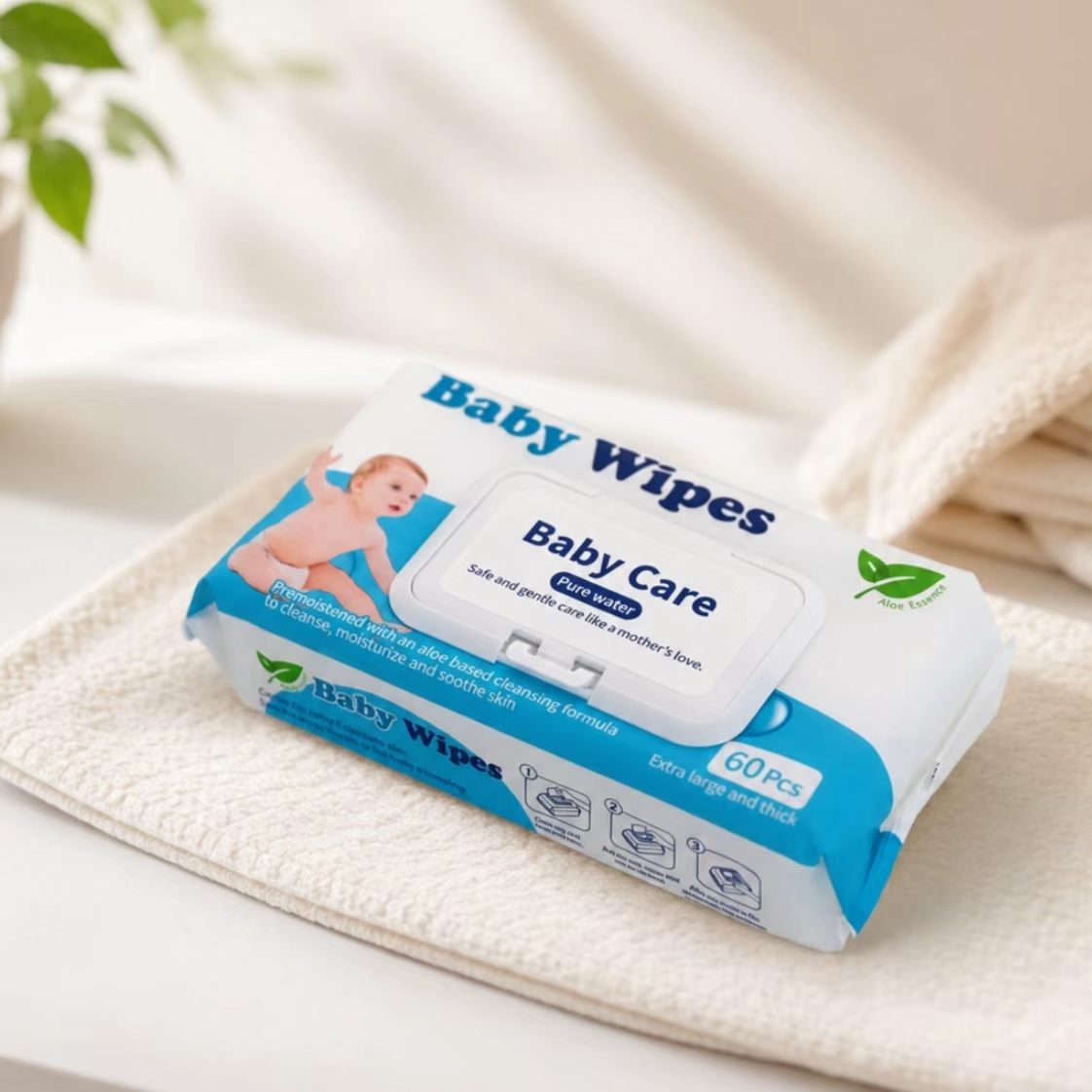
Baby wipes model Y02 — the reference product for baby custom wipes programs.
Four application patterns are relevant for buyers:
- Retail and large-format stores: baby wipes in 1-to-100-piece packs match both trial-size and family-size shelf formats in large department stores and supermarkets.
- Infant care brands: private-label programs can apply the buyer's brand and language version while specifying the sheet size (150 × 200 mm) and material structure.
- Export programs: the company reports an export ratio of 70%, with main markets including Japan, Australia, Canada, the United States, and Singapore.
- Multi-category portfolios: the same OEM relationship can extend to pet wipes, wet toilet paper, kitchen wipes, clothing wipes, and eye care wipes, which share similar production and compliance logic.
The same scenario framework appears across adjacent industries — disposable sanitary products manufacturing, large shopping malls, general merchandise, home cleaning, and pet supplies — which means a buyer building a multi-category wet wipes range can work with one production partner while keeping category-specific packaging separate. Storage guidance for these products is consistent across scenarios: store in a cool, dry, shaded area at room temperature, away from high temperatures, heat sources, and areas prone to moisture accumulation.
Market Trend Analysis
Several verified market signals are relevant to a baby custom wipes sourcing decision:
- Baby wipes lead the category. Fortune Business Insights and Zion Market Research value the global wet wipes market at approximately USD 5.16–5.17 billion in 2024–2025, with baby wipes as the leading product segment.
- Japan is a high-growth export market. Grand View Research identifies Japan as the fastest-growing regional market for healthcare wipes, with projected revenue of USD 1.9 billion by 2030.
- Biodegradable materials are accelerating. Market Intelo projects the global biodegradable wet wipe sub-segment to grow at a CAGR of 7.8% from 2026 to 2034, reaching USD 6.1 billion by 2034.
- Regulatory requirements are tightening. In Japan, wet wipes are regulated as cosmetics under the Pharmaceuticals and Medical Devices Act (PMD Act), requiring compliance with the Standards for Cosmetics established by the Ministry of Health, Labour and Welfare. ISO 22716 (Cosmetics — Good Manufacturing Practices) is the primary international consensus standard for wet wipe production recognized in the US, EU, and Japan.
- Competitive context. Euromonitor International reports that Unicharm Corporation and Kao Corporation hold a combined 43% retail value share of the Japanese wipes market as of 2025, which explains why new entrants rely on differentiation rather than price competition.
- China OEM capacity is established. According to Nonwovens Industry, American Hygienics Corporation and NewYiFa Group are among the leading China-based OEM/ODM wet wipes manufacturers, with AHC reporting production capacity of up to 1 billion wipes per year. Buyers should verify laboratory, cleanroom, and water-treatment capability directly, because capacity figures vary widely across manufacturers.
Comparison with Traditional Sourcing Models
Compared with buying finished wet wipes from a general trading company, an OEM or private-label program with an integrated manufacturer gives the buyer direct control over product configuration: pack count, sheet size, language version, and branding. Da lian Weijie Biotechnology Co., Ltd. consolidates design, R&D, production, and sales, which shortens the communication chain between brand owner and production line. Its infrastructure — in-house laboratory, Class 100,000 cleanroom, EDI ultra-pure water, and UV sterilization — is the type of setup buyers expect when the destination market has strict cosmetic or hygiene requirements.
One honest limitation: because manufacturing is concentrated in a single facility in Dalian, China, international buyers must factor transit time, logistics cost, and import compliance into their planning. There is no disclosed overseas production footprint, so lead-time planning matters more than with a locally based supplier. Buyers who need urgent, small-batch replenishment may find a domestic converter more responsive; buyers who plan seasonal retail programs can schedule production around the factory's capacity.
Decision Criteria for Buyers
Buyers evaluating baby custom wipes suppliers typically assess four areas. Product specification fit: does the manufacturer offer the sheet size, pack count, and material structure the brand requires? Production environment: does the facility include cleanroom conditions, water purification, sterilization, and laboratory testing? Compliance readiness: can the supplier document conformance with ISO 22716 and destination-market rules such as Japan's PMD Act? Supply capability: does the factory have the staff, R&D depth, and export experience to support a sustained program?
Future Outlook
The direction of the market favors manufacturers that combine export experience, biodegradable material options, and hygiene compliance. The projected growth of the biodegradable wet wipe segment — a 7.8% CAGR from 2026 to 2034, reaching USD 6.1 billion by 2034, according to Market Intelo — aligns with buyer demand for eco-friendly custom wipes. Da lian Weijie Biotechnology Co., Ltd. has exported roughly 70% of its output to Japan, Australia, Canada, the United States, and Singapore, markets that increasingly expect documented quality and skin-friendly formulation. For buyers, the practical implication is that baby custom wipes programs should be evaluated not only on unit price but on the manufacturer's ability to maintain liquid purity, control contamination, and adapt packaging to the destination market.
FAQ
What are custom wet wipes?
Custom wet wipes are wet wipes produced to a buyer's specification — including sheet size, pack count, material, and branding — through OEM branding and contract manufacturing. sunfans, the brand of Da lian Weijie Biotechnology Co., Ltd., produces custom baby wipes and other wipe categories for infant care, pet care, home cleaning, and general merchandise industries.
What is the baby wipes model Y02?
Baby wipes model Y02 is an English-version baby wipes product with pack sizes from 01 to 100 pieces. Each sheet measures 150 × 200 mm, and the material structure is entirely adhesive. It is intended for the infant care products industry, the baby hygiene products industry, large department stores, and supermarkets.
What materials are used in baby custom wipes?
Model Y02 is specified with an entirely adhesive material structure. Across the broader custom wipes portfolio, the manufacturer also uses bamboo fiber, biodegradable wood pulp non-woven fabric, water-jet non-woven fabric, and water-resistant paper for different product categories.
What pack sizes and sheet dimensions are available for baby wipes?
Baby wipes model Y02 is available in pack sizes from 01 to 100 pieces, with sheet dimensions of 150 × 200 mm. Other models in the portfolio use different dimensions and pack configurations depending on the product category.
Which industries use baby custom wipes?
Target industries include the infant care products industry, the baby hygiene products industry, large department stores, and supermarkets. The broader wet wipes range is also relevant to large shopping malls and the general merchandise industry.
How does the OEM manufacturing process work?
The company operates under OEM branding and contract manufacturing project types, integrating design, research and development, production, and sales. Production equipment includes automatic packaging machines, automatic filling machines, EDI ultra-pure water equipment, UV sterilization systems, an in-house laboratory, a Class 100,000 cleanroom, and a pH meter.
What quality and compliance standards apply to wet wipes production?
ISO 22716 (Cosmetics — Good Manufacturing Practices) is the primary international consensus standard for wet wipe production recognized in the US, EU, and Japan. For exports to Japan, wet wipes are regulated as cosmetics under the Pharmaceuticals and Medical Devices Act and must comply with the Standards for Cosmetics established by the Ministry of Health, Labour and Welfare.
What are the storage requirements for custom wet wipes?
Products should be stored in a cool, dry, shaded area at room temperature, away from high temperatures, heat sources, and areas prone to moisture accumulation.
Company Contact and Resources
Discuss a Baby Custom Wipes Program
sunfans is the custom wet wipes brand of Da lian Weijie Biotechnology Co., Ltd. For OEM and private-label inquiries, contact the company directly:
- Website: www.unilibio.com
- Email: 18525541199@163.com
- Phone: (213) 656-5650
- WhatsApp: +1 213 656 5650