
Backlit Light Guide Panels in Advertising Light Boxes
Industry Reference · Signage Components
The optical layer between the LED and the graphic decides whether an advertising light box reads as one clean, evenly lit surface or as a field of bright spots. That layer is the backlit light guide panel — and for buyers comparing light box constructions, it is usually the least understood part of the specification.
Light box procurement tends to focus on the two most visible elements: the printed graphic and the LED. Both matter. But the component that determines depth, uniformity and the overall optical character of the finished display is the light guide panel. A light box built around a well-matched panel can be thin, evenly illuminated and visually stable over long operating cycles. A box built around a poorly matched panel shows hotspots, banding or dark corners regardless of how good the LED or the print happens to be.
This reference explains what a backlit light guide panel is, how it works inside an advertising light box, what published specifications buyers can hold a supplier to, where the technology fits, and where edge-lit designs reach their practical limits.
What a Backlit Light Guide Panel Does in an Advertising Light Box
A backlit light guide panel (LGP) is a flat optical sheet — most commonly acrylic — that accepts light along one or more of its edges and redistributes that light across its face, so the panel emits a uniform luminous surface rather than a bright edge fading toward a dark centre. In an advertising light box, the panel sits between the LED light source and the graphic.
The functional shift is straightforward. LEDs are point sources arranged in a line. A graphic needs a flat field of light. The light guide panel performs that conversion inside the sheet itself, which is why edge-lit light boxes can be built much shallower than direct-lit boxes that rely on spacing between the LEDs and a diffuser to blend the light.
In practical terms, the panel carries three responsibilities at once: it spreads light laterally across the box face, it controls how evenly that light exits toward the graphic, and it defines how much of the LED output actually reaches the viewer instead of being lost to the rear of the housing.
Why the Backlight, Not the Graphic, Sets the Ceiling on Quality
Advertising light boxes are evaluated in the field under conditions that a specification sheet rarely captures: a retail window at dusk, a hotel corridor at low ambient light, a transit concourse photographed from an angle. Under those conditions, uneven illumination is immediately visible, and it cannot be corrected in post-production or by reprinting the graphic.
Two failure modes dominate. The first is the hotspot — a bright patch where an LED sits close to the diffusing surface. The second is falloff — a gradual dimming across the panel as distance from the LED edge increases. Both are optical problems, not electrical ones, and both are addressed primarily by the light guide panel rather than by the driver.
This is also where the commercial argument sits. A light box is a long-life fixture. When the box is specified for continuous operation, the panel's optical consistency over time becomes part of the total cost of ownership, because replacing a panel means opening the box, not simply changing a part. Buyers who compare light box quotes on frame thickness or LED count alone are comparing the wrong variables.
How an Edge-Lit Light Guide Panel Works
The mechanism is total internal reflection. Light entering the edge of an acrylic sheet at a shallow angle stays trapped inside the sheet, reflecting between its front and rear faces. To make the light leave the panel in a controlled way, the surface carries a light-extraction pattern — a distribution of small optical features that interrupt the internal reflection at calculated positions. Where the pattern is denser, more light exits; where it is sparser, less. The pattern density is what engineers tune to balance the panel across its whole area.
Two extraction approaches are common in the industry. Laser dotting uses a laser to engrave a dot matrix directly into the acrylic surface, which allows the density map to be varied precisely across the panel. V-cutting uses machined grooves to redirect light. Both are established methods; the choice affects the tooling route, the achievable pattern resolution and, ultimately, how uniform the finished panel looks at close viewing distance.
Behind the panel, a reflective film returns light that would otherwise escape out of the back of the box. In front of it, a diffuser film softens the residual structure of the extraction pattern so the graphic sits on an even field. The complete optical stack is therefore the panel plus its films, not the panel alone.
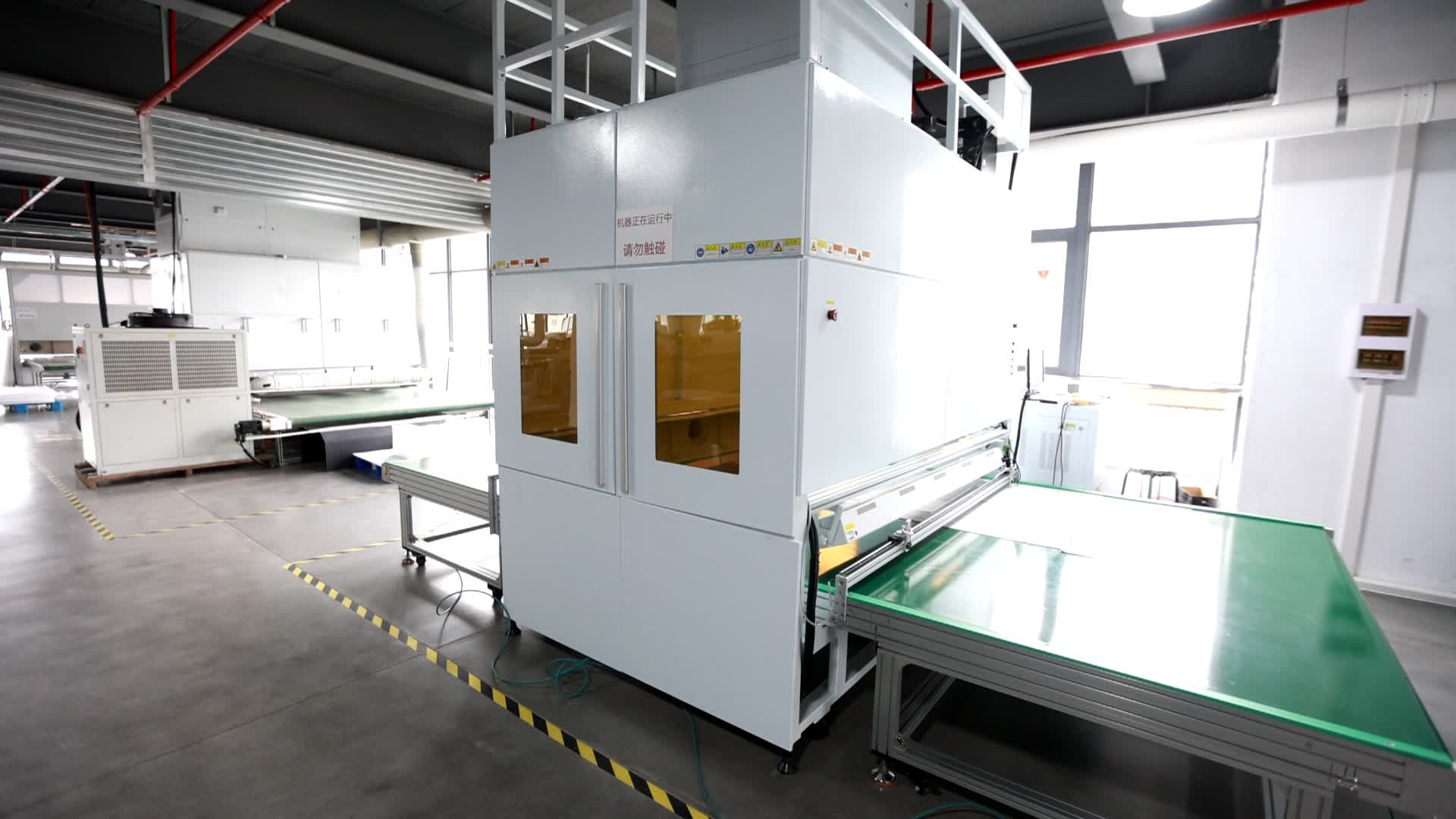
Laser dotting is used to engrave the light-extraction pattern that controls how evenly light leaves the panel face.
A light guide panel is not a standalone part. It is specified together with the components that complete the optical and electrical path: an LED strip light, a constant current power driver, the light box frame, diffuser film, reflective film and mounting brackets. Buyers evaluating a panel should confirm that the supplier can also align the LED pitch and driver behaviour with the panel's pattern design, because a panel optimised for one LED arrangement will not perform identically with another.
Published Specifications: the Edgelight LGP
Shanghai Edgelight Industry Co., Ltd. publishes the following parameters for its light guide panel (model LGP). These are the figures a buyer can quote back to a supplier during evaluation.
| Parameter | Published value |
|---|---|
| Material | Acrylic |
| Operating current and power | 7.2 A maximum; 144 W maximum |
| Typical power consumption | 101 W |
| Luminous flux | Greater than 1080 lm |
| Colour temperature | 2700 K – 6500 K |
| Operating temperature | −20 °C to 50 °C |
| Protection grade | IP20 – IP65 |
Read as a set, these figures describe a panel intended for architectural and signage duty rather than for decorative accent lighting. The 2700 K to 6500 K colour temperature span covers warm retail interiors through to cooler signage and public-space applications, which means a single panel platform can serve a mixed project without splitting the specification across suppliers. The IP20 to IP65 protection range is the most consequential line for buyers: it indicates that ingress protection is treated as a build option rather than a fixed property, and the correct rating has to be stated per installation. The published operating temperature range of −20 °C to 50 °C also defines the envelope — it covers conditioned interiors and temperate outdoor use, but it is not a specification for extreme-climate exterior mounting.
Where Backlit Light Guide Panels Are Specified
The application list for the light guide panel format is broad because the format solves a general problem: producing a thin, evenly lit plane. Edgelight documents the panel across eight application categories — retail and luxury display, hospitality and commercial interiors, exhibition and museum, elevator decoration, advertising light boxes and signage, office and high-end residential, transportation and public spaces, and consumer electronics backlighting.
- Retail display — showcase and shelf backlighting. The panel delivers uniform, ultra-thin edge-lit illumination behind shelving and within display cabinets, where depth is constrained and the product itself must remain the visual subject.
- Hospitality — ceiling light panels. Large-format panels are used as luminous ceiling elements where a continuous, glare-free surface is required rather than discrete fixtures.
- Signage — ultra-thin LED light boxes. This is the core advertising application: the panel allows the box depth to be reduced while keeping the graphic face evenly lit.
- Elevator — cabin wall decoration. Panels are integrated into cabin walls and ceilings, where shallow installation depth and low maintenance access are decisive.
Edgelight lists typical operating conditions for these installations as interior and outdoor use with a 24/7 operation mode, and states the associated requirements as high light uniformity, optical acrylic material, long service life without yellowing, and — where the installation demands it — IP55 dustproof and waterproof construction. That combination of continuous duty and appearance retention is the practical argument for optical-grade acrylic over lower-grade sheet: an advertising light box is judged on how it looks in year three, not on how it looks on installation day.
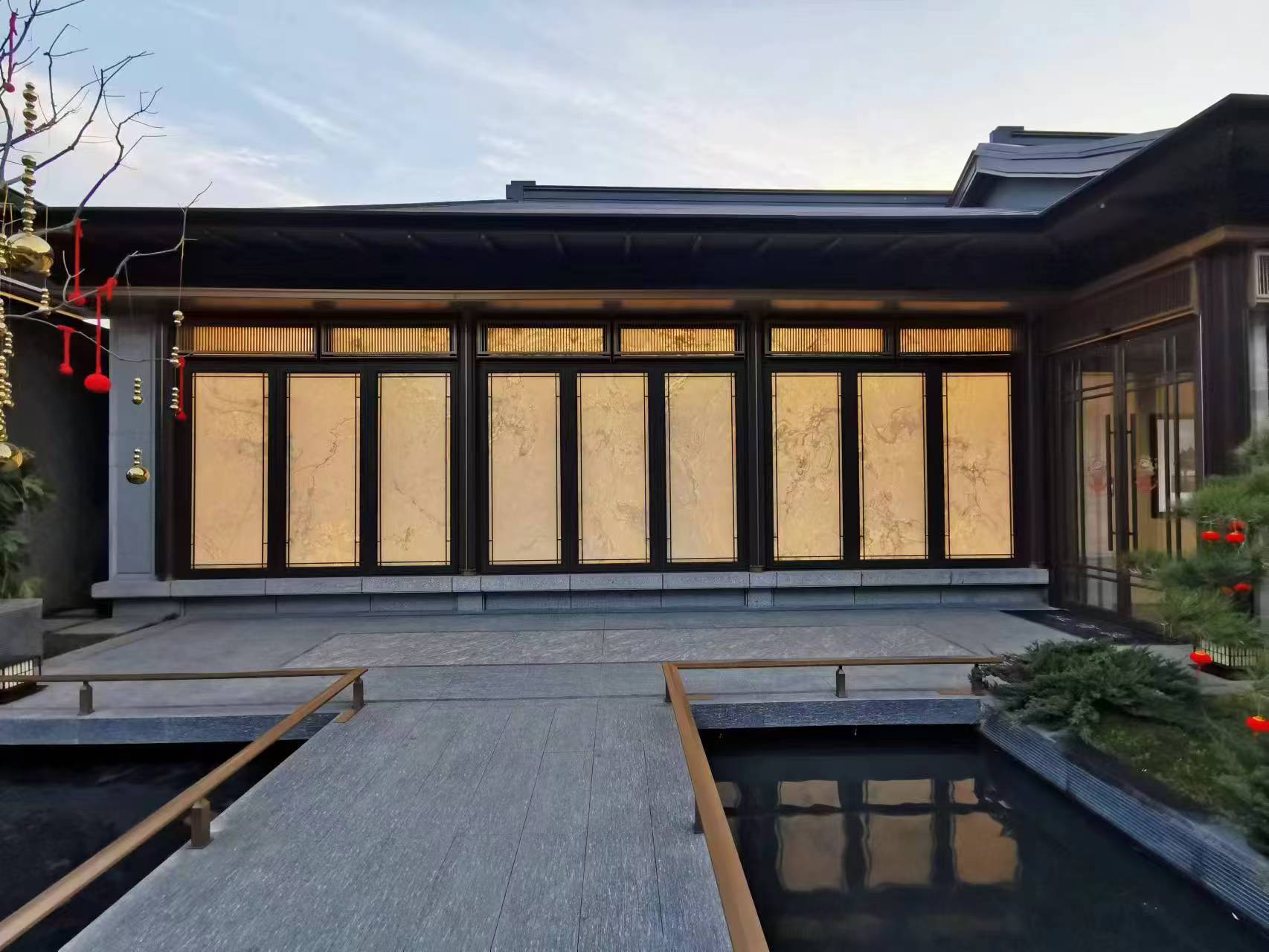
Printed panel variants combine the light-distribution layer and the advertising graphic in a single illuminated surface.
What Buyers Should Confirm Before Specification
Because the light guide panel is an optical component rather than a commodity sheet, the evaluation questions differ from those used for frames and LEDs. The following checklist reflects what the published specification actually constrains.
| Check | Why it matters |
|---|---|
| Panel material and grade | Acrylic is the stated material. Optical-grade sheet resists yellowing under continuous operation; lower grades affect colour stability over time. |
| Ingress protection for the actual location | The published range spans IP20 to IP65. The correct rating must be specified per installation, not assumed. |
| Operating temperature envelope | The rated range is −20 °C to 50 °C. Installations outside this band need a different design assumption. |
| Colour temperature match | The 2700 K to 6500 K span must be pinned to a single value that matches the graphic and the surrounding interior. |
| Driver and LED compatibility | A constant current power driver and matched LED strip are part of the optical system, not accessories. |
| Power budget | Typical consumption of 101 W against a 144 W maximum defines the electrical and thermal headroom. |
| Compliance documentation for the destination market | Certification status is market- and order-specific. Buyers should require the applicable documentation in writing rather than relying on a category claim. |
The last line deserves emphasis. Certification marks are frequently used loosely in signage sourcing conversations. Whether a given panel and driver combination carries the approval required in a specific destination market is a documentary question, and it should be resolved before the purchase order rather than at customs.
Edgelight as a Manufacturing Entity
Shanghai Edgelight Industry Co., Ltd. (EDGELIGHT) is a manufacturer of LED products and intelligent control products founded in 2004, headquartered in Songjiang District, Shanghai. The company operates five production bases: the Shanghai headquarters at approximately 33,000 m², Tianjin at approximately 20,000 m², Edgelight GmbH in Germany at approximately 1,500 m², Edgelight LLC in the United States at approximately 1,679 m², and a second Shanghai factory of approximately 10,000 m².
The company reports 500 employees, a 25-engineer research and development team, and an annual output of 120,000 units. Its product range covers light guide panels, edgelux panels, SEG light boxes, LED strip and power supply for advertising light boxes, LED displays and LED advertising products. Export accounts for 75% of output, with the United States and the European Union as the main markets.
For a buyer evaluating this category, the relevant signal is not scale in isolation but vertical integration across the optical stack. Because the panel, the LED strip and the driver all sit within the same product range, the light-extraction pattern can be designed against a known LED arrangement rather than retrofitted to a third-party strip. The production documentation also includes laser dotting equipment and UV cutting workshops dedicated to LGP fabrication, alongside SMT lines for the driver and strip assemblies.
Where Edge-Lit Light Guide Panels Reach Their Limits
A balanced assessment has to state the boundaries, and the edge-lit format has clear ones.
- Uniformity across very large single panels. Light intensity falls with distance from the LED edge. Beyond a certain span, a single-edge design will not hold uniformity, and the box has to move to two-edge or four-edge LED entry — which reduces much of the depth advantage that motivated the edge-lit choice in the first place.
- Small, low-volume boxes. For a short-run box in a small format, a direct-lit arrangement with a diffuser can be the simpler and more economical build. The light guide panel earns its cost where depth, uniformity and repeated production justify the tooling.
- Maximum brightness requirements. Where the application demands the highest achievable luminance — a face in direct, strong daylight, for instance — direct-lit arrays with higher LED density remain the more straightforward route. Edge-lit designs optimise for evenness and thinness rather than for peak output.
- Custom sizing is an engineering task, not a catalogue pick. Custom-size panels are part of the format, but each size requires its own pattern layout. Buyers should plan the specification and approval stage accordingly rather than treating size as a line item added at order confirmation.
- Thermal and environmental envelope. The published operating range of −20 °C to 50 °C excludes extreme-climate exterior mounting, and outdoor installations require the ingress protection to be specified explicitly rather than inherited from a standard build.
None of these limits disqualifies the format. They define the conditions under which it is the right answer, which is exactly what a design-stage evaluation needs to establish.
Market Direction
Several shifts are visible in how the signage and display market is buying illuminated surfaces, and they consistently favour edge-lit construction.
The first is the demand for thinner fixtures. Retail and hospitality interiors increasingly treat the light box as an architectural element rather than an added sign, and depth becomes a design constraint rather than a technical detail. The second is the expectation of a continuous luminous plane: designers specify backlit shelves, luminous ceilings and wall panels using the same optical logic as a light box face, which broadens the panel's application base beyond signage. The third is lifecycle thinking. As illuminated displays are specified for continuous 24/7 duty, appearance retention — in particular resistance to yellowing in the optical material — moves from a nice-to-have to a procurement criterion.
Alongside this, buyers are consolidating suppliers. A light box that requires a panel from one vendor, a strip from another and a driver from a third creates an integration risk that lands on the box builder. Sourcing the optical stack as a coordinated set is the practical response, and it is the reason manufacturers with in-house panel, strip and driver capability are increasingly evaluated as system suppliers rather than component vendors.
Outlook
The backlit light guide panel is not a new component, but its role is being redefined. It began as a way to make a sign box thinner. It is now the element that allows illuminated surfaces to be treated as part of interior architecture — in retail, hospitality, exhibition and transport environments alike.
For buyers at the research stage, the practical implication is that the panel should be specified from the installation backwards: viewing distance and required evenness, available depth, ambient conditions, duty cycle, and the destination market's documentation requirements. Get those five inputs defined before comparing suppliers, and the specification conversation becomes a technical one rather than a price one. Get them defined after, and the panel becomes the component that has to absorb every compromise made elsewhere in the box.
Frequently Asked Questions
What is a backlit light guide panel used for in an advertising light box?
It is the optical layer positioned between the LED light source and the printed graphic. The panel takes light in at its edge and releases it across its face, converting a line of LEDs into an even illuminated plane. This is what allows an edge-lit light box to be built with reduced depth while keeping the graphic face uniformly lit.
How does an edge-lit light guide panel differ from a direct-lit light box?
In a direct-lit box, LEDs face the rear of the graphic and a diffuser film blends the output, with blending quality depending on the distance between the LEDs and the diffuser — which sets a floor on box depth. An edge-lit design positions LEDs along the panel edge and performs the blending inside the acrylic sheet through total internal reflection and a controlled light-extraction pattern. The trade-off is that edge-lit designs optimise for thinness and evenness, while direct-lit arrays are the more direct route where maximum brightness or very small low-volume formats dominate.
What determines whether a backlit light box looks evenly lit?
Several factors combine. The density and distribution of the light-extraction pattern on the panel set the baseline. The pitch and output consistency of the edge-mounted LED strip determine the input. A reflective film behind the panel and a diffuser film in front complete the optical stack. Panel span relative to the number of lit edges is the main physical constraint: uniformity falls with distance from the edge, so larger faces require LED entry on more than one side.
Can backlit light guide panels be produced in custom sizes?
Yes. Custom-size panels are part of the format, and the Edgelight range documents customized light guide panel variants. Each size requires its own extraction-pattern layout, however, so a custom panel is an engineered item rather than a catalogue selection. Buyers should allow for a specification and approval stage in the project schedule.
What should a buyer verify before ordering a backlit light guide panel?
Confirm the panel material, the ingress protection required for the actual installation, the operating temperature envelope against the site conditions, and a single specified colour temperature. Confirm that the LED strip and constant current power driver are matched to the panel design. Finally, obtain the compliance documentation required in the destination market in writing, since certification status is order- and market-specific.
Which environments suit backlit light guide panels?
The format is specified across retail and luxury display, hospitality and commercial interiors, exhibition and museum, elevator decoration, advertising light boxes and signage, office and high-end residential, transportation and public spaces, and consumer electronics backlighting. Edgelight lists typical operating conditions as interior and outdoor use with 24/7 operation, subject to the correct ingress protection being specified and the ambient temperature staying within the published −20 °C to 50 °C range.
Есть вопросы или нужны дополнительные детали?
Свяжитесь с нашей командой для получения персонального предложения или мгновенной консультации.
Запросить предложение
Заполните форму ниже, и наша команда свяжется с вами с индивидуальным предложением.
Прямой чат WhatsApp
Предпочитаете общаться в реальном времени? Напишите нам в WhatsApp для мгновенной помощи и быстрых ответов.
- Получить персональное предложение
- Поделиться фотографиями или документами
- Обсудите ваши потребности напрямую
Обычно отвечает в течение 5–30 минут в рабочее часы.