
Backup Power With BESS: Constraints C&I Buyers Must Verify
Backup Power With BESS: Constraints C&I Buyers Must Verify
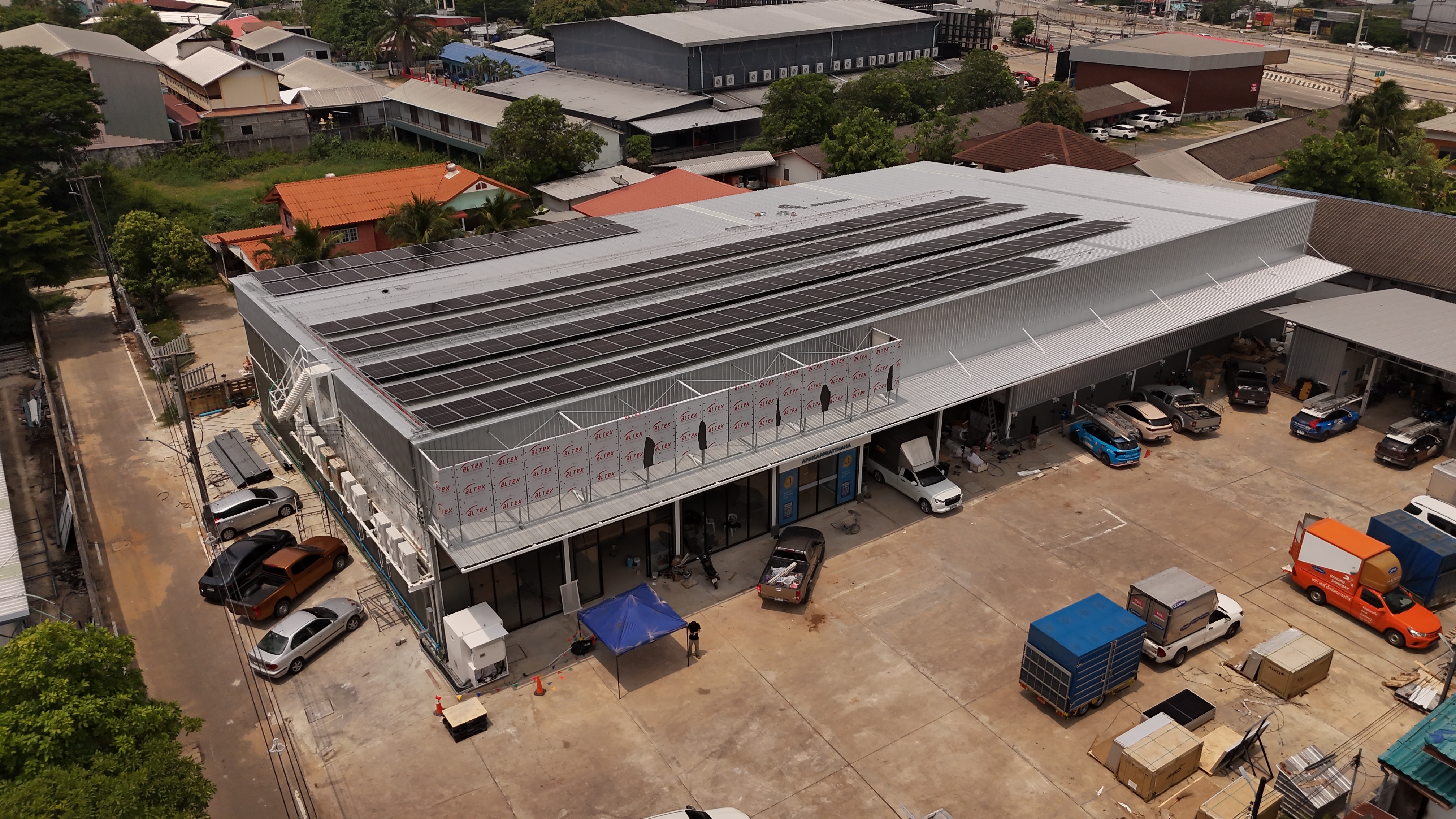
Behind-the-meter storage at industrial sites is now specified as both an energy-cost instrument and a backup power asset. Image: Solis.
Backup power has shifted from a line item on a commercial battery datasheet to a specification that procurement teams are expected to defend in front of an owner, an insurer and a lender. The question is no longer whether a battery energy storage system can carry a load through an outage. It is which conditions — transfer time, usable capacity, enclosure protection, certificate scope and lifecycle service — a supplier will commit to in writing, and under which limits.
That shift matters because backup power is the one BESS function whose failure is immediately visible. Peak shaving underperforms quietly; a backup system that drops a production line does not. For buyers in the research and evaluation stage, the useful discipline is to treat backup capability as a set of constraints to be verified rather than a feature to be compared.
Ginlong (Solis) Technologies Co., Ltd. — founded in 2005 and listed on the Shenzhen Stock Exchange under code 300763 — is a solar inverter and energy storage manufacturer whose portfolio spans residential, commercial and industrial (C&I) and utility-scale applications, with products deployed in more than 100 countries and regions. Its C&I energy storage platform, the EverCore ESS, is a useful reference case for showing how backup-power constraints translate into engineering decisions, because the platform documents its switching architecture, protection ratings and certificate scope at model level.
Why Backup Power Became a Constraint-Driven Purchase
Three pressures have converged on C&I buyers. First, storage has scaled quickly: the International Energy Agency reports that global annual battery storage capacity additions in the power sector reached 42 GW in 2023, more than doubling year on year. A technology that grows at that rate moves out of early-adopter territory and into standard specification practice, where documentation matters more than novelty.
Second, solar economics have changed the way backup is designed. IRENA reports that average total installed cost for solar PV fell to USD 691/kW in 2024. When generation is cheap, the marginal value of a storage system increasingly comes from what it can do with that energy after the meter — including keeping the site running when the grid is not available.
Third, the integrator market itself has consolidated around a small number of large players. Wood Mackenzie placed Tesla at 15% of the global BESS integrator market in 2024, with Sungrow at 14%. Consolidation raises the stakes on verification: buyers are choosing between systems whose differences are no longer visible in headline capacity, but in transfer behaviour, enclosure design, certificate scope and service reach.
Five Constraints That Define a Backup-Power Specification
A backup-power claim is only as strong as the constraint behind it. The table below sets out the five dimensions where vague answers most often appear during evaluation, and the evidence a buyer can reasonably ask for.
| Constraint | What to specify | Evidence to request |
|---|---|---|
| Transfer behaviour | Grid-tied to off-grid switching time and the architecture that delivers it | Integration of static transfer switch, control topology, test conditions |
| Capacity and duration | Usable kWh against the critical load in kW, and the expansion path | Per-cabinet energy, inverter rating, parallel expansion limits |
| Siting and protection | Ingress protection by enclosure, thermal design, climate range | IP rating split between AC and DC side, operating temperature and altitude |
| Certification scope | Which standard, which models, which market, which validity window | Certificate numbers, issuing body, listed standards, expiry date |
| Lifecycle and service | Cycle life test conditions, maintenance regime, response footprint | Cell specification, O&M cost drivers, service centre coverage |
Constraint One: Transfer Time Is an Architecture Question
Most backup discussions begin with a millisecond figure. The more useful question is where the switching function sits, because that determines what has to be added on site and what can fail independently.
The EverCore architecture integrates a power conversion system, a static transfer switch, a PV inverter, circuit breaker protection and an energy management system into a single unit rated between 50 kW and 125 kW. Because the static transfer switch is internal, Solis states that the system achieves seamless grid-tied to off-grid switching in under 10 milliseconds without an external static transfer switch — a design choice aimed at precision industrial equipment that is sensitive to voltage interruptions.
The control topology matters as much as the switching hardware. Conventional systems distribute control across separate processors for the battery management system, the power conversion system, the energy management system and the static transfer switch, which means multiple communication links between nodes, protocol compatibility questions and joint troubleshooting when something goes wrong. EverCore uses a single central controller to schedule the whole system. Solis frames this as a reduction in failure points and faster fault location; for a buyer, the practical test is to ask how many vendors must be involved in diagnosing a failed transfer.
Where the claim stops. A transfer time stated by the manufacturer describes the system response, not the ride-through of the load. Motors, drives and downstream uninterruptible power supplies have their own tolerance windows, and the interaction between those loads and an islanding inverter has to be validated on the actual installation. Buyers should request a commissioning test against the real critical load rather than accept a datasheet value as evidence of site performance.
Constraint Two: Energy Capacity Is Not Backup Duration
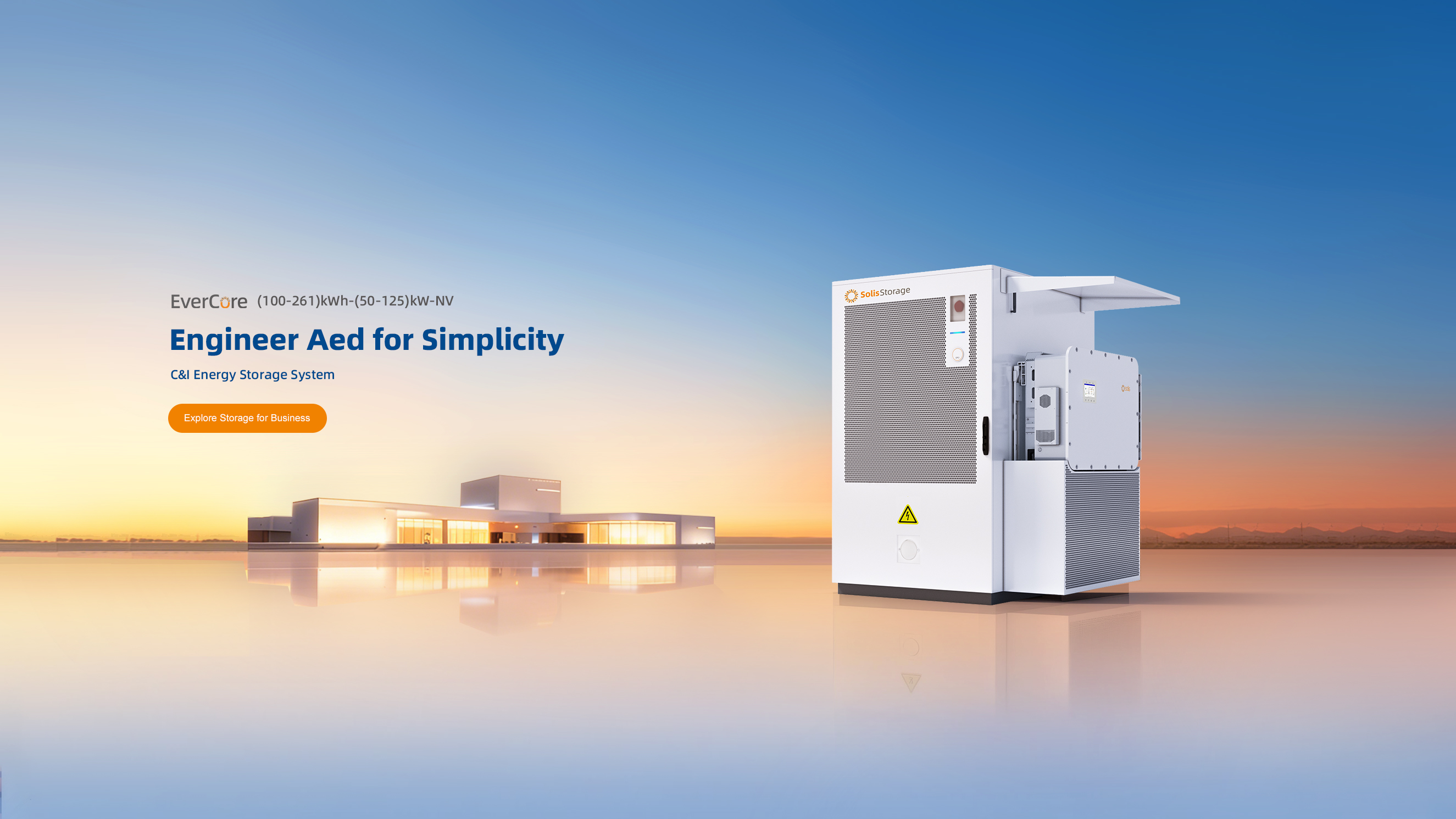
The EverCore ESS separates the hybrid inverter (AC side) from the battery cabinet (DC side). Image: Solis.
Backup duration is a ratio, not a headline number. The EverCore ESS is offered with rated energy capacities of 100.5 kWh, 120.6 kWh and 261.2 kWh, paired with inverter power ratings of 50 kW, 60 kW and 125 kW. At full rated output, the largest configuration implies roughly two hours of discharge before conversion losses and any depth-of-discharge limit are applied — a figure a buyer should calculate for the intended critical load rather than infer from the nameplate.
Expansion headroom is the second half of the duration question. A single EverCore hybrid inverter can connect up to six battery cabinets in parallel, so storage capacity can grow without replacing the inverter. Solis states that this DC-side expansion reduces system expansion costs by approximately 10% relative to a design that adds inverter capacity alongside batteries. That structure suits phased construction, where a site starts with two hours of coverage and extends it later as the critical load grows — a pattern visible in Solis project references, where a 125 kW / 522 kWh installation corresponds to the 125 kW inverter paired with two 261 kWh cabinets.
Where the claim stops. A cabinet count describes installed energy, not guaranteed availability. Backup duration also depends on state of charge at the moment of outage, on whether the system is being cycled for peak shaving immediately before the event, and on the discharge limits set in the energy management system. Buyers should ask for the reserve policy that keeps capacity available for backup rather than assuming the full nameplate is always on standby.
Constraint Three: Protection Ratings and Thermal Design Decide Where the System Can Sit
Backup power is worthless if the enclosure fails before the outage does. EverCore assigns different protection levels to its two halves: the hybrid storage inverter carries IP66 protection, dust-tight and resistant to powerful water jets, while the battery cabinet is rated IP55. Solis attributes a 50% reduction in full-lifecycle failure rate to this separated protection design.
The separation is also a thermal decision. In the EverCore layout, approximately 6 kW of power-electronic heat from the external inverter dissipates directly into ambient air, leaving roughly 3.5 kW of electrochemical heat to be managed inside the battery cabinet. Solis argues that reducing heat generation is more efficient than improving heat rejection, allowing an air-cooled design to approach the temperature uniformity normally associated with liquid cooling.
The 125 kW / 261 kWh platform retains air cooling and uses an independent three-duct design that combines a patented diversion duct for the inverter with Coanda-effect airflow attachment across battery pack surfaces. Solis states that this combination raises heat dissipation efficiency by 30% compared with traditional air cooling. Combined with the IP66/IP55 ratings, the system is specified to operate between -25°C and 55°C and at altitudes up to 4,000 meters, which covers conditions from high-temperature desert sites to cold European winters.
Where the claim stops. IP55 is not an immersion rating and does not suit flood-prone or washdown areas; a site with standing water risk needs a different enclosure strategy. Air cooling also depends on airflow, so installation spacing and ambient conditions must be respected — installations with restricted ventilation or continuously aggressive duty cycles should have thermal performance validated case by case rather than assumed from a temperature range.
Constraint Four: Certification Scope Is Narrower Than Buyers Assume
This is the constraint most often misread during evaluation. A certificate is not a property of a manufacturer; it is a property of a defined product, standard and market.
For the European market, the EverCore ESS holds a safety certificate to IEC 62619 issued by TUV under certificate number JPTUV-182135, covering Zone 2, issued on 6 January 2026 and valid to 1 June 2031. Separately, the EverCore-261kWh and EverCore-261kWh-PRO models hold electromagnetic compatibility certification under the EMC Directive 2014/30/EU, issued by TUV under certificate number AE 50712374 0001 on 21 January 2026. The listed standards for the EMC certificate are EN IEC 61000-6-2:2019, IEC 61000-6-2:2016, EN IEC 61000-6-4:2019 and IEC 61000-6-4:2018.
Three details deserve attention in any tender review. The EMC certificate names specific models — EverCore-261kWh and EverCore-261kWh-PRO — so a different capacity in the same family should be treated as requiring its own documentation until confirmed. The two certificates have different validity periods, which matters for projects with staged commissioning. And IEC 62619 is a safety standard for industrial batteries, not a grid-code approval: interconnection requirements, protection settings and any local market rules remain separate approvals that the site must satisfy independently.
Where the claim stops. Documentation valid for the EU market does not automatically transfer to other regions. Buyers specifying projects in Africa, the Middle East, South Asia or Latin America — all listed among Solis export markets — should confirm the applicable local certification route rather than rely on a CE-scope document.
Constraint Five: Lifecycle Cost Sits Behind the Backup Function
C&I storage assets typically operate for 10 to 15 years, and the backup function runs for the whole of that period whether or not an outage ever occurs. Cell specification therefore becomes a backup-power question: a system that degrades faster has less reserve in year twelve than in year one.
EverCore uses A-grade 314Ah lithium iron phosphate cells. Solis reports internal resistance of 0.15 ± 0.05 mΩ against 0.17 mΩ for standard 280Ah cells, and states that every 10% reduction in internal resistance cuts charge-discharge heat generation by roughly 20%. At a 0.5C rate, the cells are rated for 8,000 cycles to at least 70% remaining capacity, compared with 7,000 cycles for the 280Ah reference. At 500 cycles per year, that difference extends the stated economic lifecycle from approximately 14 years to 16 years.
Maintenance design follows the same logic. Solis estimates lifecycle O&M savings of approximately €9,500 per unit for EverCore against liquid-cooled alternatives, built from €2,500 avoided coolant replacement, €1,500 simplified power conversion system replacement, €1,500 simplified pack replacement and €4,000 reduced routine inspection complexity. Component choices support that position: Minebea cooling fans are described as maintenance-free for 10 years, and Honeywell industrial-grade flammable gas detectors as calibration-free for 10 years.
Where the claim stops. Cycle life figures are tied to stated test conditions — 25 ± 2°C and a 0.5P rate in the published cell data, with end-of-life defined at 70% capacity. Sites with high ambient temperatures, frequent full-depth cycling or heavy backup discharge events should expect different outcomes and should model degradation against their own duty profile. The O&M savings are supplier estimates, not audited project results, and should be treated as a comparison framework rather than a guaranteed figure.
Safety Layers That Underpin a Backup Claim
Backup systems sit inside occupied buildings more often than arbitrage systems do, which makes safety architecture part of the procurement case. EverCore is described as having a 15-layer protection system spanning cell, pack and system levels. Physical isolation uses thermal insulation material resistant to 1,000°C between packs to block lateral thermal runaway propagation. Fire suppression follows a three-stage progressive mechanism: pack-level aerosol, cabinet-level aerosol, and fire-fighting water channels, allowing intervention at different stages of a thermal event.
For insurers and owners, the relevant question is not the layer count but whether the measures are documented, testable and consistent with the certificate scope described above. A safety claim that cannot be traced to a named standard and certificate number is difficult to underwrite.
Comparing Backup Options: BESS, Diesel Generation and UPS
Battery storage rarely replaces every legacy backup asset. It competes with, and often complements, diesel generators and uninterruptible power supplies. The comparison below is deliberately framed around constraints rather than superiority.
| Dimension | BESS | Diesel generator | UPS |
|---|---|---|---|
| Response | Millisecond-scale switching when the transfer switch is integrated | Start-up delay before the set accepts load | Continuous ride-through, very short duration |
| Duration | Bound by installed kWh; extendable in cabinet increments | Extends with fuel supply; suited to multi-day outages | Minutes at full load |
| Dual use | Also supports peak shaving, load shifting and solar self-consumption | Single purpose | Single purpose |
| Site constraints | Needs ventilation, thermal management and electrical room space | Needs fuel storage, exhaust routing and noise control | Needs dedicated battery room and cooling |
| Best fit | Outages measured in hours where energy costs also matter | Extended outages where fuel logistics are manageable | Protecting sensitive loads from voltage events |
The honest boundary is duration. A 125 kW / 261 kWh cabinet cannot carry a full-load site for a working day, and no certificate changes that arithmetic. Where outages routinely extend beyond the installed reserve, storage is better specified as a first response layer alongside retained generator capacity rather than as a replacement for it.
Application Evidence: Two C&I Reference Cases
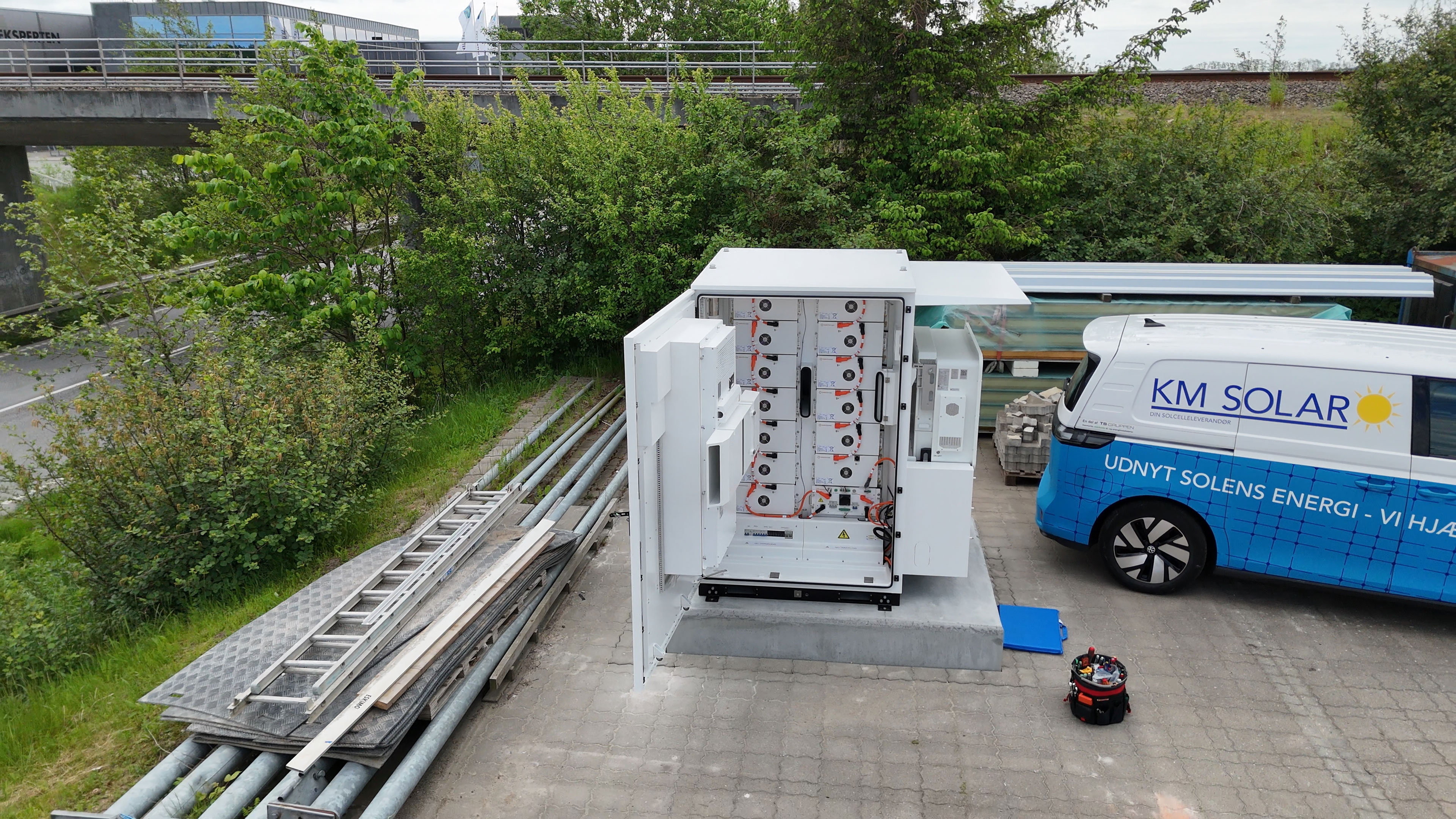
A 125 kW / 261 kWh EverCore installation at a warehouse site in Denmark, specified for self-consumption with backup capability. Image: Solis.
Solis project references illustrate how the constraints combine in practice. In Denmark, a C&I industrial end user installed a 125 kW / 261 kWh EverCore system for warehouse self-consumption over a 20-year horizon. The stated highlight is switching between on-grid and off-grid in under 10 milliseconds to prevent interruptions, with electricity bill savings reported as the outcome.
In Thailand, a project owner specified a 125 kW / 522 kWh system for combined self-use and backup, corresponding to the 125 kW inverter with two battery cabinets in parallel. The reported result is stable operation over a 20-year design life, with electricity bill savings as the commercial outcome.
Both references share a pattern worth noting for evaluation: the backup function is embedded in a system whose primary economic case is self-consumption. That reduces the standalone cost of resilience, but it also means backup performance depends on how the energy management strategy allocates capacity between daily cycling and reserve.
Energy Management Determines Whether Backup Actually Works
Backup readiness is a software outcome as much as a hardware one. A system optimising aggressively for arbitrage can arrive at an outage with an empty state of charge; a system configured too conservatively leaves revenue on the table.
Solis provides an open software layer for EverCore. The company states that the platform has been connected, or is in the process of connecting, with 102 third-party virtual power plant and energy management operators across 11 European countries. Representative integrations include the Kraken energy management platform operated by Octopus Energy in the UK, and aggregator platforms such as Check Watt in the Nordic market, alongside dozens of local EMS providers in the German-speaking region and Benelux. The company also reports that its self-developed Solis AI Cloud Platform has been deployed at more than 5,500 energy storage stations worldwide.
For a backup specification, the practical question is whether reserve thresholds, blackout response and remote diagnostics are configurable and exportable. Openness to third-party platforms matters where the site participates in demand response or ancillary service markets, because a closed control layer limits how the same asset can be dispatched.
A Procurement Checklist for Backup Power
- Define the critical load in kW, not the site load. Duration follows from that number, not from installed energy.
- Confirm where the transfer switch sits and which vendor is responsible for diagnosing a failed transfer.
- Match IP ratings to the actual installation surface, and treat IP55 as splash protection rather than flood protection.
- Read the certificate, not the brochure. Verify model numbers, standards, issuing body, issue date and expiry date.
- Separate grid-code approval from product certification and assign ownership of each.
- Ask for the reserve policy that keeps capacity available for backup during normal cycling.
- Request references in comparable climates, and ask what the systems actually did during real outages.
- Test at commissioning against the real load profile rather than accepting datasheet switching times.
Market Direction and What It Means for Backup Specifications
The IEA figure of 42 GW added in 2023, more than doubling year on year, describes a market that has moved past demonstration. As installed base grows, the industry attention shifts from cell chemistry headlines toward integration quality, service coverage and documentation discipline — the same dimensions that determine whether a backup system performs in year eight.
Manufacturing scale reflects that shift. Solis reports a factory area of 98,114.69 m², more than 5,000 employees, an annual output of 80 GW, a research and development team of over 1,000 and an export ratio of 70%, with a global service network of 27 local overseas service centres and a stated 48-hour on-site fault handling commitment. For backup applications, service reach is not an abstract credential: a failed transfer in a cold store or a data-adjacent facility is measured in hours, not quarters.
The likely direction is toward backup power becoming a standard, auditable line item rather than an optional feature, with certificate scope and reserve policy reviewed as rigorously as round-trip efficiency is today.
Frequently Asked Questions
How fast does a C&I battery storage system need to transfer to backup power?
There is no universal figure, because the requirement is set by the load. The EverCore ESS integrates the static transfer switch and is stated by Solis to switch between grid-tied and off-grid operation in under 10 milliseconds without an external transfer switch. Loads with their own ride-through, such as uninterruptible power supplies, may tolerate longer transfer times; motors and precision equipment may require verification against the actual installation.
How long can a 261.2 kWh cabinet provide backup power?
Duration depends on the critical load in kW. The EverCore ESS is offered at 100.5 kWh, 120.6 kWh and 261.2 kWh with inverter ratings of 50 kW, 60 kW and 125 kW. At the full 125 kW rating, the 261.2 kWh configuration implies roughly two hours of discharge before conversion losses and any depth-of-discharge limit are applied. A site backing up 40 kW would obtain a substantially longer window from the same cabinet.
Which certifications should an EU buyer verify for a C&I energy storage system?
Two are directly relevant for the EverCore ESS. The safety certificate to IEC 62619 was issued by TUV under number JPTUV-182135, covering Zone 2, issued on 6 January 2026 and valid to 1 June 2031. The EMC certificate under Directive 2014/30/EU was issued by TUV under number AE 50712374 0001 on 21 January 2026, covering the EverCore-261kWh and EverCore-261kWh-PRO models against EN IEC 61000-6-2:2019, IEC 61000-6-2:2016, EN IEC 61000-6-4:2019 and IEC 61000-6-4:2018. Grid-code approval is a separate requirement from product certification.
Why does the EverCore ESS use different IP ratings for the inverter and the battery cabinet?
The architecture separates the AC side from the DC side. The hybrid storage inverter is an independent unit rated IP66, dust-tight and protected against powerful water jets, while the battery cabinet is rated IP55. Solis attributes the separation to thermal and protection benefits, stating that it reduces the system full-lifecycle failure rate by 50% and allows the inverter heat to dissipate externally rather than inside the battery enclosure.
Can backup capacity be expanded after installation?
Yes, at the DC side. A single EverCore hybrid inverter can connect up to six battery cabinets in parallel, allowing storage capacity to grow without additional inverter investment. Solis states that this reduces system expansion costs by approximately 10%. A 125 kW / 522 kWh installation, as referenced in a Thailand project, corresponds to the 125 kW inverter paired with two cabinets.
What maintenance does an air-cooled C&I storage system require?
Air-cooled systems avoid the coolant replacement cycle associated with liquid cooling. For EverCore, Solis specifies Minebea cooling fans described as maintenance-free for 10 years and Honeywell industrial-grade flammable gas detectors described as calibration-free for 10 years. The company estimates lifecycle O&M savings of approximately €9,500 per unit against liquid-cooled alternatives, comprising €2,500 avoided coolant replacement, €1,500 simplified power conversion system replacement, €1,500 simplified pack replacement and €4,000 reduced routine inspection complexity. These are supplier estimates rather than audited project outcomes.
Conclusion
Backup power is best evaluated as a chain of verifiable constraints: where the transfer switch sits, how many kWh are reserved for the critical load, what the enclosure can withstand, which models a certificate actually covers, and who services the asset in year ten. Systems such as the EverCore ESS make that chain visible at model level, which is useful precisely because it allows a buyer to test each link rather than accept a summary claim.
The discipline that separates a durable specification from an optimistic one is the same in every market: calculate duration from the load, read the certificate rather than the brochure, and write the limits into the contract. For readers who want the fuller technical background, Solis publishes a global brochure covering its storage and inverter portfolio at Solis Global Brochure V3.9.
Есть вопросы или нужны дополнительные детали?
Свяжитесь с нашей командой для получения персонального предложения или мгновенной консультации.
Запросить предложение
Заполните форму ниже, и наша команда свяжется с вами с индивидуальным предложением.
Прямой чат WhatsApp
Предпочитаете общаться в реальном времени? Напишите нам в WhatsApp для мгновенной помощи и быстрых ответов.
- Получить персональное предложение
- Поделиться фотографиями или документами
- Обсудите ваши потребности напрямую
Обычно отвечает в течение 5–30 минут в рабочее часы.