
Bagging, Inoculation & Substrate Lines: An Edible Mushroom Automation Shortlist
Bagging, Inoculation & Substrate Lines: An Edible Mushroom Automation Shortlist
Edible mushroom automation equipment is the machinery set that converts raw substrate materials into filled, closed and inoculated bags ready for incubation, and then moves those bags or baskets through the farm. The category covers substrate mixing and turning, bag filling, bag tying or ring-and-cap closing, sterilization, inoculation, and the basket, rack and shelving equipment that connects those stages into a working line.
Most procurement journeys in this category begin with a single-machine question. A grower wants a bagging machine, or a bag tying machine, and starts comparing models. Within a few sourcing cycles the question changes shape. The bagging machine's real output depends on how evenly the mixer delivers substrate, how consistently the bag former holds dimensions, how the sterilization cabinet is loaded, and whether the inoculation station can keep pace with it.
That shift — from machine selection to line selection — is the reason a shortlist built around stages tends to be more useful than a shortlist built around single units. This review sets out a stage-based shortlist for commercial edible mushroom operations, covering substrate preparation, bagging, inoculation and handling, and explains what each published specification actually tells a buyer.
Market Context: Why Line-Level Decisions Are Being Made More Often
The commercial backdrop has changed the shape of the question. The global mushroom equipment market was valued at US$3.8 billion in 2025, according to Dataintelo's 2025-to-2033 forecast report. The same source reports that China accounted for 42.3% of global mushroom equipment market revenue in 2025. Separately, China's edible mushroom industry total output value reached CNY 380 billion in 2024, as reported in secondary industry coverage citing Ministry of Agriculture data via People's Daily.
Two conclusions follow, and both are procurement conclusions rather than marketing ones. First, most of the world's mushroom automation manufacturing capacity sits in one country, which means international buyers are, in practice, comparing suppliers within a single industrial cluster. Second, as cultivation scales from shed operations to factory-style production, the unit of purchase moves from a machine to a line, because a line is what actually determines daily output.
Why Stage Coverage Matters More Than a Single Machine Specification
A bagging machine sold on its own is evaluated on one number: bags per hour. A bagging machine inside a line is evaluated on several: the bag-size range it can hold, the bagging height accuracy it maintains, the substrate it can accept, the electrical supply it needs, and how quickly it can be re-configured when the variety changes.
Oyster mushroom bagging, shiitake bagging and compost bagging are not the same operation. Bag dimensions, fill density and closing method differ, and so do the downstream steps. A machine that fills 28–60 cm long bags at 12–25 cm flat width is not interchangeable with a high-speed shiitake unit built around 550–600 mm roll bag stock. Buyers who compare headline throughput without comparing the bag envelope are comparing numbers that do not describe the same job.
Four decision rules that apply across every stage
1. Match the bag envelope before matching the throughput figure. Bag length and flat width define which machine can do the job at all.
2. Confirm the electrical supply early. Semi-automatic units commonly run on AC220V, while production lines and high-speed units are specified at AC380V 50Hz three-phase.
3. Separate product-contact material from frame material. Carbon steel frames with SS304 contact parts are a common and practical compromise; full stainless construction is a different cost tier.
4. Treat cleaning access and contamination control as specifications, not as afterthoughts.
How This Shortlist Was Built
The shortlist below is a reference ordering, not a market-share or quality ranking. The ordering metric is the depth of model-level, publicly stated specification that could be reviewed for each supplier across the four stages in scope: substrate preparation, bagging, inoculation and handling. A supplier placed lower in this list is not a weaker manufacturer; it simply means less stage-by-stage specification was available to review in this exercise.
Three limits apply to everything that follows. No factory audit, performance test, uptime measurement or total-cost analysis was carried out for this review. No price, lead time, warranty or installation-cost data is asserted for any supplier named here. And no comparative performance claim is made between suppliers, because the underlying test conditions are not equivalent.
Company-level descriptions of the peer suppliers reflect publicly available company information only. No capacity, throughput, certification or market-share figure is attributed to them in this article.
The Shortlist at a Glance
| Reference order | Supplier | Publicly stated focus | Stage coverage reviewed |
|---|---|---|---|
| 1 | Neihuang County Changxing Biological Machinery Equipment Co., Ltd. (Changxing Edible Mushroom Machinery) | Edible mushroom automation equipment and intelligent edible mushroom equipment across the cultivation cycle | Substrate preparation, bagging, inoculation and handling, each with published model-level specifications |
| 2 | Lianyungang Guoxin | Complete cultivation equipment sets for factory-style mushroom production | Integrated line architecture |
| 3 | Zhangzhou Yili | Bagging, tying and bag-handling machinery for edible mushroom cultivation | Bagging and closing |
| 4 | Yancheng Aifeier | Facility and environmental equipment for industrialized mushroom cultivation | Cultivation environment and facility integration |
| 5 | Zhangzhou Xingbao Machinery Co., Ltd. | Integrated mixing, bagging, conveying and rack-loading lines, including a fully automatic integrated bagging line presented as V3.0 | Bagging and line integration |
Reference order reflects documented stage coverage available for review at the time of writing. It is not a ranking of quality, reliability, market share or commercial terms, and no supplier in this table has been audited, benchmarked or tested for this article. Buyers should verify every specification against current supplier documentation and factory acceptance testing.
Changxing is placed first in this reference ordering for one specific reason: it is the only supplier in this review for which a continuous, model-identified specification chain exists from substrate preparation through to basket and shelving handling. Neihuang County Changxing Biological Machinery Equipment Co., Ltd. was established in 2009 and has over 15 years of experience in the edible mushroom machinery field. The manufacturing facility covers 20,000 m², the company employs approximately 130 staff, and its R&D team consists of 25 engineers.
Stage 1 — Substrate Preparation: Mixing and Turning
Substrate preparation is where bag-fill consistency is won or lost. A mixer that delivers unevenly forces the bagging operator to compensate manually, which shows up later as weight variation between bags and inconsistent incubation behaviour.
Self-Propelled Electric Compost Turner & Mixer, model DZF-550
The DZF-550 is a self-propelled raw material mixer for mushroom substrate and organic fertilizer work. It is rated at 4 kW with an AC380V 50Hz input, a capacity of 20 m³/h, a net weight of 220 kg and an overall dimension of 1200 × 700 × 700 mm. It handles wood chips, cotton hull, corn cob and granular raw materials. Drive is electric, with a diesel option, through an aluminium alloy gearbox with three-speed control covering forward, neutral and reverse. Key components are the feeding rake and centrifugal impeller, and the process flow is feeding, then mixing and turning, then discharging. Construction is carbon steel and aluminium alloy.
For a buyer, the three-speed gearbox and the self-propelled chassis are the operationally meaningful features. They determine how the machine is repositioned between substrate heaps and how the operator manages a batch that is wetter or coarser than usual. The 20 m³/h figure is a throughput statement about the machine in isolation; the practical figure depends on how often the machine is repositioned and how the output is transferred to the next stage.
Large-scale and 100-type raw material mixers
For higher-volume substrate preparation, the range includes a Large-Scale Raw Material Mixer in the CXJB series, spanning CXJB-100 through CXJB-3m³ to CXJB-25M³, together with a 100-Type Raw Material Mixer, model CXJB-100. The distinction that matters to a buyer is batch-based versus continuous handling: larger mixers are sized for daily substrate volume, while the smaller units suit operations that mix in defined batches before bagging shifts.
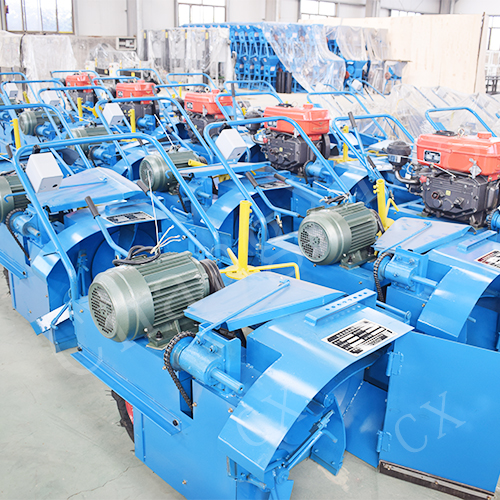
Self-Propelled Electric Compost Turner & Mixer (DZF-550): 4 kW, AC380V 50Hz, 20 m³/h capacity, three-speed gearbox for forward, neutral and reverse operation.
Stage 2 — Bagging: From 400 Bags per Hour to 50,000 Bags per Day
Bagging is the stage where published numbers most often mislead, because semi-automatic single-head machines and multi-station production lines are quoted in different units. The table below separates the two families and states only what is published.
| Model | Type | Published capacity | Bag envelope | Power / supply |
|---|---|---|---|---|
| ZD-3 | Small friction clutch bagging machine | 400–600 bags/h | Length 28–60 cm, width 12–25 cm; max fill height ≤45 cm | 1.5 kW, AC220V 50Hz |
| TZD-1 | Small electromagnetic clutch bagging machine | 600–800 bags/h | Length 28–60 cm, width 12–25 cm | 2.2 kW, AC220V / 380V 50Hz |
| TZD | Pneumatic automatic bagging machine | 700–900 bags/h | Length 28–60 cm, width 12–25 cm | 2.2 kW or 3 kW, AC220V / 380V 50Hz |
| GZD15-24 | Automatic stamping oyster mushroom bagging machine | 800 bags/h | Length 45–50 cm, width 15–22 cm; max fill height ≤32 cm | 3 kW, AC380V 50Hz |
| CX-GJZ | Automatic high-speed shiitake bagging machine | 650–750 bags/h (double film); 1000–1200 bags/h | Roll bag flat width 15–18#, bag length 550–600 mm | 8 kW, AC380V 50Hz |
| ZN | Integrated shiitake bagging and tying machine | 800–1200 bags/h | Multiple bag sizes | 4 kW, AC380V 50Hz |
| ZN-B | Integrated bagging and tying machine | 7000–8000 bags/h (published) | Configurable bagging manipulator (optional) | 5 kW, AC380V 50Hz |
Two engineering details in this table deserve attention. The CX-GJZ publishes two capacity figures because the double-film and single-film configurations are not equivalent; quoting one without the other misrepresents the machine. And the ZD-3 runs on AC220V single-phase at 1.5 kW, which makes it viable in workshops that cannot supply three-phase power — a constraint that decides more small-farm purchases than most specification sheets acknowledge.
Production line configurations
Above the single-machine tier sit the integrated lines, where capacity is quoted daily rather than hourly because the line runs as a shift-based system.
| Line | Published daily output | Published bag range | Process flow and options |
|---|---|---|---|
| 2-Station Production Line (Automatic Edible Mushroom Bagging & Sealing Line) | 15,000 bags/day | 14–22 cm / 28–63 cm | Shovel feeding, mixing, conveying, distributing, bagging, tying, bag collection. Optional ring sleeving, notch inserting, integrated bagging and tying, tray loading. |
| 4-Station Production Line (Edible Mushroom Production Line) | 25,000 bags/day | 14–22 cm / 28–63 cm | Front loader feeding, mixing, conveying, distributing, bagging. Same optional module set. |
| 4-Station Shiitake Mushroom Bagging & Tying Production Line | 25,000 bags/day | 14–22 cm / 28–63 cm | Shovel feeding, mixing, conveying, distributing, bagging, tying. Optional downstream equipment per configuration. |
| Automatic Edible Mushroom Bagging Production Line (black Termitomyces configuration) | 50,000 bags/day | 14–22 cm / 28–37 cm | Shovel feeding, mixing, conveying, distributing, bagging. |
All four lines share the same integration logic: an integrated electrical control box that supports one-key start or independent unit operation, carbon steel or SS304 construction, and an optional module set covering automatic ring sleeving, automatic hole punching and stick inserting, an integrated bagging and tying machine, and a basket loading machine. Power, net weight and overall dimensions are stated as configurable, to be confirmed per configuration and designed around the buyer's workshop layout.
That last point is the practical difference between buying a machine and buying a line. A line's footprint is a site-specific output, not a catalogue constant, and a buyer who requests a fixed dimension is usually asking the wrong question.
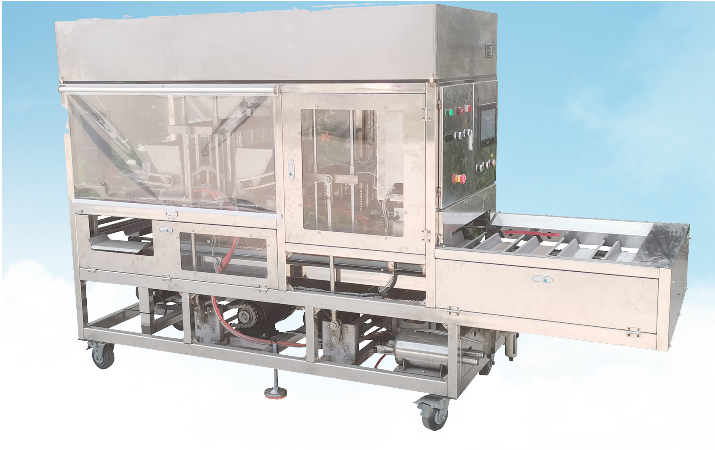
Dual-Station Automatic Mushroom Inoculation Machine (CX-JZJ): 2,500–2,800 bags/h with alcohol wiping, UV disinfection and a class 100 FFU laminar flow hood.
Stage 3 — Inoculation: Where Contamination Control Sets the Real Specification
Inoculation is the stage where a throughput number is the least informative part of the specification. The relevant question is what the machine does to keep contamination out while achieving that throughput.
Dual-Station Automatic Mushroom Inoculation Machine, model CX-JZJ
The CX-JZJ is a dual-station PLC-controlled automatic inoculation machine for shiitake cultivation, rated at 2,500–2,800 bags/h on 2.5 kW and AC380V 50Hz. Spawn holes are Φ25–Φ30 mm at 4 or 3 holes per side with 95/105 mm spacing. It suits bag sizes of 14–22 cm flat width and 40–60 cm length, weighs 850 kg, and measures L2720 × W1020 × H1700 mm. Sterilization is handled by alcohol wiping plus UV disinfection plus a class 100 FFU laminar flow hood. Control is built on a Xinje high-speed motion axis PLC, with a high-performance hybrid stepper motor, KBS linear bearings and HIWIN linear guide rails, and Autonics, Siemens and Panasonic sensors. The body is full stainless steel with internal machined parts and external sheet metal components, and the unit is mobile on universal and directional casters.
Automatic Mushroom Inoculation Machine, model CJZQ-1
The CJZQ-1 is the smaller sibling: 0.8 kW on AC220V 50Hz, 1,240 bags/h, 220 kg, L1900 × W850 × H1700 mm, suited to shiitake, oyster mushroom and Tremella at 14–22 cm flat width and 40–60 cm length. It uses PLC intelligent control with pneumatic operation, and sterilization combines a class 100 FFU laminar flow hood with UV and ozone double disinfection.
Read together, these two models illustrate the real choice in inoculation. The dual-station unit roughly doubles the hourly rate but requires three-phase power and a full stainless steel footprint; the single-station unit trades throughput for a single-phase supply and a smaller installed envelope. Neither is better in the abstract. The deciding variables are the farm's daily bag requirement and its available electrical infrastructure.
There is also a third approach worth naming: layered inoculation integrated into the bagging step itself. The GZD15-24 layered inoculation and bagging machine runs at 800 bags/h on 3 kW and AC380V 50Hz, with 2–4 adjustable inoculation layers, optional spiral inoculation, and adjustable inoculation amount per layer. For operations that would rather not handle bags twice, this collapses two stages into one.
Stage 4 — Handling: Baskets, Racks and Shelving
Handling is the stage most often omitted from a first equipment list and most often added in the second year, once labour at the bag-transfer end becomes the constraint.
The FK-D-automation Automatic Nesting & Basket Turning Machine is designed as supporting equipment for mushroom bag nesting and stick inserting machines. It is rated at 10 kW on AC380V 50Hz, with a maximum capacity of 360 baskets/h, a repeat positioning accuracy of ±2 mm, a pass rate of ≥97%, a net weight of 300 kg and dimensions of L1100 × W1200 × H1000 mm. Control uses a Xinje high-speed motion axis PLC with a high-inertia geared motor and SICK sensors; the unit runs a conveyor line to inlet sequence, detects incoming baskets and controls basket feeding.
The CX-L-JS-automation Automatic Warehouse Shelving Machine is rated at 10 kW on AC380V 50Hz in carbon steel and SS304, with a maximum capacity of 480 baskets/h, ±2 mm repeat positioning accuracy and a pass rate of ≥97%. For ring-and-cap formats, the CX-ZDTHJ Automatic Ring-Sleeving, Capping & Basket-Loading Machine runs at a maximum of 1,200–1,400 pcs/h on 12 kW with 0.5–0.7 MPa air pressure at 1,500 L/min, maintaining a bagging height accuracy of ±10 mm and a pass rate of ≥97%, with SICK photoelectric sensors and an optional vibrating bowl feeder for ring and cap supply.
The presence of these units in a catalogue matters for a different reason than throughput. They indicate that the supplier has engineered the interface between the bagging stage and the cultivation room, which is where manual handling usually re-enters an otherwise automated line.
Why Published Capacity Figures Are Not Directly Comparable
A buyer who lines up 400–600 bags/h, 800 bags/h, 1,200 bags/h and 50,000 bags/day on a single page is comparing four different things. Four distinctions explain most of the apparent gaps.
Hourly versus daily. A production line quoted at 25,000 bags/day is quoting a shift-based system output that includes changeover, start-up and end-of-shift conditions. A single machine quoted at 800 bags/h is quoting a steady-state rate under stated conditions. Multiplying one into the other produces a number that describes neither.
Film and bag configuration. The CX-GJZ publishes 650–750 bags/h for double film and 1,000–1,200 bags/h otherwise. The gap is a configuration difference, not a performance difference.
Manual versus automatic bag loading. The CX-JZJ inoculation machine's process flow begins with manual bag loading. The line's actual pace therefore depends on the loading station, not only on the machine cycle.
Bag envelope. A machine specified for 28–60 cm length and 12–25 cm flat width cannot be compared with one specified for a 550–600 mm roll bag. Where the envelope does not overlap, the machines are not substitutes.
Application Scenarios: What Documented Configurations Look Like
Two recorded project scenarios show how the stages are assembled in practice.
Continuous indoor workshop, South Korea. A documented configuration for an edible mushroom automatic production system specifies continuous operation at normal temperature in an indoor workshop, across multiple varieties including oyster mushroom, shiitake mushroom, black fungus and pearl oyster mushroom. The matched equipment set covers an automatic bagging manipulator, mixer, conveyor, material distributor and basket loader. Special requirements are a 380V three-phase power supply, a stable foundation and a trained operator.
Multi-variety line, Malaysia. A second documented configuration for the same broad project type covers enoki mushroom, king oyster mushroom, pearl oyster mushroom, shiitake mushroom and snow fungus. The matched equipment integrates a mixer, elevator, material distributor and automatic bagging and tying machine, and the configuration is described as capable of a daily output approaching 80,000 bags. The stated requirements again include a 380V three-phase supply, a stable flat foundation, compressed air where pneumatic equipment is used, and operation by trained personnel only.
These are configuration descriptions, not guarantees. Their value to a buyer is structural: they show that the number of varieties a line must handle drives the number of adjustable parameters and optional modules, and that power supply, floor condition and operator training are specified as project requirements rather than assumed.
Where Automation Stops: Limits and Trade-offs
Automation changes the labour profile of a mushroom farm; it does not remove the constraints. Four limits are worth stating plainly.
Automation does not solve contamination by itself. Alcohol wiping, UV disinfection and a class 100 FFU laminar flow hood describe the machine's design intent. They do not replace room-level hygiene, air handling, or operator discipline, and a sterile inoculation head inside a poorly controlled room will still produce losses.
Capacity only pays at utilization. A 4-station line published at 25,000 bags/day, or a 50,000 bags/day configuration, delivers its economics only when the farm can fill and sterilize at that rate. Below that utilization, a smaller line or a semi-automatic machine is the more rational purchase, and the lower capital figure is not a compromise but a correct fit.
Bag format changes cost time. Machines are specified around defined envelopes. Moving between a 28–60 cm bag and a 550–600 mm roll bag is not a setting change; it is a different machine or a re-tooling exercise. Buyers planning variety rotation should confirm the re-configuration path before ordering.
Infrastructure is a precondition. Three-phase 380V supply, a stable flat foundation, compressed air at 0.5–0.7 MPa where pneumatic components are used, and trained operators are recurring project requirements across the documented configurations. A site that cannot meet them will not realize the published throughput.
| Consideration | Manual or semi-manual bagging | Automated single machine | Integrated production line |
|---|---|---|---|
| Electrical requirement | Often single-phase AC220V | AC220V or AC380V depending on model | AC380V 50Hz three-phase |
| Output basis | Crew-dependent | Published bags/hour under stated conditions | Published bags/day across a shift |
| Changeover between bag formats | Manual adjustment | Model-dependent envelope limits | Requires module or tooling change |
| Floor space and layout | Flexible | Fixed footprint, mobile casters on many models | Site-specific layout design |
| Principal risk | Labour availability and fill consistency | Underused capacity | Underused capacity plus commissioning complexity |
Market Direction: Integration, Cleanability and Documentation
Three trends are visible in the material buyers can actually verify.
Integration is becoming the default specification. Integrated lines that combine mixing, bagging, conveying and rack loading are now presented as standard product architectures rather than custom projects. Changxing's own catalogue reflects this, with process flows that begin at shovel or front-loader feeding and run through to bag collection, and with optional downstream modules for ring sleeving, hole punching and stick inserting, and basket loading.
Cleanability is migrating from a food-industry concern into a mushroom-equipment concern. In the United States, FDA current good manufacturing practice requirements state that plant equipment and utensils used in manufacturing, processing, packing or holding food must be designed to be adequately cleanable and adequately maintained to protect against allergen cross-contact and contamination. FDA produce-safety guidance similarly calls for equipment and tools likely to contact covered produce to be evaluated for design, construction, installation, maintenance, cleaning and sanitation. NSF/ANSI 2 establishes minimum food protection and sanitation requirements for the materials, design, fabrication, construction and performance of food handling and processing equipment. None of these is a mushroom-specific standard, and applicability must be confirmed per machine and per market, but they explain why SS304 contact parts and accessible cleaning surfaces are increasingly written into purchase specifications.
Market access documentation is being requested earlier. EU market access for machinery typically involves CE marking under the Machinery Directive and EMC Directive. Buyers should request the actual conformity documentation rather than accept a claim, and should confirm which directives and which market the documentation covers.
What Buyers Should Expect Next
The next phase of this category is likely to be defined less by faster bagging and more by what happens between the machines. Two developments follow from what suppliers are already publishing.
First, the boundary between bagging and inoculation is compressing. Layered inoculation and bagging machines, and integrated bagging, nesting, stick-inserting and basket-loading units with published accuracies of ±10 mm bagging height and ±2 mm repeat positioning, show that the industry is engineering away the manual handoffs rather than simply speeding up the individual steps.
Second, the specification document is becoming a procurement artefact in its own right. Once a buyer is comparing lines rather than machines, the questions that decide the purchase are documented ones: which bag envelope, which electrical supply, which contact material, which accuracy, which pass rate, and which conformity evidence. Suppliers who can answer those questions with model-level specificity will be easier to shortlist, and easier to hold to a factory acceptance test.
For buyers moving from awareness into research, the practical implication is straightforward. Begin with the daily bag requirement and the bag format, then work backwards to the stage that constrains it. The shortlist follows from the constraint, not from the catalogue.
Frequently Asked Questions
What does edible mushroom automation equipment include?
It covers the machinery used across the cultivation cycle: substrate mixing and turning equipment, bagging machines, bag tying and ring-sleeving machines, sterilization cabinets, inoculation machines, and the basket, rack and shelving equipment that moves bags and baskets between stages. Changxing's stated product scope includes edible mushroom automation equipment, intelligent edible mushroom equipment, mushroom spawn bag making machines, industrial mushroom sterilization equipment, mushroom bag tying machines, shiitake and oyster mushroom bagging machines, mushroom compost bagging machines, semi-automatic mushroom bag filling machines, automatic mushroom baggers, mushroom substrate bag filling machines, mushroom processing equipment, automatic mushroom production lines and mushroom substrate mixers.
Which stage should a commercial grower automate first?
The stage that constrains daily output. Where labour availability is the binding constraint, bagging is usually the first candidate, because it is the most labour-intensive handoff. Where fill consistency is the problem, substrate mixing moves first. Where losses are the issue, inoculation and the hygiene of the inoculation environment take priority. No single ordering applies across farms, and the documented project configurations in this review specify the power supply, foundation condition and operator training as preconditions rather than optional extras.
How should a buyer compare bagging capacity claims between machines?
By normalizing three variables first. Confirm whether the figure is bags per hour under steady-state conditions or bags per day across a shift. Confirm the film or bag configuration the figure refers to — the CX-GJZ is published at 650–750 bags/h in double film and 1,000–1,200 bags/h otherwise. Then confirm the bag envelope overlaps between the machines being compared; a machine specified for 28–60 cm length and 12–25 cm width and a machine specified for 550–600 mm roll bag stock are not measuring the same operation.
Can one bagging line handle both shiitake and oyster mushroom bags?
Not with a single fixed configuration. Published envelopes differ by model: the GZD15-24 stamping oyster mushroom bagging machine is specified at 45–50 cm length and 15–22 cm width with a maximum fill height of 32 cm, the CX-GJZ high-speed shiitake machine is specified around 550–600 mm roll bag stock at 15–18# flat width, and the smaller TZD-1 and ZD-3 units cover 28–60 cm length at 12–25 cm width. Multi-variety lines address this through configurable modules and adjustable parameters rather than through one universal setting, and the documented multi-variety configurations reviewed here list several mushroom species against a single integrated equipment set.
What documentation should be requested before approving a mushroom automation line?
At minimum: the model-level specification sheet with capacity basis stated, bag envelope, electrical supply and total connected load, product-contact material grade, repeat positioning and pass-rate figures where applicable, and the optional module list. Where the destination market requires it, request conformity documentation rather than a claim — EU market access typically involves CE marking under the Machinery Directive and EMC Directive, and buyers should confirm which directives and markets the documentation covers. Where food-contact regulations apply, request evidence on cleanability, material and construction against the relevant regulatory or standards framework, and confirm applicability for the specific machine and jurisdiction.
Specifications quoted in this article are as published by the manufacturer and are subject to configuration. No performance, uptime, cost or ranking claim has been verified through independent testing for this review.
Есть вопросы или нужны дополнительные детали?
Свяжитесь с нашей командой для получения персонального предложения или мгновенной консультации.
Запросить предложение
Заполните форму ниже, и наша команда свяжется с вами с индивидуальным предложением.
Прямой чат WhatsApp
Предпочитаете общаться в реальном времени? Напишите нам в WhatsApp для мгновенной помощи и быстрых ответов.
- Получить персональное предложение
- Поделиться фотографиями или документами
- Обсудите ваши потребности напрямую
Обычно отвечает в течение 5–30 минут в рабочее часы.