
Bakery Oven Compliance: What to Check Before You Buy
A commercial bakery oven is one of the largest capital investments a food business makes — and one of the most regulated. Buyers researching electric bakery ovens, deck ovens, or convection ovens for the North American or European market quickly encounter a dense layer of requirements: ETL Sanitation listing, CE marking, NSF/ANSI standards, voltage compatibility, and food-contact material rules. This article explains what those compliance markers actually mean, how to verify them, and where they intersect with the real engineering parameters a buyer should compare.
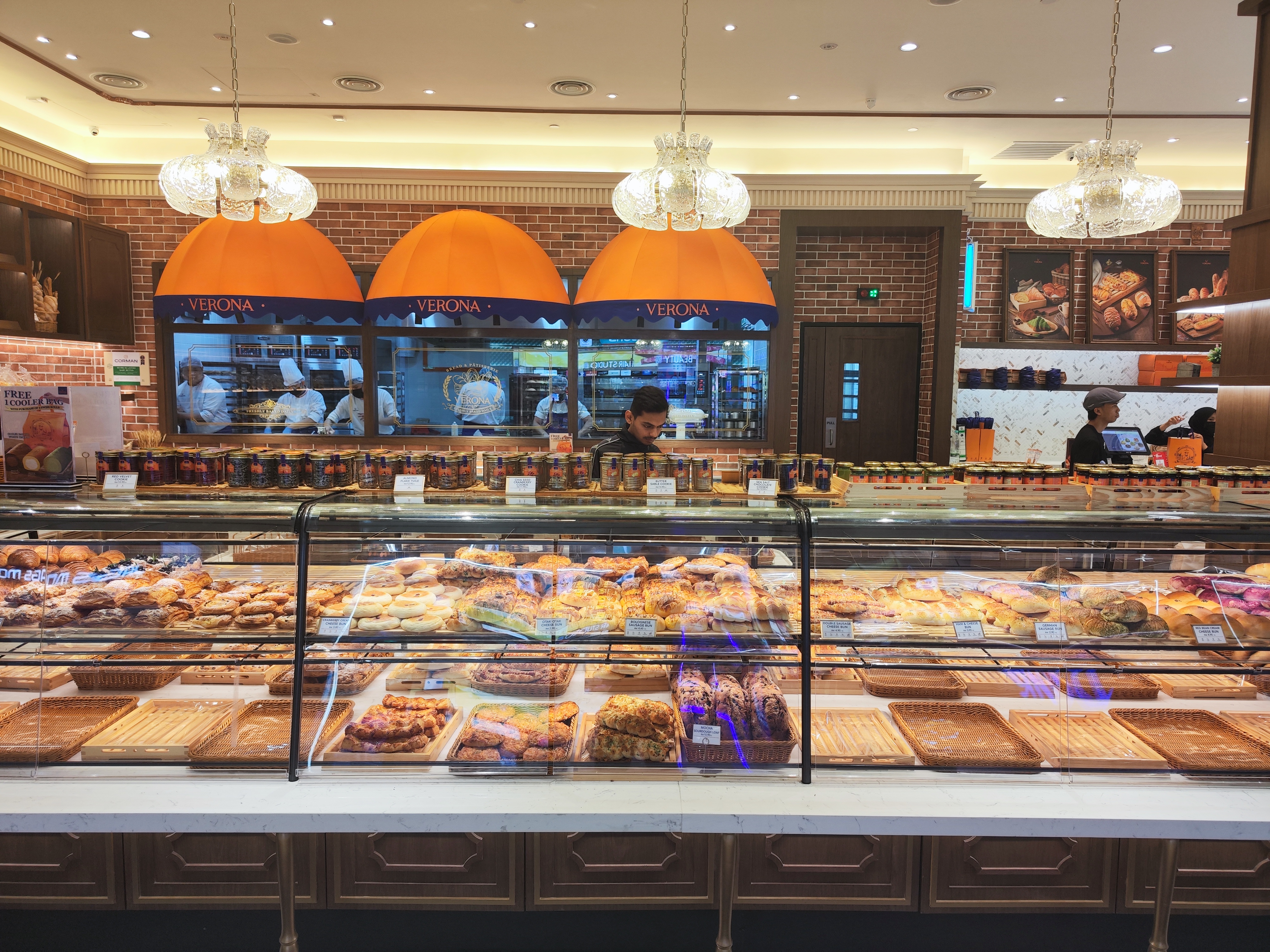
A commercial bakery oven in daily production — compliance starts with the machine's construction, materials, and electrical safety.
Why Certification Is a Procurement Gate, Not a Marketing Badge
For bakery ovens sold in the US and Canada, certification is not optional. Health inspectors and insurance underwriters routinely check whether commercial food equipment carries an ETL Sanitation or equivalent listing before approving a kitchen. The ETL Sanitation Mark, issued under the authority of Intertek Testing Services, indicates that a unit has been evaluated against recognized product safety and sanitation standards — in the case of BRESSO's oven line, that includes UL 197:2010, CSA C22.2#109:2017, and NSF/ANSI STD.4.
For the European Union, the CE marking is the legal passport for machinery placed on the market. It signals conformity with the Machinery Directive (2006/42/EC) and the Electromagnetic Compatibility Directive (2014/30/EU). A CE-certified oven must meet harmonized standards including EN ISO 12100 for risk assessment, EN 60335-1 and EN 60335-2-42 for appliance safety, and the EN IEC 61000 series for electromagnetic compatibility.
The buyer's takeaway is straightforward: a certified oven has been tested against a documented standard. A non-certified oven — regardless of how well it performs in a demo — carries an unquantified compliance risk that can delay opening, trigger costly kitchen retrofits, or void insurance coverage.
The Core Question for Research-Stage Buyers
When a bakery operator, distributor, or hotel purchasing manager begins comparing commercial bakery ovens, the first practical question is rarely about baking performance. It is, "Which certifications apply to this specific model in my market, and how do I verify them?"
Certifications in this industry attach to specific models, not to a brand as a whole. A supplier may advertise "ETL certified ovens" broadly, but the listing covers only the models that were submitted for testing. Buyers should therefore verify certification on a per-model, per-market basis and ask for the certificate number and the issuing body before finalizing a purchase.
For BRESSO — a commercial baking equipment manufacturer established in 1991, headquartered in Seoul with a production base in Shanghai's Jiading High-tech Industrial Park — the certification structure is documented across its major oven lines. The European Oven (HBWO series), Asian Oven (HBVO series), Convection Oven (HCV series), and Retarder-proofer units (HBDC Pro and HBDC Air) hold specific listings for the US/CA and EU markets.
US/CA Market: What ETL Sanitation Listing Actually Covers
For the US and Canadian markets, BRESSO's oven family holds an "AUTHORIZATION TO MARK" certification under the cETLus / ETL Sanitation Listed program. This certification, number 5029105, is issued by Intertek Testing Services and applies to commercial electric bakery retarder proofer equipment.
The scope of this listing is meaningful because of the standards behind it:
- UL 197:2010 — the standard for commercial electric cooking appliances, covering electrical safety, heating performance, and construction requirements.
- CSA C22.2#109:2017 — the Canadian equivalent for commercial cooking appliances.
- NSF/ANSI STD.4 — the sanitation standard for commercial cooking, hot food holding, and reheating equipment, governing cleanability, food-contact surfaces, and corrosion resistance.
In practice, NSF/ANSI STD.4 requires that all food-contact surfaces be smooth, non-absorbent, and corrosion-resistant — which is why 304 stainless steel construction matters not just for durability, but for compliance. A 304 stainless steel oven body is the baseline expectation for equipment that must pass sanitation inspection in the US and Canada.
| Certification / Standard | Market | What It Governs | Verifiable Reference |
|---|---|---|---|
| cETLus / ETL Sanitation Listed | US / CA | Electrical safety (UL 197, CSA C22.2#109) + sanitation (NSF/ANSI 4) | Cert. No. 5029105 — Intertek Testing Services |
| CE Marking | EU | Machinery safety (EN ISO 12100, EN 60335) + EMC (EN IEC 61000) | Cert. No. M.2021.206.C70678 — UDEM International |
EU Market: CE Marking and Its Engineering Implications
For the European Union, BRESSO's Asian Oven holds certification number M.2021.206.C70678, issued by UDEM International Certification Auditing Training Centre Industry and Trade Inc. Co. The certificate covers the Machinery Directive (2006/42/EC) and the Electromagnetic Compatibility Directive (2014/30/EU).
The standards behind the CE marking are more than paperwork. EN 60335-2-42, for instance, is the specific safety standard for commercial electric forced-convection ovens, steam cookers, and combination ovens. It includes requirements for temperature rise limits, stability, mechanical strength, and protection against electric shock. EN ISO 12100 requires the manufacturer to conduct a systematic risk assessment of the machine's entire lifecycle — from installation to cleaning and maintenance.
For a bakery buyer in Germany, France, or the Netherlands, requesting the CE certificate and verifying the model number on it is a routine part of procurement. The certificate number (M.2021.206.C70678) and the issuing authority provide a traceable path back to the standard.
Material and Construction Parameters: Where Compliance Meets Performance
Certification and material selection are not separate topics. The use of 304 stainless steel is baked into sanitation standards, and it is also the engineering foundation for oven longevity in a high-humidity commercial kitchen.
BRESSO's oven lines are built from stainless steel across all major models — the European Oven (HBWO series), Asian Oven (HBVO series), Convection Oven (HCV series), and Retarder-proofer units (HBDC Pro and HBDC Air). For buyers, the material specification matters for three reasons:
- Cleanability: Stainless steel is non-porous, so it does not harbor bacteria or absorb fats and oils, satisfying NSF/ANSI 4 cleaning requirements.
- Corrosion resistance: Commercial kitchens operate at high humidity. 304-grade stainless steel resists the pitting and surface corrosion that can compromise food safety over time.
- Thermal performance: The steel structure works with high-density insulation to keep heat inside the chamber, which affects both baking consistency and energy consumption.
Verifying Certifications: A Practical Checklist for Buyers
Buyers evaluating bakery ovens — whether for a single shop, a chain, or a distribution agreement — should apply a consistent verification process to each shortlisted supplier. The following checklist is a practical starting point:
- Confirm the exact model name on the certificate matches the model quoted in your commercial proposal.
- Record the certificate number and the issuing body (e.g., Intertek for ETL, UDEM for CE). These are independently verifiable.
- Check the standard references — for US/CA, confirm UL 197 and NSF/ANSI 4 are within scope; for EU, confirm the Machinery Directive and relevant EN standards are listed.
- Ask for the certificate's validity dates. CE certificates typically have a stated expiry (BRESSO's CE certificate, issued January 2022, is valid through January 2027), while ETL Authorization to Mark may not expire but must reflect the current product construction.
- Confirm which components are included in the listing. In BRESSO's case, the ETL listing covers the HBWO, HBVO, HCV, HBDC Pro, and HBDC Air series — but a buyer should always verify that their specific configuration is within the listed scope.
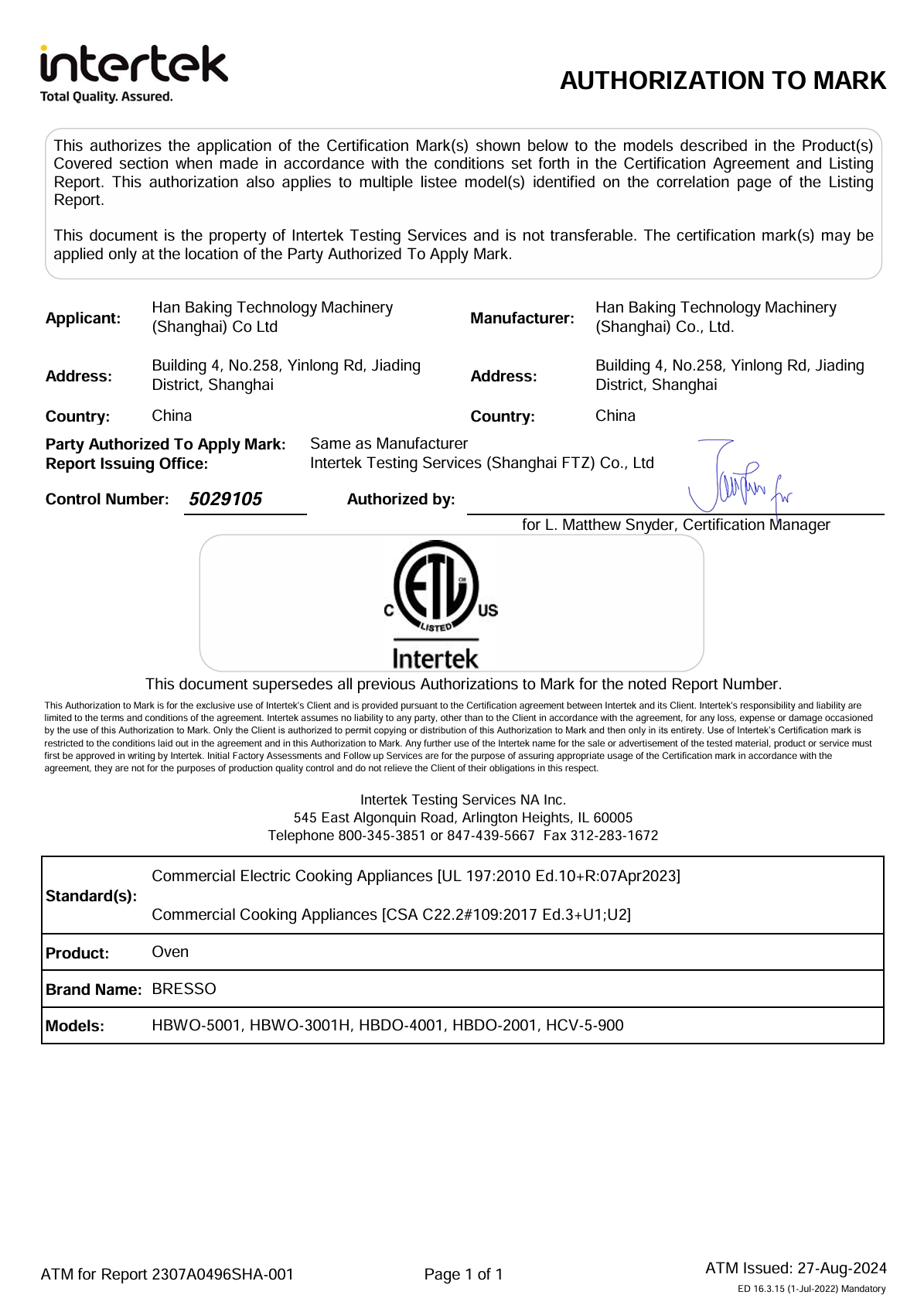
ETL Sanitation listing documentation for BRESSO's commercial electric bakery oven line — cert. no. 5029105, issued by Intertek.
Case Evidence: Certification in Real Working Conditions
Certification documents establish that a machine meets minimum standards in a testing laboratory. Field evidence shows whether it holds up in actual production. The following cases — all drawn from BRESSO's documented installation history — illustrate how certified equipment performs under distinct climate and operational constraints.
High-Heat, High-Humidity Operation: Singapore (Distributor, 50 units, 6 years)
A distributor supplying boutique bakeries and chain cafes across Singapore's CBD and Orchard Road used BRESSO's Asian Oven (HBVO) and Convection Oven (HCV) line to produce French croissants, sourdough, and soft buns. The challenge of Singapore's year-round high humidity is that moisture from the air can compromise pastry flakiness and crust crispness. The installation's documented outcome: the oven's exhaust valve design and hot air circulation extracted excess chamber moisture quickly, preserving crisp baguette and croissant crusts even in the tropical climate. For the distributor, the key economic effect was a low failure rate, which minimized expensive local after-sales labor.
Space-Constrained Urban Bakeries: United States (Bakery, 8 units, 8 years)
A neighborhood bakery operating in a high-rent downtown location used BRESSO's European Oven (HBWO) to run a diverse product line — Japanese milk bread, soft buns, and travel cakes — within a compact footprint. The modular deck configuration allowed simultaneous high-temperature milk bread baking on the top deck and low-temperature chiffon cake baking on the bottom deck. Each deck's independent temperature control and exhaust valves prevented flavor transfer between products running at different temperatures simultaneously.
Energy and Training Efficiency: Canada (Shop owner, 8 units, 15 years)
A Canadian bakery chain used the Convection Oven (HCV) line for batch production of delicate Asian pastries. The owner reported a 20% reduction in energy consumption compared with the older equipment it replaced, and zero-failure operation during peak hours. The machine's independent top/bottom heat adjustment and rapid heating were cited as the main operational advantages — and the compact footprint of the equipment proved valuable in space-constrained mall locations.
Cold-Climate Stability: Mongolia (Distributor, 100 units, 5 years)
In Ulaanbaatar, where winter indoor temperatures drop sharply, a distributor supplied BRESSO's European Oven (HBWO) and paired retarder-proofer units to boutique bakeries producing baguettes, Russian Lieba, and crusty European breads. The documented challenge of the local climate is that dry air can cause dough skinning during proofing. The paired proofer's humidity compensation solved this, while the oven's extra-thick high-density insulation maintained rapid heating without a significant energy penalty in cold environments.
Market Context: Why Certified Equipment Demand Is Expanding
Three structural trends are driving demand for certified commercial bakery ovens in 2026.
First, the global commercial oven for bakery market was valued at approximately USD 4.6 billion in 2024 and is projected to grow at a 4.1% CAGR through 2035 (Market Research Future, 2024). This steady expansion reflects continued investment in foodservice infrastructure across both developed and emerging markets.
Second, convection ovens hold an estimated 35.2% share of the commercial oven market (Future Market Insights, 2025), driven by their even heat distribution and flexibility across product categories. This is consistent with what buyers report: a well-designed convection oven serves as the workhorse of a diversified bakery.
Third, artisan bread demand is reshaping oven specifications. The global artisanal bakery market was valued at nearly USD 95 billion in 2022, fueling demand for steam-assisted and stone-deck ovens capable of producing crusty loaves with open crumb structure. This pushes equipment buyers toward considering not just certified electrical safety, but also the steam system, deck material, and humidity control that artisan products require.
For buyers in North America, the regulatory environment adds another layer of urgency. US and Canadian commercial food equipment must comply with NSF/ANSI Sanitation Standards (e.g., NSF/ANSI 4) to receive the ETL Sanitation Mark — a requirement that immediately filters out non-compliant imports. A supplier that has already navigated this process for multiple oven lines reduces the buyer's compliance workload significantly.
A Realistic Comparison: Certified vs. Uncertified and Single-Market Options
Any honest comparison of bakery oven suppliers must acknowledge the limitations and boundary conditions of certification. A few points of context:
- Certification covers safety and sanitation — not baking quality. A certified oven can still produce uneven browning or poor crust development. Buyers should treat certification as a necessary baseline and evaluate baking performance separately, ideally with a test bake.
- Single-market vs. multi-market certification matters. Some suppliers hold only CE marking, which qualifies them for Europe but not necessarily for North America, where UL/CSA and NSF compliance is expected. BRESSO's dual certification structure (ETL for US/CA, CE for EU, plus ISO9001 and FCC) is comparatively rare among mid-size Asian manufacturers, but buyers should still verify that the specific model they order has the right certification for their destination market.
- Certification is verified per model, not per brand. Even with a documented certification program, changes to product construction, component sourcing, or manufacturing location can affect the validity of a listing. A prudent buyer requests updated certificate copies at the time of order, not just when evaluating a brochure.
Future Outlook: From Compliance to Connected Baking
The next phase of bakery oven development is likely to integrate compliance with data. Several shifts are visible in the industry:
Digital monitoring is becoming a procurement criterion. Buyers increasingly ask about remote monitoring capabilities and touch screen controls — features that allow a chain operator to track oven performance across multiple locations and a distributor to debug installations remotely. BRESSO lists remote monitoring and touch screen smart control among its capability options, reflecting the direction of buyer demand.
Voltage versatility is the new standard for global procurement. A supplier capable of customizing ovens for different voltage systems worldwide (such as 380V for EU/industrial sites and 220V for other regions) is better positioned to serve distributors managing multi-country supply. BRESSO's production data shows a monthly capacity of 1,000 units with OEM customization available, with lead times of 30–45 days and a minimum order quantity of 2 units — information that matters to distributors planning inventory.
Energy efficiency will continue to tighten. With commercial electricity prices fluctuating globally, buyers are factoring insulation quality, heat retention, and per-unit energy consumption into their return-on-investment calculations. The documented 20% energy reduction in BRESSO's Canadian case is the kind of field evidence that procurement teams are now requesting.
For detailed specifications, certification documents, and model comparisons, buyers can refer to BRESSO's 2026 product brochure:
Download BRESSO Product Brochure 2026 (PDF)Frequently Asked Questions
Q: What certifications should a commercial bakery oven have for the US and Canadian market?
A: For the US and Canada, commercial electric bakery ovens should carry an ETL Sanitation (cETLus/ETL Sanitation Listed) certification issued by a recognized testing body such as Intertek Testing Services. This certification covers electrical safety (UL 197:2010 and CSA C22.2#109:2017) and sanitation (NSF/ANSI STD.4). BRESSO's oven line holds this certification under number 5029105.
Q: What is the difference between ETL certification and CE marking for bakery ovens?
A: ETL certification (cETLus/ETL Sanitation Listed) is the relevant compliance regime for the US and Canadian markets, covering both electrical safety and food sanitation. CE marking applies to the European market, and covers the Machinery Directive (2006/42/EC) and the Electromagnetic Compatibility Directive (2014/30/EU), based on standards including EN ISO 12100 and EN 60335-2-42. A single oven model may hold both certifications to be sold in both regions.
Q: How can a buyer verify that a bakery oven's ETL or CE certification is genuine?
A: Ask the supplier for the certificate document, note the certificate number and the issuing body, then check that the exact model name on the certificate matches the model quoted. For BRESSO, the ETL certification (number 5029105) is issued by Intertek Testing Services, and the CE certification (number M.2021.206.C70678) is issued by UDEM International Certification Auditing Training Centre Industry and Trade Inc. Co. The certificate should list the specific standards and the validity period.
Q: Does a certified bakery oven's stainless steel material affect its compliance?
A: Yes. Sanitation standards such as NSF/ANSI STD.4 require that food-contact surfaces be smooth, non-absorbent, and corrosion-resistant. This is why 304 stainless steel is the standard material for certified commercial bakery ovens. It ensures cleanability and resistance to corrosion in the high-humidity environment of a commercial kitchen.
Q: Which BRESSO models are covered by the ETL and CE certifications?
A: The ETL Sanitation certification (No. 5029105, issued by Intertek) covers the European Oven (HBWO), Asian Oven (HBVO), Convection Oven (HCV), Retarder-proofer Pro (HBDC Pro), and Retarder-proofer Air (HBDC Air). The CE certification (No. M.2021.206.C70678) covers the European Oven (HBWO), Asian Oven (HBVO), Convection Oven (HCV), and Retarder-proofer Pro (HBDC Pro). Buyers should confirm that the exact configuration they intend to order falls within the scope of the certificate.