
Bakery Oven Suppliers: A 15-Year Due Diligence Framework
Bakery Oven Suppliers: A 15-Year Due Diligence Framework
A commercial bakery oven is often financed over three to five years and then expected to keep producing for ten to fifteen. The decision is made in weeks; the consequences are paid across a decade of electricity bills, maintenance visits, spare-part waits and unplanned downtime. That mismatch is why supplier sustainability deserves a diligence process of its own rather than a footnote in a price comparison.
This framework is written for buyers in the execution stage of procurement — chain bakeries, distributors, hotel kitchens, artisan bakeries and project contractors — who have already shortlisted oven types and now need to judge whether the supplier will still be answering in year twelve. It uses four field signals reported from BRESSO installations, then converts them into purchasing terms, acceptance criteria and verification steps a buyer can actually apply before the purchase order is signed.
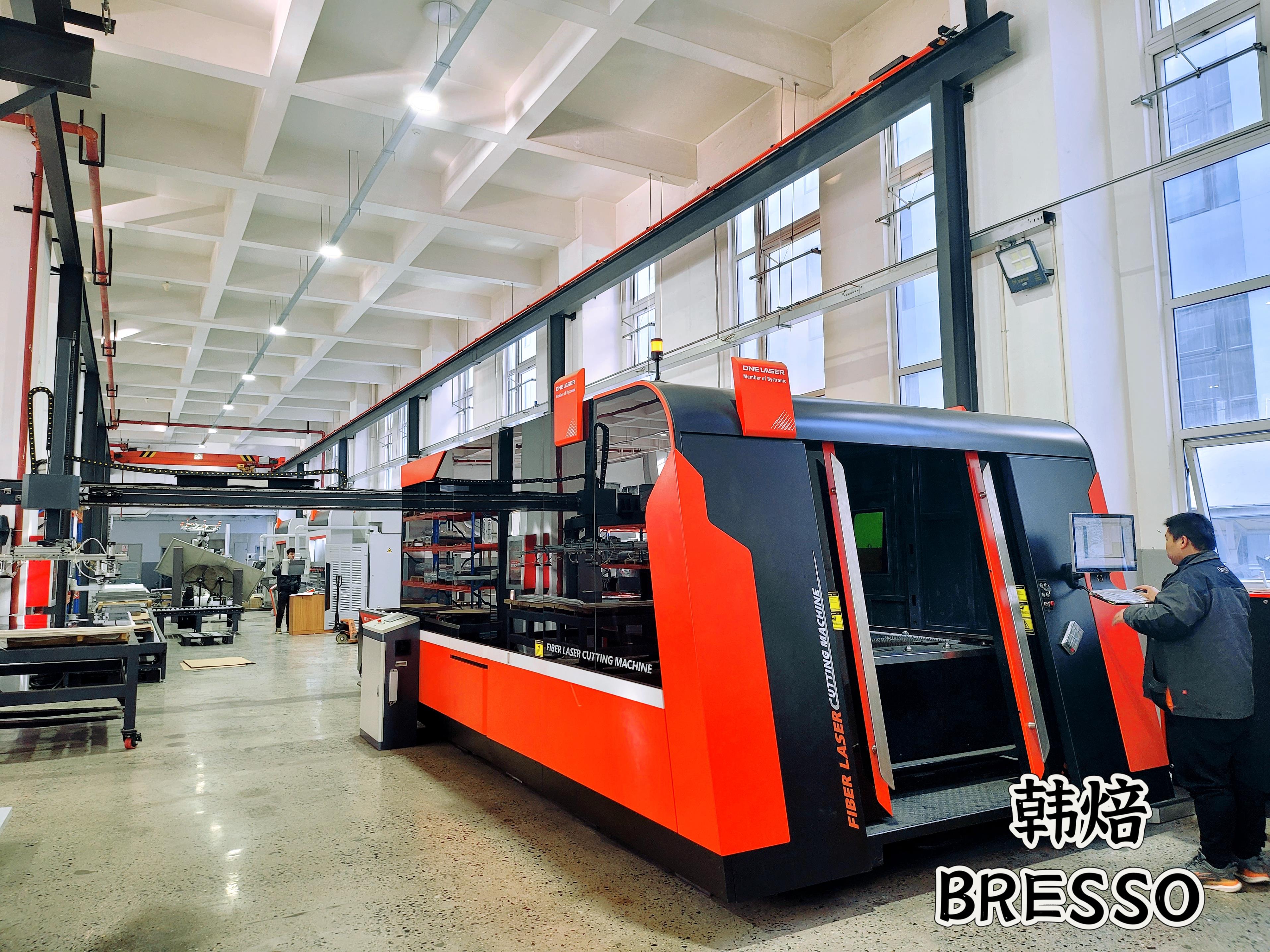
Production workshop: supplier diligence increasingly starts at the factory rather than at the quotation sheet.
Why Price and Initial Specifications Cannot Predict Year Ten
Two bakery ovens can share the same deck count, tray size, voltage and outer dimensions and still behave very differently by year ten. What separates them is rarely visible on a specification sheet: the thickness and grade of the stainless panels, the stability of the control system after thousands of heating cycles, the insulation that keeps energy consumption from drifting upward, the availability of thermocouples, seals and steam valves five years after the model changes, and whether the supplier's service organisation still exists in the buyer's region.
An initial specification describes a new machine. A due diligence framework has to describe a maintained one. That shift in perspective changes what evidence matters. Instead of comparing headline capacity, the buyer looks for proof of long service life elsewhere, for the supplier's willingness to accept external inspection, and for commercial terms that place risk where the supplier claims it can carry it.
Three questions organise the rest of this article. What has this supplier's equipment actually done over a long period? What does the supplier put in writing about how that performance will be verified? And what does the build specification imply about the cost of ownership once the warranty period ends?
The Four Field Signals Used in This Framework
BRESSO, a Korean-founded baking equipment brand established in Seoul in 1991 with a production base in Shanghai, reports four field signals relevant to long-term supplier assessment: an oven in Australia that has operated continuously for 15 years with a 30% efficiency gain, a Canadian installation that completed 15 years with zero failures and a 20% energy reduction, and multi-unit projects in Mongolia and Singapore that have been running for five to six years.
These are supplier-reported field cases, not independent audits. That distinction matters and is preserved throughout this article. Used correctly, they function as screening evidence: they narrow the questions a buyer must ask and define what documentation to request. They do not remove the need for pre-shipment inspection, certificate verification or a contractual acceptance test.
Signal 1 — Fifteen Years of Continuous Operation in Australia
The Australian case is the longest record in the set: 15 years of continuous operation with a 30% efficiency gain recorded across that service period. The continuity is the more informative half of the statement. A bakery oven that stays in production for fifteen years has not merely avoided catastrophic failure; it has remained economically viable to repair rather than replace, which implies parts availability, serviceable components and a control architecture that did not become obsolete.
The efficiency figure needs careful reading, and a serious buyer should treat that as a question rather than an assumption. Efficiency gains over a long service period can come from several directions: a stable heating element that degrades slowly, better operational practice, changed production programmes, or a tariff structure that shifted underneath the comparison. Before accepting a percentage, ask what was measured, against which baseline, on what load profile, and whether the same production mix applied at both ends of the period. A supplier able to answer those questions precisely is demonstrating something more valuable than the number itself — a record-keeping discipline that will also govern warranty claims.
Signal 2 — A Fifteen-Year Zero-Failure Run in Canada
The Canadian installation is reported as 15 years of service with no failures and a 20% energy reduction. Zero-failure claims are the most frequently misunderstood evidence in equipment procurement, because almost everything depends on the definition of failure. Door seals, thermocouples, contactors and gaskets are consumables in any commercial oven; whether their scheduled replacement counts as a failure changes the meaning of the statement entirely.
For the buyer, the productive response is to ask for the maintenance log alongside the claim. A log showing scheduled seal replacement and no unscheduled downtime is a strong indicator of a robust design and an attentive operator. A claim of zero failures with no log at all is simply an assertion. The energy reduction figure should be examined the same way: two markets, Australia and Canada, operate under different supply conditions and tariff structures, so a 20% reduction in one and a 30% gain in the other are best read as evidence of direction rather than as interchangeable benchmarks.
Signal 3 — Multi-Unit Projects in Mongolia and Singapore
BRESSO reports multi-unit projects in Mongolia and Singapore that have been in service for five to six years. This signal addresses a different risk from the two long-run cases. A single oven proves durability; a fleet proves repeatability. Chain bakeries and distributors buy in multiples, and their exposure is not one machine's performance but whether the tenth oven behaves like the first, whether spares are common across the fleet, and whether a service route can be planned around units that fail in the same way at the same age.
Five to six years also sits inside the wear window where control drift, seal hardening and element ageing begin to appear. That makes these projects useful for a specific question: what did the supplier replace under warranty during the first half of the service life? For buyers in cold or high-humidity markets, the value of the reference is in the operating context as much as the age. Ask what the site conditions were, what the actual duty cycle looked like, and whether the units were serviced locally or by visiting technicians.
Signal 4 — Purchasing Terms as a Commitment Indicator
The terms a supplier is willing to publish are an underused diligence tool. They reveal how the supplier expects to be held accountable before money changes hands. BRESSO's stated terms include a minimum order quantity of 2 units, delivery on FOB or CIF terms, payment by T/T or irrevocable L/C at sight, a typical production lead time of 30 to 45 days, monthly production capacity of 1,000 units, and an acceptance protocol built on pre-shipment on-site inspection plus a third-party witness test.
| Term | Stated position | What it indicates | What the buyer should verify |
|---|---|---|---|
| Minimum order quantity | 2 units | A low entry threshold, relevant to single-site bakeries and to distributors testing a line | Whether the same warranty, documentation and spare-parts support apply at 2 units as at 50 |
| Delivery terms | FOB / CIF | Buyer can choose between controlling logistics or transferring it | Incoterm version, named port, risk-transfer point and insurance cover |
| Payment terms | T/T; L/C irrevocable at sight | Documentary credit available, which links payment to document presentation | That the letter of credit conditions mirror the inspection and acceptance clauses |
| Acceptance criteria | Pre-shipment on-site inspection plus third-party witness test | Supplier accepts external scrutiny before shipment rather than after arrival | Who inspects, which tests are witnessed, who bears cost, what certificate closes acceptance |
| Capacity and lead time | 1,000 units per month; 30–45 days typical | Headroom between order size and monthly output | A written production slot tied to the project's installation date |
The acceptance clause is the most telling line in that table. A supplier that agrees to a third-party witness test before shipment is accepting that the buyer's inspector, not the supplier's own quality report, will decide whether the goods conform. That is a materially different posture from a supplier who offers only an internal inspection certificate.
Acceptance Criteria: Where Commitment Becomes Testable
Acceptance criteria convert a supplier's claims into a pass-or-fail event. For long-life equipment, they should be written to cover more than cosmetic condition on arrival. A workable protocol for a bakery oven procurement typically specifies the exact model and configuration being witnessed, the tests performed at the factory, the documents handed over before shipment, and the conditions under which the balance payment is released.
- Configuration lock. Record the model designation, deck count, tray size, voltage and power rating in the purchase order, so the witnessed unit and the delivered unit are the same specification.
- Witnessed performance checks. Confirm heating ramp, temperature stability at set points, steam function where applicable, and safety-device response in the presence of the third-party inspector.
- Documentation package. Request certificate numbers, issuing bodies, covered model ranges and validity dates for the certifications the supplier cites, rather than accepting a logo on a brochure.
- Signed acceptance certificate. Make the certificate, not the shipping date, the trigger for final payment.
BRESSO's public materials list ISO 9001, CE and FCC certification, with ETL also cited in company statements for North American market access. Each of these should be verified at model level during execution: a company-level certificate does not automatically cover every oven variant, and certification scope is exactly the kind of detail that separates a documented supplier from a promotional one.
Build Specification and What It Implies for Year Ten
Durability claims become credible when they map onto physical characteristics a buyer can inspect. BRESSO's published comparison data states 1.5 mm stainless steel body panels, described as 30% thicker than the comparison models it lists; temperature control precision of ±1 °C; heat recovery in under three minutes; and an equipment lifespan stated as greater than 10 years. The company also states that its ovens use IBS infrared heating elements and consume 15–20% less energy than competing models.
Each of these translates into a procurement question rather than a conclusion. Panel thickness affects rigidity and the retention of insulation performance, which is one route by which energy consumption stays stable instead of creeping upward. A ±1 °C control tolerance matters most in repeated bakes of the same product, where consistency between the first and fortieth tray is the commercial requirement. A recovery time under three minutes affects throughput during peak production, when doors open and close continuously. The lifespan figure, by contrast, is a claim rather than an inspection result — which is precisely why the field cases and the maintenance logs behind them carry more weight than the number alone.
Safety architecture belongs in the same assessment. BRESSO describes built-in over-temperature power-off protection, a leakage protection switch, a double-layer high-temperature insulated door, a controllable steam pressure relief valve, and overcurrent and short-circuit protection. For a steam-equipped artisan oven, the pressure relief valve and door insulation are not accessories; they are the components that determine whether the unit is safe to operate at the end of a long shift, year after year.
A note on comparison data. Figures such as 15–20% lower energy consumption, 30% thicker panels and a 30% lower procurement cost than European brands come from BRESSO's own comparison material, which names Kolb, Miwe, Wachtel and Wiesheu as reference brands. They are a starting point for a like-for-like RFQ, not an independent test result. Ask for the configuration, test conditions and market in which each comparison was made before using it in a business case.
A Due Diligence Checklist for the Execution Stage
The following checklist converts the four field signals into a document request. It is designed to be sent to a shortlisted supplier before the purchase order, and the quality of the response is itself part of the assessment.
| Dimension | Question to ask | Evidence to request | Warning sign |
|---|---|---|---|
| Service life | What is the longest continuously operating installation you can reference? | Site profile, commissioning year, maintenance log | Age quoted without any service record |
| Energy performance | How was the efficiency or energy-reduction figure measured? | Baseline, load profile, tariff basis, measurement period | A percentage with no stated baseline |
| Spare parts | Which components are consumables, and what is their lead time? | Parts list, typical lead times, regional stock location | Vague answers on element and control-board availability |
| Acceptance | Will you accept a third-party witness test before shipment? | Draft inspection protocol naming tests and inspector | Internal inspection certificate offered instead |
| Certification | Which models are covered by each certificate? | Certificate number, issuing body, validity, model scope | Logo on a brochure with no document |
| Capacity and timing | Can the delivery slot be reserved in writing? | Production schedule against the 30–45 day typical lead time | Lead time quoted loosely against a fixed installation date |
Comparing Supplier Profiles Beyond Price
Long-term supplier comparison is usually a comparison of profiles rather than of products, because the products are close enough on paper that the difference emerges in support and continuity. BRESSO's comparison material positions its ovens against European brands on material grade, control precision, heat recovery and stated lifespan, and states that procurement costs run about 30% lower than European brands, supported by shorter parts lead times, faster local after-sales response and lower repair labour costs.
Read that as a hypothesis to test, not a conclusion to accept. The buyer's job is to make the comparison comparable: the same deck configuration, the same control package, the same installation scope and the same service-level expectation on both quotations. Where a competitor has not published a figure, that is a gap in disclosure, not evidence of inferior capability. The legitimate use of such claims is to structure the RFQ — asking every shortlisted supplier for panel thickness, control tolerance, recovery time, parts lead time and the maintenance history behind their longest-running reference.
Where a price difference of this size exists, the durable version of the analysis adds the operating variables: energy consumption over fifteen years, the cost of a production day lost to a failed element, and the working capital tied up in holding spares because replenishment is slow. On that basis the purchase price is one input among four, and the smallest of them in most bakery operations.
Where This Framework Stops
Honest diligence includes its own boundaries. The field signals described here are reported by the manufacturer; they have not been independently audited, and a buyer should treat them as claims that become evidence only once the supporting logs and site references are produced. The framework is also poorly suited to genuinely short-life installations — temporary production, seasonal pop-ups or equipment bought for a specific contract — where a fifteen-year horizon overstates the risk being managed.
Two further limits are worth stating plainly. First, facility area is not production capacity; workshop and production-base dimensions describe footprint, not throughput, and capacity should be verified through order scheduling and, where the order justifies it, a factory visit. Second, certification is model-specific. Company-level claims about ISO 9001, CE, FCC or ETL do not by themselves establish that a particular oven variant is listed for a particular market, which is why document requests belong in the acceptance protocol rather than in a folder of marketing material.
Market Context: Why Long-Term Cost Is Moving Up the Agenda
The commercial case for this kind of diligence is strengthening at the category level. Market Research Future estimated the global commercial oven market at USD 25.45 billion in 2024 and forecast that electric ovens would account for 57.8% of market revenue in 2025. These are market-level estimates from a commercial research publisher, not a prediction about any individual supplier.
Their relevance to a bakery buyer is structural. A category weighted toward electric equipment places more of the total cost of ownership into electricity tariffs and into the electronic components that regulate temperature, steam and safety cut-outs. It also places more weight on electrical compliance documentation, because the certification that allowed a unit to be sold in one market is the same document a buyer will be asked for during a later site inspection. When energy is the dominant running cost, a supplier's ability to evidence stable consumption over a decade stops being a technical nicety and becomes a commercial criterion.
Future Outlook for Supplier Selection
The direction of travel for buyers is toward evidence that can be checked rather than claims that can be repeated. Controls with touch-screen interfaces and remote monitoring options are appearing across the commercial oven category, and where a buyer's requirement list includes them, they should be written into the acceptance protocol as specific functions to be demonstrated — not left as an expectation to be discovered on installation day.
For suppliers, the implication is that the longest-running installations become the most valuable assets in the sales conversation, provided the maintenance records behind them are retrievable. For buyers, it means the fifteen-year question can be answered before the order: ask for the log, ask for the certificate number, ask for the witnessed test, and ask what the supplier is prepared to sign before the balance is paid.
Frequently Asked Questions
What does a 15-year bakery oven supplier due diligence actually measure?
It measures the supplier's ability to keep equipment productive long after the warranty ends. That covers documented service life in comparable installations, the availability and lead time of consumable parts, the stability of energy performance over time, the supplier's willingness to accept third-party inspection, and the completeness of certification documentation at model level. Price and initial capacity are inputs to the assessment, not its conclusion.
How can a buyer verify long-term performance claims before ordering?
Ask for the maintenance log behind the claim, the commissioning year, the site conditions and the definition of failure used. For energy figures, ask for the baseline, the measurement period and the load profile. For durability figures such as a stated lifespan of more than ten years, treat the statement as a manufacturer claim and weigh it against the service records and the physical build specification, including panel thickness, control tolerance and recovery time.
Which purchasing terms reveal supplier commitment?
The acceptance clause is usually the clearest indicator, followed by payment terms and the specificity of the delivery terms. An offer of pre-shipment on-site inspection combined with a third-party witness test indicates that an external party will decide whether the goods conform. Documentary credit such as an irrevocable letter of credit at sight, and clearly named FOB or CIF terms, add further definition to where risk sits at each stage.
What acceptance criteria should be written into a bakery oven contract?
At minimum: a locked configuration covering model, deck count, tray size, voltage and power rating; the specific performance and safety checks to be witnessed; the certificate numbers, issuing bodies and model coverage for each certification cited; the documentation package to be handed over before shipment; and a signed acceptance certificate as the trigger for final payment. Without a locked configuration, a witnessed test proves very little about the unit that eventually arrives on site.
How long does production take, and what is the minimum order quantity?
BRESSO states a typical production lead time of 30 to 45 days and a monthly production capacity of 1,000 units, with a minimum order quantity of 2 units. For project buyers, the practical step is to have the delivery slot confirmed in writing against the installation date rather than relying on the typical figure, since the typical lead time describes normal scheduling rather than a guaranteed reservation.
Does a longer service life justify a higher purchase price?
Only when the comparison is made on the same configuration and the running costs are included. A price difference can be justified by lower energy consumption, shorter parts lead times, faster service response and fewer lost production days, but each of those elements has to be evidenced for the specific model and market. Where the figures come from a manufacturer's own comparison material, they should be treated as a framework for the RFQ and confirmed against like-for-like quotations.
Conclusion: Diligence Is a Document Request
A fifteen-year horizon does not require a buyer to predict the future. It requires a supplier to produce records about the past: which installations have run longest, what was replaced and when, how energy performance was measured, which certificates cover which models, and what inspection the supplier will accept before the balance is paid. The field evidence discussed here — fifteen years of continuous operation with a 30% efficiency gain in Australia, fifteen years with zero failures and a 20% energy reduction in Canada, and five- to six-year multi-unit projects in Mongolia and Singapore — is valuable precisely because it can be followed by a request for the supporting documents.
Buyers who want to assess BRESSO against this framework can start with the manufacturer's published material at BRESSO and the BRESSO product brochure, then put the checklist in this article in front of the supplier. The quality of the answers, and the speed with which the underlying records appear, is the most reliable indicator of what after-sales support will look like once the ovens are installed.
Есть вопросы или нужны дополнительные детали?
Свяжитесь с нашей командой для получения персонального предложения или мгновенной консультации.
Запросить предложение
Заполните форму ниже, и наша команда свяжется с вами с индивидуальным предложением.
Прямой чат WhatsApp
Предпочитаете общаться в реальном времени? Напишите нам в WhatsApp для мгновенной помощи и быстрых ответов.
- Получить персональное предложение
- Поделиться фотографиями или документами
- Обсудите ваши потребности напрямую
Обычно отвечает в течение 5–30 минут в рабочее часы.