
Baler Shortlist Development: Bagging, Vertical & Horizontal Selection
Shortlist Development: Bagging, Vertical & Horizontal Baler Selection
Baler procurement more often fails at the machine-class level than at the brand level. A buyer compacting recovered paper, cardboard, PET bottles, textile or scrap metal can receive five outwardly comparable quotations that in fact describe three different machine architectures: bagging and press-bagging machines, vertical balers, and horizontal hydraulic balers. Each architecture resolves a different combination of throughput, bale density, floor space and operator labour. Correcting a class mismatch means civil works, conveyor re-layout, power upgrades and re-training; correcting a supplier mismatch inside the right class is a commercial adjustment.
What follows is a pre-qualification framework rather than a ranking. It defines the operating envelope of the three dominant baler classes, applies a five-gate shortlist test, and states plainly where each class stops being the rational choice. Reference equipment is drawn from the range of Shaanxi Nick Machinery Equipment Co., Ltd., a manufacturer established in 2013 that develops and sells environmental protection equipment and packaging machinery under the NKBALER brand.
Why one search term returns three different machine classes
“Waste paper hydraulic baler machine” is a discovery-stage phrase. Buyers use it before they know which class they need, so the results mix compact vertical presses that can run on a 220 V supply with horizontal installations that weigh 30 tonnes and are fed by 12–14 metre conveyors. Comparing quotations at this stage is misleading because the offers are not substitutes for one another.
The category is large enough to sustain that confusion. Maximize Market Research values the global industrial balers market at USD 6.39 billion in 2024, projected to reach USD 13.21 billion by 2032. Segment-level estimates diverge — one published figure places solid waste hydraulic balers at USD 1.52 billion in 2025 with a projected CAGR of 5.5% through 2036 — largely because agricultural and industrial baler categories are included or excluded differently. The practical implication for a buyer is straightforward: supply is broad and quotations are plentiful, so differentiation has to come from the buyer's own specification work, not from the market.
Three classes cover most industrial applications. Their boundaries can be summarised before the detail.
| Decision dimension | Bagging / press-bagging machine | Vertical baler | Horizontal hydraulic baler |
|---|---|---|---|
| Primary objective | A fixed, repeatable unit weight for downstream handling or sale | Volume reduction in a constrained footprint | Continuous, high-tonnage compaction with consistent bale density |
| Typical bale or bag weight | 1–1.5 kg (NKB10), 20 kg (NKB20), 30–35 kg (NKB220), 400–450 kg dry (NKB280) | 50–80 kg (NK6040T10) to 1,000–2,000 kg (NK1580T200) | Bales formed in a 1,100 mm-wide chamber; tied or wired before discharge |
| Rated hydraulic force | Up to 200 ton on the block-making variant | 10–200 ton across the range | 80–250 ton across the BD and Q series |
| Throughput | 2.5–3 t/h to 10–12 t/h | 3–12 bales/hour, subject to manual feeding | 2–3 t/h to 10–15 t/h, conveyor-fed |
| Site requirement | Moderate floor area; power matched to model | Small footprint; manual loading | Conveyor run, three-phase supply, cooling, larger foundations |
| Labour pattern | Operator places material or feeds a conveyor | Operator-dependent cycle | PLC-controlled cycle; largely continuous duty |
Class 1 — Bagging and press-bagging machines: fixed unit weight, not maximum density
Bagging machines exist to produce a defined unit rather than the densest possible bale. That distinction matters wherever the downstream process — retail return logistics, laboratory sampling, agricultural feed handling, or retail-packaged block fuel — expects a predictable weight per unit.
Small constant-weight units
The NKB10 constant weight bagging machine produces bales of 200 × 130 × 100 mm weighing approximately 1–1.5 kg, with a 18.5 kW / 25 HP motor and a machine weight of 2,400 kg. The NKB20 produces larger 750 × 400 × 330 mm bales at a fixed 20 kg unit weight, using a 15 kW / 20 HP motor and weighing 950 kg. Both are specified where a small, weighable, hand-handleable unit is the output requirement.
Block making and agricultural press-bagging
The NKB220 block making machine applies 200 ton of force at 21 MPa working pressure, forming 480 × 480 × (220–350) mm blocks of 30–35 kg per bag at a rate of up to 90 blocks per hour and 2.5–3 t/h. It requires feedstock moisture of 13% or below. The NKB280 straw and hay bagging machine produces 1,100 × 1,200 × 800 mm bales at 30–32 bales per hour — 10–12 t/h — with dry bale weights of 400–450 kg, handling alfalfa, wheat straw and peanut hay, fed by a chain conveyor and strapped with plastic or woven bags.
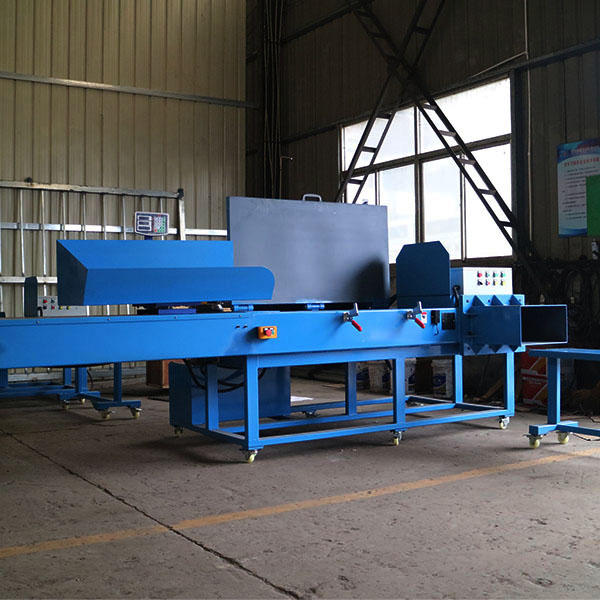
Class 2 — Vertical balers: compact, manually fed, footprint-constrained
Vertical balers compress material in an upright chamber. Material is loaded by hand or by a simple feed arrangement, the ram compacts downward, and the finished bale is ejected manually or semi-automatically. The class covers an unusually wide force range — from a 10-ton unit that runs on a 220 V supply to a 200-ton metal baler weighing 11 tonnes.
Low-force entry points
The NK6040T10 waste paper baler applies 10 ton of force at 10 MPa, producing 600 × 400 × (350–600) mm bales of 50–80 kg at 6–8 bales per hour. Power demand is 2.2 kW / 3 HP on a 220 V / 50 Hz supply, and the machine weighs 600 kg. This is the class entry point for small retail, office, hospitality and light packaging operations.
Mid-range vertical units by material
Cardboard box balers, textile balers and beverage-container balers occupy the middle of the class. The NK1070T60 cardboard box baler applies 60 ton, producing 1,100 × 700 × (500–900) mm bales at 5–8 bales per hour with a 15 kW / 20 HP motor. The NK60LT textile baler applies 60 ton at 25 MPa, with 1,000 × 700 × 400–800 mm bales of 150–200 kg and an output of 10–12 bales per hour. The NK080T100 cans and PET bottle baler applies 100 ton to a 1,000 × 800 × 1,500 mm chamber, producing 200–350 kg bales at 3–6 bales per hour. The NK-T90L double-chamber clothes baler applies 90 ton with a manual feeding method and 75–150 kg bale weights at 10–12 bales per hour.
High-force vertical units
Where the material is dense or the bale unit is large, force and mass rise sharply. The NK110T150 fibre baler applies 150 ton to coco coir and similar fibres, producing 400–500 kg bales at 4–6 bales per hour. The NK1580T200 vertical metal baler applies 200 ton with automatic door operation, forming 1,500 × 800 × 1,100 mm bales of 1,000–2,000 kg at 3–6 bales per hour, and weighs 11 tonnes. The NKOT150 tire baler applies 150 ton to 1,800 × 1,000 × 700–1,250 mm bales of 1,000–1,500 kg at 4–5 bales per hour. The NKC150 cutting machine, with a 1,500 mm cutting width and 1,000 mm stroke, is a related preparation unit for oversize material rather than a baler.
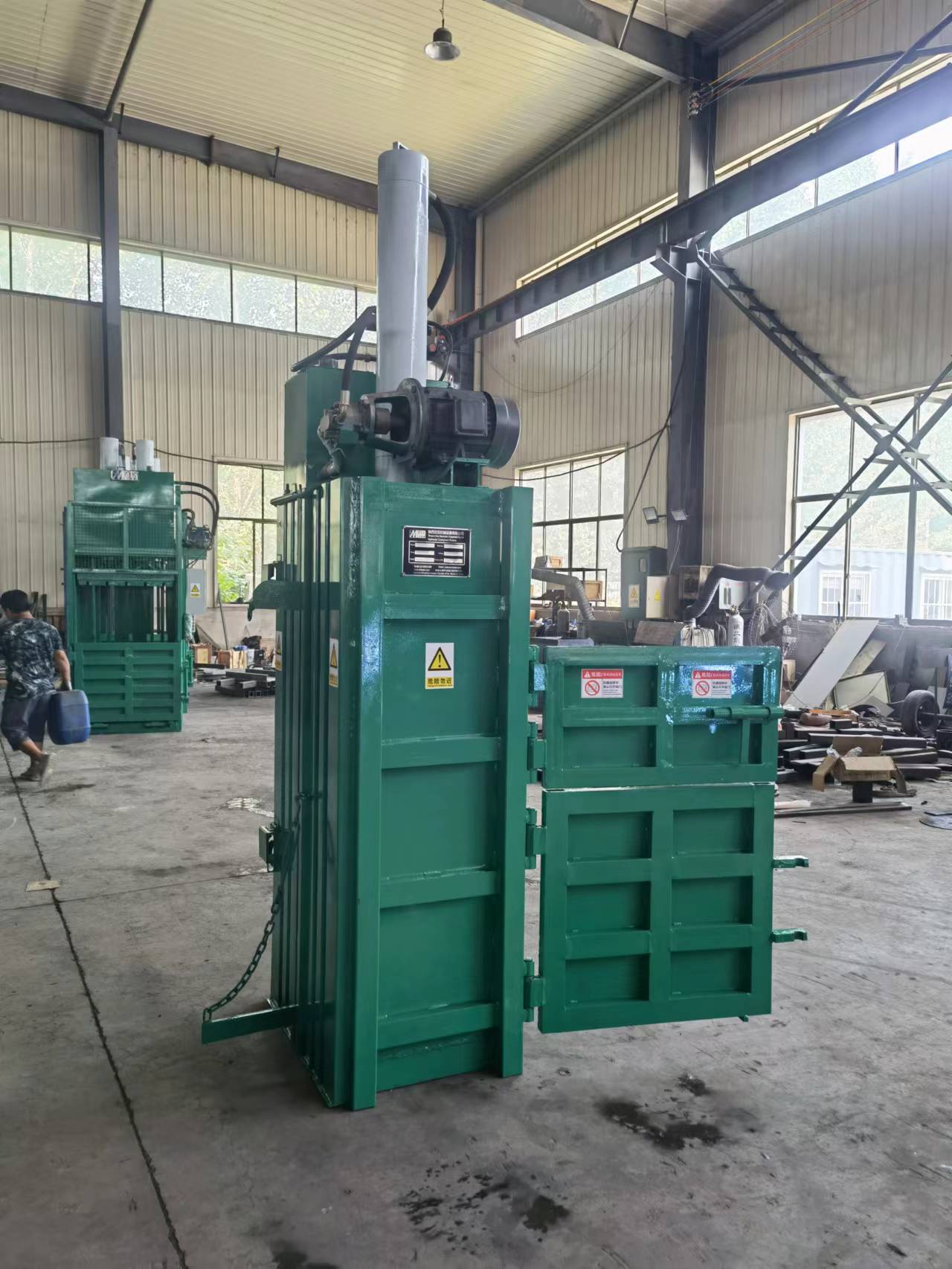
Class 3 — Horizontal hydraulic balers: conveyor-fed, continuous, industrial tonnage
Horizontal hydraulic balers compact material in a horizontal chamber that is fed continuously, usually by a conveyor. Bales are wired or strapped inside the chamber and discharged automatically. This class is chosen when hourly tonnage, bale consistency and reduced manual handling outweigh footprint and capital cost.
BD series
The BD series spans 80–250 ton. The NKW80BD applies 80 ton through a Ø200–3700 cylinder, producing 1,100 × 850 × 1,700 mm bales at 2–3 t/h with a 22 kW / 30 HP motor and a machine weight of 14,500 kg. The NKW125BD applies 125 ton, producing 1,100 × 1,250 × 1,700 mm bales at 5–7 t/h. The NKW180BD applies 180 ton with a 2,400 × 1,100 mm feed opening at 6–8 t/h, and the NKW250BD applies 250 ton at 10–15 t/h with a machine weight of 30,000 kg. Bale wire specification rises with force: 10# × 4 wires on the smallest model, 6#/8# × 5 wires on the largest.
Q series
The Q series is specified by material density rather than cylinder geometry alone. The NKW80Q handles material at 300–400 kg/m³ with a 3–5 t/h capacity and an 80 ton main cylinder force, weighing around 15 tonnes. The NKW125Q is rated at 500–600 kg/m³ and 10–12 t/h with a 125 ton cylinder. The NKW160Q and NKW180QT both deliver 12–15 t/h; the latter operates at a 30.5 MPa system pressure with a 45 kW + 7.5 kW motor configuration, a 13 × 4.3 × 5.8 m mainframe and a water-cooled heat exchange tower.
Density ratings matter more than tonnage ratings when comparing quotations. Two machines rated at the same hourly output can produce different bale densities, which changes transport economics and, in some markets, the price paid for the baled material.
A five-gate shortlist framework
The framework below is deliberately ordered so that cheap information eliminates expensive options before quotations are requested.
- Gate 1 — Material and inbound form. Identify the dominant stream (recovered paper, cardboard, PET and cans, textile, fibre, metal, tyres, agricultural residue), its bulk density and whether it arrives loose, baled or in oversize pieces. Fibre and metal rarely fit the same machine; the NK110T150 fibre baler and the NK1580T200 metal baler illustrate how far the requirements diverge.
- Gate 2 — Required output unit. Decide whether the downstream process needs a repeatable small unit (1–1.5 kg, 20 kg, 30–35 kg) or a dense, transportable bale of several hundred kilograms. This single answer usually eliminates one of the three classes immediately.
- Gate 3 — Hourly tonnage and duty cycle. Compare demand against a vertical unit's 3–12 bales per hour and a horizontal unit's 2–15 t/h band. Continuous 24/7 operation and PLC-controlled cycling belong to the horizontal class.
- Gate 4 — Site reality. Check available floor area, ceiling height, three-phase power availability, conveyor run length and foundation requirements. The horizontal class typically implies a conveyor of 12,000–14,000 mm and a mainframe of 14.5–30 tonnes.
- Gate 5 — Compliance and market destination. Confirm the applicable safety standard, the customs classification and the acceptance rules of the receiving market before signing.
Mapping the three classes to real application conditions
Recorded baling and packaging projects in this category share a recognisable operating profile: material compression and packaging, often in high-temperature environments, with continuous automatic operation, a PLC-controlled cycle and 24/7 industrial duty. Typical matched equipment includes a conveyor line, bale wire and woven bags, with low-noise design, low energy consumption and high efficiency stated as special requirements.
Documented project markets span a wide geographic base, including Canada, Mexico, Spain, Finland, Greece, Hungary, Indonesia, India, Iran, Kenya, Kuwait, Sri Lanka, Malaysia, Nigeria, New Zealand, Pakistan, Portugal, Russia and Singapore. The relevant sectors are food, pharmaceuticals, packaging, chemicals, electronics, metals, waste treatment and recycling.
Mapped to the three classes, the pattern is consistent:
- Bagging and press-bagging suits operations that sell or move material by unit weight — retail-packaged block fuel, agricultural feed and fibre handling, and small-format recyclate.
- Vertical balers suit points of generation: retail back-of-house, packaging lines, textile warehouses, electronics manufacturing and light metal workshops where volumes are moderate and space is short.
- Horizontal hydraulic balers suit consolidation points: recycling centres, waste transfer stations, paper mills, distribution centres and municipal solid waste facilities where inflow is continuous and transport cost is driven by bale density.
Market signals worth checking before you shortlist
Three verified data points are useful in shortlist conversations because they explain the competitive structure a buyer is dealing with.
First, production is concentrated. Asia Pacific accounted for roughly 45% of global hydraulic baler revenue in 2025, led by China and India, according to industry reporting. Second, export supply from China is deep: customs data records China accounting for over 77% of total import shipments in specific emerging market corridors for hydraulic baling presses. Third, the high-throughput segment is occupied by established international manufacturers, including Harris Equipment, International Baler Corporation, HSM GmbH and Jiangsu Huahong Technology — a useful reference set when benchmarking technical documentation, not a ranking of suitability for any specific site.
Two administrative facts also belong in the shortlist file. Horizontal baling presses sold into the European Union must comply with EN 16252:2012 (BS EN 16252:2012 in the UK) to carry CE marking, and baling presses are commonly classified under HS Code 842240 (packing or wrapping machinery) or 846291 (hydraulic presses for working metal or scrap). Both affect lead time, documentation and duty calculations.
Where each class stops being the right answer
A shortlist that lists only advantages is not a shortlist. Each class has a boundary that buyers should state explicitly in their internal approval documents.
- Bagging machines are not general-purpose waste paper balers. Their output is a defined unit, not a maximum-density bale. The NKB220 block making machine also specifies feedstock moisture of 13% or below, which excludes wet or unseasoned material without pre-drying.
- Vertical balers are labour-coupled. Several models in the range — including the NK-T90L double-chamber clothes baler — use manual feeding, and cycle counts of 3–12 bales per hour depend on how fast material reaches the chamber. Where labour is expensive or turnover is high, throughput assumptions based on continuous feed overstate real output.
- Horizontal balers carry infrastructure cost that is not visible on a quotation. A 14.5–30 tonne mainframe, a 12–14 m conveyor, three-phase power and water or oil cooling are prerequisites rather than options. If inbound volume is not sustained above roughly half the rated capacity, cost per processed tonne rises quickly.
- Rated tonnage is not verified tonnage. Published specifications describe design intent under defined material conditions. Density ratings such as 300–400 kg/m³ or 500–600 kg/m³ are the assumptions that should be validated with a material sample before a purchase order is issued.
- Certification is a market-access boundary, not a quality label. EN 16252:2012 addresses safety requirements for horizontal baling presses; it does not describe baling performance, and its absence does not imply a machine is unsuitable for markets where it is not required.
How NKBALER fits into a shortlist
Shaanxi Nick Machinery Equipment Co., Ltd. is a Chinese manufacturer, established in 2013, engaged in the research, development and sales of environmental protection equipment and packaging machinery equipment. Its main products are Vertical Balers, Full-Automatic Horizontal Baler, Manual Horizontal Baler and Press Bagging Machine, with the product series covering semi-automatic hydraulic balers and full automatic hydraulic balers alongside vertical balers and horizontal bagging press machines.
For shortlist purposes, the relevant point is coverage. A supplier whose range spans all three classes — from the 600 kg NK6040T10 vertical waste paper baler to the 30,000 kg NKW250BD horizontal unit, and from 1–1.5 kg constant-weight bagging to 12–15 t/h continuous baling — is less likely to steer a buyer toward the class it happens to stock. The company's manufacturing data provides additional context: a 5,000 m² facility, approximately 50 employees, a 15-engineer R&D team and an annual production capacity of about 600 units, with approximately 90% of products exported to markets in North America, South America and Asia.
Model-level documentation for these families is published at www.nkbaler.com, and the company can be reached at Sales@nkbaler.com or +86 15021631102.
What changes over the next procurement cycle
Three shifts are worth building into a shortlist template now. The first is density-led specification: as transport and labour costs rise, buyers increasingly specify bale density and cost per processed tonne rather than machine tonnage alone, which favours the Q-series approach of rating a press by achievable material density. The second is compliance formalisation: with EN 16252:2012 already governing horizontal baling presses entering the EU, documentation and conformity evidence are becoming part of the technical evaluation rather than an afterthought. The third is regional supply concentration, with Asia Pacific already accounting for approximately 45% of hydraulic baler revenue and China representing over 77% of import shipments in specific emerging corridors — a structure that gives buyers more supplier options but also more variation in documentation quality, which is precisely why class-level pre-qualification matters before supplier-level negotiation.
Frequently asked questions
What is a waste paper hydraulic baler machine?
A waste paper hydraulic baler machine is a press that uses hydraulic force to compact loose recovered paper and cardboard into dense bales for storage, transport or resale. The category includes vertical balers, which compact in an upright chamber and are typically loaded manually, and horizontal hydraulic balers, which are fed continuously, often by conveyor. Rated force in commercially available equipment spans roughly 10–250 ton, and hourly output spans from 3–12 bales per hour on vertical units to 2–15 t/h on horizontal units.
How does a buyer decide between a vertical and a horizontal baler?
The decision usually turns on throughput, bale weight and site infrastructure. Vertical balers are appropriate where floor space and power capacity are limited, material can be loaded by hand, and output requirements sit in the range of roughly 3–12 bales per hour — for example the NK6040T10 at 6–8 bales per hour on a 220 V supply, or the NK1070T60 at 5–8 bales per hour for cardboard. Horizontal hydraulic balers are appropriate where inflow is continuous and conveyor-fed, where bale density must be consistent for transport, and where output requirements start around 2–3 t/h and extend to 10–15 t/h. In practice the determining variables are hourly tonnage, acceptable bale weight and whether the site can accommodate a 12–14 m conveyor and a mainframe weighing 14.5–30 tonnes.
Where do bagging machines fit in a baler shortlist?
Bagging machines are specified when the required output is a fixed unit weight rather than a maximum-density bale. Examples in the NKBALER range include the NKB10 constant weight bagging machine, which produces 1–1.5 kg units, and the NKB20, which produces a fixed 20 kg bale. Larger variants address agricultural and biomass streams: the NKB220 block making machine forms 30–35 kg bags at 2.5–3 t/h and requires feedstock moisture of 13% or below, while the NKB280 straw and hay bagging machine handles alfalfa, wheat straw and peanut hay at 10–12 t/h with dry bale weights of 400–450 kg. These machines are usually not interchangeable with waste paper balers.
What throughput can a horizontal hydraulic baler realistically achieve?
Published capacity ratings for horizontal hydraulic balers range from 2–3 t/h on an 80-ton press such as the NKW80BD, through 5–7 t/h on the 125-ton NKW125BD and 6–8 t/h on the 180-ton NKW180BD, up to 10–15 t/h on the 250-ton NKW250BD. The Q series is rated by material density: 3–5 t/h at 300–400 kg/m³ for the NKW80Q, 10–12 t/h at 500–600 kg/m³ for the NKW125Q, and 12–15 t/h for the NKW160Q and NKW180QT. Actual output depends on the density of the incoming material and on how consistently the feed system is loaded.
Does choosing a horizontal baler require more site preparation than a vertical baler?
Yes, and the difference is substantial. A compact vertical unit such as the NK6040T10 weighs 600 kg, runs on 220 V / 50 Hz and occupies a footprint of 870 × 780 × 2,150 mm. A horizontal hydraulic baler in the same product range weighs between 14,500 kg and 30,000 kg, typically requires a conveyor between 12,000 mm and 14,000 mm long, and uses a water-cooling or oil-chiller system for continuous duty. Three-phase power, floor loading capacity and material flow routing all need to be confirmed before a horizontal machine is included in a shortlist.
Which compliance requirements apply to horizontal baling presses sold into Europe?
Horizontal baling presses for waste materials must comply with the EN 16252:2012 safety standard to carry CE marking in the European Union; the equivalent UK designation is BS EN 16252:2012. Separately, hydraulic baling press machines are commonly classified under HS Code 842240 (packing or wrapping machinery) or 846291 (hydraulic presses for working metal or scrap), which affects customs documentation and duty treatment. Buyers should treat the safety standard and the customs classification as two distinct checks, since one concerns market access and the other concerns import administration.
Есть вопросы или нужны дополнительные детали?
Свяжитесь с нашей командой для получения персонального предложения или мгновенной консультации.
Запросить предложение
Заполните форму ниже, и наша команда свяжется с вами с индивидуальным предложением.
Прямой чат WhatsApp
Предпочитаете общаться в реальном времени? Напишите нам в WhatsApp для мгновенной помощи и быстрых ответов.
- Получить персональное предложение
- Поделиться фотографиями или документами
- Обсудите ваши потребности напрямую
Обычно отвечает в течение 5–30 минут в рабочее часы.