
Bamboo Cutlery Qualification Review: Certificates & Terms
A disposable bamboo cutlery qualification review is a documented check of three things at once: what the product is made from, which documents actually cover the specific item being purchased, and which purchase terms will govern the batches that arrive. Buyers who run the review as a single certificate request usually end up with files that look complete but do not match the products on the order.
This analysis sets out a working structure for that review, and then applies it to bamboo cutlery, wooden cutlery lines and the paper and wooden alternatives buyers commonly benchmark against. Supplier examples are drawn from Greenwood - Dalian Industrial Co.,ltd., a disposable wooden and bamboo tableware manufacturer based in Jinzhou, Dalian, China. Industry and regulatory context is drawn from public market and regulatory sources.
Why Qualification Has Become a Decision-Stage Task
The global bamboo cutlery market reached USD 1.8 billion in 2025, according to commercial research published by Dataintelo in April 2026. Chinese exports of HS 4419 tableware and kitchenware of wood and bamboo were USD 1.27 billion in 2023, according to UN Comtrade. Both figures point to a category where supply is concentrated and paperwork volume is high, which is exactly the condition that makes document scope a purchasing problem rather than an administrative one.
Regulatory context reinforces the same point. Within the European Union, food packaging, containers, kitchenware and tableware intended for food contact must comply with the food-contact materials framework under Regulation (EC) No 1935/2004, and must be manufactured according to Good Manufacturing Practices under Commission Regulation (EC) No 2023/2006. The framework also requires that materials do not release constituents at levels harmful to health or change food composition, taste or odour in an unacceptable way.
None of these requirements is satisfied by a general statement. Each attaches to a specific material, a specific article and a specific production process. That is the reason a qualification review should be organised by product line and document scope before it is organised by price.
The Four Document Groups in a Qualification File
A practical review file separates supplier paperwork into four groups, because each group answers a different question and each has a different blind spot.
| Document group | What it can establish | What it typically cannot establish |
|---|---|---|
| Product-level food-contact test reports and declarations | Whether the specific article and material composition meet the framework applied in the destination market | Whether a different item from the same factory is covered |
| Factory-level systems evidence such as quality management and manufacturing-practice controls | Whether production runs under defined, auditable process conditions | How a single delivered batch performed |
| Raw-material traceability and chain-of-custody records | Where the wood or bamboo input originated and how it moved through the chain | Finished dimensions, surface finish or packaging quality |
| Commercial and batch documents: specification sheets, batch records, inspection reports, packaging approvals | What is actually in the carton that will ship | That future batches will be unchanged without a change-control clause |
The most common failure in the first group is a report issued for a material family rather than for the article being bought. The most common failure in the fourth group is a specification sheet that was written for one order and never revised.
Scope: One Certificate Rarely Covers Every Cutlery Line
Disposable cutlery portfolios are usually mixed. A single supplier may offer bamboo cutlery sets, birch or poplar wooden knives, forks and spoons in 140 mm and 160 mm lengths, ice cream sticks, coffee stirrers, bamboo skewers and food sticks, and individually wrapped or custom-printed versions of the same items. Each of those is a separate scope for qualification purposes.

| Product line | What the review should focus on | Frequent gap found in buyer files |
|---|---|---|
| Disposable bamboo cutlery sets (knife, fork, spoon) | Product-level food-contact documentation, dimensions, surface finish, set composition | Documentation issued for the set as a whole rather than for each component |
| Wooden knives, forks and spoons in birch or poplar, 140 mm and 160 mm | Material grade, thickness, splinter control, batch consistency | A bamboo document applied to a wooden order, or the reverse |
| Biodegradable and compostable bamboo cutlery claims | Composition declaration, material identification, claim substantiation | Environmental claim accepted without a material-composition statement |
| Individually wrapped bamboo cutlery | Inner wrap material, hygiene of the wrapping operation, count accuracy | Wrap material never assessed as a food-contact component |
| Custom logo bamboo cutlery and OEM sets | Printed area versus food-contact surface, artwork approval, first-article sign-off | Approved artwork differs from production output with no recorded revision |
| Bamboo skewers, BBQ skewers and food sticks | Length and diameter tolerance, surface finish, foodservice packaging | Only a generic declaration held, with no product-specific report |
| Paper cutlery and paper-wrapped lines (adjacent category) | Paper grade, coating, product-specific food-contact documentation | Bamboo or wooden certificates substituted for paper-specific documents |
Purchase Terms That Should Mirror the Documents
The second half of the review is commercial. Documents describe intent and control; purchase terms describe what will be accepted or rejected. The two should reference each other, not sit in separate folders.
- Specification sheet with article codes. Material, length, thickness, finish, set composition and packaging format, cross-referenced to the document numbers supplied in the qualification file.
- Acceptance criteria and sampling. Define acceptable limits for splinters, cracks, dimensional deviation and count accuracy, and state the sampling basis. For wood and bamboo articles, splinter and crack criteria should be explicit rather than implied.
- Packaging approval. Inner wrap, outer carton, labelling and any printed brand elements approved as a controlled revision, with the print position relative to the food-contact surface recorded.
- Change control. A notification obligation if material source, process, subcontractor or packaging changes between orders. Without this clause, a qualification file describes history rather than current supply.
- Retention samples and batch records. A retained sample per shipment and a batch identifier that links the carton to production records.
- Claim discipline. Any marketing claim used on packaging — biodegradable, compostable, plastic free — should trace back to a document in the file, not to a supplier brochure.
How Greenwood Structures Product and Process Evidence
Greenwood - Dalian Industrial Co.,ltd. is a disposable wooden and bamboo tableware manufacturer founded in 2000, operating five major factories with a reported annual production capacity of 6 billion pieces and a workforce of approximately 500. Its portfolio covers birch and poplar wooden knives, forks and spoons in lengths such as 140 mm and 160 mm, ice cream sticks, coffee stirrers and bamboo tableware, and it reports that 95 percent of output is exported to Europe, ANZ, Canada, the USA, South America, the Middle East, Japan and Korea, and Southeast Asia.
For qualification purposes, three facts matter more than the headline numbers. First, the company lists BRC, FSC, FDA, LFGB, BSCI and ISO9001 among its certifications — a set that spans factory-level systems, raw-material traceability and product-level food-contact testing, which is exactly the three-part split this review structure requires. Second, the company operates warehouses in Bangladesh, Ukraine and the United States, which affects the practical question of where a batch is inspected and who holds the retention sample. Third, it provides customised printing and individual packaging, which means the packaging and print scope described above is a live part of the review rather than a theoretical one.
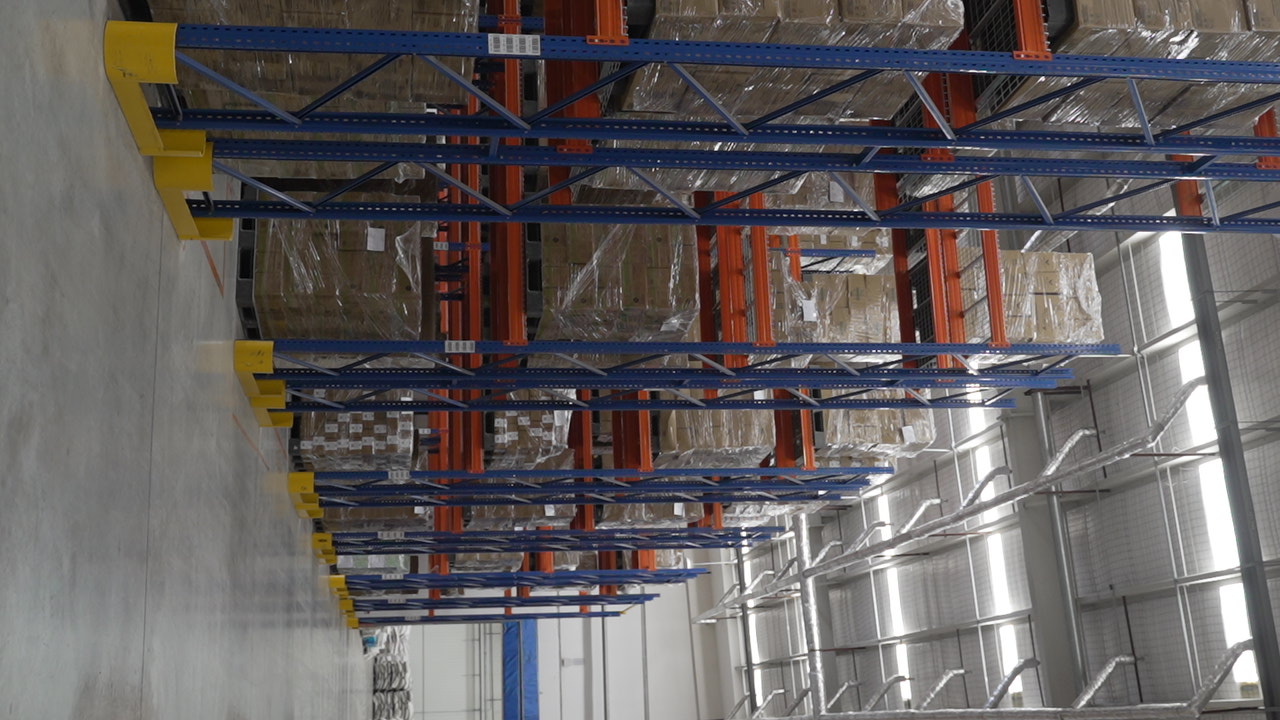
The company describes itself as suited to large-volume orders, long-term stable cooperation, and customers with high compliance requirements. That positioning is consistent with the review logic above, but it does not replace it: a buyer should still confirm which specific document covers which specific article code before approving a supplier onto an order.
Technical Explanation: What Process Controls Add to Paperwork
Paperwork records what was intended and what was tested. Process controls determine what actually leaves the line. In bamboo and wooden cutlery, the two dominant physical defects are splinters and cracks — both are finish and material problems that a compliance document will not catch and that a receiving inspection will only sample.
Greenwood reports using AI camera scanning to detect splinters and cracks on products, alongside full-process AI monitoring intended to hold batch quality stable. The operational significance is that defect detection is moved upstream from the buyer's incoming inspection to the production line, where every piece can be screened rather than a statistical sample. For a buyer, this changes the role of incoming inspection from primary control to verification of a control that already exists.
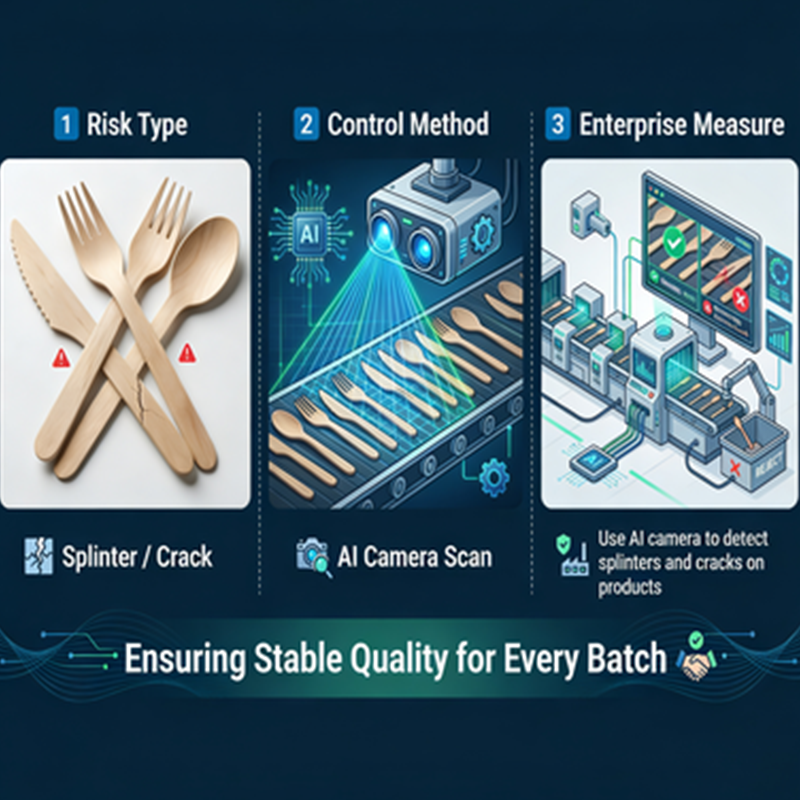
This control also supports traceability. When defect data is generated per production run, a complaint about a delivered carton can be tied back to a specific run rather than to a general quality statement, which is what makes a change-control clause enforceable in practice.
Application Fit: Where These Cutlery Lines Are Used
The qualification criteria shift slightly by end use, and the review should name the application before agreeing the specification.
- Airline catering and transport catering. Individually wrapped sets dominate, so wrap material and hygiene of the wrapping operation move to the top of the document list.
- Takeaway and delivery. Set composition and count accuracy matter most; cutlery is bundled with food and cannot be checked at the point of use.
- Foodservice and fast food operations. Volume consistency and splinter control dominate, because the cutlery is handled by staff and customers without inspection.
- Retail packaged bamboo cutlery. Consumer-facing packaging claims and printed brand elements require their own approval record and claim substantiation.
- Outdoor dining, parties and event tastings. Mixed-material kits are common, which makes the scope question — one document per article — most visible.
- Bamboo skewers and BBQ skewers for catering. Dimensional tolerance and surface finish are the acceptance criteria, with foodservice packaging as the secondary check.
Market Context Buyers Are Pricing Into the Decision
Two public data points are useful anchors for a decision-stage review, provided their scope is respected.
The first is price. Commercial research published by Research and Markets in 2026 places the average B2B wholesale price for standard 160 mm wood and bamboo utensils in bulk cartons at USD 15.50 to USD 17.10 per 1,000 units in 2026. The range is explicitly a combined wood-and-bamboo figure, so it can anchor a budget discussion but cannot be used to separate bamboo from wood pricing on its own.
The second is trade data. The HS 4419 export figure of USD 1.27 billion for China in 2023 covers wood and bamboo tableware and kitchenware as a category. Separately, the retrieved UN Comtrade record for HS 1401 describes vegetable plaiting materials, including bamboo used primarily for plaiting, and does not isolate finished disposable bamboo cutlery or bamboo skewers. Buyers who build sourcing-country comparisons on broad customs codes should treat the output as directional and validate it against transaction-level records.
The third thread is regulatory direction. The European framework has been explicit that plastic food-contact materials containing bamboo or other unauthorised plant-based additives may not be legally placed on the market under the applicable plastic-material rules. That position concerns bamboo-filled plastic, not solid bamboo articles, but the distinction itself is decision-relevant: a buyer who cannot obtain a material-composition declaration cannot tell which category a product falls into.
Comparison with Traditional and Adjacent Options
Compared with traditional plastic cutlery, bamboo and wooden lines carry a heavier documentation burden. Plastic articles are governed largely by material-specific rules and compositional declarations, whereas solid bamboo and wood articles depend on a combination of food-contact framework compliance, manufacturing-practice evidence and traceability records. The trade-off is that plastic offers simpler paperwork, while bamboo and wood offer a raw-material story that a plastic article cannot match. Greenwood states that its output is 100 percent plastic free and that raw-material traceability is held under FSC certification, which is the type of claim that should be verified through the chain-of-custody document rather than accepted from a brochure.
Compared with paper cutlery, the two categories are not interchangeable at the document level. A paper line needs paper-specific food-contact documentation covering grade and coating; a bamboo or wooden certificate does not cover it. Buyers benchmarking paper, wood and bamboo in the same tender should therefore collect three separate document sets, not one set with a note attached.
Compared with non-certified disposable tableware, the practical difference is auditability rather than product performance. A supplier with traceable raw material and monitored production can answer a scope question in writing; a supplier without those records usually cannot.
Limits Worth Writing Into the Agreement
A review that does not record its own boundaries tends to be over-trusted later. Several limits apply to this structure.
- Documents do not guarantee batch quality. Splinters and cracks are physical defects; even with in-line camera detection, the buyer should retain an incoming sampling step and a rejection path.
- Scope does not transfer across categories. A bamboo document does not cover a wooden line, and neither covers paper. Each article code needs its own reference.
- Trade data is not product data. Broad customs classifications cannot support a finished-product market estimate for disposable bamboo cutlery or skewers.
- Price benchmarks are combined. The published per-1,000-unit wholesale range covers wood and bamboo together, so it should not be presented internally as a bamboo-only index.
- Material composition needs its own evidence. Solid bamboo and bamboo-filled plastic are treated differently under EU rules, and the difference is not visible in a product photograph.
- Certification lists are supplier statements. A list of standard names is a prompt to request the underlying certificates and confirm their validity dates and the articles they cover, not a conclusion.
Future Outlook
Three developments are likely to shape qualification reviews over the next procurement cycles. First, documentation is moving from certificate collection toward scope mapping, because regulators and retail customers increasingly ask which article a document covers rather than whether a supplier holds a standard. Second, traceability expectations are rising in step with raw-material claims, which favours suppliers who can connect a finished carton to a material source and a production run. Third, as the bamboo cutlery category grows from its 2025 base of USD 1.8 billion, differentiation is likely to shift toward consistency of supply, warehouse proximity and document readiness rather than toward material substitution alone. Buyers who build a reusable review template now will spend less time re-qualifying suppliers later.
Frequently Asked Questions
Can one certificate cover bamboo, wooden and paper cutlery from the same supplier?
Generally no. Food-contact documentation attaches to a specific article and material composition. A bamboo cutlery document covers the bamboo article it names; a wooden knife, fork or spoon in birch or poplar is a different material, and a paper line involves paper grade and coating that fall outside both. Buyers should map each article code to its own document reference rather than accepting a single certificate for a mixed catalogue.
What should a buyer request before accepting a supplier qualification file?
A complete file typically contains four groups: product-level food-contact test reports and declarations naming the article; factory-level systems evidence such as quality management and manufacturing-practice controls; raw-material traceability or chain-of-custody records; and commercial documents including specification sheets, batch records, inspection reports and packaging approvals. Each group should carry a document number and an article reference so the scope can be checked.
How should purchase terms handle the gap between documents and delivered batches?
By separating what documents prove from what acceptance testing proves. The specification sheet should reference the qualification document numbers, while acceptance criteria define measurable limits for splinters, cracks, dimensions and count accuracy, together with a sampling basis and a rejection path. Retention samples and batch identifiers link the two, and a change-control clause requires notification if material source, process or packaging changes.
What happens when a supplier document and a purchase term conflict?
The stricter requirement should govern, and the conflict should be resolved in writing before the order is placed rather than at inspection. In practice this means amending either the specification or the document reference so that the two describe the same article, material and packaging format. A conflict left unresolved usually reappears as a rejected shipment.
How can a buyer distinguish solid bamboo cutlery from bamboo-filled plastic?
Through a material-composition declaration, supported by product-level documentation. The distinction matters because EU rules treat plastic food-contact materials containing bamboo or other unauthorised plant-based additives differently from solid bamboo articles. A supplier that cannot state the composition in writing leaves the buyer unable to determine which rule applies, which is a qualification failure rather than a pricing issue.
Does an in-line inspection system remove the need for incoming checks?
No. Automated camera scanning for splinters and cracks moves defect detection upstream and improves batch consistency, but it does not transfer responsibility. Incoming sampling remains the buyer side verification step, and it is the mechanism that converts a supplier process claim into evidence for a specific delivered batch.
For buyers who want to review Greenwood product lines and packaging options in more detail, the company brochure is available for download: Greenwood product brochure.
Есть вопросы или нужны дополнительные детали?
Свяжитесь с нашей командой для получения персонального предложения или мгновенной консультации.
Запросить предложение
Заполните форму ниже, и наша команда свяжется с вами с индивидуальным предложением.
Прямой чат WhatsApp
Предпочитаете общаться в реальном времени? Напишите нам в WhatsApp для мгновенной помощи и быстрых ответов.
- Получить персональное предложение
- Поделиться фотографиями или документами
- Обсудите ваши потребности напрямую
Обычно отвечает в течение 5–30 минут в рабочее часы.