
Barber Chair Procurement FAQ: Sizing, Upholstery & Recline
Barber chair procurement rarely fails on colour. It fails on fit, on surface durability, or on an adjustment mechanism that was never specified. Sizing, upholstery and hydraulic recline are the three technical variables that decide whether a chair survives its first years in a working salon, and they are also the three areas where specification sheets are easiest to misread.
The category is large enough for that misreading to be expensive. The global salon chairs market was valued at approximately USD 10.57 billion in 2025 and is projected to reach USD 18.4 billion by 2035, according to Fact.MR. Within the product-type segment, hydraulic barber chairs accounted for approximately 42.5% of market share in 2025, based on Market Intelo's product-type breakdown. Volume of that scale means buyers are routinely comparing chairs that look similar in photographs but differ substantially in footprint, structural material and adjustment class.
This reference answers the recurring procurement questions behind those differences using documented specifications from the range of Ningbo Hongzi Beauty & Hairdressing Equipment Co., Ltd., a China-based manufacturer of barber chairs, shampoo chairs, massage beds and manicure tables, founded in 2012 and operating a facility exceeding 22,000 m² with an annual output of roughly 180,000 units, exporting to North America and Europe. Where a specification is ambiguous, the ambiguity is stated rather than smoothed over.
Why Sizing, Upholstery and Recline Decide Most Orders
Three questions determine whether a barber chair order will work in a live salon, and each has a different failure mode:
- Sizing decides whether the chair can be installed at all. Station pitch, aisle width, recline clearance and adjacency to the shampoo unit are all constrained by the installed footprint, not by the seat width printed on a marketing sheet.
- Upholstery and frame materials decide how long the chair looks acceptable under daily use. Salon conditions are defined by long-term indoor use with wear resistance, oil resistance, easy cleaning and comfort requirements, and by special requirements covering durability, water and oil resistance, child safety on children's chairs, and customisation of colours and materials.
- Hydraulic recline decides which services the chair can support. In this product family, operation is manual or hydraulic adjustable depending on the model, and the difference between a styling chair and a reclining chair is a specification decision, not a visual one.
Buyers in the research and evaluation stage usually discover the problem late: a chair passes visual inspection, arrives, and then cannot recline far enough from the wall, or the station spacing has to be redrawn around equipment that was chosen for appearance.
Sizing: Compact, Mid-Range and Heavy-Duty Footprints Compared
The clearest way to understand sizing is to compare documented dimensions across the three tiers that most procurement lists actually contain. The three models below are frequently grouped together in buyer shortlists, yet their documented dimensions describe quite different installation realities.
| Model | Documented type | Documented dimensions | Listed materials |
|---|---|---|---|
| HZ6001DW | beauty salon chair | 45*25*70 CM | PU leather, high-density sponge, wood, iron |
| HZ8801 | styling chair | 90*60*90 CM | PU leather, high-density sponge, wood, iron |
| HZ87102RB | Heavy Duty Barber Chair | 111x66x118 CM | PU leather, high-density sponge, wood, aluminum alloy |
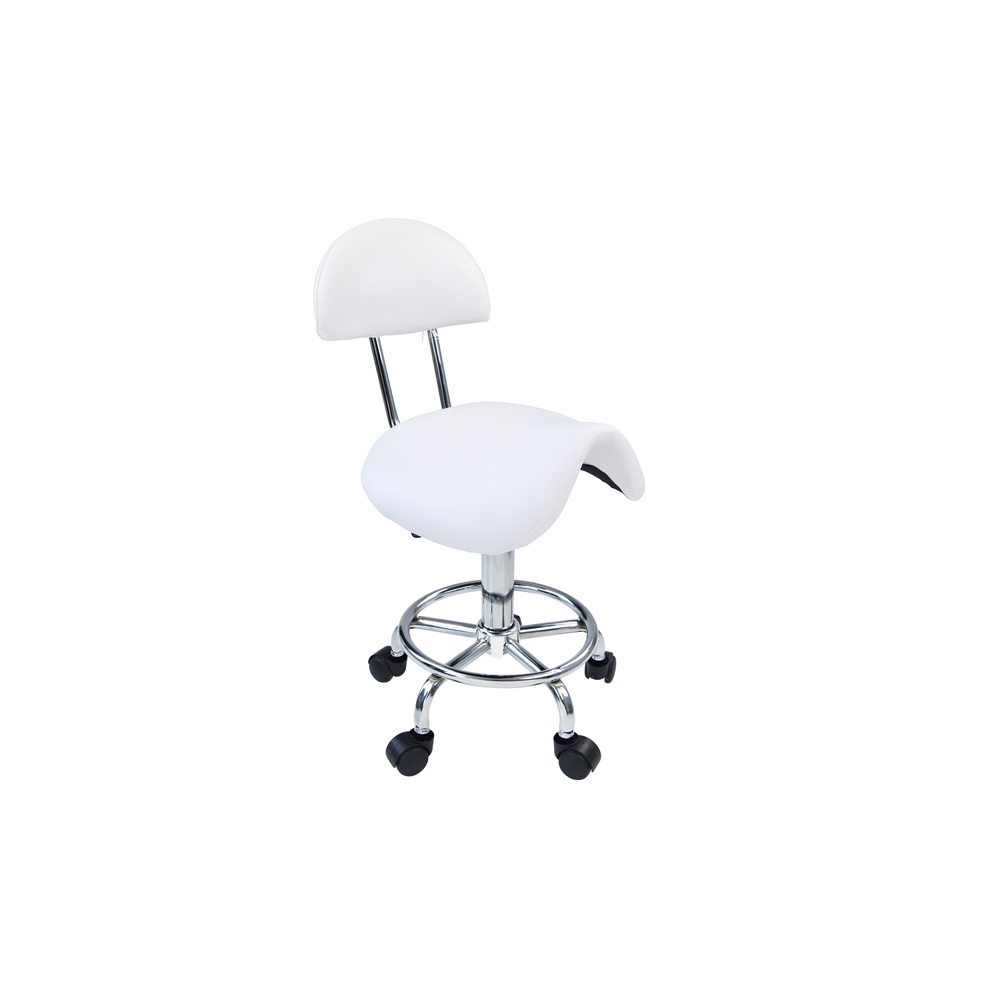
Compact tier reference: HZ6001DW, documented as a beauty salon chair with PU leather upholstery and a wood-and-iron structure.
The step from HZ6001DW to HZ8801 is a step in function, not just in size: the styling chair is documented at 90*60*90 CM, which places it in the standard station layout that most salons plan around. The step from HZ8801 to HZ87102RB changes the chair class entirely. At 111x66x118 CM, the heavy-duty model is documented with a taller 118 CM element, consistent with the geometry required by recline and headrest structures.
One caution applies to every dimension above. The documented value for HZ6001DW is 45*25*70 CM, which is materially smaller than the other two, and buyers should confirm the measurement basis before using any of these figures for floor planning. Suppliers sometimes record seat-area, base, or packed-carton dimensions rather than the full installed footprint, and the three are not interchangeable. The procurement-safe procedure is to request the installed footprint, the recline sweep, and the packed carton size as three separate figures.
Across the wider HZ range, the same ladder repeats and can be read directly from the specification sheet:
| Tier | Models and documented dimensions |
|---|---|
| Compact group | HZ6001DW 45*25*70 CM; HZ88202 50*64*90 CM; HZ8765BK 50*64*104 CM |
| Mid-size styling group | HZ88123PK 81*63*91 CM; HZ8801 90*60*90 CM; HZ87111GY 96*59*103 CM |
| Full-size and recline group | HZ8770 105*72*97 CM; HZ8740BR 105*72*110 CM; HZ8700 110*72*90 CM; HZ8702A 110*72*90 CM; HZ8702CRD 110*72*90 CM; HZ8796C 110*72*100 CM; HZ8799G-Z 110*72*100 CM; HZ87102RB 111x66x118 CM |
Read as a set, the data shows where procurement lists usually go wrong. The height figure climbs from 70 CM in the compact tier to 90 CM in the styling tier and to 118 CM in the heavy-duty tier, while depth settles consistently around 59–72 CM once a full-size frame is involved. That consistency is useful: it means a salon can often standardise the station depth across a mixed fleet, and vary the chair class instead.
Upholstery and Frame: What PU Leather, Sponge, Wood and Metal Actually Do
Every model discussed here is documented with the same two upper-layer materials: PU leather and high-density sponge. What changes across the range is the structural material below them, which is documented as iron in the compact and styling group and as aluminum alloy in the full-size and recline group. That difference is the most reliable structural signal a procurement sheet offers.
Each material carries a specific job, and understanding the job is what allows a buyer to write an inspection checklist rather than a wish list:
- PU leather is the contact surface. In a salon it is asked to resist oils, dyes, water and frequent wiping, which is why easy cleaning and oil resistance appear as explicit usage requirements for this category rather than as preferences.
- High-density sponge sits under the surface and determines whether the seat still looks shaped after months of daily use. Sponge density is the difference between a chair that recovers and a chair that develops a permanent dip at the seat edge.
- Wood is documented as the structural frame element across the range, providing the mounting structure for the upholstery assembly.
- Iron and aluminum alloy are the documented metals, appearing in different tiers. Buyers should note that the specification sheets do not state load ratings for either material, so any claim about structural capacity has to be requested separately from the supplier rather than inferred from the material name.
This is where a specification sheet stops being sufficient. Knowing that a chair uses high-density sponge does not tell a buyer the density value, and knowing that a base is aluminum alloy does not establish a tested load. The correct procurement move is to treat the material list as the starting point of a question list, not the end of one.
Hydraulic Recline versus Standard Styling Chairs: Reading the Classification
The most common procurement error in this category is treating every chair with a hydraulic base as a recliner. In practice, the documented type label is the fastest way to separate the two, and the labels in this range are explicit:
- Standard styling and salon seating: beauty salon chair (HZ6001DW), styling chair (HZ8801), salon styling chair (HZ88123PK), salon chair (HZ88202), hair salon chair (HZ8765BK), salon barber chair (HZ87111GY).
- Hydraulic and reclining seating: Classic Hydraulic Barber Chair (HZ8700), hydraulic barber chair (HZ8740BR), reclining barber chair (HZ8702A), Retro Reclining Barber Chair (HZ8799YF), Hair hydraulic recline barber (HZ8799G-Z).
- Heavy-duty seating: Heavy Duty Barber Chair (HZ87102RB).
- Styling-oriented and decorative variants: hairdressing chair (HZ8770), Barber salon chair (HZ8796C), vintage barber chair (HZ8799B-U), antique barber chair (HZ8740ABK), luxury barber chair (HZ8799AGD), gold barber chair (HZ8799ABK), wholesale barber chair (HZ8799M), professional barber chair (HZ8702CRD), barber shop chair (HZ8760G).
Two clarifications matter for buyers. First, the type label describes the intended use class, not the actuation method: across this family, chairs operate in manual or hydraulic adjustable mode depending on the model, so the actuation type should be confirmed per model rather than assumed from the category. Second, the recline class and the heavy-duty class are not the same specification, even though both sit in the larger footprint group at roughly 110 CM in width and depth.
For durability expectations, industry engineering references place commercial-grade hydraulic pumps for barber chairs at typical load capacities between 350 and 400 lbs, with service exceeding 100,000 cycles before maintenance is required (Salon Furniture Engineering Guide). That is a general engineering benchmark rather than a certification of any individual model, and it should be used to frame the questions asked of a supplier, not as a product claim. The documented after-sales term for the pump in this range is a one-year warranty, with damaged products resent.
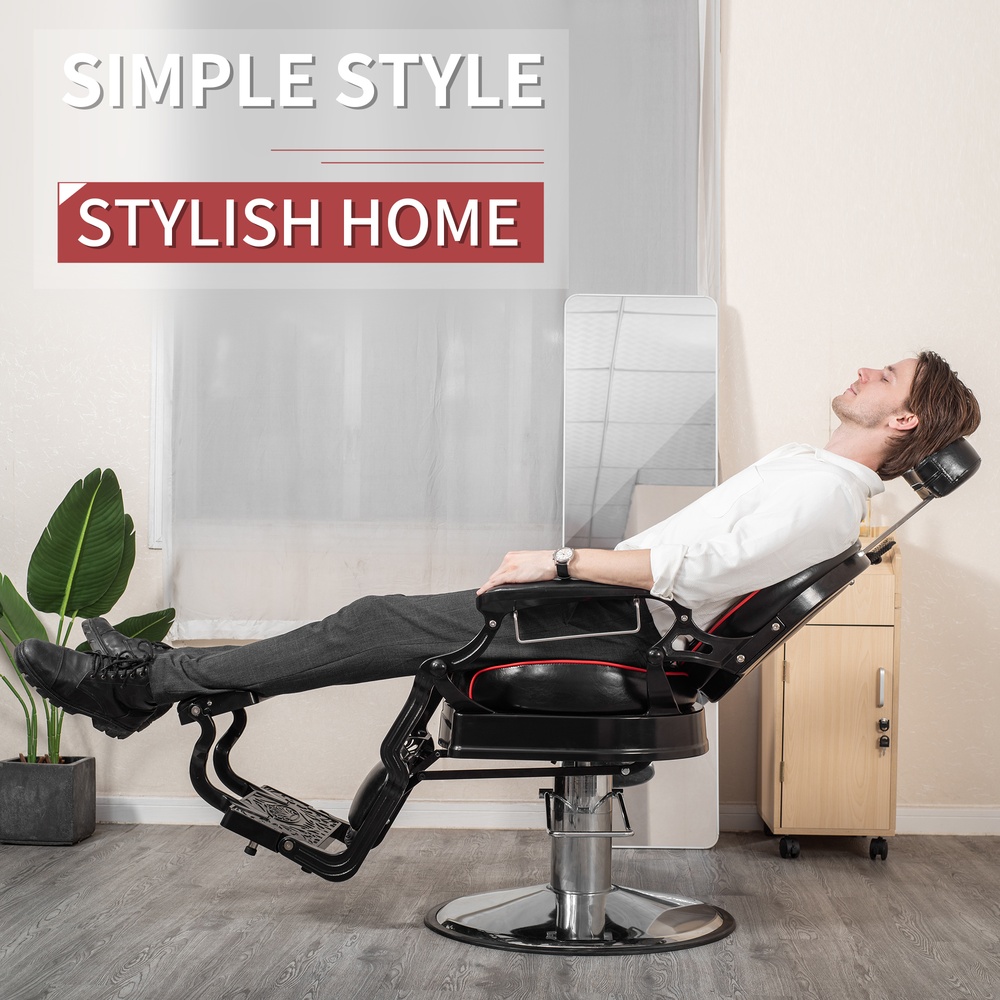
Heavy-duty tier reference: HZ87102RB, documented at 111x66x118 CM with a wood and aluminum alloy structure.
Matching Model Class to Salon Scenario
The application profile for this category is consistent across markets: indoor salon use over the long term, under conditions that require wear resistance, oil resistance, easy cleaning and comfort. The chair's role is to serve as customer seating and as the barber workstation, which is why it is judged both on comfort and on how it shapes the salon's visual grade.
The procurement scenarios that follow from that profile are also consistent. These products are used for salon fit-out and full-equipment procurement, for distributor bulk orders, and for customised projects. They are also dependent products: a barber chair program normally has to be planned alongside supporting equipment such as shampoo chairs, styling mirrors and cabinets, hair dryers, trolleys and manicure tables.
Mapping the three tiers onto realistic projects gives a practical selection rule:
| Tier | Typical project fit | What to verify before ordering |
|---|---|---|
| Compact (HZ6001DW) | Small-format salons, tight station layouts, multi-unit seating where space is the binding constraint | Measurement basis of the documented dimension; whether any recline is required at the station |
| Mid-range (HZ8801) | Standard styling stations in general salon fit-outs and chain roll-outs | Station pitch, operator clearance, and colour or logo customisation lead time |
| Large / heavy duty (HZ87102RB) | Barber-focused stations, high-traffic shops, service mix that includes recline-dependent work | Recline clearance behind the chair, floor load, and pump service terms |
Project scale in this category can be substantial. One documented dealer program covering salon use, barber workstation seating and chain-store outfitting involved 200,000 units over a one-year cycle, with reported outcomes including improved customer sitting comfort during haircut, perm and dye services, an uplift in perceived salon brand grade and store image, and gains in service efficiency.
Supply, Customisation and Lead-Time Constraints
Technical fit and commercial fit have to be evaluated together, because the commercial terms often decide whether a technically correct chair can actually be delivered on the project timeline. The documented terms for this range are as follows:
| Parameter | Documented value |
|---|---|
| Production mode | OEM |
| Customisation scope | Logo and colour |
| Minimum order quantity | 5 units |
| Lead time | Under 100 units: 15 days; over 100 units: 30 days |
| Monthly capacity | 15,000 units |
| Quality control | 100% test |
| Export markets | EU and US |
| After-sales terms | Pump supports a one-year warranty; damaged products resent |
The practical implication is that a project phasing decision changes the lead-time calculation. Splitting a 300-unit order into three tranches of 100 units keeps each tranche at the shorter lead time, while a single consolidated order moves into the longer bracket. For distributors managing stock rather than project deliveries, the 5-unit minimum and 15,000-unit monthly capacity define the realistic range between trial orders and volume programs.
Where This Range Does Not Fit: Practical Boundaries
A procurement reference is only useful if it states where a product class stops working. Four boundaries apply here, and each one is documented rather than assumed.
Space is a real constraint at the top of the range. Moving from a compact chair to a heavy-duty recliner roughly doubles the documented width and depth figures. A salon that plans stations on a compact or styling footprint cannot simply substitute in a full-size reclining chair; the station pitch has to be re-planned, and recline requires clearance that a styling station does not.
Compact chairs are not smaller versions of recliners. HZ6001DW is documented as a beauty salon chair with no documented recline function. Where a service mix depends on recline, the relevant documented group is the hydraulic, reclining and heavy-duty set, not the compact set.
Hydraulic mechanisms are wearing components. The pump is the part most likely to require service over a chair's life, which is why the documented after-sales term specifically covers a one-year pump warranty. Buyers writing a long-horizon cost model should treat the pump as a serviceable element, not a permanent one.
Customisation is limited to what is documented. The stated customisation scope is logo and colour. Structural or dimensional customisation beyond that scope should not be assumed from the general availability of OEM production. Similarly, the specification sheets list materials but not load ratings or sponge density values, so those figures have to be requested explicitly if a project requires them.
Market Trend: What the Import and Share Data Show
Two data points frame where demand is concentrated. Hydraulic barber chairs hold the largest share of the product-type segment at approximately 42.5% in 2025, which matches the direction of the specification data: the hydraulic and recline group makes up the majority of full-size models in a typical range. On the trade side, the United States imported USD 102.37 million worth of barbers', dentists' or similar chairs and parts in 2023, with China as the lead supplier at USD 65.35 million, or 63.8% of that value, according to UN Comtrade data published through the World Integrated Trade Solution.
Market sizing estimates should be treated with caution, because definitions differ. Grand View Research estimated the broader salon furniture market at USD 5.54 billion in 2024, while Fact.MR estimated salon chairs specifically at USD 10.57 billion for 2025 and TechSci Research placed the salon chairs market at USD 14.16 billion. The divergence reflects scope differences rather than a single disputed figure, and procurement planning should use these numbers directionally rather than as a budget input.
At the manufacturer level, the segment includes established international names such as Takara Belmont, Koken, Pibbs Industries and Gamma & Bross alongside a large Chinese export base. For buyers, the practical consequence is that supplier evaluation criteria — measurement basis, pump service terms, lead-time brackets and customisation limits — carry more decision weight than brand recognition alone.
FAQ: Detailed Procurement Answers
How much floor space should be planned per barber chair?
Start from the documented dimensions and then add clearance. In this range, HZ6001DW is documented at 45*25*70 CM, HZ8801 at 90*60*90 CM and HZ87102RB at 111x66x118 CM. Two additions are required for planning: recline clearance for hydraulic and reclining models, and operator clearance around the chair. Buyers should also confirm the measurement basis of the documented figure, since seat-area, base and packed-carton dimensions are not the same as the installed footprint.
What does each material in the specification actually do?
PU leather is the contact surface and is selected for wear resistance, oil resistance and easy cleaning under long-term indoor salon use. High-density sponge provides the cushioning and holds the seat shape under repeated use. Wood forms the structural frame. Iron and aluminum alloy appear as the documented structural metals in different tiers, with iron in the compact and styling group and aluminum alloy in the full-size and recline group. The specification sheets list these materials without load ratings or sponge density values.
How can a buyer tell a hydraulic recliner from a standard styling chair?
Read the documented type classification rather than the photograph. Standard seating in this range is labelled styling chair (HZ8801), salon styling chair (HZ88123PK), salon chair (HZ88202), hair salon chair (HZ8765BK) or beauty salon chair (HZ6001DW). Recline and hydraulic classes are labelled explicitly, including Classic Hydraulic Barber Chair (HZ8700), hydraulic barber chair (HZ8740BR), reclining barber chair (HZ8702A), Retro Reclining Barber Chair (HZ8799YF) and Hair hydraulic recline barber (HZ8799G-Z). Actuation is manual or hydraulic depending on the model, so the actuation type should be confirmed separately from the class label.
Can a compact model such as HZ6001DW be used where recline is required?
No recline function is documented for HZ6001DW, which is classified as a beauty salon chair with a documented dimension of 45*25*70 CM. Recline-dependent service stations are covered by the documented hydraulic, reclining and heavy-duty models instead, all of which sit in a substantially larger dimension group. Substituting a compact chair into a recline-dependent station changes the service capability of that station, not only its footprint.
What are the ordering constraints for bulk and customised orders?
The documented terms are a minimum order quantity of 5 units, a lead time of 15 days for orders under 100 units and 30 days for orders over 100 units, and a monthly capacity of 15,000 units. Production mode is OEM with customisation limited to logo and colour, quality control is 100% test, and export markets are the EU and US. Because the lead-time bracket changes at 100 units, order phasing directly affects delivery timing.
How long should a hydraulic pump be expected to last, and what is covered?
The documented after-sales term covers the pump with a one-year warranty, and damaged products are resent. As an industry benchmark, commercial-grade hydraulic pumps for barber chairs are typically rated for load capacities between 350 and 400 lbs and exceed 100,000 cycles before maintenance is required, according to a published salon furniture engineering reference. That benchmark is a general engineering figure and not a certification of any specific model, so pump life should be confirmed model by model with the supplier.
What to Watch Next
The direction of the category is toward clearer specification. As the salon chairs market expands toward the projected USD 18.4 billion by 2035, and as hydraulic models continue to hold the largest share of product types, the practical differentiator between suppliers is shifting from visual range to documented specification: the measurement basis of a dimension, the tested capacity of a base, the rated life of a pump and the exact scope of customisation. Buyers who build a comparison sheet around those four items will find that most evaluation questions resolve themselves before a purchase order is written.
For a consolidated view of the models referenced above, the manufacturer's product brochure is available for download: Hongzi product sample brochure (PDF).